

Table of Contents
Phone banking is one of the most debated outreach tools in political campaigning. Critics point to caller fatigue and low pickup rates. Advocates point to field experiments showing measurable lifts in voter turnout. Both are right, partly. The real question is not whether phone banking works in the abstract but when it works, for what goals, and how the tools you use determine whether you extract value from it or waste your volunteers’ time.
This article consolidates what the research actually says, walks through every major phone banking use case, and shows what separates campaigns that get results from those that don’t.
Key Takeaways
Phone banking is a coordinated outreach method where volunteers or staff call lists of contacts to share messages, gather data, or prompt action, and its effectiveness depends heavily on call quality, use case, and the tools behind it.
What the research shows
- Gerber and Green’s study across six states found volunteer-driven, personal phone calls increase voter turnout by 3.8 percentage points.
- Each incremental vote achieved through phone banking costs around $26, making it cost-competitive with door-to-door canvassing.
- Impersonal, scripted, or low-effort calls produce little to no measurable effect on turnout, while personal, authentic conversation drives results.
Phone banking vs. door-to-door canvassing
- Face-to-face canvassing lifts turnout by 7 to 9 percentage points per contact, compared to 2 to 4 points for phone calls.
- Phone banking with an autodialer reaches roughly 110 contacts per hour, versus 15 to 20 doors per hour for canvassers.
- Canvassing costs about $33 per vote reached on average, compared to roughly $36 for phone banking.
- Door knocking tends to win for persuasion, while phone banking wins on efficiency for volume-dependent tasks like voter identification, list cleaning, and GOTV reminders.
The cellphone problem
- TCPA regulations bar campaigns from using autodialers to reach mobile numbers without prior consent, a major constraint given that 98% of Americans now own a cellphone (Pew Research Center, 2025).
- Campaigns can either manually dial to get consent first, which caps speed at around 20 calls per hour, or use TCPA-compliant dialers that match autodialer efficiency through human intervention in the dialing process.
- Rising political call volumes have led carriers to flag unfamiliar numbers as Spam Likely, cutting pickup rates, which tools like CallHub’s Spam Label Shield address by detecting flagged numbers and automatically replacing them.
Where phone banking excels
- Voter identification campaigns use phone banking to clean and enrich outdated voter files, with autodialer-supported calls working through tens of thousands of contacts far faster than door knocking while capturing affiliation, voting plans, and issue priorities in real time.
- Voter persuasion calling requires a different approach than list cleaning, since authentic two-way conversation moves undecided voters while impersonal scripts do not.
- Campaigns that invest in volunteer training, strong call scripts, and real-time supervisor monitoring see stronger persuasion results than those running robo-blast style calls.
- Democrats Abroad used distributed phone banking campaigns through CallHub to reach American citizens overseas and military personnel, with Global Chair Julia Bryan crediting the tool with both coordinating messaging worldwide and unexpectedly helping recruit and energize volunteers.
What is phone banking?
Phone banking is a coordinated outreach campaign in which volunteers or staff call a list of contacts to share a message, gather data, or prompt action. It can be as simple as a group of volunteers manually dialing from a shared list, or as sophisticated as a software-driven operation using autodialers to reach hundreds of contacts per hour while capturing survey responses, tagging contacts, and syncing everything back to a CRM.
Political campaigns most commonly use phone banking to identify voters, persuade undecideds, recruit volunteers, register voters, and drive turnout in the final stretch of an election. The same mechanics apply to nonprofits and advocacy organizations running donor outreach or mobilization campaigns.
Does phone banking work? What the research says
The honest answer is: it depends on what you mean by “works.” Here is what the evidence actually shows.
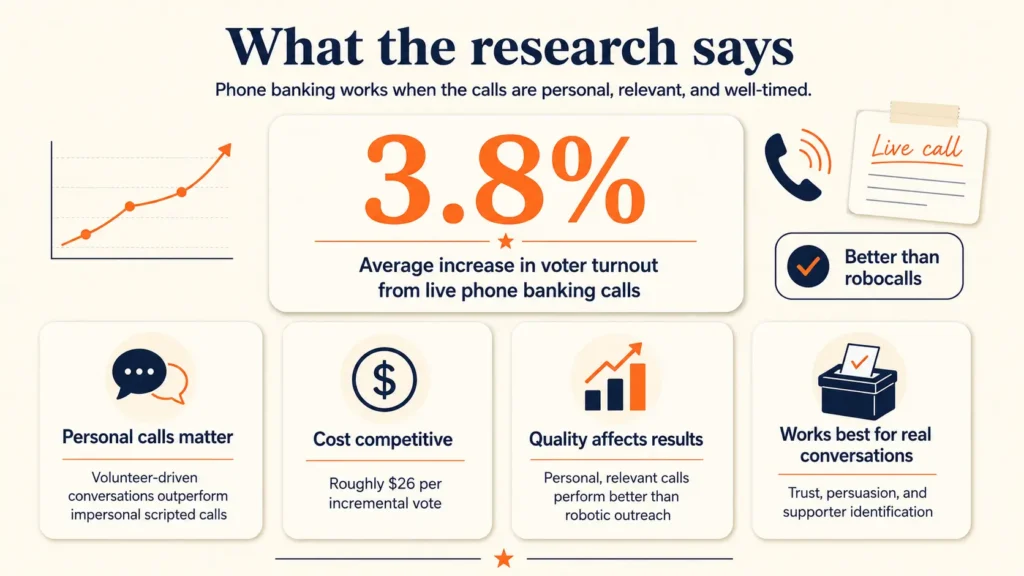
| 3.8%Average increase in voter turnout from live phone banking calls (Gerber & Green) |
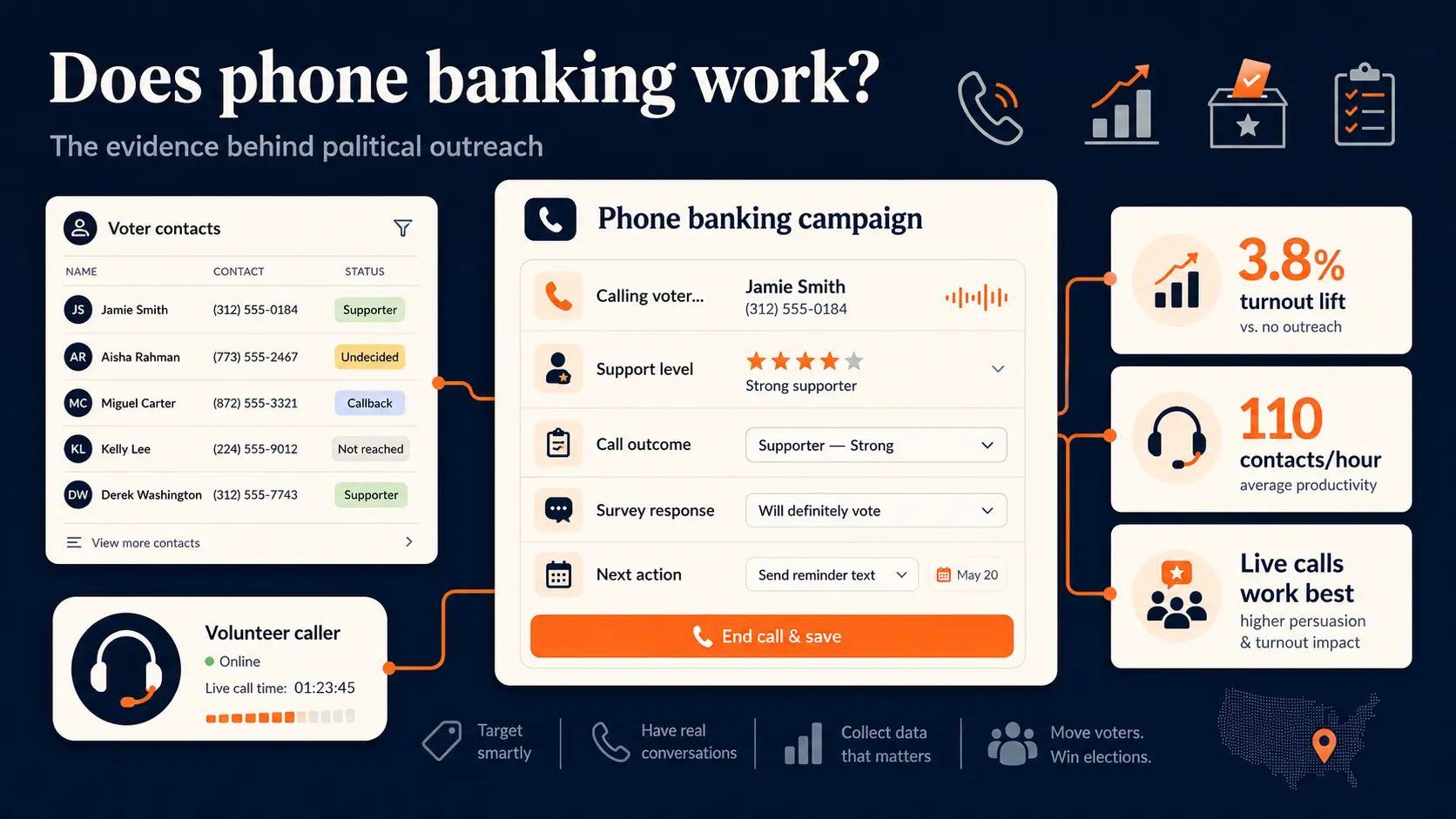
Gerber and Green’s landmark study across six states found that volunteer-driven, personal phone calls increased voter turnout by 3.8 percentage points. Critically, they also found that every incremental vote achieved through phone banking costs around $26, which is cost-competitive with door-to-door canvassing. It is worth being precise about what that evidence covers: those results come from election-cycle field experiments, so the 3.8-point lift is the figure that applies when campaigns ask how phone banking performs in elections — it measures whether a contacted voter actually casts a ballot, which is the outcome GOTV and voter ID programs are built around. Advocacy calling outside an election cycle, such as petition drives or issue campaigns, is judged on entirely different outcomes (sign-ups, donations, event attendance), and the turnout research says nothing directly about those.
However, the same researchers were clear that results depended heavily on call quality. Calls that were impersonal, scripted, or low-effort produced little to no measurable effect. The personal touch is what separates a persuasive phone banking campaign from one that generates caller ID blocks and voter complaints.
For a complete walkthrough of how to plan and run a political phone banking campaign, see the complete guide to political phone banking.
Phone banking vs. door-to-door canvassing
Door-to-door canvassing consistently shows a stronger per-contact effect on voter turnout, with face-to-face conversations lifting turnout by 7 to 9 percentage points compared to 2 to 4 points for phone calls. But that comparison misses the point. Phone banking reaches roughly 110 contacts per hour using an autodialer, compared to 15 to 20 doors per hour for canvassers. For campaigns working through large state voter files or running list-cleaning operations, phone banking is not a substitute for canvassing but a complementary tool that covers ground canvassers cannot.
The cost comparison is similarly nuanced. Canvassing costs around $33 per vote reached on average, while phone banking comes in at roughly $36. For voter persuasion, door knocking tends to win. For volume-dependent tasks like voter identification, list cleaning, and GOTV reminders, phone banking wins on efficiency.
The cellphone problem
TCPA regulations prohibit political campaigns from using autodialers to reach mobile numbers without prior consent. With 98% of Americans now owning a cellphone and 91% owning a smartphone (Pew Research Center, 2025), while landline-only households have all but disappeared, this creates a genuine obstacle. Campaigns have two practical routes: manually dialing for consent first (limiting speed to around 20 calls per hour), or using TCPA-compliant dialers that mirror autodialer efficiency while meeting FCC requirements through human intervention in the dialing process.
A secondary challenge is spam labeling. As political call volumes have climbed, carriers and contacts increasingly flag unfamiliar numbers as “Spam Likely.” Once a caller ID is flagged, pickup rates can fall sharply without campaigns understanding why. Tools like CallHub’s Spam Label Shield detect when a number is flagged and replace it automatically, keeping contact rates stable throughout a campaign.
Where phone banking genuinely excels: use cases and evidence
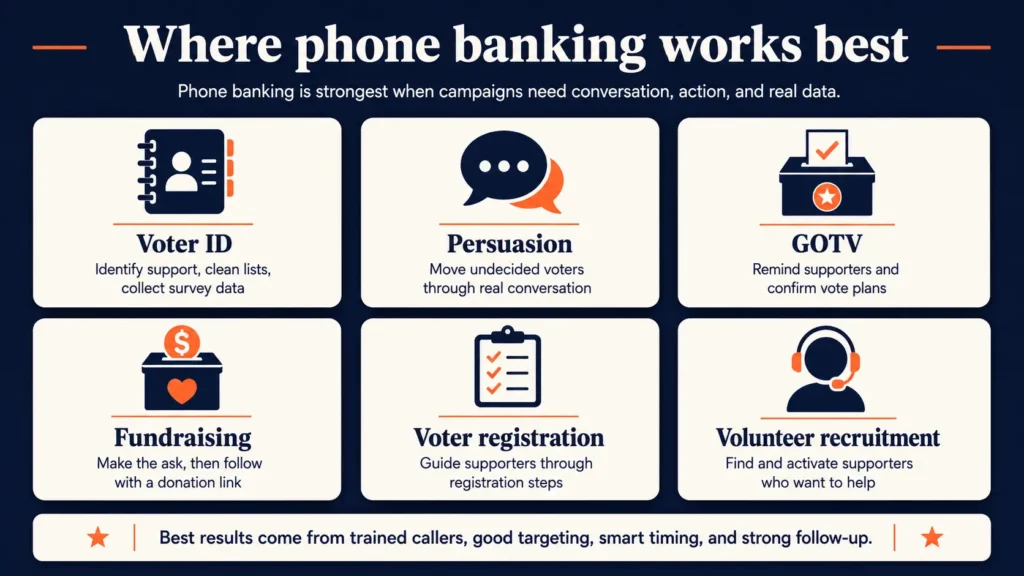
1. Voter identification
Campaign voter files obtained from state offices are almost always outdated. Contacts may have moved, changed numbers, or shifted political affiliation since the last cycle. Running a voter identification campaign by phone is one of the fastest ways to clean and enrich a list before committing resources to persuasion or GOTV.
A phone banking campaign with autodialer support can work through a list of tens of thousands of contacts in a fraction of the time required by door knocking. Volunteers can capture political affiliation, voting plans, issue priorities, and candidate support levels in real time, with survey tools, call dispositions, and tagging built directly into the software.
2. Voter persuasion
Phone banking for persuasion requires a different approach than list cleaning. The evidence is clear that impersonal scripts do not move undecided voters. Authentic, two-way conversation does. Campaigns that invest in volunteer training, high-quality call scripts, and real-time supervisor monitoring consistently see stronger results than those that treat persuasion calls like robo-blasts.
| “When we added CallHub to our voter outreach tool set in 2016, we knew that it would impact our outreach to our members, helping coordinate our efforts worldwide and ensure we were all using the same messaging. We didn’t realize how much it helped recruit and energize volunteers.”— Julia Bryan, Global Chair of Democrats Abroad |
Democrats Abroad is a strong example of phone banking at scale achieving persuasion outcomes. Using distributed campaigns run through CallHub, they reached American citizens overseas and military personnel, ultimately achieving a 300% increase in voter turnout among their targeted population.
3. GOTV in the final stretch
In the final weeks before an election, the number of doors a volunteer can knock becomes a real constraint. Phone banking removes that constraint. A large-scale Cambridge study found that three additional GOTV calls produced seven additional votes per thousand contacts. The return is real, though excessive call frequency works against campaigns: repeated calls to the same voter produce diminishing returns and can generate backlash.
The right approach is a planned multi-touch sequence, not a flood. Most campaigns see the best GOTV results when phone calls are timed and coordinated with other outreach channels, including peer-to-peer texting, so that no single channel overtaxes the voter.
4. Fundraising and call time
Call time, the practice of candidates or staff spending dedicated hours calling potential donors, is the single most proven method of political fundraising. Between 15 and 25% of donors respond to telefundraising outreach, and research comparing phone responses to email prospecting shows that calls generate roughly 250 times more responses than email campaigns at equivalent volume.
Phone banking for fundraising pairs well with follow-up text messages that include donation links. After a positive call, a quick text with a link captures momentum while it is still fresh, without requiring the donor to search for a contribution page on their own.
5. Voter registration
Voter registration is chronically underdone. Less than 20% of voters have been offered the opportunity to register at a government agency. Many eligible voters simply do not know how to navigate the process, and in some states, registration requirements have grown more restrictive in recent cycles.
Phone banking gives campaigns a direct line to supporters for walking them through registration steps, answering questions, and following up to confirm they have completed the process. Every registered voter who shows up on election day is a direct return on that outreach investment.
6. Volunteer recruitment
There are more than 10,000 campaign volunteers across the United States, and phone banking is one of the most efficient channels for finding them. Campaigns typically use two approaches: early-cycle calls targeting supporters from previous campaigns, and identification calls during voter outreach that flag enthusiastic respondents as potential volunteers.
Volunteers recruited by phone also tend to convert better than those acquired through passive channels like social media ads, because a direct conversation has already established a personal connection with the campaign.
7. Yard sign placement
Yard signs lift voter turnout by roughly 1 to 2 percentage points, primarily by building name recognition in low-information races. Getting supporters to agree to place signage requires identifying the right contacts first. Phone banking provides the fastest path to that identification, targeting enthusiastic supporters and converting the conversation into a specific commitment.
Types of phone banking campaigns
How a campaign is structured matters as much as the calls themselves. There are three main models.
In-person phone banking
Volunteers call together from a central location. Training is easier, call reluctance is lower, and there is a sense of shared momentum that distributed campaigns sometimes lack. Gamifying the process with leaderboards and volunteer rewards tends to work well in this format.
Distributed phone banking
Volunteers call from wherever they are: home, a coffee shop, anywhere with a phone and an internet connection. This format dramatically expands the volunteer pool because participation requires no commute. It also creates compliance challenges, since volunteers calling from one time zone may reach voters in another. Software that enforces timezone-based calling rules removes that risk automatically.
Distributed campaigns also benefit from dynamic caller ID features that display a local area code to the voter being called, improving pickup rates when volunteers are dialing from out of state.
Hybrid phone banking
A hybrid model combines both: some volunteers come into headquarters while others call remotely. Campaigns using this structure maintain a sense of community for those who want it without excluding volunteers who can only participate from home. List assignment through the campaign software prevents different volunteers from calling the same contacts.
What separates effective phone banking from ineffective phone banking
The research is consistent on this: phone banking works when the calls are personal, relevant, and well-timed. It fails when campaigns treat it as a volume exercise.
The factors that determine results are:
- Call quality: Authentic, conversational calls from trained volunteers outperform scripted, robotic delivery at every campaign stage.
- Targeting: Reaching contacts who are genuinely movable, whether persuadable voters, lapsed donors, or potential volunteers, delivers far better returns than blanket calling.
- Timing and frequency: Too many contacts to the same voter in a short window produces diminishing returns and increases negative sentiment. Campaigns that plan their call cadence thoughtfully see higher pickup rates and better outcomes.
- Technology: Software that handles dialing, survey capture, list deduplication, timezone compliance, and spam label management removes the friction that derails manual operations at scale.
- Follow-up: Pairing calls with a peer-to-peer text, donation link, or registration guide immediately after a positive conversation consistently improves conversion rates.
| Many campaigns also pair phone banking with peer-to-peer texting to reach voters on the channels where they are most active. A call that goes unanswered can be followed by a text that starts a conversation, and vice versa. |
Making phone banking work for your campaign
Phone banking is not a magic channel. It is a tool. Like any tool, its effectiveness depends on how it is used. The campaigns that get the most from phone banking share a few characteristics: they train volunteers well, they use software that handles compliance and call management automatically, they pair calls with text follow-up, and they treat the data from every call as an asset for future outreach.
CallHub’s phone banking software is built around these realities. Autodialer technology, timezone-based calling rules, dynamic caller ID, real-time call monitoring, Spam Label Shield, integrated texting, and CRM sync mean campaigns spend their time on the conversations that matter, not on the logistics around them.
Ready to run a phone banking campaign that gets results? Book a demo with our team and see how CallHub helps you go from contact list to conversation at scale.
Frequently asked questions
Does phone banking actually work?
Do phone banks actually work? The evidence says yes, when they are run well. Studies show volunteer-driven personal calls increase voter turnout by around 3.8 percentage points and cost roughly $26 per incremental vote, which is cost-competitive with door-to-door canvassing. What decides the outcome is who is on the line: phone banks staffed by trained volunteers having genuine two-way conversations produce those gains, while robocalls and impersonal scripted calls produce far weaker results.
How effective is phone banking?
Effectiveness depends on which outcome you are measuring, and the numbers differ by use case. On turnout, live volunteer calls move the needle by roughly 2 to 4 percentage points per contact — the Gerber and Green field experiments across six states measured 3.8 points — which is a smaller per-contact effect than door knocking’s 7 to 9 points, but delivered at far greater volume, around 110 contacts per hour with an autodialer. On GOTV specifically, a large-scale Cambridge study found three additional calls yielded seven extra votes per thousand contacts. On fundraising, 15 to 25% of donors respond to telefundraising outreach.
The caveat behind every one of those figures is call quality. They describe trained volunteers having real two-way conversations; the same researchers found impersonal, heavily scripted, or automated calls produced little to no measurable effect. So a realistic expectation is a modest but genuine per-contact lift, multiplied by the volume phone banking makes possible — not a dramatic swing from any single call.
How does phone banking compare to door-to-door canvassing?
Canvassing has a stronger per-contact persuasion effect, lifting turnout by 7 to 9 percentage points versus 2 to 4 for phone calls. But phone banking reaches 110 contacts per hour compared to 15 to 20 doors. For high-volume tasks like voter identification, list cleaning, and GOTV reminders, phone banking is the more efficient choice. Most campaigns use both in combination.
What is the most effective type of phone banking call?
Live volunteer calls that feel like genuine conversations consistently outperform scripted or automated alternatives. Calls that include a specific, relevant ask tied to the voter’s situation produce higher conversion rates than generic outreach.
Can campaigns call cell phones for political outreach?
Yes, but with restrictions. TCPA regulations prohibit the use of autodialers on mobile numbers without prior consent. TCPA-compliant dialers can reach mobile numbers at near-autodialer speed while remaining within FCC guidelines. Once consent is obtained, mobile calling rates are comparable to landline rates.
What phone banking software features matter most?
Look for autodialer or TCPA-compliant dialer technology, timezone-based calling enforcement, dynamic caller ID, integrated survey and call disposition tools, CRM sync, real-time monitoring, and spam label management. These features handle the compliance and logistics overhead so volunteers can focus on the conversations.
How many calls is too many?
There is no universal number, but research is consistent that excessive contact frequency reduces response rates and increases negative sentiment. Most practitioners find that thoughtfully spaced multi-touch sequences, where calls are paired with texts and timed to campaign milestones, outperform high-frequency blanketing of the same list.