

Multi-channel campaign outreach breaks when each channel runs like its own campaign. The phone bank has one list. The texting team has another. Email goes out from a third system. A voter replies to a text, then a volunteer calls them the next day as if nothing happened.
The problem is not that campaigns use too many channels.
The problem is that most campaigns do not connect the channels around the voter’s last action. Calls, texts, and email each do useful work. But they work best when they are sequenced, spaced, and updated from the same contact record.
This guide shows how to combine calls, texts, and email across voter ID, persuasion, GOTV, and fundraising without creating duplicate touches or burning out your volunteers.
Key Takeaways
Multi-channel campaigns perform best when calls, texts, and email are sequenced and updated from a single contact record based on the voter’s last action, rather than run as separate, disconnected efforts.
Coordination beats raw volume
- Americans received 15 billion political texts in 2022 according to Axios, and one major texting platform CEO told Business Insider he expected more than 25 billion political texts by Election Day 2024.
- Coordinated outreach differs from simply sending more messages by using the voter’s last action to decide the next touch, such as texting a voter who didn’t answer a call or shifting a pledged supporter from persuasion into GOTV.
Matching channels to voters
- Phone calls work best for trust, persuasion, voter ID, and complex questions, texts work best for speed, reminders, links, and quick replies, and email works best for context, policy detail, and event logistics.
- The voter decides which channel actually works, since a first-time voter might ignore calls but click an email, while a busy parent may reply to a text at 9 p.m. after ignoring calls all week.
- Campaigns should build adaptive sequences that respond to voter behavior instead of one uniform contact plan applied to the entire list.
Preventing channel fatigue
- Channel fatigue comes from messages that ignore prior touches rather than from message volume alone.
- Poor coordination shows up as persuasion calls sent after a voter already pledged by text, donation emails sent an hour after a donor gave by phone, or the same volunteer shift ask sent by email, text, and phone on one day.
- Good coordination tags a voter who texts back a pledge of support, removes them from the persuasion list, moves them to vote planning, and follows up with polling place info by text if they don’t answer the vote-plan call.
What calls and texts do best
- Calls are reserved for high-priority voter ID, persuasion conversations, vote planning, donor follow-up, and volunteer recruitment because they’re expensive in volunteer time and 94% of Americans say they don’t pick up unidentified calls, per a Hiya survey reported by Axios.
- Texts are used for speed-dependent tasks like event confirmations, links, ballot chasing, and quick yes-or-no questions, since Axios reports that 90% of texts are read within five minutes based on provider data.
Why single-channel outreach leaves votes on the table
Single-channel outreach misses voters because no one channel reaches everyone well. Some voters answer calls. Some reply to texts. Some need email before they understand the issue. A strong campaign uses each channel for the job it does best, then moves the voter to the next step based on what they did.
This is the difference between “more outreach” and coordinated outreach.
More outreach says, “Send another blast.”
Coordinated outreach says, “This voter did not answer the call, so send a short text. This donor clicked the link, so queue a follow-up call. This supporter already pledged to vote, so remove them from persuasion and move them to GOTV.”
That shift matters because voters are already flooded.
Axios reported that Americans received 15 billion political texts in 2022, and 2024 was expected to exceed that volume. Business Insider later reported that one major texting platform CEO expected more than 25 billion political texts by Election Day 2024.
Volume alone does not make a campaign smarter. Without coordination, it just makes the campaign louder.
Different voters live on different channels
Campaigns often argue about the “best” channel. That is the wrong question.
The better question is, “What is this channel best at?”
A phone call is better for trust, persuasion, and complex questions. A text is better for speed, reminders, links, and quick replies. Email is better for context, policy detail, fundraising stories, event logistics, and follow-through.
The voter decides which one works in the moment.
A first-time voter may ignore calls but click an email about early voting. A strong supporter may answer the phone if the caller ID looks local. A busy parent may reply to a text at 9 p.m. after ignoring every call all week.
That is why a campaign should not build one giant contact plan for the whole list. It should build a sequence that adapts.
Channel fatigue and how coordination prevents it
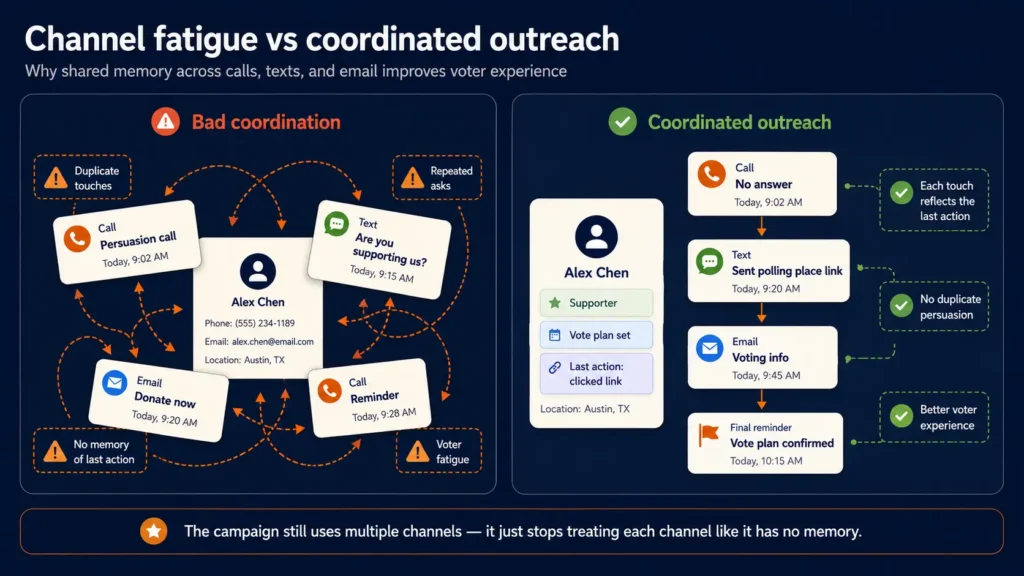
Channel fatigue happens when the voter feels chased instead of guided.
It is not just “too many messages.” It is too many messages that do not remember the last touch.
Bad coordination looks like this:
- A voter gets a persuasion call after they already pledged support by text.
- A donor gets a donation email an hour after giving through a call.
- A volunteer receives the same shift ask by email, text, and phone on the same day.
- A supporter gets a GOTV reminder before the campaign has confirmed how they plan to vote.
Good coordination looks different.
A voter who replies “yes” to a text is tagged as a supporter. The phone bank does not call them for persuasion again. They move to vote planning. If they do not answer the vote plan call, they get a text with polling place information. If they click the link, they move to final reminder.
The campaign still uses multiple channels. It just stops treating each channel like it has no memory.
The three channels and what each does best
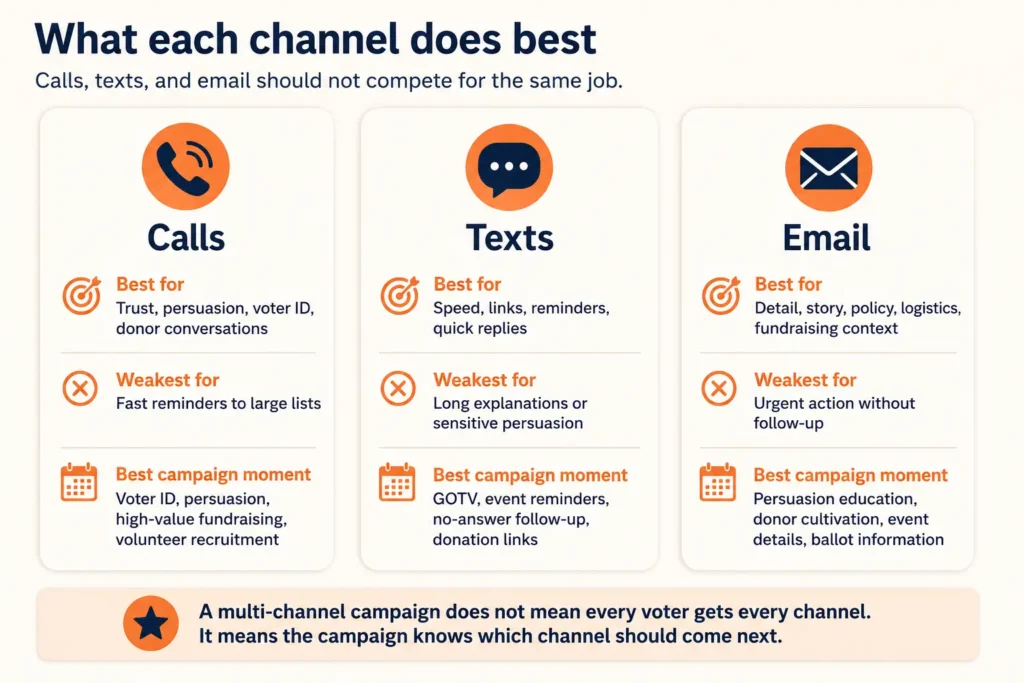
Calls, texts, and email should not compete for the same job. Use each channel where it gives the campaign the strongest advantage.
| Channel | Best for | Weakest for | Best campaign moment |
| Calls | Trust, persuasion, voter ID, donor conversations | Fast reminders to large lists | Voter ID, persuasion, high-value fundraising, volunteer recruitment |
| Texts | Speed, links, reminders, quick replies | Long explanations or sensitive persuasion | GOTV, event reminders, no-answer follow-up, donation links |
| Detail, story, policy, logistics, fundraising context | Urgent action without follow-up | Persuasion education, donor cultivation, event details, ballot information |
A multi-channel campaign does not mean every voter gets every channel. It means the campaign knows which channel should come next.
Calls: your highest-trust, highest-effort channel
Calls are best when the campaign needs a real conversation.
Use calls when the voter’s answer matters, when the issue needs explanation, or when the campaign needs to hear tone, hesitation, and questions. A live call can identify support, move an undecided voter, answer ballot questions, or turn a warm donor into a contribution.
But calls are expensive in volunteer time.
Many voters also screen unknown numbers. Axios reported a Hiya survey where 94% of Americans said they did not pick up unidentified calls because of robocalls. That does not mean phone banking is dead. It means calls need to be targeted.
Use calls for:
- High-priority voter ID.
- Persuasion conversations.
- Supporter vote planning.
- Donor follow-up after interest.
- Volunteer recruitment.
- Candidate or surrogate callbacks.
- Contacts who replied to a text and need a conversation.
CallHub’s phone banking software lets campaigns set up call lists, scripts, and volunteer access in one place. Do not use calls to repeat information that a text could handle faster. Do not use calls to repeat information that a text could handle faster.
Texts: fast, scalable, and built for action
Texts are best when the campaign needs speed.
A text can confirm an event, send a link, chase a mail ballot, follow up after a missed call, or ask a quick yes-or-no question. Axios reported that 90% of texts are read within five minutes, based on provider data. Treat that as a useful direction, not a guaranteed campaign result.
Texting works because it fits into a voter’s day. It does not require the voter to stop what they are doing and pick up the phone.
Use texts for:
- No-answer follow-up after a call.
- Polling place links.
- Early vote reminders.
- Event reminders.
- Donation links after a call.
- Volunteer shift confirmations.
- Quick supporter checks.
- Ballot cure or deadline reminders, where allowed.
Texts can also create fatigue fast. Keep them short, timely, and tied to a clear action.
If your team uses peer-to-peer texting, make sure replies do not sit in a separate tool. A reply should update the voter record and inform the next call, email, or reminder. CallHub’s peer-to-peer texting page explains this connected reply workflow in more detail.
Email: the follow-through channel for depth and donation
Email is best when the campaign needs more space.
A text can remind. A call can persuade. Email can explain.
Use email for:
- Issue education.
- Candidate story.
- Debate follow-up.
- Endorsement announcements.
- Long-form donor appeals.
- Volunteer onboarding details.
- Event logistics.
- Ballot guide information.
- Early voting instructions.
Email is not usually the best channel for urgent GOTV by itself. Many people do not open political emails quickly enough for same-day action.
Campaign Monitor’s benchmark data lists 19.4% open rate and 2.8% click-through rate for Government and Politics email. Those numbers do not mean email is weak. They mean email should not carry the entire campaign alone.
Email works best when it warms up the next touch.
For example:
- Send an issue email to undecided voters.
- Call the people who opened or clicked.
- Text the people who did not answer.
- Move responders into the next campaign step.
That is email doing its real job.
How to sequence calls, texts, and email across the campaign lifecycle
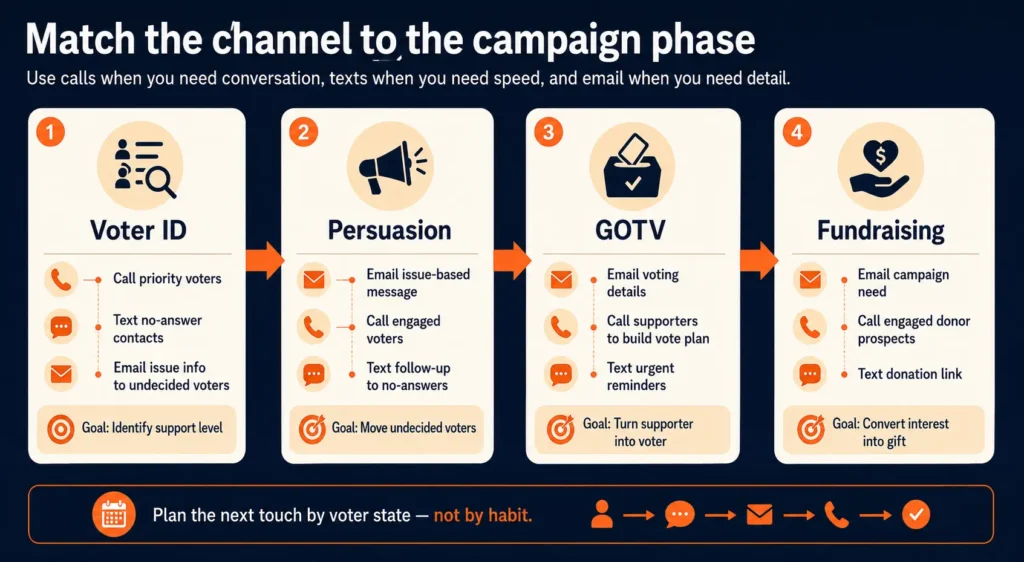
The best multi-channel campaign outreach sequence matches each channel to the campaign phase. Use calls when you need conversation, texts when you need speed, and email when you need detail. Then update the next step based on the voter’s response, not a fixed calendar blast.
This is the core rule: do not plan channels by habit. Plan them by voter state.
A voter can be uncontacted, undecided, supportive, pledged, donated, unreachable, or opted out. Each state needs a different next step.
Voter ID phase: calls first, text opt-in follow-up
In voter ID, the campaign needs to learn where voters stand.
Start with calls for high-priority voters because the answer matters. A live conversation lets the volunteer tag support level, record issue concerns, and identify who needs follow-up.
A simple voter ID sequence can look like this:
| Step | Channel | Who gets it | Goal |
| 1 | Call | Priority voter universe | Identify support level |
| 2 | Text | No-answer contacts | Ask for quick support response or link to info |
| 3 | Undecided or information-seeking voters | Share issue detail or candidate background | |
| 4 | Call | Engaged undecided voters | Persuasion or candidate callback |
| 5 | Text | Supporters | Confirm next action or event |
This is where phone banking with texting becomes useful. The text is not a separate campaign. It is the next step for people the call could not reach.
For general calling mechanics, use the complete guide to political phone banking.
Persuasion phase: email for depth, call for conversation
Persuasion needs context and trust.
Do not start by blasting every undecided voter with the same script. Segment them by issue, geography, language, or past action. Then use email and calls in a way that builds the case without crowding the voter.
A persuasion sequence can look like this:
- Send an email about the voter’s likely issue.
- Track opens and clicks.
- Call voters who engaged.
- Text no-answer contacts with a short follow-up.
- Route strong responses into volunteer, donor, or supporter lists.
- Stop persuasion touches once the voter commits.
This keeps your volunteers focused on people who showed some signal.
It also gives the call more context. A volunteer can say:
“Hi, this is Maya with the Singh campaign. We sent a note yesterday about the school board vote and wanted to ask what issue matters most to you this year.”
That is better than starting cold.
GOTV phase: text for urgency, call for confirmation, email for logistics
GOTV is where channel timing matters most.
Use texts for urgent reminders. Use calls for vote plan confirmation. Use email for details that voters may want to save, like early voting hours, ballot drop box locations, ID rules, or transportation information.
A GOTV sequence can look like this:
| Timing | Channel | Audience | Purpose |
| 10-14 days out | Supporters and likely supporters | Explain voting options and key deadlines | |
| 7-10 days out | Call | High-priority supporters | Build a vote plan |
| 5-7 days out | Text | No-answer supporters | Send voting link or early vote reminder |
| 2-4 days out | Call | Supporters with no vote plan | Confirm time and method |
| Final 72 hours | Text and call | Supporters who still need action | Turnout only |
At this stage, remove people as they complete the action. If someone has already voted, they should not keep getting “go vote” calls.
Use your get-out-the-vote outreach strategy to decide which voters need high-touch follow-up and which voters need only a final reminder.
Fundraising: live calls plus text follow-up link
Campaign fundraising is a good example of why sequence matters.
A live call can create the ask. A text can deliver the donation link. Email can explain the campaign story and give donors something to forward.
A fundraising sequence can look like this:
- Email donors with the campaign need.
- Call high-likelihood donors who opened or clicked.
- Text the donation link during or right after the call.
- Send a thank-you text after the gift.
- Remove that donor from the next donation ask.
- Move them to volunteer, event, or recurring donor follow-up.
The last two steps matter most.
If a donor gives at 3 p.m., they should not receive a generic “please donate” text at 6 p.m. That is not a fundraising problem. It is a coordination problem.
Coordination rules that keep channels from working against each other
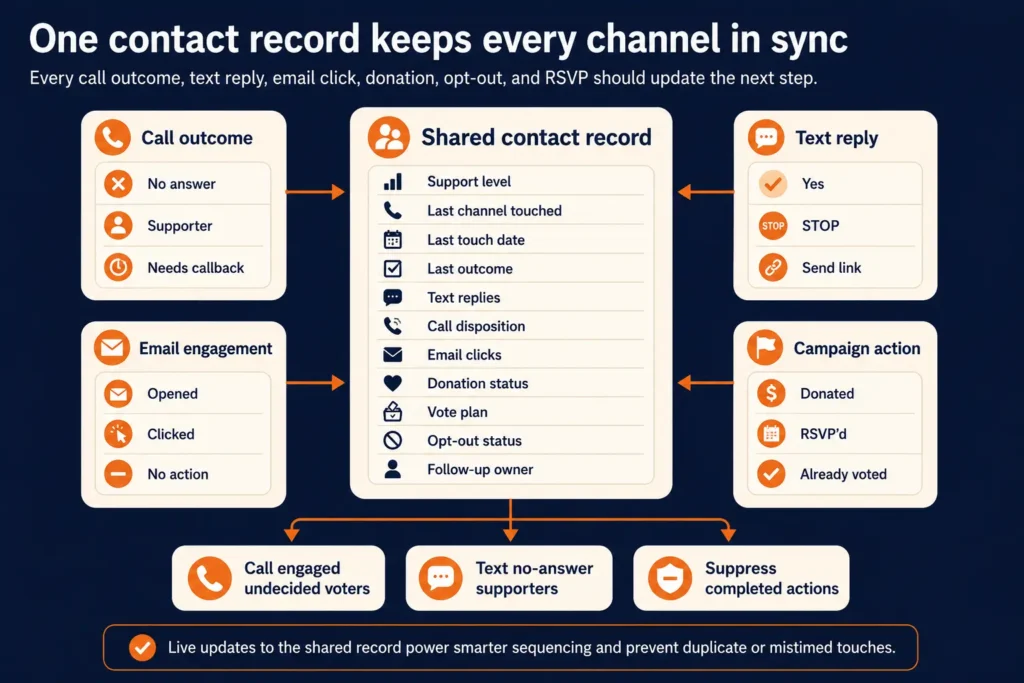
Campaigns coordinate calls, texts, and email by using one shared contact record, one suppression logic, and one campaign sequence. Every call outcome, text reply, email click, donation, opt-out, and RSVP should update the next step before the next channel reaches that voter.
That is the rule. Here is how it works in practice.
Shared contact data: the foundation of coordination
Multi-channel outreach breaks when channels run on frozen lists.
A campaign exports a voter list Monday morning. The text team imports it. The call team imports it. The email team imports it. By Monday afternoon, the data is already stale.
Someone replied. Someone donated. Someone opted out. Someone asked for a callback. But the other tools do not know.
A shared contact record prevents that.
At minimum, your campaign should track:
- Contact status
- Support level
- Last channel touched
- Last touch date
- Last outcome
- Text replies
- Call dispositions
- Email opens and clicks
- Donation status
- Volunteer status
- Vote plan
- Opt-out status
- Follow-up owner
The goal is not to collect more data. The goal is to stop volunteers from repeating work the campaign has already done.
Spacing and frequency guidelines by channel
There is no perfect frequency rule for every campaign. The right cadence depends on the voter’s relationship to the campaign, the election date, and the urgency of the ask.
Use this as a starting point.
| Contact type | Recommended cadence | Notes |
| Cold or low-engagement voter | One touch, then wait 3-5 days | Avoid stacking channels too early |
| Undecided voter | Email or text first, then call within 24-72 hours if engaged | Use issue interest to guide the call |
| Supporter with no vote plan | Call, then text reminder within 24 hours if no answer | GOTV follow-up should be fast |
| Donor prospect | Email first, call engaged contacts, text link after conversation | Remove donors from repeat asks after giving |
| Volunteer prospect | Text or call quickly after sign-up | Speed matters when intent is fresh |
| Opted-out contact | Stop the channel they opted out of and update suppression | Confirm rules for cross-channel opt-outs |
Do not treat this as a rigid calendar. Treat it as a pressure gauge. The closer you get to election day, the faster the follow-up can be. The less engaged the voter is, the more careful the spacing should be.
When not to layer channels on the same contact
More channels can hurt when the campaign does not have a reason for each touch.
Do not layer channels when:
- The voter already completed the action.
- The voter opted out.
- The contact is cold and has not engaged.
- The message is the same across every channel.
- The follow-up is only happening because the list was exported too early.
- A volunteer needs a conversation, but the campaign sends a generic blast instead.
- The ask is sensitive and should be handled by a trained caller.
A simple rule helps:
If the next touch does not reflect the last action, pause before sending it.
Compliance: what to know before you send
Compliance is part of campaign design. It affects which channel you use, who you can contact, what consent you need, how you handle opt-outs, and what records you keep.
This section is not legal advice. Use it as a checklist, then confirm with counsel, your party, your committee, your compliance lead, or your vendor.
TCPA and 10DLC rules for texting
Political calls and texts sit inside a complex rule set.
Start with the FCC’s rules for political campaign calls and texts. Then check your state rules, carrier rules, and vendor requirements.
For texting, also review CTIA’s Messaging Principles and Best Practices. CTIA’s guidance treats messages from organizations, agents, or representatives as non-consumer messaging and expects senders to follow consent, opt-out, privacy, and content practices.
Campaign teams should confirm:
- Whether the message is peer-to-peer or broadcast.
- Whether consent is needed for the channel and method.
- Whether the campaign must register for 10DLC.
- Whether the script includes the correct sender identity.
- Whether opt-out language is included where needed.
- Whether “STOP” and other opt-outs are honored.
- Whether state-level rules add extra limits.
- Whether suppression applies across future texts.
Do not wait until the final GOTV weekend to solve 10DLC, opt-outs, or deliverability. Registration and review can take time.
Email list building and opt-in best practices
Email has its own rules and deliverability risks.
The FTC’s CAN-SPAM Act compliance guide says commercial email must avoid false headers, avoid deceptive subject lines, identify the message as an ad where required, include a physical postal address, provide a clear opt-out method, and honor opt-out requests promptly.
Campaign emails may involve different legal categories depending on sender, message type, and jurisdiction. Still, the practical rule is simple: use clean lists, clear sender identity, and easy unsubscribe.
Gmail also tightened sender requirements in 2024. Google’s email sender guidelines say bulk senders above 5,000 daily messages to Gmail accounts must use SPF, DKIM, and DMARC, and marketing or subscribed messages must support one-click unsubscribe.
Before a large campaign email send, check:
- Domain authentication.
- Sender identity.
- List source.
- Unsubscribe process.
- Spam complaint rate.
- Segmentation.
- Whether inactive contacts should be suppressed.
- Whether the email matches the voter’s last action.
Email can help the campaign. Bad email habits can damage the sender reputation right before the moment you need inbox placement most.
Tools political campaigns use for multi-channel outreach
Political campaigns need tools that keep calls, texts, and email connected to the same campaign logic.
A spreadsheet can manage a small single-channel push. It cannot manage fast updates across a phone bank, peer-to-peer texting, email, donations, vote plans, and opt-outs without a lot of manual work.
What to look for in political campaign outreach software
A campaign outreach tool should help you answer five questions:
- Who should be contacted next?
- Which channel should reach them?
- What did they do last?
- What should happen if they reply, click, donate, or do not answer?
- Where can the campaign see results across every channel?
Look for:
- Calling, texting, and email in one campaign view.
- Shared contact records.
- Supporter tags and segments.
- Call dispositions.
- Text replies.
- Email opens and clicks.
- Vote plan fields.
- Donation status.
- Opt-out suppression.
- CRM integrations.
- Volunteer roles and permissions.
- Real-time reporting.
- Workflow automation.
CallHub’s political campaign outreach software is built for campaigns that need calling, texting, and email to work from one contact record. Its workflow automation helps teams route contacts to the next step based on call outcomes, text replies, and other campaign actions.
The reporting view that matters
Do not judge a multi-channel campaign by channel reports alone.
A text report can tell you replies. A call report can tell you conversations. An email report can tell you clicks. None of those alone tells you which sequence moved the voter.
The better report answers:
- How many voters moved from uncontacted to identified?
- Which sequence produced the most supporter IDs?
- Which channel created the most vote plans?
- Which follow-up converted no-answer contacts?
- Which donor path led to gifts?
- Which precincts need more calls instead of more texts?
- Which volunteers need coaching?
A campaign manager should not have to stitch three reports together the night before election day.
Conclusion
The campaigns that win are not always the ones that use the most channels.
They are the ones that use each channel for what it does best, in the right order, without doubling up on voters already in motion.
Calls create trust. Texts create speed. Email creates depth. The strategy is not to run all three at once. The strategy is to move each voter through the right sequence based on what they did last.
For deeper calling strategy, use the complete guide to political phone banking. To see how CallHub coordinates calls, texts, and email in a single campaign, explore the unified outreach platform for campaigns.
FAQ
What is multi-channel outreach in political campaigns?
Multi-channel outreach in political campaigns means using calls, texts, and email together in one coordinated sequence. Each channel has a role, and each voter’s next touch should reflect what they did in the last one.
What is omnichannel political outreach?
Omnichannel political outreach is a connected version of multi-channel outreach. The campaign does not just use several channels. It connects them through shared contact data, so calls, texts, and email respond to voter behavior in real time.
How do you combine phone banking with texting?
Use phone banking for conversations, then use texting for no-answer follow-up, reminders, links, and quick responses. A common sequence is call first, text non-contacts, email voters who need more detail, then re-call engaged contacts.
What is the best channel sequence for voter outreach?
The best sequence depends on the campaign phase. For voter ID, call first and text no-answer contacts. For persuasion, email for context and call engaged voters. For GOTV, text for urgency, call for confirmation, and email for logistics.
How effective is texting compared to phone calls for campaigns?
Texting is faster and easier to scale. Calls are better for trust and persuasion. A text can move someone to a link or reminder, but a call is better when the campaign needs a real answer, a vote plan, or a donor conversation.
How do campaigns avoid overwhelming voters with too many touchpoints?
Campaigns avoid fatigue by spacing touches, suppressing people who already acted, honoring opt-outs, and making each touch reflect the last action. Do not send the same ask across every channel just because the tools allow it.
What tools do political campaigns use for multi-channel outreach?
Campaigns use calling tools, peer-to-peer texting tools, email platforms, CRMs, voter files, and reporting dashboards. The stronger setup connects those actions in one contact record so every channel knows what happened before.
How do campaigns stay compliant when texting voters?
Campaigns should review FCC rules, TCPA requirements, CTIA messaging guidance, 10DLC registration, state rules, opt-out handling, and sender identification before texting voters. Compliance depends on message type, channel, consent, and jurisdiction.