





Table of Contents
Are you trying to make sense of all the union rules, regulations, and labor laws that affect your members and campaigns? As a union leader or organizer, understanding union laws is core to protecting workers, negotiating strong contracts, and staying compliant as you grow.
Union laws (or labor union law) are the federal and state rules that govern how unions are formed, how they run internally, how employers can respond, and what rights workers have at every step. These laws decide what’s legal during organizing, bargaining, strikes, dues collection, and day‑to‑day workplace life.
In this guide, you’ll learn:
- The major US union and labor laws you need to know in 2025 (NLRA, Taft‑Hartley, Landrum‑Griffin, and more).
- How union rules, bylaws, and federal regulations fit together.
- What employers and unions can and cannot do under US law.
- How rights like Beck objector status, union‑security clauses, and right‑to‑work laws affect dues and membership.
- Where to turn for legal help and enforcement if someone breaks the rules.
What is union law?
Union law (or labor union law) is the part of United States labor law that governs how unions are formed, how they operate, how they interact with employers, and which rights workers have in union and non‑union workplaces. It sits alongside other federal labor laws on wages, safety, and discrimination, and is built mainly on the National Labor Relations Act and related statutes.
Read Also: Navigating Union Laws: Unions, Here is Your Guide
Understanding Union Laws: Key Legislation
Three critical statutes form the foundation of union legislation in the United States:
- The National Labor Relations Act (NLRA),
- The Landrum-Griffin Act, and
- An assortment of additional pertinent laws.
These acts play a pivotal role in defining the terrain of labor and union activities.
Major US union and labor laws at a glance
Before diving into each statute in detail, here’s a quick overview of the core union laws you’ll see referenced throughout this guide.
| Law | Year | Who it covers | What it does |
| National Labor Relations Act (NLRA) | 1935 | Most private‑sector employees and employers | Establishes workers’ rights to organize, form, and join unions, bargain collectively, and engage in protected concerted activity; defines unfair labor practices for employers and creates the NLRB to enforce these rights. |
| Taft‑Hartley Act (Labor Management Relations Act) | 1947 | Unions, employers, and employees covered by the NLRA | Amends the NLRA to add unfair labor practices for unions, regulate certain strikes and secondary boycotts, and allow states to pass right‑to‑work laws that limit union‑security agreements. It also gives employers more room to express views about unions as long as they avoid threats or retaliation. |
| Landrum‑Griffin Act (Labor‑Management Reporting and Disclosure Act) | 1959 | Labor unions and their members | Protects union members’ rights inside their unions, sets standards for union elections and financial reporting, and requires greater transparency and accountability from union leadership. |
| Key state labor and union laws | Varies by state | Public‑sector workers and, in some cases, private‑sector workers | Regulate public‑sector collective bargaining, govern union‑security and right‑to‑work rules, and may expand or limit union rights beyond the federal baseline. |
National Labor Relations Act

Data source: Medium.
The NLRA is the backbone of US union law for most private‑sector workplaces. It gives employees the right to form, join, or assist a union, choose representatives, act together to improve conditions, or refrain from these activities, and it prohibits employers and unions from interfering with these rights.
Under the NLRA, the National Labor Relations Board (NLRB) oversees union elections, investigates unfair labor practice charges, and orders remedies when employers or unions break the law.
Taft‑Hartley Act (Labor Management Relations Act)
The Taft‑Hartley Act amended the NLRA to define additional unfair labor practices for unions, regulate picketing and secondary boycotts, and allow states to pass right‑to‑work laws that limit union‑security agreements.
It also gives employers some rights to communicate their views about unions, as long as they do not threaten or retaliate against workers.
Landrum-Griffin Act
The Landrum‑Griffin Act focuses on internal union governance. It requires unions to hold regular, fair elections, file financial reports, and follow rules that protect members’ rights to free speech, vote, and participate in union affairs. It also gives the Department of Labor authority to enforce many of these requirements.
Other Relevant Legislation
Even when a law is not “about unions,” it shapes the environment unions work. For example, FLSA (Fair Labor Standards Act) sets wage and overtime baselines, OSHA (Occupational Safety and Health Administration) sets safety standards, and civil rights laws prohibit discrimination that unions often help members challenge. Understanding these statutes helps unions bargain for stronger contracts and spot legal violations beyond the union contract itself.
Read Also: Labor Union Pros and Cons: Everything You Need to Know.
The Role of State Governments in Union Laws
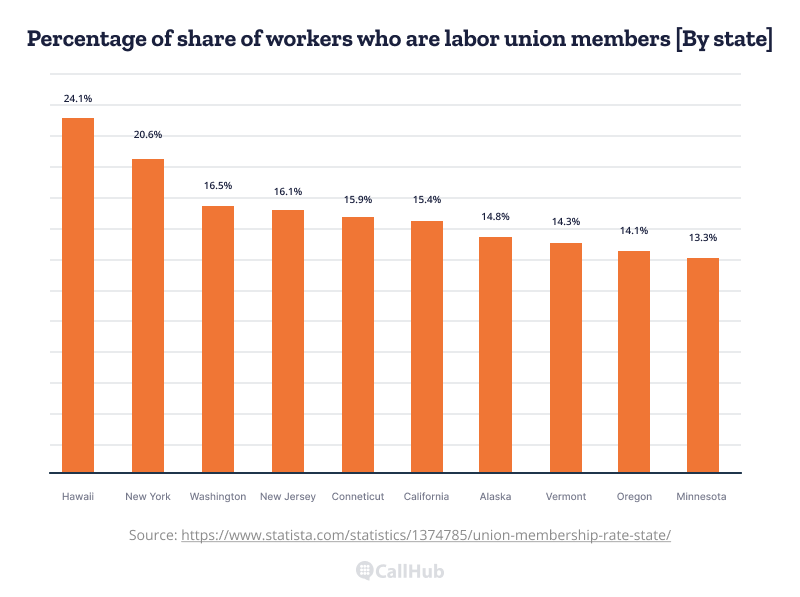
Data source: Statistica.
State governments hold considerable sway over union-related legislation within their own territories, supplementing federal guidelines. These regional authorities have the discretion to fortify existing labor laws, thereby exerting greater control over the dynamics of labor relations.
Across various states, there is a diverse range of statutes that govern unions in the public sector. While some impose limitations on government workers’ rights to assemble and form unions, others adopt more permissive stances. States such as Colorado, Nevada, and Virginia have made policy choices that grant public employees the freedom to become part of unions and participate in collective bargaining processes.
You May Also Like: Learn Which Labor Union Software Works Best For You.
Workers’ Rights and Protections Under Union Laws
Union laws afford workers an extensive range of rights and safeguards. The National Labor Relations Act (NLRA) ensures your entitlement to form, join, and engage in collective bargaining through labor organizations. As a union-represented employee, you are entitled to Weingarten Rights that permit the presence of a union representative during investigatory interviews with potential disciplinary consequences.
The Role of Government Agencies in Enforcing Union Laws
Several government bodies bear the responsibility for implementing employment legislation, a massive undertaking. The National Labor Relations Board is tasked with supervising union elections, mediating conflicts, and imposing sanctions on employers who engage in unfair labor practices or discrimination as dictated by the NLRA.
Navigating the Unionization Process
Embarking on the journey to organizing a union? It starts with initial conversations between coworkers who are eager to improve their workplace environment. Next in the process, workers show their intent to unionize by signing cards that express their support, eventually moving towards an official vote.
Read Also: Union Authorization Card 101: All You Must Know Before Asking for Signs
Dispute Resolution and Legal Remedies for Union-Related Issues

Source: Union Membership Trends: Who’s to Blame for the Decline
Workplace settings invite different kinds of conflicts, not limited to disputes between employees and employers. Here are some union laws around different conflicts as commonly seen in unionized workplaces.
- Disputes around jurisdiction
Employees could sometimes be represented by multiple unions. If the unions are engaged in a tussle over some issue, Section 8(b)(4)(D) & 10(k) of the NLRA intervenes. If there is reasonable evidence that the conflicting representatives (unions) are engaged in a “jurisdictional” or work-assignment dispute and the employee caught in the middle is neutral, the Board intervenes and settles the matter.
Of course, the law is more nuanced than that, considering the complicated nature of the relationship between multiple unions, the employees they represent, and their workplace.
- Laws that monitor union behavior
While several laws have been the result of union advocacy and lobbying, unions themselves are not free from scrutiny. Here are regulations that keep union behavior in check to provide a truly safeguarded workplace for employees:
- Unions cannot threaten employees with a loss of jobs unless they join the union. Threatening workplace consequences for not being a member, although they have paid or promised to pay the initiation or union membership fee.
- Unions cannot refuse to process grievances reported by a member because they criticized union officials. They cannot refuse this even when an employee is not a union member if they are in a state “where union security clauses are not permitted”.
- They cannot threaten, assault, or prevent non-members from crossing picket lines or entering employment premises.
- They also cannot strike over issues that are not related to the terms and conditions of the members’ employment. Nor can they force neutral members into disputes with the labor unions and employers.
- Laws that govern disputes with the employer
Employers and unions have famously been at loggerheads. However, to ensure the employees’ will to join or not join a union is not influenced by their job security, some laws pertaining to employer behavior are in place. Let’s take a look at some of these federal laws.
- Like unions cannot threaten workers to become a member, employers cannot threaten them not to join. They also cannot threaten them with the closing of a factory, plant, or branch if a union represents them.
- Alternatively, they also cannot promise them benefits if they don’t join a union (essentially, bribing is prohibited).
- Employers cannot punish workers with additional work, transfers, layoffs, or terminations because they engaged in protected concerted or union activity, filed an unfair labor practice charge, or participated in an investigation by the NLRB.
- Employers also cannot question workers about their sympathies or activities with a union if they affect or influence the exercise of their National Labor Relations Act.
Union membership trends in the union laws
Union membership differs by state laws as well as other factors like age, industry, and earnings. We have listed some key highlights of union membership trends in our detailed blog.
Read Also: Union Membership Trends: Who’s to Blame for the Decline.
Putting union laws into action with CallHub
Understanding union laws is only the first step. The real challenge is putting those rules into practice every day, educating members, documenting issues, and mobilizing people quickly when rights are at risk.
That’s where CallHub can help:
- You can reach members and potential members fast with TCPA compliant calling and texting campaigns when there’s a union vote, contract update, or urgent issue at the workplace.
- You can keep conversations organized, segment your lists (by shop, shift, or role), and follow up with targeted reminders about meetings, actions, and key legal deadlines.
- You can build stronger engagement by making it easy for workers to ask questions, share concerns, and get timely information about their rights under union laws.
If you’re planning a campaign around organizing, a union election, or contract bargaining, tools like CallHub give you the communication backbone to turn legal rights into real power on the ground.
Explore how unions use CallHub to engage members and run winning campaigns.
Frequently asked questions on union laws
What is the National Labor Relations Act (NLRA)?
The National Labor Relations Act (NLRA) is a 1935 federal law that protects most private‑sector employees’ rights to organize, join or support a union, bargain collectively, and engage in concerted activity to improve their working conditions. It also defines unfair labor practices for employers and unions and created the National Labor Relations Board (NLRB) to enforce these rights.
What major labor laws have unions helped shape?
Unions have played a key role in winning and defending major labor protections in the United States, including the NLRA, unemployment insurance, the Fair Labor Standards Act (minimum wage and overtime), workers’ compensation laws, and the Occupational Safety and Health Act (OSHA). These laws have had a lasting impact on wages, safety, and job security for millions of workers.
What is the Landrum‑Griffin Act?
The Landrum‑Griffin Act, or Labor‑Management Reporting and Disclosure Act of 1959 (LMRDA), is a federal law that protects union members’ rights inside their unions and sets standards for democratic elections and financial transparency. It requires unions to hold fair elections, file financial reports, and follow rules that safeguard members from corruption and abuse.
How do state governments impact union laws?
State governments impact union laws by deciding whether to allow right‑to‑work rules, how much bargaining power public‑sector unions have, and whether state labor protections go beyond the federal baseline. As a result, the laws governing public‑sector unions and union‑security agreements vary widely from state to state.
Can my employer punish me for supporting a union?
In most private‑sector workplaces covered by federal law, an employer cannot legally fire, discipline, demote, or otherwise retaliate against you because you support a union or take part in protected organizing activity. If this happens, you may be able to file a charge with the appropriate labor agency and seek remedies.