


How to become a political strategist? It’s not a mainstream path that many take but if you are in for the ride, this is right article for you.
In 1992, Bill Clinton assumed the United States presidency, ending the 12-year reign of the republican party.
This feat was partly achieved by James Carville, a political strategist who was instrumental in ending the long Democratic drought. One of the formulations he used for the campaign is commonly used by parties today.
There is no denying that political strategists are an integral part of a campaign and an aspirational career for many.
But what does a political strategist do, and what does it take to become one? This post will help you define a clear path to becoming a political strategist.
A quick note on job titles first: plenty of these roles are advertised as “campaign strategist” rather than by the title in our headline. If that is the phrasing you searched for, you are in the right place — the path below is the same one, whichever of the two words an employer happens to use in the listing.
Key Takeaways
A political strategist specializes in one or more campaign competencies, such as polling, opposition research, technology, or fundraising, to help a candidate win, and the title is used interchangeably with campaign strategist, with the real distinction being whether someone works for a single campaign through Election Day or advises multiple races for a consulting firm or party committee.
Core specialties within the role
- Voter polling strategists design public opinion, baseline, and bushfire polls, choose samples and focus groups, analyze data, and recommend changes to campaign messaging based on results.
- Opposition researchers investigate rival candidates to expose ideological inconsistencies and personal transgressions, relying on strong written and verbal communication, investigative skill, and networking ability.
- Technology strategists now handle AI-assisted list segmentation, consent and texting-compliance rules, and tighter tool integration, on top of traditional work with mass-texting and call-center software, data management platforms, and website or app development.
- Fundraising strategists raise and allocate campaign money, run fundraising events, stay current on fundraising technology, and apply organizational and leadership skills to manage volunteers.
- Strategists typically specialize in one of these areas but pick up other responsibilities over time because all of these functions work closely together toward winning the election.
Education and experience path
- Most campaigns prefer hiring political strategists with a graduate degree, though a degree is not a strict requirement for the job.
- A bachelor’s degree in political science, communications, history, or public administration, with coursework in research methodology, international law, political theory, and public policy, provides a solid starting foundation.
- A graduate degree focused on practical learning in campaigning, legislative action, and voter involvement, covering subjects like human rights law, election laws, and decision theory, adds the specialization employers look for.
- Work experience, including volunteering on political campaigns, is critical to breaking into the field and can help compensate for not having a degree in a directly relevant program.
What does a political strategist do?
Political strategists, often called political consultants or advisors, specialize in specific competencies to help an electoral candidate win.
So what does a campaign strategist do differently? In practice, nothing — the two titles get used largely interchangeably, and what separates them is who signs the cheque rather than the work itself. “Campaign strategist” usually describes someone on one campaign’s payroll through Election Day, while the consulting-firm and party-committee version of the job, advising several races at once, tends to carry the broader title.
Strategists may only be responsible for one aspect of campaigning (at least in national campaigns). But, if they have the experience and knowledge, they can take up other responsibilities too, as described below:
Voter polling
A voter polling strategist conducts polls in the field to determine how a candidate is perceived or what causes will be best received by voters. Based on these polls, the strategist suggests changes in campaigning methods or causes.
A political polling strategist must be well-versed in the following:
- Designing different types of polls (public opinion, baseline, bushfire polls, etc.)
- Choosing samples/focus groups (based on the target audience)
- Data analysis
- Tailoring political strategies (based on the polls)
Read Next: 7 Political Persuasion Tactics to Sway Voters and GOTV.
Opposition researchers
Some political strategists dedicate their time to learning about the opposing candidate. They focus on revealing ideological inconsistencies, personal transgressions, and anything else to showcase the opposition’s weaknesses to dilute their support.
Key skills that an opposition researcher must possess are:
- Strong written and verbal communication skills
- Investigative skills, an eye for detail
- Networking skills
Technology strategists
Given how integral technology is today, campaigners also need political advisors to help them adopt the right political technology for campaigning — and the stack has moved on, with AI-assisted list segmentation, consent and texting-compliance rules, and tighter integration between tools now part of the brief rather than nice-to-haves. As a technology strategist, you will be required to have a good understanding of:
- Voter communication tools (mass texting and call center software like CallHub)
- Data collection and management software
- Internal communication tools
- Staff recruitment and management software
- Website and app development technology
Fundraising strategist
Political fundraising strategists are responsible for raising money for the campaign. Apart from raising money, their job also includes managing and allocating funds appropriately. The essential skills that you will need to become a fundraising strategist are:
- Fundraising event management
- Strong written and verbal communication (to communicate with donors)
- Up to date with fundraising technology
- Organizational and leadership skills (to manage your volunteers)
While the roles may seem different, strategists from all fields work closely together to achieve the common objective of winning the elections. That is how they gain experience in other aspects of campaigning.
Resources to learn more about these fields in detail:
– American Associate of Political Consultants Certificate programs
Qualifications to become a political strategist
Educational requirements
While it’s not mandatory, most campaigns prefer hiring political strategists with a graduate degree, as it indicates a strong foundation.
Here’s a good combination of majors you can opt to get a headstart:
Bachelor’s Degree
Majoring in political science, communications, history, or public administration would be a good start. A few subjects that will help your career in this field include:
- Research Methodology
- International government
- Statistics
- Political theory
- Communication studies
- International law
- Public policy
- Political behavior
- Voting and protests
- American political system
- Racial attitudes and racial politics
After your bachelor’s, opt for a graduate degree to earn a specialization and for more exposure to the work of a political advisor.
Graduate degree
A graduate degree that includes practical learning and explores campaigning, legislative action, and voter involvement would be perfect for giving you a boost toward becoming a political strategist. A few subjects that you can consider taking up on how to become a political strategist are:
- Human rights laws
- Public choice
- Judicial selection
- Political and civic organizations
- Election laws
- Decision theory
Experience: how most campaign strategists break in
Work experience is critical to building a career as a political strategist. Even if you don’t have a degree in the relevant programs (or don’t want to opt for it), this is where you can make up for it.
Gain experience by:
- Volunteering for political campaigns will give you insights into campaigning and help you decide what field to specialize in.
- Applying for relevant internships. Internships will provide you with relevant hands-on experience of your responsibilities. You may have to intern for 3-4 years (even after college) before you can start moving up the ladder.
Apart from gaining experience, you also need to make sure that you showcase your skills wherever possible.
- Showcase your work and opinions on social media. This will help you build a relevant audience and get you under the right people’s radar. Apart from that, it also serves as social proof of your existing knowledge.
- Network with relevant people. These include your college professors (if applicable), campaign managers and staffers (from your internship), other consultants, etc. Contact them on social channels, share your work (and ask them to do the same), and ask for referrals and recommendations.
- Create a website portfolio: Upload all your work on a website so you can share it easily. Plus, a website portfolio will make you more discoverable by people searching for online strategists.
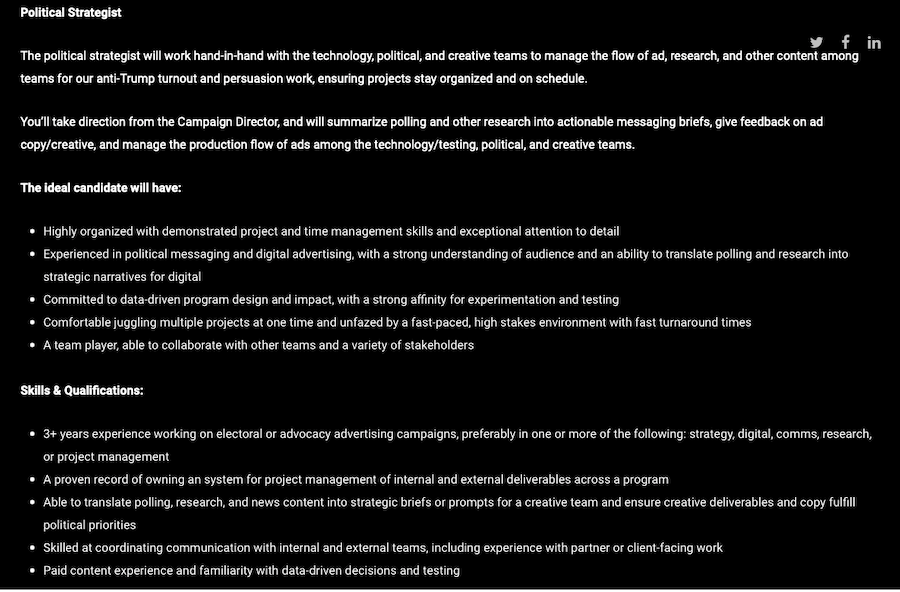
Every bit of experience will be an added point to your resume. The more points you have, the better your chances will be. Here’s an example of a job posting for a political strategist at a consulting firm. Notice how the focus is more on experience than education:
How do you become a Democratic strategist?
Everything above applies whoever you end up working for. But most people searching for this job search for it by party — and the party-side path has its own entry points, employers and job titles that are worth knowing before you apply anywhere.
On the Democratic side, there are four places the work actually sits:
- Party committees: the DNC plus the committees that run specific chambers — the DCCC (House), DSCC (Senate) and DLCC (state legislatures). They hire in bulk as a cycle ramps up, but almost never for a job called “strategist” at entry level. Look instead for organizing fellow, regional field organizer, digital organizer, data associate or research associate; the strategist title arrives a cycle or two later.
- State and county parties: the most realistic first door, and the one people overlook. State party staff roles (field director, data director, communications or compliance staff) hand you more responsibility sooner than a national committee would, and a state party is where you learn an electorate well enough to advise on it.
- Democratic consulting shops: firms specializing in polling, media buying, direct mail, digital fundraising or persuasion research, working several races at once. This is where the “strategist” title is most common, and most hires here arrive with at least one cycle of campaign or committee work behind them.
- Progressive advocacy groups, unions and PACs: issue-advocacy organizations, labor political departments and independent-expenditure groups run year-round programs rather than cycle-length ones, which makes them a steadier place to build a track record between elections.
Two practical things to plan around. First, cycle jobs end: fellowships and field roles are often funded only through Election Day, so expect to rebuild your position every couple of years until you reach senior or firm-side work. Second, party-side hiring runs on vouching — the committee and consulting world is small, and a recommendation from a manager you worked a cycle for moves you further than a CV does.
The structure mirrors almost exactly on the Republican side (the RNC, NRCC, NRSC and RSLC, with their own firm ecosystem), and nonpartisan equivalents exist at civic-engagement organizations, ballot-measure campaigns and public affairs firms. One caveat worth knowing early: partisan work builds a partisan record, and switching sides later is unusual, so choose the ecosystem you actually want to be known in.
What do people look for in a political strategist?
Understanding what campaigners look for when hiring a political strategist is an excellent way to prepare yourself for interviews or meets.
Apart from the key skills and qualifications we spoke about above on how to become a political strategist, campaigners look for the following:
- Track record: Whether you have experience devising good strategies. They don’t always have to be successful, but a creative, data-driven approach is what you need.
- Social proof: This includes recommendations from peers or seniors, how many people adapt or listen to your opinion, etc. This would be covered if you are active on social media (as we pointed out above).
- Rapport/relationship-building skills: Networking and collaborating are essential to your job. So, be confident and respectful when putting forth your points. Also, listen to what they have to say. This helps build trust and rapport with the campaigner.
Read Next: Ads to Whitelabeling: 7 Top Strategies to Drive Your Political Consultancy Business
Political strategist job prospects
If you fulfill the above requirements for how to become a political strategist, political advisors have three major job prospects.
- Political strategists for candidates: This includes helping local and national candidates win elections. You’ll work with the candidate’s election office.
- Political strategists for businesses/organizations: Other organizations hire political strategists to help promote a cause or legislation.
- Political strategy consultant: If you have a good enough portfolio, you can also work as a consultant. You could either be a part of a consulting agency or work independently. Your clients would include both businesses and candidates.
When hiring a political strategist, campaigns post RFPs on their website or other third-party websites. Alternatively, they may ask for recommendations and send RFPs only to them (which is why networking is so important).
Related websites to follow:
– FindRFP
– Campaigns and Elections: Consultant Directory
A political strategist is quite a rewarding role. However, it doesn’t come easy and requires much work during the initial phase. Hopefully, you now know exactly where to direct your efforts to start climbing that ladder.
If you want to read more about how to become a political strategist, you can read our article: Political Campaign Strategies To Win An Election
Featured image source: Jeshoots