
This guide will help you navigate advocacy vs. lobbying, understand the key differences, and know when to advocate and when to lobby. You’ll see why advocacy and lobbying aren’t just interchangeable terms but distinct strategies with different rules and implications.
We’ll explore examples and common terminology and address concerns you might have about the limits and boundaries of these activities. Whether you’re a nonprofit organizations, an activist, or an individual passionate about change, this knowledge will empower you to make a more significant impact.
So, why should you care about advocacy vs. lobbying? Why is this distinction vital? How does it relate to your goals and aspirations?
Let’s uncover the answers.
Key Takeaways
Advocacy is broad, proactive support for a cause or policy, while lobbying is the narrower slice of advocacy that directly asks a decision-maker to act on specific legislation.
Defining the Two Activities
- Advocacy covers activities and publications designed to influence public policy, laws, budgets, and other aspects of society, including speaking up for or defending a specific interest.
- Lobbying is a planned effort to influence government elected officials, legislators, or policymakers to shape decisions or policies for a specific cause or group.
- Grassroots lobbying mobilizes public opinion or constituents to pressure legislators into supporting a specific issue or piece of legislation.
- Direct lobbying involves lobbyists communicating personally with legislators or officials to persuade them through direct, relationship-based engagement.
How They Overlap
- Lobbying sits inside advocacy rather than beside it, meaning all lobbying counts as advocacy but most advocacy work, such as educating and mobilizing, never becomes lobbying.
- Both activities aim to influence policy outcomes and public decision-making toward a different result than would otherwise occur.
- Both are legal for nonprofits within limits, since advocacy without a legislative ask is uncapped and 501(c)(3) organizations may lobby as long as it remains an insubstantial part of their work under the substantial part test or the elected expenditure test per IRS guidance and the National Council of Nonprofits.
- Both rely on the same relationships with legislators, staffers, coalition partners, and supporters, and both require consistent, evidence-backed messaging to stay credible.
Key Differences
- Advocacy’s goal is to raise awareness, educate, and inform the public and policymakers about an issue or cause.
- Lobbying’s goal is specifically to influence government decisions, policies, or legislation, or to gain political influence.
- Advocacy methods include public awareness campaigns, providing information, sharing stories, and mobilizing supporters.
- Lobbying methods include direct communication with lawmakers, advocating for or against specific bills, and providing data and arguments to support a position.
Examples
- Advocacy examples include meeting with a legislator to share stories about a policy’s impact, raising awareness on social media without urging legislative action, and offering technical expertise or nonpartisan research at hearings in response to a request.
What is advocacy?
Advocacy is a form of proactive support or action to promote a particular cause, idea, or policy that aims to influence decisions within political, economic, and social institutions. It includes speaking up on behalf of or defending a specific interest.
Advocacy encompasses various activities and publications designed to influence public policy, laws, budgets, and multiple aspects of society. It is a fundamental tool to create positive change and address critical societal issues.
Recommended: Say The Right Things: How to Use Communication For Advocacy
What is lobbying?
Lobbying is a planned effort to influence government elected officials, legislators, or policymakers to shape decisions or policies for a specific cause or group. It involves various tactics and methods to persuade these decision-makers to adopt a particular stance or take specific actions.
Lobbying is crucial for businesses, interest groups, nonprofit organizations, and advocacy organizations to participate in the democratic process and advocate for their interests within the government and legislative arenas.
There are two primary types of lobbying:
Grassroots lobbying
Grassroots lobbying involves mobilizing and engaging the general public opinion or constituents to influence legislators and government elected officials on specific issues or legislation. It aims to create a groundswell of public support that can influence lawmakers’ decisions and policy outcomes.
Direct lobbying
Direct lobbying, or traditional lobbying, involves direct communication between lobbyists and legislators or government elected officials. It focuses on building personal relationships with lawmakers and directly influencing their decisions through persuasive communication.
Read Next: What Are The Restrictions On 501c3 Political Activity?
Advocacy vs. lobbying: Difference between advocacy and lobbying
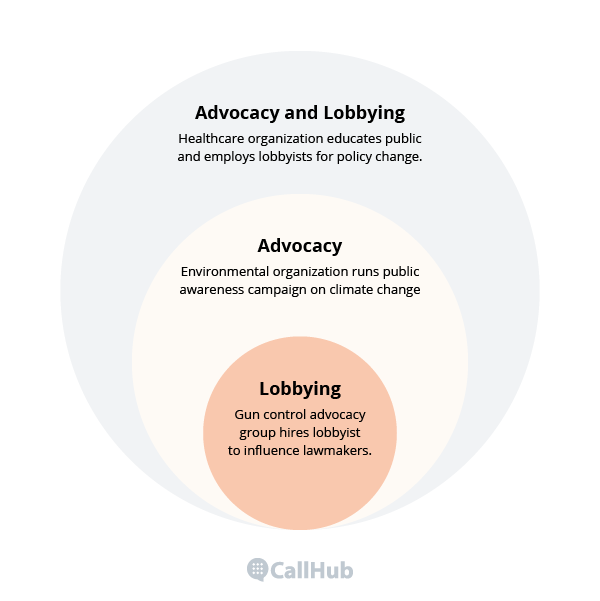
Advocacy and lobbying are both ways to influence change, but they have distinct purposes and approaches. Understanding the nuances between advocacy vs. lobbying is essential for effective engagement in societal change.
Similarities between advocacy and lobbying
Before the differences, it helps to name what the Venn diagram above only shows visually: lobbying sits inside advocacy, not beside it. Lobbying is the narrower slice of advocacy that asks a decision-maker to act on a specific piece of legislation. That means all lobbying is a form of advocacy, while most advocacy work — educating, informing, mobilizing — never crosses into lobbying at all.
Here is the common ground the two share:
- Both set out to influence policy outcomes and public decision-making. Whether you are shifting public opinion or asking for a vote, the end goal is a decision made differently than it otherwise would have been.
- Both are legal activities for nonprofits, within limits. Advocacy that stops short of a legislative ask is not capped, and 501(c)(3) organizations may also lobby as long as it stays an insubstantial part of their work — measured either by the substantial part test or by electing the expenditure test, per IRS guidance on lobbying and the National Council of Nonprofits. Neither activity is off-limits; only the volume of lobbying is.
- Both run on relationships. Legislators, staffers, coalition partners, and your own supporter base are the same network in either case — the contacts you build through advocacy are the ones you turn to when a bill is finally moving.
- Both demand message discipline. A consistent, evidence-backed story told the same way by staff, volunteers, and supporters is what makes either effort credible, and a scattered message weakens both equally.
Because they overlap this much in purpose and in practice, the line between them is drawn less by what you do than by what you ask for — and that line is where the rules, the reporting, and the limits change.
Let’s break down the differences between them:
| Advocacy | Lobbying | |
| Goal | Seeks to raise awareness, educate, and inform the public and policymakers about a particular issue or cause. | Lobbying is specifically geared towards influencing government decisions, policies, or legislation or gain political influence. |
| Methods | Advocacy involves activities such as public awareness campaigns, providing information, sharing stories, and mobilizing supporters. | Includes direct communication with lawmakers, advocating for or against specific bills, providing data and arguments to support a particular position, and mobilizing grassroots support. |
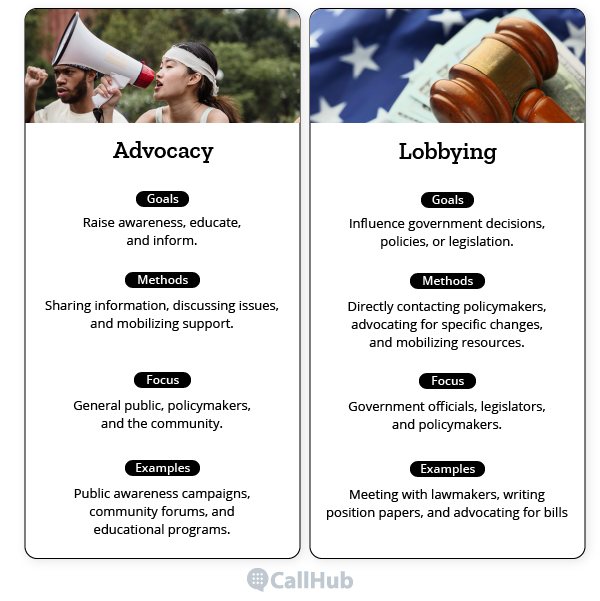
Examples of advocacy vs. lobbying
Here are examples that illustrate the distinction between advocacy and lobbying:
Advocacy:
- Meeting with a legislator to share stories and experiences about how a policy impacts the people you represent.
- Utilizing social media platforms to raise awareness about a particular cause or issue without explicitly urging legislative action.
- Engaging with government officials to provide information and insights into how a specific problem or issue affects a particular group or organization.
- Offering technical expertise and advice to a legislative body in response to a request, such as participating in hearings to provide insights.
- Sharing nonpartisan research, studies, or analyses related to broader social, economic, or similar problems without advocating for specific legislation.
Lobbying:
- Meeting with a Member of Congress and explicitly requesting their vote in favor of, or opposition to, a specific piece of legislation.
- Sending emails to members of your organization, urging them to contact their elected officials to support or oppose a specific bill or pending regulations.
- Creating an online petition that asks either your organization’s members (direct lobbying) or the general public opinion (grassroots lobbying) to contact their legislators in support of or opposition to specific legislation.
- Developing materials or organizing events designed to advocate for a particular position on legislation explicitly.
Advocacy vs. lobbying: Difference in vocabulary
Understanding the key terminology used in advocacy and grassroots lobbying can clarify the distinctions between these activities:
Common terms in non-lobbying advocacy
| Educate | Providing information and knowledge to raise awareness and understanding about an issue. |
| Inform | Disseminating facts, data, and insights to keep stakeholders updated on specific matters. |
| Show | Demonstrating or presenting evidence to illustrate the significance of a cause or issue. |
| Advance policy issues/Advocate for change | Promoting or pushing for specific policy-related concerns without directly engaging in legislative action. |
| Mobilize support | Encouraging individuals or groups to actively back a cause. |
| Promote a cause/Campaign for/Endorse | Highlighting and endorsing a specific issue through public campaigns. |
Expand your knowledge: 5 Advocacy Tools That Stop Your Campaign From Falling Behind
Common terms in lobbying
| Lobby | Actively engaging with lawmakers, policymakers, or government officials to influence their decisions or actions. |
| Persuade/Sway/Influence | Using persuasive arguments and reasoning to win support for a particular stance or position. |
| Convince | Achieving agreement or acceptance through effective argumentation or negotiation. |
| Win legislative victories | Successfully achieving the desired outcomes in the form of legislative actions or decisions. |
| Petition/Appeal/Solicit | Formally request a government body or official to address a specific issue. |
Relevant resource: Challenges In Lobbying Strategies: How Not To Lose The Good Fight
Advocacy vs. lobbying: Who can engage in these activities?
Anyone can engage in advocacy.
Lobbying, on the other hand, often involves specialized professionals known as lobbyists who possess in-depth knowledge of government processes. While individuals and organizations can petition the government directly, it is more common for organizations and businesses to hire lobbyists to represent their interests.
Effective lobbying involves understanding the concerns and priorities of various lobbying interests and tailoring your efforts accordingly.
Many lobbying groups actively participate in shaping public policy and advocating for their causes. Industries such as health, insurance, oil and gas, technology, and electricity are particularly active in hiring lobbyists. For instance, in 2022, the pharmaceutical and health products industry spent over $375 million on lobbying efforts, as reported by OpenSecrets.
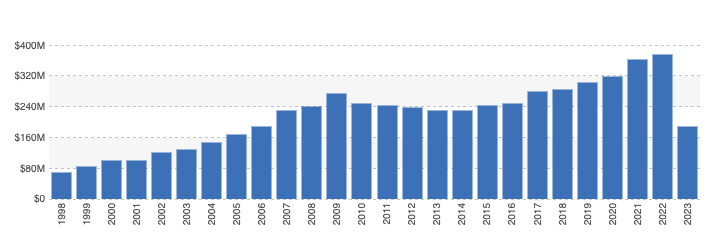
Annual lobbying in pharmaceuticals/health products. Source: OpenSecrets.
FAQs about advocacy vs. lobbying
1. Is advocacy considered lobbying?
No, advocacy is not considered lobbying. Advocacy focuses on raising awareness, educating, and informing about specific issues or causes without directly pushing for specific legislative changes.
2. What is the difference between lobbying and advocacy in healthcare, nursing, and public health?
In healthcare, nursing, and public health, the distinction between lobbying and advocacy remains the same: Advocacy involves activities like raising awareness, educating the public, and informing policymakers about health-related issues. On the other hand, lobbying specifically targets government decisions and legislative actions related to healthcare policies. The key difference lies in the intent to influence specific legislation.
3. What’s an example of lobbying?
An example of lobbying is a healthcare organization urging lawmakers to support a bill that proposes increased funding for a specific healthcare program. This directly seeks to influence a legislative decision.
4. How can I determine lobbying limits for my 501c3?
Lobbying must be done within an effective and fair framework that promotes transparency and accountability. Lobbying activities that target the federal government are subject to specific regulations and reporting requirements.
To determine lobbying limits for your 501(c)(3) organization, refer to the IRS guidelines and use the “expenditure test” and “substantial part test” to ensure compliance.
For guidance on lobbying restrictions for nonprofits, refer to this article, ‘Can Nonprofits Lobby? How to Lobby Within the Limits’.