


Table of Contents
Let’s get straight to the point. U.S. charitable giving hit a record 592.5 billion dollars in 2024, with individual donors contributing about 392.5 billion dollars, or two‑thirds of all gifts. That means your ability to attract, retain, and upgrade individual donors is still the single biggest lever for your donor fundraising growth.
At the same time, fundraisers are operating in a more competitive, data‑rich environment, with new tech, donor expectations for personalization, and stricter compliance rules across channels. If you are still relying on your annual appeals and a basic email list, you are leaving major money—and donor relationships—on the table.
But first, what is major donor fundraising?
Major donor fundraising is the deliberate process of identifying, cultivating, and soliciting supporters who can make large, often multi‑year gifts to your organization. These donors don’t just provide funding; they often bring networks, advocacy, and credibility.
Well‑designed major donor programs typically include:
- A clear definition of what counts as a major gift for your organization.
- A portfolio of assigned prospects with named relationship managers.
- A documented plan for each prospect across the donor cycle.
Major donor fundraising cycle
Most successful organizations follow a donor cultivation cycle, a structured process that guides how you move a prospect to a long‑term partner. The steps are the same for a regular cycle, but for major donors, each step is more intentional and personalized.
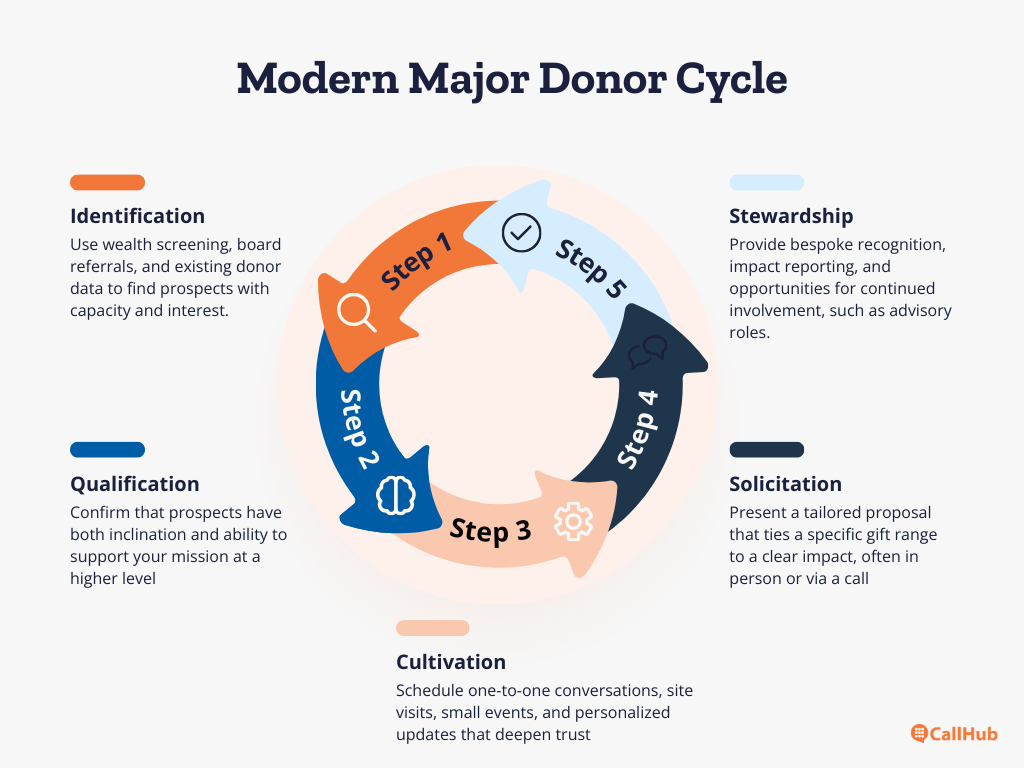
When you align your campaigns to the donor cultivation cycle, you avoid the “ask, ask, ask” trap that turns supporters off and drives them to disengage.
1. Identification and qualification
Effective donor fundraising begins with identifying the right people and confirming they are a good fit.
- Use event sign‑ups, petition signatures, peer‑to‑peer campaigns, and website opt‑ins to capture new prospects.
- Enrich records with data points like location, past giving, and estimated capacity.
- Use simple surveys—delivered via SMS or phone—to ask supporters about their interests and how they prefer to hear from you.
2. Cultivation and engagement
Cultivation is about showing your value before you ask. That can include:
- Sharing impact stories that connect your mission to outcomes in that year.
- Inviting donors to events, briefings, or virtual town halls.
- Sending tailored content based on what they have already engaged with.
With 41% of fundraisers reporting that fewer than 20% of prospects respond positively to initial outreach, skipping cultivation is a major risk. It leads to low conversion and missed long‑term relationships.
3. Solicitation and stewardship
When it is time to ask, your aim is to have clarity and relevance.
- Use specific amounts tied to tangible impact (for example, “a gift of 250 dollars covers…”) to increase trust and motivation.
- Make it easy to give with mobile‑friendly donation pages, SMS donation links, and quick reply options.
After the gift, a strong stewardship plan—with timely, personal thank‑you’s and clear impact reports—helps turn one‑time donors into loyal supporters.
Research shows recurring donors are significantly more likely to give again compared to one‑time donors, making stewardship for sustainers especially valuable.
Read also: Major Gift Fundraising: The 9 Essential Steps To Guide You
Key Takeaways
Major donor fundraising is the deliberate process of identifying, cultivating, and soliciting supporters capable of large, often multi-year gifts, and it remains the biggest growth lever for nonprofits since individual donors drove two-thirds of the record 592.5 billion dollars given in the U.S. in 2024.
What a major donor program requires
- Individual donors contributed about 392.5 billion dollars of the 592.5 billion dollar total raised in 2024, making them the primary source of nonprofit revenue.
- A well-designed major donor program defines what counts as a major gift for the organization, assigns prospects to named relationship managers, and documents a plan for each prospect across the donor cycle.
- Major donors bring more than funding, often contributing networks, advocacy, and credibility to an organization.
The donor cultivation cycle
- Identification and qualification starts with capturing prospects through event sign-ups, petitions, peer-to-peer campaigns, and website opt-ins, then enriching records with location, past giving, and capacity data.
- Cultivation and engagement means proving value before asking, through impact stories, event invitations, and content tailored to prior engagement, since 41% of fundraisers report that fewer than 20% of prospects respond positively to initial outreach.
- Solicitation and stewardship works best when asks tie specific dollar amounts to tangible impact and giving is made easy via mobile-friendly pages and SMS links, followed by timely thank-yous and impact reports.
- Recurring donors are significantly more likely to give again than one-time donors, which makes stewardship of sustainers especially valuable.
Building the strategy
- Clarifying goals means setting specific targets for total revenue, recurring revenue, and major gifts, then segmenting donors by giving level, engagement, and preferred channel.
- Nonprofits with clear, segmented goals are more likely to see year-over-year gains in both dollars raised and donor counts.
- A major donor society, or giving circle, creates defined giving tiers, exclusive benefits like events and leadership updates, and tangible impact framing, as shown by the Goodman Theatre’s tiered examples of what 5,000, 2,500, or 1,000 dollar gifts support.
- Matching gift programs can extend beyond workplace giving through leadership matches that unlock other gifts, challenge campaigns that double community fundraising, and multi-year matches that build predictable revenue for capital initiatives, such as a donor committing 100,000 dollars to match new or increased gifts during a campaign.
Building a modern major donor fundraising strategy
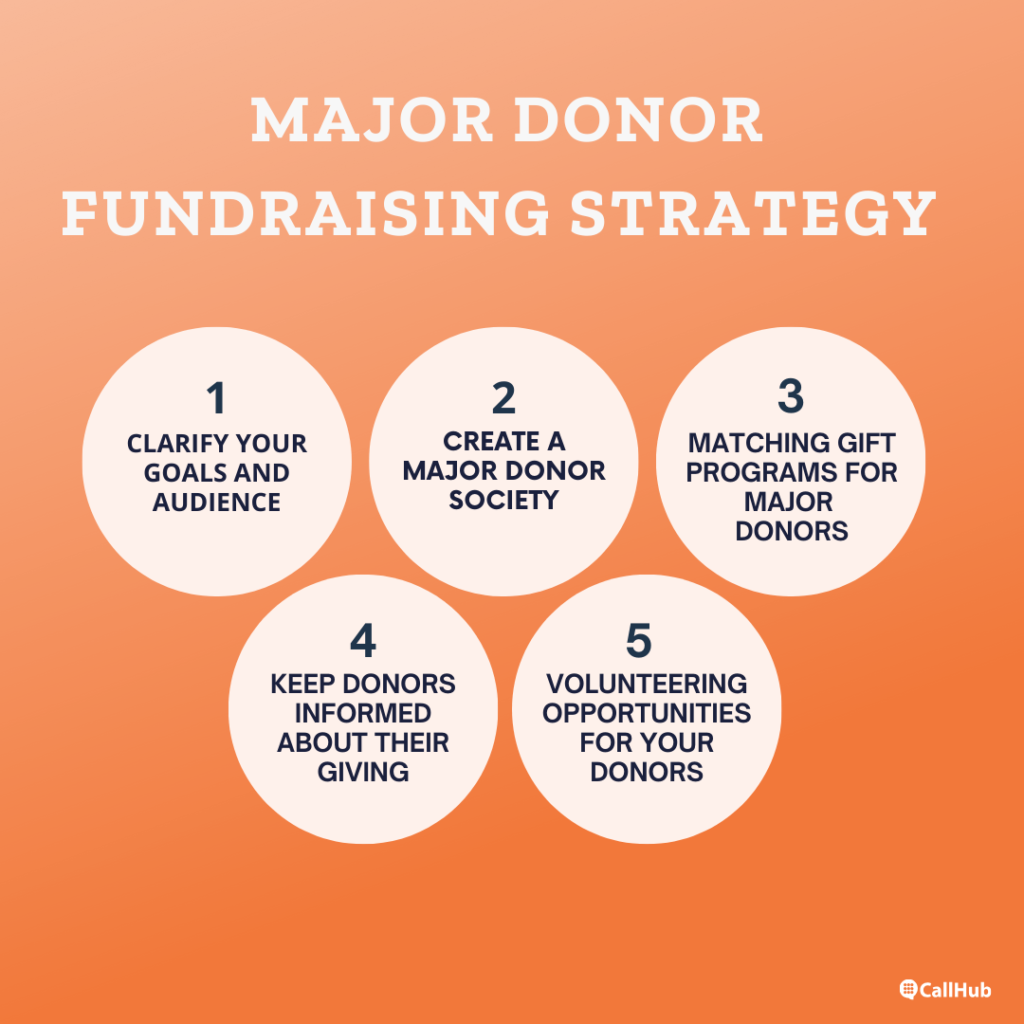
Think of your donor fundraising strategy as the blueprint that aligns your goals, audiences, and outreach methods so you can raise more with less guesswork.
1. Clarify your goals and audience
Start by defining who you are trying to reach and what you want them to do.
- Revenue goals: Set specific targets for total revenue, recurring revenue, and major gifts.
- Donor segments: Group donors by giving level, engagement, and preferred channel (for example, SMS‑responsive, phone‑responsive, email‑only).
- Funnel stage: Decide which content serves awareness (top of funnel), consideration (middle), and conversion/upgrade (bottom).
Surveys of nonprofits show that teams with clear, segmented goals are more likely to see year‑over‑year gains in dollars raised and donor counts. |
2. Create a major donor society
A donor society (or giving circle, leadership circle, or loyalty club) gives your major and leadership‑level donors a clear identity, benefits, and sense of belonging. Here are the steps you can use:
- Structure: Set giving levels (for example, 5,000 dollars, 10,000 dollars, 25,000 dollars+) and assign meaningful names to each tier.
- Benefits: Offer exclusive events, behind‑the‑scenes access, recognition in programs or digital walls, and direct updates from leadership.
- Impact framing: Show how each level moves the needle—for instance, Goodman Theatre shows specific examples of what 5,000 dollars, 2,500 dollars, or 1,000 dollars supports, making the impact tangible.
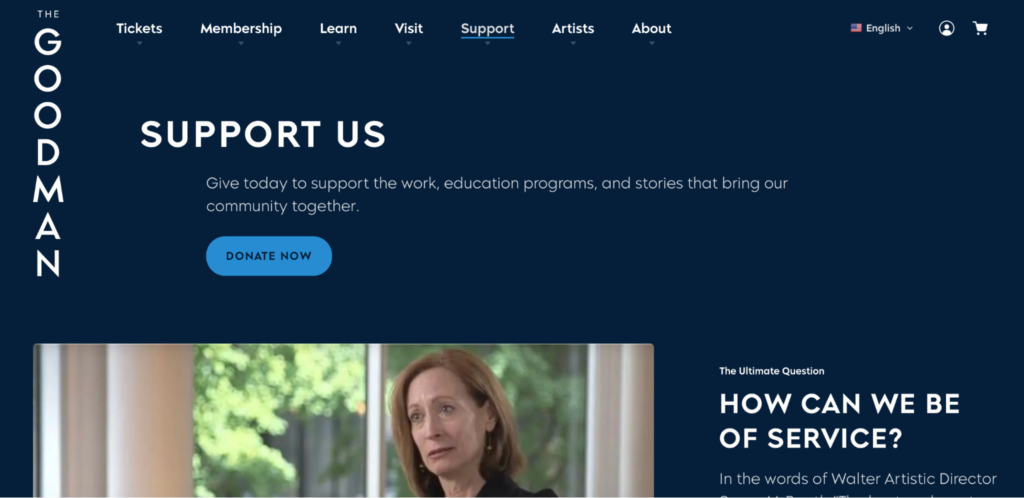 Source: GoodmantheaterThe Goodman Theatre’s donor program illustrates this approach very well. They presented various donation options, such as corporate partnerships and planned giving, and highlighted how gifts at different levels fuel productions and community programs. |
3. Matching gift programs for major donors
Matching gift programs are not just for workplace giving—they can be powerful tools for major donor leverage,
- Leadership matches: Ask a major donor (or group of donors) to commit a lead gift that “unlocks” or matches gifts from others during a campaign period.
- Challenge campaigns: Frame the match as a challenge—if your community raises a set amount, the major donor will match it, doubling the impact.
- Multi‑year matching: For capital or strategic initiatives, a major donor might match gifts over several years, helping you build stable, predictable revenue.
In practice, this might look like a donor committing 100,000 dollars to match all new or increased gifts during one of your campaigns, which can motivate both mid‑level and prospective major donors to stretch their giving.
Read also: 3 Undeniably Good Matching Gifts Strategies For Nonprofits
4. Keep donors informed about their giving
Major donors expect to see how their gifts change lives, not just in one‑off reports but through ongoing storytelling. So you can share:
- Impact stories to share narratives that connect major gifts to specific outcomes.
- Regular updates—short, frequent emails, SMS, or personal calls—between formal reports, so donors feel involved rather than “solicited and forgotten.”
- Use photos, brief videos, or quick metrics to show progress toward goals funded by major donors.
Here, for example, Habitat for Humanity highlights specific donors, explains how gifts fund tangible projects like homes and disaster relief, and shows ongoing results rather than one‑time outcomes. 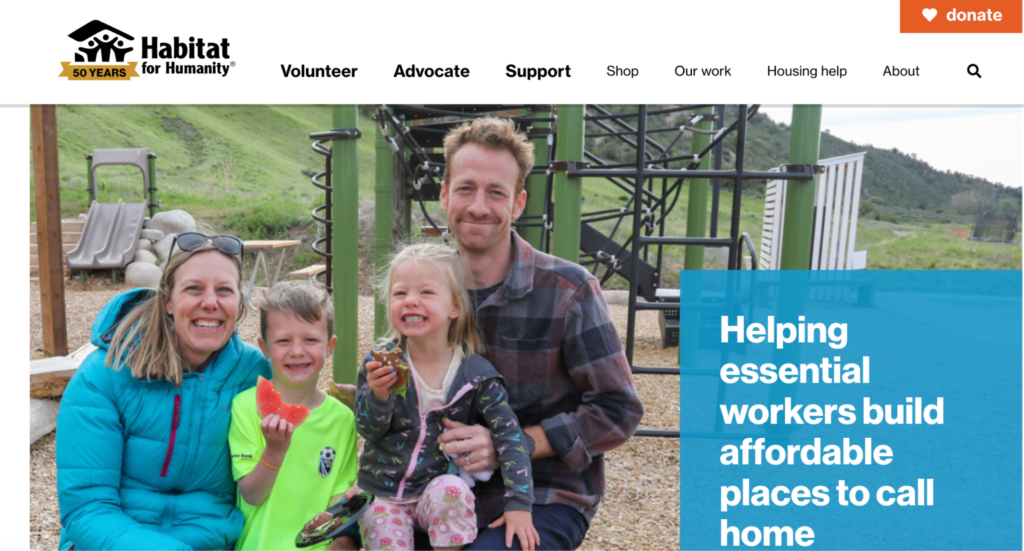 Source: Habitat for Humanity |
5. Volunteering opportunities
Many major donors want to see and feel the work they support, not just read about it, and that is where volunteering opportunities come towards them, where they can use their:
- Skilled volunteering to invite donors to lend expertise (for example, finance, marketing, legal) in advisory groups or short‑term projects.
- Program‑side volunteering where it offers ways to participate in or observe the work, such as build days, classroom visits, clinics, or backstage tours, depending on your mission.
- Leadership roles that provide opportunities to chair committees, host events, or lead peer‑to‑peer fundraising efforts.
These experiences deepen connection and can inspire larger, more frequent gifts as donors see the direct impact of their time and resources.
Read also: How to train your campaign volunteers
(banner on 5 fundraising scripts – downloadable as CTA)
How outreach software powers major donor fundraising
You cannot run a sophisticated, multi‑touch major donor program only from spreadsheets and inboxes. Your outreach software should be the bridge between your strategy and day‑to‑day activity, especially across phone, SMS, and email.
What a good outreach software should do?
Look for tools that:
|
Capability |
What it does? |
|
Centralize contact records |
Store contact details, consent, giving history, communication logs, and preferences in one place for a complete donor view. |
|
Integrate channels |
Sync SMS, calling, and email activity so every interaction automatically updates the donor profile. |
|
Automate workflows |
Trigger follow-ups based on events like donations, event attendance, or survey responses to reduce manual work. |
|
Support segmentation & personalization |
Build audience segments by behavior, channel preference, and gift level so you can send more relevant, tailored messages. |
|
Track key fundraising metrics such as response rates, conversion, donor retention, and upgrade performance by segment. |
CallHub connects texting and calling campaigns to CRMs like Salesforce, NationBuilder, and Blackbaud, so calls and sms conversations automatically update donor records. That makes it easier for your team to see the full history of each donor and coordinate outreach without duplicating work.
Turn major donor relationships into results
If you want to win in today’s fundraising landscape, you need a donor fundraising strategy that combines smart segmentation, a clear donor cycle, and integrated channels—calls, texts, and email—powered by robust outreach and donor management software.
The organizations that succeed in coming years will not be the loudest askers—they will be the most consistent relationship builders.
Use tools like CallHub to meet donors where they are, show impact across every touchpoint, and make it effortless to say “yes” again and again.
FAQs on donor fundraising
1. What are the four types of donors?
Typically, donors fall into four categories: individual donors, major donors, recurring donors, and institutional donors (such as foundations or corporations).
2. What is the 33% rule for nonprofits?
The 33% rule suggests that no single donor or funding source should account for more than one-third of total revenue, helping organizations reduce financial risk.
3. What is the best fundraising software for nonprofits?
The best software depends on your needs, but strong platforms offer CRM integration, multi-channel outreach, automation, and compliance support. Tools like CallHub are especially effective for SMS- and call-driven fundraising.
4. What are effective donor fundraising ideas?
Examples include matching gift challenges, peer-to-peer campaigns, leadership giving societies, recurring donor programs, and personalized major donor outreach.