


Table of Contents
You have 10,000 contacts, 20 volunteers available for a Saturday session, and two channels to choose from. Which one do you use?
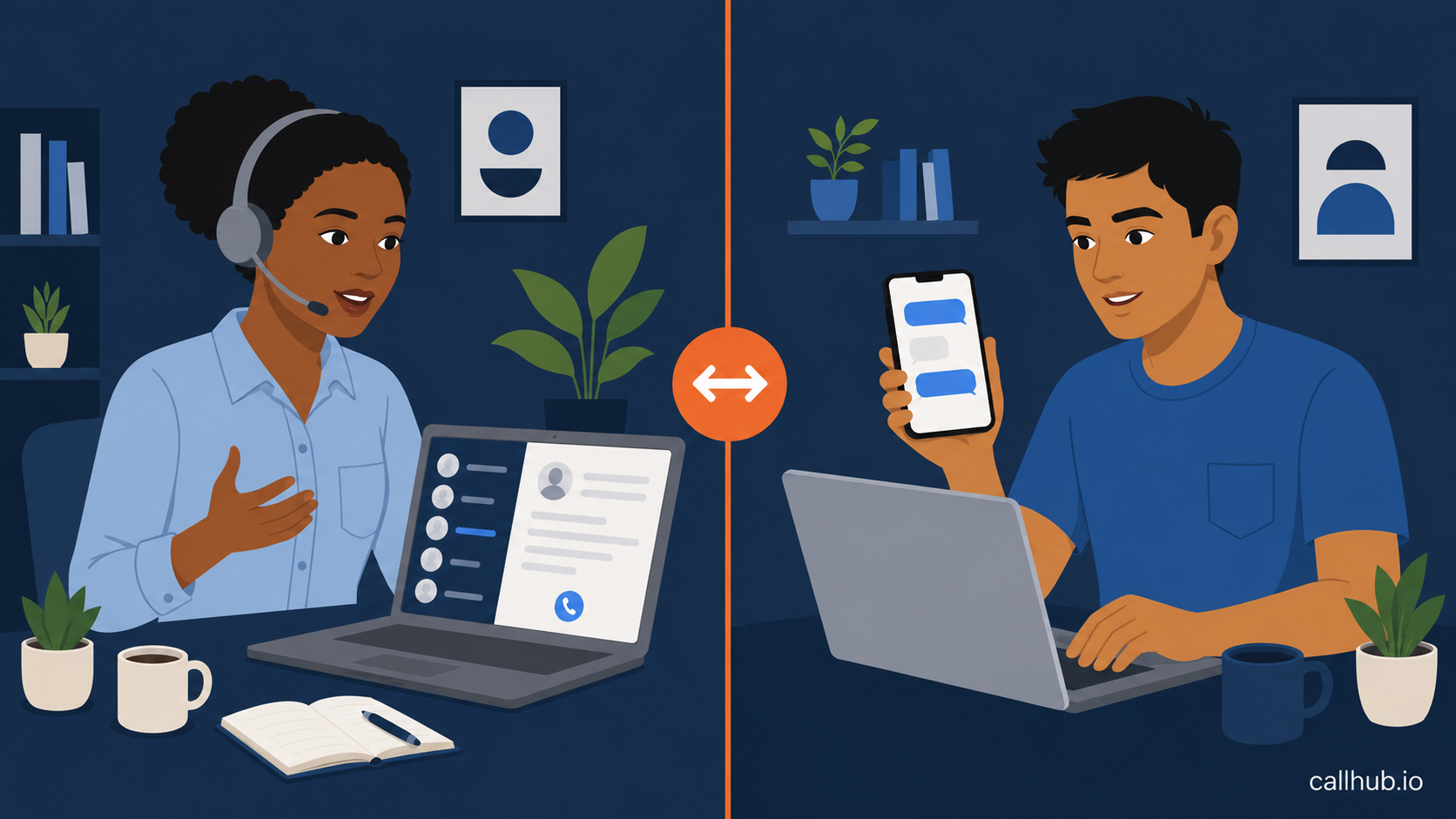
Text banking is the process of reaching contacts through SMS or peer-to-peer texting at scale, using volunteers or automated broadcasts. Phone banking is the process of reaching contacts through live, script-guided calls, with volunteers working through a contact queue.
Most campaigns treat these as competing options. That framing leads to underperforming outreach. The real question is not which channel is better. It is which contact, at which stage of the campaign, is better served by a call or a text. Used in sequence, the two channels consistently outperform either one alone.
This guide covers the data on each channel, the use cases where each wins, and the sequencing strategy that puts them both to work.
What is phone banking?
Phone banking is a structured outreach method in which volunteers or staff make calls from a shared contact queue, follow a script on screen, and log call outcomes in real time. The data syncs back to a voter file or CRM automatically.
For a full breakdown of how to set one up from scratch, see the CallHub complete guide to political phone banking.
What is text banking?
Text banking is the process of reaching contacts through text messages, either via mass SMS broadcast or through peer-to-peer (P2P) texting, where volunteers send individual personalized messages from a platform that manages the queue and responses.
P2P texting feels like a one-to-one conversation to the recipient. Mass text broadcasts reach the full list at once. Most campaigns use a combination of both depending on the goal and the list segment.
For a deeper guide on running a text banking program, see the CallHub article on how to run a text banking campaign.
Phone banking vs text banking: a head-to-head comparison
Neither channel is universally better. Each wins in different conditions. Here is how they compare across the dimensions that matter most for campaign planning:
| Dimension | Phone banking | Text banking |
|---|---|---|
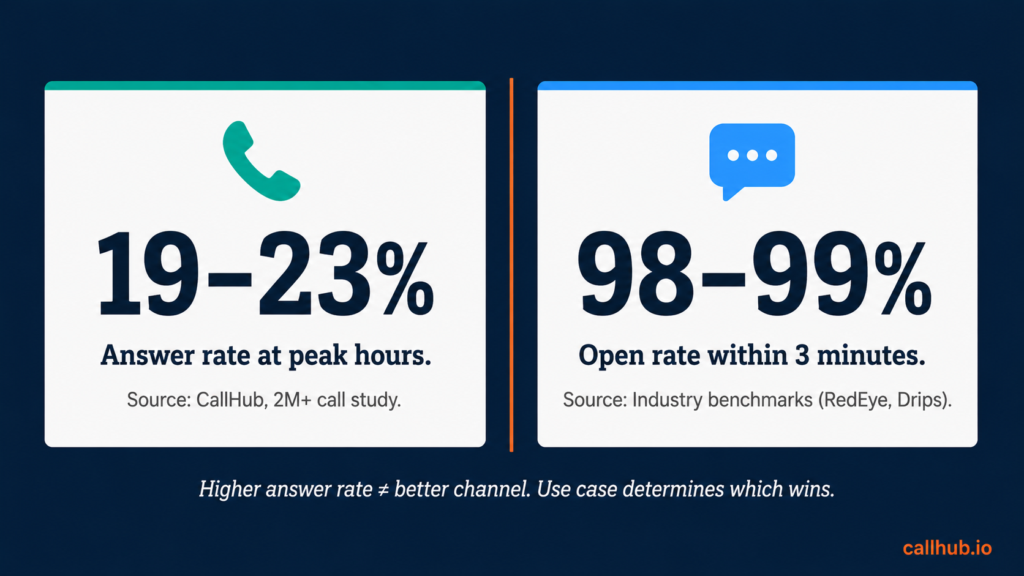
| Open / answer rate | 19-23% answer rate at peak hours (CallHub, 2M+ call study) | 98-99% open rate within 3 minutes (industry benchmarks, RedEye, Drips) |
| Persuasion rate per contact | Higher: live conversation is the strongest per-contact persuasion method | Lower: short-form messages are less effective for shifting undecided contacts |
| GOTV lift | 3-4% voter turnout increase (Yale GOTV experiments database, Analyst Institute) | Approximately 3% voter turnout increase (multiple sources, including Impactive research) |
| Scale per volunteer hour | 15-25 call attempts per hour (Power Dialer) | Hundreds of messages per hour (P2P); thousands instantly (mass broadcast) |
| Best for | Persuasion, voter ID, relationship-building, high-value contacts | Reminders, sharing links, rapid response, high-volume low-engagement contacts |
| Volunteer training time | Higher: scripts, dispositions, and compliance require a briefing | Lower: volunteers can participate after a short walkthrough |
| Cost per completed contact | $0.75 to $3.50 per completed contact (The Political Group, 2026 data) | Significantly lower per message; varies by list size and P2P vs. broadcast model |
| Compliance | TCPA: requires manual dial for cell phones or prior consent for automated dialing. Calling hours enforced by timezone. | TCPA: 10DLC registration required for mass texts. Opt-out management mandatory. |
| Can send a link | No | Yes |
| Can have a conversation | Yes | Yes (P2P, with delay) |
One note on a stat that often circulates: SMS response rates are frequently cited as 295% higher than phone call response rates (BSG, cited by Drips.com). That figure measures reply rate in SMS marketing, not persuasion rate or voter turnout lift. The channels perform differently on different outcomes. Use both stats together rather than treating either as a declaration of which channel is better overall.
When phone banking works better
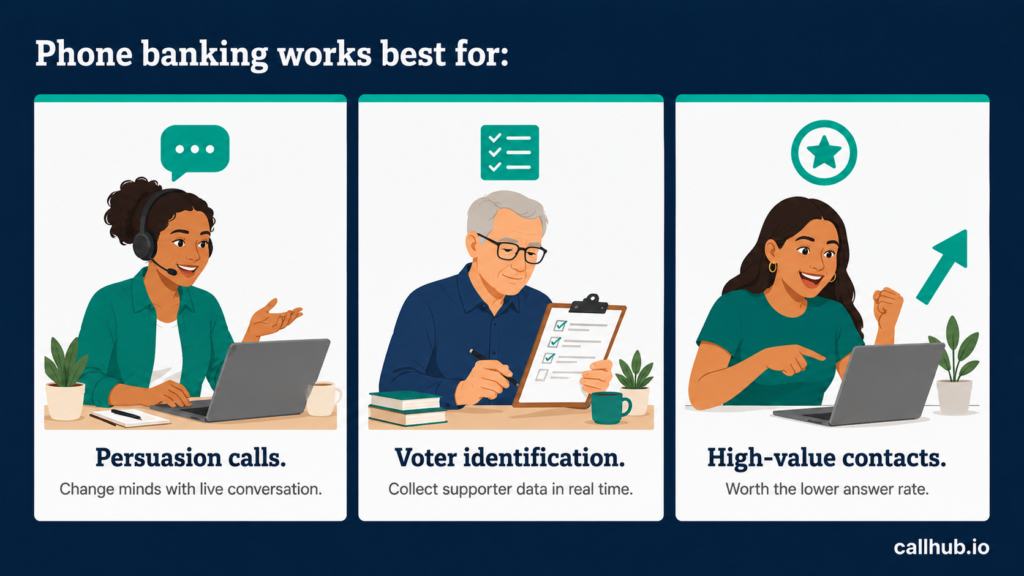
Phone banking outperforms text banking in four specific situations. In all four, the value comes from the live conversation itself.
Phone banking for persuasion calls
When your goal is to change a contact’s mind, a call is the right tool. Live conversations allow volunteers to listen, respond, address objections, and leave a human impression that a text message cannot match. According to research cited in the Yale GOTV experiments database, quality phone conversations are one of the few outreach methods with a measurable, documented persuasion effect on undecided voters.
The Analyst Institute consistently finds phone banking among the highest-performing voter contact methods when measured by persuasion per contact, not just contacts per hour.
Use phone banking for persuasion when:
- Contacts are marked undecided or soft opposition in your voter file
- Your campaign is in a persuasion window (pre-primary, competitive district, close polling margin)
- The message requires nuance that a short text cannot carry
Phone banking for voter identification
Voter ID calls are one of the most data-intensive uses of phone banking. Volunteers call through a list, ask a set of scripted questions, log supporter levels, and the responses sync directly to your voter file. A well-run voter ID campaign turns a raw contact list into a segmented, actionable database in a single session.
Text banking can collect basic survey responses, but the data quality and conversation depth of a live call is higher. For voter ID specifically, call first.
Phone banking for high-propensity, high-value contacts
80% of people do not pick up calls from unknown numbers, according to the Pew Research Center. That is the challenge of phone banking. The counter-argument is that the 20% who do answer are often your highest-value contacts. They are more likely to be engaged, more likely to be persuadable, and more likely to turn out on election day.
For your high-propensity, high-priority contacts, a call is worth the lower answer rate. Reserve your text channel for the broader list where volume matters more than depth.
When text banking works better
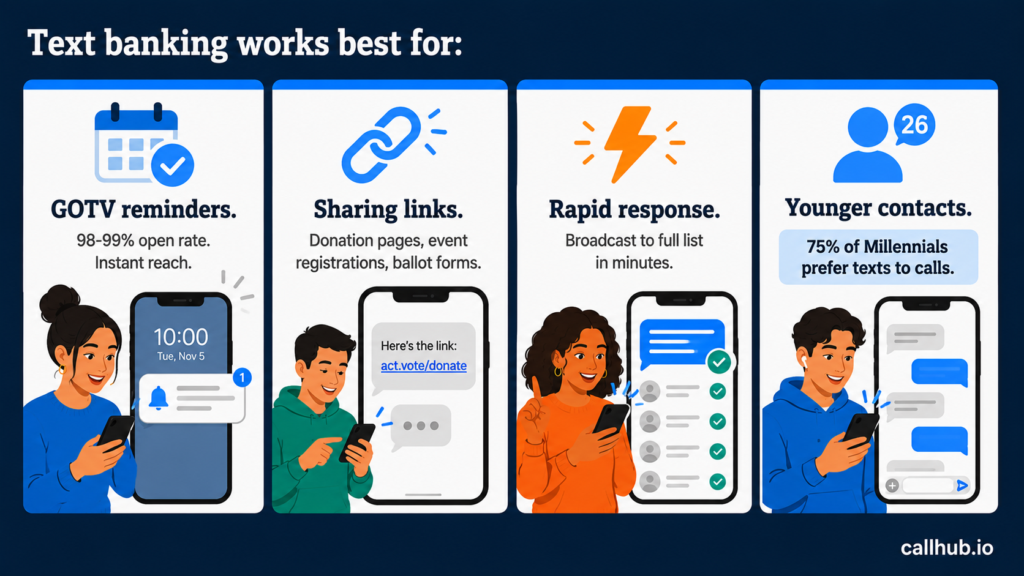
Text banking outperforms phone banking in four situations. In all four, the value comes from speed, scale, or the ability to deliver something a voice call cannot.
Text banking for GOTV reminders
With a 98-99% open rate and most messages opened within three minutes of delivery, text banking is the fastest way to reach a large list with a time-sensitive message. Election day reminders, polling place information, ballot return deadlines, and early voting alerts all belong in the text channel.
“People don’t check their emails because people get a million emails a day,” Eli Zbar, Communications Strategist for the Dianne Watts BC Liberal Party Leadership Campaign, observed about their outreach program. Text banking cut through where email could not.
Text banking for sharing links and driving action
Phone banking has one structural limitation: you cannot send a link over a phone call. Donation pages, ballot request forms, event registration links, polling location lookups, and volunteer sign-up forms all require a text.
As Eli Zbar put it directly: “You can’t send someone a link over the phone.” For any ask that requires a contact to click, share, or complete a form, text banking is the right channel.
Text banking for rapid response
When something time-sensitive happens, text banking reaches your list immediately. A breaking news moment, a last-minute debate, a fundraising deadline, or an emergency mobilization ask all require speed. A phone bank session takes scheduling and volunteer coordination. A text broadcast or P2P campaign can go out in minutes.
Text banking for reaching younger and mobile-first contacts
75% of Millennials prefer texting to talking on the phone, according to a Research Brief survey cited by Drips. For contacts under 40, a well-written text is more likely to be read and acted on than a call from an unknown number. Segment your list and match the channel to the contact’s communication preference where your voter file data supports it.
How to combine phone banking and text banking in a sequence
This is where most campaigns leave significant contact rate improvement on the table. Running both channels independently on the same list is not a multi-channel strategy. Sequencing them so that each channel’s results inform the other is.
The call-first, text non-contacts sequence
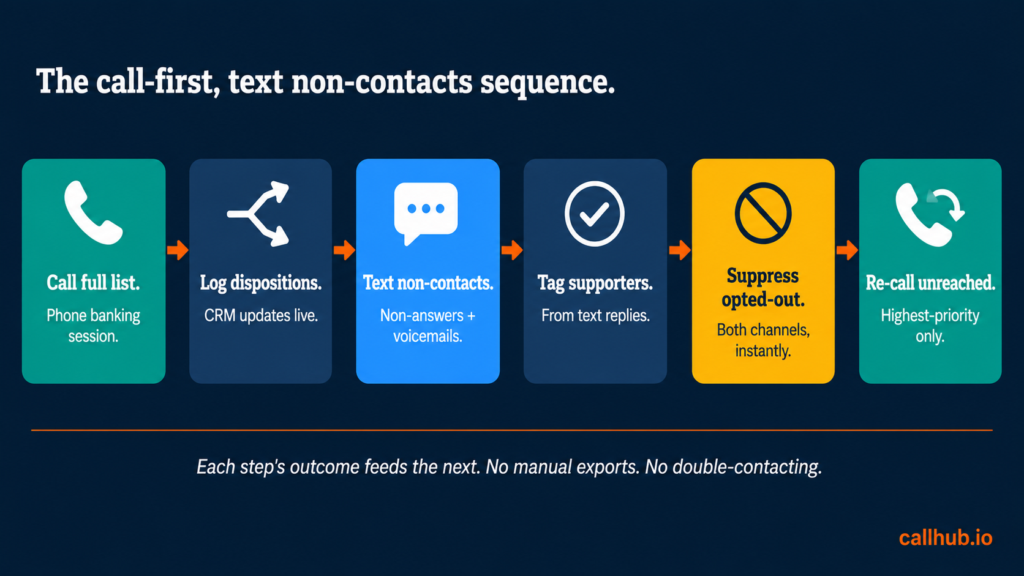
This is the most reliable sequencing model for GOTV and voter ID programs:
| Step | Action | Channel | What happens in your CRM |
|---|---|---|---|
| 1 | Call through your full target list | Phone banking | Contacts logged as answered, voicemail, no answer, refused |
| 2 | Export non-answers and voicemails from the calling session | Transition | CRM generates a “not reached by call” segment automatically |
| 3 | Run a follow-up text to all non-contacts | Text banking | “Hi [Name], we tried to reach you earlier. [Short message + link or ask].” |
| 4 | Identify contacts who replied to the text with support | Text banking response | Tag as confirmed supporter, move to GOTV priority queue |
| 5 | Do not re-call contacts who replied to the text | Suppression | CRM suppresses these contacts from the next calling session |
| 6 | Re-call contacts who did not respond to either channel | Phone banking | Second attempt on the highest-priority unreached contacts |
The logic: Phone banking reaches the contacts who answer calls. Text banking catches a portion of those who did not. Together, your effective contact rate is significantly higher than either channel achieves alone. The key is making sure the channels share a contact record so suppression and follow-up routing happen automatically, not through manual list exports.
Using call data to personalize follow-up texts
Not all non-contacts are equal. A contact who answered and expressed strong support should get a different follow-up text than a contact who did not answer at all.
With a live CRM sync, the call disposition from session one becomes the targeting logic for session two:
- Answered, strong supporter: Text with a specific follow-up ask (donate, volunteer, share event link)
- Answered, undecided: Text with a simpler, lower-barrier ask (learn more, read this)
- Voicemail or no answer: Text with the original message in a shorter format
- Refused: Suppressed from both channels immediately
This level of personalization is not achievable with manual list exports. It requires a calling platform and a texting platform that share a live contact record.
What running both channels from a single platform looks like
When calling and texting programs run as separate tools, the coordination problem is predictable. A contact who answered a call and donated is still in the texting queue because the two tools do not share a contact state. A volunteer who opts someone out of texts has no way to suppress that contact from the calling queue without a manual update.
CallHub runs both channels in a single campaign, with a shared live contact record. When a contact answers a call and expresses support, that disposition is immediately visible to the text campaign. When a contact replies “STOP” to a text, they are suppressed from calling campaigns in real time. No manual export. No 24-hour lag.
For campaign managers who want to understand how the calling side of this works, see the guide on how to run a virtual phone bank.
For a comparison of calling platforms specifically, see the phone banking software guide.
To explore how CallHub handles both channels in a unified campaign, see the phone banking software product page.
Conclusion
Phone banking and text banking are not competing channels. They serve different moments in the same relationship.
Calls earn the conversation. A live voice conversation remains the strongest per-contact persuasion method available to campaigns. It is the right tool for undecided voters, high-value contacts, and voter ID programs where data quality matters.
Texts extend the reach. With a 98-99% open rate and the ability to deliver links, reminders, and rapid-response messages instantly, text banking reaches the contacts who would never answer an unknown number.
The sequence beats either channel alone. Call first. Text the contacts you did not reach. Use call dispositions to personalize what those texts say. Suppress anyone who opts out across both channels immediately.
For campaigns, nonprofits, and unions that want to run both channels without the coordination overhead, the CallHub complete guide to political phone banking covers the full program strategy from voter ID through GOTV.
Frequently asked questions
What is the difference between phone banking and text banking?
Phone banking uses live, script-guided calls to reach contacts through a shared calling queue, with volunteers logging outcomes in real time. Text banking uses SMS or peer-to-peer texting to reach contacts through written messages, either through mass broadcast or individual volunteer-sent messages. Phone banking allows real conversation and is stronger for persuasion. Text banking allows scale and link-sharing and is stronger for reminders and rapid response. Most effective outreach programs use both in sequence.
Is phone banking or text banking more effective?
Neither is universally more effective. Phone banking produces higher persuasion rates per contact. Text banking produces higher open rates and better GOTV reminder performance at scale. Both channels produce a voter turnout lift of approximately 3-4% when run well, according to research in the Yale GOTV experiments database and studies cited by the Analyst Institute. The most effective approach is running both in sequence.
What is text banking in politics?
Text banking in politics is the process of reaching voters, donors, and supporters through text messages as part of a campaign’s outreach strategy. Campaigns use text banking to send GOTV reminders, share donation links, promote events, deliver rapid-response messages, and follow up contacts who did not answer calls. It is typically conducted by volunteers using a peer-to-peer texting platform or through mass SMS broadcast tools. According to NGP VAN, Americans received over 15 billion political texts in 2022.
Should I call first or text first?
Call first. Phone banking reaches the contacts who answer calls and generates valuable voter ID and supporter data in the process. Text banking then catches a portion of the non-contacts with a shorter, faster message. This sequence consistently produces higher combined contact rates than leading with texts. The exception is time-sensitive rapid-response situations where you need to reach the full list immediately.
Can a volunteer do both phone banking and text banking in the same session?
Yes, on platforms that support both channels natively. On separate tools, a volunteer would need to log into two different systems and work from potentially different contact lists. On a unified platform, the contact record is shared, so a volunteer working through a calling queue and a volunteer working through a texting queue are both updating the same underlying data. This eliminates the double-contact problem.
What is 10DLC and does it apply to text banking?
10DLC stands for 10-digit long code. It is a registration system managed by mobile carriers that requires businesses and organizations to register their phone numbers and campaign messaging before sending mass texts to US numbers. It applies to SMS broadcasts and most peer-to-peer texting programs. Unregistered texting campaigns face significant deliverability problems including message blocking and carrier filtering. For a full breakdown of compliance requirements across both channels, see the CallHub phone banking compliance guide.
Does text banking work for nonprofits and unions, not just political campaigns?
Yes. Text banking is used by nonprofits for donor outreach, volunteer coordination, and program check-ins. Labor unions use it for member mobilization, contract campaign updates, and strike authorization outreach. Advocacy organizations use it for legislative action alerts and constituent engagement. The tools and compliance requirements are the same regardless of use case. The message content and list segmentation differ by organization type.
How do volunteers participate in text banking?
For peer-to-peer texting programs, volunteers log in to a texting platform, receive a queue of contacts, and send each contact a personalized message using a pre-written template. They handle responses as they come in, using scripted reply options or free text depending on the program. Unlike phone banking, P2P texting does not require a specific time window. Volunteers can participate from anywhere and can respond to contacts asynchronously. For mass broadcast programs, a smaller number of staff or administrators typically set up and send the campaign, with volunteers not directly involved in the sending process.
What is the compliance difference between phone banking and text banking?
Phone banking to cell phones using an automated or predictive dialer requires prior express consent under the TCPA, though political calls using a manual dial method have a different standard. Calling hours must be respected based on the contact’s local timezone (8:00 AM to 9:00 PM). Text banking requires 10DLC registration for mass SMS programs, a clear opt-out mechanism in every message, and consent documentation. Both channels require do-not-contact suppression. Running both channels on a platform with a shared contact record means opt-outs in one channel suppress the contact in both automatically.