





Table of Contents
Spam texts have exploded over the past few years, costing consumers billions and eroding trust in SMS as a channel. In response, US carriers, the FCC, and industry groups have tightened controls on business texting. Their answer on the carrier side is A2P 10DLC.
What if I told you that in just one month of 2025, Americans received around 19.2 billion spam texts—and that reported losses to text‑based scams hit 470 million dollars in 2024 alone?
Today, A2P 10DLC is the standard for organizations that want their texts to actually reach people, without being filtered as spam. It’s not just about stopping bad actors anymore; it’s about proving you’re a legitimate sender so carriers will reliably deliver your messages.
What is A2P 10DLC?
A2P stands for Application‑to‑Person messaging: texts sent from software (like CRMs, campaign tools, or marketing platforms) to people. 10DLC means 10‑digit long code—normal‑looking local numbers such as 415‑555‑1234 that are approved for business use.
A2P 10DLC combines those two ideas. It’s a framework where brands and campaigns are registered, vetted, and assigned specific messaging rules and throughput limits. All major US carriers now expect application‑originated traffic on local numbers to go through this framework.
In practical terms, if you’re sending bulk or automated texts from a 10‑digit local number to US recipients, you’re expected to be using A2P 10DLC.
This article explores A2P 10DLC, its benefits, and how your business can register for a 10DLC number.
What are the benefits of A2P 10DLC?
A2P 10DLC is about more than ticking a compliance box. Done right, it helps you:
- Comply with carrier rules and industry standards
- Improve deliverability and throughput
- Build trust with both carriers and your audience
- Protect your brand from being associated with spam
Let’s look at the key benefits.
- Increases trust in your brand
- Improved deliverability
- Reduced spam and fraud
- Enhanced engagement
- Complies with regulations
1. Increased trust
Carriers check your messages to make sure you’re not sending spam. This might feel strict, but it helps build trust with your contacts. When you register, you get a Trust Score. This score is based on your message type, industry, and business nature. The higher your Trust Score, the more messages you can send per second.
Carriers know you’re a verified organization. They won’t block or restrict your messages if you follow the rules.
Trust Score: During the 10DLC vetting process, carriers attach a trust score to your organization depending on three main factors:
- Nature of work
- Industry
- Message use case (transactional, promotional, etc.).
This trust score determines your throughput or the number of messages your 10DLC can send per second.
2. Reduced spam and fraud
10DLC was implemented for two reasons:
- To improve transparency between businesses and consumers.
- To reduce instances of spam messages and monitor text marketing practices.
Every organization must register their brand and each campaign (the type of messages you send). Carriers use this info to spot and block spam. If you try to sneak spam messages under a different campaign, your number could be blocked.
Since March 2022, registration is mandatory for any business sending A2P messages. Each use case (like marketing, alerts, or customer care) must be registered separately.
3. Compliance with regulations
Texting laws are strict. The Telephone Consumer Protection Act (TCPA) and Cellular Telecommunications Industry Association (CTIA) require businesses to get consent before texting anyone. A2P 10DLC registration makes sure you follow these rules.
You must:
- Get permission (opt-in) before sending texts
- Store proof of consent
- Allow people to opt out at any time
Read Also: SMS Opt-in to grow your mobile list
4. Improved deliverability
Changes in text policies and a crackdown on spam messages by congressional leaders, the TCPA, and the CTIA mean that many text messages are not being delivered.
Text message deliverability has dropped as spam has increased. With A2P 10DLC, your messages are more likely to reach inboxes. Your deliverability depends on your Trust Score and use case.
Here’s a quick look at Trust Scores and message throughput:
| Trust Score | Messages per second (MPS) on all major US carriers | AT&T MPS | T-Mobile MPS | Verizon MPS |
| 75 – 100 | 225 | 75 | 75 | 75 |
| 50 – 74 | 120 | 40 | 40 | 40 |
| 1 – 49 | 12 | 4 | 4 | 4 |
| 0 | 12 | 4 | 4 | 4 |
The higher your score, the more messages you can send, and the better your deliverability.
5. Enhanced engagement
A2P 10DLC means your texts go to people who want them. Consent-based messaging leads to higher engagement. People are more likely to read and respond to messages they’ve agreed to receive.
Read Also: The Challenges A2P 10DLC Messaging Solves and How You Can Comply
To summarize, A2P 10DLC provides a reliable and trustworthy method for organizations to engage with consumers, improving overall engagement and effectiveness of outreach initiatives.
Why are carriers implementing 10DLC regulations?
Most people are far more likely to respond positively to business or political text messages they’ve clearly consented to receive. In the past, however, it was easy for brands to reuse the same numbers for multiple purposes and quietly shift from helpful alerts into promotional or high‑frequency messaging that felt like spam.
Because of this rising spam and fraud problem, North American carriers introduced A2P 10DLC and The Campaign Registry as a trust framework for business texting: brands must register who they are and what they send so carriers can verify legitimacy, reduce spam, and keep SMS a trusted channel.
Do you need to register for A2P 10DLC?
Yes.
If you send texts from a 10-digit number as a business or nonprofit, you must register for A2P 10DLC.
Without registration, carriers will filter or block your messages. Registering for A2P 10DLC is essential for nonprofits and campaigns to ensure message deliverability and compliance.
Shortcode sunset policy for telecom carriers
With the introduction of A2P 10DLC, network carriers have been steadily phasing out shortcodes. Different network carriers have introduced ‘sunset’ policies that aim to discourage the use of shortcodes until they are completely phased out.
Some carriers will ‘sunset’ or discontinue shared shortcodes once 10DLC is implemented across all carrier networks. They will provide a migration period for users of shared shortcodes to move either to dedicated shortcodes or 10DLC as part of their “wind down” process.
Read Also: Long code vs. 10DLC- Everything You Wanted to Know
How do I register for A2P 10DLC?
Registering for A2P 10DLC is relatively straightforward compared to shortcodes. When the registration process began for 10DLC, CallHub’s support team used to register all our users for it personally.
However, we have automated the process so users can easily and quickly register for 10DLC services on the CallHub dashboard.
To register your brand, click’ Compliance’ to the dashboard’s settings tab. You will be directed through the registration process from then on.
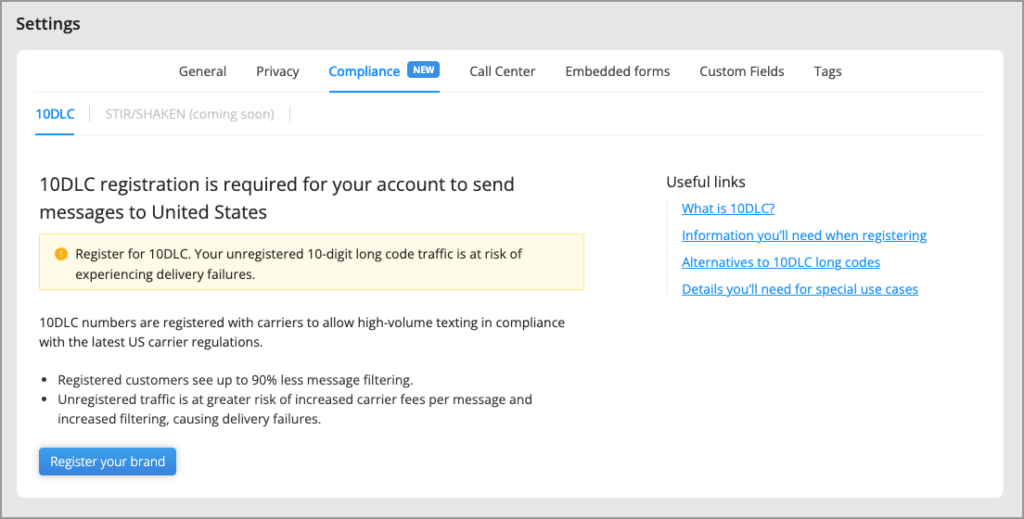
Registration occurs in four steps:
- Enter your details and indicate if you intend to send political messages.
- Provide your contact information, including email, phone number, and address.
- Check the acknowledgment box and pay $44 for Brand Registration and Vetting Charges. Once registration is complete, these charges will be refunded as credits to your account.
- Post this, your brand is vetted, and a trust score is assigned. With the trust score, you can now register your campaign for 10DLC. Under the campaign registration process, you specify your industry and the use cases for sending text messages. The entire process takes five business days.
If you need support while registering your brand, our support team can always help.
A2P 10DLC registration for non-CallHub users
You can register for A2P 10DLC only through your texting application. You can follow the guidelines laid out by the text messaging application you use and follow them for an easy registration process.
Read Also: The Complete Guide to Text Messaging for Customer Service (With SMS Templates)
What information do you need to register for A2P 10DLC?
Before you begin A2P 10DLC registration, gather the following:
Brand / company details
- Legal company name
- Country of registration
- Organization type (private, publicly traded, nonprofit, etc.)
- Tax ID / EIN (or equivalent corporate number)
- Website URL
- Regions or countries where you operate
- If publicly traded, your stock ticker and exchange
Campaign details
- Campaign name and description
- Campaign use case (e.g., marketing, alerts, 2FA, customer care)
- Sample messages for each campaign
- Detailed opt‑in process (how contacts give consent, CTA wording, and where it appears; screenshots or URLs if applicable)
Contacts
- At least one authorized point of contact: name, title, email, phone
- Customer support email and phone number that end‑users can contact
- Optional second POC as backup
Read Also: 10DLC Registration: 2025 SMS Outreach Rules You Must Know
A2P 10DLC campaign use cases and types
Under A2P 10DLC, campaign use cases refer to the messages sent to consumers and their intended purpose or specific use.
There are two broad categories of campaigns under A2P 10DLC:
- Standard campaigns
- Special campaigns.
We explore the different campaign types under these categories, their use, and how much they cost.
Standard campaign types
| Type | Use Case | Monthly Charges |
| 2FA (Two-factor authentication) | These campaigns are sent out for verification, sharing one-time passwords, or authentication purposes. | $10 |
| Account notification | Any notification about an account being used by the consumer. All messages are related to the account. | $10 |
| Customer care | Any messaging about customer service and resolutions. | $10 |
| Delivery-related | Notifications associated with the delivery of a product or service. | $10 |
| Fraud alerts | Alert consumers about fraud-related activity on their accounts. | $10 |
| Higher education | Messages sent out by Colleges and Universities. | $10 |
| Low-volume (<6000 messages/day) mixed | Low volume of messages, irrespective of use case. | $2 |
| Machine-to-machine | Conversations between two business assets, with no involvement of humans. | $10 |
| Marketing content | Any campaign that sends out marketing-related content. | $10 |
| Mixed type | A mix of different uses. | $10 |
| Polling and Voting | Messages send out for non-political surveys and research. | $10 |
| Public Service Announcements (PSAs) | Messages are sent out for non-political surveys and research. | $10 |
| Security alerts | Alerting consumers that any of their software or hardware has been compromised. | $10 |
Special campaign types
| Type | Use Case | Monthly Charges |
| Agents and Franchises | Brands that need dedicated local numbers for their franchises, agents, etc. | $30 |
| Carrier Exemptions | Any exemptions provided by carriers. | $10 |
| Charity | Messages sent out by registered charities, including 5013C charities. Does not include religious organizations. | $3 |
| Emergency | Messages during emergencies, natural disasters, promoting public safety, safeguarding during a conflict, etc. | $5 |
| K-12 Education | Messaging related to K-12 educational institutions and distance learning centers, Does not include post-secondary school. | $10 |
| Platform Free Trial | Trial messages when learning about a service. | $0 |
| Political Campaigns | Messaging designed to influence specific groups but for preapproved Federal campaigns and select organizations only. | $10 |
| Proxy | Messaging using proxy or pooled numbers for peer-to-peer or app-based messaging. | $10 |
| Social | Messaging between closed communities. | $10 |
| Sole Proprietor | Individuals with a billing address but without an EIN / Tax ID. Here’s a set of guidelines for sole proprietors. | $.75 |
| Sweepstake | Messages related to sweepstakes or contests. | $10 |
| UCaaS High-Volume | Unified communications as a service – high volume. | $10 |
| UCaaS Low-Volume | Unified communications as a service – low volume. | $2 |
Selecting the appropriate use case option for your organization during registration ensures your messages comply with regulations and carrier requirements. Different use cases have their own restrictions associated with messaging content, frequency, and other factors. Businesses must understand and adhere to these guidelines.
What is the deadline for A2P 10DLC registration?
From January 26, 2023, new A2P campaigns will be subjected to a new vetting process, including a $15 campaign vetting fee.
We recommend that you register as soon as possible. If not, your text messages will be subject to higher filters and penalties.
Qestions related to A2P 10DLC
What impact will 10DLC brand registration have on your texting?
With a 10DLC brand registration, you can–
- Improve throughput.
- Increase deliverability.
- Convert existing landline numbers into a registered 10DLC number to maintain brand recall.
- Protect your brand’s reputation—By registering for 10DLC, you send the message that your brand is spam-free and trustworthy.
- Make it easy for customers to reach you- Customers can call you on the same number on which they send you text messages.
- Save costs- You incur fewer monthly costs than a shortcode or toll-free number.
- Text from a local number- 10DLC allows you to rent multiple numbers for the same campaign, allowing localization of your campaign and potentially increasing your answer rates by upto 4 times!
Do I need to make changes to how I send outbound messages?
If you use your application to send outbound messages, you must add registered phone numbers to the platform to associate them with a campaign. You need not make any changes if you do not send outbound messages.
If you are using 10-digit phone numbers
If you use long codes for sending outbound messages, you must make changes to adhere to A2P 10DLC regulations.
- Register your business with a registered A2P 10DLC provider to be a verified sender and comply with regulations.
- Specify the use case for your campaigns. Choose whether you need to register for one or more use cases. Depending on the number of use cases you register for, you need to follow certain restrictions on the content of your messages and the frequency with which you can send out messages.
If you use shortcodes for outbound messages.
Shortcodes already comply with the rules and regulations set by the TCPA and CTIA. When you register for a shortcode, you go through 8-12 weeks of vetting and registration before receiving approval.
Do Trust Scores influence message throughput?
The higher the trust score of your brand, the higher the throughput that is made available to you. But yes, your trust score does affect the permitted throughput of messages.
For example, if you are registered for marketing use cases, and your trust score is between 75-100, you can send upto 225 messages per second (MPS). On the other hand, if your trust score is around 1 – 49, you can send 12 MPS.
For more information, you can also read: A2P 10DLC Brand Approval Best Practices – Twilio Support
How do you get a Trust Score?
The Campaign Registry (TCR) assigns a trust score during the brand registration. TCR is a third party that oversees the new regulation system for network carriers.
A trust score between 1-100 is given to organizations based on predetermined criteria during the brand registration process— 1 being the least credible and 100 being the highest. A high trust score indicates that your messages will not be marked as spam or filtered or face slow deliverability.
Trust scores are determined based on:
- The type of business.
- The type of messages, known as use cases, that the business wants to send out.
Trust scores generally do not change over time and remain static. You are more likely to receive a low trust score if–
- The data you provided during the brand registration process and the actual data, such as your address and business type, are different.
- You have a very small brand footprint.
You can appeal for reconsideration of your trust score with the help of your A2P 10DLC provider. If you appeal for reconsideration within 45 days of receiving the trust score, re-vetting is free of charge. If more than 45 days have passed since you received a low trust score, the re-vetting process will cost you $40.
What is the fees for unregistered 10DLC messages?
Starting March 1, 2022, fees for unregistered 10DLC messages are-
- Inbound and Outbound SMS: $.004 per message.
- Inbound and Outbound MMS: $.013 per message.
Stay compliant with CallHub’s texting software
CallHub’s text messaging platform offers–
- Consent management
- Compliance with and assisted registration for A2P 10DLC
- Compliance with TCPA, CTIA, and CASL regulations.
- SMS, MMS, HD video, Peer-to-peer texting, and more such capabilities.
Sign up today for effective text outreach with CallHub’s SMS marketing software.
Featured Image Source: Karolina Grabowska
FAQs on A2P 10DLC
What is A2P 10DLC, and why does it matter for nonprofits and campaigns?
A2P 10DLC stands for Application-to-Person 10-Digit Long Code. It’s a messaging standard in the US that allows organizations to send mass texts using local 10-digit numbers. For nonprofits, political campaigns, and advocacy groups, A2P 10DLC ensures higher deliverability, compliance with regulations, and builds trust with supporters by reducing spam.
What is A2P 10DLC registration?
A2P 10DLC registration is the process of verifying your organization and messaging use cases with mobile carriers. Registration is required to send bulk texts from a 10-digit number. It involves submitting your organization’s details, campaign information, and sample messages to receive approval and a trust score.
Who needs to register for A2P 10DLC?
Any organization or business sending mass text messages to US recipients using a 10-digit long code must register for A2P 10DLC. This includes nonprofits, advocacy groups, and political campaigns using texting platforms for outreach.
What information is required for A2P 10DLC registration?
You’ll need your organization’s legal name, tax ID/EIN, website, campaign details, sample messages, and a point of contact. Nonprofits should also indicate their nonprofit status during registration.
How long does A2P 10DLC registration take?
Registration typically takes about 5 business days, though it may vary depending on the completeness of your information and the carrier’s processing times.