


Table of Contents
When UCSF needed to close care gaps among African American patients, they didn’t add more clinical staff. They added a texting program. By reaching patients directly on their phones with appointment reminders and health education, UCSF saw patient engagement reach 76.4% among that patient population. Their in-person programs couldn’t match that rate at scale.
That outcome came from a healthcare nonprofit thinking like an outreach organization, not just a clinical one.
Nearly half of all US hospitals operate as nonprofits. 2,978 out of 6,093 total hospitals are nonprofits, according to the American Hospital Association (AHA). But the term “healthcare nonprofit” stretches far beyond hospital systems. It covers neighborhood free clinics, federally qualified health centers, disease-specific advocacy organizations, and policy coalitions that never see a single patient directly.
They share a mission, a tax structure, and a common challenge: Building outreach programs that actually reach the people they’re designed to serve. This guide explains how healthcare nonprofits are structured, how they’re funded, and what separates organizations running effective community outreach from those that aren’t.
What is a healthcare nonprofit?
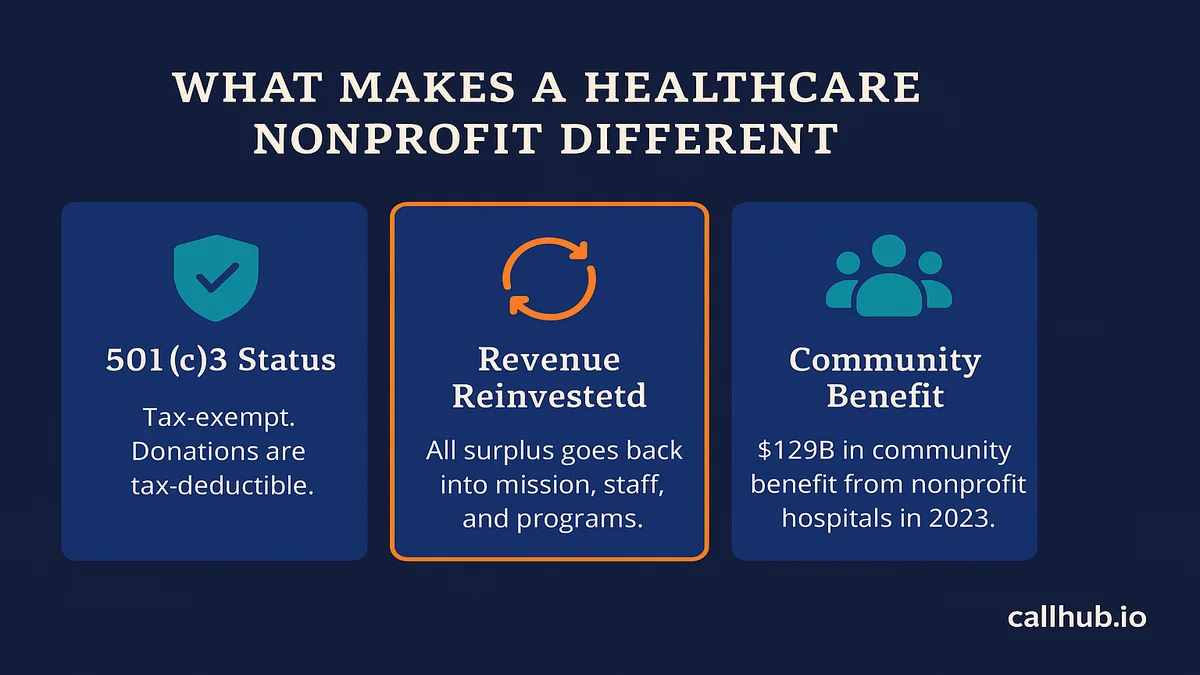
A healthcare nonprofit is a tax-exempt organization whose primary purpose is improving public health, delivering medical services, or advancing health-related advocacy, and that does not distribute profits to shareholders or private owners. All revenue is reinvested into the mission.
The IRS grants tax-exempt status under Section 501(c)(3) to qualifying healthcare organizations that demonstrate a public benefit purpose. That status unlocks access to tax-deductible donations, grant funding, and in most states, property tax exemptions. Organizations must file Form 990 annually and document their community benefit activities to maintain that status.
The key difference from for-profit healthcare
For-profit health systems return excess revenue to investors. Nonprofit healthcare organizations reinvest that revenue into services, staff, facilities, and community programs.
This isn’t just a governance distinction. The AHA reports that nonprofit hospitals provided $129 billion in total community benefit in 2023, including charity care, health education, and community health improvement programs. That investment happens because the mission requires it, not because shareholders are demanding it.
One question that surfaces often: “Are nonprofit hospitals really nonprofit?” It’s a fair question, given that large nonprofit health systems generate hundreds of millions in annual surplus. The designation refers to how profit is distributed, not whether revenue exists. Mayo Clinic and Mass General Brigham generate significant surpluses; those surpluses fund capital improvements, research, and community programs rather than investor dividends.
How healthcare nonprofits qualify for tax-exempt status
The IRS requires organizations applying for 501(c)(3) status to demonstrate that their primary purpose is charitable, educational, or scientific, and that no part of net earnings benefits any private individual. For hospitals, this typically means documenting charity care, community benefit spending, and the absence of private inurement. There’s no federally mandated minimum level of charity care, but the documentation requirement is ongoing and reviewed annually.
Types of healthcare nonprofit organizations
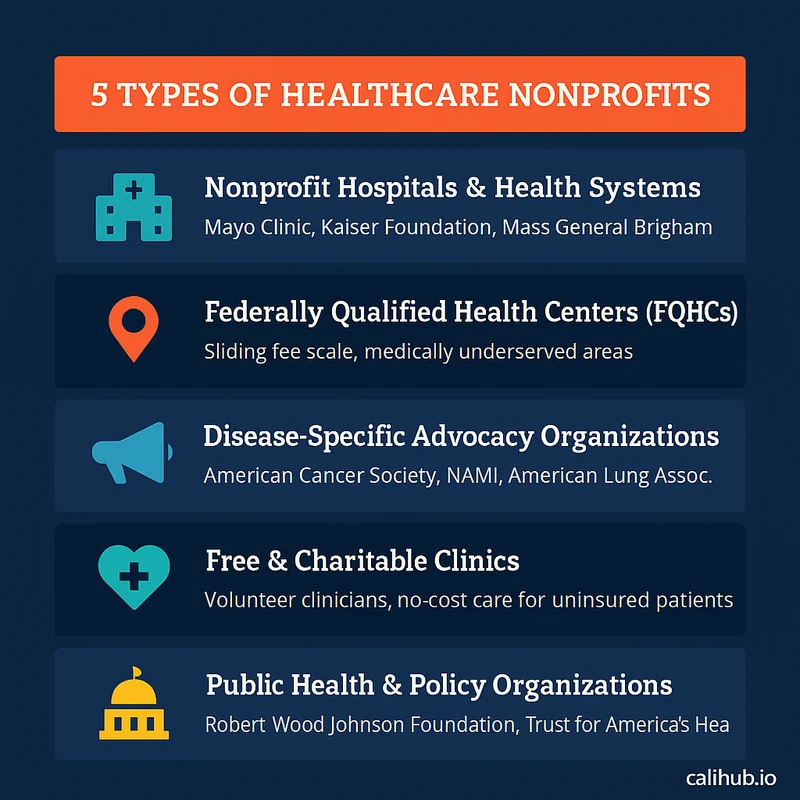
Healthcare nonprofits don’t fit a single category. The five types below cover most of the sector. Each operates with a different structure, funding model, and relationship to the communities it serves.
Nonprofit hospitals and health systems
These are the largest and most visible healthcare nonprofits in the US. The Mayo Clinic, Mass General Brigham, Kaiser Foundation Hospitals, and Intermountain Health are all nonprofit health systems. Nonprofit hospitals account for roughly 58% of all community hospitals in the country, the single largest segment of the hospital landscape.
They employ the full range of clinical staff, operate emergency departments, and carry the heaviest regulatory burden. They also run some of the most complex community outreach operations in the sector: care gap programs, preventive screening campaigns, post-discharge follow-up, and population health initiatives. UCSF’s texting program for care gap closure is a model that many smaller health nonprofit organizations are beginning to replicate.
Federally Qualified Health Centers (FQHCs)
Federally Qualified Health Centers (FQHCs) are community-based health care providers funded under Section 330 of the Public Health Service Act. They serve patients regardless of ability to pay, operate on a sliding fee scale, and are required to be located in medically underserved areas.
FQHCs differ from nonprofit hospitals in one critical way: they’re built specifically to reach the populations that traditional healthcare systems miss. Community Health Centers of the Central Coast in California and Community Health Centers of the Rutland Region in Vermont are examples of organizations whose entire model is designed around geographic and demographic gaps in care. Their outreach programs reflect that mission: multilingual, mobile, and community-embedded.
Disease-specific advocacy organizations
The American Heart Association, the American Cancer Society, the National Alliance on Mental Illness (NAMI), and the American Lung Association are all healthcare nonprofits. They don’t deliver clinical care. They fund research, run public education campaigns, advocate for policy, and support patients navigating complex diagnoses.
Their outreach model looks more like a political campaign than a clinical operation. They mobilize volunteers, run text and call programs, coordinate legislative advocacy, and use constituent data to drive engagement. The skills that power health advocacy campaigns for organizations apply directly to this type of work.
Free and charitable clinics
Free clinics operate outside insurance systems entirely. Licensed clinicians donate their time to provide primary care to uninsured or underinsured patients at no cost. The Free Clinic of the Finger Lakes in New York and the Shade Tree Family Clinic in Utah sustain clinical capacity almost entirely on donated labor and philanthropic support.
Their outreach challenge is distinct from other health nonprofit organizations. They need to reach people who may actively distrust formal healthcare institutions, often lack reliable communication channels, and don’t show up in insurance data. Community trust is the core infrastructure, not the clinical one.
Public health and policy advocacy organizations
Organizations like the Robert Wood Johnson Foundation, the Trust for America’s Health, and state-level public health advocacy groups don’t deliver care at all. They shape the environment in which care is delivered: funding research, influencing policy, and building coalitions that push for legislative change.
Their outreach targets legislators, coalition partners, and public audiences rather than patients. Their campaigns draw on the same tools that political advocacy organizations use: constituent email programs, targeted texting, phone banking, and community organizing.
How healthcare nonprofits are funded
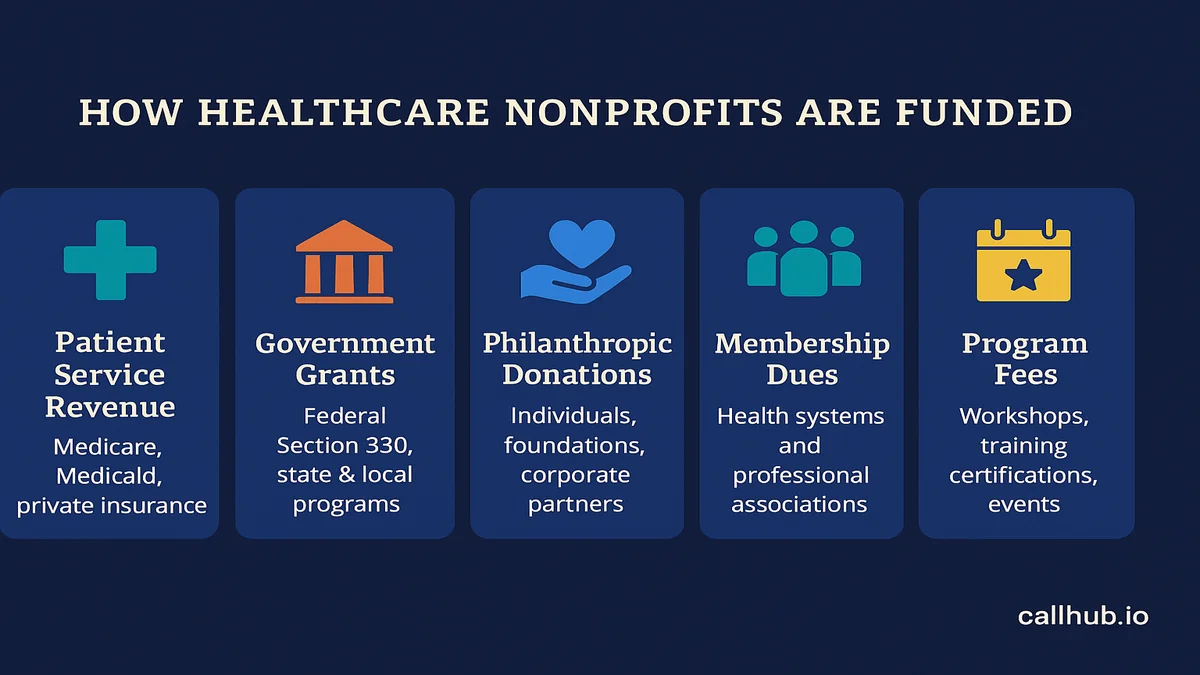
Healthcare nonprofits pull from a wider range of revenue sources than most sectors. The mix varies significantly by type:
- Patient service revenue: For hospitals and FQHCs, this is the largest single source. Reimbursements from Medicare, Medicaid, and private insurance cover the majority of operating costs.
- Government grants: Federal, state, and local grants fund specific programs. Section 330 funding supports federally qualified health centers serving medically underserved areas throughout the US. Organizations should follow established 501(c)(3) fundraising rules when applying for and reporting on public grant funding.
- Philanthropic donations: Individual donors, foundations, and corporate partners. For disease-specific advocacy organizations, this is often the primary source.
- Membership dues: Some healthcare advocacy organizations fund operations through contributions from member hospitals, health systems, or professional associations.
- Program fees and earned revenue: Workshops, training certifications, and educational events can generate revenue for organizations with strong educational missions.
The practical implication for outreach teams: Multiple funding sources mean multiple stakeholders with different reporting requirements and success metrics. Outreach programs need to document their impact clearly for each funder, which means tracking the right metrics from day one.
How healthcare nonprofits run community outreach programs
This is where the operational picture diverges sharply from the structural one. Understanding how a healthcare nonprofit is legally organized tells you very little about how it actually reaches people in the field.
Building a volunteer and supporter base
Most healthcare nonprofits rely heavily on volunteers, not just for clinical services but for outreach, health education, and community canvassing. The American Cancer Society mobilizes tens of thousands of volunteers annually for programs like Relay for Life.
Managing that volunteer base requires the same infrastructure that political campaigns use: recruitment workflows, shift scheduling, training programs, and outcome tracking. Many organizations now run peer-to-peer texting (P2P texting) programs to recruit and communicate with volunteers at scale. Text generates higher response rates than email and lower friction than phone calls for volunteers signing up on their own time.
Patient outreach and care gap campaigns
Closing care gaps is one of the highest-ROI investments for nonprofit healthcare organizations. That means reaching patients who are overdue for screenings, missing follow-up appointments, or not adhering to treatment plans.
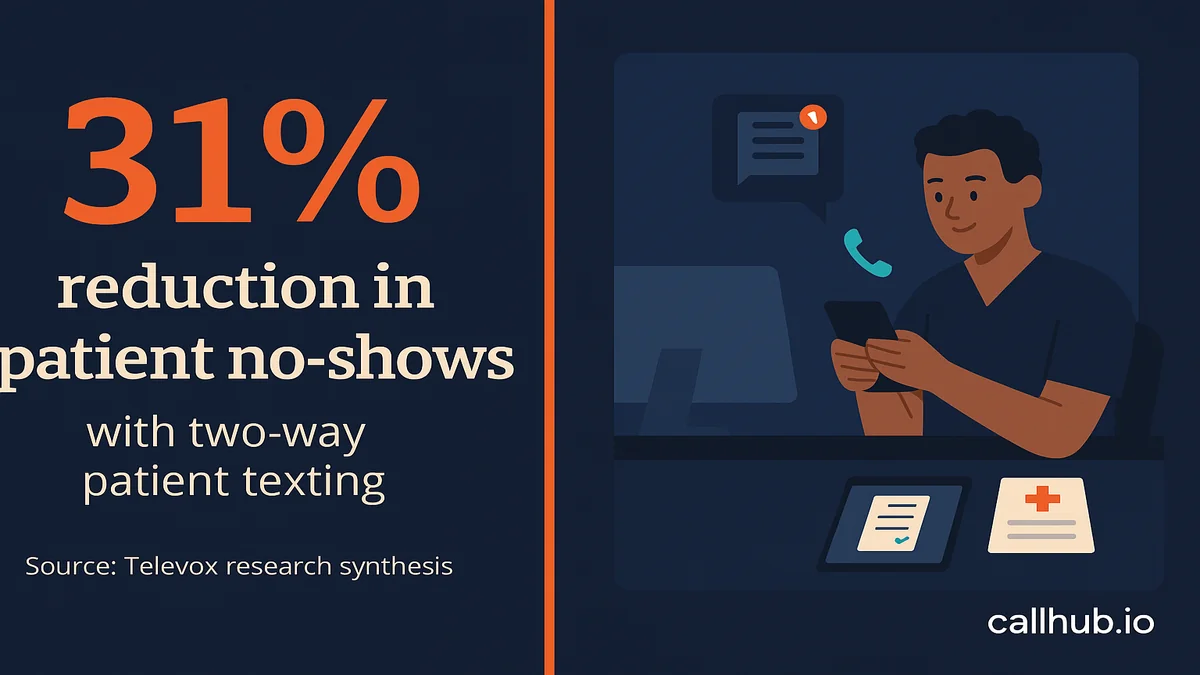
Healthcare organizations that adopted two-way texting with patients reduced no-shows by 31%, according to research synthesized by Televox across their hospital network client base. The mechanism is straightforward: text reminders lower the friction of confirming and rescheduling appointments compared to phone calls or mailed notices. UCSF’s 76.4% patient engagement rate with African American patients came from exactly this kind of channel investment.
For patient outreach to work at scale, the communication channel needs to meet HIPAA standards. That means encrypted message transmission, audit logs, and Business Associate Agreements (BAAs) with any vendor handling patient data. SMS tools for healthcare nonprofits that were not built for this compliance environment create regulatory exposure that no organization should accept.
Community health education campaigns
Health education campaigns reach people before they become patients. Vaccination drives, preventive screening awareness, and chronic disease management programs are among the most effective tools a healthcare nonprofit has for reducing downstream costs and improving community health outcomes.
These campaigns typically run across multiple channels: door-to-door canvassing, community health fairs, text and call outreach, and digital media. The organizations running the most effective ones treat them as integrated year-round programs, not one-off events. Community outreach strategies that work across constituent types apply directly to this work.
Advocacy and legislative campaigns
Many healthcare nonprofits also run campaigns to influence healthcare policy: Medicaid expansion, drug pricing legislation, and public health funding. This work sits close to what pure advocacy organizations do: Identify targets, mobilize constituents, generate calls and messages to legislators, and build coalitions.
The boundary between healthcare nonprofit and advocacy organization is permeable. Organizations like the National Patient Advocate Foundation run full advocacy software for nonprofits programs alongside their clinical or educational work. The organizing tools are the same; the compliance requirements differ.
What makes outreach at healthcare nonprofits different
Healthcare nonprofit outreach isn’t harder than other sectors, but it carries a specific set of constraints that most other sectors don’t face.
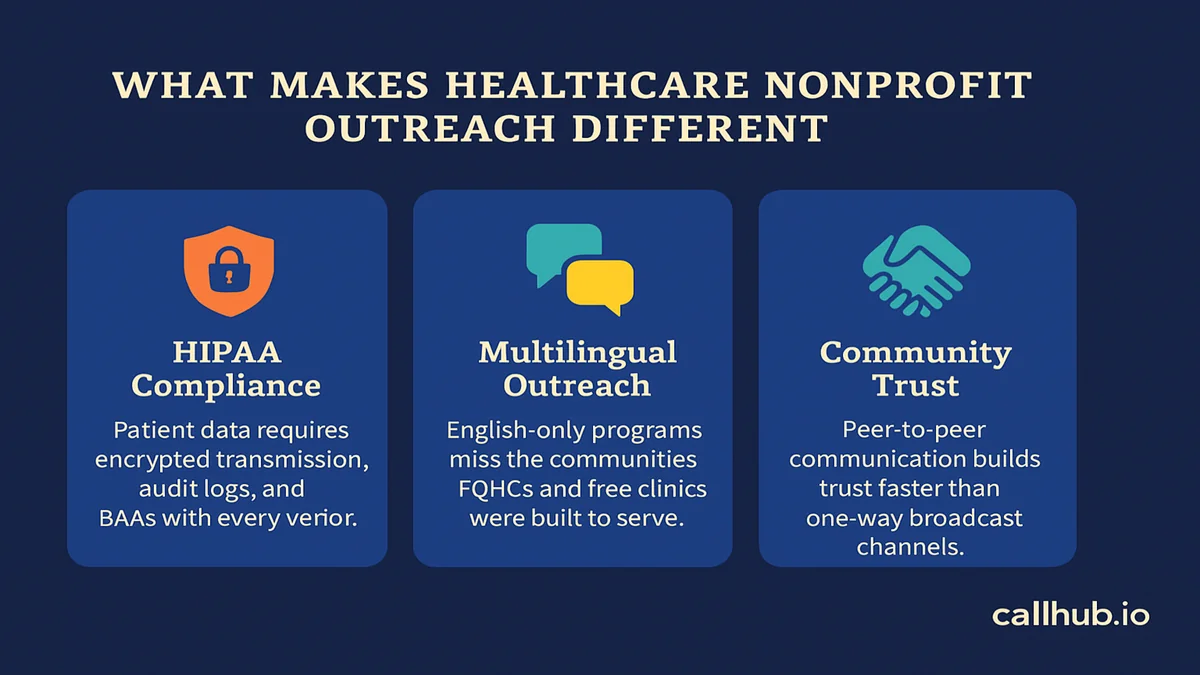
HIPAA applies to any outreach program that touches patient data. The Health Insurance Portability and Accountability Act (HIPAA) governs how Protected Health Information (PHI) is collected, stored, and transmitted. PHI covers any individually identifiable health information: Names, appointment dates, diagnoses, and contact information linked to a health record. If an outreach program communicates about a patient’s condition, appointment, or care history, it’s handling PHI.
That triggers HIPAA’s technical safeguards requirements: Encryption, access controls, audit trails, and BAAs with vendors. General-purpose mass texting tools that lack BAAs or don’t support HIPAA-compliant data handling create compliance exposure. This is one area where the choice of outreach platform has direct regulatory consequences.
Multilingual outreach is often non-negotiable. Many healthcare nonprofits serve communities where English isn’t the primary language. FQHCs in particular often operate in communities with significant Spanish-speaking, Vietnamese, Mandarin-speaking, or other non-English populations. An outreach program running only in English will systematically miss the people the organization was designed to serve.
Trust is slow to build and fast to lose. Many of the communities that healthcare nonprofits serve have historical reasons to be cautious about healthcare institutions. Outreach communications need to feel local, human, and consistent. They shouldn’t read like a broadcast from an institution. Organizations that invest in peer-to-peer communication models (trained community health workers, volunteers from the community, two-way text programs) build trust faster than those relying on one-way broadcast channels.
Nonprofit text messaging strategies developed for donor outreach often apply to healthcare outreach with modification for compliance requirements.
Running outreach that actually reaches the people you serve
Healthcare nonprofits that run effective outreach programs aren’t necessarily larger or better funded than those that don’t. They’re more deliberate about the connection between mission and communication infrastructure.
The organizations doing this well share a pattern: they’ve chosen outreach tools that meet their compliance requirements; they’ve built multilingual capability into programs from the start, not retrofitted it after launch; and they treat volunteer and patient engagement as an ongoing program rather than a seasonal campaign.
For organizations building or improving that infrastructure, SMS and calling tools built for healthcare outreach programs are the starting point for HIPAA-compliant, scalable engagement. For the broader strategy behind this work, how health advocacy campaigns are structured is the next read.
Frequently asked questions
What is the largest healthcare nonprofit in the United States?
Kaiser Permanente (Kaiser Foundation Hospitals and Health Plan) is widely cited as the largest integrated nonprofit healthcare organization in the US, serving over 12 million members across eight states and Washington DC. By annual revenue, large academic medical center networks like Mass General Brigham and CommonSpirit Health also consistently rank among the largest nonprofit organizations in the country overall.
What is the difference between a nonprofit and a not-for-profit in healthcare?
The terms are often used interchangeably, but there’s a technical distinction. “Nonprofit” typically refers to organizations qualifying for 501(c)(3) status that can accept tax-deductible donations. “Not-for-profit” sometimes describes a broader category that includes membership organizations and mutual benefit associations that don’t qualify for 501(c)(3). In practice, most healthcare organizations use “nonprofit” to mean the 501(c)(3) designation.
Are nonprofit hospitals required to provide free care?
Not in a strict legal sense. Nonprofit hospitals are required to provide community benefit, a category that includes charity care but also health education, research, and subsidized programs. The Affordable Care Act requires nonprofit hospitals to maintain a financial assistance policy, but the amount of free care isn’t federally mandated. Individual states may set their own minimums, and charity care levels vary significantly across the sector.
What regulations do healthcare nonprofits need to follow for outreach?
Healthcare nonprofits conducting patient outreach must comply with HIPAA’s Privacy and Security Rules when handling Protected Health Information (PHI). Outreach involving phone calls or text messages must also comply with the Telephone Consumer Protection Act (TCPA), which governs consent requirements for automated communications. Organizations that include fundraising asks in outreach also need to follow IRS rules and applicable state charitable solicitation laws.
How do healthcare nonprofits measure the impact of outreach programs?
Common metrics include: Appointment adherence rates, screening completion rates for preventive care campaigns, volunteer activation and retention rates, community reach counts, and health outcome data where available. Grant funders often set specific metrics as reporting requirements. Organizations running texting and calling programs can track delivery rates, response rates, and conversation outcomes directly within their outreach platforms.
Can a healthcare nonprofit use SMS and phone calls for outreach?
Yes, with the right infrastructure. Text and call programs are among the most effective tools for patient engagement and community health outreach. For programs that involve patient data or health-related communications, HIPAA compliance is required: Platforms must offer BAAs, encrypted transmission, and audit logging. Campaigns that include fundraising or advocacy asks also need TCPA-compliant consent mechanisms.
What is the difference between a healthcare nonprofit and a public health agency?
A public health agency, like a city or county health department, is a government entity funded by public tax dollars and accountable to elected officials. A healthcare nonprofit is a private organization with 501(c)(3) status, funded through a mix of grants, donations, and service revenue. Both work on community health outcomes and often partner closely. The key practical difference: Public agencies are subject to government procurement rules and public records laws; healthcare nonprofits have more flexibility in how they operate and deploy outreach programs.