

You have a voter list with 50,000 contacts, an election deadline, a volunteer team of varying sizes, and three dialer types you keep hearing about: auto dialer, power dialer, and predictive dialer. Choosing wrong means either your volunteers sit idle waiting for calls to connect, or your contacts get a half-second of silence before an agent joins and hang up.
Two variables determine the right answer: your team size and your campaign stage. A voter persuasion drive with 4 volunteers needs a different dialer than a GOTV operation with 20 agents working through 100,000 contacts on election eve. This article explains how each dialer works, which campaign stages they are built for, and the compliance rules specific to political calling that apply regardless of which you choose.
CallHub provides all three dialer types plus a preview mode, so campaigns can match the right tool to the right stage rather than compromising on one option for the entire cycle.
Key Takeaways
Choosing between an auto dialer, power dialer, and predictive dialer for political phone banking comes down to two variables: volunteer team size and the current stage of the campaign.
Auto Dialer as the Umbrella Category
- Auto dialer is the umbrella term for any automated outbound dialing system that dials numbers from a list without an agent manually keying each one, which includes both power dialers and predictive dialers.
- A system labeled simply an auto dialer typically runs at a fixed calling ratio of 1:1, 2:1, or 3:1, dialing that many lines per available agent based on expected answer rates.
- When a contact answers under this fixed-ratio setup, the call routes to the first free agent.
Power Dialer
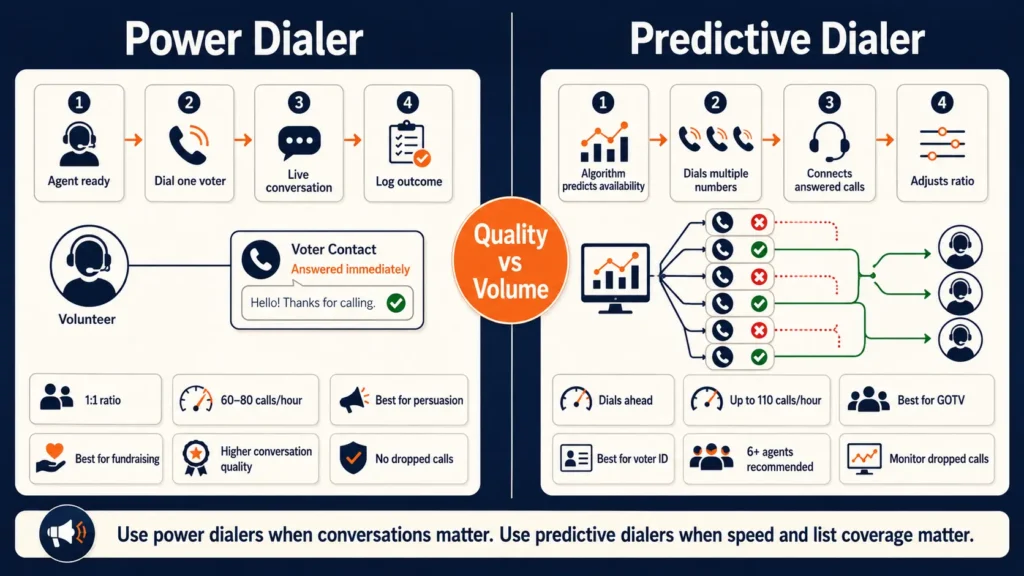
- A power dialer places the next call only when an agent actively initiates it, so the agent is already on the line before the contact answers and there is no silent pause on connect.
- It runs at a strict 1:1 ratio, automatically queuing and placing the next call once an agent finishes and marks the current call complete.
- CallHub data shows an estimated 60 to 80 calls per hour with a power dialer, since agents can take unpredictable amounts of time per conversation.
- It is the standard choice for voter persuasion, fundraising, major donor outreach, volunteer recruitment, and distributed volunteer teams calling from home through the CallHub mobile app, where conversation quality and agent-controlled pacing matter most.
Predictive Dialer
- A predictive dialer dials multiple numbers in advance and connects only answered calls to free agents, using an algorithm that predicts when an agent will finish a call and times new calls to land just as that agent becomes available.
- The algorithm continuously calculates the ratio from four inputs: number of active agents, average call duration, historical answer rates, and call connection time, converting recent answer and drop data into a probability that determines whether it dials at a 1:1, 1:2, or 1:3 ratio.
- If multiple contacts answer at once, the dialer connects one to an agent and drops, plays a message for, or routes the others to voicemail depending on campaign configuration, and it scales the ratio down automatically when answer rates drop or agents are busy to limit dropped calls.
- It can reach up to 110 calls per hour, the highest throughput of the three options, making it suited for GOTV operations, large-scale voter ID surveys, and election-day reminders with short, standardized calls.
- Predictive dialers perform best with 6 or more agents per campaign, since fewer agents give the algorithm too little data to predict availability accurately, raising the risk of dropped calls and compliance violations.
What is an auto dialer? The umbrella term explained
“Auto dialer” is the umbrella category that covers all automated outbound dialing systems, including power dialers and predictive dialers. Any software that automatically dials numbers from a list without an agent manually keying each number qualifies as an auto dialer.
In practice, when a campaign manager refers to an “auto dialer,” they typically mean a system running at a fixed calling ratio: for every available agent, the system dials a set number of lines simultaneously (1:1, 2:1, or 3:1). The manager sets the ratio based on expected answer rates. When a contact answers, the call routes to the first free agent.
The distinction matters because power dialers and predictive dialers are both auto dialers but work very differently. The sections below cover each in detail.
What is a power dialer?
A power dialer is an automated outbound dialer that dials the next number only when an agent actively initiates the call. The agent is already on the line before the contact answers, which means there is no pause or delay when the call connects.
This makes power dialers the right tool for campaigns where conversation quality matters more than raw volume. Agents have time to read call notes, review a branching script, and fill in call dispositions between calls without being pushed to the next contact before they are ready.
How a power dialer works
The power dialer operates at a strict 1:1 ratio: one call per one free agent. When an agent finishes a call and marks it complete, the dialer automatically queues and places the next call. The agent is connected before the contact picks up, ensuring no awkward silence on answer.
CallHub data shows an estimated 60–80 calls per hour with a power dialer.
Because each call is handled individually, agents can take unpredictable amounts of time per conversation, which makes power dialers well-suited for calls where the outcome cannot be scripted in advance.
Power dialer: best for these campaign types
Power dialers are the standard choice for phone banking operations that require genuine two-way conversation: voter persuasion, fundraising, major donor outreach, and volunteer recruitment. Distributed volunteer teams using the CallHub mobile app from home also benefit from the power dialer’s agent-controlled pace, since remote volunteers tend to work at different speeds than a centralized call center.
What is a predictive dialer?
A predictive dialer is an automated outbound dialer that dials multiple numbers in advance and connects only answered calls to free agents. It uses an algorithm that continuously analyzes call metrics to predict when an agent will finish their current conversation, then places new calls in time for one to answer just as the agent becomes free.
How a predictive dialer works
The algorithm runs a continuous calculation using four inputs: the number of active agents, average call duration, historical answer rates, and the time it takes for a call to connect.
From these inputs, it estimates the probability that a given outbound call will be answered. That probability then determines the calling ratio for the next round.
- The dialer gathers recent metrics: answered calls, dropped calls, and the number of active agents at that moment.
- It converts those metrics into a probability that a single outbound call will be answered.
- The dialing ratio is expressed as calls dialed per free agent. If the estimated answer probability is 1 in 3, the dialer places 3 simultaneous calls per available agent.
- The dialer runs calling rounds using ratios of 1:1, 1:2, or 1:3, adjusting dynamically as agent availability and answer rates shift.
- If more than one contact answers simultaneously, the dialer connects one to the agent and either drops, plays a message for, or routes the others to voicemail handling, depending on how the campaign is configured.
| The predictive dialer scales its ratio up and down in real time. If answer rates drop or agents are all busy, the ratio decreases automatically to avoid excess dropped calls. |
The predictive dialer can reach up to 110 calls per hour, making it the highest-throughput option available.
Predictive dialer: best for these campaign types
Predictive dialers are built for GOTV operations, large-scale voter ID surveys, election-day reminders, and any campaign stage where covering the entire list is the priority and calls are short and standardized. They perform best with 6 or more agents per campaign. Below 6 agents, the algorithm does not have enough data to predict availability accurately, which increases the risk of dropped calls and compliance violations.
Are political dialers legal? TCPA and ATDS explained
Political campaign managers frequently ask whether automated dialers are legal. The answer is yes, and the legal framework is more favorable for political campaigns than many realize.
Power and predictive dialers are not ATDS
The TCPA defines an Automated Telephone Dialing System (ATDS) as equipment that can store or produce telephone numbers to be called using a random or sequential number generator and then dial those numbers.
In Facebook Inc. v. Duguid (2021), the US Supreme Court confirmed that this definition is narrow. A system qualifies as an ATDS only if it generates random or sequential numbers and then dials them. Power dialers and predictive dialers do not do this. They dial from lists uploaded by the campaign manager, not from randomly or sequentially generated numbers. This removes them from ATDS classification entirely.
As a result, political campaigns calling from uploaded voter lists using a power or predictive dialer are not subject to the prior-consent requirements that apply to commercial ATDS calling.
Political calling exemptions for landlines
Political campaigns making live calls to landlines are generally exempt from the TCPA’s prior express consent requirement. Campaigns can call landline numbers on voter files without obtaining consent first, as long as those numbers are not on the national or internal Do Not Call list and calling hours comply with FCC time-of-day rules (generally 8 AM to 9 PM local time for the recipient).
Mobile phones carry a different standard. While power and predictive dialers are not ATDS, campaigns should consult compliance counsel before launching automated campaigns to cell phones, particularly for states with additional restrictions beyond federal TCPA rules.
The 3% abandoned call rule
For predictive dialers used in telemarketing contexts, the TCPA requires that abandoned calls, meaning calls answered by a live person but not connected to an agent within 2 seconds of the contact saying “hello,” must not exceed 3% of all answered calls in a 30-day rolling period per campaign.
Political campaigns using predictive dialers for voter outreach should monitor drop rates throughout the campaign. In CallHub, “Enable Dropped Restrictions” is checked by default when running a predictive dialer campaign to help stay within the 3% threshold. The regulation also requires that any abandoned call plays a recorded message that includes instructions for how the contact can remove themselves from the calling list.
Carrier spam flagging
Carriers flag calls with average durations below 30 seconds as potential spam. This is not a TCPA rule but an operational reality that campaigns must plan around. Campaigns should monitor average call duration in their reporting dashboards and investigate if the metric falls near or below 30 seconds consistently.
All CallHub dialers are SHAKEN/STIR compliant, giving callers a Verified Caller badge that reduces the risk of being flagged as spam by the carrier network.
Power dialer vs predictive dialer vs auto dialer: key differences
The table below covers all three dialer types across the factors that matter most for political campaign managers.
| Factor | Auto dialer | Power dialer | Predictive dialer |
| Dialing method | Fixed ratio set by manager (1:1 to 3:1) | Sequential — dials next number only when agent is free | Algorithm predicts agent availability; dials ahead of time |
| Calls per hour (CallHub data) | Up to 110/hr (at 3:1 ratio) | 60–80/hr | Up to 110/hr |
| Best team size | Any — works well for smaller teams (<8 agents) | Small to mid-sized teams; 1:1 ratio per agent | 6+ agents recommended; scales best with larger teams |
| Agent control | Manager sets ratio; agent waits for routed calls | Agent controls pace and timing of each call | Dialer drives pace; agent focuses purely on conversations |
| Compliance risk | Moderate — 3% abandoned call rule applies | Lower — 1:1 ratio means no dropped calls | Higher — must actively monitor drop rate; 3% rule critical |
| Best campaign stage (political) | Voter ID, list cleaning, GOTV reminders | Voter persuasion, fundraising, high-value donor calls | GOTV, large voter ID surveys, election-day reminders |
| Conversation quality | Moderate — agent may join with 1–3 sec delay | High — agent is live before contact answers | Lower for personalization; higher for volume throughput |
| Best list quality | Works well with low-quality lists (bad numbers, low answer rates) | Works with clean, curated lists | Built for low-quality lists — filters unanswered calls automatically |
What they have in common: shared features for political campaigns
Despite operating differently, all three dialer types in CallHub share a set of features that make them effective for political outreach.
| Feature | What it does | Why it matters for political campaigns |
| CRM integration | Contact details, call outcomes, and notes sync automatically after each call | Agents always know who they are calling; a supporter who donated last week does not receive a duplicate fundraising ask |
| DNC filtering | Both dialers automatically scrub contacts against internal and national Do Not Contact lists before dialing | Prevents calls to restricted numbers and reduces TCPA legal exposure |
| Call monitoring and coaching | Supervisors can listen to live calls without the contact knowing, and barge in to assist the agent if needed | Useful for training new volunteers and maintaining script consistency across distributed teams |
| Reporting and analytics | Answer rates, average call duration, agent performance, unique contacts reached, and conversion rates all tracked in real time | Campaign managers can identify underperforming volunteers, adjust calling ratios, and make data-driven decisions mid-campaign |
| SHAKEN/STIR compliance | All CallHub dialers carry a Caller Verified badge compliant with SHAKEN/STIR regulations | Reduces the risk of being flagged as spam; critical for political campaigns calling large lists across multiple states |
Which dialer for which campaign stage?
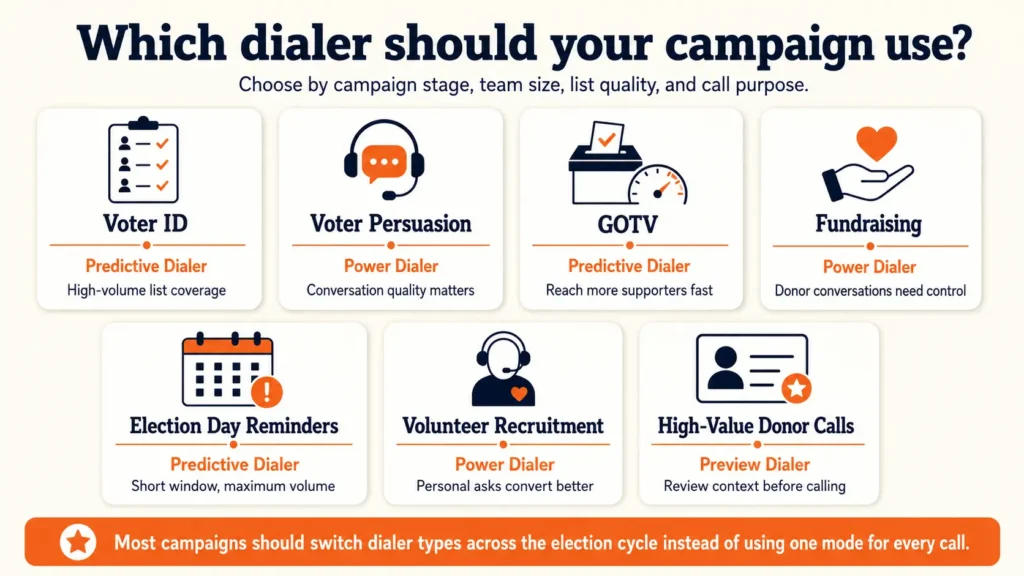
The most common mistake campaigns make is choosing a single dialer for the entire election cycle. Each stage has different requirements for volume, conversation quality, team size, and list quality. The table below maps each campaign stage to the right dialer.
| Campaign stage | Recommended dialer | Why | Notes |
| Voter ID / list cleaning | Predictive dialer | High volume, list quality often poor, conversation depth not required | Auto dialer also viable for smaller teams |
| Voter persuasion | Power dialer | Conversation quality matters; variable call lengths; agent needs time to take notes and follow a branching script | Avoid predictive — dropped calls hurt trust-building |
| GOTV (large-scale) | Predictive dialer | Volume is the priority; 6+ agents; simple reminder script; short calls | Power dialer if targeting a smaller, curated supporter list |
| Fundraising / call time | Power dialer | Relationship-based; conversations are unpredictable in length; donors need to feel heard, not rushed | Preview dialer for major donor calls |
| Election-day reminders | Predictive dialer | Extremely short contact window; maximum volume needed; brief, scripted message | Start early; monitor drop rate closely |
| Volunteer recruitment | Power dialer | Personal ask works better; variable conversation length; agent may need to answer questions | Can use auto dialer for initial warm-up pass |
| Voter registration guidance | Power dialer | Complex information to convey; supporters often need step-by-step help; follow-up required | |
| High-value donor calls | Preview dialer | Agent reviews contact record before the call connects; relationship context is essential | Do not use predictive for major donors |
Things to consider when choosing the right dialer
The campaign stage decision table above covers most situations. For edge cases, these four factors help resolve the remaining ambiguity.
Call ring time
Call ring time is the period between when a call is placed and when it is answered or dropped. With a power dialer, agents wait out the ring time before the next call begins. A predictive dialer eliminates that wait by keeping multiple calls active so the agent moves directly from one answered call to the next.
If ring time is creating significant idle time for your volunteer team, a predictive dialer will resolve it. If your team is small and idle time is acceptable, a power dialer’s control benefits outweigh the efficiency loss.
Average call duration
The predictive dialer’s algorithm assumes a consistent average call duration when calculating its calling ratio. Campaigns where conversations vary widely in length, fundraising calls, major donor outreach, voter persuasion conversations with undecideds, cause the algorithm to over-dial and produce more dropped calls.
If your average call durations are high or unpredictable, use the power dialer with a 1:1 ratio.
Purpose of calling
Short, standardized calls (surveys, GOTV reminders, voter registration confirmation) can run at predictive dialer speed without losing effectiveness. Conversations where the outcome depends on the specific exchange, fundraising, persuasion, volunteer asks, are better handled by a power dialer where the agent controls the pace and the contact never experiences a connection delay.
Database quality
Low-quality lists, those with a high proportion of invalid numbers, disconnected lines, and wrong contacts, perform better with a predictive dialer. The algorithm automatically skips unanswered calls and connects only live answers to agents, so agents spend zero time on bad numbers.
If your list is high-quality and curated, a power dialer is sufficient and gives agents more control.
A checklist for the final decision:
- How personalized will my conversations be? More personalized = power dialer.
- How large is my list and how many volunteers do I have? Large list, 6+ agents = predictive dialer.
- What campaign stage am I in? See the decision table above.
Power dialer in action: Democrats Abroad (300% voter turnout increase)
Democrats Abroad is the official Democratic Party arm serving millions of Americans living outside the United States. Its mission is to inform and mobilize overseas voters so that expats can participate in American elections.
The organization identified that low overseas voter turnout stemmed from a complicated voting process, issues with shifting addresses, and a widespread lack of awareness about voting rights.
To address these issues, volunteers used a power dialer to reach voters directly. They called individuals to understand the specific problems each person was facing, documented the issues for reference, and followed up with voters by providing exact solutions tailored to their situation.
| 300%Increase in overseas voter turnout achieved by Democrats Abroad in the 2018 US midterm elections using a power dialer (CallHub case study) |
The power dialer was the right choice here because agents needed time to prepare for each call, conversations were highly variable in length, and the quality of each individual interaction determined whether the voter ultimately cast a ballot.
Read the case study here: How Democrats Abroad achieved a 300% increase in voter turnout.
Predictive dialer in action: Organizing for Change (7% voter turnout increase)
Organizing for Change (OFC) is a nonpartisan strategic initiative of environmental groups based in British Columbia. The organization works to advance policies that benefit both the environment and local communities.
OFC and 24 partner organizations, including the Dogwood Initiative and STAND, ran a distributed phone banking campaign using CallHub. The goal was to conduct a survey to collect voter data that would inform their GOTV strategies.
Execution: each organization called its own members to complete a standardized survey. While questions were consistent across groups, each used a unique script tailored to its membership. Volunteers did not need prior knowledge of individual prospects; they followed the script to capture survey responses. CallHub’s volunteer management system coordinated all 25 organizations on a single platform.
| 7%Voter turnout increase achieved by Organizing for Change and partner groups using a predictive dialer for GOTV survey calling (CallHub case study) |
The predictive dialer was the right choice here because the campaign prioritized volume over personalization, scripts were short and standardized, and the coalition had enough volunteer capacity to run the algorithm effectively. The voter data collected through the survey then informed the GOTV push that produced the turnout lift.
Read the case study here: How Organizing for change ran a successful GOTV campaign.
Frequently asked questions
How does a predictive dialer work?
A predictive dialer analyzes recent call metrics, including answer rates, average call duration, and agent availability, to calculate the probability that a given outbound call will be answered. It then dials multiple numbers in advance at a ratio (1:1, 1:2, or 1:3 per free agent) calibrated to ensure an answered call is ready just as an agent finishes their current conversation. The ratio adjusts automatically in real time.
What is the difference between an auto dialer and a power dialer?
An auto dialer is the broad category: any system that automatically dials numbers from a list. A power dialer is a specific type of auto dialer that dials one number per agent at a time, placing the next call only when the agent is ready. A predictive dialer is another type of auto dialer that dials ahead of agent availability using an algorithm. All power dialers are auto dialers, but not all auto dialers are power dialers.
Is a predictive dialer legal for political campaigns?
Yes. Power and predictive dialers are not ATDS under the definition confirmed by the US Supreme Court in Facebook Inc. v. Duguid (2021), because they dial from uploaded lists rather than generating random or sequential numbers. Political campaigns calling landlines on voter files generally do not require prior consent under the TCPA. Mobile phone calling has additional considerations, and campaigns should review state-level rules before launching automated cell phone outreach. The 3% abandoned call rule applies when using a predictive dialer for calls answered by a live person.
What is the 3% abandoned call rule?
The TCPA requires that no campaign abandon more than 3% of all answered calls over a 30-day period per campaign. An abandoned call is one that a live person answers but that is not connected to an agent within 2 seconds. For predictive dialer campaigns, the “Enable Dropped Restrictions” setting in CallHub is on by default to help campaigns stay within this threshold.
How many agents do you need for a predictive dialer?
A minimum of 6 agents per campaign is the practical threshold for a predictive dialer. Below 6 agents, the algorithm does not have enough data to predict availability accurately, which increases dropped calls and compliance risk. For campaigns with fewer than 6 volunteers, a power dialer or auto dialer is the better choice.
What dialer should I use for GOTV?
For large-scale GOTV operations with 6 or more agents and a list of thousands of contacts, use a predictive dialer. The algorithm keeps agents on calls continuously and maximizes the number of contacts reached within your calling window. For smaller, targeted GOTV outreach to a curated supporter list where a personal touch matters, use a power dialer.
Can volunteers use a predictive dialer from home?
Yes. CallHub’s predictive dialer supports distributed phone banking. Volunteers can participate using the CallHub mobile app or a desktop browser from any location. Campaign managers can assign lists through sub-accounts, preventing overlap between volunteers. Timezone-based calling rules ensure distributed volunteers in different states stay compliant with local calling hours.
What dialer is best for voter ID calling?
Voter ID calling typically involves a short standardized survey, a large list, and the goal of covering as many contacts as possible. A predictive dialer is the standard choice for voter ID campaigns. If your team is too small for a predictive dialer (fewer than 6 agents), an auto dialer at a 2:1 or 3:1 ratio is a workable alternative.
What is the best auto dialer for political campaigns?
The best dialer depends on the campaign stage. For voter persuasion and fundraising: power dialer. For GOTV, voter ID, and election-day reminders: predictive dialer. For high-value donor calls or any call where the agent needs contact context before connecting: preview dialer. CallHub provides all four modes, so campaigns can switch dialer types by campaign rather than being locked into one approach for the entire cycle.
What is a power dialer vs auto dialer?
A power dialer is a type of auto dialer. The term “auto dialer” refers broadly to any system that dials automatically from a list. A power dialer operates at a 1:1 ratio, dialing one number per agent at a time and only when the agent initiates the call. If you hear “auto dialer” used in the context of a fixed-ratio system where the manager sets a specific number of calls per agent, that is typically referring to the ratio-based auto dialer mode rather than a power dialer.
Three dialers, three clear use cases. Auto dialers and power dialers are the right tools for campaigns prioritizing conversation quality: voter persuasion, fundraising, volunteer recruitment, and major donor outreach. Predictive dialers are the right tool when volume is the priority: GOTV, voter ID surveys, and election-day reminders at scale. Preview dialers cover the highest-stakes individual calls where context matters most.
No campaign runs the same operation at every stage of the cycle. The most effective phone banking programs match the dialer to the stage rather than picking one approach and applying it uniformly.
See how CallHub’s phone banking software handles all three dialer modes, compliance management, and distributed volunteer coordination in a single platform. Book a demo to see it running against a real voter contact workflow.
For a complete overview of how phone banking fits into your entire strategy, see the complete guide to political phone banking.