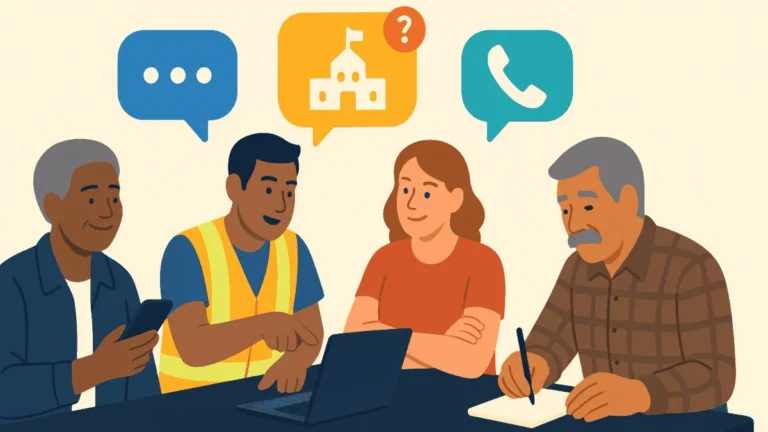


Phone banking local election voters works because small races are won in small numbers. A city council, school board, county board, or small mayoral campaign may not need 50,000 conversations to change the result. It may need a few hundred more supporters to answer the phone, hear the candidate’s name, and make a vote plan.
That is why local campaigns should not treat phone banking as something only big campaigns can afford. You need four things to start: a win number, a voter list, a script, and a few people willing to make calls for two hours on a weeknight.
This article focuses on local campaign phone banking. For the broader strategy, use CallHub’s complete guide to political phone banking.
Why phone banking works differently for local races
Phone banking is effective for local elections because each completed conversation can carry more weight. Local races have smaller voter universes, lower turnout, and thinner margins than statewide or national campaigns. A well-run phone bank helps identify supporters, persuade undecided voters, and turn out voters who may otherwise skip the race.
In a local race, the voter may know the candidate, the volunteer, the school, the road, the ward, or the issue on the ballot. That changes the call. It makes the conversation feel less like a campaign script and more like a neighbor asking for help.
Local elections are decided by thin margins
Most local campaigns do not lose because nobody liked the candidate. They lose because too few likely supporters were identified and turned out.
Start with the math. If 8,000 people are registered in your district and only 35% usually vote in similar elections, you are likely looking at about 2,800 votes cast. In a two-candidate race, the basic win number is 1,401 votes.
That does not mean you need to call 8,000 people. It means you need to know where the next few hundred votes can come from.
A local phone bank helps you answer three questions:
- Who already supports us?
- Who is persuadable?
- Who needs a reminder, ride, ballot information, or vote plan before election day?
That is the work that wins small races.
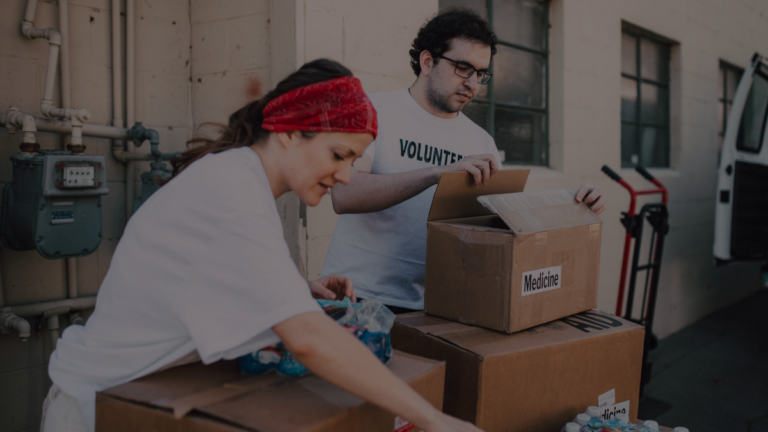
Your volunteers are neighbors, not strangers
Local campaign phone banking works best when it sounds local.
A volunteer saying, “I live in Ward 3, too,” has a different effect than a generic campaign caller reading a national script. A parent calling another parent about a school board race can speak to the issue in plain terms. A tenant calling about a city council housing vote can explain why the race matters in daily life.
This is where smaller campaigns have an advantage. They may not have the biggest budget, but they often have the most believable messengers.
Use that. Match volunteers to voters when you can:
- Parents call parents for school board races.
- Neighborhood volunteers call their own precincts.
- The candidate calls high-value undecided voters.
- Local endorsers call voters who know their work.
- Volunteers with language skills call voters who prefer that language.
The smaller the race, the more personal the call should feel.
The data on turnout impact
The research on phone banking is strongest when calls are personal, volunteer-led, and targeted.
Nickerson’s American Politics Research study on volunteer phone calls and turnout found that volunteer phone calls boosted turnout by 3.8 percentage points per 1,000 completed contacts. Green and Gerber’s Get Out the Vote found that volunteer calls cost about $35 per vote generated, compared with about $91 per vote generated for direct mail, which often had no measurable effect.
The lesson for local campaigns is simple: phone banking is not just cheaper than many forms of paid outreach. It is also easier to aim at the exact voters you need.
The quality of the call matters. A rushed robocall to a broad list is not the same as a volunteer asking a voter one real question and recording the answer. The Political Group’s 2026 election guide cites a research consensus that quality phone conversations can increase turnout by 3–5 percentage points.
For a local campaign, that can be the margin.
Start with your win number
Your phone bank should not begin with the question, “How many people can we call?”
It should begin with the question, “How many votes do we need to win?”
A win number gives your phone bank a job. Without it, volunteers call through a list and hope activity turns into votes. With it, every call has a purpose.
How to calculate the contact universe you actually need
Use this basic process:
| Step | What to calculate | Why it matters |
| 1 | Registered voters in the district | Gives you the full possible universe |
| 2 | Expected turnout | Shows how many people are likely to vote |
| 3 | Win number | Tells you how many votes you need |
| 4 | Known supporters | Shows how much of the goal is already covered |
| 5 | Remaining vote gap | Tells your phone bank what it must help close |
| 6 | Target call universe | Keeps volunteers focused on voters who matter |
Here is a simple example.
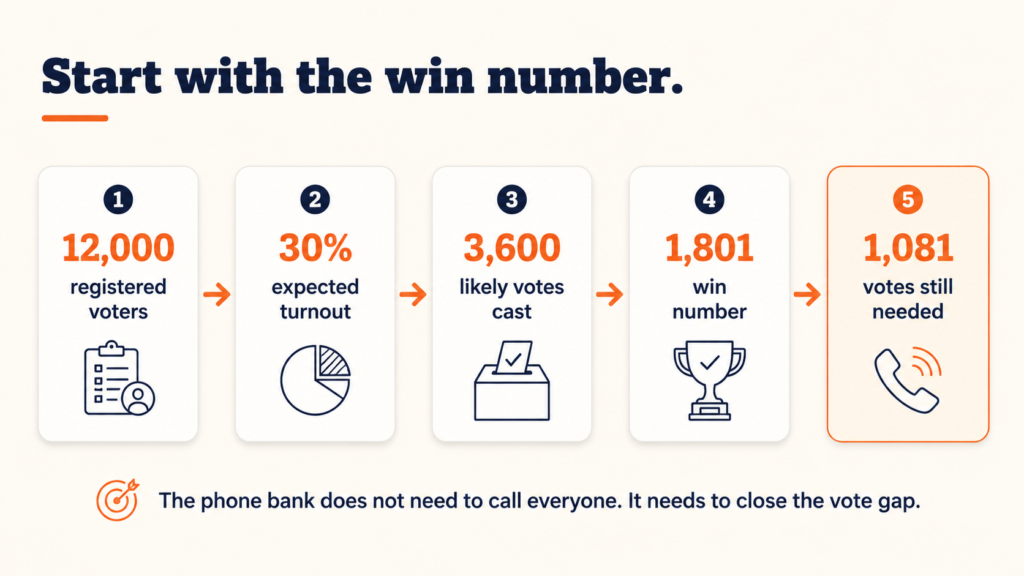
Your city council district has 12,000 registered voters. Similar local races have 30% turnout. That means you can expect about 3,600 votes.
In a two-candidate race, the basic win number is 1,801. Add a 10% buffer, and your target becomes about 1,981 votes.
Now say you have 900 likely supporters from past data, endorsements, donor lists, yard sign requests, and personal networks. You still need about 1,081 votes.
Your phone bank universe should focus on voters who can help close that gap:
- High-propensity voters who are likely to vote but not yet identified.
- Past supporters of similar candidates or issues.
- Voters in precincts where your candidate has a clear message advantage.
- Low-propensity supporters who need GOTV follow-up.
- Undecided voters who match your likely support profile.
Do not call the whole voter file just because you have it. Call the voters who can change the result.
How to size your volunteer team from that number
Once you know the number of completed conversations you need, you can calculate volunteer capacity.
A single volunteer manually dialing can usually talk to 10–15 people per hour. With an automated dialer, that can rise to 45–50 conversations per hour, based on CallHub internal data.
For planning, be conservative.
If you need 1,000 completed conversations and volunteers are manually dialing, assume 10 completed conversations per hour.
That means you need about 100 volunteer hours.
If each volunteer shift is two hours, that is 50 shifts.
You could cover that with:
- 10 volunteers making calls for five shifts each.
- 25 volunteers making calls for two shifts each.
- 50 volunteers making calls for one shift each.
That is very possible for a local campaign if you start early. It becomes painful if you wait until the final week.
How to get a voter list for a local race
A local campaign needs a voter list before it needs a dialer, a script, or a volunteer training plan.
The list decides who gets called. A bad list wastes your best volunteers. A good list turns a small team into a focused campaign operation.
Free options: state and county voter files
In many places, voter files are available through state or county election offices. The rules, cost, fields, and formats vary by state.
Start with your local election office website. The National Association of Secretaries of State’s Can I Vote directory can help you find official state election resources.
Look for terms like:
- Voter file
- Registered voter list
- Voter registration data
- Election data request
- Public voter list
- Precinct voter data
Some offices let campaigns download files online. Others require a form, fee, or statement of permitted use. Some may provide only certain fields. Some may restrict commercial use or sharing.
Read the rules before you upload the list anywhere.
For a local race, even a basic voter file can be useful if it includes:
- Voter name
- Address
- Precinct or district
- Phone number, if available
- Vote history
- Party registration, where available
- Mail ballot or absentee status, where available
- Language preference, where available
If the public file does not include phone numbers, you may need a phone append from a vendor or a campaign data platform.
When to use a paid data vendor
A paid vendor may be worth it when you need better targeting, cleaner phone numbers, or modeled data.
For a very small race, you may not need a large paid data package. But you may need help if:
- Your public file has no phone numbers.
- You need likely voter scores.
- You need modeled partisanship or issue scores.
- You need mobile numbers for texting follow-up.
- You need absentee or early vote data updates.
- You need to match donors, volunteers, or petition signers to the voter file.
The question is not, “Can we afford data?”
The better question is, “Will better data save enough volunteer time to be worth it?”
If your team has 10 volunteers, every hour matters. A cleaner list can be cheaper than wasting 30 volunteer hours calling wrong numbers, moved voters, or people outside the district.
What to look for in the data
Do not overload volunteers with every field in the file. Give them the fields that help them make a better call.
For local campaign phone banking, the most useful fields are:
- Name
- Phone number
- Precinct or neighborhood
- Voting history
- Party registration, where available
- Support score or target group
- Issue tag, if you have one
- Preferred language, if known
- Mail ballot status, if relevant
- Past contact history
Also create simple call outcomes before the first session. Use tags your team can act on later:
- Strong supporter
- Lean supporter
- Undecided
- Lean opponent
- Strong opponent
- Wants candidate call
- Needs ballot information
- Needs ride
- Wrong number
- Do not call
- No answer
- Voicemail left
The goal is to build a better list every time you call.
The three types of phone banking calls and when to use each
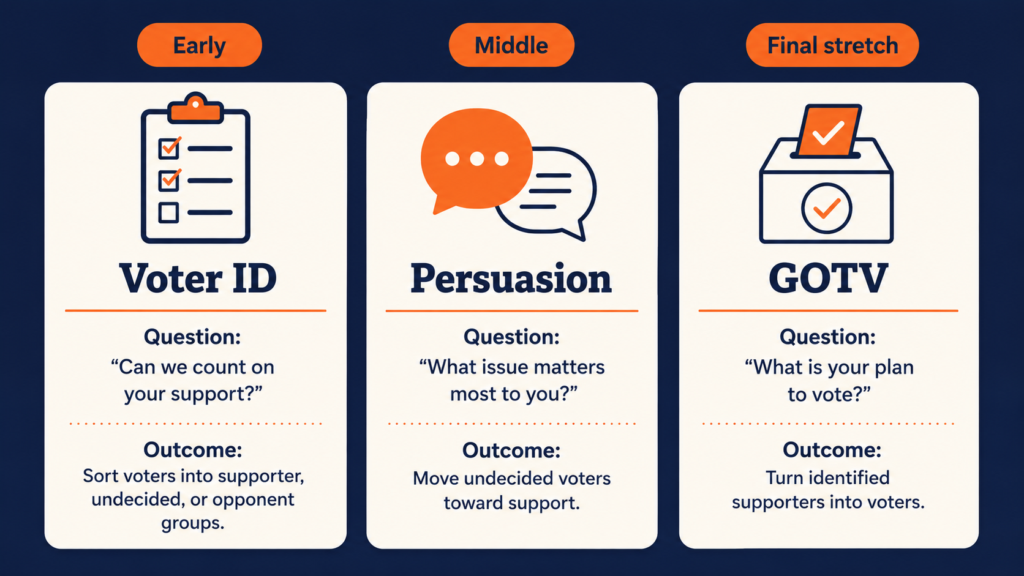
Local campaigns usually run three kinds of phone banking calls: voter ID, persuasion, and GOTV.
Do not mix them into one messy script. Each call has a different job.
| Call type | Best used for | Main question | Main outcome |
| Voter ID | Early and middle campaign | “Can we count on your support?” | Sort voters into supporter, undecided, or opponent groups |
| Persuasion | Middle campaign | “What issue matters most to you?” | Move undecided voters toward support |
| GOTV | Final stretch | “What is your plan to vote?” | Turn identified supporters into voters |
Voter ID: who supports you
Voter ID phone banking helps you find out where voters stand.
Run these calls early, before your campaign spends money and volunteer time on the wrong voters. The main goal is to sort the list into supporters, undecided voters, and opponents.
A voter ID call should be short:
“Hi, this is Maya calling with Priya Shah’s campaign for city council. Priya is running to fix the unsafe crossing on Oak Street and expand after-school programs. Can we count on your support in the June 4 election?”
Then record the answer.
Do not turn every voter ID call into a long persuasion debate. If someone is undecided and open to hearing more, tag them for follow-up. If someone supports you, move them into GOTV. If someone opposes you, stop spending time there unless the campaign has a specific reason.
Persuasion: moving undecided voters
Persuasion calls are for voters who may support you but need a reason.
These calls should happen after you know your core message, your strongest issue, and your most common objections. In a local race, persuasion works best when it stays close to daily life.
Focus on one issue at a time:
- Safer streets near schools.
- Faster permit approvals for small businesses.
- Cleaner parks.
- Lower utility bills.
- Better bus routes.
- More transparent school board decisions.
The script should ask what the voter cares about before it explains what the candidate believes.
A good persuasion call sounds like this:
“Hi, I’m calling with Priya Shah’s campaign for city council. We’re talking with voters about what they want the next council to fix first. Is there one local issue that matters most to you this year?”
Listen first. Then connect the candidate to the issue if there is a real connection.
Do not force a message that does not fit the voter’s concern. Local voters can smell a canned answer from three blocks away.
GOTV: turning out supporters
GOTV phone banking is for people who already support you or are likely to support you.
The goal is not persuasion. The goal is turnout.
A GOTV call should help the voter make a plan:
- Are you voting early or on election day?
- Do you know your polling place?
- Do you need your mail ballot drop-off location?
- What time do you plan to vote?
- Do you need a ride?
- Can we send you a reminder?
These calls should be focused, friendly, and practical.
Green et al. found in the Journal of Politics that targeted two-round phone banks can nearly triple turnout effects compared with single-contact programs. The lesson is useful for local races: do not treat GOTV as one call. Use a sequence.
Call supporters once to confirm the vote plan. Then call or text again closer to election day if they have not voted yet or still need information.
Writing scripts for a local race
A local race script should not sound like it came from a presidential campaign with the names swapped out.
Keep it short. Keep it local. Give volunteers room to sound human. For more ready-to-use examples, use these phone banking script templates.
The core elements of a local race script
Every local phone banking script needs five parts:
- A clear introduction.
- A local reason for the call.
- One main question.
- A response path based on the answer.
- A clear data outcome for the volunteer to record.
Here is a simple voter ID script.
“Hi, is this Jordan?
My name is Sam, and I’m a volunteer with Priya Shah’s campaign for city council. I live here in District 4, and I’m calling because this race could come down to a small number of votes.
Priya is running to make school crossings safer, improve bus service, and make city spending easier for residents to track.
Can we count on your support in the June 4 election?”
If yes:
“Great, thank you. Do you already know whether you plan to vote early, by mail, or on election day?”
If undecided:
“Thanks for being open. Is there one local issue you most want the next council member to focus on?”
If no:
“Thanks for letting me know. I’ll update our list so we do not keep calling about support.”
If they ask for more information:
“I can send you Priya’s website and a short summary of her local priorities. Would text or email be better?”
This script does not try to do everything. It identifies support, opens the door to persuasion, and records useful data.
How to handle common objections and questions
Volunteers need simple answers to common pushback. Do not make them improvise.
Here are common local race objections and response paths.
“I do not vote in local elections.”
“I understand. A lot of people skip them, but local races often decide the services people deal with every week, like streets, schools, parks, and housing rules. Can I ask which issue matters most to you locally?”
“I have never heard of this candidate.”
“That makes sense. Local races do not get much coverage. Priya is running for city council in District 4 and is focused on safer school crossings, better bus service, and more transparent city spending. Is one of those issues important to you?”
“How did you get my number?”
“We’re calling from a voter contact list used for this local election. I can also mark you as do not call if you prefer.”
“I do not want campaign calls.”
“Understood. I’ll mark that now. Thanks for your time.”
“Is this a real person?”
“Yes, I’m a volunteer with the campaign. No worries, I know campaign calls can sound scripted.”
The most important rule: when someone asks not to be called, mark it right away.
Should the candidate make calls themselves?
Yes, but not to everyone.
The candidate’s time is too valuable for broad list calling. Use candidate calls where they can change the outcome.
The candidate should call:
- High-value undecided voters.
- Local endorsers and community leaders.
- Past donors or likely donors.
- Volunteers who have not signed up yet.
- Voters with specific issue concerns.
- People who requested a candidate follow-up.
- Super voters in very small precincts.
A candidate call can move a voter because it signals respect. In a small race, hearing directly from the person on the ballot can matter.
But candidate calls only work if the campaign tracks them. Do not let the candidate make calls from a personal notebook with no follow-up. Add every outcome back to the campaign list.
Setting up and running your phone banking sessions
A local campaign phone bank does not need to look like a large campaign call center.
It needs a clear goal, a clean list, a script, a simple tool setup, and someone watching the results while volunteers call.
In-person vs. virtual phone banks
Both can work.
An in-person phone bank is better when volunteers are new, nervous, or local to the same area. It creates energy. People can ask questions. The campaign can fix issues fast.
Use an in-person phone bank when:
- You are training first-time volunteers.
- You want the candidate to join and motivate the team.
- You need to build campaign culture.
- You are calling through a priority precinct together.
- You need tight quality control.
A virtual phone bank is better when volunteers are spread out or the campaign has limited space. It is easier to schedule and scale.
Use a virtual phone bank when:
- Volunteers are comfortable calling from home.
- You have a clear script and tool.
- You can support people by chat or video.
- You need several short shifts across the week.
- You are calling a larger list.
For most local campaigns, the best setup is hybrid. Run one in-person launch session to train everyone, then run virtual shifts through the rest of the campaign.
What tools small campaigns actually need
A small campaign does not need a complicated tech stack.
You need:
- A voter list.
- A phone banking tool.
- A script.
- Disposition tags.
- Volunteer assignments.
- A way to track results.
- A follow-up process for supporters, undecided voters, and no answers.
Spreadsheets and personal phones can work for a tiny campaign, but they break fast once multiple volunteers start calling the same list. You lose track of who was called, who asked not to be called again, who needs a ride, and who should get a follow-up text.
That is where phone banking software helps.
CallHub lets smaller campaigns upload a voter list, assign volunteers, use scripts, record call outcomes, and track progress from one place. It also helps campaigns connect calling with texting and email, so a voter who does not answer can get a follow-up text instead of disappearing from the campaign.
The point is not to add tools. The point is to reduce the manual work between calls.
For a real campaign example, see how one nonprofit used CallHub to organize 500+ callers and mobilize 1M+ voters.
Training volunteers in under 30 minutes
A volunteer training does not need to be long. It needs to remove fear.
Use this 30-minute training structure:
| Time | What to cover | Goal |
| 0–5 minutes | Explain the shift goal | Volunteers know why they are calling |
| 5–10 minutes | Walk through the script | Volunteers understand the main question |
| 10–15 minutes | Show the tool | Volunteers can call, record, and tag outcomes |
| 15–20 minutes | Practice in pairs | Volunteers get the nerves out before calling |
| 20–25 minutes | Cover objections | Volunteers know what to say when calls get hard |
| 25–30 minutes | Start calling together | Volunteers build momentum right away |
Do not spend 30 minutes explaining campaign theory. Volunteers learn by calling.
The lesson is the same in larger programs. In CallHub’s 275,000 calls with CallHub case study, dynamic scripts helped volunteers move through conversations without getting stuck.
Timing: when to run each phase of calling
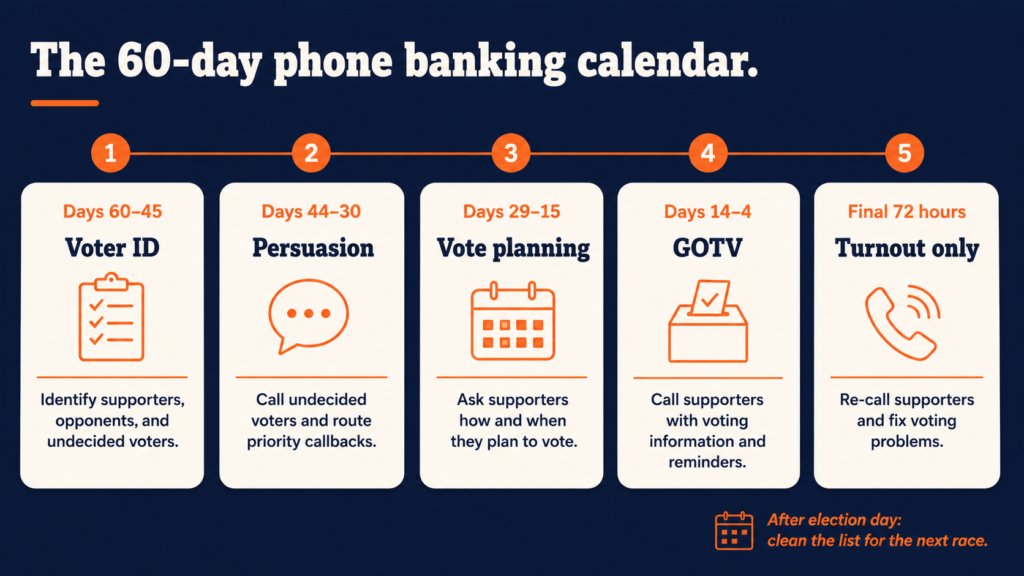
Local campaigns should start phone banking earlier than they think, but not all calls should have the same purpose.
The Political Group’s 2026 guide notes that local races often concentrate phone banking in the final 60 days, when voter attention starts to rise. That is a good planning window.
Use the 60 days to move from voter ID to persuasion to GOTV.
The 60-day calling calendar
| Timeline | Calling focus | What to do |
| Days 60–45 | Voter ID | Clean your list, call high-priority voters, and identify supporters, opponents, and undecided voters |
| Days 44–30 | Persuasion | Call undecided voters, route high-value voters to the candidate, and send follow-up information |
| Days 29–15 | Support ID and vote planning | Keep identifying supporters and ask likely supporters how they plan to vote |
| Days 14–4 | GOTV | Call supporters and likely supporters with polling place, ballot, ride, and reminder information |
| Final 72 hours | Turnout only | Re-call supporters, send reminders, and fix voting problems |
| After election day | Data cleanup | Update the list while the information is still fresh |
Days 60–45: Set the list and start voter ID
Clean your voter file. Remove obvious bad records. Segment your first call universe. Start with high-propensity voters and voters likely to care about your main issue.
Your goal is to identify supporters, opponents, and undecided voters.
Days 44–30: Persuasion and candidate callbacks
Call undecided voters. Route high-value voters to the candidate. Send follow-up information to people who asked for it. Start tracking the most common objections.
Your goal is to move persuadable voters and sharpen the campaign message.
Days 29–15: Expand support ID and build vote plans
Keep identifying supporters. Start asking likely supporters how they plan to vote. Recruit more volunteers from strong supporters.
Your goal is to turn support into a turnout plan.
Days 14–4: GOTV calling
Call supporters and likely supporters. Focus on early voting, mail ballots, polling place information, and rides. Stop spending time on clear opponents.
Your goal is to make sure supporters know exactly how and when they will vote.
Final 72 hours: Turnout only
This is not the time for long persuasion calls. Call your supporters. Re-call people who promised to vote but have not yet voted, if you have vote history updates. Send reminders. Fix problems.
Your goal is to get every identified supporter to cast a ballot.
After election day: Update the list
Win or lose, clean the data. Your local campaign may end, but the relationships do not. The next school board, council, bond, or ballot measure campaign will need this list.
Conclusion
A local campaign does not need a massive operation to run a useful phone bank.
It needs a clear win number, a current voter list, a script built for the race, and enough volunteers to work through the right voters before election day. The math is on your side because local races are decided by fewer votes than most campaigns realize.
Start with the voters who can change the result. Identify your supporters early. Move undecided voters while there is still time. Use the final stretch for GOTV.
For the full strategy behind campaign calling, use CallHub’s complete guide to political phone banking. If you are ready to set up calling for your own race, explore CallHub’s phone banking software for small and growing campaign teams.
FAQ
What is phone banking in politics?
Phone banking is a voter contact method where campaign staff or volunteers call voters to identify support, persuade undecided voters, recruit volunteers, or remind supporters to vote.
Is phone banking worth it for a small local campaign?
Yes. Phone banking is often worth it for small campaigns because local races have smaller voter universes and thinner margins. A few hundred completed conversations can help identify supporters, move undecided voters, and turn out people who may skip a low-visibility race.
How many calls does a phone banker make per hour?
A volunteer manually dialing can usually talk to 10–15 people per hour. With an automated dialer, output can rise to 45–50 conversations per hour when answer rates and list quality are strong.
What should you say during phone banking?
Start with who you are, why you are calling, and one clear question. For a local race, mention a local issue and ask whether the voter supports the candidate, wants more information, or has a plan to vote.
How do you get a voter list for a local election?
Start with your state or county election office. Many provide registered voter files for campaigns, though rules and fees vary. If the public file lacks phone numbers or targeting data, consider a paid data vendor or phone append.
What is the difference between voter ID calling and GOTV calling?
Voter ID calling finds out who supports you, who opposes you, and who is undecided. GOTV calling focuses only on turning out supporters and likely supporters by helping them make a vote plan.
Should the candidate personally call voters?
Yes, but only for high-value calls. The candidate should call key undecided voters, community leaders, donors, volunteers, endorsers, and voters who asked for a follow-up. Volunteers should handle broad list calling.
What is the best phone banking software for small campaigns?
The best phone banking software for small campaigns should let you upload a voter list, assign volunteers, use scripts, record outcomes, track progress, and follow up across channels. If your campaign plans to call and text, choose a tool that keeps those actions connected.