

Want to make phone banking more consistent, comfortable, and useful for your volunteers? A phone banking script gives every caller a clear path through the conversation.
A phone banking script is a prepared call guide that volunteers or campaign staff use when calling voters, donors, supporters, or community members. For political campaigns and advocacy groups, it helps volunteers start the call, ask the right question, handle common responses, and log the outcome without sounding robotic.
A good script does not force every caller to read word for word. It gives them structure so they can stay focused, respectful, and useful while still sounding like a real person.
This guide includes phone banking script templates you can adapt for voter ID, Get Out The Vote (GOTV), persuasion, fundraising, volunteer recruitment, surveys, and voicemail follow-up.
Key Takeaways
A phone banking script is a prepared call guide that helps volunteers or campaign staff open a call, ask the right question, handle responses, and log outcomes without sounding robotic.
Basic script structure
- Every script needs a greeting that confirms you are speaking with the right person before moving forward.
- Identification comes next, stating who is calling and which campaign or organization they represent.
- The reason for calling explains why the call matters right now, followed by one main question tied to the campaign goal.
- A response path guides the volunteer based on the answer, data capture tells them what to record, and the close ends politely while confirming the next step.
- A copyable template follows this pattern: confirm the name, introduce the volunteer and campaign, state the reason for calling, then ask the main question, and campaigns should save a separate copy for each call type.
Etiquette rules
- Volunteers should confirm the person’s name first since phone numbers are not always accurate and landlines may reach someone else in the household.
- With a predictive dialer there can be a short connection delay, so the script should move straight into confirming the name since the voter may already have said hello.
- Callers should introduce themselves briefly, stating their name, their campaign or organization, and the reason for the call without over-explaining.
- Scripts should build in pauses after a line like the quick-question opener so the voter has room to respond before the main ask.
- Scripts should stay simple with short sentences and one question at a time so volunteers from different backgrounds can scan while listening and generate cleaner data.
- Volunteers should thank every respondent regardless of their answer, and scripts should remind them to stay calm and close politely if a call turns uncomfortable.
Script types by campaign goal
- Voter ID calls use a support identification script built around the question ‘Can we count on your support?’
- GOTV calls use a vote plan script centered on asking ‘Do you have a plan to vote?’
- Persuasion calls use an issue conversation script that asks ‘What issue matters most to you?’
- Fundraising calls use a donation call script asking ‘Can we count on you to contribute?’
Phone banking script template: the basic structure
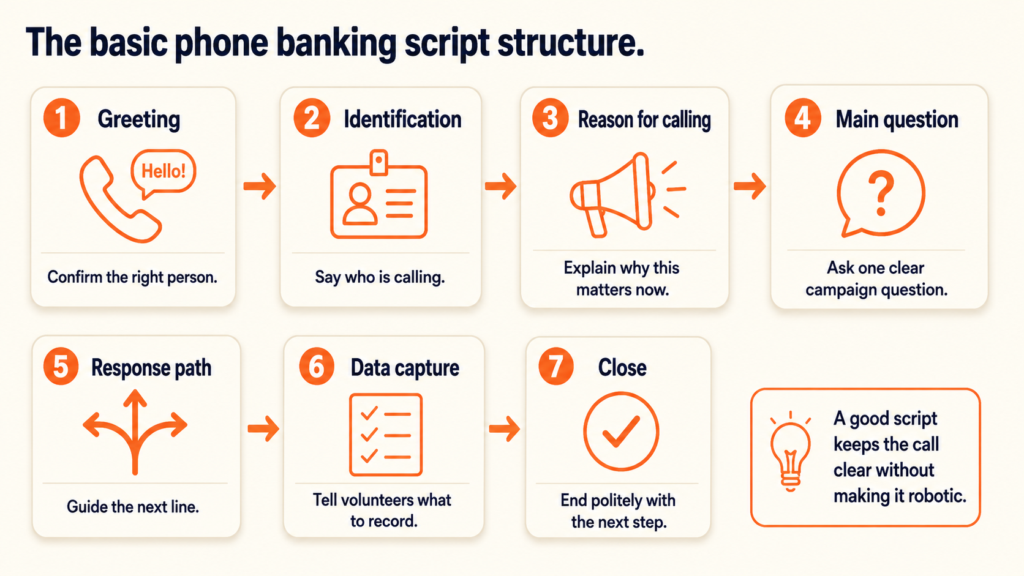
Most campaign phone scripts follow the same basic structure. The details change based on the campaign goal, but the call still needs a clear opening, one main ask, response paths, and a clean close.
| Script part | What it should do |
| Greeting | Confirm you are speaking with the right person |
| Identification | Say who is calling and which campaign or organization you represent |
| Reason for calling | Explain why this call matters now |
| Main question | Ask the primary campaign question |
| Response path | Guide the volunteer based on the answer |
| Data capture | Tell the volunteer what to record |
| Close | End politely and confirm the next step |
Here is the basic customizable phone banking script template:
“Hi, is this [Name]? My name is [Volunteer Name], and I’m calling with [Campaign or Organization]. We’re reaching out because [reason for call]. [Main question].”
Example:
“Hi, is this Jordan? My name is Maya, and I’m a volunteer with the Rivera campaign. We’re calling voters in District 4 because early voting starts next week. Can we count on your support?”
That is enough to start. The rest of the script should guide volunteers based on what the person says next.
Treat the bracketed version above as a copyable phone banking script template: paste it into your calling tool, swap the bracketed fields for your candidate, area, and main ask, and keep a saved copy for each call type so volunteers always open the right one.
Phone banking script etiquette
You are calling someone who may not expect the call. Etiquette matters because it sets the tone before the campaign message begins.
Here are the basic rules to follow when creating a phone banking script.
Make sure you’re talking to the right person
Phone numbers are not always accurate. When you are calling a landline, there is also a chance you may reach someone else in the household.
Start by confirming the person’s name.
“Hi, is this [Name]?”
If you reach the wrong person, ask the volunteer to mark the outcome correctly. If your phone banking software allows household switching, the volunteer can move to the correct contact.
If you are using a predictive dialer, remember that there may be a short delay when the call connects. The voter may have already said hello by the time the volunteer joins, so the script should move straight into confirming the name.
Introduce yourself to build rapport
The first thing a caller should do is introduce themselves. The script should let callers say their name, the campaign or organization they represent, and the reason for the call.
Example:
“Hi, my name is [Your Name], and I’m a volunteer with [Campaign Name]. We’re calling voters in [Area] about the upcoming election.”
Keep this short. The caller does not need to explain the entire campaign in the first sentence.
Pause and wait for a reply
Build pauses into the script. This gives the conversation room to breathe and helps volunteers avoid sounding rushed.
Example:
“I’m not going to take much of your time. I just have a quick question about the upcoming election.”
[Pause]
“When you vote on [Date], will you be supporting [Candidate]?”
The pause matters. It gives the voter a chance to respond before the caller moves to the main ask.
Keep your phone banking script simple
Volunteers speak with people from different backgrounds, age groups, neighborhoods, and political viewpoints. A good script uses short sentences and one question at a time.
Avoid long blocks of text. Volunteers should be able to scan the script while listening.
A simple script gets cleaner answers and better data.
Be thankful and show it
Thank people for every response, even when they do not support the campaign.
Example:
“Thanks for letting me know. I’ll update our list.”
If someone supports your campaign, show genuine appreciation.
Example:
“That’s great to hear. Thank you for your support.”
Gratitude keeps the call human and helps supporters feel more connected to the campaign.
Remind volunteers to stay calm
Making calls for a full shift can be tiring. Some voters will be friendly. Some will be busy. Some may be short with the caller.
A good script should remind volunteers not to take negativity personally. If a conversation becomes uncomfortable, they can close politely and move on.
Example:
“Thanks for your time. I’ll let you go.”
Types of phone banking scripts with examples
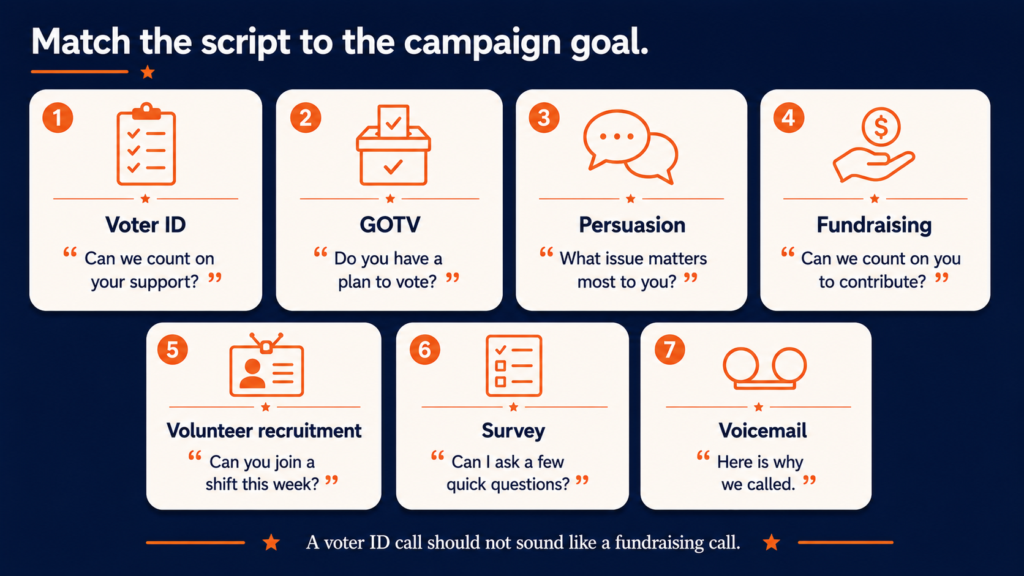
Different campaign goals need different scripts. A voter ID call should not sound like a fundraising call. A GOTV script should not sound like a persuasion script.
Every phone bank script example below is written out as a complete call rather than a blank frame, so you can hear how the structure sounds once the brackets are filled in and decide which wording fits your campaign before a shift starts.
Use this table to choose the right script type.
| Campaign goal | Script type | Main question |
| Voter ID | Support identification script | “Can we count on your support?” |
| GOTV | Vote plan script | “Do you have a plan to vote?” |
| Persuasion | Issue conversation script | “What issue matters most to you?” |
| Fundraising | Donation call script | “Can we count on you to contribute?” |
| Volunteer recruitment | Volunteer ask script | “Can you join a shift this week?” |
| Survey | Phone survey script | “Can I ask you a few quick questions?” |
| Voicemail | Follow-up message | “Here is why we called and where to learn more.” |
Voter ID phone banking script
A voter ID script helps your campaign identify supporters, opponents, and undecided voters. Use it early and in the middle of the campaign so your team knows who should receive persuasion, GOTV, volunteer recruitment, or no further outreach.
Sample voter ID script:
“Hi, is this [Name]? My name is [Volunteer Name], and I’m a volunteer with [Campaign]. We’re calling voters in [Area] about the upcoming election. Can we count on your support for [Candidate or Issue]?”
If yes:
“Great, thank you. Do you already know how you plan to vote, early, by mail, or on Election Day?”
If undecided:
“Thanks for being open. What issue matters most to you this year?”
If no:
“Thanks for letting me know. I’ll update our list.”
If wrong number:
“Thanks for clarifying. I’ll mark this as the wrong number so we do not keep calling you.”
What volunteers should record:
- Supporter
- Lean supporter
- Undecided
- Opposed
- Wrong number
- Needs follow-up
- Do not call
Volunteer recruitment script
It is often efficient to combine voter ID and volunteer recruitment. Once a volunteer identifies a supporter, they can ask whether that person wants to help the campaign.
Sample volunteer recruitment script:
“Thanks for supporting [Candidate or Cause]. We’re looking for volunteers to help reach more voters before [Election Day or Event Date]. Could you join a short phone banking or canvassing shift this week?”
If yes:
“That’s great. Which works better for you, a weekday evening or a weekend shift?”
If maybe:
“No problem. Can we send you the volunteer sign-up link so you can look at the available shifts?”
If no:
“Thanks for considering it. We appreciate your support.”
What volunteers should record:
- Interested in volunteering
- Wants sign-up link
- Needs follow-up
- Not interested
- Already volunteering
Persuasion phone banking script
Persuasion scripts are for undecided voters or supporters who need more information. These calls should ask questions before making the case.
A good persuasion script does not start with a long speech. It starts by learning what the voter cares about.
Sample persuasion script:
“Hi, is this [Name]? I’m [Volunteer Name], a volunteer with [Campaign]. We’re talking with voters in [Area] about what they want to see changed this election. What issue matters most to you right now?”
If the voter names an issue:
“Thanks for sharing that. [Candidate] has been focused on [related issue or policy]. Would it be helpful if I shared a quick summary of where they stand?”
If the voter is unsure:
“That makes sense. The issues we hear about most often are [Issue 1], [Issue 2], and [Issue 3]. Is one of those especially important to you?”
If the voter is not interested:
“No problem. Thanks for your time.”
What volunteers should record:
- Top issue
- Persuasion status
- Wants more information
- Needs candidate or staff follow-up
- Opposed
- Do not call
GOTV phone banking script
A GOTV script is for identified supporters. The goal is not to persuade them. The goal is to help them vote.
GOTV scripts are most useful close to Election Day, during early voting, or during mail ballot chase programs.
Sample GOTV script:
“Hi, is this [Name]? This is [Volunteer Name] with [Campaign]. Election Day is [Date], and we’re calling supporters to make sure they have a plan to vote. Are you voting early, by mail, or on Election Day?”
If voting early:
“Great. Do you know where and when you plan to vote?”
If voting by mail:
“Have you already returned your ballot?”
If voting on Election Day:
“Do you know what time you plan to go?”
If they need information:
“No problem. We can send you the polling place or ballot information after this call.”
What volunteers should record:
- Vote plan made
- Voting early
- Voting by mail
- Voting on Election Day
- Needs polling place information
- Needs ride or accessibility support
- Already voted
- Needs reminder
Phone banking is especially useful for GOTV when calls are personal and targeted. The StatesWin and Sister District Phonebanking Research summary cites David Nickerson’s finding that nonpartisan GOTV phone calls produced a 3.8% turnout boost across eight studies. The same summary notes that unhurried, personal calls perform better than rushed volume-focused calls.
Fundraising call script
Fundraising scripts work best when the call goes to a warm list: past donors, event attendees, active supporters, or people who have already engaged with the campaign.
Sample fundraising call script:
“Hi [Name], this is [Volunteer or Candidate Name] calling with [Campaign]. Thank you for supporting [Candidate or Cause] before. We’re raising funds for [specific goal], and I wanted to ask if you’d consider contributing [amount] today.”
If yes:
“Thank you. I can send the secure donation link by text or email if that’s easier.”
If maybe:
“That’s completely fine. Can I send the link so you can review it later?”
If no:
“Thanks for considering it. We appreciate your time and support.”
What volunteers should record:
- Donated
- Pledged to donate
- Send donation link
- Needs follow-up
- Not interested
- Do not call
Phone survey script
A phone survey script helps campaigns collect structured answers from voters, members, donors, or supporters. Keep it short and ask permission first.
Sample phone survey script:
“Hi, is this [Name]? My name is [Volunteer Name], and I’m calling with [Organization]. We’re asking voters in [Area] a few quick questions about [Issue or Election]. Do you have two minutes?”
If yes:
“Thank you. First question: which issue matters most to you right now, [Option 1], [Option 2], [Option 3], or something else?”
If no:
“No problem. Thanks for your time.”
Survey script tips:
- Ask permission before starting.
- Keep questions short.
- Read answer options clearly.
- Repeat the answer if needed.
- Do not debate the respondent.
- Thank them before ending the call.
What volunteers should record:
- Survey answers
- Issue priority
- Support level
- Follow-up needed
- Refused survey
- Do not call
Voicemail script
Only leave voicemail if the campaign approves it. Some campaigns prefer no voicemail and only want volunteers to mark “No answer.”
Sample voicemail script:
“Hi [Name], this is [Volunteer Name] calling with [Campaign]. We’re reaching out about [election, event, or deadline]. You can learn more at [website] or look out for a follow-up message from us. Thank you.”
Keep voicemail short. Do not add extra claims, policy details, or personal opinions.
What volunteers should record:
- Voicemail left
- No answer
- Follow-up text needed
- Follow-up email needed
How to write a phone banking script volunteers can actually use
A script should help callers have better conversations, not trap them in stiff lines.
Here is how to write one that volunteers can use during a real shift.
Keep the opening under 15 seconds
The voter decides quickly whether to stay on the line. A long opening gives them more reasons to hang up.
Keep the first line simple:
“Hi, is this [Name]? I’m [Volunteer Name], calling with [Campaign].”
Then move to the reason for the call.
Use one main ask
Do not make the same script identify support, persuade, recruit volunteers, ask for donations, and confirm a vote plan.
Pick one primary goal.
If the script has too many goals, volunteers will rush and voters will get confused.
Write the way people speak
Read the script out loud before giving it to volunteers. If it sounds unnatural, rewrite it.
Avoid:
“We are contacting constituents regarding their civic participation behavior.”
Use:
“We’re calling voters in your area about the upcoming election.”
Add response paths
Every script should tell volunteers what to do after common answers.
At minimum, include paths for:
- Yes
- No
- Undecided
- Busy
- Wrong number
- Wants more information
- Do not call
- Hostile or angry
The more clarity you give volunteers, the fewer calls drift into awkward territory.
Tell volunteers what to record
A script should not end with the closing line. It should also tell volunteers which outcome or survey answer to log.
For example:
If the voter says yes, mark “Supporter” and ask the vote plan question.
If the voter asks not to be called, mark “Do not call” immediately.
This is how your campaign turns conversations into usable data.
Include a handoff line
Volunteers should not guess when they do not know the answer.
Give them a simple handoff line:
“That’s a good question, and I don’t want to guess. I’ll mark this for follow-up so someone from the campaign can get you the right answer.”
That line protects the volunteer, the voter, and the campaign.
How to handle common responses during a phone bank
Volunteers do not need a perfect answer to everything. They need a few reliable lines that keep the call respectful and on track.
| Voter response | What the volunteer can say |
| “I’m busy.” | “No problem. Is there a better time for someone to follow up?” |
| “How did you get my number?” | “We’re calling from a campaign contact list. I can mark your preference if you don’t want more calls.” |
| “I’m not interested.” | “Thanks for letting me know. I’ll update our list.” |
| “I already voted.” | “Great, thank you for voting. I’ll mark that so we don’t keep reminding you.” |
| “I don’t know enough yet.” | “That makes sense. What issue would you like more information about?” |
| “Stop calling me.” | “Understood. I’ll mark that now.” |
| “I have a question you can’t answer.” | “I don’t want to guess. I’ll mark this for follow-up from the campaign.” |
| “Wrong number.” | “Thanks for letting me know. I’ll mark that so we don’t call again for this person.” |
Do-not-call requests need immediate attention. The FCC’s political campaign calls and texts guidance explains that political calls and texts are subject to rules based on call type, technology, consent, and phone number type. Campaigns should also follow their own internal suppression rules and any state-specific requirements.
How to build branching scripts for better calls
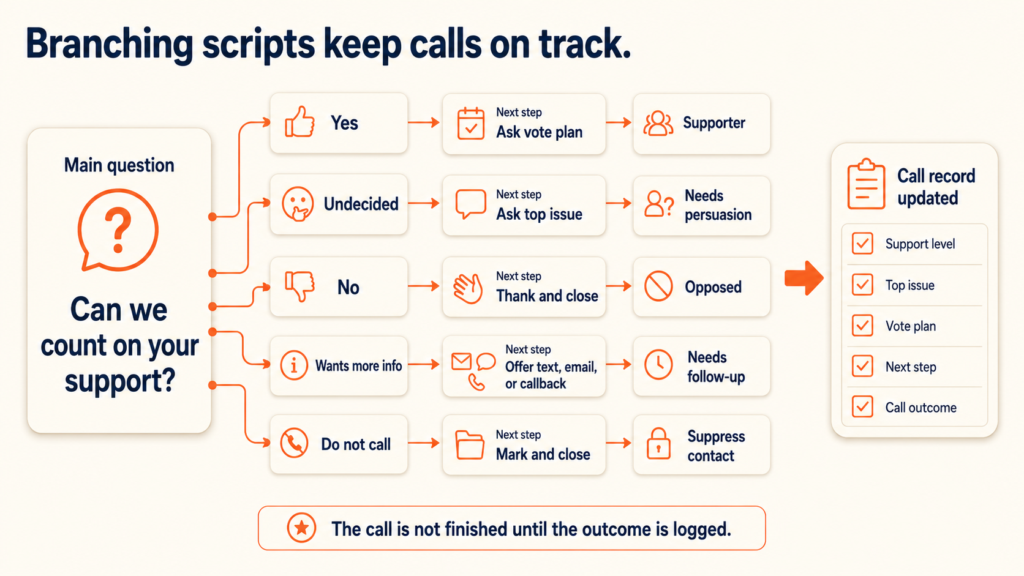
A branching script changes based on the voter’s answer.
Instead of giving every volunteer one long block of text, you create paths. If the voter says yes, the script moves to a vote plan. If the voter says undecided, it moves to an issue question. If the voter says no, it moves to a polite close.
Example branching flow:
| Main question | Answer | Next script path |
| “Can we count on your support?” | Yes | Ask vote plan question |
| “Can we count on your support?” | Undecided | Ask top issue question |
| “Can we count on your support?” | No | Thank them and close |
| “Can we count on your support?” | Wants more information | Offer text, email, or callback |
| “Can we count on your support?” | Do not call | Mark do-not-call and close |
Branching scripts help new volunteers stay calm because they do not have to decide what comes next on their own.
CallHub’s phone banking software lets campaigns add scripts, survey questions, call dispositions, and branching logic so volunteers can follow the right path during the call.
How to log survey answers and call outcomes
A script is only useful if the call result gets recorded correctly.
Call outcomes help the campaign decide who gets called again, who gets a text, who needs follow-up, and who should be removed from the list.
Common call dispositions include:
| Disposition | Use when |
| Strong supporter | They clearly support the campaign |
| Lean supporter | They are likely supportive but not fully committed |
| Undecided | They need persuasion or more information |
| Opposed | They do not support the campaign |
| No answer | They did not pick up |
| Voicemail left | Approved voicemail was left |
| Wrong number | Contact data is incorrect |
| Needs follow-up | Staff or a senior volunteer should call back |
| Do not call | They asked not to receive more calls |
Keep notes short and factual.
Good note:
“Asked for polling place link. Prefers text.”
Weak note:
“Seemed kind of annoyed but maybe still interested.”
The first note tells the next volunteer what to do. The second creates confusion.
Phone banking script + CallHub = easy campaign setup
Once your script is ready, the next step is campaign setup.
In CallHub, you can create a calling campaign, upload contacts, add your script, enable call dispositions, and create survey questions for volunteers. Volunteers can then join the campaign, see the script during the call, answer survey questions, and add notes.
Your volunteers can refer to the script, fill in survey questions, and log outcomes during calls. The data flows back into your campaign system, which helps you follow up with the right contacts after the shift.
A good setup usually looks like this:
- Create the phone banking campaign.
- Upload or sync your contact list.
- Add your script.
- Add survey questions and response options.
- Add call dispositions.
- Add branching paths for common answers.
- Test the script with one volunteer before launch.
- Monitor call outcomes during the campaign.
This keeps your script connected to campaign action. A supporter can move into GOTV. An undecided voter can move into persuasion. A wrong number can be cleaned from the list.
For a complete overview of how campaigns plan and run phone banking from start to finish, see the complete guide to political phone banking. For step-by-step setup guidance, use the political phone banking guide. For newer volunteers, share the first-time phone banking guide before their first shift.
Best practices for effective scripts
A good script is only as strong as the way it is delivered.
Use these phone banking tips to improve call quality.
Keep it conversational
Volunteers should not sound like they are reading a legal disclaimer. Give them short lines and simple transitions.
A script should guide them, not replace their voice.
Personalize where it matters
Use the voter’s name, area, issue, or previous action if you have that information.
Example:
“We’re calling voters in Ward 3 because early voting starts this weekend.”
That sounds more relevant than:
“We’re calling all voters about the election.”
Avoid jargon
Campaign language can confuse people outside the campaign.
Avoid phrases like:
- Voter universe
- Persuasion target
- Propensity score
- Contact universe
- Field program
Use plain language instead.
Test the script before the shift
Ask two or three volunteers to read the script out loud before the campaign goes live.
Watch for:
- Lines that sound stiff
- Questions that are too long
- Missing response paths
- Confusing survey options
- Unclear closing lines
Fix those before the full volunteer shift starts.
Train with short role-plays
A 10-minute role-play can prevent a lot of first-call anxiety.
Have volunteers practice:
- One easy supporter call
- One busy voter call
- One undecided voter call
- One do-not-call request
This helps volunteers hear the script before they use it with real people.
For more calling guidance, read these phone banking tips for campaigns.
Phone banking script mistakes to avoid
Small script problems can turn into messy calls. Watch for these mistakes.
Starting with a long intro
The first line should confirm the person and identify the caller. Save campaign details for later in the script.
Asking too many questions
A voter ID script should identify support. A GOTV script should make a vote plan. A fundraising script should make a donation ask.
Do not ask for everything in one call.
Giving volunteers no response paths
Volunteers need to know what to say after yes, no, undecided, busy, wrong number, and do-not-call responses.
Without response paths, calls become inconsistent.
Writing in campaign jargon
Use the language voters use. If the voter would not say the phrase in a normal conversation, reconsider it.
Forgetting do-not-call handling
Every script should tell volunteers exactly what to do when someone asks not to be called again.
Not telling volunteers what to record
The call is not finished until the outcome is logged.
A strong script includes both the words to say and the data to capture.
Using the same script for every campaign goal
A persuasion script should not sound like a GOTV script. A fundraising script should not sound like a phone survey.
Match the script to the job.
The way forward
A well-crafted phone banking script can turn a nervous volunteer into a useful caller.
The goal is not to make every conversation identical. The goal is to give volunteers enough structure to stay clear, respectful, and focused while still sounding human.
Start with a short opening. Ask one main question. Add response paths. Tell volunteers what to record. Test the script before the shift.
Once your script is ready, CallHub helps you put it to work with calling campaigns, branching scripts, survey questions, call dispositions, volunteer access, and reporting from one place.
Explore CallHub’s phone banking software to see how campaigns manage scripts, calling lists, survey answers, and outcomes in one system.
Frequently asked questions on phone banking scripts
What is a phone banking script?
A phone banking script is a call guide volunteers use during campaign phone calls. It includes the opening line, main question, response paths, and instructions for recording the result.
What should a phone banking script include?
A phone banking script should include a greeting, caller identification, reason for calling, main ask, response paths, closing line, and call outcome instructions.
How do you start a phone banking call?
Start by confirming the person’s name, identifying yourself and the campaign, then explaining why you are calling.
Example:
“Hi, is this [Name]? I’m [Volunteer Name], calling with [Campaign]. We’re reaching out because [reason].”
How long should a phone banking script be?
The opening should be short enough to read in 10-15 seconds. The full script can be longer if it includes branches, but volunteers should not read long paragraphs out loud.
Most voter ID and GOTV calls should stay around 1-2 minutes. Persuasion, fundraising, and volunteer recruitment calls may take 2-3 minutes if the person is engaged.
Can volunteers use the same script everywhere?
You can reuse the basic structure, but the best results come from tailoring the script to each goal, race, issue, and audience.
Refresh:
- Candidate names
- Election dates
- Local issues
- Event details
- Donation links
- Volunteer shift times
- Voting deadlines
What is a political phone banking script?
A political phone banking script is a campaign call script used to identify voters, persuade undecided voters, recruit volunteers, raise funds, or turn supporters out to vote.
How do you write a phone survey script?
Ask permission first, keep questions short, use clear answer options, and tell the volunteer how to record each response.
Example:
“We’re asking voters in [Area] a few quick questions about [Issue]. Do you have two minutes?”
Should volunteers read the script word for word?
New volunteers can stay close to the script. Experienced volunteers can sound more natural, but they should keep the campaign’s main message and required questions intact.
The script should protect consistency without making every caller sound robotic.
What should a volunteer say if someone asks not to be called?
They should say:
“Understood. I’ll mark that now.”
Then they should record the correct do-not-call or opt-out outcome based on the campaign’s instructions.
What’s the difference between advocacy and political scripts?
Political scripts usually focus on voter ID, persuasion, volunteer recruitment, fundraising, and GOTV. Advocacy scripts may focus on issue education, event turnout, supporter surveys, petition follow-up, or patch-through calls to decision-makers.
Both need the same foundation: a clear opening, one main ask, response paths, and accurate outcome logging.
Is phone banking still worth doing?
Yes, when calls are targeted and personal. Phone banking is useful for voter ID, GOTV, persuasion, fundraising, volunteer recruitment, and list cleaning. For the research behind the tactic, read does phone banking work.