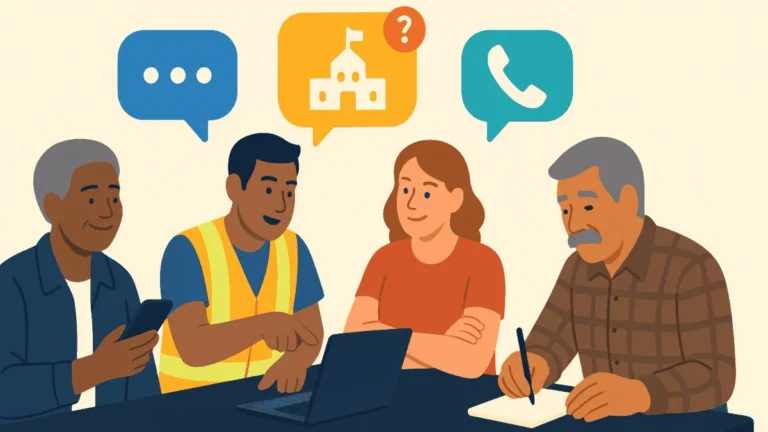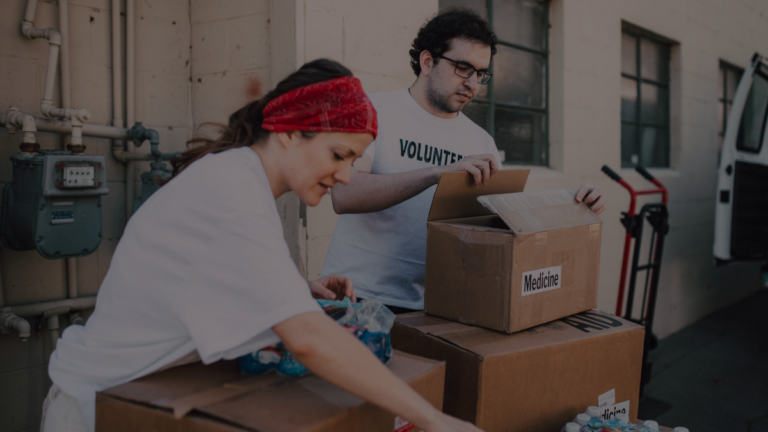


You have three weeks until election day. Twenty volunteers. A list of 5,000 voters. Do you send them door-to-door or call them on the phone? That single decision shapes how many real conversations your campaign has before the polls open.
The phone banking vs canvassing question has been debated in campaign offices for decades. Both tactics create real conversations with real voters. Both move turnout numbers. But they do it at different costs, depths, and scales, and the research is specific about when each earns its place in a ground game.
This article walks through the data on voter turnout lift, contact rates, and cost per vote, then gives you a practical framework for choosing between them or running both together. Every data point comes from a named source.
Key Takeaways
Phone banking and canvassing are the two core direct voter contact tactics campaigns choose between, and research shows each wins on a different metric: depth of impact versus scale of reach.
Defining the Two Tactics
- Phone banking is organized outreach by phone where volunteers or staff work from contact lists and scripts to identify supporters, persuade undecided voters, or drive GOTV, often using software with power or predictive dialers to scale calls.
- Canvassing is in-person, door-to-door outreach where a volunteer can read body language, maintain eye contact, and adjust the conversation in real time in ways a phone call cannot.
- Both tactics cover voter ID, persuasion, and GOTV, and both create two-way conversations that outperform one-way contact like mail, robocalls, or digital ads.
- Phone banking can run from anywhere, letting a volunteer in another state work a list the same night, while canvassing requires physical presence in the district and more coordination and prep per shift.
Canvassing Turnout Data
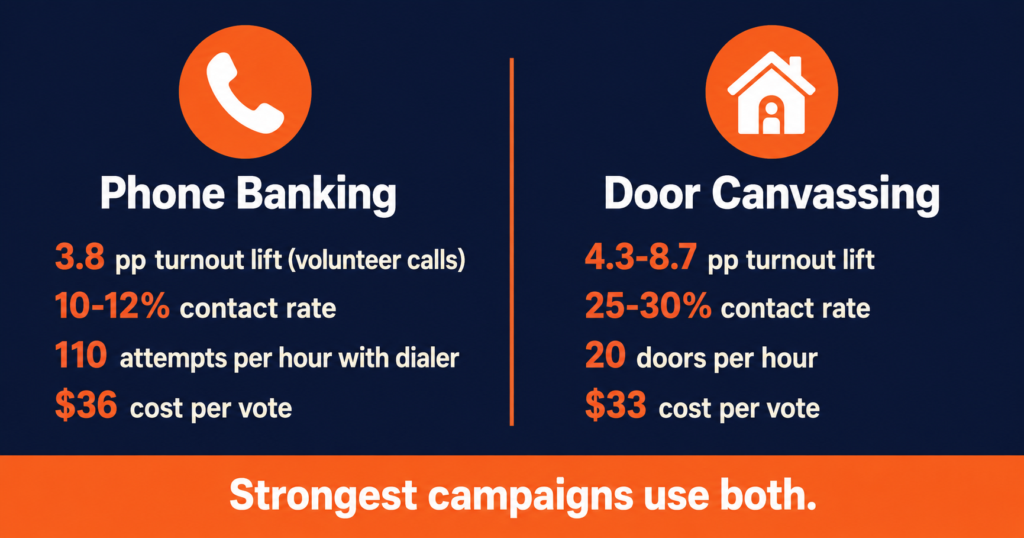
- Gerber and Huber’s pooling of 51 canvassing experiments found that contact with a canvasser increases turnout by 4.3 percentage points, as reported by SSIR in 2016.
- The original 1998 Gerber and Green New Haven study found personal canvassing raised turnout probability by 8.7 percentage points versus a control group, while phone calls in that same study showed no statistically significant effect.
- Canvassing contact rates run 25% to 30% depending on population density and geography, according to Green and Gerber’s 2019 research.
- Separate MoveOn GOTV research found volunteer canvasser contact increased turnout by approximately 9 percentage points among targeted voters.
Phone Banking Turnout Data
- Nickerson’s 2004 study across eight field experiments found nonpartisan GOTV calls from volunteers boosted turnout by 3.8 percentage points.
- Commercial phone banks using paid callers with scripted, impersonal outreach raise turnout by less than 1 percentage point, a notably smaller effect than volunteer calls.
- Sister District’s 2022 Phonebanking Research puts volunteer phone calls at 2 to 3 percentage points of turnout lift, consistent with Nickerson’s findings.
The Contact Rate Problem
- A Kennedy and Hartig meta-analysis cited via Green and Gerber 2019 found professional phone center contact rates fell from 36% in 1997 to just 6% in 2018.
- Volunteer phone banks running good lists during optimal calling windows see around 10-12% contact rates, well below canvassing’s 25-30% range.
Phone banking vs canvassing: what is the actual difference?
The two terms get used loosely in campaign planning. Getting precise about what each tactic does matters before comparing how well they do it.
What is phone banking?
Phone banking is organized outreach to voters by phone. Volunteers or staff work from contact lists, following a script, to identify supporters, persuade undecided voters, or remind committed supporters to vote. Campaigns use phone banking software to manage lists, deliver scripts on-screen, log survey responses, and scale operations with power or predictive dialers that skip unanswered calls.
A single phone banking operation can serve multiple campaign goals:
- voter ID in the early months,
- persuasion in the middle of the cycle,
- fundraising asks, volunteer recruitment, and
- a GOTV push in the final stretch before election day.
What is canvassing?
Canvassing means volunteers physically visiting voters at their doors. The conversation is face-to-face. A canvasser can see whether someone is rushed or willing to talk, maintain eye contact, pick up on hesitation, and adjust the conversation in real time in ways no phone call can replicate.
Canvassing, like phone banking, covers voter ID, persuasion, and GOTV. The defining variable is the medium: in-person contact versus remote contact. Everything that follows from that difference shapes how, and when, to use each one.
Where they overlap and where they do not
Both are forms of direct voter contact. Both create two-way exchanges that outperform one-way communication such as mail, robocalls, and digital ads. Both require real volunteers having real conversations.
Where they split is in scale, depth, and logistics. Phone banking runs from anywhere, meaning a volunteer in another state can work your list tonight. Canvassing produces deeper contact but requires physical presence in the district, more preparation per volunteer shift, and geographic coordination that takes time to build.
For a full explainer on what phone banking is and how it fits across a campaign cycle, see our dedicated guide.
The data: which one actually moves voters?
The most thorough body of evidence on this question comes from political scientists Alan Gerber and Donald Green at Yale. Their book Get Out the Vote pulls together results from dozens of controlled field experiments. The findings have been replicated across multiple election types and geographies. They give a clear answer with important nuance.
SHORT ANSWER: Canvassing produces a larger per-contact turnout lift than phone banking. Phone banking reaches far more voters per volunteer hour. The right choice depends on your goal and your capacity, not on which tactic has the better headline number.
Canvassing: the turnout numbers
After pooling results from 51 canvassing experiments, Gerber and Huber estimated that contact with a canvasser increases voter turnout by 4.3 percentage points (SSIR, 2016). The original Gerber and Green 1998 New Haven study found that personal canvassing raised the probability of turnout by 8.7 percentage points relative to the control group. In that same study, phone calls showed no statistically significant effect on turnout (J-PAL, Poverty Action Lab).
Canvassing contact rates range from 25% to 30%, depending on population density and geography (Green and Gerber, 2019). Not every knock opens a door, but when a door opens, that conversation carries real weight. Separate MoveOn GOTV research found that volunteer canvasser contact increased turnout by approximately 9 percentage points among targeted voters.
The mechanism is social. Face-to-face contact creates an interpersonal commitment that a letter or a phone call does not. When a voter tells a human being standing at their door that they plan to vote, they are more likely to follow through.
Phone banking: what the research says
Phone banking produces real results, just smaller per contact than canvassing. Nickerson (2004), across eight field experiments, found that nonpartisan GOTV calls from volunteers boosted turnout by 3.8 percentage points. That figure is for volunteer calls, not for commercial phone centers.
The distinction matters. Commercial phone banks that use paid callers with scripted, impersonal outreach raise turnout by less than 1 percentage point. Sister District’s 2022 Phonebanking Research puts volunteer phone calls at 2 to 3 percentage points of turnout lift, which is consistent with Nickerson. The quality of the conversation drives the result, not just the fact of making a call.
For a deeper look at the evidence, see our breakdown of research on phone banking effectiveness.
The contact rate problem for phone banking
Here is the friction point every campaign manager runs into: fewer people answer calls from unknown numbers than they used to. A ScienceDirect meta-analysis (Kennedy and Hartig, 2019, via Green and Gerber, 2019) found that professional phone center contact rates fell from 36% in 1997 to just 6% in 2018. Volunteer phone banks running good lists during optimal calling windows see around 10-12% contact rates.
Canvassing contact rates remain at 25-30%. A canvasser who knocks 20 doors in an hour reaches five to six people in real conversation. A phone banker at 10% contact from 20 calls reaches two. The depth of each canvassing conversation is higher, and so is the probability of actual contact.
Volume changes that equation. With a predictive dialer, a phone banking volunteer can attempt 110 contacts per hour, not 20. At a 10% contact rate, that is 11 real conversations per hour. A canvasser at 30% contact from 20 doors per hour reaches six. Phone banking wins on total conversations per shift, even with a worse contact rate.
Head-to-head: phone banking vs canvassing at a glance
| Metric | Phone banking | Door canvassing |
| Turnout lift per contact | 3 to 3.8 pp (volunteer calls) | 4.3 to 8.7 pp |
| Contact rate | 10 to 12% (volunteer); 6% (pro center) | 25 to 30% |
| Reach per volunteer hour | 110 attempts / 11 conversations | 20 knocks / 5 to 6 conversations |
| Cost per vote secured | ~$36 | ~$33 |
| Volunteer location | Fully remote possible | Must be physically present |
| Conversation depth | Good — two-way, no visual cues | Highest — face-to-face |
| Best for | Scale, GOTV reminders, voter ID | Persuasion, high-priority precincts |
Scale, cost, and reach: where phone banking wins
Reach per volunteer hour
The clearest advantage of phone banking is volume. A door canvasser covers roughly 20 doors per hour at a normal pace. A phone banking volunteer using a predictive dialer can attempt 110 contacts per hour, five times the reach. That gap decides the strategy when you have a large universe and a short window.
For campaigns with contact lists in the tens of thousands, phone banking is often the only realistic way to touch every voter before election day. Canvassing the same list would require more volunteers than most campaigns can field.
Cost per vote: the numbers in context
Door-to-door canvassing costs approximately $33 per vote secured; phone banking costs approximately $36 per vote secured. The $3 difference looks small in isolation. It narrows further when you account for the full cost of field canvassing: travel, printed materials, organizer coordination, and the time required to manage volunteers spread across a geographic territory.
The phone banking per-vote figure also improves with list quality. A dialer that automatically skips disconnected numbers, answering machines, and busy signals cuts wasted volunteer time and drives more real conversations per hour worked.
Volunteer access and geography
Canvassing requires volunteers who can be physically present in the target district. For national organizations supporting races in distant states, or for campaigns with supporters who have mobility limitations, that is a genuine constraint.
Phone banking removes it. A volunteer anywhere in the country can make calls for a city council race in a city two states away. That expanded pool of available hours is a structural advantage that compounds across a full campaign cycle, particularly for smaller campaigns that rely heavily on remote supporters.
When to choose phone banking
Use phone banking when:
- Your volunteer base is dispersed. If supporters are spread across states or unable to travel to the district, phone banking allows them to contribute meaningful hours without leaving home.
- You need to cover a large voter universe fast. Reaching 50,000 voters in two weeks requires the scale that only phones can deliver.
- Your goal is voter ID or GOTV reminders. Short, targeted calls to confirm voter registration, polling location, or turnout commitment are well matched to phone banking. The conversation needs to be effective, not long.
- You are following up on earlier contacts. Calls to warm contacts, people already identified as supporters by a previous touch, are significantly more effective than cold outreach. If canvassers have already knocked on a door, a follow-up call closes the loop.
- Your campaign geography is large or rural. Door canvassing in low-density areas is expensive and slow. Phone banking covers those precincts without the travel overhead.
- Your budget is tight. Phone banking infrastructure costs less per volunteer shift to set up and run than a comparable field canvassing operation.
When to choose canvassing
Use canvassing when:
- You need to persuade swing voters. The research is consistent: face-to-face contact produces deeper attitude change. If the goal is moving a voter who leans the wrong way, canvassing is the stronger tool by a meaningful margin.
- You are targeting a small, high-priority universe. Local elections with tight geographies and identified precincts are where canvassing earns its cost. The right 200 doors in the right neighborhood can decide a city council race.
- You want the highest possible GOTV lift. Canvassing turns out voters at roughly 4.3 percentage points, ahead of volunteer phone calls. In a close race, that difference can be the race.
- Your volunteers are local. If your supporters live in the district and your target precincts are walkable, canvassing is your most powerful single tactic and the one that creates the deepest voter relationships.
- You are running a deep canvassing effort. Deep canvassing, extended empathic conversations designed to shift deeply held views, depends on face-to-face presence to work at full effect.
How to run both together: the combined-strategy playbook
The strongest campaigns do not choose between phone banking and canvassing. They sequence them. Each tactic covers the other’s weaknesses, and a combined ground game produces results that neither approach alone can generate.
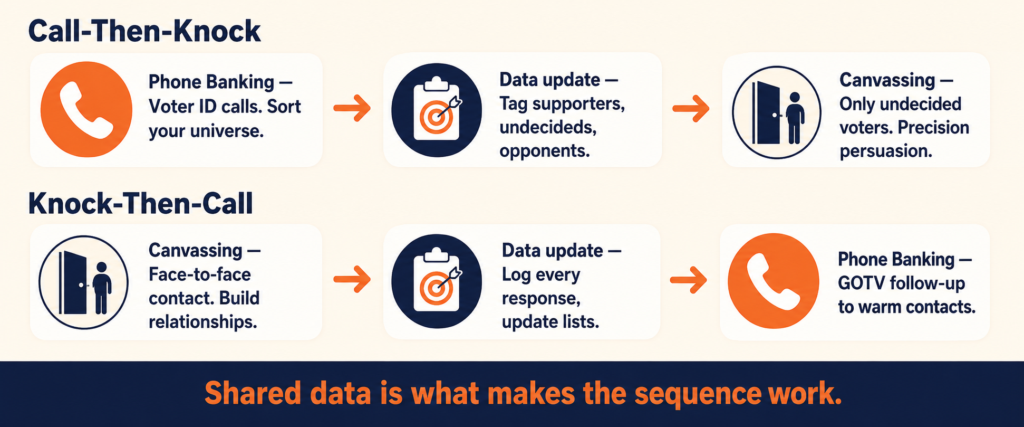
The knock-then-call sequence
Canvassers hit the target list first, making face-to-face contact with identified supporters. Phone banking volunteers then follow up by confirming turnout commitments, answering questions that came up at the door, and delivering GOTV reminders in the final 48 to 72 hours before the polls open.
Australia’s Greens Party MP Jamie Parker ran this sequence in his hyperlocal campaign, pairing door-to-door canvassing with structured phone-banking follow-up throughout the campaign period. The phone calls reinforced the face-to-face contact and kept supporters engaged through to election day.
The call-then-knock sequence
A phone banking voter ID operation runs first to sort the universe into supporters, opponents, and undecided voters. Canvassers then go out with targeted walk lists, spending their face-to-face time entirely on the undecided voters who need persuasion.
This approach makes canvassing significantly more efficient. Instead of a canvasser spending time on a door that opens to a committed opponent or a locked door, every knock goes toward a genuine opportunity for persuasion. The phone banking operation turns canvassing into a precision tool.
Data handoff: Making canvassing and phone banking work together
A combined strategy only works if the data flows both ways. When a canvasser logs a voter ID response, that should update the phone banking list before the next session. When a phone banker records a GOTV commitment, that record should be accessible to field staff running the next day’s walk lists.
In practice, this means CRM or VAN integration: canvassing apps and phone banking software that sync voter responses in real time so neither team duplicates work or misses a high-priority contact.
One organization running a national volunteer recruitment campaign through CallHub made 900,000 calls and recruited 800 volunteers in four months, with every phone banking response flowing directly into NationBuilder so the CRM current across both channels. Phone banking was not a standalone operation; it was the data engine that made the entire ground game more targeted.
For a full walkthrough of setting up a coordinated operation, see our complete guide to political phone banking.
How to decide: a four-question framework
When planning a voter contact operation, answer these four questions. The answers point clearly toward the right balance of tactics.
| Question | Phone banking is usually better when… | Canvassing is usually better when… |
| What is your primary goal? | You need voter ID, GOTV reminders, event reminders, or fast follow-up. | You need deeper persuasion with swing voters or high-priority households. |
| How large is your voter universe? | Your list is large, especially 5,000+ voters in a short outreach window. | Your list is smaller, highly targeted, and concentrated in specific precincts. |
| Where are your volunteers? | Your volunteers are remote, dispersed, or available in short shifts. | Your volunteers are local, know the district, and can knock doors in person. |
| What is your timeline? | You are close to Election Day or behind on outreach and need to scale quickly. | You have months to build a field operation and run repeated in-person contact. |
Ready to use phone banking and canvassing together?
Neither phone banking nor canvassing wins this comparison outright. Canvassing creates deeper in-person contact and stronger persuasion opportunities. Phone banking helps campaigns reach more voters in less time and run GOTV outreach at scale.
For most campaigns, the best strategy is not choosing one over the other. It is using both: canvassing for high-priority precincts and persuasive conversations, and phone banking for voter ID, follow-up, reminders, and large-scale turnout work.
When both tactics share data, campaigns can build a stronger field operation than either channel can deliver alone.
If your campaign is ready to build a phone banking program that works alongside your field team, explore CallHub’s phone banking software built for political campaigns.
Frequently asked questions
Is phone banking as effective as canvassing?
Not per contact. Canvassing yields a larger lift in turnout per conversation (4.3 percentage points vs 3.8 for volunteer phone calls). But phone banking reaches five times more voters per volunteer hour. At scale, phone banking can generate more total votes moved than a canvassing operation with the same number of volunteers. The strongest campaigns use both: canvassing for depth in high-priority precincts, phone banking for breadth across the full universe.
How many doors can a canvasser knock on per hour?
A typical canvasser covers roughly 20 doors per hour, with actual conversations at 25 to 30% of those attempts, yielding around five to six real contacts per hour. The figure varies by neighborhood density, weather conditions, and canvasser experience. In a tight, walkable precinct, that number can run higher.
What is the contact rate for phone banking?
Professional phone center contact rates fell to 6% by 2018 (Kennedy and Hartig, 2019). Volunteer phone banks that use warm lists and call during optimal hours typically see 10 to 12% response rates. Good list hygiene, removing disconnected numbers, DNC contacts, and stale records, improves that rate meaningfully and keeps volunteer time focused on real conversations.
Does virtual phone banking work as well as in-person canvassing?
Virtual phone banking, where volunteers call remotely from home, is as effective as in-person phone banks. The quality of the conversation does not depend on where the volunteer sits. In-person canvassing is a different category entirely: the face-to-face element is the mechanism that creates its larger persuasion effect. Virtual phone banking replaces in-person phone banking. It does not replace canvassing.
What is the difference between phone banking and canvassing?
Phone banking reaches voters by phone call. Canvassing reaches them face-to-face at their door. Both are forms of direct voter contact that outperform one-way outreach methods. Phone banking scales faster and works with remote volunteers. Canvassing creates deeper, more persuasive contact but requires physical presence and more time per voter reached. For a complete breakdown, see our political canvassing guide.
Can phone banking and canvassing be used together?
Yes, and the evidence supports combining them. Both the call-then-knock and knock-then-call sequences outperform either tactic alone. The call-first approach turns canvassing into a precision persuasion tool by pre-sorting the voter universe. The knock-first approach creates warm contacts that a follow-up phone call can then activate for GOTV. The key requirement for either sequence is that canvassing and phone banking data flows into a shared system in real time.
How much does phone banking cost compared to canvassing?
At the per-vote level, phone banking costs approximately $36 per vote secured, compared with $33 for door canvassing. The gap closes when you factor in field canvassing logistics: travel, printed walk packets, organizer time, and the cost of coordinating volunteers across geography. Phone banking is generally lower cost to set up and run per volunteer shift, which matters when budgets are tight and timelines are short.