


Union phone banking starts from a different place than most outreach calls. You are not calling strangers. You are calling people who already belong to the union, work in the same shops, pay dues, receive services, vote in union elections, or have a direct stake in the contract.
That changes the whole call.
The script cannot sound like cold outreach. The list does not come from a voter file. The goal is not always persuasion. Sometimes the goal is turnout. Sometimes it is strike readiness. Sometimes it is fixing bad contact data before the next contract fight.
A strong union phone banking program helps members feel known, not processed. It gives organizers a direct line into worksites, shifts, departments, and member concerns before decisions are made in the room without them.
How union phone banking differs from political phone banking
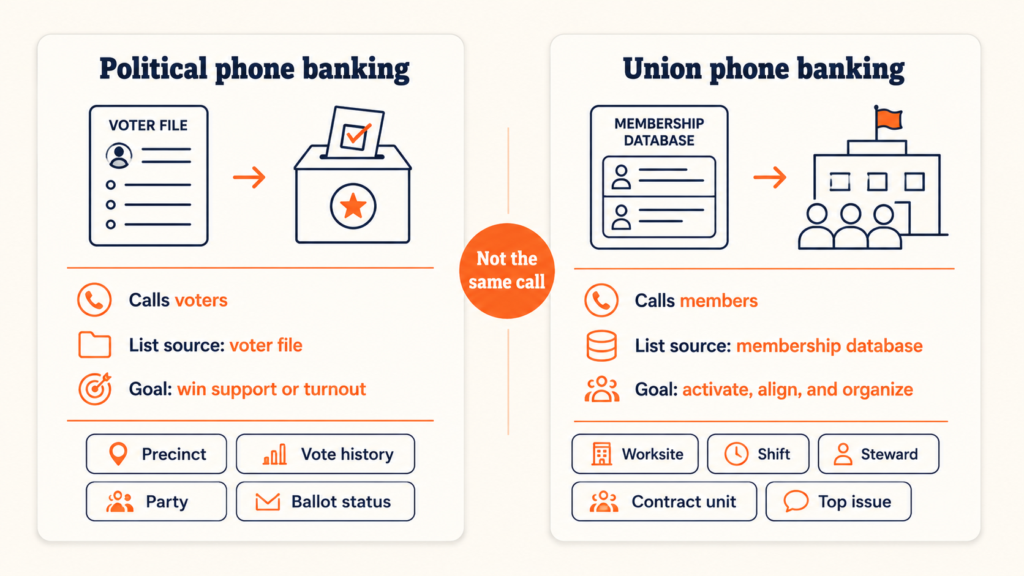
Union phone banking is member outreach by phone. Instead of calling a broad voter file, unions call members, lapsed members, workers, stewards, or union households to mobilize action, collect responses, share updates, and move people through campaigns like contract fights, strike votes, elections, renewals, and member service follow-up.
Political phone banking usually asks, “Can we win your vote?”
Union phone banking usually asks, “Can we count on you to act with us?”
That difference changes the tone, the data, the caller, and the follow-up.
You are calling members, not voters
A voter may have no relationship with the campaign. A union member does.
That relationship may be strong, weak, frustrated, or inactive. But it exists. The member may know the local president, their steward, their grievance rep, or the last time the union did not call them back. That history enters the call before the first sentence.
So the call should not open like a generic campaign script.
Weak opening:
“Hi, I’m calling on behalf of Local 812 to ask if you support our contract campaign.”
Stronger opening:
“Hi, this is Maya with Local 812. I’m calling members in the evening shift at North Plant because bargaining starts next week, and we need to know what issues people want us to push hardest.”
The second version tells the member why the call matters, why they were called, and how their answer will be used.
That is the union advantage. Members are not just targets. They are part of the organization.
Your list is your membership database, not a voter file
Political campaigns often start with a voter file. Union calling starts with the membership database.
That database may include:
- Member name
- Phone number
- Worksite
- Department
- Shift
- Steward assignment
- Membership status
- Dues status
- Contract unit
- Preferred language
- Past event attendance
- Past survey response
- Grievance history, where appropriate
- Political action status, where appropriate
That list is often more useful than a voter file because it reflects the member’s actual relationship with the union. But it also gets stale fast.
Members change shifts. Phone numbers go dead. New workers join. Lapsed members fall off. Retirees may stay politically active. A workplace campaign can get messy if nobody updates the record after calls.
This is why every union phone bank should do two jobs at once:
- Move the campaign forward.
- Improve the member record.
A call that ends with “wrong number” is not a wasted call if the team fixes the database before the next round.
The goal shifts by campaign type
A union calling campaign can serve many goals. That is why one standard script will not work.
Use this table to match the campaign to the call goal.
| Campaign type | Main call goal | Best caller | Key outcome to record |
| Contract campaign | Identify issues and mobilize turnout | Stewards and organizers | Top issue, support level, meeting RSVP |
| Strike authorization | Confirm readiness and vote plan | Trusted stewards and rank-and-file leaders | Yes vote, concerns, turnout plan |
| Electoral GOTV | Turn out union members or union households | Political team and volunteers | Candidate support, vote plan, ballot status |
| Membership renewal | Reactivate lapsed or inactive members | Staff, stewards, or member leaders | Renewal status, reason for lapse, follow-up needed |
| Member services | Follow up on problems and services | Staff or trained reps | Issue resolved, escalation needed, next step |
The call structure should follow the campaign goal. A strike authorization call should not sound like a survey. A grievance follow-up call should not sound like a GOTV script.
The five main use cases for union phone banking
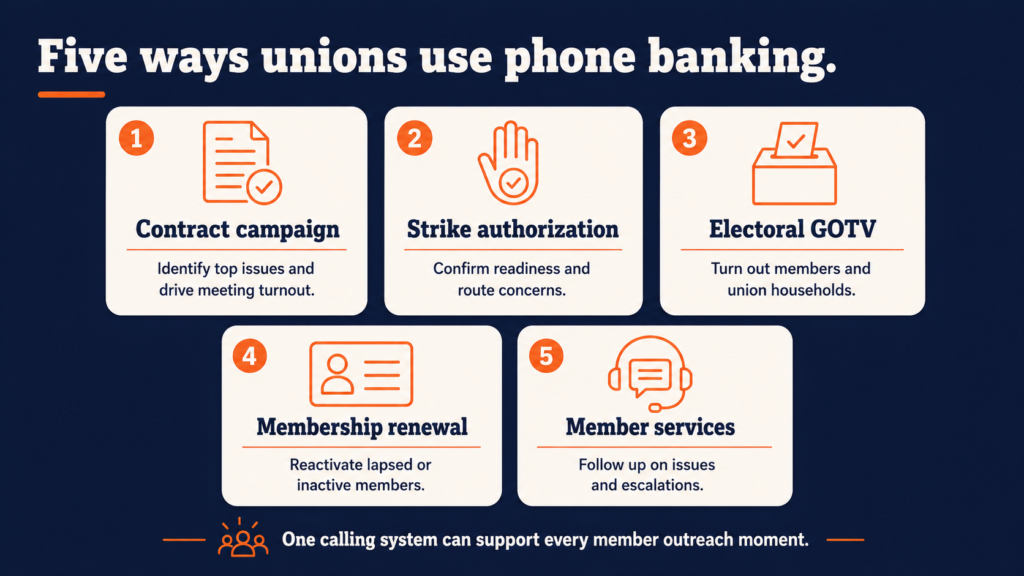
A union phone bank is not one tactic. It is a flexible member contact system.
Most unions use calling across five major situations: contract campaigns, strike authorization, electoral work, member renewal, and member services.
Contract campaign mobilization
Contract campaign calls help the union understand member priorities and build visible support before bargaining.
The best contract phone banks do not just tell members what the bargaining team is doing. They ask members what matters, record the answers, and turn those answers into turnout.
A contract campaign call should answer three questions:
- What issue matters most to this member?
- Will they show up for the next action?
- Who needs a follow-up from a steward or organizer?
A simple contract campaign script can sound like this:
“Hi, this is Jordan with Local 812. I’m calling members at North Plant because bargaining starts next week. We’re asking everyone what issue they most want the bargaining team to prioritize. Is it wages, staffing, scheduling, safety, or something else?”
If the member answers:
“Thanks. We’re asking members with that concern to join the contract meeting on Thursday at 6. Can we count on you to be there?”
The call does not need to solve every issue. It needs to collect the issue, ask for action, and create a follow-up path.
Strike authorization and action alerts
Strike authorization calls are high-stakes because they test unity.
The goal is not just to remind members to vote. The goal is to find concerns early enough to address them. A member who is unsure about a strike vote should not be treated like a “no.” They should be routed to someone they trust.
Many organizers treat 80% yes or higher as the credibility floor for a strike authorization vote. That is not because every union constitution requires 80%. It is because a weak strike authorization result can tell the employer that members are divided.
A strike phone bank should track:
- Yes vote
- No vote
- Undecided
- Needs steward follow-up
- Has strike hardship concern
- Needs childcare or transportation information
- Wants more details on strike benefits
- Already voted
- Wrong number
A strike authorization script should be direct.
“Hi, this is Priya with Local 812. I’m calling because our strike authorization vote is this Friday. The bargaining team needs a strong yes vote to show management that members are united. Have you made a plan to vote?”
If yes:
“Great. What time are you going?”
If unsure:
“Thanks for being honest. What is your biggest concern right now?”
The follow-up matters more than the first call. If a member raises a concern about strike pay, health insurance, retaliation, or timing, route that member to a steward or officer who can answer clearly.
Electoral GOTV and political action
Unions also use phone banking for electoral work, ballot measures, and political action.
This is the use case that looks most like political phone banking, but the audience is still different. You are often calling union members, union households, retirees, or members in a specific local or worksite. The message connects the election to wages, healthcare, staffing, safety, or bargaining power.
Use electoral calls for:
- Member-to-member candidate education
- Ballot measure outreach
- Early vote reminders
- Mail ballot chase
- Polling place information
- Union household GOTV
- Volunteer recruitment for canvassing
- PAC fundraising, where allowed
Keep electoral calls separate from internal union election calls and contract calls. The compliance rules, list permissions, and disclaimers may differ.
For broader electoral calling mechanics, use the complete guide to political phone banking or a focused get out the vote phone banking guide.
Membership renewal and lapsed member reactivation
Renewal calls work best when they start with listening.
A lapsed member may have missed dues because of a job change, layoff, confusion, frustration, or a bad experience. A script that jumps straight to “renew today” can make that worse.
Start with the reason.
“Hi, this is Carla with Local 812. I’m calling because our records show your membership is not active right now. We’re checking in with members to understand what happened and see whether we can help fix it. Is now an okay time?”
Then listen.
Useful outcomes to track:
- Wants to renew
- Needs payment link
- Needs staff follow-up
- Changed job
- Retired
- Moved
- Has unresolved issue
- Does not want to renew
- Wrong number
A renewal phone bank can also uncover deeper organizing problems. If many lapsed members cite the same issue, that is not just a dues problem. It is a campaign signal.
Member services and grievance follow-up
Calling is useful after a member service interaction, too.
A member who filed a grievance, asked a benefits question, or requested help with a workplace issue should not disappear into a case note. A short follow-up call can confirm whether the issue was resolved and whether the member needs escalation.
This kind of call should be handled carefully. Not every volunteer should see sensitive member information. Use staff, trained reps, or stewards with the right access.
A follow-up script can be simple:
“Hi, this is Daniel with Local 812. I’m following up on the scheduling issue you raised last week. I wanted to check whether anyone has gotten back to you and whether the issue is still active.”
Record the next step clearly:
- Resolved
- Not resolved
- Needs rep follow-up
- Needs documentation
- Escalated
- Member unavailable
- Do not discuss by phone
Member service calls build trust because they show the union remembers. That matters before the next mobilization ask.
Who makes the calls: staff, stewards, or volunteers?
The best caller depends on the goal of the call.
A staff organizer can move fast and stay consistent. A steward may have more trust. A rank-and-file volunteer may sound more real than either. A local officer may be best for sensitive calls.
Use this table to decide.
| Caller type | Best for | Avoid using them for |
| Staff organizers | Large call lists, campaign tracking, structured follow-up | Calls where a trusted peer is needed |
| Shop stewards | Contract issues, strike readiness, worksite turnout | Calls outside their worksite or relationship area |
| Rank-and-file volunteers | GOTV, meeting turnout, action reminders | Sensitive grievances or private member issues |
| Local officers | High-value undecided members, leaders, escalations | Broad reminder calls that waste officer time |
| Political volunteers | Electoral GOTV and member-to-voter calls | Internal union election or confidential member service calls |
Do not assign callers only by availability. Assign them by trust.
When shop stewards lead the outreach
Shop stewards are often the strongest callers because they know the workplace.
They know who works nights, who just transferred, who is frustrated about scheduling, and who other members listen to. That context matters more than a perfect script.
Use steward-led calls when:
- The campaign is worksite-specific.
- The issue is tied to the contract.
- Members need trusted answers.
- The call may surface concerns or conflict.
- Follow-up depends on workplace knowledge.
A steward should not need a long script. They need the goal of the call, the key ask, the common answers, and a simple way to record outcomes.
When to involve rank-and-file volunteers
Rank-and-file volunteers are useful when the campaign needs reach and peer energy.
Use them for:
- Meeting reminders
- Rally turnout
- GOTV calls
- Petition follow-up
- Member survey calls
- Strike vote reminders, if trained
- Volunteer recruitment
Train them on boundaries. A volunteer can remind a member about a vote. They should not guess at legal rights, contract language, dues rules, or grievance outcomes.
Give volunteers a simple handoff line:
“That is a good question, and I do not want to guess. I’m going to mark this for a steward follow-up so someone can give you the right answer.”
That one sentence prevents bad information from spreading.
Building your call list from the membership database
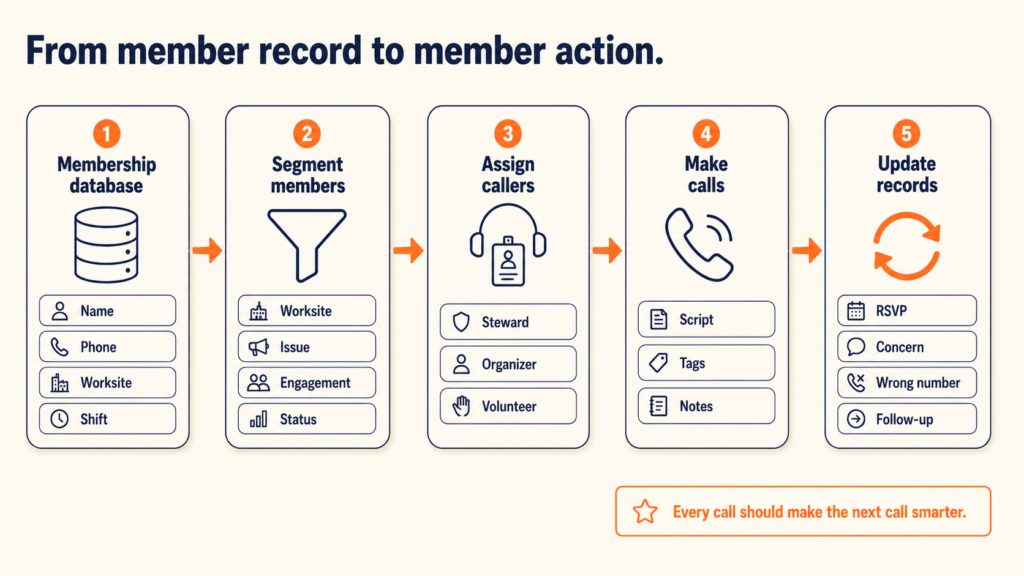
Your membership database should be the source of truth for union phone banking.
The phone bank should not create a second version of the truth in a spreadsheet that never gets updated. Every call outcome should improve the member record or trigger a follow-up.
Using your membership database as the source of truth
Before launching a phone bank, decide which database fields matter for the campaign.
For a contract campaign, you may need:
- Worksite
- Department
- Shift
- Steward assignment
- Contract unit
- Top issue
- Meeting attendance
- Support level
- Follow-up owner
For a political campaign, you may need:
- Member household status
- Voting district
- Candidate or issue support
- Early vote status
- Mail ballot status
- Volunteer interest
- PAC status, where relevant
For a renewal campaign, you may need:
- Membership status
- Dues status
- Last payment date
- Lapse reason
- Renewal link sent
- Staff follow-up needed
Do not make callers scroll through 30 fields. Show them what helps the conversation.
Segmenting by workplace, shift, issue, or engagement level
A union calling campaign gets better when the list is segmented.
Useful segments include:
- Worksite
- Department
- Shift
- Steward area
- Bargaining unit
- New members
- Lapsed members
- High-engagement members
- Low-engagement members
- Members who attended the last meeting
- Members who opened a text or email
- Members who have not been reached in 90 days
- Members who raised a specific issue
Segmentation helps you make the call feel specific.
Generic:
“We’re calling members about the contract.”
Specific:
“We’re calling night-shift members at North Plant because staffing and overtime came up in bargaining prep.”
The second version tells the member this call is about their real workplace.
Keeping contact data current
Bad phone numbers are an organizing problem.
If 20% of your membership database has stale phone numbers, every campaign starts with a reach problem. The fix is not one big cleanup project every few years. The fix is making data updates part of every call.
Track these outcomes:
- Wrong number
- Disconnected
- New number collected
- Prefers text
- Prefers email
- Language update
- Shift changed
- Worksite changed
- Retired
- Left employer
- Still active
A phone bank should also have a “data repair” follow-up path. If a steward knows the member’s new number, update it. If a text gets a reply with a new phone number, update it. If a member says they moved worksites, update it before the next list pull.
This is where connected systems matter. A calling tool that does not update the membership database creates more cleanup later.
Writing scripts for union calling campaigns
A union script should sound like a member conversation, not a marketing pitch.
The script should give callers structure without making them sound robotic. It should also make clear what the caller should record after the call.
For general script structure, these phone banking script templates can help. For union calls, adapt the opening, issue language, and follow-up path to the campaign type.
The core elements of a union script
Every union calling script needs six parts:
- Who is calling.
- Why this member is being called.
- Why the issue matters now.
- One main question.
- A clear ask.
- A disposition or follow-up outcome.
Here is a contract campaign version.
“Hi, is this Ana?
This is Marcus with Local 812. I’m calling members at North Plant because bargaining starts next week, and we’re checking what issues members want the team to prioritize.
The top issues we’re hearing are staffing, overtime, and safety. Which one is most important to you right now?”
If the member answers:
“Thanks. We’re asking members to attend the contract meeting this Thursday at 6 so the bargaining team can show management where members stand. Can we count on you to be there?”
Record:
- Top issue
- Meeting RSVP
- Support level
- Needs follow-up
- Notes
That is enough. The call has a purpose, and the data can be used.
How to adapt the script by use case
The best union phone banking scripts change the main question.
| Use case | Main question | Main ask |
| Contract campaign | “Which issue matters most to you?” | Attend the contract meeting |
| Strike authorization | “Have you made a plan to vote?” | Vote yes and confirm turnout |
| Electoral GOTV | “Do you have a plan to vote?” | Vote early, by mail, or on election day |
| Renewal | “Can you share what led to the lapse?” | Renew or schedule staff follow-up |
| Member services | “Was the issue resolved?” | Confirm resolution or escalate |
Do not use a GOTV script for a contract fight. Do not use a renewal script for a strike vote. Members can tell when the union is not listening to the actual moment.
Handling member skepticism and disengagement
Some members will push back.
That does not mean the call failed. It means the member trusted the caller enough to say what they think.
Common concerns include:
“I never hear from the union unless you need something.”
Response:
“That is fair, and I appreciate you saying it. Part of why we’re calling is to make sure we are hearing from members before decisions get made. What would you want the local to do differently?”
“I do not think a strike will work.”
Response:
“I hear you. A strike vote is a serious step. What is your biggest concern about it right now?”
“I already told someone about this issue.”
Response:
“Thanks for letting me know. I do not want you to have to repeat yourself again after this call. I’m going to mark this for follow-up and note that you already raised it.”
“I’m not interested.”
Response:
“Understood. Before I let you go, is there anything you want us to update in your contact information or worksite record?”
Do not argue with members. Record the concern and route it to the right person.
Compliance: what union organizers need to know
Union phone banking sits inside different rules depending on the campaign.
A contract campaign, internal union election, federal political campaign, PAC call, and member service follow-up may all have different requirements. Treat compliance as part of campaign setup, not something to check after the script is written.
This section is not legal advice. Use it as a planning checklist and confirm the details with counsel, your international, or your compliance team.
LMRDA restrictions on using membership lists
The Labor-Management Reporting and Disclosure Act matters when calls involve internal union elections.
Section 401(g) says union dues, assessments, similar union funds, and employer money cannot be used to promote a candidate in a covered union election. Section 401(c) gives a bona fide candidate the right, once within 30 days before an election, to inspect a list with members’ names and last known addresses. The statute refers to names and addresses, not a general right to export phone numbers.
Use the full statutory text here: 29 U.S. Code § 481.
For phone banking, the practical rule is this:
Keep internal union election activity separate from union-funded organizing, member services, contract, and political programs.
Before anyone uses a membership list for internal candidate calls, confirm:
- Who owns the list.
- Who can inspect the list.
- Whether phone numbers can be used.
- Whether union phones, staff time, office space, software, or funds can be used.
- Whether all candidates receive equal treatment.
- What records need to be preserved.
Do not let a normal member outreach phone bank accidentally become an internal election campaign.
PAC rules and separating internal vs. external political outreach
Union political calls need careful setup.
A union may call members about endorsed candidates, ballot measures, or GOTV, but the rules can change based on whether the campaign is internal member communication, PAC activity, independent expenditure work, or coordinated electoral activity.
Before launching political calls, decide:
- Is this call to members only, union households, or the general public?
- Is the call about a federal, state, or local election?
- Is PAC money involved?
- Is the call coordinated with a candidate or party?
- Does the script include express advocacy?
- Are disclaimers required?
- Can the membership list be used for this purpose?
- Which staff or volunteers may access the list?
Do not mix electoral lists and contract lists unless your compliance team approves the data use. A member who gave a phone number for workplace updates may not expect that number to be used in a broader political program.
TCPA considerations for outbound calling
Phone banking also touches calling and texting rules.
Political and nonprofit calls are treated differently from commercial telemarketing, but that does not mean every call or text is free from rules. Autodialed calls, prerecorded voice messages, wireless numbers, consent, opt-outs, caller ID, time-of-day restrictions, and state laws can all matter.
Use the FCC’s political calling and texting guidance as a starting point: Rules for political campaign calls and texts.
For union campaigns, build these checks into setup:
- Scrub internal do-not-call requests.
- Honor opt-outs across channels.
- Keep caller ID clear.
- Track consent where needed.
- Avoid calling outside permitted hours.
- Separate prerecorded voice from live volunteer calls.
- Review state-specific rules before large campaigns.
- Keep records of scripts, lists, and suppression logic.
If your campaign uses texting, prerecorded calls, or automated dialing, get compliance review before launch.
Tools and technology for union phone banking
Union phone banking software should do more than dial numbers.
It should help the union keep member context, protect lists, assign the right callers, update records, and connect calls to the next action.
What a union actually needs from a calling platform
Unions looking for a general overview of calling platform capabilities can start with CallHub’s phone banking software page before reviewing the union-specific features below. A union calling platform should support:
- List upload and segmentation
- Caller assignment by worksite, shift, or steward area
- Branching scripts
- Tags, notes, and dispositions
- Call recording controls, where allowed
- Live monitoring for training
- Volunteer access controls
- Real-time dashboards
- Follow-up text and email options
- CRM or membership database sync
- Opt-out and suppression management
- Role-based access for locals, chapters, or regions
For smaller locals, the most important feature is simplicity. For larger unions, the most important feature is coordination across locals, staff, and programs.
CallHub’s phone banking platform for unions supports calling, texting, and email for member mobilization, GOTV, surveys, and union communications. Its call center software also supports branching scripts, call outcomes, CRM sync, and follow-up flows.
Use tools only where they reduce work. A tool that adds another export, another login, and another report may make the campaign look more organized while making the organizer’s job harder.
CRM integration and keeping member records up to date
Union outreach gets messy when the phone bank and membership database do not talk.
The caller learns that a member changed shifts. The phone banking report shows “updated,” but the membership database stays wrong. The next campaign pulls the old shift again.
That is the coordination trap.
A better setup pushes outcomes back to the member record:
- Wrong number updates the contact record.
- New worksite updates the member profile.
- Strike vote concern creates a follow-up task.
- Meeting RSVP updates the event list.
- Lapsed member renewal updates membership status.
- No answer triggers a text or email follow-up.
CallHub supports integrations such as NationBuilder and NGP VAN, and its workflow automation can route members to the next step based on call outcomes.
The goal is simple: every call should make the next call smarter.
Conclusion
Union phone banking works because the relationship already exists.
You are not starting from zero. You are calling members, workers, retirees, or union households who already have a stake in the organization. The job is to activate that relationship with the right ask, the right caller, and the right follow-up.
A union that runs calling well across contract campaigns, strike votes, electoral work, renewals, and member services builds more than a call list. It builds a stronger member connection for the next fight.
For broader calling mechanics, use the complete guide to political phone banking. For union-specific outreach across calls, texts, and email, explore CallHub’s phone banking platform for unions.
FAQ
What is union phone banking?
Union phone banking is organized outreach where union staff, stewards, or member volunteers call members, workers, retirees, or union households to mobilize action, collect responses, share updates, or follow up on issues.
How is union phone banking different from political phone banking?
Political phone banking usually calls voters from a voter file. Union phone banking calls people with an existing relationship to the union, often from a membership database. The goal may be contract mobilization, strike readiness, renewal, member services, or electoral GOTV.
What is a union calling campaign?
A union calling campaign is a planned phone outreach effort tied to a union goal, such as contract turnout, strike authorization, member renewal, political action, or grievance follow-up. It uses a defined list, script, caller team, and response tracking process.
Who should make union phone bank calls?
The best caller depends on the campaign. Staff can handle scale and consistency. Stewards are best for workplace-specific trust. Rank-and-file volunteers work well for turnout and reminders. Officers should handle high-value, sensitive, or escalated calls.
How do unions use phone banking for elections?
Unions use phone banking for member-to-member candidate education, ballot measure outreach, early vote reminders, mail ballot chase, volunteer recruitment, and GOTV. These calls should follow PAC, election, and list-use rules.
Can a union use its membership list for political calls?
Sometimes, but the rules depend on the type of election, funding source, audience, and list permissions. Internal union elections, member communications, PAC activity, and external political outreach can have different rules. Confirm with counsel before using a membership list for political calls.
What should a union phone banking script include?
A union script should include who is calling, why the member is being called, why the issue matters now, one main question, a clear ask, and a response outcome to record.
What software do unions use for phone banking?
Unions use phone banking software that can upload member lists, assign callers, show scripts, record responses, track outcomes, and sync results back to the membership database. Larger unions also need role-based access, reporting, texting, and CRM integrations.