
Every advocacy director gets the same shortlist when they ask for recommendations: NationBuilder, EveryAction, VoterVoice. Those platforms are legitimate. They’re also priced for organizations that need everything, and most nonprofits don’t. Most need specific capabilities (phone banking, action alerts, and constituent calling programs) and end up paying for a CRM, donor management, and event ticketing they already have somewhere else.
This guide to advocacy software for nonprofits takes a different approach. Instead of ranking 12 platforms alphabetically, it maps tools to the four campaign models that drive nonprofit advocacy. By the end, you’ll know which type of platform fits how you actually run campaigns, and when it’s worth layering a specialist tool on top of what you already have.
What is advocacy software for nonprofits?
Advocacy software for nonprofits is a category of tools that helps organizations mobilize supporters, communicate with elected officials, and coordinate campaigns across phone, text, email, and digital action channels. It covers everything from patch-through calling systems to online petition tools to legislative targeting platforms.
The category includes both all-in-one platforms (NationBuilder, EveryAction) that combine CRM, fundraising, and advocacy in one system, and specialist tools (CallHub, VoterVoice) that focus on one or two channels and integrate with the CRM you already use.
How advocacy software differs from a general nonprofit CRM
A general nonprofit CRM (Salesforce Nonprofit Success Pack, Bloomerang, DonorPerfect) tracks relationships, donations, and program participation. It stores your data.
Advocacy software acts on that data. It dials your supporters at scale, sends action alerts to the right legislative districts, tracks whether a constituent call reached a target legislator’s office, and reports outcomes back to the record.
| Nonprofit CRM | Advocacy software |
|---|---|
| Stores contacts, gifts, and relationships | Activates contacts in campaigns |
| Tracks program participation | Tracks campaign outcomes (calls placed, bills influenced) |
| Runs reports on fundraising | Runs reports on constituent engagement |
| Manages your database | Connects your database to elected officials, legislative systems, and multi-channel outreach |
Most advocacy-focused nonprofits need both. The question is whether you buy an all-in-one platform that tries to do both, or connect a specialist advocacy tool to an existing CRM.
501(c)(3) vs. 501(c)(4): Does your tax status change what you need?
Yes, but modestly. A 501(c)(3) organization faces strict limits on direct lobbying activity (generally no more than 5–20% of total activities under the substantial part test). A 501(c)(4) social welfare organization has more latitude for lobbying and political activity.
The practical impact on software: 501(c)(3)s conducting issue advocacy (contacting legislators about a policy, not endorsing a candidate) can use any advocacy tool. 501(c)(4)s running direct lobbying or electoral campaigns may need platforms with built-in compliance controls and lobbying disclosure tracking. If you’re unsure which activities apply to your organization, consult legal counsel before signing any software contract.
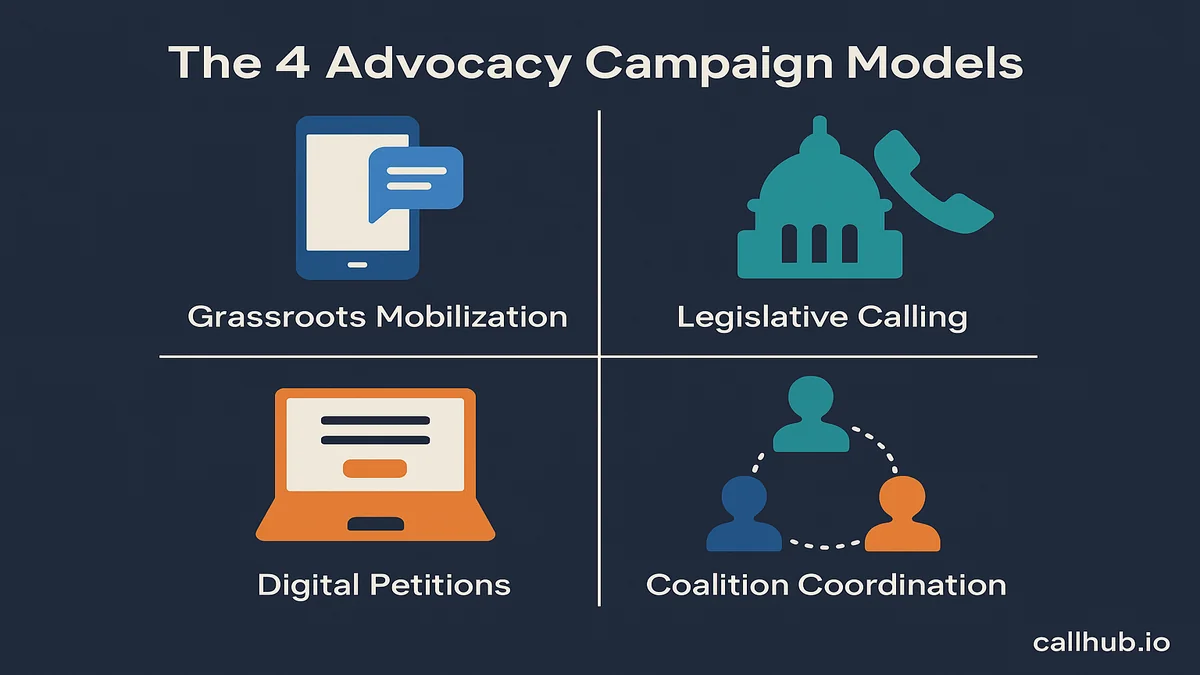
The four advocacy campaign models and the tools that fit each
No single platform wins across all four of these. The right tool depends on which model your campaigns primarily run on.
Grassroots mobilization campaigns
Grassroots mobilization is about turning supporters into participants. Your job is to reach as many people as possible, get them to take action (sign a petition, call their representative, attend a rally), and do it at a cost per contact that doesn’t drain the program budget.
Text messaging is the dominant channel here. Nonprofits averaged 21 advocacy and fundraising texts per subscriber in 2024, according to MissionWired’s nonprofit texting insights report, and SMS open rates run at 98% versus 20–30% for email. For grassroots mobilization at scale, peer-to-peer texting (where volunteers text supporters individually from a shared queue) produces higher engagement than broadcast texts because replies route back to the same volunteer.
Tools that fit this model: CallHub (peer-to-peer texting and text broadcasting), Action Network (email plus social action, free tier available), and EveryAction for organizations that need integrated fundraising alongside mobilization.
Legislative calling and patch-through campaigns
Legislative campaigns run on constituent contact. Your supporters call their senator, your staff tracks whether the call went through, and your lobbyist reports the volume to the legislative office. Speed matters: A vote happens in 48 hours, and you need to move 500 calls before it does.
Patch-through calling is the mechanism. A supporter calls a hotline (or clicks a link in an email), hears a brief message, and is transferred directly to their legislator’s office. The platform routes the call, tracks the outcome, and lets you report constituent engagement in real time.
VoterVoice is the specialist here. It combines legislative targeting (routing callers to the right district office based on their zip code), action alert emails, and patch-through calling in one platform built for government relations teams. CallHub also runs patch-through campaigns for organizations that need a high-volume phone component without a full legislative database.
Digital petition and action alert campaigns
Digital advocacy tools focus on online actions: Petition signatures, letter-writing to legislators, email-your-representative forms, and social media amplification. The defining feature is the advocacy network, which pre-populates forms with supporter addresses, matches them to the right elected official, and tracks whether submissions were delivered.
Bonterra’s FastAction network has 25 million pre-filled supporter profiles (Bonterra), which increases petition completion rates by removing friction from the submission process. Action Network offers similar functionality on a nonprofit-friendly pricing model, with a free tier for organizations under 10,000 contacts.
Tools that fit this model: Bonterra/EveryAction (largest advocacy network, most government affairs integrations), Action Network (cost-effective for grassroots digital campaigns), and NationBuilder (strong for email-driven action alert campaigns).
Coalition and volunteer coordination campaigns
Coalition campaigns involve multiple organizations working together: Shared messaging, joint events, coordinated days of action. The coordination challenge is different from single-org advocacy. You need to manage lists that belong to multiple organizations, assign work across staff from different groups, and report outcomes back to each coalition partner separately.
NationBuilder handles this well with its “nation” concept, where organizations can share data within a controlled permission structure. Salesforce NPSP with an advocacy add-on is common for large coalitions with existing Salesforce infrastructure.
For the outreach execution layer (phone banking and texting) within a coalition, CallHub’s communication platform for nonprofits supports multi-organization access, separate reporting by organization, and list management across coalition partners.
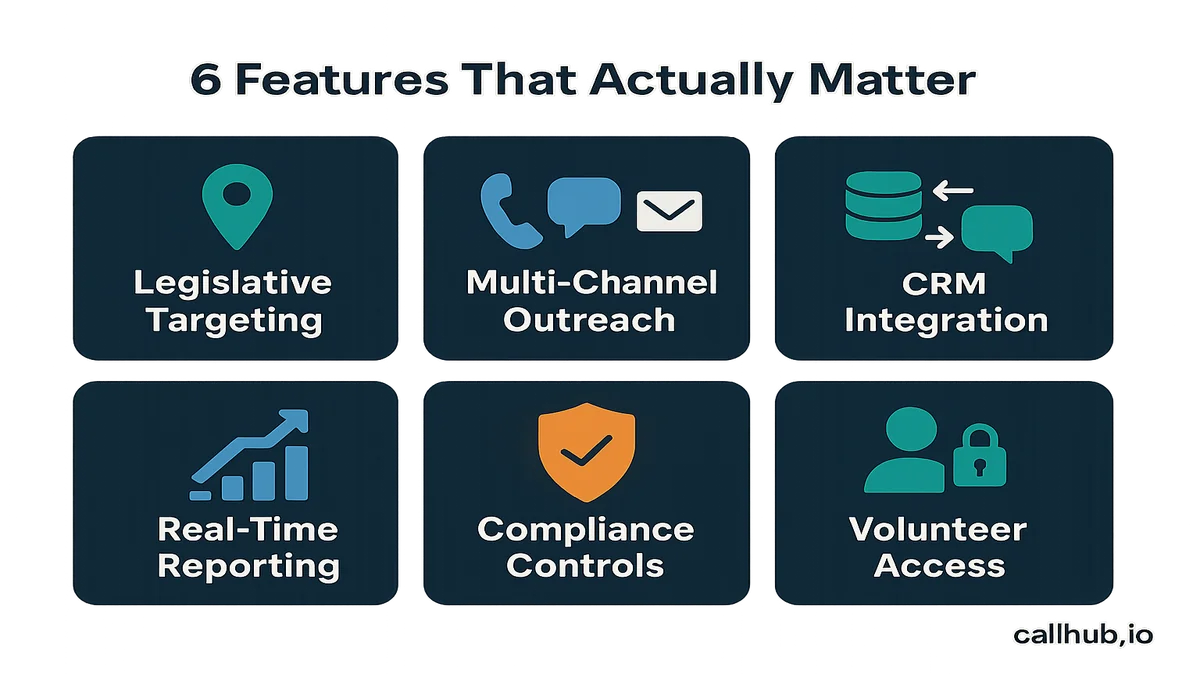
The 6 features that actually matter in nonprofit advocacy software
Most vendor feature pages list 40+ capabilities. These six determine whether the platform actually fits your program.
- Legislative targeting: Does the platform automatically route constituents to the right legislative district based on their address? Essential for any federal or state lobbying campaign. VoterVoice and EveryAction include this natively. CallHub does not. It’s built for volume calling and texting, not legislative matching.
- Multi-channel outreach: Phone, text, email, and online action in one platform, or at minimum, clean integration with the channels you use. A platform that forces you to export lists to send a text message defeats the purpose of unified outreach.
- CRM integration: Two-way sync with your existing CRM. As Tim Petterson, Communications and Campaigns Director at Hospo Voice, puts it: “NationBuilder is probably the source of truth for us. It works for us combined with other tools like CallHub and the other platforms that we use.” The advocacy tool should write outcomes back to the record automatically, not require a manual import.
- Real-time reporting: Know whether your supporters are reaching legislator offices, how many calls went through, and which districts are underperforming. All of this during the campaign, not the next morning.
- Compliance controls: Opt-out management, TCPA compliance for text messaging, and state-level calling restrictions. This is especially important for 501(c)(3) organizations that need to document the advocacy-versus-lobbying split in their activities.
- Volunteer access controls: Most nonprofit advocacy runs on volunteers. The platform needs to let volunteers take action without exposing your full contact database. Branded portals, limited-access accounts, and session-based controls are table stakes.
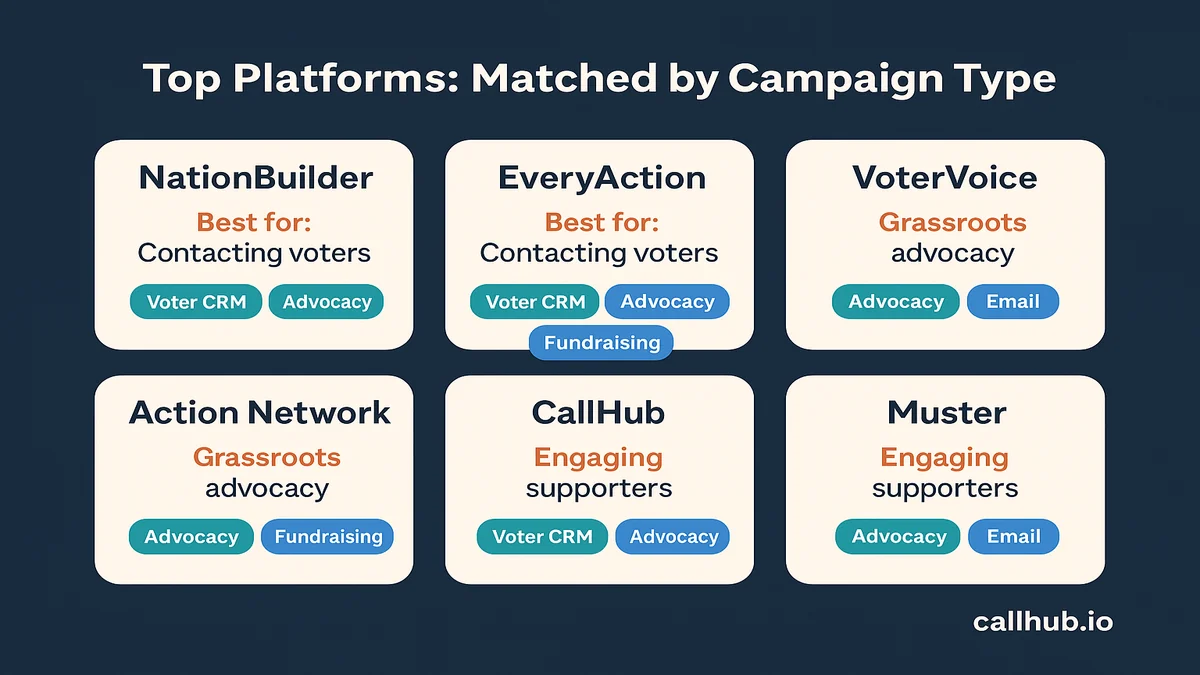
Top advocacy software for nonprofits: Matched by campaign type
| Tool | Best for | Starting price | Patch-through calling | Legislative targeting | CRM integration |
|---|---|---|---|---|---|
| NationBuilder | Email-driven action alerts, coalition coordination | ~$39/mo | No | Basic | Built-in CRM |
| EveryAction by Bonterra | All-in-one: Fundraising plus advocacy plus CRM | Custom | Yes (via integrations) | Yes | Built-in CRM |
| VoterVoice | Legislative calling, government relations | Custom | Yes | Yes | Integration-based |
| Action Network | Grassroots digital petitions, budget-conscious orgs | Free / $10–$100/mo | No | Basic | Limited |
| CallHub | Phone banking, peer-to-peer texting, high-volume calling | Usage-based | Yes | No | Salesforce, NationBuilder, Raiser’s Edge |
| Muster | Small-to-mid advocacy orgs, legislative campaigns | ~$100/mo | Yes | Yes | Integration-based |
NationBuilder
NationBuilder is the most flexible of the all-in-one options. Its strength is list management and email-driven campaign coordination. The platform makes it relatively easy to run multi-layered action alert campaigns, track supporter history across years, and manage coalition networks with granular permission controls. Its weakness for serious advocacy programs is the limited built-in calling infrastructure. Organizations with high-volume phone banking needs typically connect a specialist calling tool on top.
EveryAction by Bonterra
EveryAction is the highest-ceiling all-in-one option, and the most expensive. Its FastAction pre-filled network’s 25 million supporter profiles is a real advantage for petition-heavy campaigns. Fewer clicks to complete an action means more completions. The platform covers fundraising, CRM, advocacy, email, and event management in one place. It’s the right choice for mid-to-large organizations that want to consolidate tools, not the right choice for a small nonprofit that only needs outreach and action alerts.
VoterVoice
VoterVoice is purpose-built for government affairs teams. Its legislative database and district-routing engine is the most accurate of any platform on this list. If your primary activity is constituent lobbying (driving volume calls and emails to legislative targets), VoterVoice is worth the pricing conversation. It doesn’t try to replace your CRM or handle fundraising.
Action Network
Action Network sits at the other end of the budget spectrum. The free tier supports up to 10,000 contacts with unlimited action pages, basic email, and petition tools. The paid tier adds API access and advanced reporting. For grassroots organizations running entirely on digital actions and email, it covers the essentials at a price that doesn’t require a board vote to approve. Its limitations show at scale: No phone integration, no patch-through calling, and basic reporting compared to EveryAction or VoterVoice.
CallHub
CallHub is not a full advocacy platform. It’s the specialist for phone and SMS campaigns. CallHub reports delivering 355 million calls and texts to 32 million contacts, serving 3,000+ organizations including Human Rights Campaign, Amnesty International, and American Red Cross.
Where CallHub fits in a nonprofit advocacy stack: Organizations that already have a CRM or all-in-one platform and need serious phone banking and peer-to-peer texting on top of it. CallHub connects to Salesforce, NationBuilder, and Raiser’s Edge, syncing contact data in both directions so call and text outcomes write back to your primary record.
For organizations adding peer-to-peer texting to their programs, CallHub platform data shows a 93% increase in overall revenue and a 108% increase in gifts for nonprofits that made the shift. Pair that figure with the MissionWired open rate data for a more complete picture.
John Chrastka, Founder and Executive Director of EveryLibrary (America’s Library PAC), describes the fit: “We’ve really found that CallHub has that capability that lets our campaigns integrate the data side and to bring the easy-to-use, intuitive-to-manage technologies to these volunteers with a small amount of training.”
See the guide to running a grassroots political advocacy campaign for how phone and text fit into a multi-channel advocacy structure.
Muster
Muster targets the middle of the market: Advocacy-focused nonprofits and associations that want legislative targeting and action alert management without EveryAction’s price tag. Its patch-through calling and legislator contact tools are solid, and the interface is simpler than VoterVoice’s. It’s worth a demo if you’re in the $100–$500/month range and your primary activity is legislative campaigns.
What does advocacy software cost for nonprofits?
Advocacy software pricing is one of the least transparent categories in nonprofit tech. Most vendors require a demo before sharing numbers. Here’s what published data reveals.
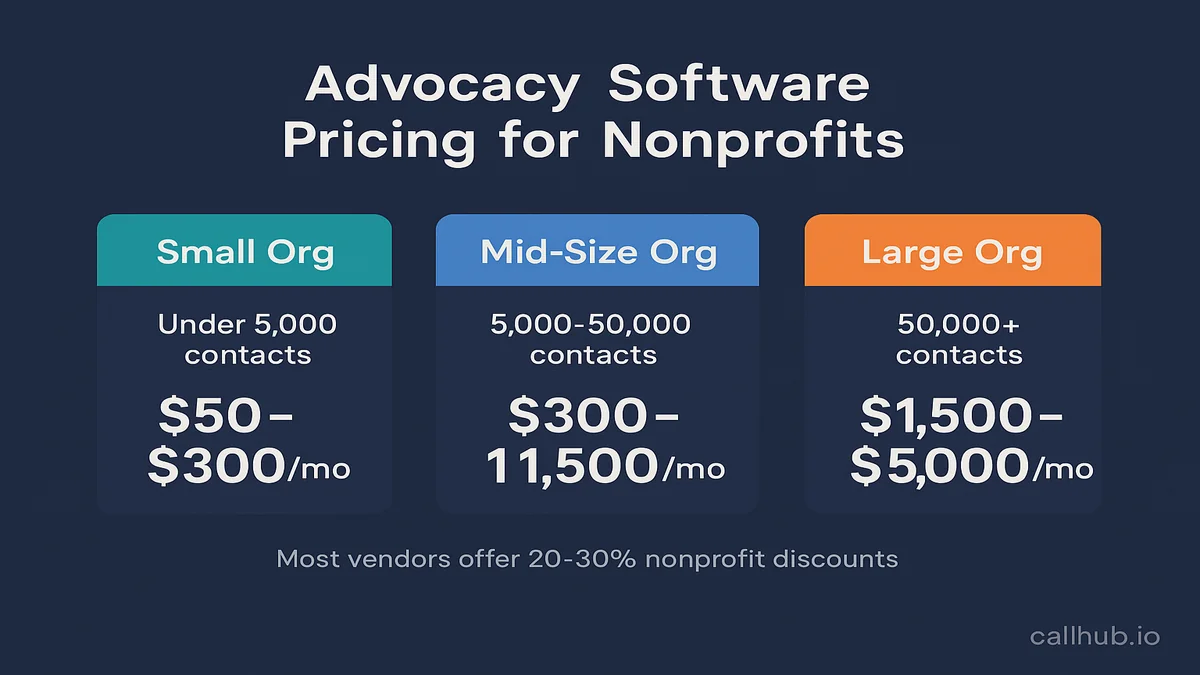
According to Muster’s advocacy software pricing guide, typical price ranges break down by organization size:
| Organization size | Typical monthly cost |
|---|---|
| Small (under 5,000 contacts) | $50–$300/month |
| Mid-size (5,000–50,000 contacts) | $300–$1,500/month |
| Large (50,000+ contacts) | $1,500–$5,000+/month |
Enterprise platforms like EveryAction and Salesforce NPSP with advocacy add-ons sit at the top of these ranges or above them. Action Network’s free tier is the exception for budget-constrained organizations.
Pricing models: Per-contact, per-action, and flat monthly
Per-contact: You pay based on your database size. Common for all-in-one platforms. Cost scales with list growth, which can create budget surprises during a fast-growth campaign.
Per-action: You pay per petition signature, call placed, or message sent. Common for usage-heavy advocacy tools. Predictable for planning but can spike during high-activity campaigns.
Flat monthly: A fixed fee for a set number of contacts and features. Most common for SMB-tier tools like Muster’s entry pricing.
CallHub uses usage-based pricing for calls and texts. That works well for organizations with episodic campaign schedules: You pay more during a legislative push and less during quieter months.
What free options actually cover
Action Network’s free tier is real and functional for digital advocacy:
- Unlimited action pages (petitions, email-your-rep, events)
- Up to 10,000 contacts
- Basic email campaigns
- Public API access
What it doesn’t cover: Phone banking, patch-through calling, advanced reporting, or dedicated support.
For phone and text programs, there’s no meaningful free tier. For nonprofit discounts, most vendors offer 20–30% off list price for verified 501(c)(3) organizations. Ask specifically during a demo. It’s rarely listed publicly.
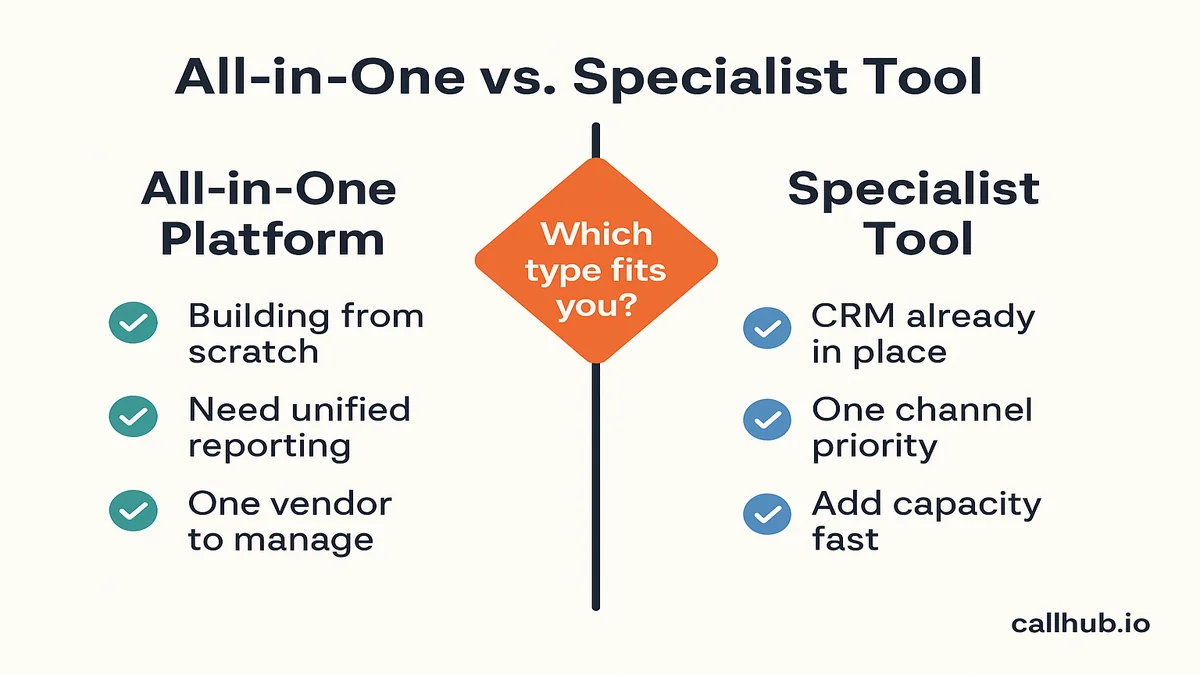
All-in-one platform vs. specialist tool: Which fits your nonprofit?
| All-in-one wins when | Specialist wins when |
|---|---|
| You’re consolidating tools and reducing vendor count | You have an existing CRM you’re committed to |
| Fundraising and advocacy live in the same program | Your primary need is one channel (phone, text, or digital action) |
| You want unified reporting across all activities | You want top-tier execution in a specific channel |
| Your team can’t manage integrations | Your current stack already covers donor management and CRM |
| You’re building a program from scratch | You need to add capacity quickly without a full platform migration |
The most common pattern for mid-size nonprofits: An existing CRM (Salesforce, NationBuilder, or Bloomerang) plus a specialist for the primary campaign channel. A grassroots mobilization organization might run NationBuilder as its CRM and CallHub for peer-to-peer texting and phone banking. A government affairs team might use Salesforce NPSP and VoterVoice for legislative targeting.
The organizations that struggle are the ones who buy an all-in-one expecting it to work well everywhere and find that the phone banking module is weak, email deliverability is mediocre, and the platform does everything at a B-minus level rather than one thing well.
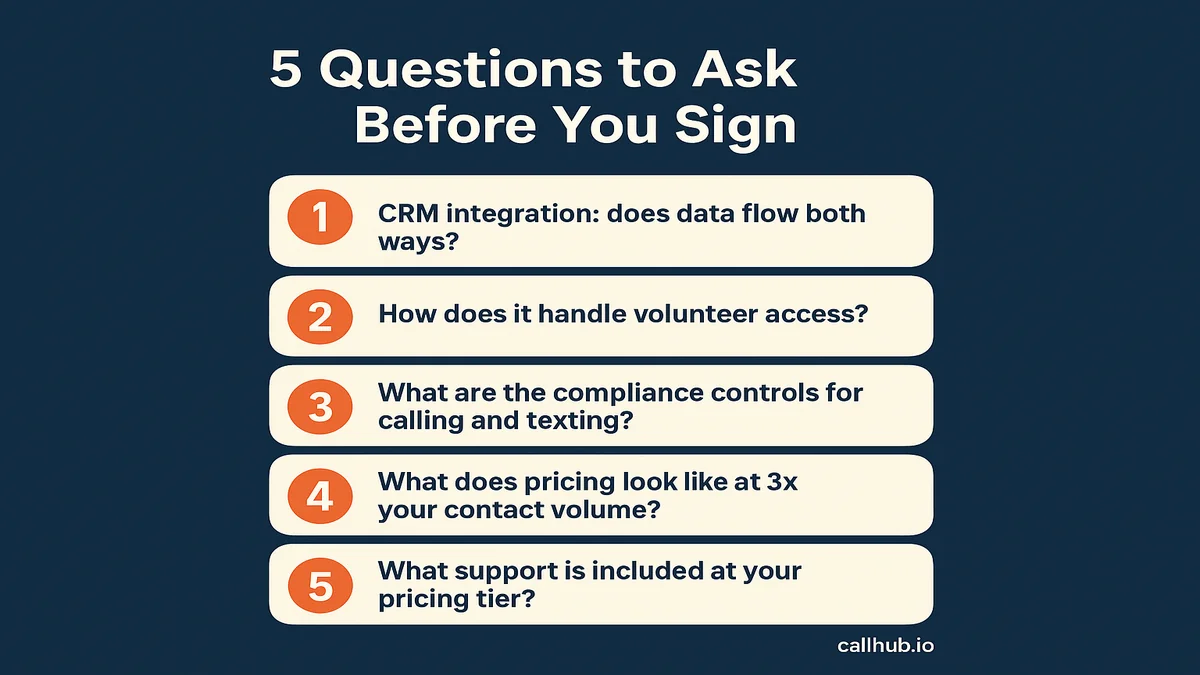
5 questions to ask before signing any advocacy software contract
- Does it integrate with your current CRM, and does data flow both ways? A one-way integration (contacts in, nothing back) is not a real integration. Campaign outcomes need to write back to the contact record automatically.
- How does it handle volunteer access? Can volunteers take action without seeing your full contact database? What does the volunteer-facing interface look like on a phone?
- What are the compliance controls for calling and texting? TCPA compliance, state-specific calling restrictions, and opt-out management must be automatic, not manual. Ask how the platform handles do-not-contact requests in real time.
- What does the pricing look like at three times your current contact volume? You may grow. Don’t sign a contact-based pricing contract that becomes unaffordable at 50,000 contacts if you’re planning to reach that number in two years.
- What support does the nonprofit pricing tier include? Discounted pricing sometimes means reduced support. Know whether you’re getting onboarding assistance, a dedicated account manager, or a shared support ticket queue before you commit.
Ready to add phone banking and peer-to-peer texting to your advocacy campaigns?
Most nonprofits don’t face a choice between advocacy software and their current CRM. They face a choice between accepting weak phone and text capabilities in their all-in-one platform, or adding a specialist tool that handles those channels properly.
For organizations running constituent calling campaigns, grassroots mobilization via text, or patch-through calling programs, CallHub layers on top of any existing CRM or advocacy platform. Contacts sync in from Salesforce, NationBuilder, or Raiser’s Edge. Call and text outcomes write back automatically. Volunteers work through a simple browser-based interface that requires minimal training.
See how CallHub works for nonprofit advocacy campaigns or read the phone banking guide for nonprofits to understand what a dedicated calling program adds to an advocacy stack.
Frequently asked questions
What is the best advocacy software for nonprofits?
There’s no single best platform. The right tool depends on your campaign model. For legislative calling and patch-through campaigns, VoterVoice leads. For all-in-one advocacy plus fundraising, EveryAction is the ceiling. For phone banking and peer-to-peer texting at scale, CallHub is the specialist. For budget-constrained organizations doing digital advocacy, Action Network’s free tier covers the essentials.
How much does nonprofit advocacy software cost?
Small organizations typically pay $50–$300 per month. Mid-size organizations (5,000–50,000 contacts) pay $300–$1,500/month. Large organizations pay $1,500–$5,000+/month for enterprise platforms. Most nonprofit-focused vendors offer 20–30% discounts for verified 501(c)(3) organizations.
What is the difference between advocacy software and a nonprofit CRM?
A nonprofit CRM stores your contacts, donation history, and relationship data. Advocacy software activates that data in campaigns: Placing calls, sending texts, routing constituents to their legislators, and reporting outcomes back to the record. Most serious advocacy programs use both.
Is NationBuilder good for nonprofits?
NationBuilder works well for nonprofits running email-driven action alert campaigns and coalition coordination. Its all-in-one CRM, email, and campaign tools reduce the number of platforms to manage. It’s less suitable for high-volume phone banking (its built-in calling is basic) or government affairs programs that need legislative district routing.
Can nonprofits get discounts on advocacy software?
Most advocacy software vendors offer nonprofit discounts of 20–30% for verified 501(c)(3) organizations. Action Network offers a functional free tier for digital-only advocacy programs. Always ask about nonprofit pricing when requesting a demo. It’s rarely listed publicly.
Do I need advocacy software if I already have a CRM?
It depends on your campaign model. If your campaigns run primarily on email and online actions, your CRM’s built-in email tool may be sufficient. If you’re running phone banking, patch-through calling, or high-volume text messaging, you likely need a specialist tool. The question isn’t CRM versus advocacy software. It’s whether your current tools handle your primary campaign channel well.
What is a patch-through call?
A patch-through call is a calling mechanism where a supporter dials a number (or clicks a link), hears a brief recorded message, and is then transferred directly to their legislator’s office. The platform routes the call based on the caller’s zip code, connecting them to the right congressional district, state senate seat, or local official. VoterVoice and CallHub both support Patch-through Calling.
How do I choose between an all-in-one advocacy platform and a specialist tool?
If you’re building a program from scratch or need to consolidate tools, an all-in-one platform reduces vendor management overhead. If you already have a CRM you’re committed to, a specialist tool for your primary campaign channel typically delivers better execution at a lower total cost. The mass text messaging for nonprofits guide and the text messaging for nonprofit advocacy organizations resource cover the texting side of nonprofit advocacy in detail.