


Table of Contents
When healthcare outreach teams search for HIPAA compliance software, the results look nearly identical: Vanta, Sprinto, Secureframe, Hyperproof. All Governance, Risk, and Compliance (GRC) platforms. All built for IT departments running security audits. All useful, but not the complete picture for organizations running patient calling programs.
The category those results miss is the software your agents actually use to reach patients. Calling platforms, outreach communication tools, and any system that transmits Protected Health Information (PHI) during patient contact are also a form of HIPAA compliance software. They just belong to a different category, and no current guide covers both.
Per U.S. Department of Health and Human Services (HHS) Office for Civil Rights data, 133 or more healthcare data breaches involving 500 or more records are reported in a single year. HHS can assess penalties of up to $2.19 million per violation category per year under 2025 inflation-adjusted figures. That exposure lives in both layers of your software stack.
This guide maps both.
What HIPAA compliance software is (and where most guides stop)
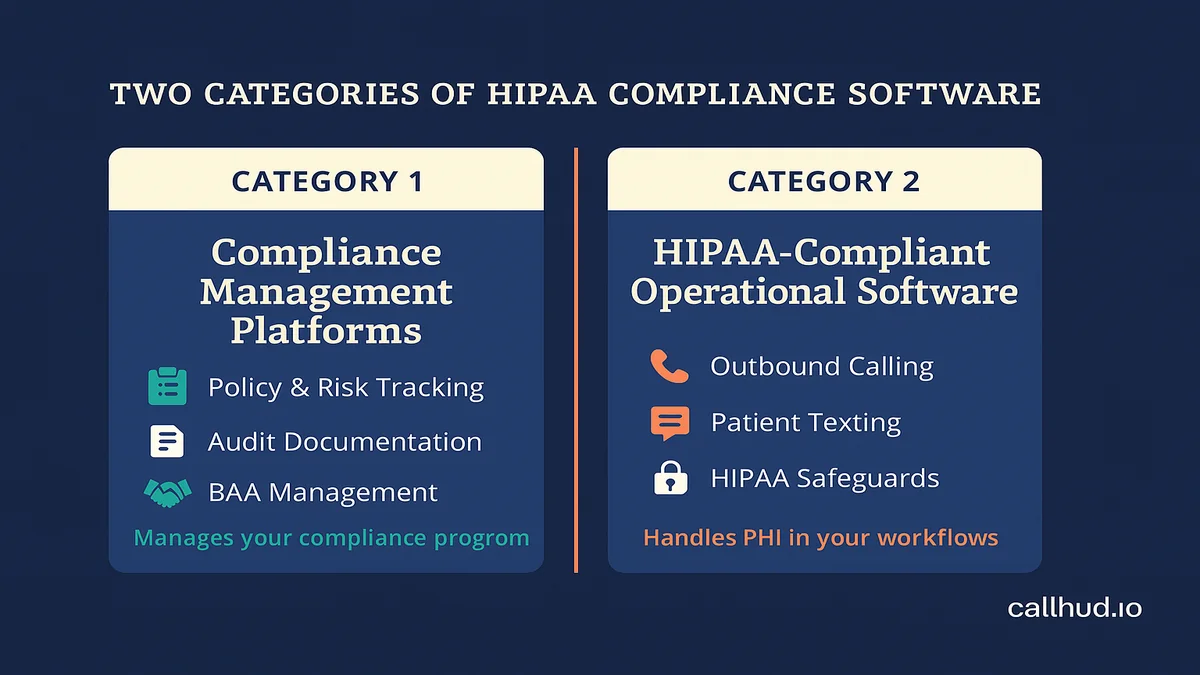
HIPAA compliance software is any software system that helps a covered entity or business associate meet requirements under the Health Insurance Portability and Accountability Act (HIPAA). The term covers two distinct categories: Tools that manage compliance documentation and audit readiness, and tools that handle PHI in day-to-day operational workflows.
The distinction matters because the two categories solve different problems and neither replaces the other.
Compliance management platforms
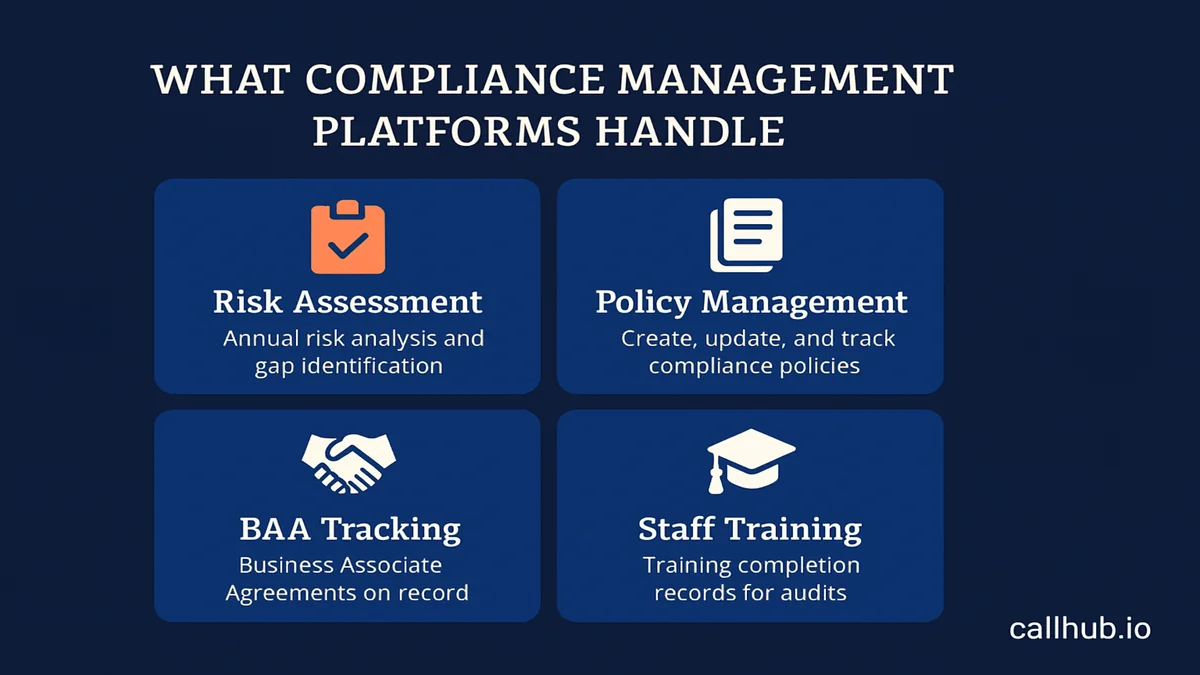
These handle the policy and audit layer. Compliance management platforms help organizations document policies, track Business Associate Agreements (BAAs), run risk assessments, manage staff training records, and produce audit-ready documentation. They are the administrative backbone of a HIPAA compliance program.
HIPAA-compliant operational software
These handle the operational layer. Any software that transmits, receives, or stores PHI as part of a patient outreach workflow belongs here: calling platforms, texting tools, case management systems. This software does not manage your compliance program. It is subject to it. It must meet HIPAA’s technical safeguards: Encryption, access controls, audit logs, and Multi-Factor Authentication (MFA).
Most published healthcare compliance software guides cover only the first category. Healthcare outreach organizations running patient contact programs need both.
HIPAA compliance management platforms: what they do and who they’re for
Compliance management platforms handle documentation, risk assessments, and audit preparation. Here are three widely used options at different market tiers.
Compliancy Group
Compliancy Group is a compliance management platform built specifically for healthcare organizations, including providers, billing companies, and business associates. Its core product walks users through HIPAA’s administrative, physical, and technical requirements and generates documentation for HHS audits. The platform is positioned at small to mid-sized healthcare organizations that need guided, step-by-step compliance program setup rather than enterprise-grade automation.
Vanta
Vanta is a compliance automation platform that spans HIPAA alongside System and Organization Controls 2 (SOC 2), ISO 27001, and other frameworks. It connects to your infrastructure, collects audit evidence automatically, and surfaces control gaps. Vanta is built for technology companies running multiple compliance frameworks. Enterprise pricing starts at several thousand dollars per year, making it a poor fit for most nonprofit advocacy organizations with a focused HIPAA use case.
Accountable HQ
Accountable HQ serves the smaller end of the market: medical practices, therapy offices, and nonprofits with limited compliance staff. Pricing starts at $39–$99 per month for small practices, per their 2026 pricing breakdown, making it one of the more accessible options. It covers HIPAA policy management, risk assessments, and BAA tracking without the complexity of a full GRC platform.
What these platforms don’t cover for outreach programs
All three platforms manage the administrative requirements of HIPAA. None of them govern the software your agents use to make outreach calls or send patient texts. A signed BAA with your compliance management vendor does not make your calling platform HIPAA compliant. The calling platform must meet HIPAA technical safeguards independently and requires its own BAA with your organization.
HIPAA-compliant communication software for outreach teams
The second category of HIPAA compliance software covers tools that carry PHI during outreach. For healthcare advocacy organizations and health-focused nonprofits, this primarily means calling platforms and outreach communication software that handles contact data for patient populations.
What makes communication software HIPAA-compliant
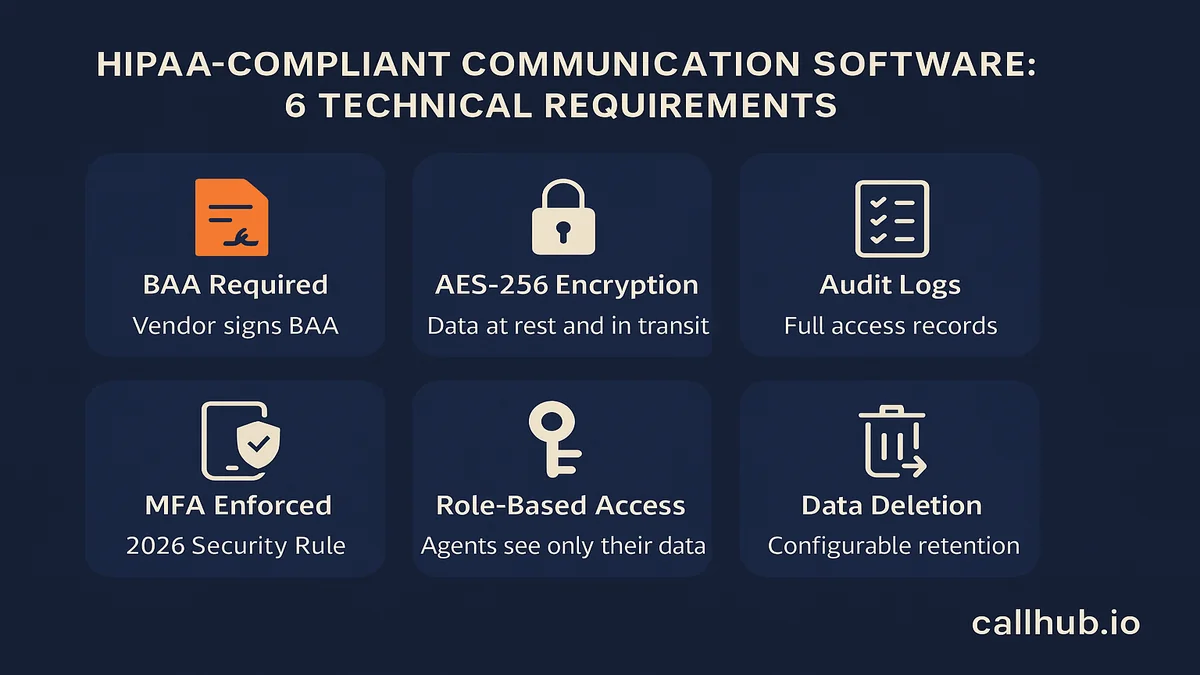
A communication platform is HIPAA-compliant when it meets the technical and administrative safeguards in the HIPAA Security Rule. The minimum requirements for any calling or outreach platform handling PHI:
- BAA availability: The vendor must sign a Business Associate Agreement making them a business associate under HIPAA
- End-to-end encryption: PHI transmitted over the platform must be encrypted in transit and at rest. AES-256 is the current standard
- Audit logs: The system must record who accessed PHI, when, and what actions were taken
- MFA: Mandatory under the 2026 HIPAA Security Rule update. Multi-Factor Authentication is now a baseline requirement, not optional
- Role-based access controls: Agents should only see the contact data relevant to their specific role
- Data retention and deletion: The platform must support defined retention schedules and PHI deletion on request
How this category differs from patient messaging apps
Outreach calling platforms and clinical patient messaging apps are not the same tool. Clinical messaging apps are built for care team communication inside a health system: specialist-to-referral, nurse-to-doctor. They are not built for high-volume outbound contact programs with scripted calls and large contact lists.
Outreach calling platforms are built for the opposite workflow: calling and texting large contact lists with scripts, dispositions, compliance controls, and call recording across an entire healthcare advocacy program. They must meet the same HIPAA requirements as clinical messaging tools, but the operational design is fundamentally different.
For requirements specific to the texting channel, see the full guide to HIPAA-compliant texting for healthcare organizations.
What to look for in a HIPAA-compliant calling and outreach platform
When evaluating calling platforms for a patient outreach program, verify these before signing:
- Will the vendor sign a BAA? (If not, stop the evaluation.)
- Is PHI encrypted at rest and in transit?
- Does the platform maintain tamper-proof audit logs?
- Is MFA enforced across all user accounts?
- Can you restrict agent access with role-based permissions?
- Does the vendor hold independent certifications: HIPAA attestation, SOC 2 Type II, or ISO 27001?
- Does the platform support PHI deletion and configurable data retention?
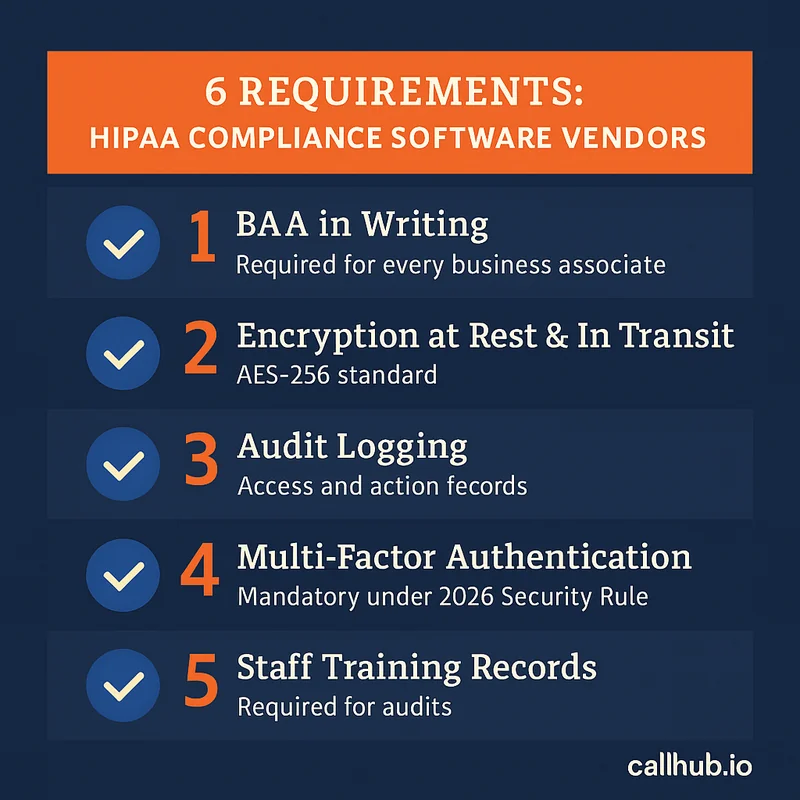
6 requirements to verify in any HIPAA compliance software vendor
These requirements apply to both categories. Whether you are evaluating a compliance management platform or a HIPAA-compliant call center software option, verify each of these before signing a contract.
- BAA in writing: Any vendor that touches PHI must sign a Business Associate Agreement. This is non-negotiable under HIPAA and legally required for every business associate relationship.
- Encryption at rest and in transit: PHI must be encrypted wherever it is stored and whenever it is transmitted. AES-256 for data at rest is the current standard.
- Audit logging: The vendor must maintain logs that record access, actions, and changes to PHI. Logs must be available to your organization on request.
- Multi-Factor Authentication: Mandatory as of the 2026 HIPAA Security Rule update. Any vendor that does not enforce MFA is already out of compliance with the updated rule.
- Staff training documentation: Compliance management platforms specifically should track and document staff HIPAA training completion. Missing training records are a common audit deficiency.
- PHI deletion and data portability: When the vendor relationship ends, confirm in writing that a documented process exists to retrieve and delete your data. Do not leave this for the offboarding conversation.
How CallHub fits into a HIPAA-compliant outreach stack
For healthcare outreach organizations that need a HIPAA-compliant calling platform, CallHub belongs in the second category: operational communication software.
CallHub is built for high-volume outbound contact programs. Healthcare advocacy teams use it to run patient calling campaigns, peer-to-peer texting outreach, and health education programs at scale. The platform meets HIPAA’s technical safeguard requirements across the board:
- BAA: CallHub signs Business Associate Agreements for healthcare customers
- Encryption: PHI in transit and at rest is encrypted to AES-256 standard
- Audit logs: Full call logs, access logs, and activity records are maintained for compliance documentation
- MFA: Multi-Factor Authentication is enforced across agent and admin accounts
- Role-based access: Managers can restrict which contact data individual agents see
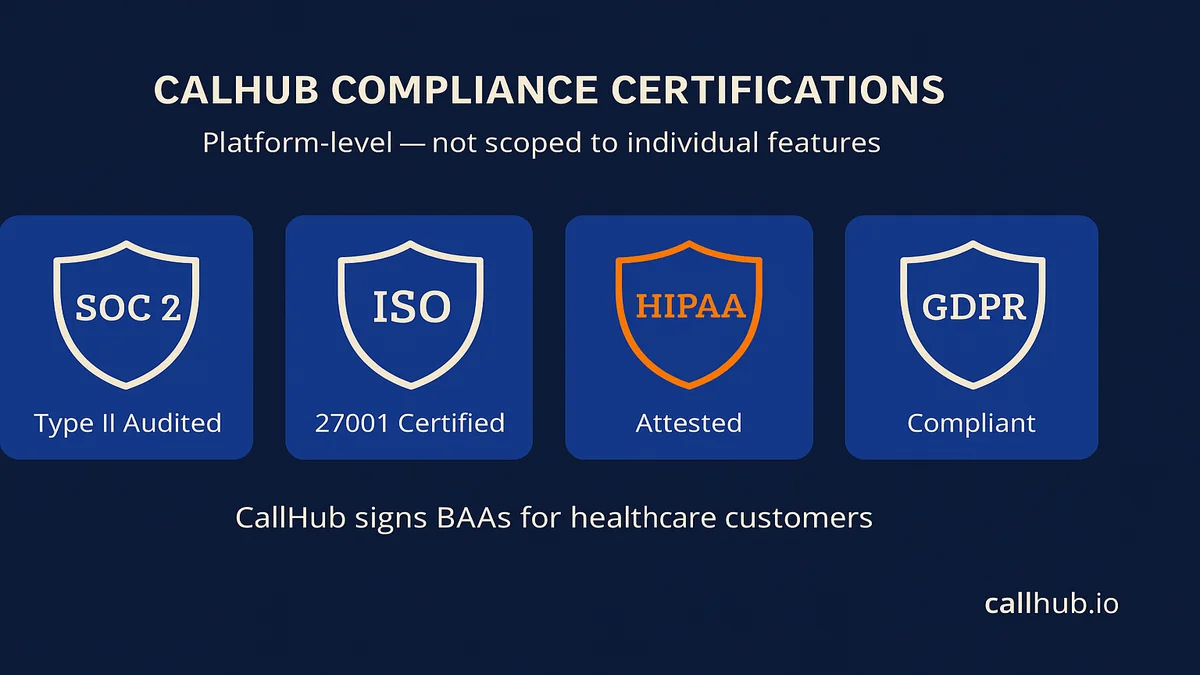
- Certifications: CallHub holds SOC 2 Type II, ISO 27001, HIPAA attestation, and GDPR compliance at the platform level. These certifications are not scoped to any single feature
For the full technical safeguards breakdown, see CallHub’s HIPAA, SOC2, and ISO 27001 compliance certifications.
CallHub covers the operational software layer. Your compliance management platform (Compliancy Group, Accountable HQ, or whichever option fits your organization’s scale) covers the policy and audit layer. Both are required. Neither replaces the other.
Choose software that covers both layers of your compliance program
A complete HIPAA compliance program for a healthcare outreach organization requires two software layers. The compliance management platform handles policies, risk assessments, and audit documentation. The HIPAA-compliant communication software handles the actual patient contact. Every guide that lists only the first category is giving outreach organizations half an answer.
Before selecting any vendor in either category, run through the six requirements above. Confirm the BAA. Verify encryption. Check the audit logs. These steps apply regardless of which platforms you choose.
For calling and outreach programs specifically, HIPAA-compliant call center software built for healthcare outreach teams covers the technical controls and BAA your compliance program requires.
Use the HIPAA compliance checklist for healthcare outreach teams to review your full program before your next audit cycle.
Frequently asked questions
What is HIPAA compliance software?
HIPAA compliance software is any software system that helps a covered entity or business associate meet Health Insurance Portability and Accountability Act requirements. The term covers two categories: compliance management platforms that handle policies, risk assessments, and audit documentation, and HIPAA-compliant operational software that processes PHI in day-to-day workflows such as patient calling or outreach programs.
What is the difference between HIPAA compliance software and HIPAA-compliant software?
HIPAA compliance software typically refers to tools that manage, document, and audit your compliance program: Risk assessments, policy templates, BAA tracking. HIPAA-compliant software refers to any operational tool that has implemented HIPAA’s required technical safeguards to handle PHI. A calling platform that signs a BAA and encrypts contact data is HIPAA-compliant software. It is not, however, a compliance management platform. Both terms apply to different categories, and outreach organizations need tools from both.
Does HIPAA compliance software prevent data breaches?
No. HIPAA compliance software reduces legal risk and documents good-faith compliance efforts. It does not guarantee breach prevention. HHS assesses penalties based on whether an organization implemented the required safeguards, not solely on whether a breach occurred. Proper controls reduce breach likelihood, but no software eliminates the risk entirely.
Is there an official HIPAA certification for software?
No official HIPAA certification exists for software vendors. There is no government-issued “HIPAA certified” designation. Vendors claiming “HIPAA certification” are typically referring to a third-party compliance attestation. The meaningful indicators to look for are: A SOC 2 Type II audit report, ISO 27001 certification, HIPAA attestation from a third-party auditor, and the vendor’s willingness to sign a BAA.
How much does HIPAA compliance software cost?
Compliance management platforms range from $39–$99 per month for small practices to $12,000 or more per year for enterprise GRC platforms, per Accountable HQ’s 2026 pricing guide. HIPAA-compliant calling platforms vary by volume and feature set. Most require a direct quote since pricing scales with agent count and outreach volume.
Is HIPAA compliance software the same for covered entities and business associates?
The underlying HIPAA requirements are the same. Both covered entities (healthcare providers, health plans) and business associates (vendors and contractors who handle PHI) must implement HIPAA’s administrative, physical, and technical safeguards. The documentation flow differs: Covered entities typically run their own compliance management program, while business associates must sign BAAs with the covered entities they serve and maintain independent safeguard documentation.
Do I need a separate BAA with every software vendor my team uses?
Yes, if the vendor handles PHI. A Business Associate Agreement is required with every vendor that creates, receives, maintains, or transmits PHI on your behalf. This includes your calling platform, CRM, texting tool, and compliance management platform. A BAA with one vendor does not cover the others. Review the HIPAA compliance checklist for healthcare outreach teams for a full list of vendor relationship requirements.