
501(c)(4) status is one of the most politically flexible tax designations available to advocacy organizations. A 501c4 lets your organization lobby, run direct advocacy campaigns, and engage in political activity at a scale that a 501(c)(3) cannot. Yet many organizations that qualify hold back, worried about crossing a compliance line they cannot quite locate.
The rules are not as complicated as legal language makes them sound. There is a primary purpose test to understand, a clear line between lobbying and political campaign activity, and a set of outreach tools that let you scale while staying compliant.
This guide covers what a 501c4 organization is, what the political activity rules mean in plain English, and how to run the phone banking, peer-to-peer texting, and canvassing campaigns that turn your advocacy mandate into real-world impact.
Key Takeaways
A 501(c)(4) is a tax-exempt social welfare organization that, unlike a 501(c)(3), can engage in substantial lobbying and partisan political activity as long as that activity does not become its primary purpose.
What Defines a 501(c)(4)
- A 501(c)(4) must operate primarily for the promotion of social welfare, meaning community benefit rather than private benefit.
- Donors to a 501(c)(4) do not receive a tax deduction for their contributions, and the organization’s donor list does not need to be publicly disclosed.
- The IRS applies a facts and circumstances test to determine whether any single type of activity, including political work, has become too dominant.
- A 501(c)(3) cannot participate or intervene in political campaigns and can only lobby as a minor, secondary activity, while a 501(c)(4) has far more room to engage in both.
Who Qualifies
- Qualifying organizations include civic leagues, social welfare groups, issue-based advocacy organizations covering areas like environmental, housing, immigration, and public health work, labor union affiliates, and neighborhood or homeowners’ associations.
- PAC affiliates can qualify, though PACs themselves are not 501(c)(4)s.
- Qualifying organizations share a primary social welfare mission, using political activity as a tool to advance that mission rather than as the reason for existing.
The Primary Purpose Test
- A 501(c)(4) can run voter registration drives, phone bank for candidates, endorse candidates, run political ads, and deploy staff for partisan campaign work, but political campaign activity cannot be its primary purpose.
- The IRS sets no fixed percentage limit for political activity, instead applying a facts and circumstances test based on the organization’s total activities, budget, and stated mission.
- Most advisors cite 49% as the practical ceiling for political campaign activity measured by time and resources, though this figure is an industry convention rather than a statutory safe harbor and recent court decisions have revisited these standards.
- Organizations should track both budget allocation and time allocation between political and social welfare work, and involve a tax attorney with exempt organizations experience if either measure approaches 50%.
Lobbying vs. Political Campaign Activity
- Social welfare advocacy, such as educating the public or organizing community action, carries no limit under a 501(c)(4).
- Lobbying, defined as attempting to influence legislation through direct or grassroots contact, also carries no limit as long as it relates to the organization’s social welfare purpose.
- Political campaign activity, meaning participation for or against candidates for public office, is the one category that cannot become the organization’s primary purpose.
- A 501(c)(4) can run unlimited legislative alert campaigns, contact lawmakers directly, and fund ballot initiative efforts without restriction, unlike a 501(c)(3), which can only lobby as a minor activity and can never endorse candidates.
What is a 501(c)(4) organization?
A 501(c)(4) organization is a tax-exempt social welfare nonprofit recognized under Section 501(c)(4) of the Internal Revenue Code. Unlike a 501(c)(3), a 501c4 can engage in substantial political activity, including partisan campaign work, as long as that activity is not the organization’s primary purpose. Donors do not receive a tax deduction for contributions, and the organization’s donor list does not need to be publicly disclosed.
The defining requirement is that the organization must operate primarily for the promotion of social welfare, meaning community benefit rather than private benefit. The Internal Revenue Service (IRS) uses a “facts and circumstances” test to evaluate whether any single type of activity has become too dominant.
What makes a 501(c)(4) different from a 501(c)(3)?
The core difference is political activity. A 501(c)(3) is prohibited from participating or intervening in political campaigns and can only conduct lobbying as a minor, secondary activity. A 501c4 has far more room.
For a full breakdown of how the two designations differ on formation, governance, and permitted activities, see our 501(c)(3) vs 501(c)(4) differences and setup guide. The short version: if political advocacy is central to your organization’s mission, a 501c4 gives you the structure to pursue it without putting your tax-exempt status at risk.
Types of organizations that qualify for 501(c)(4) status
The designation covers a wide range of civic and advocacy organizations:
- Civic leagues and community advocacy groups
- Social welfare organizations focused on local or national issues
- Issue-based advocacy organizations (environmental, housing, immigration reform, public health)
- Labor union affiliates and workers’ rights organizations
- Neighborhood associations and homeowners’ associations
- Political action committee affiliates (though PACs themselves are not 501c4s)
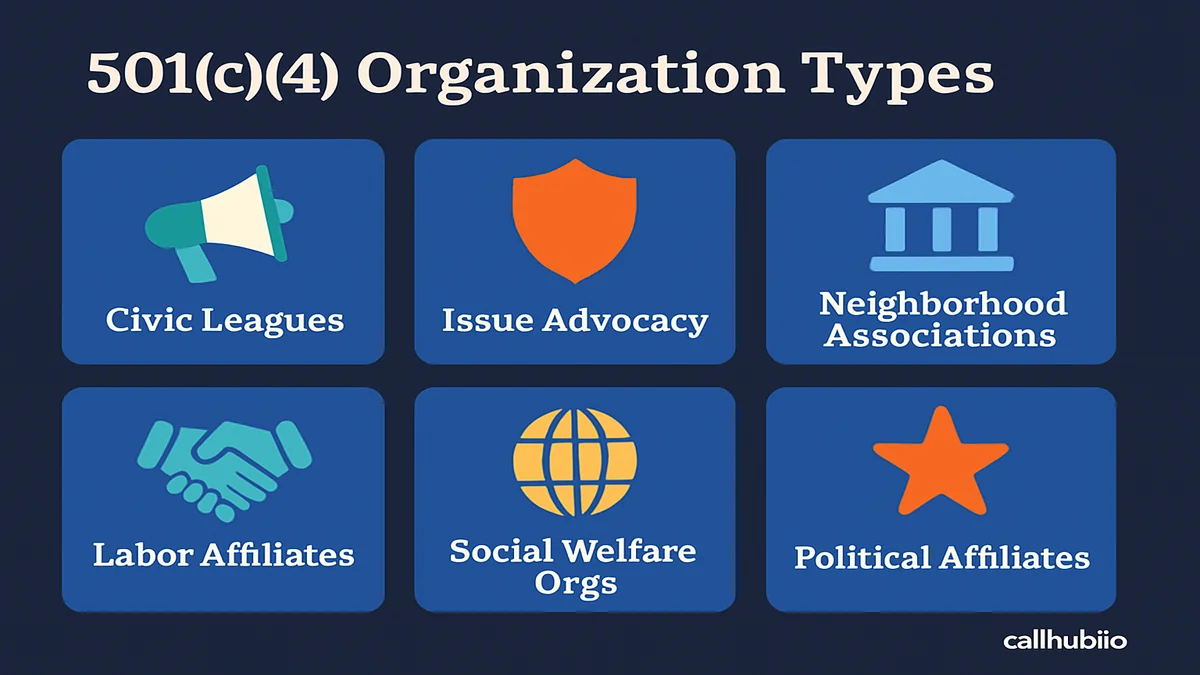
What these organizations share is a primary social welfare mission, with political activity as a tool for advancing that mission rather than the reason for the organization’s existence.
What can a 501(c)(4) do? Political activity rules explained
A 501(c)(4) organization can do substantial political campaign activity. It can run voter registration drives, phone bank for candidates, endorse candidates, run political ads, and deploy staff for partisan campaign work. What it cannot do is make political campaign activity its primary purpose.
Understanding what “primary purpose” means in practice is what determines whether your organization can do everything it needs to do.
The primary purpose test: what it means in practice
The IRS does not define a fixed percentage limit for how much political activity a 501c4 can conduct. The standard is a “facts and circumstances” test that looks at the totality of the organization’s activities, budget allocation, and stated mission.
The practical ceiling most advisors cite is 49%. If political campaign activity, measured by both time and resources, stays below that threshold and the remainder of your work serves a genuine social welfare purpose, you are on safe ground. But the 49% figure is an industry convention, not a statutory safe harbor. Recent court decisions have revisited these standards, which makes tracking your activity allocation essential.
Two measures matter most for your compliance records:
- Budget allocation: What percentage of your organization’s spending goes to political campaign activity vs. social welfare programs?
- Time allocation: How much staff and volunteer time is spent on political work vs. social welfare work?
If either measure approaches or exceeds 50%, you are in a risk zone. A tax attorney with exempt organizations experience should be involved before you hit that threshold.
Lobbying vs. political campaign activity: where the line is
This distinction trips up many organizations. Lobbying and political campaign activity are both permissible for a 501c4, but they are treated differently under the tax code. Understanding the difference between advocacy and lobbying matters for how you classify and track your activity.
| Activity type | Definition | 501c4 limit |
|---|---|---|
| Social welfare advocacy | Educating the public on issues, organizing community action | No limit |
| Lobbying | Attempting to influence legislation through direct or grassroots contact | No limit (must relate to social welfare purpose) |
| Political campaign activity | Participating in campaigns for or against candidates for public office | Cannot be primary purpose |
A 501c4 can lobby without limit, provided the lobbying relates to the organization’s social welfare mission. You can run unlimited legislative alert campaigns, contact lawmakers directly, and fund ballot initiative efforts. For more on how nonprofit lobbying works in practice, see our guide on rules on nonprofit lobbying.
What 501(c)(4)s can do that 501(c)(3)s cannot
The political activity gap between the two designations is significant:
| Permitted activity | 501(c)(3) | 501(c)(4) |
|---|---|---|
| Endorse candidates for office | Never | Yes |
| Run campaign ads for or against a candidate | Never | Yes (not primary purpose) |
| Phone bank for a candidate | Never | Yes |
| Run partisan voter registration drives | Limited | Yes |
| Lobby legislators without a spending cap | No | Yes |
| Keep donor identity confidential | No | Yes |
| Issue advocacy (nonpartisan) | Yes | Yes |
For details on what a 501(c)(3) can and cannot do in an election year, see 501(c)(3) political activity compliance rules.
How to start a 501(c)(4) organization
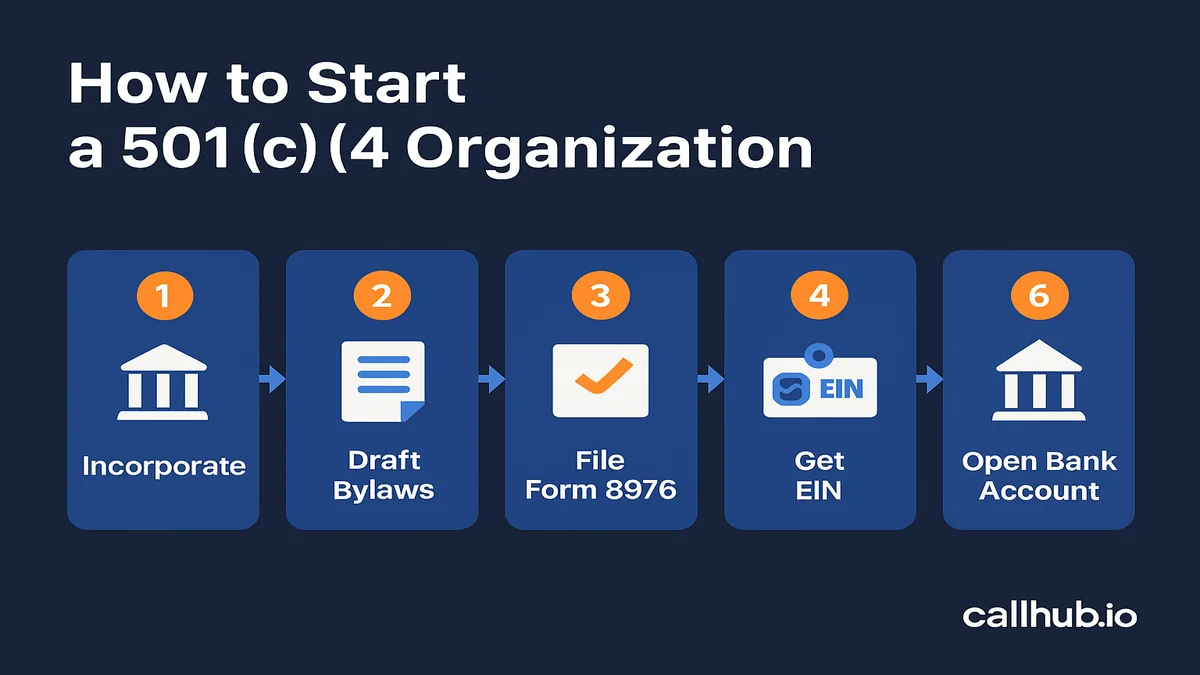
The formation process is less bureaucratic than a 501(c)(3). There is no IRS approval required before you begin operating, though you must notify the IRS within 60 days of organizing. The core steps:
- Incorporate in your state as a nonprofit corporation
- Draft bylaws that define your social welfare mission and governing structure
- File IRS Form 8976 within 60 days of formation
- Apply for an Employer Identification Number (EIN)
- Open a bank account in the organization’s name
- Register with your state as required for fundraising or lobbying activities
For a detailed walkthrough of incorporation, board requirements, and how this process compares to 501(c)(3) formation, see the 501(c)(3) vs 501(c)(4) differences and setup guide.
IRS Form 8976: the 60-day filing requirement
The most common compliance mistake new 501c4 organizations make is missing the Form 8976 deadline. The IRS requires organizations claiming 501c4 status to submit Form 8976, the Notice of Intent to Operate Under Section 501(c)(4), within 60 days of formation.
Missing this deadline costs $20 per day until the form is filed, with a maximum penalty of $5,000 for the organization. There is also a separate $5,000 penalty per responsible person if the delay is intentional. Filing is done electronically through pay.gov, and there is a one-time $50 user fee.
Compliance records to maintain from day one
Strong records are your protection if the IRS ever questions whether political activity has become your primary purpose. From the first day of operations, track:
- Time logs for staff and volunteer activity (political vs. social welfare)
- Budget allocation records separating political campaign expenses from social welfare expenses
- Meeting minutes documenting board decisions on political activity scope
- Documentation of your social welfare programs and their measurable outcomes
- All lobbying activity logs if your state requires lobbying registration
The cleaner these records are, the simpler any compliance review becomes.
How 501(c)(4) organizations run political advocacy campaigns
501c4 status exists so you can run the outreach campaigns that move people, whether that is turning out voters, building pressure on a legislative campaign, or shifting public sentiment on an issue. The toolkit is phone banking, peer-to-peer texting, and canvassing. For a broader view of how these channels work together in a full advocacy program, see the complete guide to political advocacy.
Phone banking for political outreach
Phone banking is the most direct large-scale contact method for advocacy campaigns. A 501c4 organization can run partisan phone banking campaigns, including calls that explicitly support or oppose candidates, as long as the activity stays within the primary purpose bounds.
The key operational variables are script design and volunteer management:
- Script branching: Different supporter profiles need different scripts. A voter who attended your last event gets a different ask than a cold contact. Dynamic branching scripts let volunteers navigate the conversation without losing control of the message.
- Dialer type: For high-volume outreach, a predictive or power dialer eliminates manual dialing and keeps volunteers on calls rather than waiting. For conversations requiring more nuance, a preview dialer gives volunteers a moment to review the contact record before connecting.
- Data sync: Call outcomes need to flow back to your contact database in real time. Delayed sync means your next contact attempt may use stale data.
CallHub’s phone banking software for advocacy campaigns handles script branching, multiple dialer modes, and direct database integration in one platform.
Peer-to-peer texting campaigns
Text messaging reaches supporters where phone calls cannot. Text messages have a 98% open rate, according to the CTIA, compared to roughly 20% for email. For advocacy campaigns focused on legislative alerts, event mobilization, or get-out-the-vote (GOTV) efforts, that reach difference is meaningful.
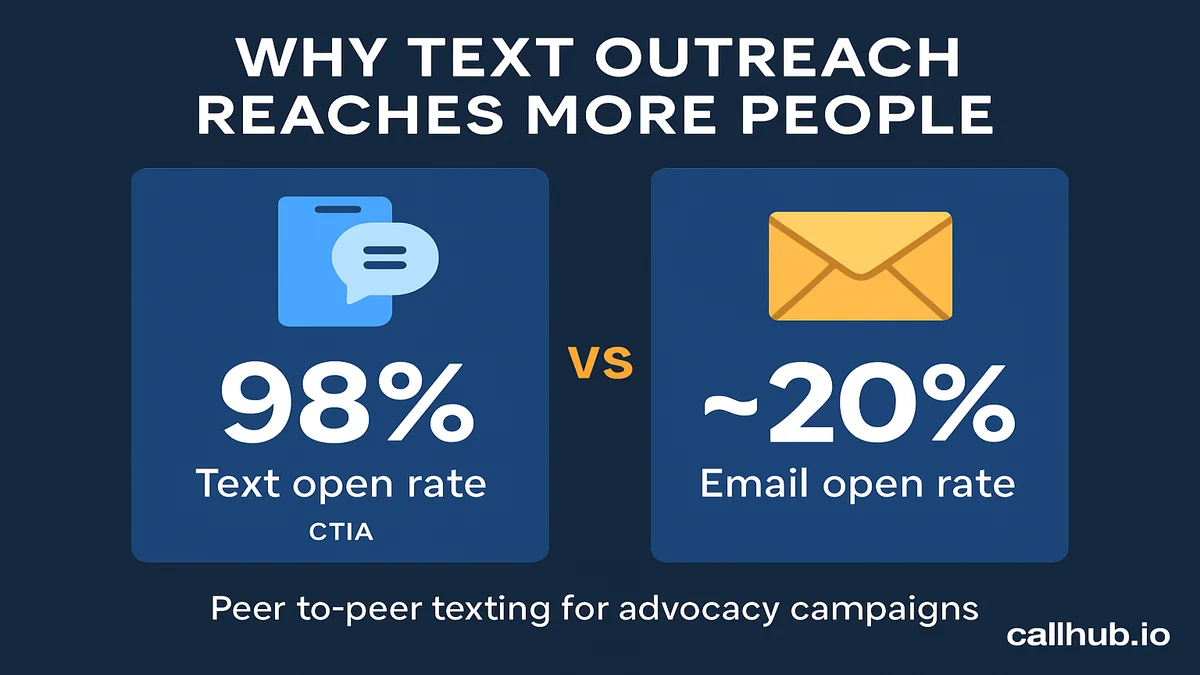
Peer-to-peer texting (P2P texting) keeps the conversation personal. Volunteers send and receive individual texts rather than a broadcast blast, which produces significantly higher response rates than mass texting alone.
For 501c4 outreach, P2P texting works well for:
- Mobilizing supporters before a key legislative vote
- Sending personalized GOTV messages in the final days before an election
- Following up phone contacts with a confirmation or link to voter resources
- Recruitment outreach for events, volunteer shifts, and advocacy days
The compliance consideration for text outreach: Telephone Consumer Protection Act (TCPA) consent requirements apply to text campaigns regardless of your tax status. Anyone receiving a text from your organization must have provided prior express written consent. This is a legal requirement, not a best practice.
Door-to-door canvassing
Canvassing gives your campaign a physical presence in the communities you are trying to reach and remains one of the highest-impact contact methods for persuasion and GOTV. The canvassing operations that scale require digital infrastructure even when the activity is face-to-face: contact lists loaded on mobile devices, real-time turf assignments syncing between teams, and immediate data entry so the afternoon shift builds on the morning shift’s work.
For a 501c4 running partisan campaign activity, canvassing counts toward your political activity threshold. Track volunteer hours and territory coverage in the same compliance log you use for phone banking.
Staying compliant when you scale outreach
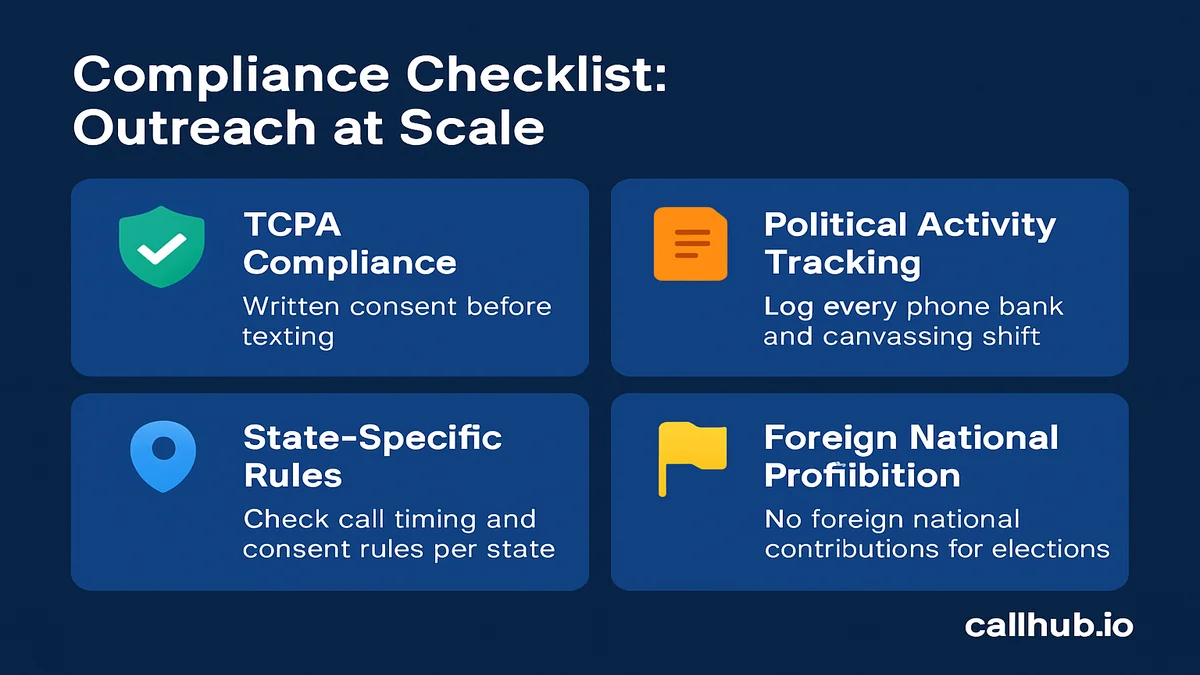
High-volume outreach creates compliance exposure if you have not built the right infrastructure:
- TCPA compliance: Get written consent before texting. Document it. For phone calls using an automatic dialer, the consent requirements are specific to the technology used.
- State-specific rules: Federal Communications Commission (FCC) regulations set the floor, but many states have stricter rules on call timing, consent documentation, and do-not-call list honoring.
- Political activity tracking: Every phone bank shift, canvassing day, and text campaign that supports or opposes a candidate should be logged in your compliance records with time, cost, and purpose.
- Foreign national prohibition: 501c4 organizations cannot accept contributions from foreign nationals for use in federal, state, or local elections.
Consult legal counsel before running automated outreach at scale, especially for campaigns crossing multiple states.
How 501(c)(4) organizations fund their advocacy work
Unlike a 501(c)(3), a 501c4 cannot offer tax-deductible contributions. Donors to a 501c4 do not get a charitable deduction on their tax return. That is the trade-off for political activity flexibility, and it affects how you build your fundraising case.
The main revenue sources for 501c4 organizations:
- Membership dues: Many civic and issue-based 501c4 organizations fund their work primarily through membership. Dues are not tax-deductible but are straightforward to collect at scale.
- Individual donations: Major donors who prioritize political impact over a tax deduction are a significant funding source for established advocacy organizations.
- Grants: Some private foundations can make grants to 501c4 organizations, though the grant typically cannot fund political campaign activity directly. Grants generally support social welfare programming.
- Earned revenue: Consulting services, publications, events, and other earned income can fund operations without restricting how the funds are spent.
- 501(c)(3) affiliate transfers: Many larger advocacy organizations operate a parallel 501(c)(3) for educational and social welfare programs and a 501c4 for political activity. Shared expenses are allocated appropriately between the two entities. A tax attorney should structure any affiliate relationship.
The donor privacy advantage is significant: 501c4 organizations are not required to publicly disclose their donor lists. This matters in politically contested campaigns where donor visibility could create exposure for supporters.
Run your 501(c)(4) political advocacy campaigns with CallHub
501c4 status gives your organization the political advocacy freedom that a 501(c)(3) cannot offer. The primary purpose test and the lobbying vs. campaign activity distinction are the two compliance pillars. Understand both, track your activity allocation from day one, and you can use that freedom fully.
The outreach playbook is phone banking, peer-to-peer texting, and canvassing at scale, with every contact and outcome tracked back to your supporter database.
If you are ready to build the outreach infrastructure for your next campaign, CallHub’s phone banking software built for advocacy organizations connects your dialer, text campaigns, and contact data in one place.
To see how all three channels work together across a full campaign program, see how CallHub helps 501(c)(4) organizations run compliant outreach campaigns.
Frequently asked questions about 501(c)(4) organizations
Are donations to a 501(c)(4) tax-deductible?
No. Contributions to 501c4 organizations are not tax-deductible to the donor. The trade-off for greater political activity latitude is the loss of the charitable deduction. If tax deductibility for donors is important to your fundraising strategy, a 501(c)(3) entity or a parallel 501(c)(3)/501c4 structure may be a better fit for your organization.
Can a 501(c)(4) endorse candidates?
Yes. A 501c4 can publicly endorse candidates for public office, run ads supporting or opposing candidates, and conduct partisan phone banking and canvassing campaigns. The constraint is that these activities cannot become the primary purpose of the organization, measured across both time and budget allocation.
What is the primary purpose test for 501c4 organizations?
The IRS uses a “facts and circumstances” test rather than a fixed percentage limit to evaluate whether an organization’s political activity has become too dominant. The test looks at total activity mix, budget allocation, and stated mission. While no statutory cap exists, tax advisors commonly treat 49% as a practical ceiling for political campaign activity. Organizations approaching that threshold should consult legal counsel before scaling further.
What happens if a 501(c)(4) exceeds political activity limits?
If the IRS determines that political campaign activity has become the primary purpose of a 501c4 organization, the organization risks losing its tax-exempt status. Income would then be subject to corporate income tax, and the IRS can retroactively revoke exemption for years in which it finds the primary purpose test was not met. The financial and operational consequences are significant.
Can a 501(c)(4) do unlimited lobbying?
Yes, with one condition: the lobbying must relate to the organization’s social welfare mission. A 501c4 can contact legislators directly, fund ballot initiative campaigns, and run legislative alert outreach without a lobbying spending cap. This is a significant operational advantage over a 501(c)(3), which must keep lobbying to a minor portion of its overall activity.
What is “dark money” in the context of 501(c)(4) organizations?
501c4 organizations are not required to publicly disclose their donors, which means substantial political spending can occur without public visibility into who is funding it. This arrangement is sometimes described as “dark money” in political journalism. It is legal under current IRS rules. Whether your organization limits or embraces anonymous giving is a strategic and values decision, not a compliance question.
How does a 501(c)(4) differ from a political action committee?
A 501c4 is a tax-exempt social welfare organization. A political action committee (PAC) is specifically organized to make contributions to or expenditures on behalf of candidates and is regulated by the Federal Election Commission (FEC) with specific contribution limits and disclosure requirements. Many 501c4 organizations maintain a separate affiliated PAC, with the 501c4 handling issue advocacy and the PAC handling direct candidate support.