
Campaigns don’t lose on election day. They lose in the six weeks before it, when a disorganized Get Out the Vote (GOTV) program runs tactics in the wrong order, contacts the wrong voters at the wrong time, or burns out its volunteer base before the final push. Your gotv timeline isn’t a scheduling nicety for well-funded operations. It’s the operational backbone that determines whether your effort converts into ballots cast.
This guide gives you the complete GOTV calendar: What to do in each of the four phases from eight weeks out to election night, how timing differs based on your state’s voting rules, and what to cut if you’re starting later than you should be.
Key Takeaways
A GOTV (Get Out the Vote) timeline is a phase-by-phase calendar that maps which voter contact activities happen in which window before election day, moving from universe building through early outreach, full mobilization, and a final 72-hour push.
Why sequencing matters
- Universe building must precede outreach, persuasion must precede mobilization, and scripts must be locked before callers go live, or volume won’t save a disorganized program.
- Starting Phase 3 tactics like high-volume calls and door knocks in week seven burns volunteer capacity before it counts, while running voter ID work in week two is too late to act on the data.
- Skipping universe building entirely means callers spend the final days reaching voters who oppose the campaign or have already voted.
Phase 1 (8-5 weeks out): Build the GOTV universe
- Phase 1 is operational, focused on organizing data, defining the voter universe, building the contact plan, and setting up volunteer infrastructure before any GOTV calls begin.
- Voters are sorted into four categories: strong supporters as first call priority, soft supporters for high mobilization value, persuadable voters who get converted or cut by Phase 3, and opposition supporters who are never contacted for GOTV.
- The voter contact plan built during this phase defines which voters get called, texted, or canvassed, channel timing per phase, daily contact volume targets, and what data flows back to the voter file, with a separate early-vote track for mail and early-vote states.
- Volunteers need to be fully recruited and trained by the end of Phase 1, since rushed onboarding under GOTV pressure in the final 10 days produces poor call quality and early burnout.
Phase 2 (4-2 weeks out): Early outreach by state type
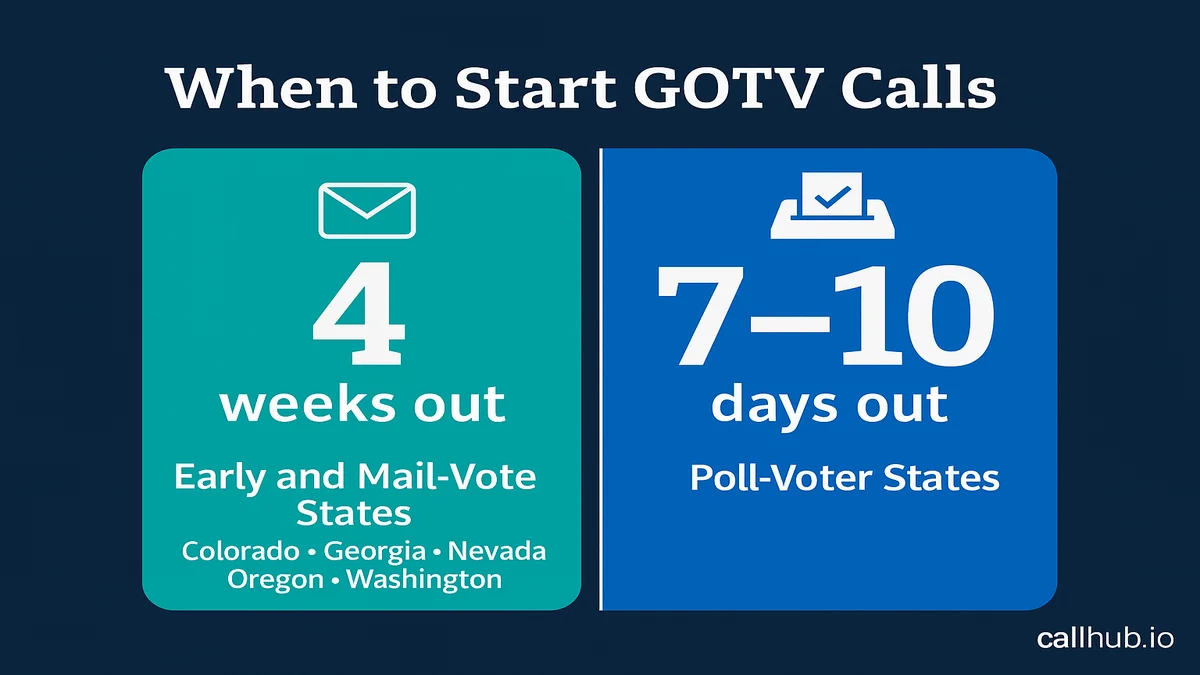
- Phase 2 timing splits by state voting rules: heavy early-vote and mail-ballot states start full GOTV calls and texts four weeks before election day, while traditional poll-voter states can hold until 7-10 days out.
- States with high early or mail-vote participation, including Colorado, Georgia, Nevada, Oregon, and Washington, require outreach to confirmed supporters starting four weeks out because ballots are already being cast.
- Waiting until the final 10 days in a mail-heavy state like Georgia risks missing voters who already cast their ballots weeks earlier.
What is a GOTV timeline?
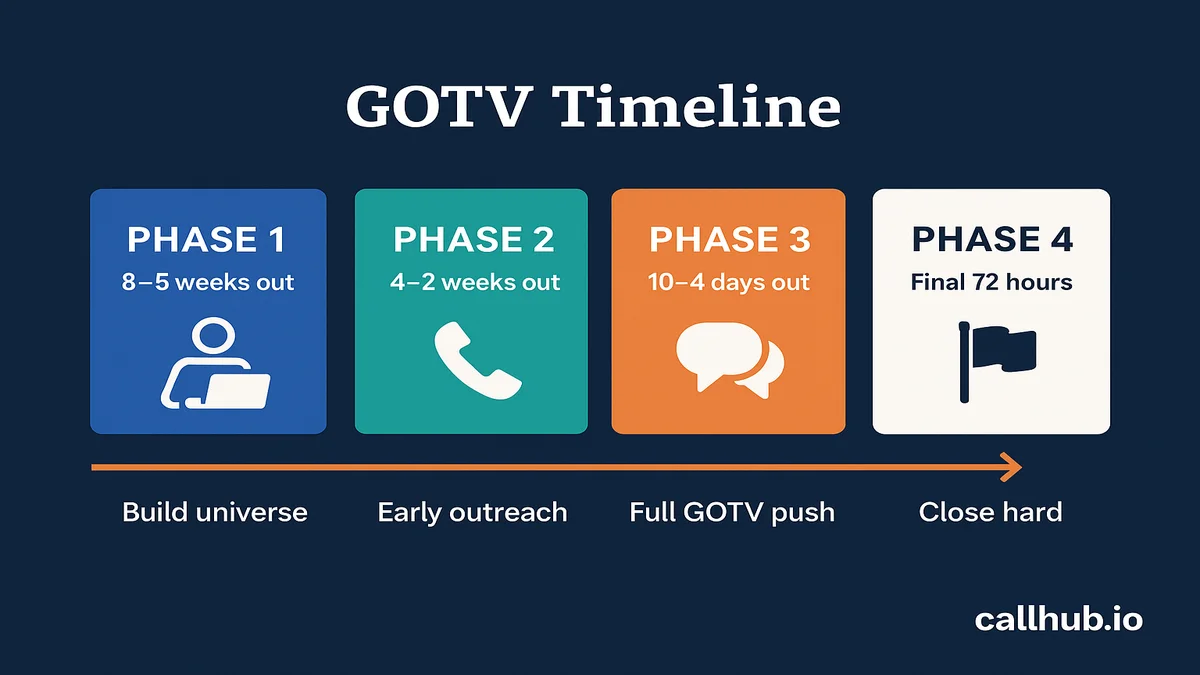
A GOTV timeline is the phase-by-phase calendar that maps which voter contact activities happen in which window before election day. It starts eight weeks out with universe building and data cleanup, moves through early outreach for mail and early voters, escalates to full mobilization in the final 10 days, and ends with the 72-hour close and election day voter chase.
The calendar matters because GOTV isn’t one thing: It’s four distinct phases, run in sequence. Starting Phase 3 tactics (high-volume calls and door knocks) in week seven burns volunteer capacity before it counts. Running voter ID work in week two is too late to act on the data. Skipping universe building entirely means your callers spend the final days reaching out to voters who oppose you or have already voted.
Why sequencing matters more than effort
Most campaigns that struggle with GOTV don’t fail because they didn’t try hard enough. They fail because they ran the right tactics in the wrong order. Universe building precedes outreach. Persuasion precedes mobilization. Scripts must be locked before callers go live. When these steps are out of sequence, volume doesn’t save you. Your volunteers spend the critical final days calling the wrong people with the wrong message.
The four-phase structure below gives you the right order. Treat it as a sequenced checklist, not a menu.
Phase 1 (8–5 weeks out): Build your GOTV universe
Eight weeks out, you’re not making GOTV calls yet. You’re building the target list that makes those calls worth making. Phase 1 is operational: Organize your data, define your voter universe, build your contact plan, and get your volunteer infrastructure in place. Everything that happens in Phases 2, 3, and 4 runs on what you build here.
Don’t rush past this phase because it doesn’t feel like “real” GOTV work. The campaigns that consistently outperform on election day are the ones that enter Phase 3 with clean data, a trained volunteer base, and a locked contact plan.
Define your four voter categories
Your GOTV universe comes from your voter file or CRM. Sort your contacts into four categories based on their support level and likelihood to vote:
- Strong supporters: Committed to your cause or candidate, with high likelihood to vote. Your first call priority in every phase.
- Soft supporters: Identified as supportive but less certain to turn out. High mobilization value: Every successful contact with this group moves real votes.
- Persuadable voters: Not yet committed. Still in the persuasion window in Phase 1. By Phase 3, if they haven’t converted, shift to mobilization framing or cut them from your GOTV universe entirely.
- Opposition supporters: Do not contact for GOTV. Mobilizing opponents’ voters is the most efficient way to help the other side.
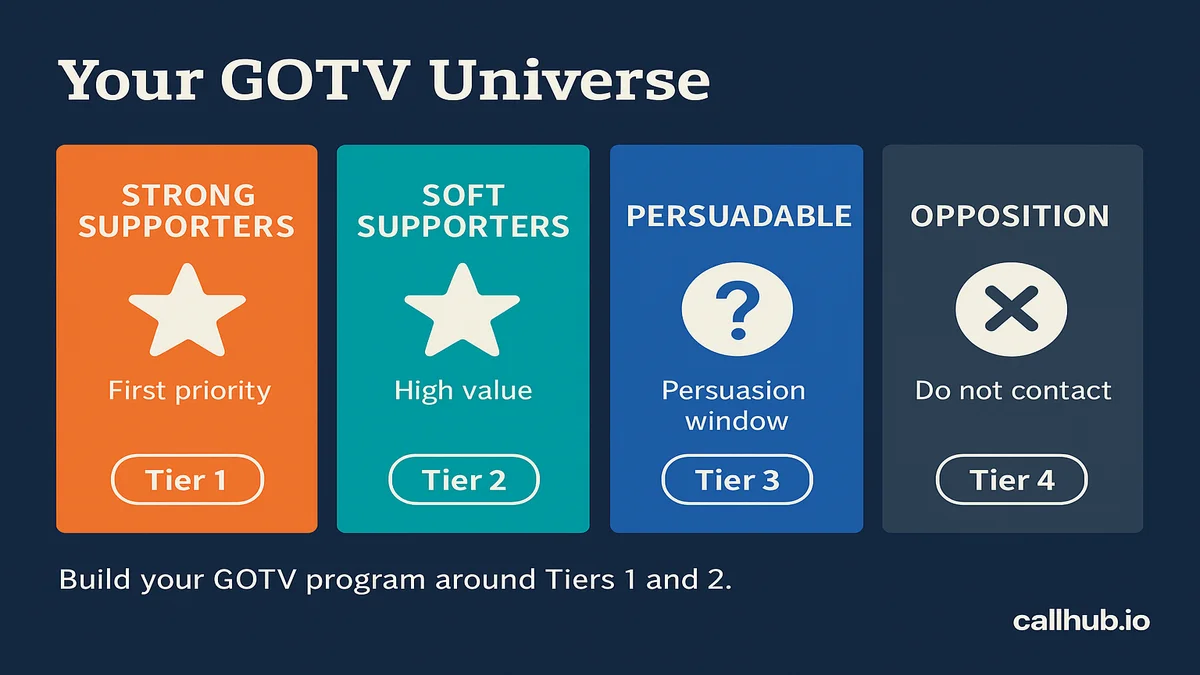
Your GOTV program should be built around strong and soft supporters. Everyone else is a lower priority until your base is covered.
Create your voter contact plan
Your voter contact plan defines which voters receive which type of outreach, on which channel, and in which phase. Build it in Phase 1 while you still have time to fix data gaps.
At minimum, your plan should address:
- Which voters get called vs. texted vs. canvassed
- Channel timing per phase (more on this in Phases 2 and 3)
- Daily contact volume targets for each phase
- Which tools handle each contact type
- What data flows back to your voter file after each outreach
If you’re in an early or mail-vote state, your contact plan needs a separate early-vote outreach track layered on top of the standard poll-voter track. Build that distinction now. Campaigns that don’t account for early voters in their contact plan are still calling people who voted three weeks ago.
Recruit and train volunteers
Volunteers need to be recruited, trained, and scheduled before Phase 3 begins. By the end of Phase 1, you should have your full roster confirmed and your first training sessions complete.
Training in Phase 1 covers platform orientation, script familiarity, and data entry hygiene. Don’t wait until the final 10 days to onboard new callers. Rushed training under GOTV pressure produces poor call quality, inconsistent dispositions, and a volunteer base that burns out early.
A volunteer who makes 10 confident, well-dispositioned calls in Phase 3 is worth more than one who makes 40 uncertain ones. Build the skill now.
Phase 2 (4–2 weeks out): Early outreach
Phase 2 is where your GOTV timeline splits based on your state’s voting rules. Campaigns in heavy early-vote and mail-ballot states begin GOTV outreach four weeks before election day. Campaigns in traditional poll-voter states can hold until 7–10 days out before escalating to full GOTV calls.
Getting this split wrong is one of the most common GOTV execution errors. A campaign in Georgia that waits until the final 10 days to start calling is leaving votes in the mail, literally. Voters who cast ballots by mail or in early in-person voting do so weeks before election day. If you haven’t reached them before their ballot window opens, you’ve missed them.
Early and mail-vote states: Start now
If you’re running in Colorado, Georgia, Nevada, Oregon, Washington, or another state with high early or mail-vote participation, begin GOTV calls and texts for your confirmed supporters four weeks out. Your outreach in this phase focuses on voting logistics: Does the voter have their mail ballot? Have they returned it? Do they know their early vote location and hours?
The call script shifts from persuasion to activation. You’re not trying to convince anyone at this stage. You’re helping your supporters get their ballot in before the window closes.
Poll-voter states: Voter ID and persuasion
In states where the majority of voters cast an in-person ballot on election day, the window from four to two weeks out is still primarily a voter ID and persuasion phase. Finalize your supporter classifications, run last persuasion calls on undecideds, and confirm your GOTV universe before the full push begins.
This is also the time to run final phone banking strategies for GOTV training sessions and test your dialer and texting setup at realistic contact volume. If your platform can’t handle your Phase 3 call load, you want to find that out now, not the weekend before the election.
Finalize your script and train your callers
Before Phase 3 begins, every piece of your GOTV outreach infrastructure should be locked. Check these off by the end of Phase 2:
- GOTV call script finalized, branching logic built, loaded into your dialer
- Text message templates written and approved
- All volunteers trained on script navigation and disposition codes
- Contact lists segmented by voter type: Early voters, mail voters, in-person voters
- Backup contact lists ready for election day voter chase
Phase 3 (10–4 days out): Full GOTV push
Phase 3 is the main event. This is when your full GOTV program goes live across all channels: Calls, texts, and canvassing. The window runs from 10 days before election day to roughly four days out, when the intensity escalates further into the final 72-hour close.
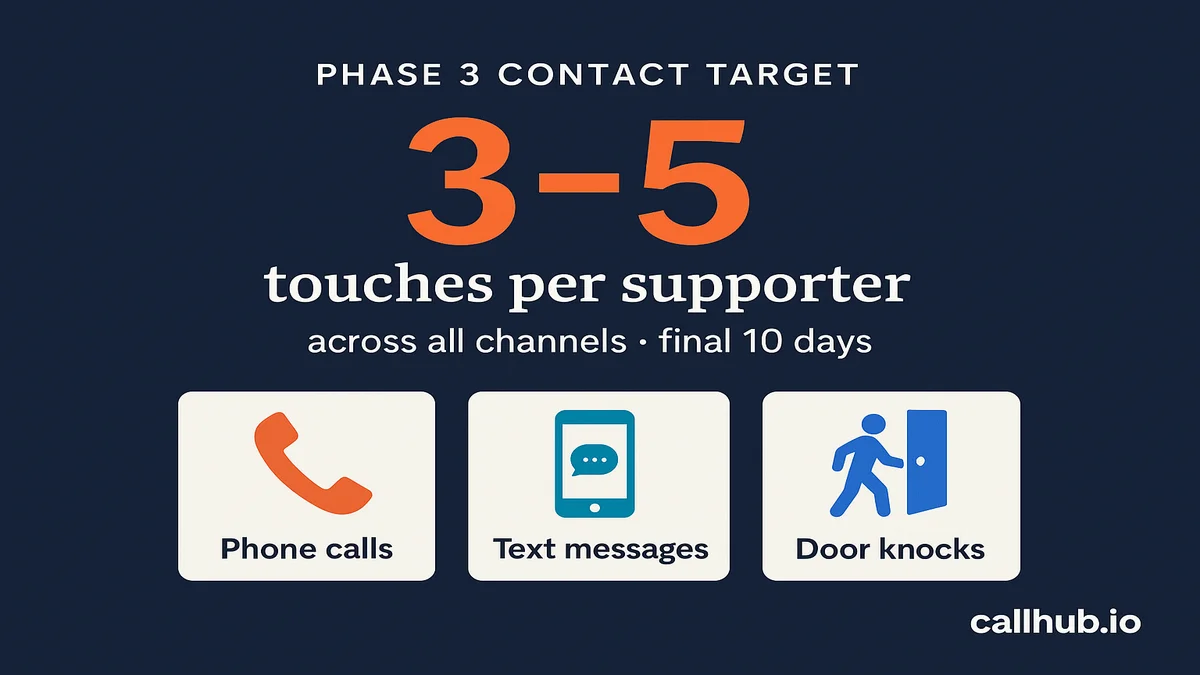
Your contact target for this phase: Three to five total touches per confirmed supporter across all channels in the final 10 days. That’s not five calls. It’s five contacts across phone, text, and door-to-door combined. Research-backed GOTV programs use that multi-touch approach because each additional contact reinforces voting intention in a way that a single well-timed call can’t achieve on its own.
Phone banking and texting: The contact volume phase
Phase 3 is your highest-volume phone and text period. According to Yale GOTV experiments, phone banking lifts voter turnout by 3–4 percentage points among contacted voters. For a local race with 15% baseline turnout, that lift is the difference between a race and a win.
Schedule calls in the evenings on weekdays when more voters are home, and throughout the day on weekends. Pair call attempts with follow-up texts on the same day for supporters who don’t pick up the first time. Your GOTV script samples for phone banking and texting should shift in this phase from asking about voting plans to confirming logistics: Polling location, hours, and whether the voter needs help getting there.
Door-to-door canvassing
Door-to-door canvassing raises turnout by 2–4 percentage points among contacted households, according to Analyst Institute research. That lift comes from the personal contact, not just the information delivered, which is why canvassing still outperforms digital outreach even in high-tech campaigns.
Plan your canvass routes using your GOTV universe data. Prioritize soft supporters in precincts with strong historic turnout patterns. A well-targeted canvass route covers more persuadable doors per volunteer hour than a broad, untargeted one. And your volunteers’ willingness to canvass in the final push depends heavily on how focused and achievable their assignments feel.
The voter chase model
As Phase 3 progresses, shift from full-universe outreach to a voter chase model. Each day, pull a list of supporters you’ve contacted who haven’t yet voted (using early vote return data where available) and prioritize them for re-contact. You’re actively closing the gap between your committed supporter count and your confirmed ballot count.
The voter chase model works only if your CRM data is clean and real-time. Call dispositions need to sync back to your voter file daily. Contacts who have already returned mail ballots need to be removed from your call list so you’re not calling voters who are already done. If your data isn’t flowing correctly, your chase list is noise.
Phase 4 (final 72 hours and election day): Close hard
The 72 hours before polls close are the most intensive period in any GOTV calendar. Your universe work is done. Your outreach has been running for weeks. This phase is about converting remaining uncommitted supporters into ballots cast, as efficiently as possible.
Call until 9 p.m. every allowable day from the Saturday before the election through election eve. Don’t slow down on Sunday afternoon expecting election day to handle it. Voters who don’t respond on Saturday often vote on Sunday or Monday when reached. The voters still in your chase list in the final 72 hours are the hardest to move. They need more contacts, not fewer.
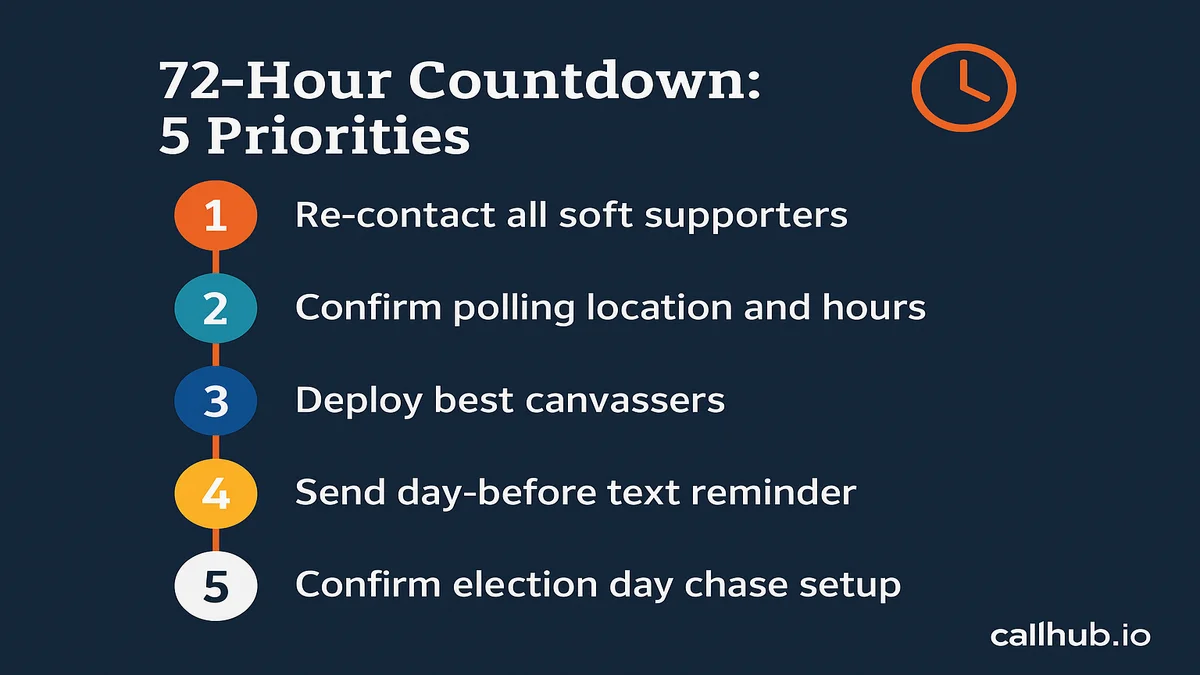
72-hour countdown priorities
Focus your final three days on this sequence:
- Re-contact all soft supporters who haven’t confirmed they’ve voted. These are your highest-value remaining targets.
- Confirm polling location and hours for all remaining universe voters. Logistics failures cost real votes in this window.
- Deploy your best canvassers. Door knocks in the 72-hour window have the highest mobilization impact of any contact in the cycle.
- Send a day-before reminder text to your full supporter universe. A well-timed text the evening before election day drives incremental turnout at low cost.
- Confirm your election day voter chase setup is ready. Who’s working the chase list? Where does the data flow? Does your team know the protocol?
Election day voter chase
Election day GOTV is about your remaining confirmed supporters who haven’t voted yet. Most campaigns pull updated data throughout the day, from poll observers, early vote reports, or ballot return feeds, and continuously update the chase list as the hours narrow.
The script is direct: Confirm the voter hasn’t cast a ballot yet, remind them polls close at X p.m., and address any logistics barrier (transportation, work schedule, childcare). The goal of each contact is to identify and remove one obstacle between that supporter and the polls.
Prioritize calls and texts by support score and turnout propensity. Don’t spend election day call capacity on weak supporters when strong supporters haven’t voted yet.
What if you’re starting GOTV late?
If you’re reading this with fewer than three weeks before election day, you don’t have time for the full four-phase program. That’s the reality, and it’s more common than campaign textbooks acknowledge. Here’s how to triage a compressed timeline.
Two to three weeks out: Skip the full Phase 1 universe build. Pull your strongest support tier from whatever data you have, build a clean contact list in the next 48 hours, and go straight to outreach. Lock your GOTV script immediately.
Ten days out: You’re in Phase 3 territory from day one. Prioritize phone banking and texting over canvassing: Calls and texts scale faster with remote volunteers. Focus entirely on your top supporter tier. Don’t try to cover your persuadable universe; there isn’t enough time to act on what you find.
One week out: Run the tightest version of Phase 4 you can. Narrow your GOTV universe to strong supporters only. Get every available volunteer making calls on the final weekend. Review last-minute GOTV tips for election day for tactics that deliver fast under short timelines.
Starting late doesn’t mean losing. It means cutting scope, not quality. A focused 10-day program with clean targeting outperforms a disorganized 8-week one that tries to cover everyone.
How CallHub powers every phase of your GOTV timeline
Running a GOTV program across four phases means coordinating calls, texts, canvassing, and data sync across weeks of intensive voter contact. CallHub’s political campaign platform connects all of that into one program, so your call data flows back to your voter file in real time, your text reminders reach supporters who don’t pick up, and your chase list stays current as your team works the phones on election day.
From universe-building in Phase 1 to the 72-hour close in Phase 4, CallHub’s Power Dialer, peer-to-peer texting (P2P texting), and Text Broadcasting tools scale to the contact volume your GOTV calendar requires. Read the ultimate guide to get out the vote to see how campaigns integrate CallHub’s tools across each phase of their program.
Frequently asked questions
When should a GOTV campaign start?
Universe building and volunteer recruitment should begin eight weeks before election day. Active GOTV outreach starts four weeks out for mail and early-vote states, and 7–10 days out for traditional poll-voter states. The earlier you define your voter universe, the better your Phase 3 outreach performs.
What is the difference between voter ID and GOTV?
Voter ID is the process of identifying which voters support your candidate or cause. It happens months before election day. GOTV is the process of mobilizing those identified supporters to actually cast a ballot. The two are sequential: Effective GOTV depends on completed voter ID work. Without knowing who to mobilize, you’re contacting your full voter universe and hoping for the best.
How long does the GOTV phase last?
The full GOTV calendar runs eight weeks if you start on schedule. The active outreach phase (Phases 3 and 4) runs for 10–14 days before election day. In mail and early-vote states, the outreach window starts four weeks out to reach voters before their mail ballot deadlines.
How many times should you contact a voter during GOTV?
Aim for three to five total touches per confirmed supporter across all channels in the final 10 days. That counts phone calls, text messages, and door knocks combined. Spread contacts across different days and channels rather than making multiple calls on the same day. Channel variety reinforces the message more effectively than repetition on one channel.
What is the 72-hour rule in a political campaign?
The 72-hour rule refers to the final three days before polls close: The highest-intensity period of any GOTV program. Campaigns use this window for final outreach to uncommitted supporters, intensive canvassing, election-eve text reminders, and setting up the election day voter chase. Every GOTV calendar should reserve maximum volunteer capacity for this window.
What should you do if your GOTV starts late?
Narrow your universe immediately and cut scope, not quality. Focus on strong supporters only, skip the persuadable tier, and run the tightest version of Phase 3 and Phase 4 you can with the time available. A 10-day program with clean, focused targeting outperforms a broad program that tries to reach everyone in a compressed window. See the late-start triage section above for a phase-by-phase breakdown.