
47% of young Americans aged 18–29 voted in 2024, according to CIRCLE at Tufts University. That is up from 39% in 2016 and just below the 50% recorded in 2020, the highest two-cycle youth participation rate in decades. Most coverage treated this as a turning point. The more useful number is the other 53%.
Youth voter turnout is the percentage of eligible voters aged 18–29 who cast a ballot in a given election. Even at 47%, young voters trail older age groups by 15 to 20 percentage points. Among some demographics, the gap is far wider: Black men aged 18–29 voted at 25% in 2024, while white women the same age voted at 58%.
The research is clear on the cause: The primary driver is not motivation, it is contact. Young people who are directly reached by a campaign or organizing effort vote at dramatically higher rates than those left untouched. This article covers why the gap persists by demographic and which three Get Out the Vote (GOTV) methods produce the highest uplift among 18–25-year-olds.
Key Takeaways
Youth voter turnout (18-29) reached 47% in 2024, up from 39% in 2016 but below the 50% peak in 2020, and the persistent gap with older voters traces to contact rates rather than motivation.
Why the turnout gap persists
- Registration complexity trips up many 18-25-year-olds who move for college or work and miss re-registering, especially in states without automatic or same-day registration.
- 20% of young people report not feeling they know enough to vote, according to CIRCLE and Child Trends research, reflecting an information gap rather than apathy.
- Life transitions like starting college, moving cities, and changing jobs cluster in the 18-25 window and displace voters from familiar voting locations and routines.
- Low political efficacy among first-time voters shifts once organizers make direct, personal contact before election day.
The apathy myth
- Gen Z turnout hit 31% in the 2018 midterms, the highest youth midterm participation since 1994, and 50% in 2020, the highest rate in 30 years.
- Turnout rises where youth-specific organizing programs run at scale and stays flat where they do not, indicating contact drives the variation, not interest.
The contact gap and demographic breakdown
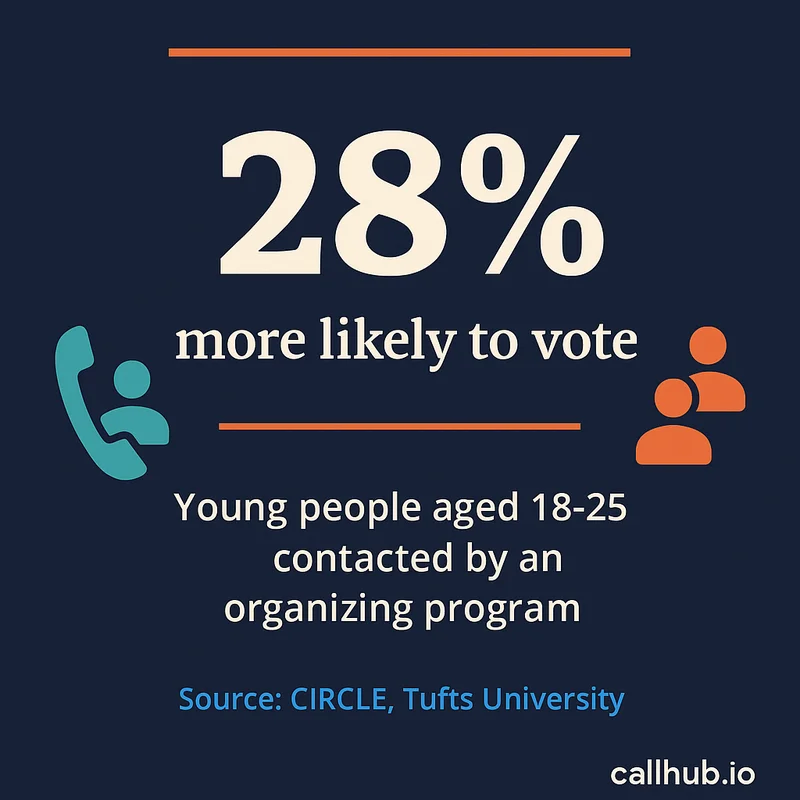
- A CIRCLE analysis of 129 nonprofits found young people contacted by a campaign or organizing program vote 28% more than peers who receive no contact.
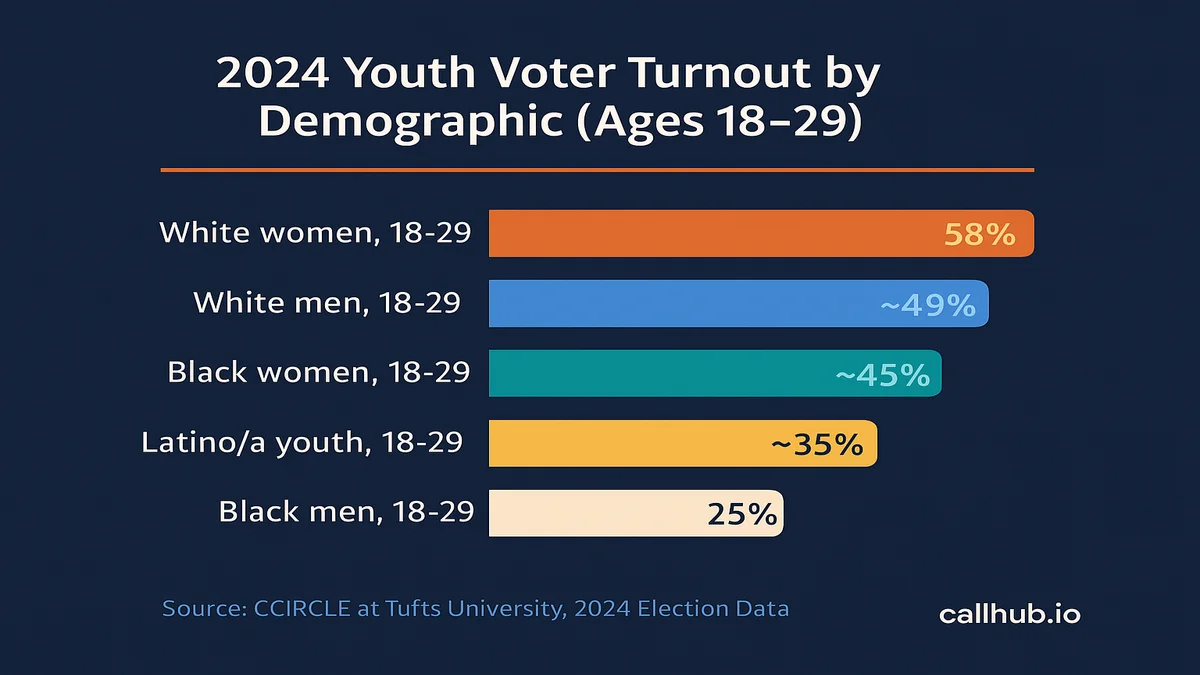
- 2024 turnout varies widely by demographic: 58% for white women 18-29, about 49% for white men, about 45% for Black women, about 35% for Latino/a youth, and 25% for Black men.
- Black male youth and Latino youth voters face the widest contact gaps, reflecting under-outreach rather than inherently lower engagement.
Which GOTV methods work
- Relational organizing, where volunteers contact their own social network instead of a cold list, delivers the largest uplift among youth-focused methods.
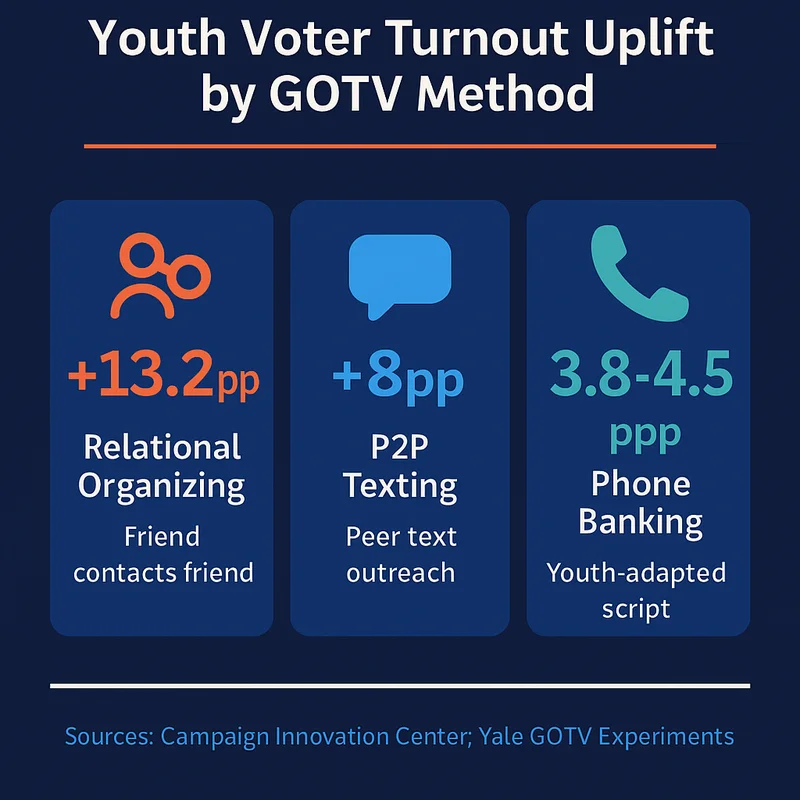
- A field experiment by Donald Green and the Campaign Innovation Center found a 13.2 percentage-point turnout increase when a voter was contacted by a friend versus a stranger using the same script.
- NextGen America applied distributed relational organizing to reach more than 3 million young people through peer texting and volunteer calling, scaling it by equipping volunteers with tools to reach their own contacts rather than random lists.
Why youth voter turnout is consistently lower than other age groups
Youth voter turnout is consistently lower than turnout among older age groups because first-time and early voters face structural barriers that more experienced voters have already navigated. These barriers include registration complexity, information gaps, and life instability. They are real. They are also not fixed.
Structural barriers that suppress first-time voter participation
Four factors reliably suppress youth turnout in every election cycle:
- Registration complexity: Many 18–25-year-olds move frequently for college or work. Re-registering at a new address is a step many miss, especially in states without automatic or same-day registration.
- Information gaps: 20% of young people report they don’t feel they know enough to vote, according to CIRCLE and Child Trends research. This is not apathy. It is the absence of a trusted guide.
- Life transitions: Starting college, moving cities, and changing jobs all cluster in the 18–25 window. These transitions displace voters from familiar voting locations and routines.
- Low political efficacy: First-time voters are less likely to believe their vote will matter. This perception shifts when organizers make direct, personal contact before election day.
None of these barriers are fixed. All of them respond to direct outreach.
The myth of apathy: What Gen Z voter turnout data actually shows
The dominant narrative about young voters is that they are disengaged. The data does not support this. Gen Z voter turnout in the 2018 midterms reached 31%, the highest youth midterm participation since 1994. In 2020, youth turnout hit 50%, the highest rate in 30 years.
What varies most in Gen Z voter turnout data is not interest. It is contact. In elections where youth-specific organizing programs ran at scale, turnout followed. Where they did not, the gap held.
The organizer’s question is not “how do we get young people to care?” It is “how do we reach them before election day?”
What youth voting statistics reveal about the contact gap
Young people contacted by a campaign or organizing program vote 28% more than peers who receive no contact. That is the finding from a CIRCLE analysis of 129 nonprofits conducting direct outreach to 18–25-year-olds. The contact effect is not a hypothesis. It is measured, replicated, and large.
Which youth demographics have the widest turnout gaps
The 47% overall youth turnout figure masks significant variation by race and gender. CIRCLE’s 2024 breakdown shows:
| Demographic | 2024 Turnout |
|---|---|
| White women, 18–29 | 58% |
| White men, 18–29 | ~49% |
| Black women, 18–29 | ~45% |
| Latino/a youth, 18–29 | ~35% |
| Black men, 18–29 | 25% |
Organizers working with Black youth male voters and Latino youth voters face the widest contact gaps. These are not audiences who are inherently harder to move. They are audiences that have been reached less.
The contact effect: What direct outreach does to young voter turnout
The 28% contact uplift from CIRCLE’s nonprofit data holds across multiple study designs. The mechanism is consistent: When a young person is contacted by someone who shares their community, their lived experience, or their issue interests, the conversation converts. When contact comes from a stranger reading a generic script, conversion rates fall sharply.
This is why the three highest-performing GOTV methods for youth share a common feature: They all prioritize personal, peer-based contact over broadcast outreach.
The three GOTV methods proven to move young voters
Not all GOTV outreach performs equally with 18–25-year-olds. These are the three methods with the strongest evidence base for youth uplift, along with how much each one moves the numbers.
Relational organizing: The highest-impact channel for youth
Relational organizing is the practice of having volunteers contact members of their own social network, including friends, family, and neighbors, rather than a cold contact list. For youth voters, the uplift is larger than any other single method.
A field experiment by political scientist Donald Green and the Campaign Innovation Center found a 13.2 percentage-point turnout increase when a voter was contacted by a friend versus a stranger running the same script. For 18–25-year-olds, who are most likely to ignore outreach from unfamiliar sources, the friend effect is foundational.
NextGen America used distributed relational organizing at scale, contacting more than 3 million young people via peer texting and volunteer calling programs. The contact volume was only possible because the program built a large volunteer base and gave each volunteer a tool to reach their own network, not a random walk list.
If you have young volunteers, your highest-leverage move is to give them a digital relational organizing tool and let them work their own contacts. For a deep look at how this works in practice, see the ultimate guide to relational organizing, or for the volunteer-captain model built specifically for turnout, see relational organizing for GOTV.
Peer-to-peer texting: Reaching voters on the channel they actually use
Peer-to-peer texting is an outreach method where volunteers send individually crafted text messages to a contact list. Each message is sent one at a time by a human volunteer, not blasted from an autodialer.
A 2018 field experiment measured the impact of friend-to-friend text outreach: 8 percentage points higher turnout among young voters who received peer text contact versus a control group with no contact. Young voters respond to peer-to-peer (P2P) texting because the channel feels personal, replies are handled by a real person, and the format does not feel like broadcast advertising.
A peer-to-peer texting platform lets your volunteers send at volume without sacrificing the one-to-one feel that drives the result. For youth voter programs, this is your highest-throughput contact channel.
Phone banking with youth-specific script adjustments
Phone banking produces 3.8 to 4.5 percentage-point turnout increases, according to Yale GOTV experiments. With youth voters, that range is achievable, but only with script adjustments. A standard phone bank script built for 45-to-65-year-old voters will underperform with 18–25-year-olds.
Phone banking is most effective as a secondary channel for youth, layered on top of relational organizing and P2P texting rather than run as the primary contact method. For a deeper look at how to structure your phone banking program, see phone banking strategies for GOTV.
Youth-specific script adjustments are the subject of the next section.
Youth GOTV script adjustments: What to change and why
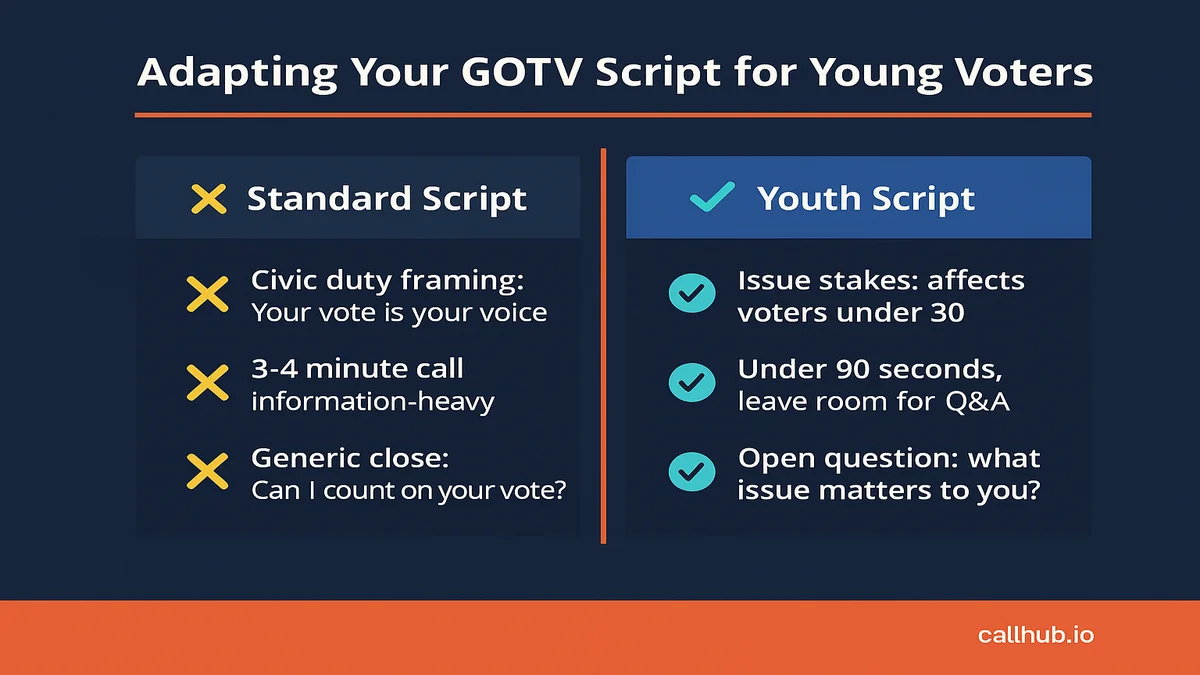
A standard GOTV phone script is built around civic duty framing: “Your vote matters, and election day is coming.” Research on 18–25-year-olds consistently shows this framing underperforms. Young voters respond to issue stakes, not civic obligation.
Here are the core adjustments:
| Script element | Standard version | Youth-specific adjustment |
|---|---|---|
| Opening hook | “Are you planning to vote on November 5th?” | “We’re reaching out to young voters in [area] before election day. Got 30 seconds?” |
| Motivation frame | “Your vote is your voice.” | Lead with a specific issue: “The [issue] ballot measure is being decided by voters under 30 in your district.” |
| Call duration | 3 to 4 minutes, information-heavy | 90 seconds or less. Leave room for the voter to ask a question. |
| Closer | “Can I count on your support?” | “What’s one issue you want elected officials to prioritize?” Then confirm their plan to vote. |
| Follow-up method | Another call | A text follow-up after the call with one link |
Lead with the issue, not civic duty
Young voters are policy-motivated at higher rates than older cohorts. They respond to specific stakes: “This candidate’s position on student loan policy directly affects voters under 30 in this district.” Generic civic-duty framing registers as impersonal and easy to dismiss.
The most effective youth scripts name the issue before asking about turnout intent. The issue surfaces the motivation; the voting plan question converts it.
Keep it short and leave space for a real conversation
Youth voter outreach fails most often because the volunteer talks too much. Three adjustments work across most youth scripts:
- Cut the opener to 15 words or fewer
- Ask one open question about an issue the voter cares about
- Confirm the voting plan in the last 20 seconds of the call, not as the central pitch
Scripts that run longer than 90 seconds with first-time voters see sharply lower completion rates. The goal is to start a conversation, not deliver a briefing.
How to build your youth GOTV contact plan
A youth GOTV program is not a standard contact program with a different demographic filter. It requires a younger volunteer base, channel sequencing built around mobile-first contact, and scripts adjusted for the issues driving 18–25-year-old turnout in your race.
Build a young volunteer base for relational outreach
Your relational organizing program will only reach young voters if the volunteers are also young. Older volunteers working their own networks will reach older voters. To recruit a young volunteer base:
- Partner with local colleges, high school civics programs, and campus advocacy groups
- Offer credit, internship hours, or issue alignment as the entry point, not “volunteer for the campaign”
- Recruit through the channels young people already use: Instagram, Discord, group chats
- Give volunteers a mobile-first tool. If the relational organizing interface requires a desktop, adoption drops sharply.
Once recruited, GOTV-specific volunteer training differs from a standard phone-bank onboarding — build it into the process before the first shift.
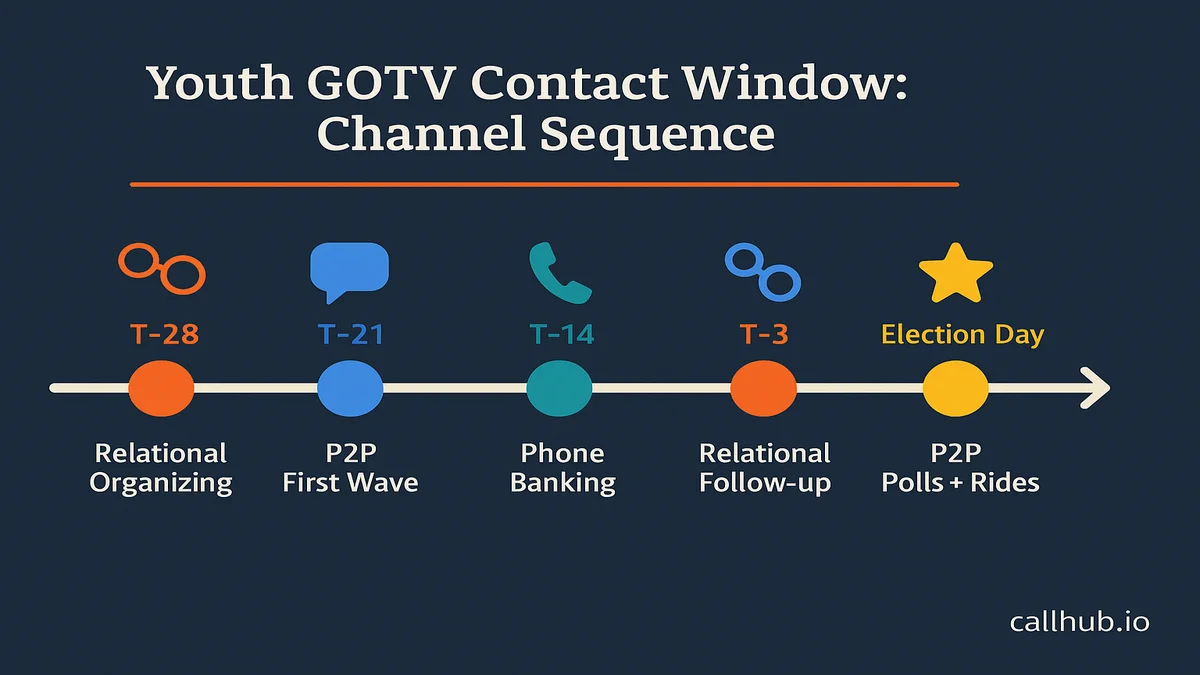
Sequence your channels across the contact window
| Timeline | Channel | Action |
|---|---|---|
| T-28 days | Relational organizing launch | Deploy volunteer app. Volunteers begin texting their own networks. |
| T-21 days | P2P texting (first wave) | Send issue-based first contact to list. |
| T-14 days | Phone bank (youth script) | Layer phone banking on top of unresponded text contacts. |
| T-7 days | P2P texting (reminder wave) | Send voting plan confirmation request. |
| T-3 days | Relational organizing follow-up | Volunteers follow up with friends who have not confirmed. |
| Election day | P2P texting (polls and rides) | Polling location info and transportation support if available. |
Channel sequencing matters because each contact reinforces the previous one. A voter who gets a text from a friend, a call from a volunteer, and a reminder text on election day has heard from your program three times. Each contact is from a personal source.
For the broader framework on how these tactics fit together, see the complete guide to get out the vote. A broader look at what has worked for youth voter programs in past cycles is also covered in how to get young people to vote.
Turn your youth voter data into a contact win this cycle
Youth voter turnout is a contact problem, not an apathy problem. The organizers who close the gap are the ones who deploy relational organizing and peer-to-peer texting before election day. The ones who wait for young voters to show up on their own are the ones reading post-election gap analysis in November.
Relational organizing, peer-to-peer texting, and youth-adapted phone banking all produce measurable uplift. Combined and sequenced correctly, they compound. The research supports running all three, not choosing one. These three tactics fit inside a larger system: See the complete GOTV strategy guide for the full phase-by-phase plan.
If you’re building your youth contact program now, start by setting up a peer-to-peer texting program for your youth GOTV effort and layer relational organizing on top of it. That is where the uplift is largest and most consistent. Explore CallHub’s GOTV platform to coordinate calling, texting, and relational outreach in one place.
Frequently asked questions
What percentage of young people voted in the 2024 election?
47% of Americans aged 18–29 voted in 2024, according to CIRCLE at Tufts University. That is down from 50% in 2020 but up from 39% in 2016, making 2020 and 2024 the two highest youth turnout elections in three decades.
What is the main reason youth voter turnout is low?
Contact is the primary driver. Young voters who are directly reached by a campaign or organizing effort vote at significantly higher rates than those who are not contacted. Structural barriers including registration complexity, information gaps, and life transitions also suppress first-time voter participation, but all of these respond to direct outreach.
What GOTV method has the highest impact on young voter turnout?
Relational organizing produces the largest per-contact uplift: A 13.2 percentage-point increase in turnout when a voter is contacted by a friend versus a stranger, according to field research by Donald Green and the Campaign Innovation Center. Peer-to-peer texting produces an 8 percentage-point increase in comparable studies.
Is phone banking effective for reaching young voters?
Phone banking is effective but must be adapted for a young audience. Generic civic-duty scripts underperform. Youth-specific scripts lead with issue stakes, run under 90 seconds, and leave room for the voter to ask a question. Phone banking works best as a secondary channel layered on top of relational organizing and peer-to-peer texting.
How is Gen Z voter turnout different from previous generations of young voters?
Gen Z voter turnout follows a similar trajectory to previous generations, with higher turnout in presidential years and lower in midterms, but Gen Z showed unusually strong midterm performance in 2018 (31%) and 2022. Gen Z voters are also more issue-motivated than their predecessors. They respond to specific policy stakes over generic civic-duty framing, which changes how scripts and messaging need to be built.
How many questions does a youth GOTV phone script need?
One or two questions is optimal. Open with a brief issue-stakes question, then close with a voting plan confirmation. Scripts that exceed two questions or run longer than 90 seconds see higher hang-up rates with 18–25-year-old contacts.
What is relational organizing and how does it differ from canvassing?
Relational organizing is the practice of having volunteers contact people they already know, including friends, family, classmates, and neighbors, rather than a cold contact list. Traditional canvassing sends volunteers to unfamiliar doors. The distinction matters for youth voters: Contact from a trusted peer converts at significantly higher rates than contact from an unknown volunteer, regardless of script quality.