
You have the supporters. You have the cause. You have a clear picture of the change you need. What you might not have yet is a structured path from organizing energy to actual policy change, and that gap is where most advocacy efforts stall.
Policy advocacy is the process of influencing decision-makers to adopt, change, or reject specific policies. It is not lobbying alone. It is not just rallying supporters. It is a coordinated effort that moves between public mobilization, direct legislative engagement, media pressure, and coalition work. Each tactic reinforces the others until the decision-maker moves.
This guide gives you the framework to run a policy advocacy campaign from start to finish: From setting your goal and mapping stakeholders to choosing outreach tactics that reach legislators and measuring what works.
What is policy advocacy?
Policy advocacy is the act of influencing public policy decisions by educating decision-makers, mobilizing constituents, and building the political will needed to drive legislative or regulatory change. It covers everything from a single constituent calling their representative to a national coalition coordinating thousands of actions over months.
Unlike direct program delivery, policy advocacy targets the rules of the game: The laws, regulations, and budget allocations that determine how resources are distributed and which communities are served.
Policy advocacy vs. lobbying: what’s the difference?
Lobbying is a subset of policy advocacy. Direct lobbying means communicating a specific position on specific legislation to a legislator or their staff. Policy advocacy is broader: It includes public education, coalition building, media campaigns, and grassroots mobilization that creates the political environment in which lobbying happens.
| Policy advocacy | Direct lobbying | |
|---|---|---|
| Audience | Public, media, decision-makers | Legislators and their staff |
| Goal | Shift public opinion and build political will | Influence a specific vote or decision |
| 501(c)(3) limits | Generally unrestricted | Subject to IRS substantiality test |
| Tactics | Full toolkit: Calls, texts, canvassing, coalitions, media | Meetings, testimony, written positions |
The distinction matters most for nonprofits navigating IRS rules, which we cover in the compliance section below.
For a deeper look at where the line falls, read advocacy vs. lobbying: what’s the difference.
Why policy advocacy matters for your organization
The policy environment determines what is possible for the communities you serve. Organizations that choose not to engage with policy often find that decisions made without their input directly undermine their program work.
Three reasons advocacy organizations show up in policy spaces:
- Representation: Your constituents rarely have direct access to decision-makers. Organized advocacy creates that access.
- Efficiency: A single policy change can do what years of direct service cannot. Fixing a broken rule affects everyone it touches.
- Durability: Program funding disappears. Policy changes, once won, are harder to undo.
According to the Council on Foundations, grassroots lobbying increased constituent contact with Congress by over 300% between 2000 and 2020. Organizations that build advocacy capacity compound that access over time.
The 4 types of policy advocacy
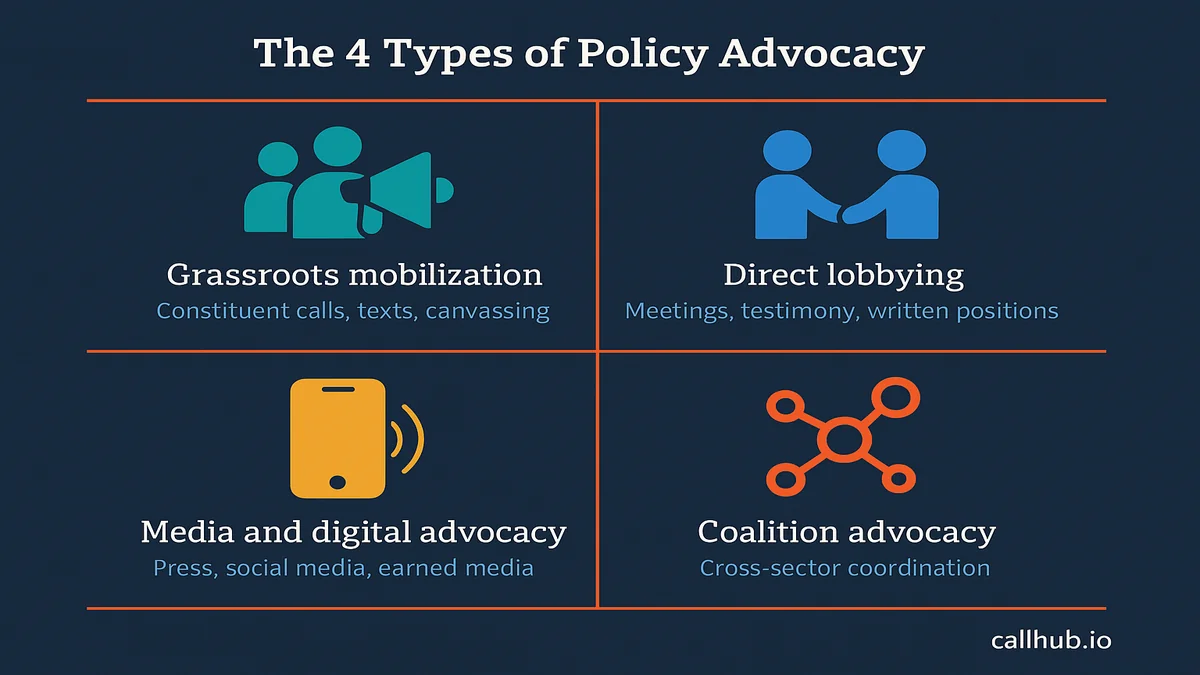
Most campaigns use more than one type. Understanding the four helps you choose the right combination for your goal and your capacity.
| Type | Best for | Primary channel |
|---|---|---|
| Grassroots mobilization | Mass constituent pressure | Calls, texts, canvassing, email |
| Direct lobbying | Building relationships and making specific asks | In-person meetings, testimony |
| Media and digital advocacy | Shifting public opinion | Press, social media, earned media |
| Coalition advocacy | Issues requiring cross-sector legitimacy | Coordination across organizations |
Grassroots mobilization
Grassroots mobilization turns supporters into active constituents who contact decision-makers directly. It is the most scalable type of policy advocacy because it multiplies your reach beyond your staff capacity.
Tactics include: Constituent phone calls and texts to legislators, letter-writing programs, town hall attendance, and online petition drives that feed into direct outreach. The defining feature is that the contact comes from ordinary constituents, not from your staff.
Use grassroots mobilization when: You need to demonstrate political cost to a decision-maker, when volume matters more than relationship, or when you want to build a permanent constituent engagement infrastructure.
Direct lobbying
Direct lobbying means your staff or designated advocates communicate a specific position on specific legislation directly to a legislator or their staff. Relationships, credibility, and the quality of your policy argument do the heaviest lifting here.
Tactics include: Legislative meetings (particularly during lobby days and advocacy days), written testimony, bill hearings, and policy briefings with staff. Coalition letters and sign-on letters count as direct lobbying when they reference specific legislation.
Use direct lobbying when: You need to move a specific bill, build a relationship with a key vote, or correct misinformation circulating in a committee.
Media and digital advocacy
Media advocacy uses earned media coverage, op-eds, social media, and digital content to build public support and increase political pressure. It works by making inaction visible and raising the political cost of opposing your position.
Tactics include: Press releases and media pitches, constituent stories placed in local outlets, op-eds from credentialed advocates, social media campaigns with a clear ask, and digital ads in a legislator’s district.
Use media advocacy when: You need to shift the narrative, when a legislator is avoiding direct meetings, or when your direct lobbying has plateaued and you need public pressure to move things.
Coalition advocacy
Coalition advocacy builds coordinated action across multiple organizations, sectors, and constituencies. A coalition that includes healthcare systems, unions, businesses, and faith groups carries a different weight than a single advocacy organization.
Tactics include: Formal coalition letters, joint testimony, shared messaging, coordinated lobby days, and co-branded public communications. Effective coalitions assign clear roles rather than trying to reach consensus on everything.
Use coalition advocacy when: Your issue spans multiple sectors, when you need to counter well-funded opposition, or when key legislative relationships exist in partner organizations that your organization does not have.
How to run a policy advocacy campaign: A 6-step framework
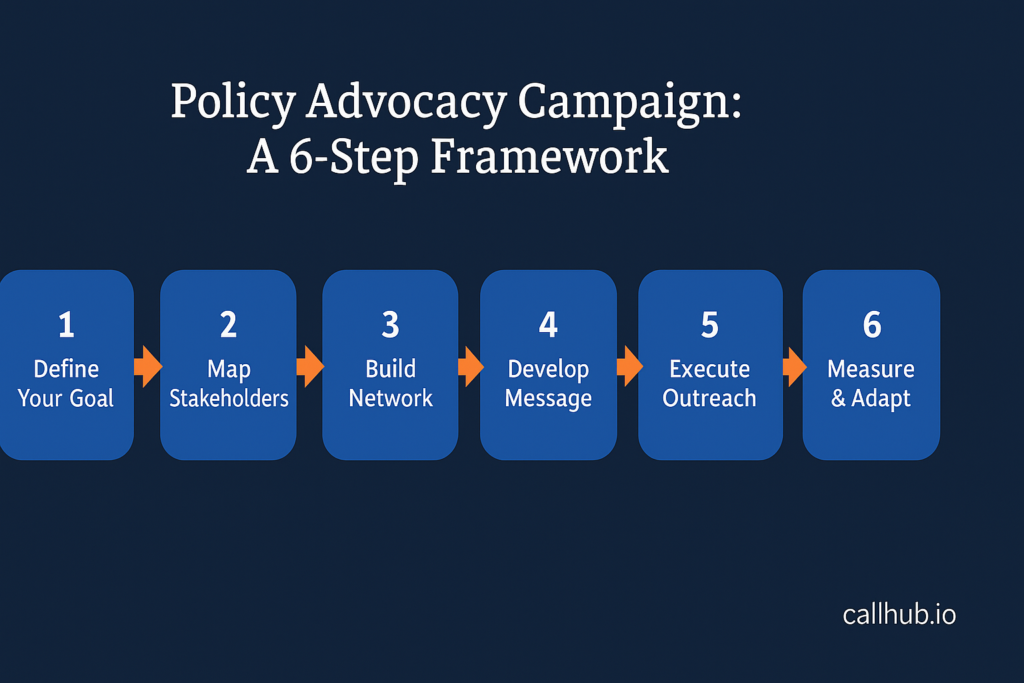
Step 1: Define your policy goal
Your goal needs to be specific enough to know when you have won. “Improve mental health funding” is a direction. “Pass SB 412 to increase the state mental health block grant by $15 million in the FY2027 budget” is a goal.
A good advocacy goal is specific (which bill, which regulation, which budget line), time-bound (which session, which vote), and winnable with the resources you can realistically deploy.
If your goal is too broad, you will not be able to build a clear ask for your advocates or demonstrate progress to funders.
Step 2: Map your stakeholders and decision-makers
Before you run a single call or meeting, map who makes the decision and who influences the decision-maker.
Build a stakeholder matrix with three categories:
- Decision-makers: The legislators, regulators, or officials who vote on or approve your policy goal
- Influencers: Staff, community leaders, peer organizations, and media who shape the decision-maker’s view
- Potential allies: Constituencies the decision-maker already trusts who could carry your message with more weight than you can alone
Assign a persuadability score to each decision-maker. Focus your most intensive outreach on persuadable votes, not on supporters who are already with you or opponents who are already locked.
Step 3: Build and segment your advocate network
An advocate network is not a list of everyone who agrees with you. It is a segmented group of people willing to take a specific action at a specific time.
Segment your network by: Geography (constituent of which legislator), engagement history (acted before vs. untested), capacity (willing to meet in person vs. willing to make one call), and expertise (doctors, small business owners, teachers, whoever carries the most credibility on your specific issue).
The segmentation determines the ask. A supporter in a swing district gets a different message than a supporter in a safe seat. An expert ally gets asked to testify; a first-time advocate gets asked to call.
For detailed strategies on building this kind of advocate base, read the complete guide to grassroots advocacy strategies.
Step 4: Develop your core message
Your message is not your policy position. Your message is the reason a legislator who has not yet made up their mind should support your position.
A strong advocacy message has three parts:
- The problem: Specific, local, and relevant to the decision-maker’s constituents
- The ask: One specific action the legislator can take
- The why-now: What changes if they act now vs. waiting
Keep the message to three sentences. Advocates who have to memorize a paragraph will adapt it on the fly and lose consistency. Short enough that every constituent call, text, and meeting delivers the same core ask.
Step 5: Execute multi-channel outreach
Your outreach plan determines how your message reaches the decision-maker. A constituent phone call carries more weight than a petition signature. A personal meeting carries more weight than a phone call. The goal is to move as many advocates as possible to the highest-weight action they are willing to take.
The outreach channels and their specific execution are covered in the next section.
Step 6: Measure, report, and adapt
Most campaigns measure activity counts: Calls made, emails sent, meetings held. Those numbers matter, but they do not tell you whether you are moving the decision-maker.
Add two tracking layers to your standard activity metrics:
| What to track | Why it matters |
|---|---|
| Decision-maker vote signals | Direct indicator that pressure is working |
| Media coverage volume and framing | Indicator of narrative shift |
| Coalition growth | Indicator of legitimacy building |
| Geographic concentration of actions | Shows whether constituent pressure is reaching the right districts |
| New vs. returning advocates | Shows network depth vs. reliance on a core group |
Report to your coalition and funders monthly. Use the data to shift resources: If constituent calls in three swing districts are going to voicemail at 80%, shift to peer-to-peer texting to drive attendance at town halls and call-in events instead.
Outreach tactics that move decision-makers
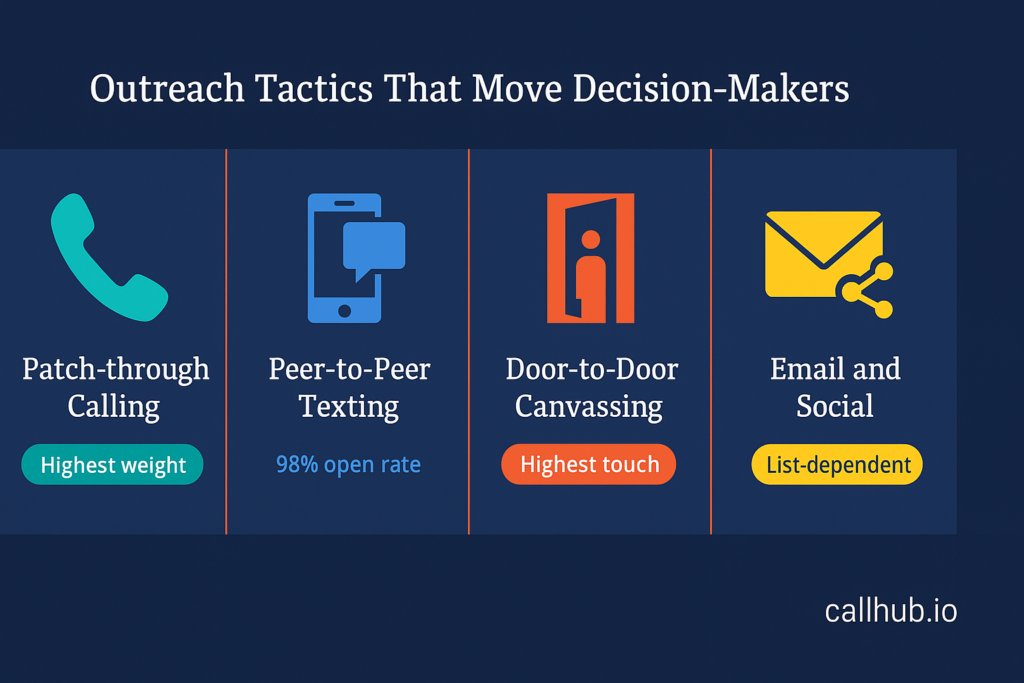
Tactics differ in the weight they carry with decision-makers and the resources they require to execute at scale. Build your outreach plan around the highest-weight tactics your advocate network can sustain.
Patch-through calling campaigns
A patch-through calling campaign connects constituents directly to their legislator’s office in a single call. An advocate calls in, hears the message, confirms they want to be connected, and the system transfers them live to the legislator’s office.
A single constituent phone call is worth more than dozens of emails, according to congressional communication research cited by Quorum.us. Phone calls require an action from the legislator’s staff, generate a real record, and signal a level of commitment that form emails do not.
Patch-through calling is particularly effective during floor votes and committee hearings, when the timing of constituent pressure is as important as the volume. CallHub’s Patch-through Calling connects your advocates to their representatives in real time, without requiring advocates to look up the number themselves, which reduces friction between the ask and the action.
Peer-to-peer and broadcast texting
Text messages have a 98% open rate within the first three minutes, according to industry messaging benchmarks, making them the most reliable channel for time-sensitive advocacy actions.
Two texting models for advocacy: Peer-to-peer texting puts a volunteer behind each initial message, creating a personal exchange that drives higher response rates. Broadcast texting delivers one message to your full list, ideal for low-lift actions like petition signings or call-in days where personalization is less critical.
Eli Zbar, Communications Strategist for the Dianne Watts BC Liberal Party Leadership Campaign, found peer-to-peer texting essential for real-time supporter engagement: “It was really effective during voting, when we were able to do voter registration and troubleshooting via text messaging. I could have 50 people who all had issues, and individually troubleshoot them one at a time. You can’t do that on the phone.”
For advocacy campaigns, CallHub’s peer-to-peer texting is most effective for initial recruitment into a call-in campaign, day-of reminders for lobby days and town halls, and follow-up asks after a broadcast message does not convert.
Door-to-door canvassing
Canvassing is the highest-touch form of constituent outreach. It reaches supporters who have not opted into your list and builds visibility in the district. For policy advocacy, canvassing is most effective for collecting petition signatures, recruiting advocates for a call-in campaign, and building local earned media through visible neighborhood presence.
Canvassing also generates the constituent stories that power every other channel. The person who tells a canvasser about how a broken policy affected their family is the same person who can sit across from a legislator’s staff and make the issue real.
Email and social media campaigns
Email drives higher-commitment actions: Petition signatures, event registrations, and meeting requests. It requires your advocates to already be on your list. Treat email as the channel for deepening engagement with people who are already with you.
Social media is most effective when it creates visible constituent pressure in a specific legislator’s district. Local hashtag campaigns, tagging a legislator’s account in constituent testimonials, and coordinated posting during a committee vote all increase the visibility of an issue to the legislator’s team. Social media rarely moves a vote alone, but it raises the cost of saying no.
Policy advocacy examples that worked
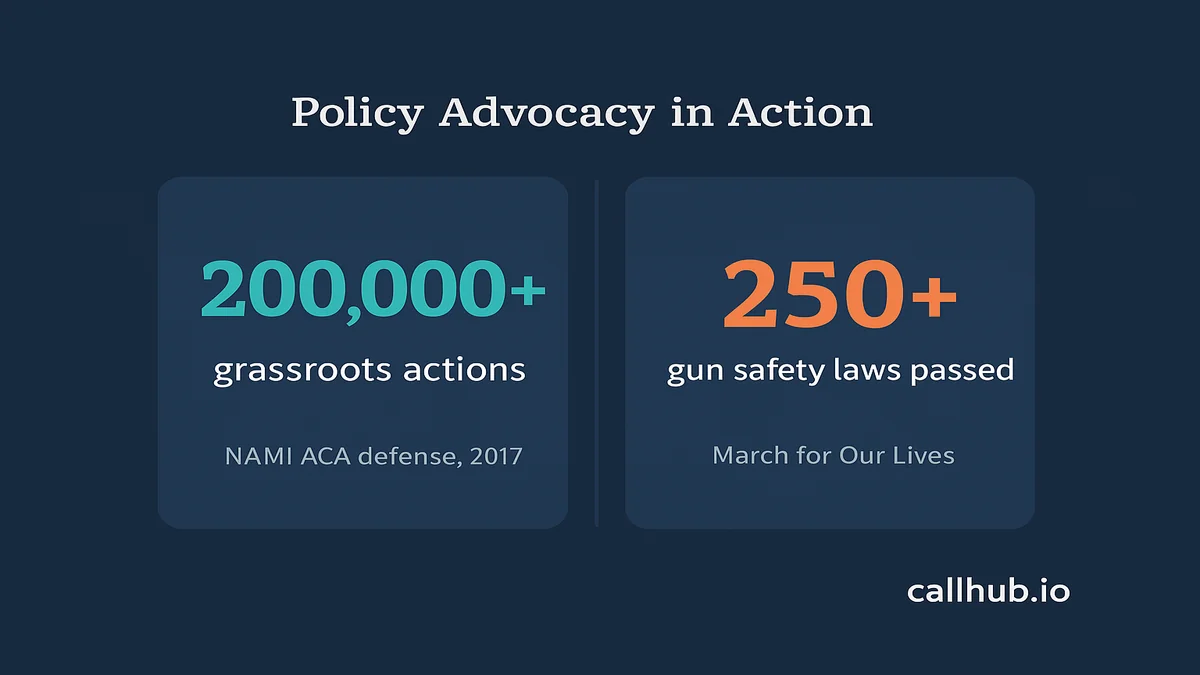
NAMI’s ACA defense: 200,000 grassroots actions
In 2017, the National Alliance on Mental Illness (NAMI) reportedly coordinated over 200,000 constituent actions in defense of the Affordable Care Act, according to public policy advocacy research published by Quorum.us. The campaign combined a segmented advocate database, time-sensitive call-in campaigns, and coordinated social media to generate constituent contact during a narrow legislative window.
The result was visible constituent pressure in swing districts at the exact moment when persuadable votes were being made. The scale of the grassroots response was one of several factors cited in coverage of the ACA’s survival.
March for Our Lives: From rallies to 250+ gun laws
March for Our Lives claims its advocacy campaign contributed to the passage of more than 250 gun safety laws following its founding march in 2018, according to their organizational reporting. The model combined mass public mobilization with a sustained direct lobbying program that translated public attention into specific legislative asks at the state and local level.
The lesson here is sequencing: Mass mobilization creates the political environment; direct lobbying converts that environment into specific wins. Neither works as well without the other.
Texas REALTORS® Advocacy Day: A direct lobbying model
Texas REALTORS® runs one of the most replicated advocacy day models in the country. Members from across the state travel to Austin for a single day of coordinated legislator meetings, all delivering the same message around a set of legislative priorities.
The model works because it is organized, not spontaneous. Every meeting is pre-scheduled. Every advocate carries the same one-page brief. Every ask is specific. The discipline of the program is what makes hundreds of individual meetings feel like one coordinated campaign to the legislature.
What nonprofits need to know about policy advocacy compliance
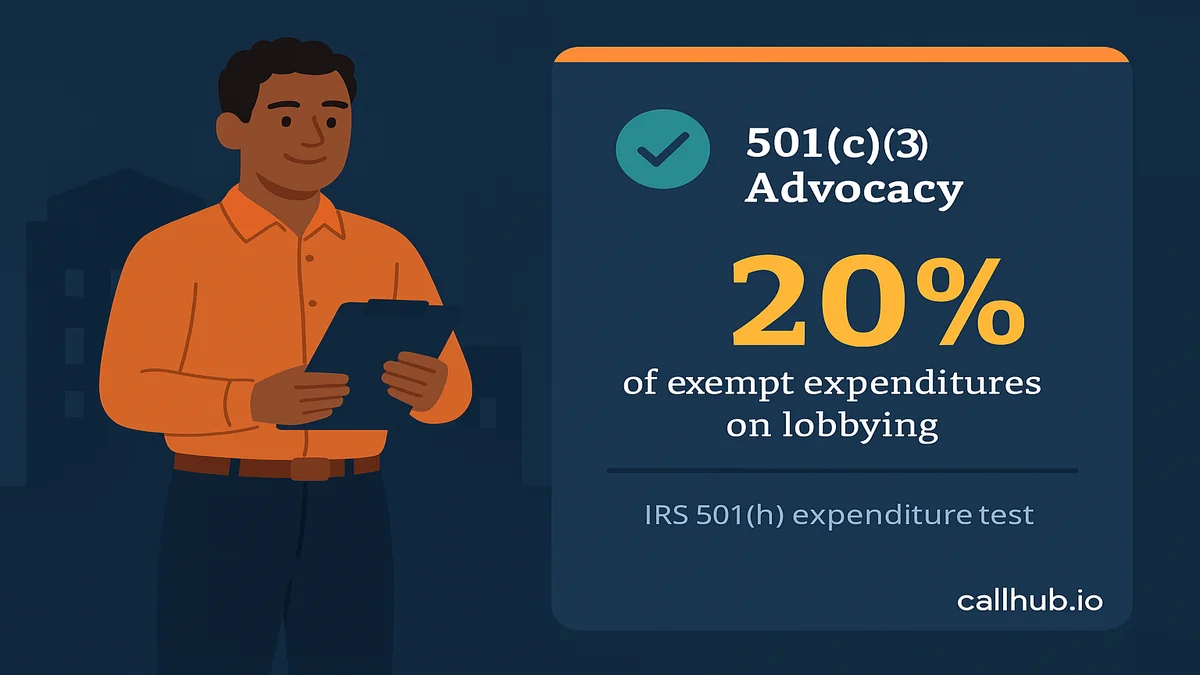
Nonprofits registered as 501(c)(3) organizations can engage in policy advocacy with clear boundaries on direct lobbying.
The IRS applies a substantial part test to lobbying activity for 501(c)(3)s: Lobbying expenditures must not make up a substantial part of your total activity. The IRS has generally treated under 5% of total budget as a safe zone, though the standard is not formally defined by a fixed percentage.
A cleaner option for most nonprofits is to elect the 501(h) expenditure test. Under 501(h), a 501(c)(3) can spend up to 20% of its first $500,000 in exempt purpose expenditures on lobbying (total cap: $1 million). This gives predictable, budgetable limits and requires filing Form 5768.
| Activity | 501(c)(3) allowed? |
|---|---|
| Educating the public about an issue | Yes, unrestricted |
| Calling legislators to support a bill | Yes, subject to lobbying limits |
| Distributing nonpartisan voter education | Yes |
| Endorsing a candidate | No |
| Coordinating with a political campaign | No |
| Grassroots lobbying (urging public to contact legislators on specific legislation) | Yes, subject to lobbying limits |
Always consult legal counsel before structuring a lobbying program. The line between public education and direct lobbying is fact-specific, and the IRS can challenge classification after the fact.
Start your policy advocacy campaign with the right outreach
Policy advocacy works when organizers combine a clear goal, a segmented supporter base, and multi-channel outreach. The organizations that move legislation are the ones that show up consistently: With the right message, through the right channels, at the right moment.
The gap for most organizations is execution: Getting advocates to act at the right moment, at the volume needed to create political cost. Outreach infrastructure determines whether your campaign reaches every persuadable vote or just your core districts.
See how CallHub powers advocacy outreach for campaigns and nonprofits, from Patch-through Calling to peer-to-peer texting, in one coordinated program.
For the broader strategy behind effective advocacy organizing, read our guide on how to run a political advocacy campaign.
Frequently asked questions
What is policy advocacy in simple terms?
Policy advocacy is the work of influencing decision-makers to adopt, change, or reject specific policies. It includes everything from constituent phone calls to a legislator’s office to coalition sign-on letters, media campaigns, and in-person lobbying. The common thread is a coordinated effort to affect a specific policy outcome.
What is an example of policy advocacy?
NAMI reportedly coordinated over 200,000 constituent actions in defense of the Affordable Care Act in 2017, combining phone call campaigns, social media, and direct lobbying during a narrow legislative window. Another example: Texas REALTORS® runs an annual advocacy day where members meet with legislators in a coordinated, single-day program, all delivering the same message on a set of specific bills.
What does a policy advocate do?
A policy advocate works to influence decision-makers on a specific policy goal. Day-to-day work includes researching legislation, building and maintaining a network of advocates, coordinating call-in and meeting campaigns, developing messaging, and tracking decision-maker positions. Senior advocates manage direct relationships with legislative staff and brief organizational leadership on the status of specific bills.
Can nonprofits engage in policy advocacy?
Yes. 501(c)(3) organizations can engage in substantial policy advocacy activity, including grassroots mobilization and direct lobbying, subject to IRS limits. Most nonprofits can elect the 501(h) expenditure test, which allows up to 20% of their first $500,000 in exempt purpose expenditures to be spent on lobbying. Nonprofits cannot endorse candidates or coordinate with political campaigns. Read our guide on types of advocacy explained for a full breakdown of activity types and legal considerations.
What is the difference between policy advocacy and direct lobbying?
Policy advocacy covers the full range of activities to influence policy: Public education, media campaigns, coalition building, grassroots mobilization, and direct lobbying. Direct lobbying is a specific subset: Communicating a specific position on specific legislation directly to a legislator or their staff. All direct lobbying is policy advocacy, but most policy advocacy is not direct lobbying.
How do you measure the success of a policy advocacy campaign?
At the outcome level, the question is: Did the bill pass, did the budget include your ask, did the regulation change? At the activity level: Constituent contacts made, advocate network size, meeting access achieved, and media coverage secured. Tracking decision-maker vote signals over time is the most direct leading indicator that your campaign is working. Track both, and report monthly to your coalition and funders.
What outreach tools are most effective for advocacy campaigns?
Constituent phone calls carry the most weight with legislative staff. Patch-through Calling automates the connection between your advocates and their representatives, making high-volume call campaigns manageable. Peer-to-peer texting drives the time-sensitive mobilization that call campaigns depend on. For a full comparison of outreach channels and when to use each, read our guide on advocacy vs. lobbying: what’s the difference.