


Table of Contents
In 2012, a group of fast food workers in New York City walked off the job demanding $15 an hour and the right to organize. At the time, the federal minimum wage was $7.25. Industry analysts called their ask politically impossible.
By 2019, 29 states and dozens of cities had passed $15 minimum wage laws. The Fight for $15 became one of the most documented wins in modern community advocacy, not because of a large budget or celebrity endorsements, but because it ran a disciplined campaign: A specific ask, a coalition that grew outward from workers to faith leaders to healthcare advocates, and outreach channels that could reach millions of people at low cost.
Community advocacy works when you run a campaign like a campaign, not like a petition. The difference between an issue that gets a response and one that gets filed is almost always structural: Who’s at the table, what they’re asking for, and how they reach the people who can change it.
This guide skips the definitions. If you want to know what community advocacy is, that’s already covered. What follows is the execution playbook: Six steps from goal-setting to coalition to outreach to sustained pressure.
Why community advocacy campaigns win (and why most don’t)
Most advocacy campaigns stall at the same point: They raise awareness, collect signatures, and generate some media. And then nothing happens.
The pattern isn’t unique to any one issue. The gap between awareness and a policy win is almost always a mobilization gap. A decision-maker who gets 500 form emails responds differently than one who gets 500 personal constituent calls in a single afternoon. The volume is the same; the form of contact is entirely different.
Campaigns that win share three things:
- A clear, bounded ask that a decision-maker can actually deliver
- A coalition that represents the people most affected, not just the people most organized
- Outreach channels that can put constituent volume on a decision-maker in a tight window
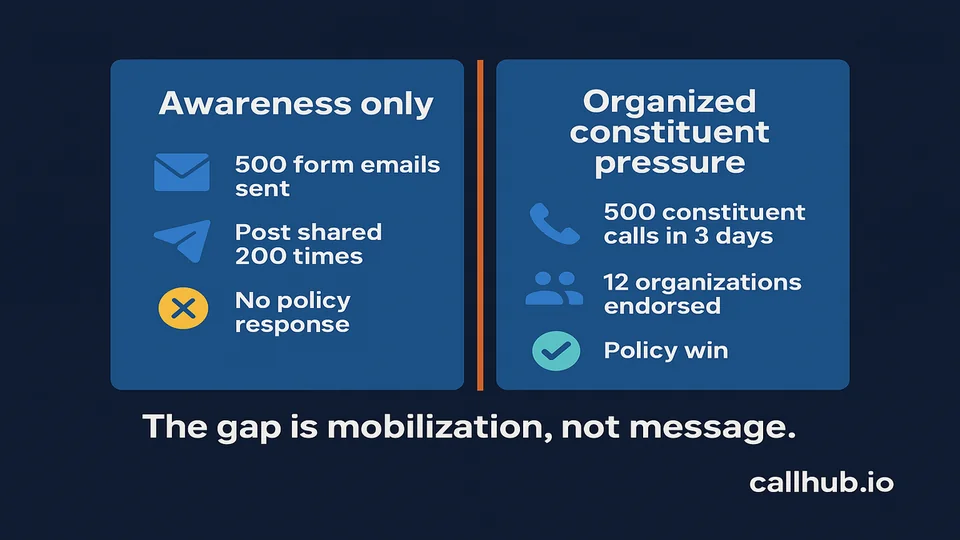
Campaigns that lose tend to confuse education with advocacy. Getting the public to understand an issue is not the same as getting a decision-maker to act on it. Both matter, but only one produces a policy outcome.
Step 1: Set a goal your campaign can actually win
A community advocacy goal is achievable when it identifies a specific ask, names the decision-maker who can deliver it, and sets a defined timeline that creates urgency for action. Without a named decision-maker and a bounded ask, a campaign can build awareness indefinitely without closing the distance to a policy win.
The first failure in community advocacy happens before anyone makes a call or sends a text. It happens when the campaign goal is written.
“Improve public transportation” is not a goal. “Persuade the City Council to approve Route 14 service restoration by Q1” is a goal. One is a direction; the other is a target.
Translate community concerns into a winnable ask
Start with the problem the community is actually experiencing, not the problem the organization has capacity to solve. The two are often different. Talk to the people most affected, map what they need to change, then ask: Who has the authority to change it, and what would they need to see or hear to act?
That sequence (problem, decision-maker, ask) prevents the most common mistake in goal-setting: Building a campaign around what the organization already knows how to do instead of what the community actually needs.
Choose the right type of change
Community advocacy typically seeks one of three types of change:
- Policy change: A new law, regulation, or ordinance (e.g., passage of an affordable housing ordinance)
- Systems change: A shift in how an institution operates (e.g., a hospital adopting a language access policy)
- Environmental change: A physical or infrastructure change (e.g., a crosswalk installation, a park renovation)
Each type requires a different decision-maker, a different timeline, and a different kind of pressure. Knowing which type you’re pursuing before you start organizing saves months.
Apply the SMART standard to your advocacy goal
A SMART advocacy goal is: Specific (a named decision-maker and a defined ask), Measurable (you’ll know when it’s been won), Achievable (within the current political landscape), Relevant (to the community most affected), and Time-bound (with a decision point that creates urgency).
A goal that meets this standard gives your campaign a finish line. Without one, you’ll spend energy indefinitely without knowing what winning looks like.
Step 2: Map your stakeholders and build a coalition
Winning community advocacy campaigns are rarely led by one organization. They’re won by coalitions: Groups of organizations and individuals who bring different audiences, credibility, and leverage to the same ask.
Before you recruit a single volunteer or send a single message, map who has a stake in your issue.
Who holds the decision-making power
Start with your primary target: The person or body with the authority to deliver your ask. That could be city council members, school board trustees, regulatory agency directors, or state legislators. Research their history on related issues, their political relationships, and what they respond to. Not every decision-maker responds to the same kind of pressure.
Who influences the decision-maker
Secondary targets are the people or institutions that the decision-maker trusts or answers to. Community foundations, faith leaders, major employers, local media editors, and peer elected officials all carry informal authority. A faith coalition endorsing your ask changes the political calculus in a way that 500 petition signatures won’t. Map these relationships before you start recruiting coalition partners.
Identify and address opposition early
Every advocacy campaign has opposition, and identifying it early is not pessimism. It is strategy. Understand what the opposing argument is, who is making it, and whether evidence, relationships, or constituent volume can neutralize it. Campaigns that ignore opposition get surprised by it at the worst possible moment.
For a deeper grounding in the grassroots advocacy tactics that underpin coalition strategy, the Grassroots Advocacy 101 guide covers the organizing fundamentals in more detail.
Step 3: Recruit and train your advocacy team
Coalition partners set the map. Advocates deliver the pressure. The volunteers, staff, and community leaders who make calls, send texts, show up to hearings, and talk to their neighbors are where the campaign converts from a plan into a force.
Core roles every advocacy campaign needs
Not every advocate needs the same training. Fill these four roles before you launch:
- Spokespeople: Two to three people who can represent the campaign in media, at hearings, and in meetings with decision-makers. They need message discipline and basic media training.
- Constituent advocates: People with a personal connection to the issue who can share their story in calls and texts. Authenticity matters more than polish here.
- Volunteer coordinators: People who manage the outreach team’s scheduling, training, and quality oversight.
- Data leads: People who track outcomes, log responses, and flag issues in real time.
Where to find advocates
Existing organizational networks are the fastest starting point: Membership lists, newsletter subscribers, event attendees, past donors. Coalition partners bring their own networks. Partner organizations in related issues (healthcare, housing, environment) often share constituents with your cause.
Community engagement strategies built around existing relationships consistently outperform cold recruitment. The people who already care about your issue are your most credible advocates.
Train for message discipline
The single most important training objective is message consistency. A decision-maker who hears 200 variations of a story reads it as disorganized. A decision-maker who hears 200 people delivering the same clear ask in their own words reads it as organized constituent pressure.
Training doesn’t require certification or lengthy sessions. A 30-minute briefing, a one-page message guide, and a practice call or text exchange covers the essentials. The goal is confidence, not scripting.
Community organizing and volunteer mobilization principles apply directly here: Whether a constituent contact lands often comes down to whether the advocate felt prepared enough to have a real conversation.
Step 4: Pick the right outreach channels
The outreach channel question is where many nonprofit advocacy campaigns make a consequential error. They default to email and miss the constituent contact that changes the political math.
Each channel serves a different role in the advocacy outreach stack.
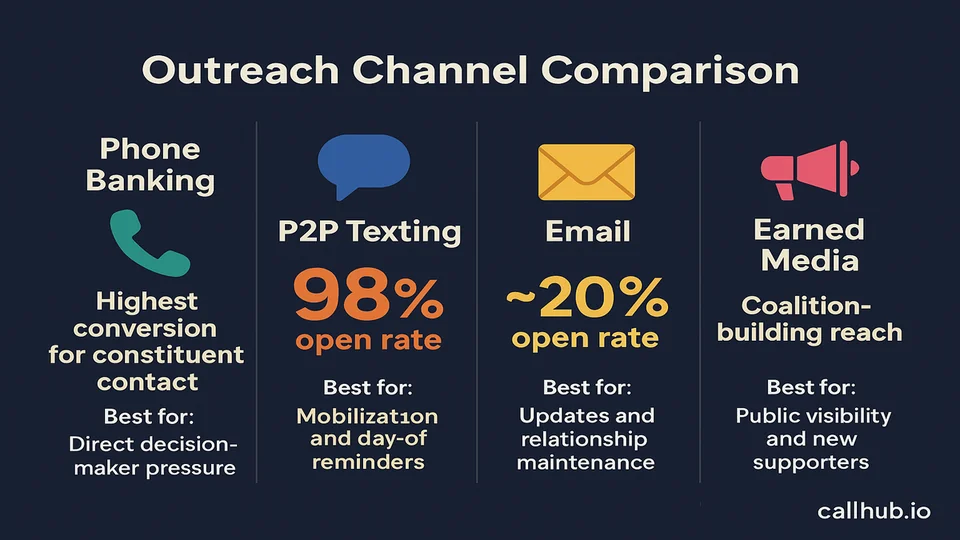
Phone banking: The highest-conversion channel for constituent contact
Phone calls are the most persuasive format for direct constituent contact. A call from a constituent to their elected official carries more weight than an email, a social media post, or a form letter. Volume matters: 500 constituent calls to a district office in a single week is a signal that’s hard to ignore.
Phone banking at scale requires a platform that manages large volunteer teams, tracks outcomes in real time, and keeps contact lists clean. For campaigns running dozens of volunteers across multiple locations, CallHub’s advocacy outreach platform handles phone banking and peer-to-peer texting without requiring technical staff to run it.
Peer-to-peer texting: Built for mobilization
Peer-to-peer texting (P2P texting) puts an individual message from a real person into a supporter’s phone. Text messages have a 98% open rate compared to roughly 20% for email. For supporter mobilization, event reminders, and day-of call-to-action prompts, P2P texting reaches people where email doesn’t.
The constraint on P2P texting is throughput: Each message requires a human send. For time-sensitive moments like “Call your councilmember today, here’s the number,” that personal touch is exactly what drives response rates.
Email: For education and sustained engagement
Email is not a mobilization channel; it’s a relationship channel. Use it for longer updates, resource sharing, and keeping your broader supporter list warm between activation moments. Open rates don’t support using email for urgent asks, but email does its job in building the organizational context that makes a supporter willing to pick up the phone when the campaign asks.
Social media and earned media: For coalition building
Organic social media builds public visibility but rarely moves a decision-maker directly. Where it earns its place is coalition-building: Bringing new organizations, journalists, and potential supporters into the campaign’s orbit. Earned media (news coverage, op-eds, public hearings) can shift a decision-maker’s political read on an issue faster than any outreach channel.
For a practical breakdown of how these channels combine in practice, community outreach strategies covers the channel-mix decisions in detail.
Step 5: Run your campaign in phases
Most advocacy campaigns try to run at full intensity from week one. That burns out volunteers, exhausts your contact list, and arrives at the decision moment with less momentum, not more.
Effective campaigns are phasic. The intensity builds toward the decision point.
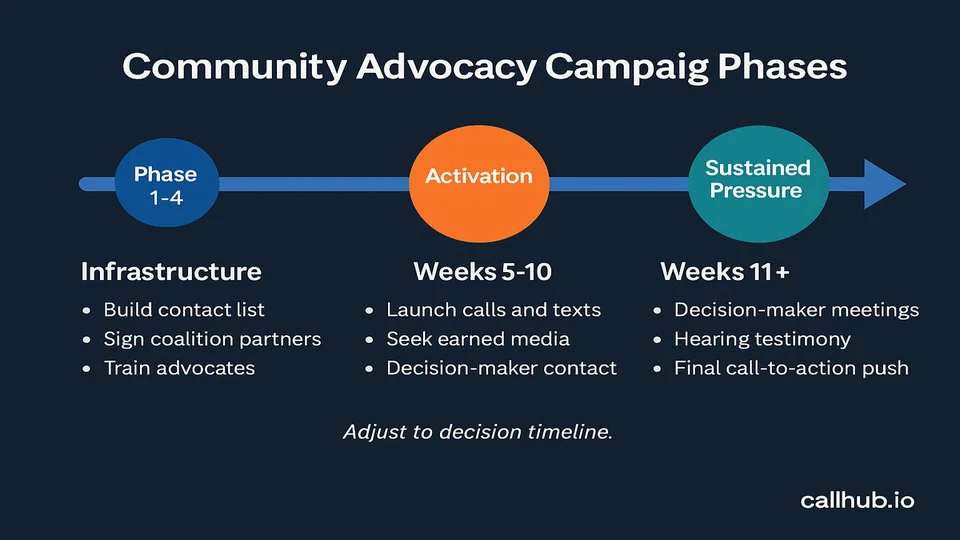
Phase 1 (weeks 1–4): Awareness and list-building
The first phase is infrastructure. You’re building the list, signing up coalition partners, training your core team, and getting the message right. Public-facing activity in this phase is minimal. Key outputs: A clean contact list, trained advocates, a confirmed coalition, and a clear message framework.
Phase 2 (weeks 5–10): Activation
This is when the campaign becomes public. Calls to action go out, constituent contact begins, and earned media is sought. Events, hearings, and direct decision-maker contact all happen in this phase.
The goal is not maximum volume. It is maximum quality at growing volume. A well-coordinated activation week with 300 constituent calls is more effective than a disorganized one with 1,000. Coordinators should track outcomes daily and adjust the contact strategy based on what’s working.
Phase 3 (weeks 11+): Sustained pressure and decision-maker engagement
As the decision point approaches, the campaign narrows its focus to the decision-makers who can be moved and the constituents who can move them. Direct meetings, public hearing testimony, and final call-to-action pushes happen here.
Not every campaign hits a clean three-phase structure. Some decisions happen faster; some drag on for months. The phases are a framework for managing energy and resources. Adjust to the decision timeline, not the other way around.
Step 6: Measure progress and sustain momentum
Advocacy campaigns that don’t track outcomes can’t improve. They also can’t report results to supporters, which makes sustaining engagement harder over time.
The five metrics every community advocacy campaign should track
| Metric | What it measures |
|---|---|
| Constituent contacts made | Total calls, texts, emails, and meetings with decision-makers |
| Constituent contact rate | Of people asked to act, what percentage did? Below 5% means the ask is unclear or the list is cold. |
| Coalition growth | Number of organizations and individuals who have publicly endorsed or participated |
| Decision-maker sentiment shifts | What is the decision-maker’s staff saying when constituents call? Track the language. |
| Media coverage | Named mentions in local press and social engagement on campaign content |
No single metric tells the full story. The combination tells you whether the campaign is building pressure or leveling off.
Close the feedback loop with your supporters
One of the fastest ways to lose volunteer momentum is to let people feel like their contact didn’t matter. Reporting back (“You made 450 calls this week, here’s what the district office said”) keeps people engaged between action moments.
According to the Community Tool Box from the University of Kansas, campaigns that report outcomes to their supporter base sustain participation rates significantly longer than campaigns that don’t. That’s not surprising. People stay involved when they can see evidence that they’re making a difference.
Keep the network warm between wins
A community advocacy network is an asset that depreciates without maintenance. Between major campaign moments, stay in contact: Share relevant news, invite supporters to non-urgent actions, and acknowledge milestones publicly. The organizations that can mobilize quickly when the next issue emerges are the ones that kept the relationship alive in the quiet periods.
Community advocacy in action: 3 examples at different scales
Neighborhood level: Crosswalk installation campaign
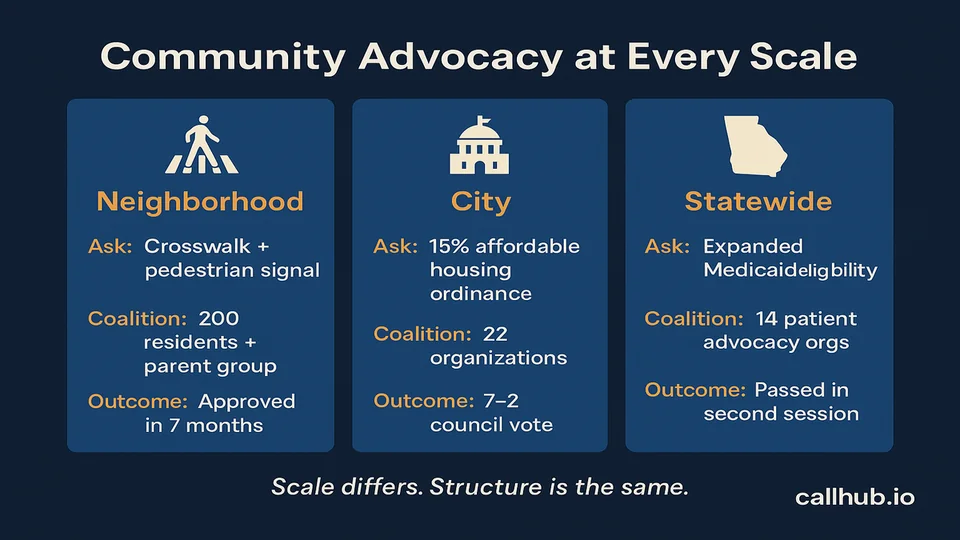
A neighborhood organization documented 11 near-miss incidents at an uncontrolled intersection over 18 months. Their ask was specific: A marked crosswalk and a pedestrian signal, deliverable by the City Department of Transportation.
They identified the district councilmember as the primary target. In four weeks, 200 residents called or emailed the district office. A parent coalition and a local school joined as endorsers. The city approved the crosswalk installation at the next capital review cycle, seven months from the first call to action.
The campaign had no dedicated budget, two staff hours per week, and a clear ask. That combination is replicable.
City level: Affordable housing advocacy
A coalition of housing organizations, faith groups, and tenant advocates ran an 18-month campaign for an inclusionary zoning ordinance requiring 15% affordable units in new developments. The coalition started with six organizations and grew to 22.
P2P texting mobilized supporters before council hearings. Phone banking activated constituents in the neighborhoods with the highest housing cost burden. The ordinance passed with a 7-2 council vote. The Pew Research Center has documented the growth of local housing advocacy as one of the most active areas of community civic engagement in the past decade.
Statewide: Healthcare access advocacy
A state-level network coordinating 14 patient advocacy organizations ran a two-year campaign for expanded Medicaid eligibility. The scale required a different approach: A coordinated message across 14 organizations, phone banking targeting constituents in 25 swing legislative districts, and an earned media strategy placing op-eds in regional papers across the state.
The campaign tracked constituent contacts by legislative district, concentrating resources on undecided legislators. The bill passed in the second session. What made it work was discipline: Every organization in the coalition delivered the same message to the same targets on the same timeline.
Your campaign starts with a decision
You now have the six-step framework: A winnable goal, a stakeholder map, a trained team, the right outreach channels, a phased execution timeline, and a measurement system that tells you whether the pressure is building.
What separates campaigns that win from campaigns that stall isn’t the size of the organization or the budget. It’s the clarity of the ask and the quality of the constituent contact that delivers it. Policymakers respond to organized constituents, not organized emails.
If you’re building the outreach infrastructure for your campaign, CallHub for advocacy organizations handles phone banking, peer-to-peer texting, and contact management in one place, so your team focuses on the work that builds political power, not the tools.
And if you’re evaluating options before committing, the advocacy software for nonprofits buyer’s guide covers what to look for and what to avoid.
FAQ
What is community advocacy?
Community advocacy is organized action by residents, nonprofits, or coalitions to change policies, systems, or conditions that affect a community. It includes constituent outreach, coalition-building, earned media campaigns, and direct engagement with decision-makers. For a full definition and overview of advocacy types, see our guide to what advocacy is.
What are the most effective community advocacy strategies?
The most effective strategies combine a specific ask with organized constituent contact. Phone banking and peer-to-peer texting consistently outperform email for mobilization because they require a personal response. Coalition-building multiplies the campaign’s visible support. None of these strategies work without a clear, deliverable goal tied to a named decision-maker.
How do you start a community advocacy campaign?
Start with the problem the community is experiencing and identify the decision-maker with authority to address it. Set a specific, time-bound goal. Map your stakeholders: Who needs to be in the coalition, who influences the decision-maker, and who will oppose the ask. Build your outreach list before launching public activity, train your advocates, then run.
What is the difference between community advocacy and lobbying?
Lobbying is a specific form of advocacy involving direct contact with legislators or regulatory officials on specific legislation, and it’s regulated by law. Community advocacy is broader: It includes public education, coalition-building, constituent contact, earned media, and community organizing. Nonprofits organized as 501(c)(3) entities can engage in a limited amount of lobbying without losing tax-exempt status. The threshold depends on the organization’s size and the type of lobbying activity.
How do nonprofits do advocacy without violating their 501(c)(3) status?
501(c)(3) organizations can advocate for issues and engage in lobbying within certain limits set by the Internal Revenue Service (IRS): Either the “substantial part” test or the 501(h) election, which gives organizations clearer spending thresholds. They cannot engage in partisan political activity or candidate endorsements. Consult an attorney with nonprofit tax experience before running a campaign with significant lobbying activity.
What are examples of community advocacy?
Community advocacy operates at every scale: A neighborhood group winning a crosswalk installation, a city coalition securing an affordable housing ordinance, a statewide patient advocacy network expanding Medicaid eligibility, and national movements like Fight for $15 winning minimum wage increases across 29 states. The scale differs. The structure (a clear ask, a coalition, organized outreach, measurement) is the same across all of them.
How do you measure the success of a community advocacy campaign?
Track five metrics: Constituent contacts made, constituent contact rate, coalition growth, decision-maker sentiment shifts, and media coverage. A high contact rate with no sentiment shift from the decision-maker means the ask needs refinement or the campaign is contacting the wrong people. A campaign that tracks these in real time can adjust before the decision point arrives.
What tools do community advocates use to organize supporters?
The core tools are a contact management or customer relationship management (CRM) system, a phone banking or peer-to-peer texting platform, and an email system. For campaigns with significant constituent outreach volume, a unified outreach platform that handles calls and texts in one system reduces the coordination overhead that slows campaigns down.


