





Table of Contents
The election is over, but the evidence is still scattered across calling reports, text exports, canvass sheets, voter files, and volunteer notes. A useful post GOTV analysis brings those records together before memories fade and campaign accounts disappear.
The goal is not to produce a victory-lap deck or assign blame after a loss. It is to decide what the campaign should repeat, stop, change, and test next time. That requires more than counting calls, texts, and doors.
What a post-GOTV analysis should answer
A post-GOTV analysis should answer five questions: What did the campaign plan, what did it execute, whom did it reach, what happened after contact, and what evidence supports the campaign’s conclusions?
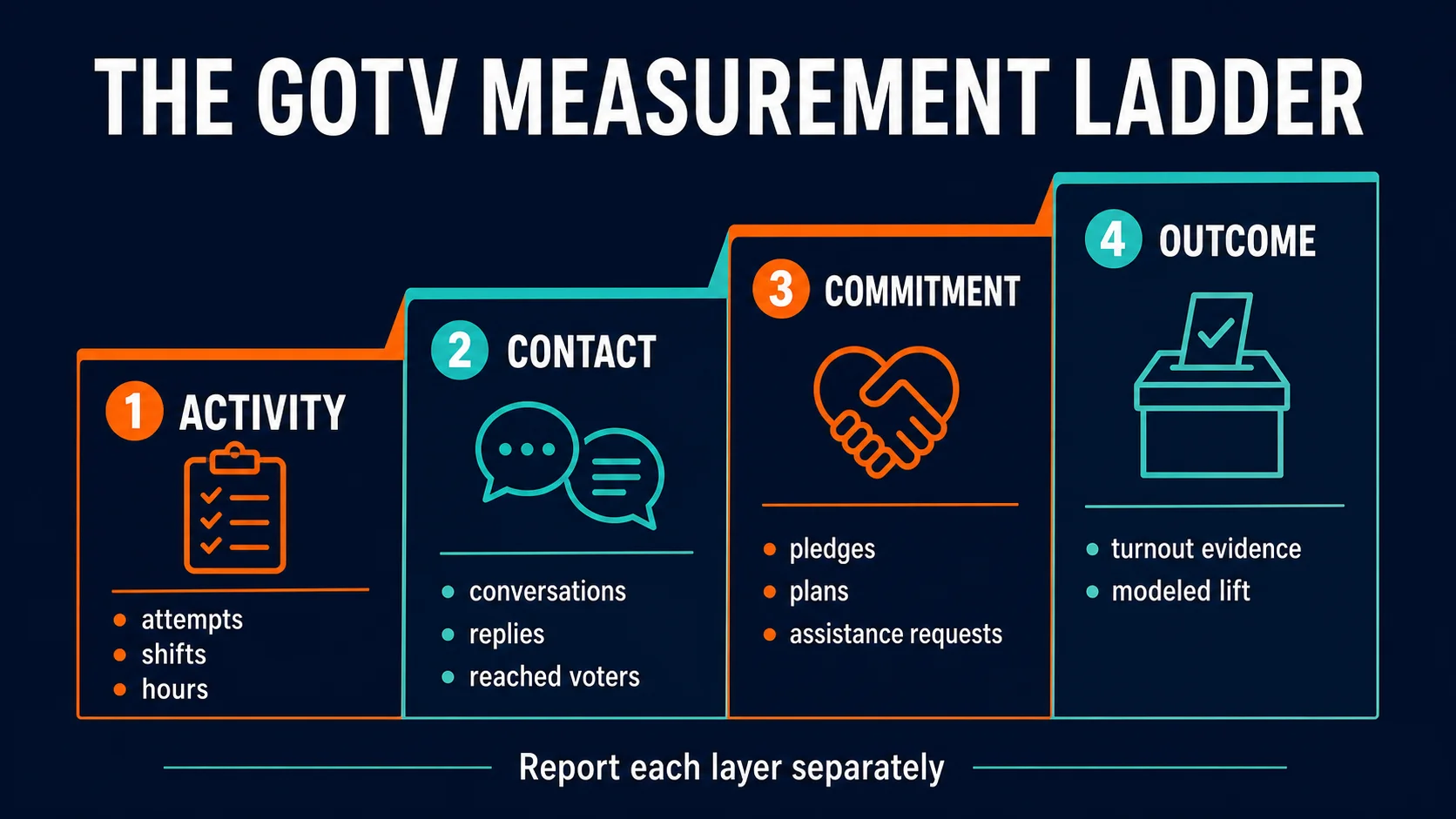
Those questions create a measurement ladder:
- Activity: How many calls, texts, emails, and door attempts did the campaign complete?
- Reach: How many unique voters received at least one successful delivery or attempt?
- Response: How many voters answered, replied, opened a conversation, or completed a survey?
- Conversion: How many voters made a plan, requested assistance, returned a ballot, or confirmed voting?
- Turnout: How many contacted voters appear in verified turnout records, where those records are legally available?
Campaigns often jump from activity to turnout. That shortcut creates bad conclusions. Ten thousand calls can represent ten thousand unique voters or five attempts to the same two thousand voters. Neither total proves that the calls caused anyone to vote.
Reconstruct the original plan before judging the result
Do not evaluate the program against a goal invented after Election Day. Reconstruct the targets that guided the campaign before GOTV began, using the same week-by-week GOTV timeline the campaign built at the start of the cycle.
| Measure | Planned | Actual | Decision question |
|---|---|---|---|
| Priority voter universe | 25,000 | 24,300 | Did list changes improve or weaken targeting? |
| Unique voters reached | 18,000 | 15,400 | Where did reach fall short? |
| Meaningful contacts | 7,200 | 6,850 | Which channels produced the gap? |
| Vote plans recorded | 4,000 | 4,180 | Which scripts and segments converted? |
| Volunteer shifts filled | 320 | 274 | When and why did shifts go unfilled? |
Record the original definitions beside the targets. If “contact” meant a live phone conversation in one report and a delivered text in another, the totals cannot be compared until the definitions are normalized.
Pull and reconcile the data before the debrief
Pull the raw data before the team meets. A debrief based on memory will overvalue dramatic incidents and undervalue patterns spread across thousands of ordinary contacts.
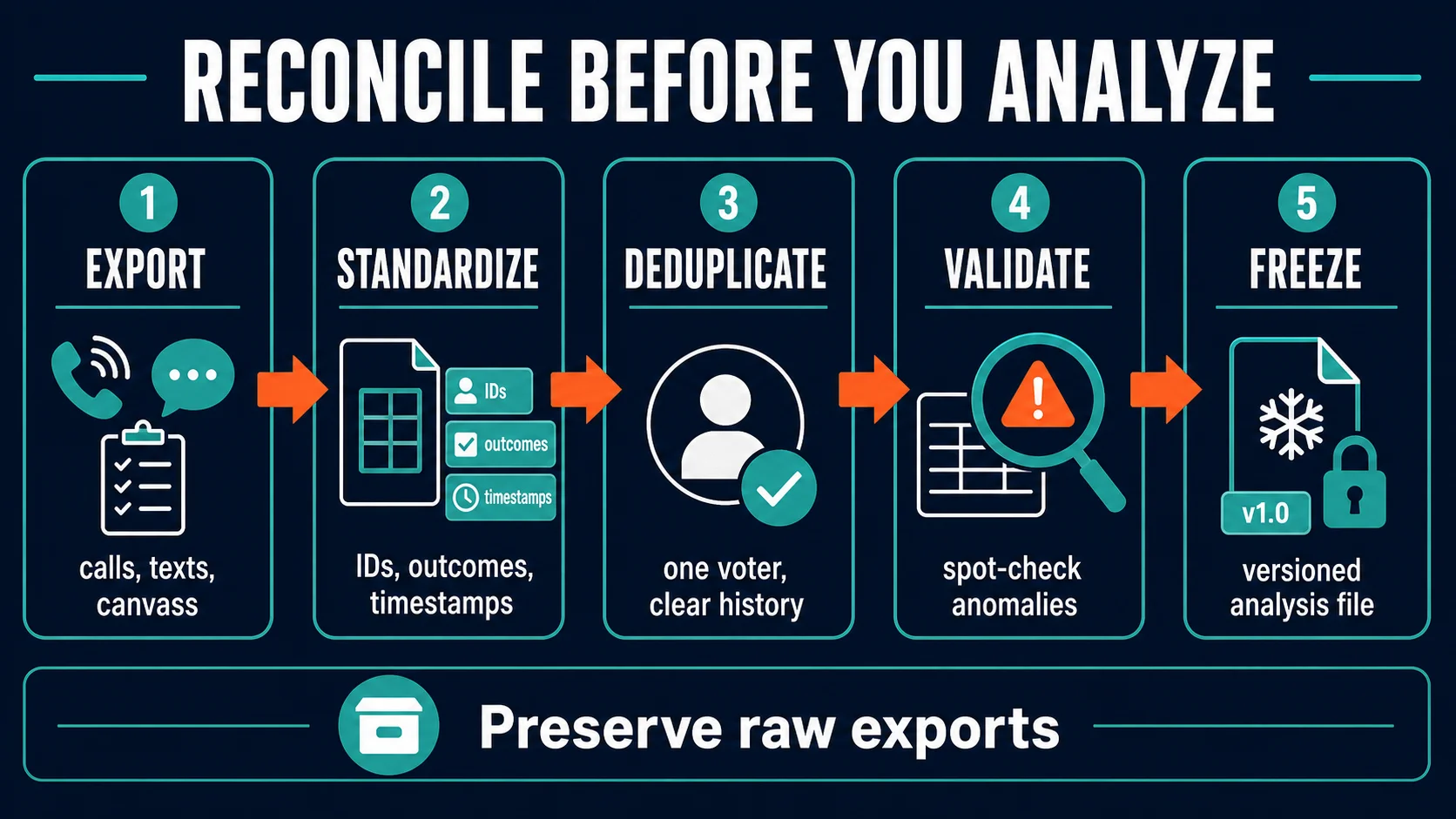
Export these records while platform access is still active:
- Campaign-level reports for calls, texts, email, and canvassing.
- Agent or volunteer reports by shift.
- Script versions and survey questions.
- Contact-level dispositions, responses, and timestamps.
- Opt-outs, wrong numbers, failed deliveries, and incomplete records.
- Volunteer schedules, attendance, cancellations, and support requests.
- Spending by channel, including platform, data, printing, and staff costs.
CallHub’s guide to phone banking analytics explains how historical reports support trend analysis, performance reviews, return on investment, and agent benchmarking. Exportable reports should become part of the campaign archive, not remain inside a dashboard that future staff may never access.
Normalize voter IDs, timestamps, and outcomes
Create one data dictionary before merging exports. It should define every field, accepted value, and calculation used in the analysis.
| Field | Standard definition | Common cleanup |
|---|---|---|
| Unique voter | One voter-file or campaign CRM identifier | Resolve duplicates across phone, text, and canvass lists |
| Attempt | One outbound contact action | Remove platform retries that should not count as separate volunteer actions |
| Meaningful contact | A two-way conversation or recorded response | Exclude voicemail drops and passive deliveries |
| Vote plan | A recorded method and intended time or date | Separate complete plans from vague intent |
| Assistance request | A request for polling, ballot, identification, or transport help | Consolidate equivalent disposition labels |
| Confirmed voted | Self-report or verified turnout record | Keep self-report and official match in separate fields |
Convert timestamps into one time zone. Map “answered,” “contacted,” and “successful” into a shared outcome only when they mean the same thing. Keep a copy of every raw export so later analysts can audit the cleaned file.
Match contacts to verified turnout when legally available
Use a stable voter identifier to match outreach records with post-election turnout data. Compare unique voters, not rows of activity. A voter contacted by phone and text still represents one person.
Build the matched file with four safeguards:
- Preserve the raw voter and contact files separately.
- Restrict access to staff who need the matched data.
- Document unmatched records and the reason they failed.
- Keep self-reported voting separate from verified turnout.
Turnout history shows whether a person voted, not whom they supported. Campaigns must also follow applicable voter-file agreements, privacy commitments, and retention rules. Treat the archive as sensitive campaign infrastructure.
The post-GOTV metrics to calculate
The best post-election dashboard moves from volume to quality. Calculate reach, conversion, efficiency, and data quality with the same denominators across comparable groups.
Reach and contact metrics
Start with four basic rates:
| Metric | Formula | What it reveals |
|---|---|---|
| Attempt coverage | Unique voters attempted / target universe | Whether the campaign worked through the intended list |
| Delivery rate | Delivered messages / messages sent | List quality and carrier or channel delivery |
| Answer rate | Answered calls / calls placed | Calling-time, number, list, and segment performance |
| Contact rate | Unique meaningful contacts / unique voters attempted | The share of attempted voters who had a real interaction |
Report both the numerator and denominator. “A 32% contact rate” is incomplete without the number of voters attempted and the definition of contact.
Segment the rates by precinct, voter group, day, time window, script, channel, and volunteer shift. A campaign-wide average can hide a strong evening calling window or a list segment with broken contact data.
Conversion and assistance metrics
Contact becomes useful when it produces a recorded next step. Select conversions that match the campaign’s theory of change.
Useful GOTV conversion rates include:
- Vote-plan conversion rate: Complete vote plans / meaningful contacts.
- Assistance-request rate: Voters requesting help / meaningful contacts.
- Assistance-resolution rate: Requests resolved / assistance requests.
- Confirmed-vote rate: Voters confirming they voted / meaningful contacts.
- Ballot-return conversion: Matched ballot returns / contacted mail-ballot voters.
Do not combine every positive disposition into one “success” total. A supporter who already voted, a voter who made a plan, and a voter who needs transportation require different analysis and follow-up.
Efficiency and data-quality metrics
Efficiency shows what the campaign received for its scarce volunteer hours and budget. Data quality shows whether those conclusions deserve confidence.
Calculate:
- Meaningful contacts per volunteer hour.
- Vote plans per volunteer hour.
- Cost per meaningful contact.
- Cost per completed vote plan.
- Disposition completion rate.
- Duplicate-contact rate.
- Unmatched voter-record rate.
- Missing volunteer or shift attribution rate.
A low cost per contact is not automatically good. It can reward a channel that reaches easy voters while another channel handles harder, high-priority voters. Read efficiency beside targeting and conversion.
Correlation is not causal lift
Contacted voters often turn out at higher rates because campaigns deliberately target people who are already likely to vote. A simple contacted-versus-uncontacted comparison does not isolate the effect of GOTV.
Credible causal claims require a comparison design established before outreach, such as randomized holdouts. CallHub’s phone banking for GOTV guide cites research that found a 3.8 to 4.5 percentage-point turnout increase from volunteer phone banking. The cited midterm studies also found a 0.9 to 1.4 point increase from plan-making texts. Those findings explain what well-designed studies measured. They are not automatic multipliers for your campaign’s totals.
If the campaign did not run an experiment, use careful language:
- “Contacted voters turned out at a higher observed rate.”
- “The association remained after segmenting by prior turnout.”
- “The campaign cannot attribute the full difference to outreach.”
- “The next cycle should reserve a valid holdout where practical.”
Compare channels without rewarding volume alone
Compare channels on the outcome they were assigned to produce, not on their largest available number. Texts will usually dominate send volume. Calls and canvassing can produce richer conversations. Email may coordinate supporters without creating direct turnout lift.
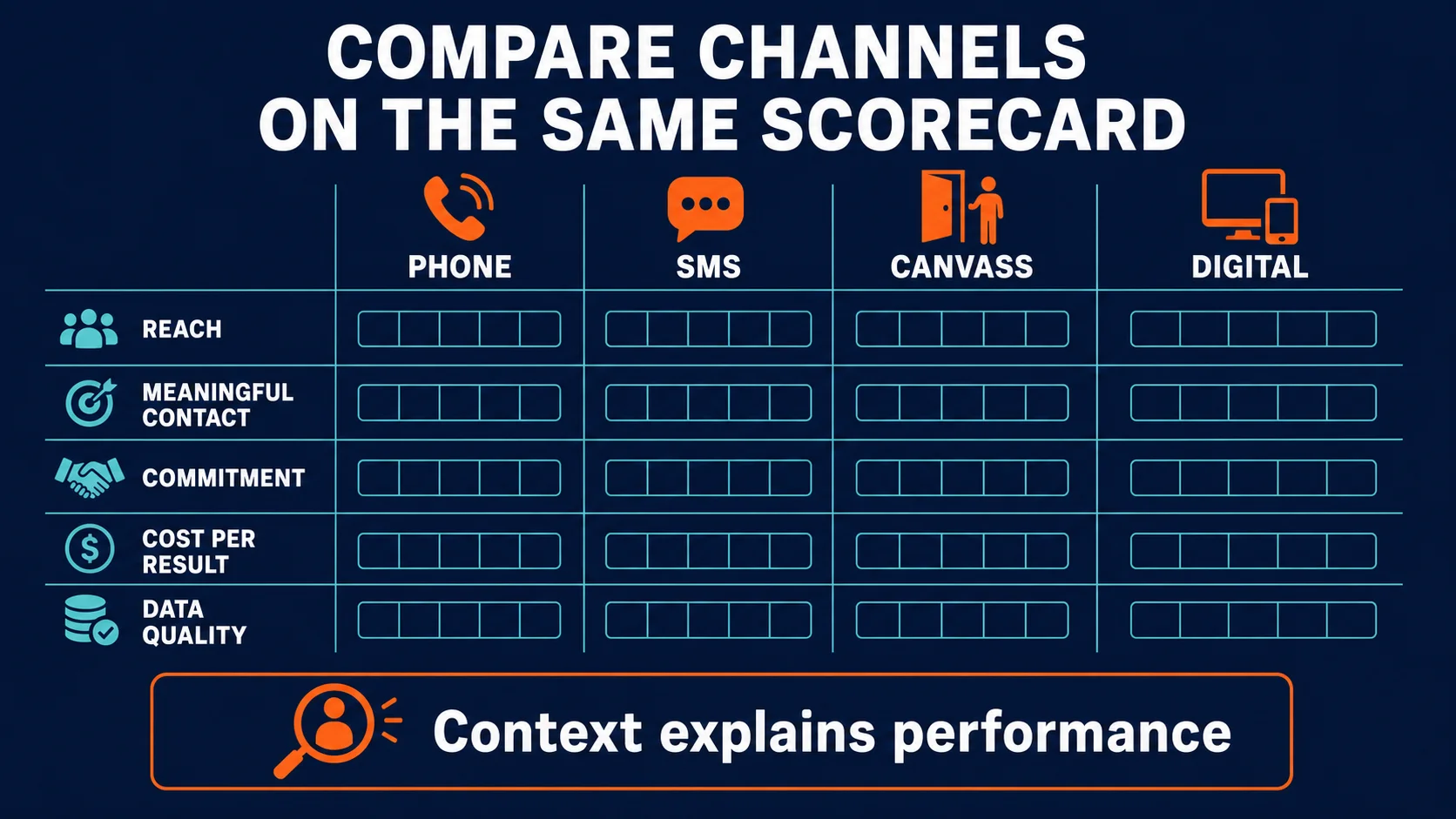
Use a shared channel scorecard:
| Channel | Primary job | Fair denominator | Core outcome | Efficiency measure |
|---|---|---|---|---|
| Phone | Resolve logistics and make vote plans | Unique voters attempted | Meaningful conversations and plans | Contacts per volunteer hour |
| Text | Prompt replies and send reminders | Delivered texts to unique voters | Replies, plans, and help requests | Cost per conversion |
| Canvassing | Hold high-trust doorstep conversations | Doors attempted | Contacts, plans, and resolved barriers | Contacts per canvasser hour |
| Coordinate and distribute information | Delivered emails | Clicks to official information or volunteer actions | Cost per action |
Read sequencing and overlap
Last-touch attribution gives too much credit to the final message before a recorded action. GOTV usually works as a sequence.
A typical sequence might look like this:
- A volunteer calls and records a preferred voting method.
- The voter receives a text with official polling information.
- A canvasser visits after the voter reports a transport problem.
- An Election Day reminder confirms that the issue was resolved.
GOTV script and outcome-logging guidance helps campaigns standardize the dispositions that make this sequence visible. Review assisted conversions, channel overlap, and the time between touches. Do not force every outcome into one winning channel.
Research summarized in the GOTV phone banking guide recommends coordinating roughly three to five touches per confirmed supporter. Your analysis should test whether frequency improved response up to a point, then produced opt-outs or diminishing returns.
Turn findings into allocation rules
Every channel comparison should end with a decision.
| Finding | Next-cycle rule |
|---|---|
| Evening calls produced the highest contact rate | Protect evening shifts and recruit specifically for those hours |
| Text reminders converted after unanswered calls | Automate the call-to-text handoff |
| Canvassing resolved transport needs well | Reserve doors for voters with high-friction barriers |
| Email produced few direct actions | Use email for coordination, not as the primary turnout channel |
| Six or more touches increased opt-outs | Cap frequency and share suppression lists across tools |
Write each rule with an owner, a date for review, and the evidence behind it.
Assess volunteer performance without creating the wrong incentives
Volunteer performance should identify coaching needs and future leaders, not reward whoever received the easiest list. Volume matters, but it belongs inside a balanced scorecard. If those coaching gaps trace back to onboarding, CallHub’s guide to training GOTV volunteers covers what GOTV-specific volunteer training should include.
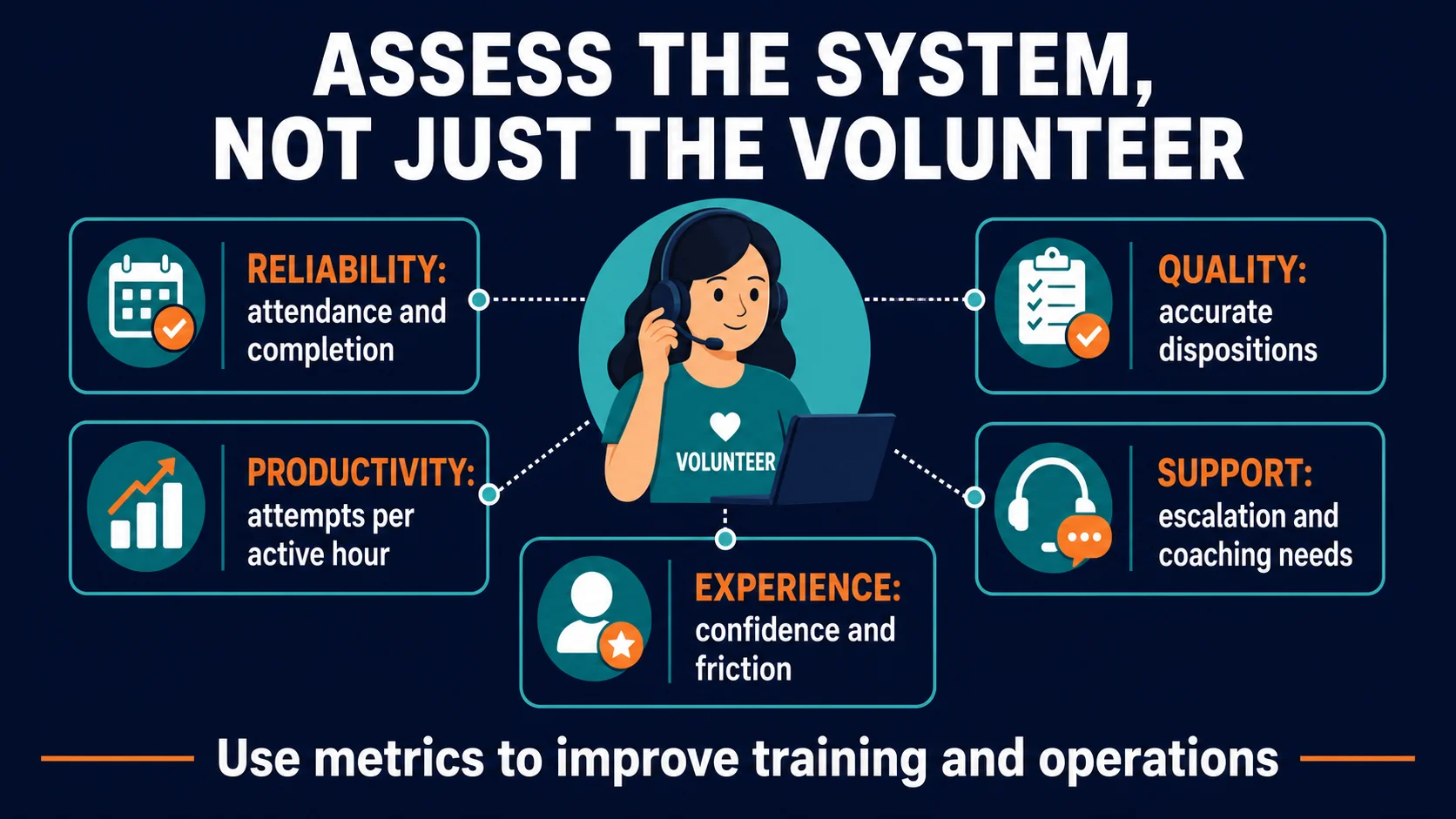
| Dimension | Example measure | Why it matters |
|---|---|---|
| Reliability | Shifts attended / shifts accepted | Predicts whether plans survive late-cycle pressure |
| Productivity | Meaningful contacts per active hour | Shows efficient use of volunteer time |
| Quality | Complete and accurate disposition rate | Protects follow-up and analysis |
| Conversion | Vote plans per meaningful contact | Shows conversation effectiveness |
| Learning | Improvement after coaching | Identifies volunteers who adapt |
| Leadership | Peers supported or shifts led | Identifies future captains |
Compare like-for-like assignments
Compare volunteers within similar channels, time windows, list segments, and experience levels. A first-time caller on a cold list should not be ranked directly against a team captain calling repeat supporters.
Review the context behind outliers:
- Did low productivity reflect technical problems?
- Did a high conversion rate come from a very small sample?
- Did one volunteer receive a cleaner list?
- Did another volunteer resolve complex assistance cases that took longer?
- Did incomplete dispositions inflate apparent speed?
The review should produce coaching actions and recognition categories. “Most calls” can be one category, but so can “best data quality,” “most improved,” “most reliable,” and “future shift leader.”
Use leaderboards with care
Leaderboards can motivate teams when the measures are transparent and fair. In CallHub’s Organizing for Change case study, 24 partner groups centralized their contact data, used volunteer-team analytics and leaderboards, and reported turnout gains of up to 7% in some ridings.
The debrief also found that friendly competition helped participating groups set goals. The lesson is not to rank every volunteer publicly. It is to choose measures that reinforce the behavior the campaign needs.
Run the debrief while the evidence is fresh
Hold the operational debrief after people have had a short recovery period but before access, memories, and context disappear. Collect individual feedback first, then use the group meeting to interpret evidence and make decisions.
The Commons Library campaign debrief guide recommends comparing internal effort and external impact with the original strategy while avoiding personal blame. That principle matters after both victory and defeat.
NGP VAN’s campaign debriefing guide also frames the post-election review as a chance to capture team feedback, recognize contributions, and carry lessons into the next cycle.
Collect feedback before the meeting
Send a short survey to staff, volunteer leaders, and a representative sample of volunteers. Ask:
- What should the campaign repeat exactly?
- What created avoidable work?
- Which script or channel produced the best conversations?
- Where did voters need help the campaign could not provide?
- Which tool or process failed under pressure?
- What training would have improved your shift?
- Would you volunteer again, and in what role?
Anonymous responses can surface issues that junior staff or volunteers will not raise in a crowded meeting.
Use a 60-minute decision agenda
Keep the meeting structured:
- 0 to 10 minutes: Restate goals, definitions, and known data limits.
- 10 to 25 minutes: Review activity, reach, conversion, and turnout evidence.
- 25 to 40 minutes: Review channel, script, list, and volunteer findings.
- 40 to 50 minutes: Identify lessons to repeat, stop, change, or test.
- 50 to 60 minutes: Assign owners, deadlines, and archive responsibilities.
Capture each decision in a log with five fields: Evidence, interpretation, decision, owner, and next review date. A lesson without an owner is only a meeting note.
Preserve the next cycle’s starting point
The campaign archive should let a future team understand both the results and the reasoning behind them. Saving a final slide deck is not enough.
Retain:
- Raw platform exports and a cleaned analysis dataset.
- The metric dictionary and calculation logic.
- Voter-universe criteria and list versions.
- Scripts, survey questions, and disposition definitions.
- Training materials and technical troubleshooting notes.
- Experiment designs, holdout rules, and analysis results.
- Volunteer rosters, role preferences, and consented contact information.
- The final decision log and unresolved questions.
Create a clear folder structure with read-only raw data, documented working files, and a final archive. Record which software is required to open each file.
Assign ownership and retention rules
Name one long-term owner for the archive. Record who can access it, when access should be reviewed, and when data should be deleted or refreshed.
| Asset | Owner | Access | Review trigger |
|---|---|---|---|
| Raw voter-contact exports | Data lead | Restricted | End of legal or contractual retention period |
| Clean analysis dataset | Campaign manager | Restricted | Before reuse in another cycle |
| Scripts and training | Organizing lead | Campaign team | Before the next launch |
| Volunteer roster | Volunteer lead | Limited outreach staff | Before any post-election contact |
| Decision log | Campaign leadership | Future campaign leads | At next planning retreat |
Do not leave ownership with a temporary staff account. Move essential files to an organization-controlled location and test access before staff contracts end.
Turn election volunteers into a durable organizing base
Volunteer retention begins with specific recognition and a credible next step. A generic thank-you email sent weeks later tells volunteers that the campaign viewed them as temporary labor.
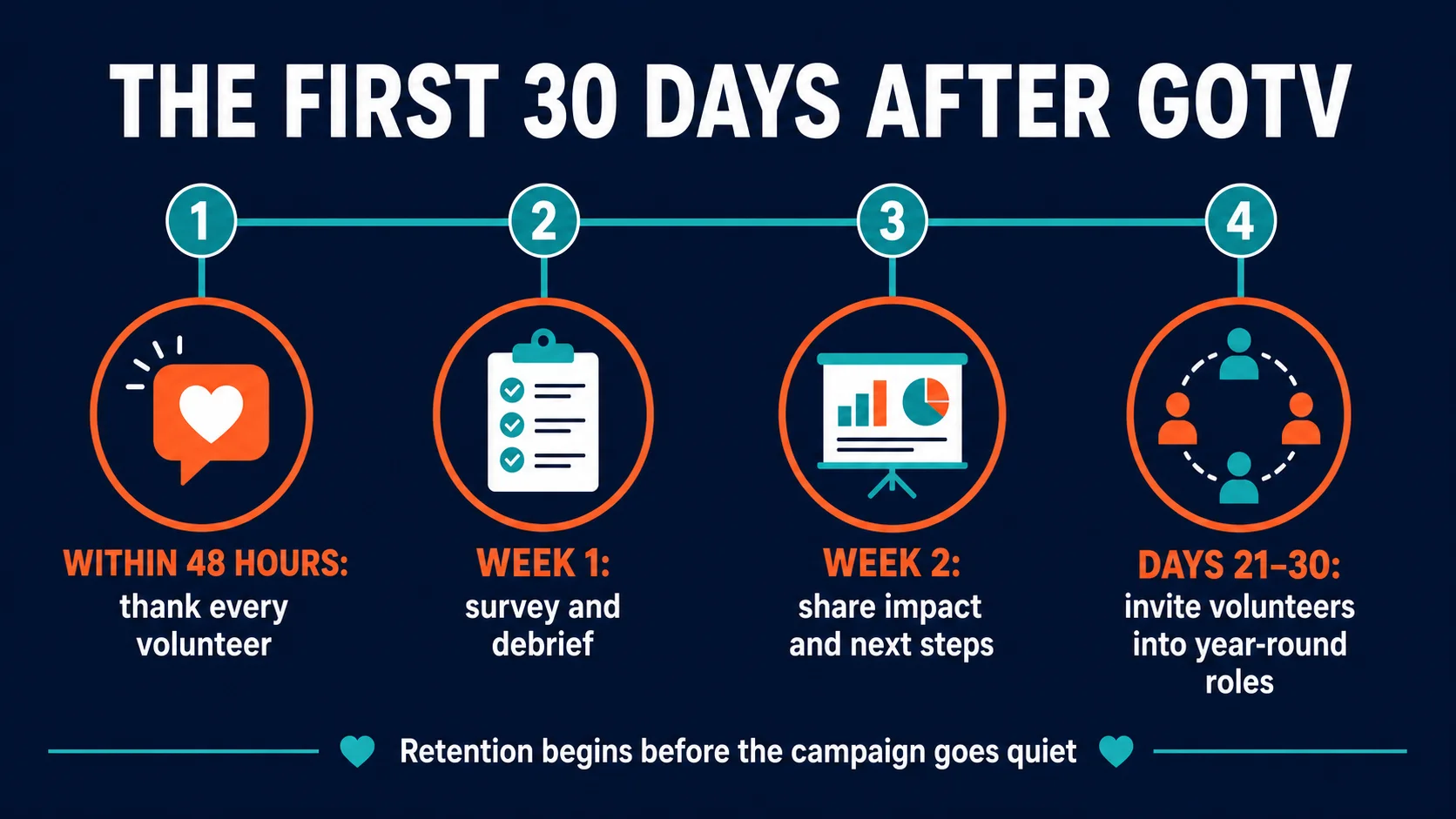
Use a 30-day sequence:
- Within 48 hours: Thank volunteers and report an honest result they helped produce.
- Within one week: Invite feedback and share the debrief timeline.
- Within two weeks: Recognize contributions and explain the next organizing need.
- Within 30 days: Offer a concrete role, training, community event, or issue campaign.
The thank-you should name the contribution: Conversations completed, vote plans recorded, assistance requests resolved, or shifts led. Avoid claiming that volunteer activity alone caused the election result.
Segment the volunteer roster
Do not send the same follow-up to everyone. Create practical segments:
| Segment | Evidence | Next invitation |
|---|---|---|
| Future leaders | High reliability, data quality, and peer support | Captain training or planning role |
| Returning volunteers | Completed multiple shifts and requested future work | Early access to the next action |
| Skilled specialists | Supported data, technology, language, or logistics | Role-specific project |
| Occasional supporters | Completed one shift or event | Low-commitment community action |
| Recovery needed | Reported burnout or conflict | Appreciation without an immediate ask |
Store role preferences and contact permission with the roster. A list of names without context forces the next campaign to recruit from zero again.
Make the next GOTV program easier to run
Post-election analysis is not about proving that every tactic worked. It is about building a defensible record of what happened, what remains uncertain, and what the next team should do differently.
For a system that keeps calling, texting, and volunteer activity connected, explore CallHub’s unified outreach tools for political campaigns, including CallHub’s GOTV platform built specifically for turnout programs.
Use the findings to improve your complete plan for the next GOTV campaign, and revisit CallHub’s complete GOTV strategy guide before you build next cycle’s plan.
Frequently asked questions
What should be included in a campaign post-mortem analysis?
Include planned versus actual goals, activity, unique reach, meaningful contacts, conversion, efficiency, data quality, volunteer performance, and available turnout evidence. End with decisions, owners, deadlines, and questions the campaign could not answer.
How soon after the election should a campaign debrief?
Give the team a short recovery period, then debrief while access and memories remain current. Export data immediately, collect individual feedback within the first week, and hold the group review once the core reports are ready.
How do you measure GOTV campaign effectiveness?
Measure activity, reach, contact, conversion, efficiency, and verified turnout as separate layers. Use experimental holdouts when you need a credible estimate of causal turnout lift.
How do you compare voter contact channels?
Compare channels by the job each one was assigned and use a common outcome where possible. Review unique voters, meaningful contacts, conversions, cost, volunteer time, sequencing, and overlap instead of comparing raw send totals.
How do you evaluate campaign volunteers fairly?
Use reliability, productivity, data quality, conversion, learning, and leadership. Compare volunteers with similar assignments and investigate list quality, shift timing, technical problems, and sample size before ranking performance.
What campaign data should be saved after an election?
Save raw exports, the cleaned dataset, metric definitions, list criteria, scripts, training, experiments, volunteer records, and the decision log. Assign an organization-controlled owner and document access, retention, and deletion rules.
How do you keep volunteers engaged after Election Day?
Thank them quickly with specific evidence of their contribution, invite feedback, recognize different kinds of work, and offer a realistic next action within 30 days. Segment future leaders, returning volunteers, specialists, and occasional supporters so each person receives a relevant invitation.