

Table of Contents
In January 2024, tens of thousands of New Hampshire voters got a call that sounded exactly like Joe Biden, telling Democrats to skip the primary and save their vote for November. The voice was fake. Political consultant Steve Kramer had used AI voice cloning to generate it and route it through 3,000 spoofed numbers. The Federal Communications Commission (FCC) proposed a $6 million fine, and Kramer was separately indicted on 13 felony counts of voter suppression.
That case is extreme, but it points at something every GOTV program manager already feels in the final week of a campaign. GOTV compliance is not the same problem as routine phone banking compliance. The volume is higher, the timeline is shorter, and a mistake made three days before an election is far more visible, and far more costly, than the same mistake made in June.
This guide covers what the Telephone Consumer Protection Act (TCPA), carrier texting rules, and state law actually let a GOTV program do with calls and texts, what changes specifically on election day itself, and a practical checklist for the final 72 hours. It is one piece of the complete guide to GOTV, scoped specifically to the compliance side of the program.
Why GOTV compliance is a different problem than routine phone banking compliance
A persuasion phone bank in June has weeks of runway. A GOTV push has days. That single difference changes the risk profile of everything else.
Volume compresses into a shorter window. A program that might spread 50,000 contacts across two months during persuasion season tries to run the same volume in the final week before an election. Every consent gap, every stale opt-out list, and every mistimed call gets multiplied by that compression.
The audience is already-identified supporters, not cold outreach. GOTV lists come from voter files, past donors, and volunteer sign-ups rather than purchased lists, which lowers some risk. But it does not remove the requirement for prior express consent before autodialed or prerecorded calls and texts to cell phones. A supporter who has not opted in is still a compliance risk, regardless of how sympathetic they are to the campaign.
Mistakes are harder to walk back. A compliance failure discovered in June gets fixed quietly. A compliance failure that surfaces four days before an election becomes a news story, exactly the outcome Steve Kramer’s campaign produced.
None of this means GOTV compliance requires different law. It means the same TCPA and carrier rules that apply year round carry more weight in this specific window. For the broader baseline across every calling and texting scenario, not just GOTV, see the phone banking compliance guide.
A GOTV program that treats compliance as a scheduling detail, rather than a design constraint, is the one that ends up scrambling. Consent tracking, registration, and time-zone logic need to be settled before the final push starts, not patched together once volunteers are already dialing.
The federal baseline: TCPA rules for GOTV calls and texts
GOTV texting and calling are legal, and the exemptions that apply to political speech are real. Political calls and texts are exempt from the National Do Not Call (DNC) registry, under the FCC’s political campaign robocall and robotext rules. But that exemption does not remove the TCPA’s consent requirements, and campaigns that treat “political calls are exempt” as “political calls are unrestricted” are the ones that end up in FCC enforcement actions. For the federal rules that apply to political calls specifically, see the rules that govern political calls.
The TCPA splits into two different rule sets depending on the device on the other end.
Cell phones vs. landlines: Different rules for GOTV outreach
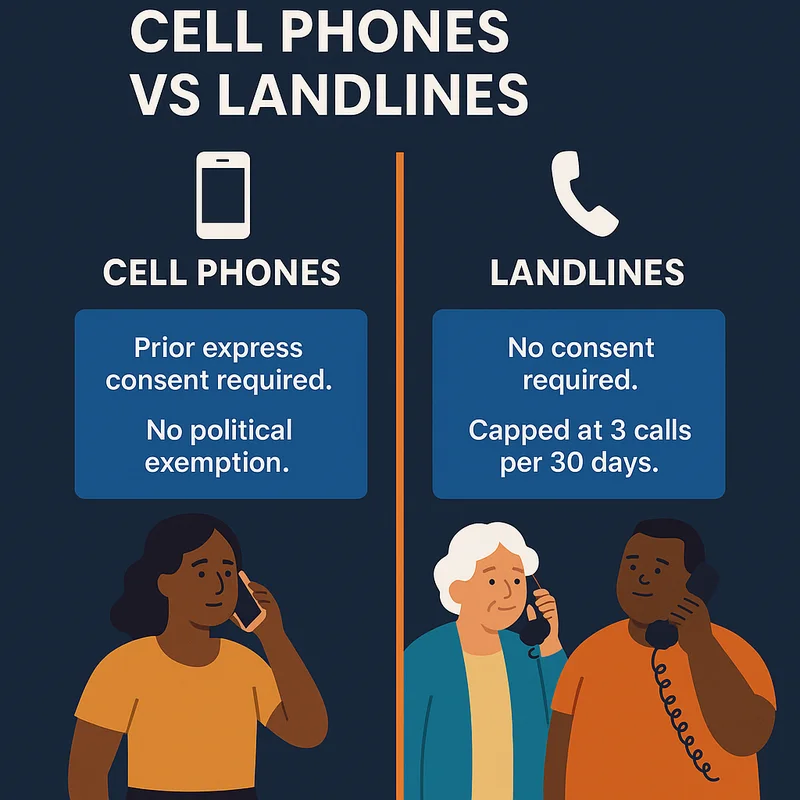
Autodialed or prerecorded voice calls, and texts of any kind, sent to a cell phone require the recipient’s prior express consent, regardless of political purpose. There is no political exemption for this requirement. A GOTV text blast to a purchased or scraped cell number list, without consent on file, is a TCPA violation waiting to happen.
Landlines work differently. Political robocalls to residential landlines are permitted without prior consent, but they are capped at no more than three calls within any consecutive 30-day period. A fourth call in that window, even to the same supportive household, is a violation.
A live volunteer manually dialing a number, one call at a time, without an autodialer or prerecorded message, sits outside the TCPA’s autodialer restrictions entirely. This is why phone banking platforms distinguish manual dialing from predictive or autodialed calling in their compliance design, and why GOTV phone banking scripts are built around a live volunteer reading from a script rather than a prerecorded message.
Consent and opt-out: What a GOTV list needs before you dial or text
Before a GOTV list goes live, confirm three things:
- Every cell number on the list has documented prior express consent, either from an opt-in form, a prior interaction, or an established relationship the campaign can point to
- Every outgoing text includes clear opt-out instructions, typically “Reply STOP to opt out”
- Opt-outs are processed immediately, not batched for end-of-day cleanup
The FCC’s 2024 Report and Order added a “revoke all” requirement. Once a supporter opts out through any single channel, the campaign must honor that opt-out across every automated call and text channel at once, not just the one the opt-out arrived through. A supporter who texts STOP has opted out of autodialed calls too, even if they never explicitly said so on the phone.
10DLC registration for GOTV texting programs
Yes, political campaigns need 10-Digit Long Code (10DLC) registration to send GOTV texts at volume. Major US carriers now filter unregistered application-to-person (A2P) traffic aggressively, which means an unregistered GOTV text blast does not bounce, it simply never arrives, and the campaign has no way of knowing which supporters were silently dropped.
Registration runs through The Campaign Registry (TCR), with a separate political identity verification step most carriers require specifically for political campaigns. Brand registration typically takes one to three business days. Campaign-level registration takes another two to seven. That timeline makes 10DLC registration something a GOTV program needs to complete during the planning phase, not the week the final text push is scheduled to go out.
Skipping registration does not make a GOTV text program cheaper. It makes it invisible, since carriers block the traffic rather than flag it for review.
10DLC is the standard path for high-volume texting, but it is not the only registration type carriers enforce against. Short code and toll-free numbers carry their own separate registration and verification requirements. A GOTV program using more than one number type, a 10DLC number for regular contact and a short code for a final election-day blast, needs both registered, not just one.
Registration is the mechanical requirement. What gets sent once the number is registered is a separate question, covered in the GOTV text messaging strategy guide.
Time-of-day rules: What changes on election day itself
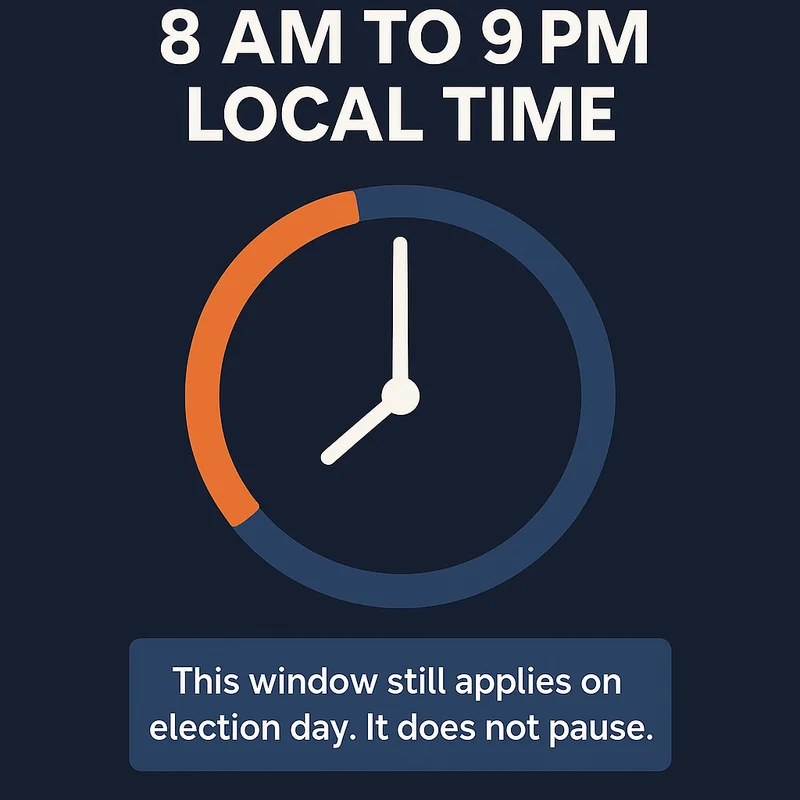
Calls and texts to residential and cell numbers are generally restricted to the hours between 8 AM and 9 PM in the recipient’s local time zone, not the caller’s. A volunteer calling from a different time zone than the contact must calculate the contact’s local time, not their own.
Election day itself does not suspend this rule. The 8 AM to 9 PM window still applies on election day, which surprises campaigns that assume the urgency of the day creates an exception. It does not. A GOTV reminder sent at 6 AM local time to remind a supporter that polls just opened is a timing violation, however well intentioned.
The night-before cutoff campaigns get wrong
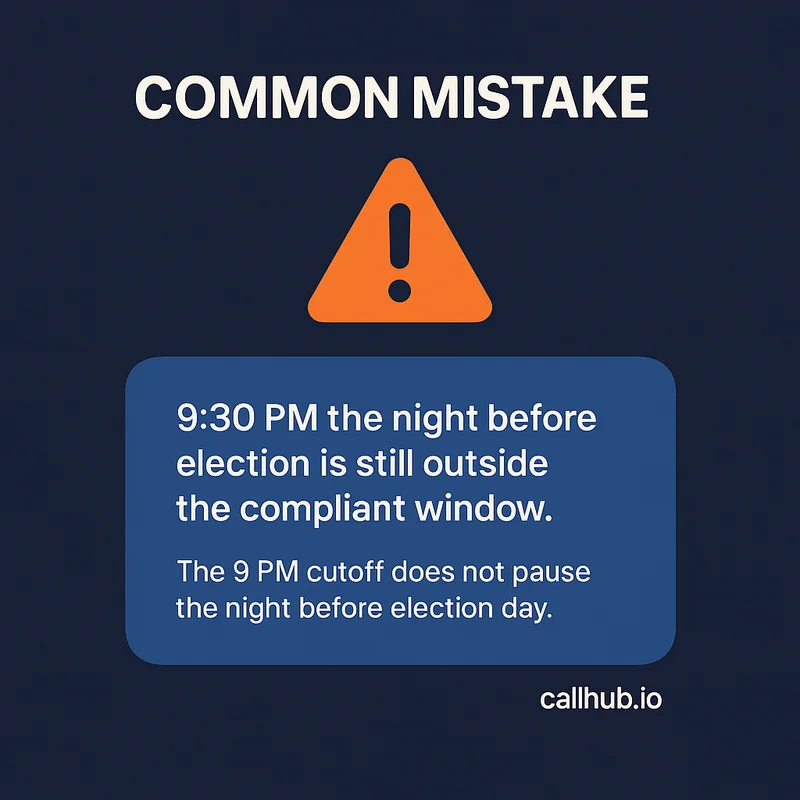
The most common mistake in the final 72 hours is treating the night before the election as an extension of election day itself. It is not. The 9 PM local cutoff applies the night before exactly as it applies every other night of the campaign. A final reminder text sent at 9:30 PM the night before the election, timed to catch supporters before bed, is still outside the compliant window.
Build the last pre-election contact wave to land before 9 PM local time, then resume the following morning at 8 AM local time for the election-day reminder wave. Treating these as two separate windows, not one continuous push, is what keeps a GOTV program compliant through its highest-volume stretch.
State-specific rules: Mini-TCPA laws and election-day restrictions
Federal TCPA rules are the floor, not the ceiling. A mini-TCPA is a state-level statute that layers additional consent requirements, calling-hour limits, frequency caps, and in some states, a private right of action, on top of the federal baseline. A multi-state GOTV program has to satisfy the strictest rule that applies to each contact, not a single national standard.
Two categories of state rules matter most for a GOTV program:
| Rule type | What it restricts | Why it matters for GOTV |
|---|---|---|
| Mini-TCPA statutes | Consent requirements, calling hours, and call frequency, often stricter than federal TCPA | A call that is compliant federally can still violate a specific state’s mini-TCPA |
| Electioneering and polling-place restrictions | Political activity within a set distance of a polling place, commonly around 100 feet | Applies to in-person GOTV activity near polls, not to calls or texts, but campaigns running both channels on election day need to track both rule sets separately |
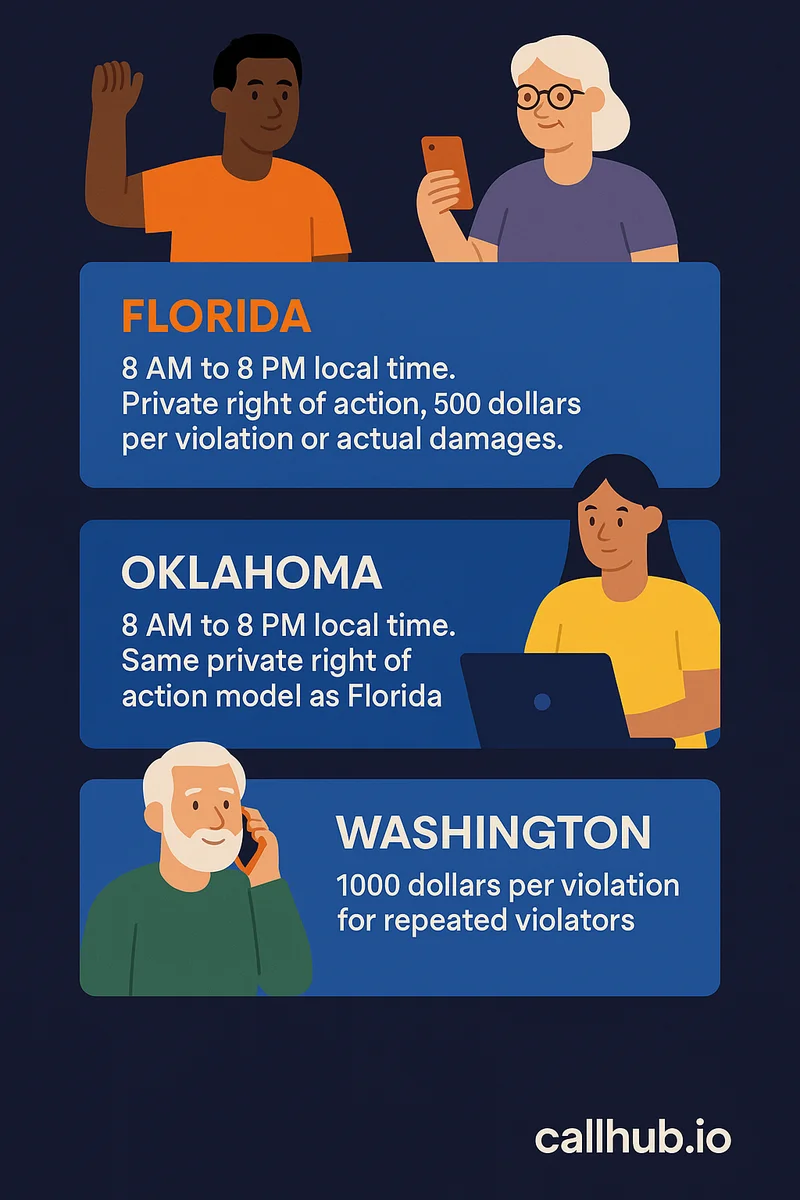
Florida and Oklahoma are the two states worth checking first. Florida’s Telephone Solicitation Act and Oklahoma’s Telephone Solicitation Act, both summarized by law firm Goodwin’s mini-TCPA tracker, cut the compliant calling and texting window to 8 AM to 8 PM local time, an hour shorter than the federal 9 PM cutoff, and both carry a private right of action with statutory damages of $500 per violation, or actual damages, whichever is greater. A GOTV text sent at 8:30 PM is compliant under federal TCPA but not in Florida or Oklahoma. Washington’s mini-TCPA adds its own layer, with damages of $1,000 per violation for repeated violators.
Because mini-TCPA statutes vary by state and change between election cycles, a GOTV program should confirm current requirements for every state it operates in rather than assuming last cycle’s rules still apply. A multi-state program that sets its calling window to the strictest state it operates in, rather than running separate schedules per state, removes an entire category of mistake.
A practical election-day compliance checklist
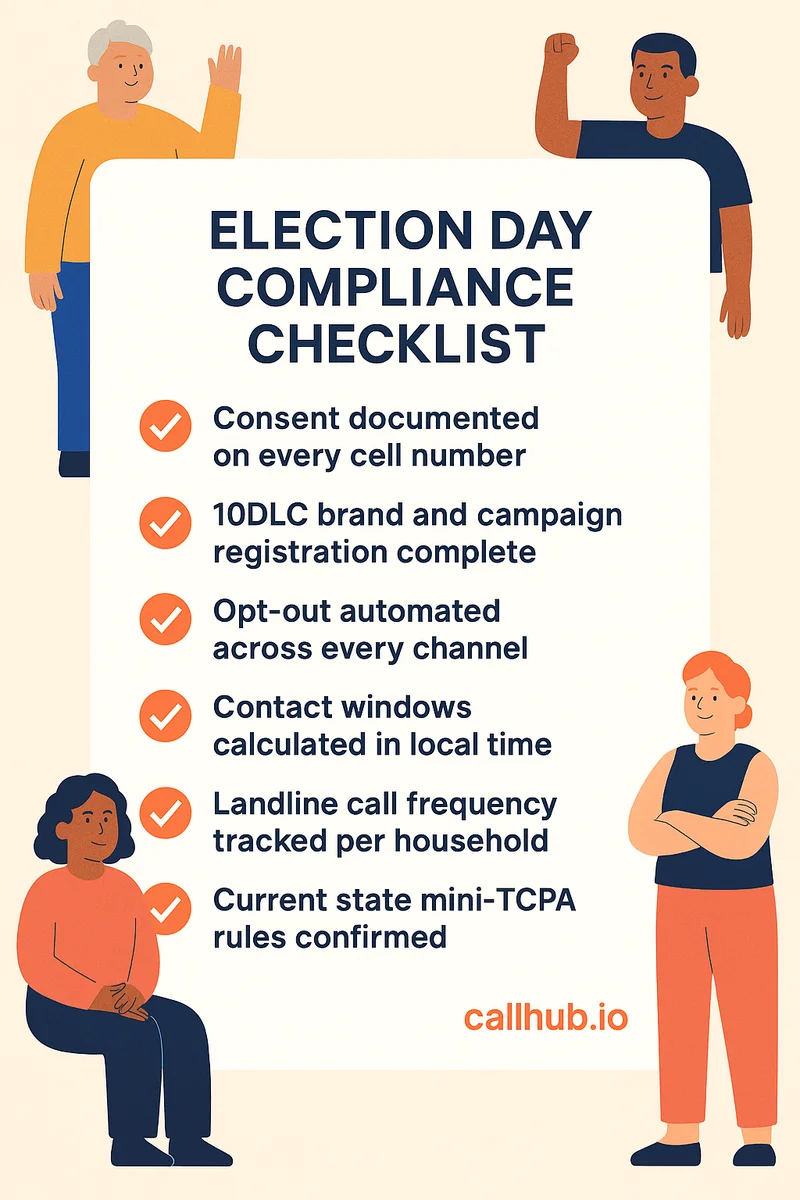
Run this list before the final GOTV push goes live, not during it.
| Check | Why it matters |
|---|---|
| Every cell number on the GOTV list has documented consent | Autodialed calls or texts without consent carry TCPA penalties regardless of political purpose |
| 10DLC brand and campaign registration completed with The Campaign Registry | Unregistered A2P texts get silently filtered by carriers, not flagged |
| Opt-out handling is automated and applies across every channel | The FCC’s “revoke all” rule requires one opt-out to cover calls and texts alike |
| Contact time windows are calculated in the recipient’s local time zone, not the caller’s | The 8 AM to 9 PM rule does not pause for election day or the night before |
| Landline robocall frequency is tracked per household, not per campaign | The 3-calls-per-30-days cap applies per residential number |
| Current mini-TCPA requirements confirmed for every state in the program | Florida and Oklahoma cut the compliant window to 8 AM to 8 PM local, an hour shorter than federal TCPA |
TCPA violations carry penalties of $500 per call or text, rising to $1,500 for willful violations, under 47 U.S.C. § 227. At GOTV volume, a single overlooked list segment can turn into a five or six-figure exposure fast.
Build compliance into the GOTV program, not the final checklist
The pattern in every GOTV compliance failure, from a missed opt-out to Steve Kramer’s deepfake robocall, is the same. Compliance got treated as a final-week check instead of a program design choice made months earlier.
Consent tracking, 10DLC registration, and time-zone-aware scheduling are not things a campaign layers on top of a GOTV push. They are decisions that need to be built into the contact list, the dialer configuration, and the texting workflow before volume ramps up. A GOTV program built this way does not need a scramble in the final 72 hours, because the compliance work already happened.
CallHub’s TCPA-compliant calling and texting tools enforce time-zone-aware calling hours and automated opt-out handling at the platform level, so a GOTV push does not depend on a volunteer remembering the rules under deadline pressure. For the rest of the program this compliance work supports, see CallHub’s coordinated GOTV campaign strategy.
Frequently asked questions
Is GOTV texting legal?
Yes. Political texts are exempt from the Do Not Call registry, but texts to cell phones still require the recipient’s prior express consent under the TCPA, same as any other autodialed cell contact. Consent, not political purpose, is what makes a GOTV text compliant.
Can you call voters on election day?
Yes, within the same 8 AM to 9 PM local time window that applies every other day. Election day does not create an exception to the TCPA’s time-of-day rule, so a call placed at 6 AM to catch early risers before work is still a timing violation.
Can you text voters on election day?
Yes, under the same 8 AM to 9 PM local time restriction that governs calls. The rule does not distinguish between calls and texts for time-of-day purposes.
Do political campaigns need 10DLC registration?
Yes, for texting at any real volume. Carriers filter unregistered application-to-person traffic, so an unregistered GOTV text program does not get flagged, it simply stops arriving. Registration runs through The Campaign Registry and includes a political identity verification step.
Are political calls and texts exempt from the Do Not Call registry?
Political calls and texts are exempt from the national DNC registry specifically. They are not exempt from the TCPA’s consent requirements for autodialed or prerecorded calls and texts to cell phones, which apply regardless of the DNC exemption.
What is a mini-TCPA law?
A mini-TCPA is a state statute that adds its own consent, calling-hour, or frequency rules on top of the federal TCPA, sometimes with a private right of action for violations. Florida and Oklahoma both shorten the compliant calling and texting window to 8 AM to 8 PM local time, an hour tighter than federal TCPA. A GOTV program operating across multiple states has to satisfy the strictest applicable rule in each state, not a single federal standard.
What happens if a voter replies STOP during a GOTV push?
The opt-out applies immediately and, under the FCC’s 2024 “revoke all” rule, extends across every automated call and text channel the campaign uses for that contact, not just the channel the STOP arrived through. Continuing to call or text that number afterward is a violation regardless of intent.
What are the penalties for a TCPA violation during a GOTV push?
TCPA violations carry penalties of $500 per call or text, rising to $1,500 for willful violations, under 47 U.S.C. § 227. Because GOTV pushes run at high volume in a short window, a single non-compliant list segment can scale into a significant financial exposure quickly.