





Table of Contents
Joining a university as a student transformed my views on how educational institutions could operate. More than anything else, I found my university to be considerate of us, the young adults studying there. The one seemingly simple but undoubtedly effective initiative they had adopted was a school text messaging service.
I say ‘effective’ because of one incident in particular.
It was just before the Christmas break, and all assignments and projects had piled on. I’m usually organized, and that week I’d made a schedule for all the deadlines. For the most part, I was following it pretty well. But there was a looming feeling that I’d forgotten something.
The feeling persisted for a few days before the ping; I got a text notification from our university saying:

I had submitted the online copy, but had totally forgotten about the hard copy submission!
Then, I got the text message one day in advance– just enough time to get the assignment printed and put it in my folder.
If the school text messaging service reminded me about a critical submission, similar services can help students with motivation, nudges, and updates about their academic lives.
- 84% of students claim that school text reminders aid them in getting everything done for college.
- 85% found that such reminders inform them of things they didn’t realize they must do.
- 86% of students claim that school text messages prompted them to do tasks they hadn’t completed.
(From personal experience, I can vouch for that!)
So yes, students value texts from schools. But what about administrators, admissions teams, and student services staff? How does texting help them? Where does it fit? And what does good implementation look like?
This article answers all these questions and guides you with the main use cases, benefits, and templates.
What is a school text messaging service?
School text messaging services provide secure, instant communication between schools and parents, students, or staff via bulk SMS. Unlike personal texting, a school SMS service lets administrators send bulk messages to thousands of contacts at once, manage opt-ins and opt-outs, and track delivery and response rates — all from a centralized dashboard.
Why are schools in the USA moving to SMS communication?
Although emails and circulars have been the standard for student communication, they have low open rates and are often overlooked. Text messaging has quickly caught up and is shifting how schools communicate with key stakeholders: the board, trustees, admin, parents, and students.
Two concepts explain the shift:
- Instant communication
- Easy accessibility
The74 million organization examined 3.3 million text messages and found that parents are highly responsive, with 73% of texts receiving a response within 11 minutes.
Joy Smithson, a SchoolStatus data scientist, said:
“We get a lot higher rates of response with text messages.” Placing a phone call, on the other hand, is “for those more critical conversations,”
8 Common use cases for a school text messaging service
Now we know why US schools have moved towards using more technology in their messages, especially text messages.
It also makes it easy for institutions to share admissions information, remind students of deadlines, and alert students during emergencies. Thus, it proves to be the right channel for communicating with and engaging students.
Let’s discuss eight ways to use text messaging services for schools and universities to reach out to your student body.
1. Help streamline student recruitment
When recruiting or fostering students’ engagement within your institution, students prefer to receive the necessary information via text and want a personal connection with the sender.
Using a school text messaging service, you can streamline recruitment in this way:
- Send mass texts about deadlines, documentation, and other administrative details.
- You can send links to registration forms (e.g., for dorms).
- Send reminder text messages about availing financial aid or registering for classes, etc.
- Use conversational texting to provide hand-holding throughout the process.
- Use P2P texting to nurture interested parties and encourage them to take the next steps in the admission process.
School text template:
Hi {first_name}, this is [School administrator] from [University_name]. I saw you were interested in our marketing program. We would love to discuss your goals over a call. Would you be interested?
2. Strengthen the admission process for the school text messaging service
Students depend heavily on family members, friends, or high school counselors to help them through the admissions process. Without this, getting into and through all four college years becomes hard. However, not many families can help their kids make these decisions, and many find it frustrating.
Setting up a mass texting program that connects high school seniors and current college students with peer counselors and college coaches nationwide strengthens the admissions process.
The college coaches or counselors can send reminders about deadlines around key milestones in the process, such as the FAFSA (Free Application for Federal Student Aid) and college applications. They can also offer guidance for students with current courses, housing, financial aid, and other difficulties. CallHub’s one-on-one texting platform scales and humanizes how your institution communicates with students. It can help you build better relationships with Generation Z as they navigate college. This is one way a school text messaging service can make admissions feel more personal and less overwhelming.
Template for school SMS service:
Hey {first_name}, this is [School administrator] from [University_name]. I am in the junior year of the [course name]. Seeing your resume, I’m excited to have you at the university. I am your assigned buddy here, and I can help you with your admission process and first weeks here. Feel free to reply to this number if you have any questions.
3. Engage alumni with your school/college
In a 2020 study, 90% of alumni professionals confessed that they “need to do more” to engage former students. With a school text message service, you can ensure student engagement and involvement even before they graduate.
An engaged student who enjoyed their time at the school and found value in your courses will continue being engaged as an alumnus. But your school text messaging services will be terminated after they graduate.
Get them to opt into your alumni text messaging services to ensure the connection continues. Offer incentives that benefit them and provide value as graduate students.
After-school text message template to engage alumni:
Hey {first_name}, congratulations on graduating from [University_name] ! Did you know [University_name] has a strong alumni network that gives former students job updates, career opportunities, event invites, campus benefits, and more?
Text [shortcode] ALUM to 56667 to opt into the network.
Note that although you have an opt-in from a contact as a student, you may need a separate opt-in from the same contact to continue messaging after they are no longer on your school register.
Read also: Alumni Engagement Strategy & Best Practices: 9 Top Ways to Nurture Your Network
4. Use surveys for alumni fundraising and engagement
Getting your alumni to commit to attending your fundraiser may be easy, but following up with them to ensure they do so is not a walk in the park. You need to keep track of who has agreed to or denied your request and review data spreadsheets to follow up with them. Frustrating right? You can quickly solve this problem by creating polls and surveys.
Text surveys are an acceptable way to initiate a two-way conversation, record responses, identify alumni’s interests, and follow up accordingly. By reaching out to them based on their interests or past involvement, you can solicit donations or get alumni to attend your event.
CallHub’s P2P texting tool enables you to conduct surveys based on multiple choices and tag respondents accordingly. Then, you can sync these with your CRM and shoot surveys based on tags.
For example, if you know that a specific alumni group includes former university athletes (based on previous surveys), you can target them for fundraisers benefiting your athletic teams. Similarly, those who replied saying they were part of the orchestra can be targeted for fundraisers benefiting cultural infrastructure.
Survey texts make it easier to make notes and follow up on commitments. The information collected through surveys can also be used to reach out to alumni and keep them engaged.
Template for school texting:
Hey {first_name}, I hope you are doing well. As a former member of our school’s illustrious quiz team, I have bad news. Our chem lab is suffering due to a lack of funds. We’re raising funds for its wear and tear. Would you like to help us?
5. Schedule reminders for required books and materials for school text messaging service
Most students don’t look at the syllabus before their first day and show up unprepared for class. To make the most of the first day, professors can send an SMS broadcast to their students listing the materials and assignments they should bring.
You should also remember that professors are busy people with an endless number of tasks on their minds. They might even forget to send a text. CallHub’s scheduling feature lets professors schedule text messages to be sent later and set up recurring text campaigns if needed.
School text template:
Hi {first_name}, this is your Geography professor, [professor_name]. I’m sharing a list of books required for this year’s first term. Ensure you have a copy for our first class on [DD/MM/YYYY]. <link>
6. Keep students updated and ensure they meet deadlines
School life is busier than ever, so students aren’t the best at meeting deadlines. But that’s not something to worry about. You can stop the delay with a simple text message reminder. Text messages can be used to:
- Send first-year students a welcome message and back-to-school tips on their first day.
- Inform the student body about upcoming events and attendance requirements.
- Make sure that students have met class enrollment deadlines.
- Alert students of class time changes and cancellations.
- Collect student feedback to identify areas that need adjustment.
- Remind students to return borrowed books so that others can use them.
- Promote extracurricular activities to connect students with the school, relieve stress, build real-world skills, and form lasting friendships.
This is one of the simplest ways a school text messaging service improves student follow-through
Template for mass text messaging for schools:
Hi {first_name]}, this is a reminder that your [subject_name] assignment for Q1 is due on [DD/MM/YYYY]. Any delay will be marked as a failure.
7. Keep parents informed about the progress for school text messaging service
Schools often convey a student’s progress to their respective parents. This ensures no communication gap, and parents or the administration can schedule meetings to discuss the child’s performance.
Emails were traditionally used in such cases. However, as we have seen, they have a low open rate. Moreover, if a simple text can do the job, why not implement this quick and convenient option?
Here are the steps to take:
- Rent a dedicated keyword for school-parent communications from CallHub. Promote it with parents.
- Give a clear understanding of what to expect from your texts.
- Set auto-responses for when a parent texts the keywords. The auto-responses should collect more information about the parent, e.g., the ward’s name and class.
- Send a text that defines the nature of future messages (as a reminder of the expectations you set), outlines ways to opt out, and provides alternate ways to contact the school.
School text messaging service helps schools share timely parent updates without relying only on email.
Template for school-parent texts:
Dear parent, the results for grades [mention grades] are now available. We have a record 100% pass rate this time! Check your ward’s grades here <link>. (Required: student ID & birthdate for password).
Read also: Use School Calling Software for Easier Parent Outreach
8. Text alerts for emergencies for the school text messaging service
In emergencies, schools need to send alerts to a large number of contacts. The matter is urgent, and one cannot waste time sending the alert manually.
With a 98% open rate, texts come to the rescue.
Additionally, the Clery Act requires colleges and universities to report crimes on and around campuses. Mass text messaging for schools can help you report such instances promptly.
And texting tools come in handy. Mass texting tools like CallHub can auto-send one text per second. That’s 3600 texts in an hour! If you create multiple campaigns with the exact text (simply duplicate the original campaign and target a different contact list!)
Thus, a mass texting tool can allow you to send emergency alerts or broadcasts to your contacts in a considerably short time. For urgent outreach, a school text messaging service is often the fastest channel schools have.
Template for school emergency text alert:
ALERT! School is closed [day and date] due to severe weather. Enjoy the long weekend, and stay safe.
Read also: 6 Things You’re Missing Out On Without a School Text Alert System.
If you’ve already adopted a school text messaging service, these use cases can help you make the most of it. If you’re not convinced, the following benefits will convince you.
How to choose the best school text messaging service (+ how CallHub compares)
With dozens of SMS platforms on the market — from EZ Texting and Text-Em-All to Textline and DialMyCalls — school organizers often ask: what should I actually look for? Below is a breakdown of the features that matter most for schools in the USA, and how CallHub stacks up.
| Feature to look for | Why it matters for schools | CallHub |
| Mass texting (Broadcast SMS) | Reach all parents/students instantly for emergencies and announcements | ✅ Send to 100,000+ contacts in minutes |
| P2P (Peer-to-Peer) texting | Personal 1:1 outreach for admissions, counselling, and engagement | ✅ Up to 3,500 texts/hour per agent |
| Two-way SMS | Allow parents and students to reply and start conversations | ✅ Full two-way inbox with auto-routing |
| SMS opt-In / Opt-out | Legal compliance — manage consent automatically | ✅ Keyword opt-in, auto opt-out, STOP handling |
| 10DLC registration support | Required for high-volume US school messaging since 2023 | ✅ Supported with setup guidance |
| FERPA-aware data handling | Protect student records — role-based access control | ✅ Permissions by staff role |
| CRM integration | Sync with your SIS or CRM for clean contact lists | ✅ Integrates with Salesforce, HubSpot, and more |
| Pricing model | Predictable costs for school budgets | ✅ Pay-per-use + flat plans available |
How does a school text messaging service benefit you?
Text messaging services for schools don’t just benefit students or parents. They help you with retention and student involvement in extracurricular activities. Here are some of the benefits of such a school texting service.
1. Retain more applications for admissions
My university admissions process was one of the most daunting things in my academic life. Of course, the course itself was super challenging. But the anxiety about leaving my home country, getting all the documents in place, and not knowing what to expect was pressing down on me.
Of course, a school text messaging service helped me here, too.
My ‘buddy’ answered all my questions, gave me tips on what to carry, and shared insights on campus life. This university was in my top three choices anyway, but such mentoring finalized my admission there.
Similarly, for you, a school text messaging service can help nurture applications into confirmed admissions
2. Keep your campus community safe with a school text messaging service
During an emergency or crisis, reaching out to your students and staff by email or phone isn’t feasible, since emails may not be read and you can’t call every student quickly. Rather, you should send simple Yes/No questions to your campus community to ensure they’re safe, and then follow up with those who’ve indicated they’re in danger.
For example, you can alert your staff and students by asking them if they’re on campus. If they reply “No,” their response will be recorded, and they will receive an automated response asking them not to go near campus. If they respond with a “Yes,” they will receive a reply asking where they are on campus, then providing the specific evacuation route.
The replies to the initial question are set before the question is sent. This makes it easy for your administrative staff to ensure that the evacuation personnel assist your campus community.
3. School text messaging service helps to increase parent responses
Using tools like peer-to-peer texting, you can send hundreds of texts within a few seconds and increase parent responses by engaging in one-on-one conversations with them. It allows schools to have meaningful conversations with parents and record data based on their answers, so you can send relevant messages.
Personalization of texts is easy with tags, such as {first_name}, which will fill in the parent’s first name in the message when it’s sent. In addition, you can send messages using a local area code to reduce the number of parents who unsubscribe.
These features make a school text messaging service more personal and more likely to get a response,” at the end of this paragraph
4. School text messaging service increases student engagement
For a school text messaging service to engage students, it must:
- Send regular and valuable updates
- Initiate conversations (e.g., via surveys)
- And provide valuable incentives to students.
An engaged student is more likely to participate in extracurricular activities. They are involved with the school or college in the real sense and add value to your institution with their participation.
These students can also prove to be active alumni who contribute to your school/college’s functions in the future. They are more likely to attend your event, volunteer as mentors for future students, donate funds, or fund your activities even after their graduation.
5. School text messaging service helps centralize communications
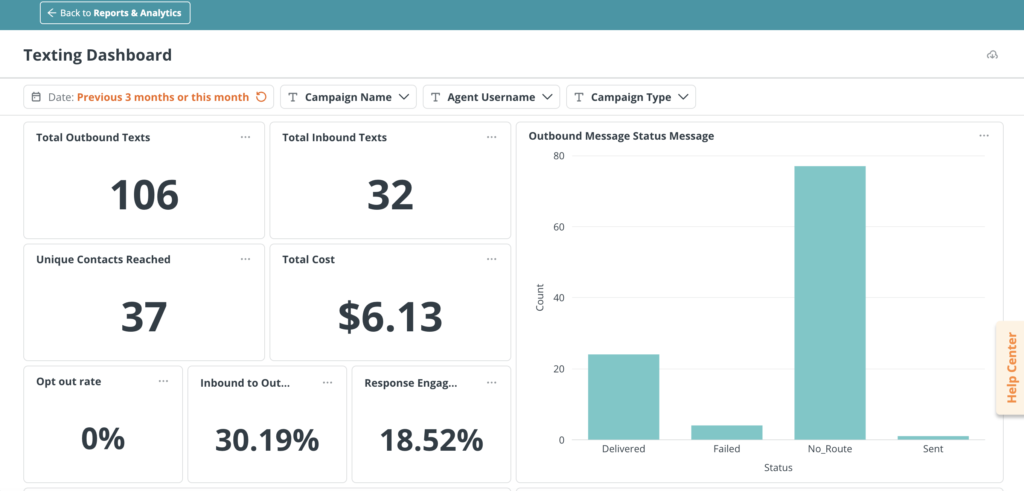
A school text messaging service centralizes all text communications with students and parents. It can be a single repository for all your past P2P and mass texts. When you invest in CallHub, you get centralized data on each campaign and its performance.
Through analytics, you can know:
- Total number of inbound and outbound texts.
- Unique contacts reached
- Metrics like Opt-out rate, engagement ratio
- Total cost incurred to send the messages in the selected timeframe
- Graphically, one can understand the delivered status and other metrics.
Many schools and universities in the United States offer their students innovative ways to connect through text messaging. Now it’s your turn to do the same. These are just a few examples of how school text messaging services can help build better relationships, streamline admissions, communicate with parents, and improve the overall student experience.
Want to try a school text messaging service to increase engagement? Check out CallHub if you’re looking for a free school text messaging service to get started
Feature image source: Csaba Balazs/Unsplash.
FAQs: School text messaging service
1. How can schools use text messaging services effectively?
Schools can use text messaging to send reminders about deadlines, share emergency alerts, notify parents about schedule changes, communicate with parents, and engage students in activities. Effective use includes segmenting audiences, scheduling messages, and using templates for consistency
2. Are school text messaging services secure and compliant with privacy laws?
Yes, reputable school text messaging services comply with privacy laws such as FERPA and TCPA. They use secure systems to protect student and parent data and require opt-in consent for messaging.
3. What is the best school text messaging service?
The best school text messaging service depends on your school’s needs, budget, and required features. Popular options include:
- Remind
- CallHub
- TalkingPoints, and
- ParentSquare.
When choosing, consider factors like ease of use, compliance, integration capabilities, support, and pricing.
4. Are there any limitations to using text messaging for schools?
Limitations may include message length, potential costs, and the need for recipients to opt in. Schools should also ensure messages are relevant and not excessive to avoid unsubscribes.