

Your GOTV script probably ends with some version of the same line: “Can we count on you to vote?” Most contacts say yes. A chunk of them still do not show up on election day.
That gap between a yes and a ballot cast is where most GOTV programs leak turnout. A field experiment covering 287,228 Pennsylvania voters found the fix is not a better reminder. It is a voting plan: A specific answer to when, where, and how someone will vote. Adding that single question to a GOTV call raised turnout by 4.1 percentage points among people reached, and 9.1 points in single-voter households.
This article breaks down the research behind that question, from David Nickerson and Todd Rogers, and turns it into script language you can add to your phone banking and canvassing conversations this week.
Key Takeaways
A Pennsylvania field experiment shows that adding a voting plan question to GOTV scripts closes the gap between voters saying yes and actually casting a ballot.
The research and its core finding
- Nickerson and Rogers ran the experiment on 287,228 registered Pennsylvania voters, published in Psychological Science in 2010.
- A GOTV call that helped voters build a voting plan raised turnout by 4.1 percentage points among people reached, verified against the official Pennsylvania voter file after the 2008 general election.
- Turnout was checked against the state’s official record rather than self-reported answers, which is what makes the result hold up.
- A standard encouragement call reminding someone an election is happening produced no significant effect, and neither did a plain self-prediction question like do you plan to vote.
Why the plan works
- A voting plan is a specific commitment about when, where, and how someone will vote, not just whether they intend to.
- Psychologists call this an implementation intention, a rule linking a specific future situation to a specific response in the form whenever situation X arises, I will do Y.
- Analyst Institute has tracked this pattern across dozens of GOTV experiments, finding that specific plans outperform general encouragement because the plan itself becomes the reminder.
- The script that moved turnout asked three things in sequence: what time the contact planned to vote, which polling place they would go to, and how they would get there.
The household split
- The 9.1 percentage point lift applied only to single-eligible-voter households, where one person on the voter file lives alone or is the only registered voter.
- In multiple-eligible-voter households, with two or more registered voters, none of the scripts moved turnout, and researchers could not explain this null result with certainty.
- Most voter files flag household size, so campaigns can filter for single-eligible-voter households ahead of a canvass or phone bank and prioritize the voting plan script for them first.
Applying it to scripts
- The three details that make a plan concrete are time, the specific polling place confirmed rather than assumed, and the method of getting there, and skipping any one weakens the effect.
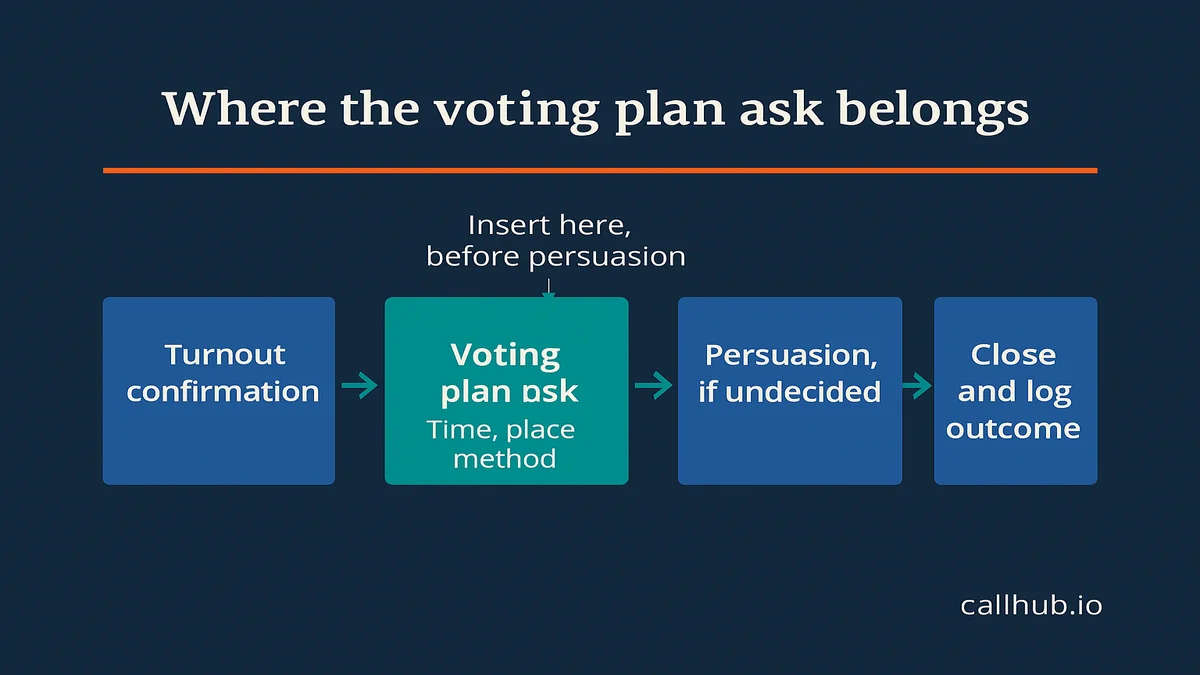
- The voting plan questions should follow the standard turnout confirmation and come before persuasion or a closing ask, functioning as a branch point where confirmed voters get the three questions and undecided contacts get routed to persuasion content.
What is a voting plan, and why does asking about it work?
A voting plan is a specific commitment about when, where, and how someone will vote, not just whether they intend to. It works because it converts a vague intention into a concrete plan tied to a real moment: A day, a time, a location, and a way of getting there.
Most GOTV scripts stop at intention. “Do you plan to vote?” invites a polite yes and nothing more. A voting plan question asks the contact to picture Tuesday: What time they will leave, which polling place they are headed to, how they will get there. That extra step is the entire mechanism.
Implementation intentions: the psychology behind the plan
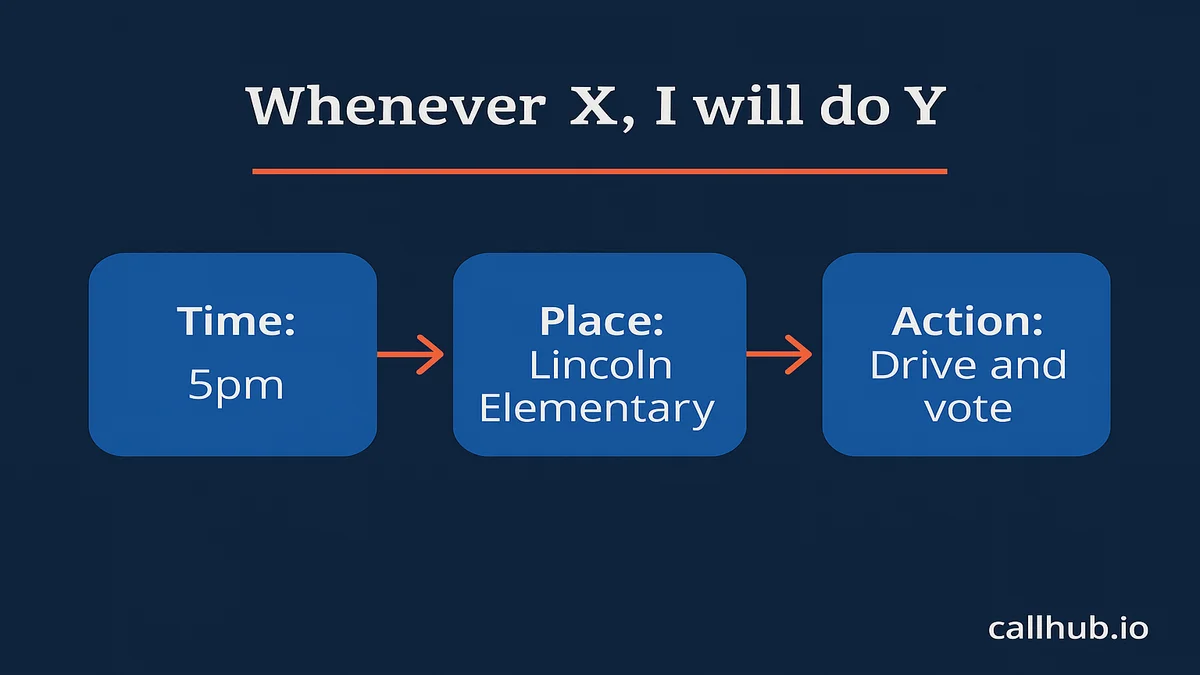
Psychologists call this an implementation intention: A rule that links a specific future situation to a specific response, in the form “whenever situation X arises, I will do Y.” Instead of a general goal (“I want to vote”), the person commits to a trigger and an action (“At 5pm, I will drive to the Lincoln Elementary polling place”).
Analyst Institute has tracked this pattern across dozens of GOTV experiments: Specific plans outperform general encouragement because the plan itself becomes the reminder. The voter does not have to decide anything on election day. They already decided last week.
Inside the research: the Nickerson and Rogers voting plan experiment
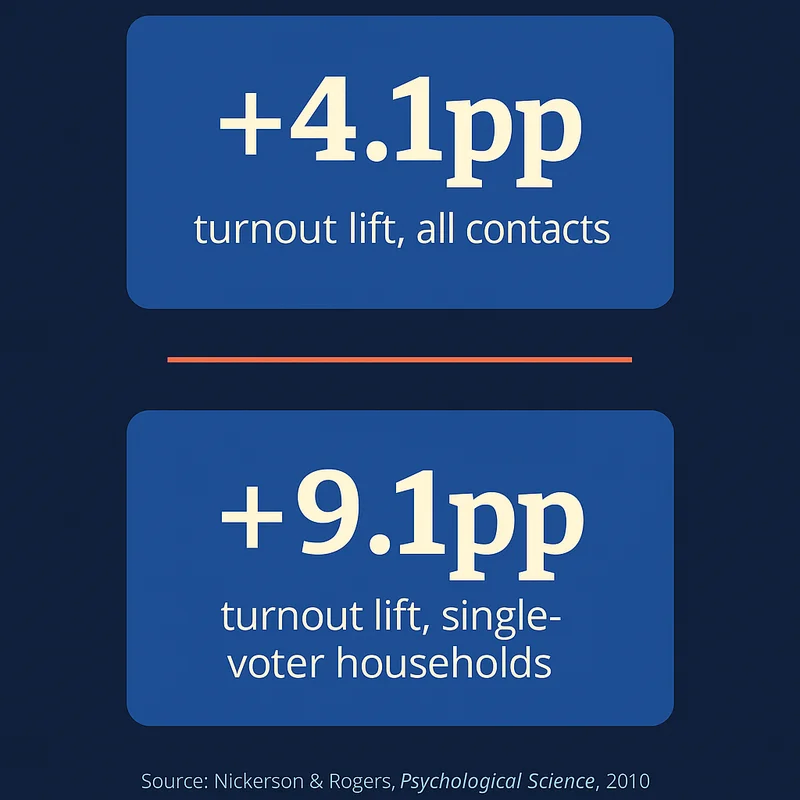
The core finding: A GOTV call that helped voters build a voting plan increased turnout by 4.1 percentage points, verified against the official Pennsylvania voter file after the 2008 general election.
Nickerson and Rogers, published in Psychological Science (2010), ran the experiment on 287,228 registered voters. Callers were randomly assigned different scripts, and turnout was checked against the state’s official record rather than self-reported answers, which is what makes the result hold up.
What worked: asking for specifics, not a promise
The script that moved turnout did three things in sequence:
- Asked what time the contact planned to vote
- Asked which polling place they would go to
- Asked how they would get there
Each answer forced a small decision the voter had probably never made out loud. That act of deciding, not the act of promising, is what the Yale ISPS GOTV field experiments and related research consistently link to turnout gains.
What didn’t work: reminders and self-predictions
A standard encouragement call, the kind that simply reminds someone an election is happening, produced no significant effect on its own. Neither did a plain self-prediction question like “do you plan to vote?” Both scripts left the decision-making to election day, which is exactly the gap a voting plan closes.
The single- vs. multi-voter household result
The 9.1-point lift only applied to single-eligible-voter households, homes where one person on the voter file lives alone or is the only registered voter. In multiple-eligible-voter households, homes with two or more registered voters, none of the scripts moved turnout.
Do not present the 9.1-point figure as a universal result. The researchers could not explain the null result with certainty, but it is a reminder that a voting plan script is not a guaranteed lift for every contact type. Build it into your program, but track results by household composition before you claim credit for the difference.
Most voter files flag household size, so identifying single-eligible-voter households ahead of a canvass or phone bank is usually a filtering step, not a guess. If your file supports that filter, prioritize the voting plan script for those households first, and run it as a standard part of your turnout script for everyone else until your own program data gives you a clearer read.
What a voting plan conversation sounds like
A voting plan conversation is short: Three specific questions, asked in order, right after the contact confirms they intend to vote.
“Great, when are you planning to head to the polls, morning or evening?”
“And which polling place will you be going to, is it still the one on [street]?”
“How are you getting there? Walking, driving, or catching a ride?”
None of these questions ask the voter to promise anything new. They ask the voter to describe a plan that, once said out loud, is harder to skip.
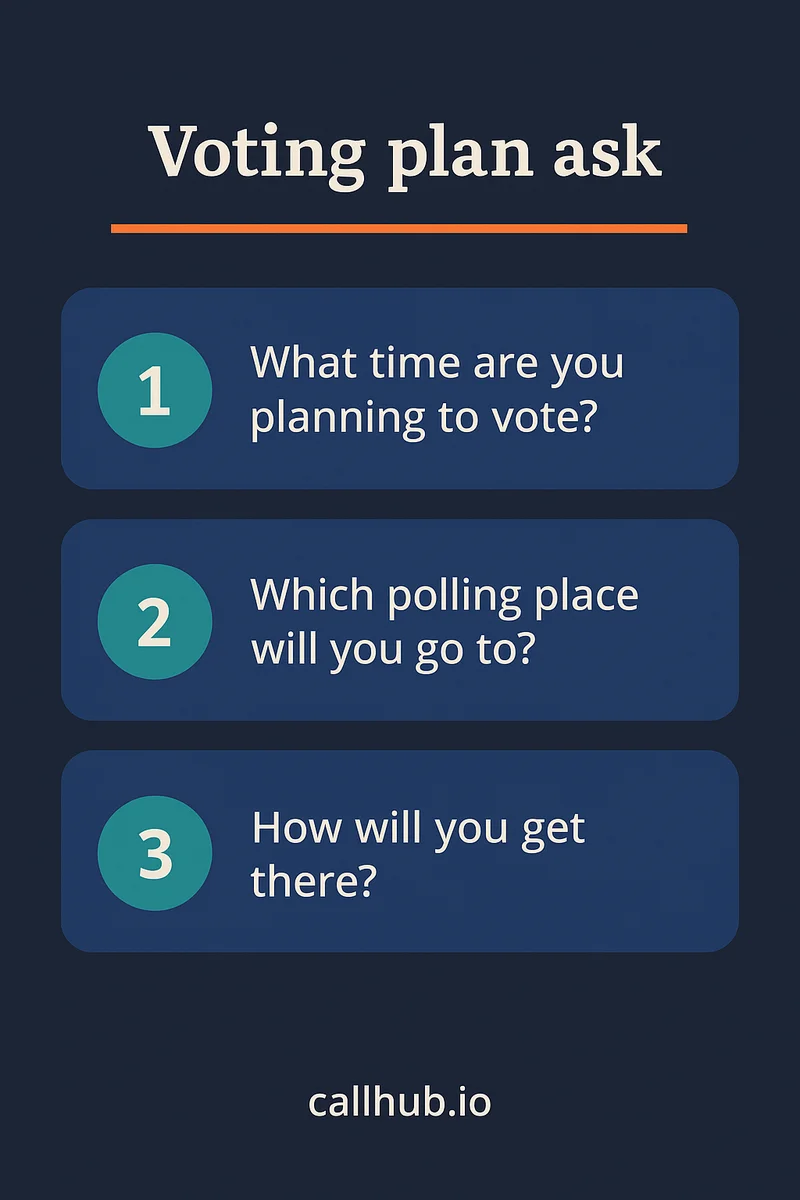
The three questions that make a plan concrete
The research points to three specific details that separate a real plan from a vague intention:
- Time: A part of the day, or an exact hour if the contact offers one
- Place: The specific polling location, confirmed rather than assumed
- Method: How the contact will physically get there
Skip any one of the three and the plan gets vaguer, which weakens the effect.
Adding the ask to your phone banking script
The voting plan questions belong right after your standard turnout confirmation, before you move to persuasion or a closing ask. Treat it as a branch point in the script: Contacts who confirm they will vote get the three questions; contacts who are undecided get routed to your persuasion content instead.
“Branching scripts help deter the volunteers from being confused. It leaves no room for them to decide the information,” says Kayla Lawrence-White, Community Relations and Program Design Office at New York Cares. A voting plan ask is exactly the kind of branch that benefits from being built into the script itself, in phone banking software for GOTV calls, rather than left to a volunteer’s memory.
That structure matters most on election-week shifts — see the GOTV timeline for when this kind of shift-heavy push typically ramps up — when campaigns are running volunteers who have never worked a script before. A new caller needs only a few minutes of training to handle the voting plan branch correctly, because the script routes the conversation instead of asking the volunteer to remember the rule on their own; see how GOTV volunteer training differs from standard phone banking for how to structure that onboarding.
Where in the call flow the ask belongs
Ask the voting plan questions before persuasion, not after. A voter who has just committed to a time, place, and method is in a decided frame of mind. Introducing a persuasion pitch immediately afterward risks reopening a decision the contact just closed.
Handling “I don’t know yet”
Some contacts will not have a time or polling place ready. Do not push for a forced answer.
- Offer the polling place lookup tool your campaign uses and confirm the address on the spot
- Suggest a natural anchor, “before work” or “on your lunch break,” instead of an exact time
- Log the partial plan and flag the contact for a short follow-up closer to election day
Bringing the voting plan ask to the door
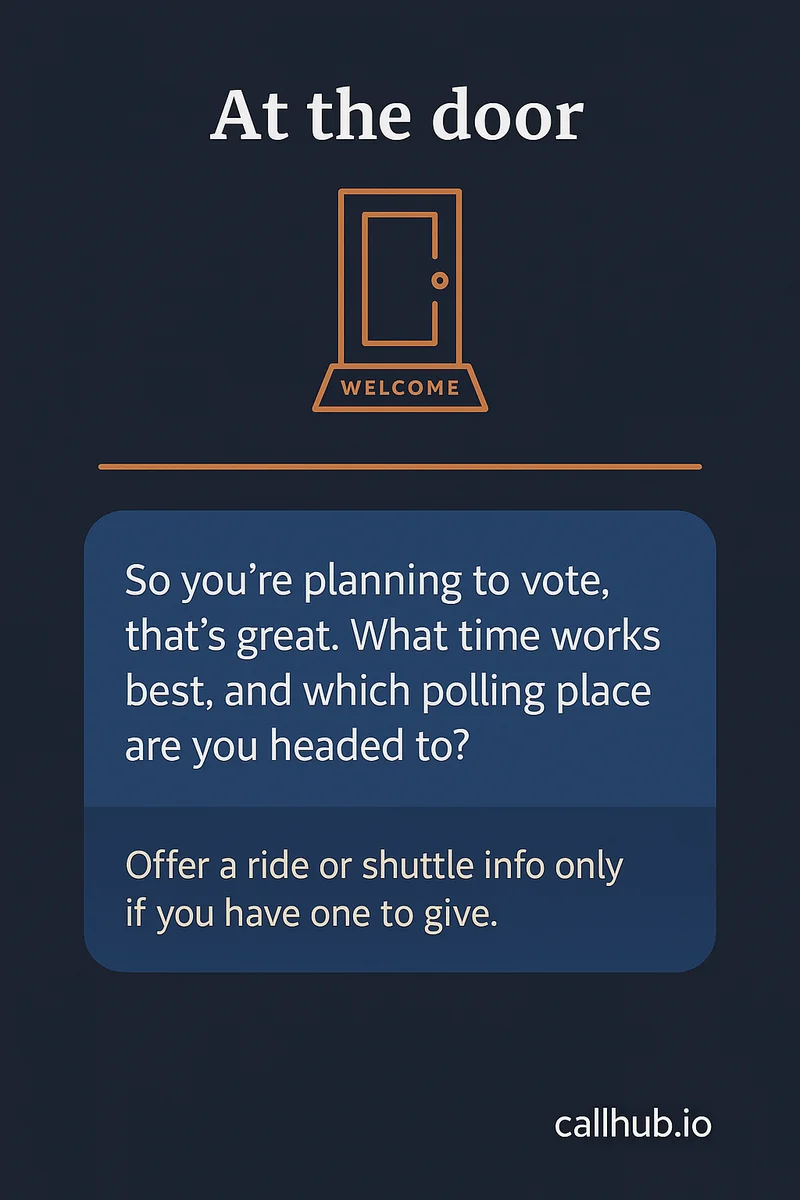
The same three questions work at the door, adjusted for a face-to-face conversation. Canvassers have an advantage phone bankers do not: They can hand over a printed polling place confirmation or point down the street toward the location.
A door script version: “So you’re planning to vote, that’s great. What time works best for you, and do you know which polling place you’re headed to?” Follow with the transportation question only if the canvasser has a resource to offer, a ride-share partner or a shuttle schedule, so the question leads somewhere useful. Pair it with the rest of your door-to-door canvassing tips so the ask fits naturally into a normal conversation instead of sounding like an add-on script. For the complete canvassing operation this fits into, see door-knocking for GOTV.
Recording the plan for follow-up contact
Write down whatever the contact tells you, even a partial answer, on the walk sheet or app. A voter who said “probably after work” is a better follow-up target three days out than one whose sheet is blank. Pair this with your general canvassing conversation approach so voting plan questions sit naturally inside the rest of your door-knock script.
Feed that data back into your voter file the same day, while the conversation is still fresh for the canvasser. A plan logged three days before election day only helps if whoever runs your final GOTV push can see it and act on it, rather than sitting unread on a paper sheet in someone’s bag.
Common mistakes that blunt the effect
Most of the turnout lift disappears when the ask gets flattened into a rule rather than a real conversation. Watch for five specific ways that happens.
| Mistake | Fix |
|---|---|
| Treating the ask as a yes/no question | Ask for a specific time, place, and method, not another promise |
| Asking every household the same way | Track single-voter versus multi-voter households separately before judging results |
| Running the ask after persuasion | Move it earlier, right after turnout confirmation |
| Forcing an answer from an undecided contact | Offer an anchor point and log a partial plan instead |
| Leaving the ask off the printed script | Build it into the script as a branch point, not a volunteer ad-lib |
For more script formats built around this kind of structured branching, see CallHub’s GOTV phone banking scripts.
Put the research into your next GOTV script
The voting plan ask is one of the highest-evidence additions a GOTV script can make, but the lift comes specifically from generating a concrete plan, not from a generic reminder, and it does not affect every household equally. Add the three questions as a branch point, track results by household type, and treat the null result for multi-voter households as a reason to keep testing, not a reason to skip the tactic.
This voting plan ask is one tactic inside a much larger GOTV system — see the full GOTV playbook for how it fits alongside canvassing, phone banking, and texting across your program.
See how phone banking software built for GOTV scripts can turn this into a branch point your volunteers never have to remember on their own, or explore coordinated GOTV calling and canvassing tools if you are running both channels together.
Frequently asked questions
What is a voting plan?
A voting plan is a specific commitment a voter makes about when, where, and how they will vote, rather than a general statement that they intend to vote. Research shows the specificity itself, not just the intention, is what drives higher turnout.
How much does asking about a voting plan increase turnout?
Nickerson and Rogers (2010) found that a GOTV call built around a voting plan increased turnout by 4.1 percentage points overall, and by 9.1 percentage points in single-eligible-voter households. The result was verified against the official Pennsylvania voter file, not self-reported answers.
Does a voting plan ask work for every voter?
Not equally. Nickerson and Rogers found the turnout lift was concentrated in single-eligible-voter households. Contacts in multiple-eligible-voter households, such as married couples, showed no measurable effect from any script tested. Track results by household type before assuming the tactic is working everywhere.
What questions should I ask to help someone make a voting plan?
Ask three things: What time they plan to vote, which polling place they are going to, and how they will get there. Each question should get a specific answer, not a restated promise to vote.
Should the voting plan ask replace persuasion in a GOTV call?
No. Ask the voting plan questions after a contact confirms they intend to vote and before any persuasion content. For undecided contacts, route them to your standard persuasion script instead, the same way you would in any GOTV phone banking script.
Can voting plan questions work at the door as well as on the phone?
Yes. The same three questions work in a canvassing conversation, with the added advantage that canvassers can hand over a printed polling place confirmation or point toward the location directly.
What if a voter refuses to give specifics?
Do not force an answer. Offer a natural time anchor like “before work” and log whatever partial plan the contact gives you, then flag them for a short follow-up contact closer to election day.