

A phone bank with 5 volunteers can make 150 to 200 voter contacts in a 3-hour shift. Finding and keeping those volunteers is where most campaigns fall short. Recruiting phone banking volunteers is a different challenge from general volunteer recruitment — the pool is narrower, the ask is more specific, and first-shift drop-off is a real problem if expectations are not set clearly from the start.
This guide covers where to find phone banking volunteers for your political campaign, how to ask them, what to tell them before the first shift, and how to keep them coming back. It also walks through the operational steps — sign-up forms, onboarding, training on CallHub, goal-setting, and appreciation — that turn a recruited volunteer into a reliable one.
Read also: Complete guide to political phone banking.
Key Takeaways
A five-person phone bank can generate 150 to 200 voter contacts in a three-hour shift, but recruiting volunteers for that specific task requires narrower channels and clearer asks than general volunteer recruitment.
High-converting volunteer sources
- The existing supporter and donor list converts best because donors and petition signers have already demonstrated commitment, so campaigns should segment by recency and prioritize contacts active in the last 90 days.
- State and county party organizations, including Democratic, Republican, and affiliates like Working Families Party, maintain volunteer networks and can fill a phone bank shift through a single email request.
- Mobilize and VolunteerBlue serve as the standard free platforms for progressive and Democratic campaign volunteer recruitment, letting campaigns list shifts and send automatic reminders.
- College and university political groups such as Campus Democrats and College Republicans deliver reliable volunteers because students have flexible schedules and often bring multiple friends to a session.
Additional channels
- Relational organizing through current volunteers multiplies recruitment quickly, since CallHub’s feature lets volunteers reach personal contacts directly and one volunteer asking three friends who each ask two more compounds fast.
- Local Facebook groups, Instagram, X, and NextDoor reach politically engaged people not yet connected to a campaign, with Instagram and X working better for younger volunteers and NextDoor suited to hyper-local district campaigns.
- Phone banking can recruit its own volunteers by targeting lapsed supporters or event attendees who signed up but never showed, converting a meaningful share of them into active callers.
- General volunteer platforms like VolunteerMatch, Idealist, and HandsOn Network are built for nonprofit skills-based roles rather than political phone banking, so campaigns using them should clearly describe the commitment to filter for genuine interest.
Making the ask
- A vague ask like ‘let us know if you want to help’ is the most common reason interested supporters fail to convert into phone bankers, so effective asks name a specific shift, state the time commitment, and secure a yes or a concrete follow-up before the call ends.
- The recommended phone script stays under 90 seconds, references the supporter’s prior action such as donating or signing a petition, and offers an alternate shift time if the first one does not fit their schedule.
Where to find phone banking volunteers for your campaign
General volunteer sites like VolunteerMatch and Idealist work well for nonprofits looking for skills-based help. For political phone banking specifically, the best sources are narrower and more targeted. Here are the seven that consistently deliver.
1. Your existing supporter and donor list
The people who have already given money or signed a petition are your warmest pool. They have already demonstrated commitment to the cause. A direct ask to this list, framed as a next step in their involvement, converts better than any cold recruitment channel. Segment by recency of engagement and prioritize those who have taken action in the last 90 days.
2. Party organization networks
State and county party organizations maintain volunteer networks that campaigns can tap directly. Democratic and Republican party offices, as well as third-party organizations like Working Families Party affiliates, regularly share volunteer opportunities with their contact lists. Getting your phone bank shifts listed through the county party takes one email and can fill a session quickly.
3. Mobilize and VolunteerBlue event listings
Mobilize is the standard platform for progressive campaign volunteer recruitment. Posting your phone bank shifts there puts them in front of an audience that is specifically looking for campaign volunteer opportunities. VolunteerBlue serves a similar function for Democratic campaigns. Both platforms are free for campaigns to list events and send shift reminders automatically.
4. College and university political groups
Campus Democrats, College Republicans, and independent political groups are consistently among the most reliable sources of phone banking volunteers. Students have flexible schedules, are often looking for campaign experience, and can bring multiple friends at once. Contact the faculty advisor or club president directly, offer an on-campus phone bank session as a starting point, and give participants a clear picture of what the experience will look like.
5. Relational organizing through current volunteers
Your existing volunteers are your most underused recruitment channel. A volunteer who asks a friend to join is delivering a warm introduction with built-in accountability. CallHub’s relational organizing feature lets volunteers reach out to personal contacts directly through the app, which campaigns have used to scale volunteer pools significantly. One volunteer asking three friends, who each ask two more, compounds fast.
6. Social media — Facebook groups, Instagram, and X
Facebook groups organized around local politics, neighborhoods, or specific issues are often the fastest way to reach people who are already politically engaged but not yet connected to your campaign. Post specifically about phone banking, name the dates and times, and be honest about what the experience involves. Instagram and X work better for reaching younger volunteers through shared content. NextDoor can be effective for hyper-local campaigns focused on a specific district.
7. Using phone banking itself to recruit volunteers
Campaigns have successfully used phone banking to make volunteer recruitment calls at scale. A call program specifically targeting lapsed supporters or event attendees who signed up but never came in can convert a significant number to active phone bankers. This approach closes the loop between the tool and its own growth: the platform you are recruiting for also handles the recruitment outreach.
A note on the general volunteer platforms: sites like VolunteerMatch, Idealist, and HandsOn Network are better suited to nonprofits seeking skills-based volunteers. They have value for ongoing organizational roles, but they are not where political phone banking volunteers are typically found. If your campaign uses them, include a clear description of what phone banking involves so that only genuinely interested volunteers apply.
How to ask someone to phone bank: scripts and messaging
The single most common reason campaigns fail to convert interested supporters into phone bankers is a vague ask. “Let us know if you want to help” is not an ask. The effective version names a specific shift, gives a clear picture of the commitment, and gets a yes or a specific follow-up before the conversation ends.
The goal of every ask is the same: get them signed up for a specific shift before they leave the conversation.
The phone ask
Use this when calling from a supporter or event attendee list. Keep it under 90 seconds.
“Hi [Name], this is [Your Name] calling from [Campaign Name]. You [donated / signed up at our event / signed our petition] recently, and I wanted to reach out personally.
We have a phone banking session on [Day], [Date] from [Time] to [Time] — it is about 2 to 3 hours, we provide the script, and you can join from home. Would you be able to join us for that shift?
IF YES: Excellent. I will send you the sign-up link right now. You will get a reminder the day before with everything you need.
IF MAYBE / NOT SURE: Totally understand. We also have a shorter option on [alternate day/time] if that works better. Which shift looks more realistic for you?
IF NO: No problem at all. If you ever want to get more involved, our sign-up page is always open — I can send you the link. And thanks for everything you’ve already done for the campaign.”
For the full ask script with additional branches and objection handling, see the volunteer recruitment phone script.
The text ask
Short, specific, and easy to respond to. Send to supporters who have opted in to campaign texts.
“Hi [Name], this is [Campaign Name]. We’re hosting a phone bank on [Day, Date] at [Time] — 2-3 hrs, script provided, can be done from home. Interested? Reply YES and I’ll send the link, or let me know a better time.”
The email ask
Subject line: Can you join us for a phone bank on [Day]?
“Hi [Name],
You’ve already shown how much you care about [issue/candidate]. The next step is a phone bank shift — a couple of hours calling voters who could decide this race.
Here’s what it looks like:
- [Day], [Date], [Time to Time]
- Takes about 2 to 3 hours
- You can join from your phone or laptop at home
- We provide the script and the training
Sign up here: [link]
Questions? Reply to this email and I’ll get back to you today.
Thanks, [Name] [Campaign Name]”
The social media post
“Want to make a real difference for [candidate/issue] before [date]? Join our phone bank on [Day, Date] at [Time]. No experience needed — we train you and provide the script. Works from home. Sign up: [link]”
The warm handoff principle
The biggest drop-off point in volunteer recruitment is not the ask — it is the gap between a “yes” and the first shift. A volunteer who says yes but does not sign up for a specific slot will often not follow through. Get them to the sign-up form or confirm a specific date before the conversation ends. If you are texting or emailing, send the link immediately. Do not wait for them to ask for it.
What to tell phone banking volunteers before their first shift
60% of first-time phone banking volunteers do not return for a second session (Solidarity Tech). The most common reason is not that the experience was bad. It is that they were not prepared for what it actually involves. Volunteers who feel blindsided by low contact rates or hostile responses assume they are doing something wrong, feel embarrassed, and do not come back.
The campaigns with the strongest volunteer retention rates brief their recruits honestly before the first shift. Here are the five things every new phone banking volunteer needs to hear.
1. Most calls will not be answered
On a typical voter contact list, contact rates run at 10 to 20% of dials. That means 8 out of 10 calls go to voicemail, ring out, or hit a disconnected number. This is normal. It is not a reflection of how the volunteer is performing. Volunteers who know this going in dial through it. Volunteers who do not know it often stop after 20 unanswered calls, assume the list is broken, and give up.
2. A good shift is 2 to 3 hours, with a target of 30 to 50 conversations
Set a concrete expectation for what a productive session looks like. With a power dialer, an experienced phone banker can reach 30 to 50 voters in a 2 to 3-hour shift. New volunteers should aim for 20 to 30. Giving them a number to work toward makes the shift feel achievable rather than endless.
3. Some voters will be hostile, and that is okay
Campaigns that skip this part do their volunteers a disservice. A small percentage of voters will be rude, dismissive, or actively unkind. This is a feature of phone banking, not a failure. Prepare volunteers by role-playing two or three difficult responses in the pre-shift training. Normalize it. The right response is always a polite, brief close and a move to the next call.
4. The script is a guide, not a cage
Volunteers who feel locked into a rigid script often sound robotic, which creates worse conversations than a natural deviation would. Tell them the script covers everything they need, but they should feel free to use their own words as long as they hit the key points. The goal is a real conversation, not a recitation.
5. Their notes and dispositions matter
Every call disposition, survey response, and note a volunteer enters directly affects the campaign’s targeting, follow-up strategy, and data quality. This is the part that makes their hours count beyond the calls themselves. Frame data entry as the moment their work compounds — it is how one shift turns into better calls for every volunteer who comes after them.
Training time: Initial volunteer training should take 60 to 90 minutes, with a 15 to 20 minute refresher at the start of each subsequent shift (CallHub data). Do not try to cover everything in a single session. Volunteers retain more from shorter, repeated briefings than from a single comprehensive orientation.
Read also: How to train campaign volunteers.
How to keep phone banking volunteers coming back
Recruitment solves the first shift. Retention is what builds a campaign’s calling capacity over time. Here are five practices that consistently improve second-shift and third-shift return rates.
Get the re-sign-up before they leave
The highest-leverage moment in volunteer retention is the end of the first shift, before the volunteer logs off or walks out the door. Ask them to sign up for the next session right then, while their energy is still present. A volunteer who signs up for a second shift before they leave the first one is far more likely to show up than one who receives a follow-up text two days later (Sister District Project). Make this part of your shift close routine, not an afterthought.
Offer micro-shifts for busy supporters
Not every supporter can commit to a 3-hour block. Offering 45 to 60 minute micro-shifts on weekday evenings expands the pool of people who can participate. A supporter who phones from their car between picking up kids and making dinner is making real contacts. Count them. Flexibility in shift length, per Solidarity Tech data, increases volunteer participation rates by 40 to 50% compared to fixed-length-only formats.
Build the ladder of engagement
The most durable phone banking teams are organized so that experienced volunteers have a path to more responsibility. The ladder looks like this: first-time caller, regular caller, shift lead, virtual phone bank host. Each step up gives a volunteer a new identity and a new reason to keep coming back. Callers who become shift leads are recruiting and training others, which multiplies their impact and deepens their commitment.
Send a thank-you within 24 hours
A thank-you text or email sent within 24 hours of a shift consistently improves return rates. It should be specific: name the number of contacts made, acknowledge the effort, and include the link to sign up for the next session. Generic thank-you messages have less effect than ones that reflect what the volunteer actually did during their shift.
CallHub’s automated post-shift messaging lets you trigger these texts automatically based on campaign activity data, so no volunteer slips through without acknowledgment.
Share weekly impact numbers
Volunteers who can see the cumulative effect of their work stay more engaged than those who operate in isolation. A weekly update showing total contacts made, voter IDs gathered, and shifts logged across the whole team turns individual phone banking sessions into a visible collective effort. Share this in your volunteer group chat, email, or social media — whatever channel your volunteers are most active on.
Read also: Volunteer retention strategies.
Recruit volunteers in 6 steps
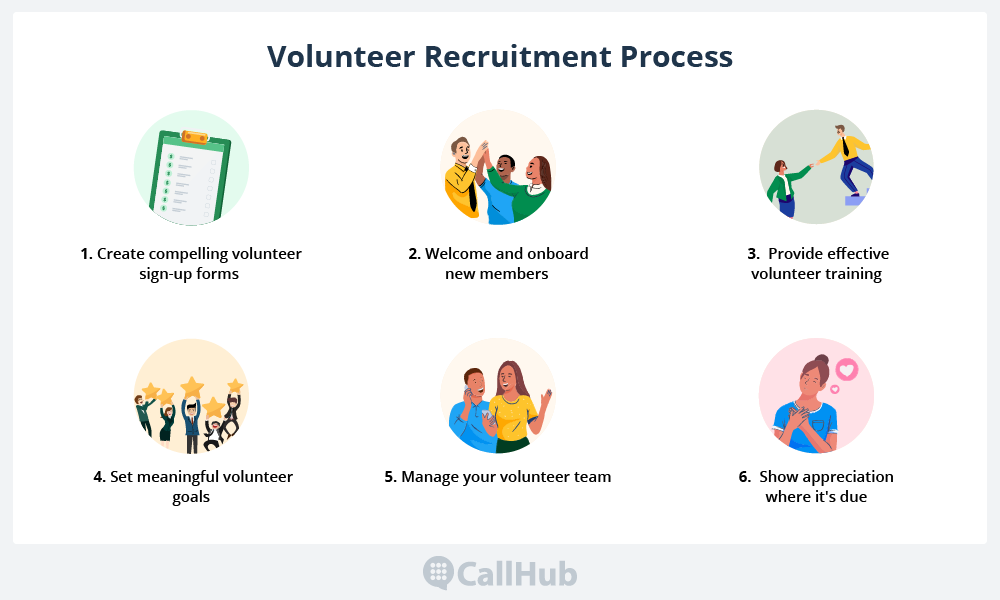
Once you have found and committed your phone banking volunteers, the following steps cover the operational side: getting them signed up, onboarded, trained on CallHub, goal-directed, and appropriately appreciated.
Step 1: Create a volunteer sign-up form
The journey of recruiting volunteers begins with a well-crafted volunteer sign-up form. This form serves as the gateway for potential volunteers to express their interest in joining your cause.
Mandatory fields for your volunteer sign-up form
To ensure you gather essential information from potential volunteers, include the following mandatory fields:
- First and last name.
- Email address and phone number.
- City or area (to match with local opportunities where applicable).
- Days and times when the volunteer is available.
- Skills, qualifications, and areas of interest.
- Preferred volunteer roles (provide a list).
- Emergency contact name and information.
For phone banking specifically, your sign-up form should also capture: availability by time of day (morning, afternoon, evening), whether the volunteer can host or join a virtual phone bank, and any prior phone banking experience. This lets you schedule your most experienced volunteers on your highest-priority calling windows and match new volunteers to shifts where support will be available.
Integration options for your volunteer sign-up form
To streamline volunteer recruitment and management, integrate your sign-up form with your CRM system.
Here’s how to create volunteer sign-up forms on NationBuilder:
- Log in to your NationBuilder.
- Navigate to the “Website” tab and select “New page.”
- Choose “Volunteer signup” as your page type and click “Create Page.”
- You’ll be directed to the Volunteer Settings > Basics page.
- Designate a point of contact for all new volunteer signups from the dropdown menu under Volunteer Settings > Basics.
- You will see fields for first name, last name, email address, and mobile phone number. Customize by adding fields for address, availability, and so on.
- Configure additional settings such as tags, roles, and confirmation emails.
- Save and publish the page.
- Share the link with potential volunteers.
Find out more: How to create a custom volunteer signup page on your website.
Additional CRM platforms commonly used in political and advocacy campaigns:
NGP VAN: Creating Online Action Forms
Salesforce Nonprofit Cloud: Customize the Volunteer Signup Page
Salsa: Create a Sign-up Form
If you do not use a specific CRM, you can link your sign-up form directly to your website. Most website builders and content management systems offer simple form integration.
Volunteer sign-up sites
General volunteer listing platforms can supplement your recruitment efforts, particularly for nonprofit and advocacy organizations. Sites like VolunteerMatch, Idealist, All for Good, DoSomething.org, HandsOn Network, Catchafire, Serve.gov, and AARP Create the Good are useful for skills-based and community volunteer roles. For political phone banking specifically, they deliver fewer qualified recruits than the campaign-specific channels covered above — Mobilize, VolunteerBlue, and party networks will produce more relevant applicants for phone bank shifts.
For a comprehensive list of volunteer management platforms, see: 23 Best Volunteer Management Software to Recruit and Organize Volunteers.
Step 2: Welcome new members and plan for onboarding
Welcoming new volunteers and onboarding them effectively is a crucial step in ensuring their engagement and long-term commitment. A well-structured onboarding process sets the stage for a successful volunteer experience.
During this phase, ensure that volunteers:
- Meet with a team leader or coordinator. Assign each new volunteer a team leader or mentor who can guide them through their initial experience. This connection provides support and helps volunteers feel integrated from day one.
- Complete orientation and basic training. Many volunteers are motivated by a deep conviction in the organization’s mission, making it a decisive factor for their involvement. Start with an orientation that introduces your mission, values, and culture, followed by basic training on role-specific skills and procedures.
- Participate in at least one activity or project. Research shows a connection between active participation and volunteers’ intention to continue. Encourage volunteers to join at least one shift or project as soon as possible after onboarding. Hands-on experience reinforces training and gives them an immediate sense of contribution.
- Log their volunteer hours accurately. Implement a clear, simple system for volunteers to record their hours. This helps you track contributions and understand availability patterns.
- Provide feedback through an engagement survey. Breitsohl and Ehrig (2017) found that insufficient engagement can lead to volunteer shortages and added burden on paid staff. Seek feedback regularly through short surveys to understand what is working and what is not.
Step 3: Train volunteers
Effective volunteer training is the cornerstone of a successful phone banking program. It gives volunteers the knowledge they need to perform their tasks confidently and produces better conversations with voters.
Here is what training should cover:
- Clearly outline role expectations, responsibilities, and tasks. Research shows that role clarity correlates with satisfaction and commitment among volunteers.
- Establish specific volunteer objectives. When volunteers have a sense of connection to the organization’s mission, they are more likely to stay involved longer.
- Familiarize volunteers with the tools and procedures they will use, including calling software, scripts, and communication platforms.
- Identify knowledge or skills gaps and provide targeted training to address them.
- Build in a framework for ongoing evaluation — training should not be a one-time event.
Training volunteers on CallHub
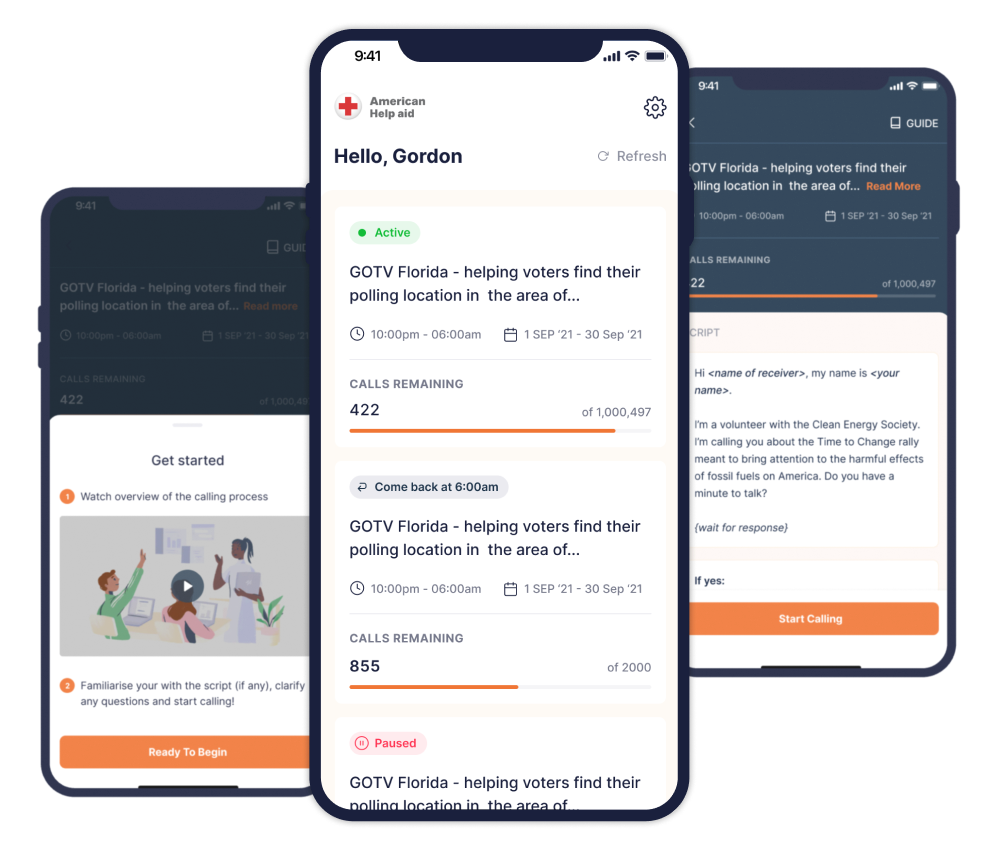
Platform navigation
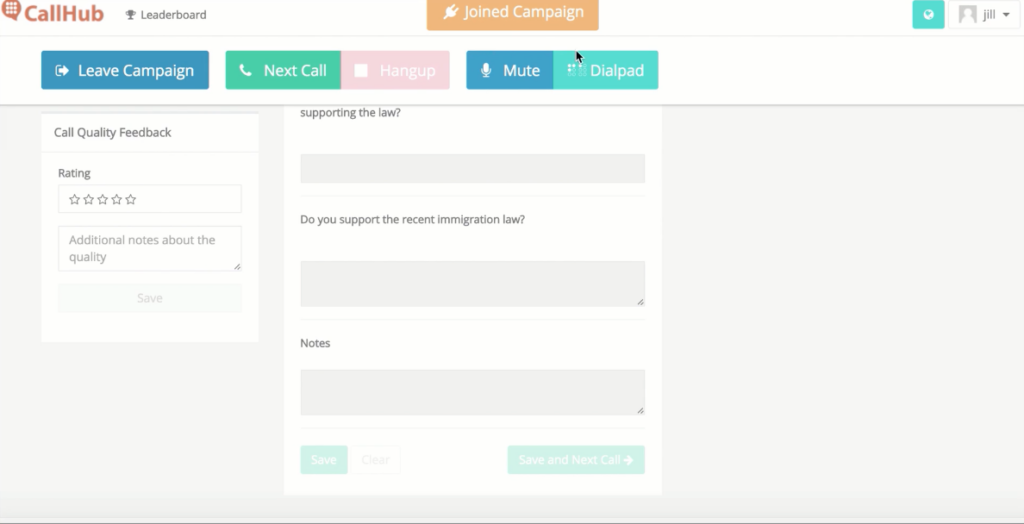
Ensure volunteers are comfortable navigating the CallHub platform and can find the campaigns assigned to them. Both the desktop app and the mobile app provide clear campaign dashboards once a volunteer logs in.
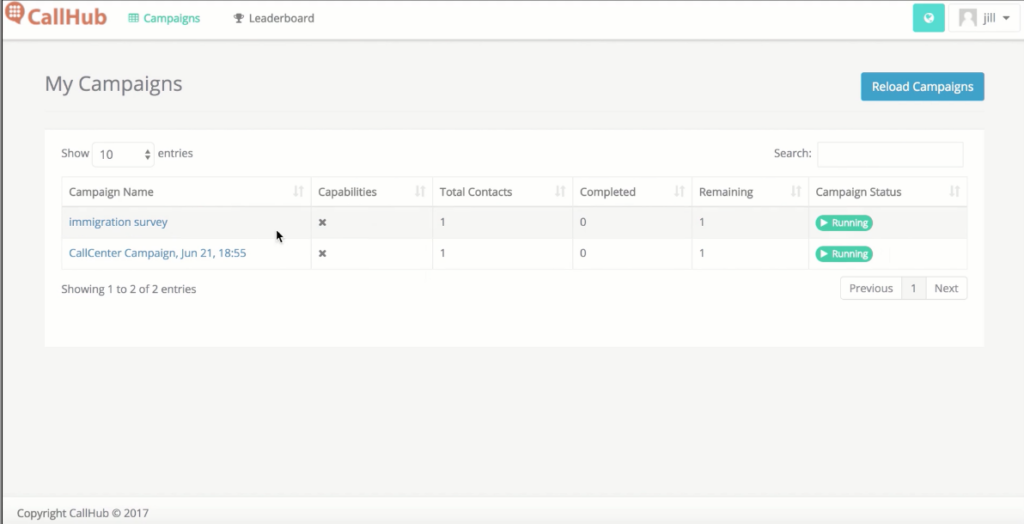
Desktop app view
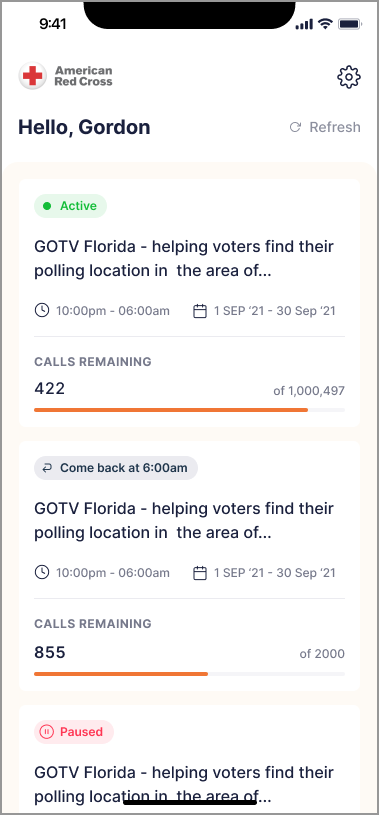
Mobile app view
Joining a calling campaign
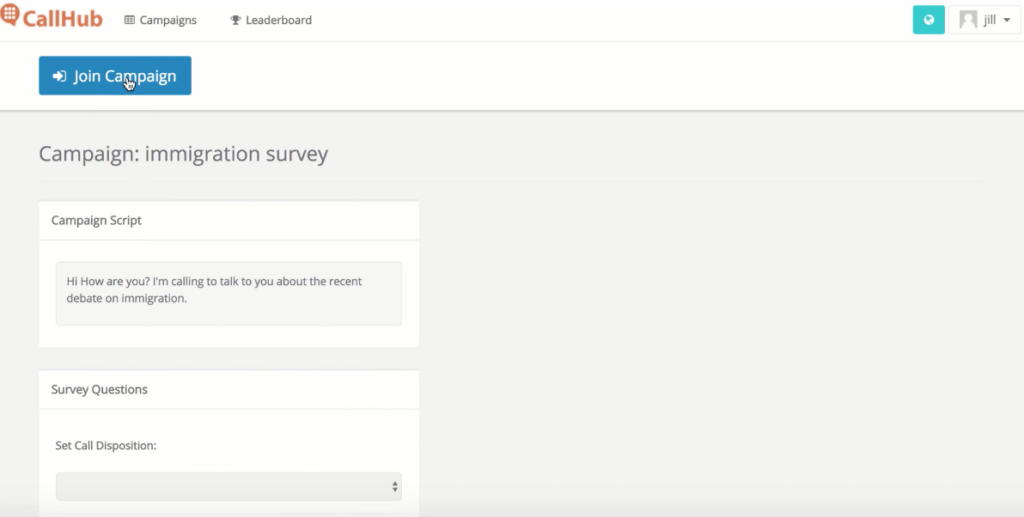
Volunteers click the “Join Campaign” button and then “Next Call” to start making calls. The Dialpad is available for entering extensions during calls.
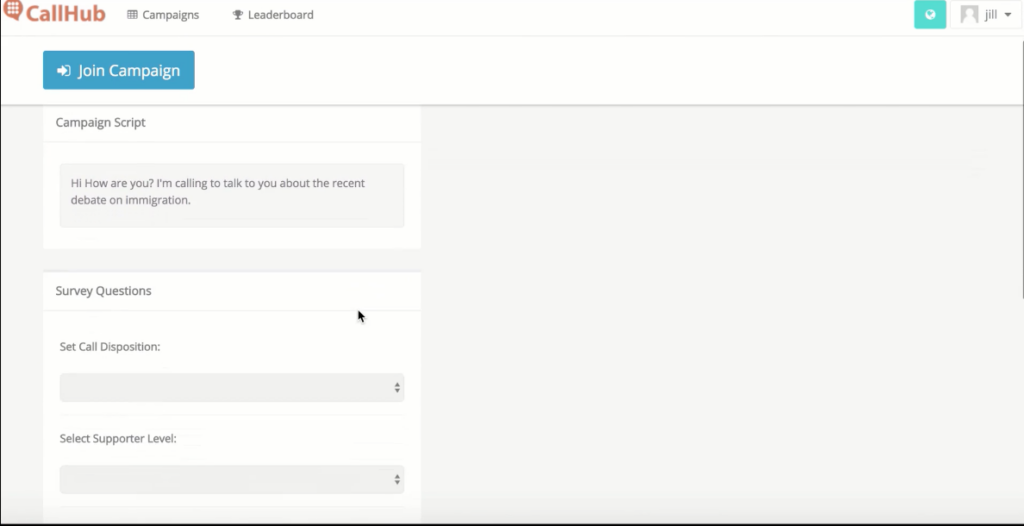
Desktop app view
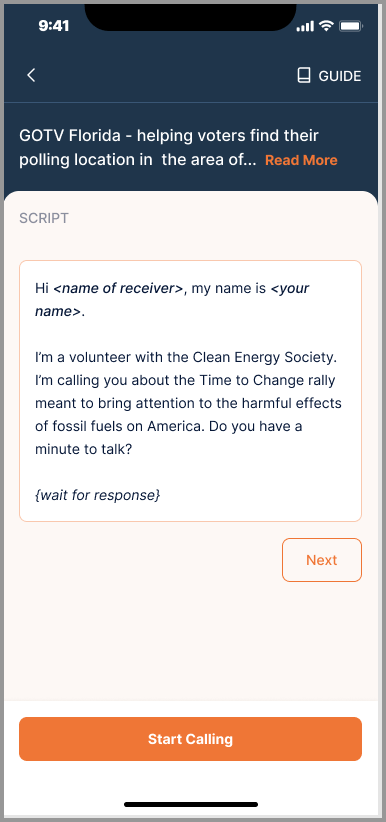
Mobile app view
Script navigation
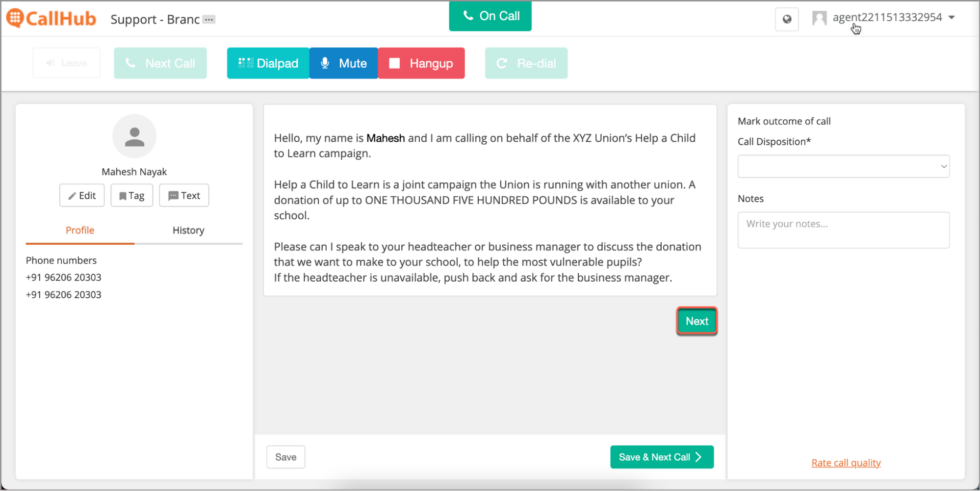
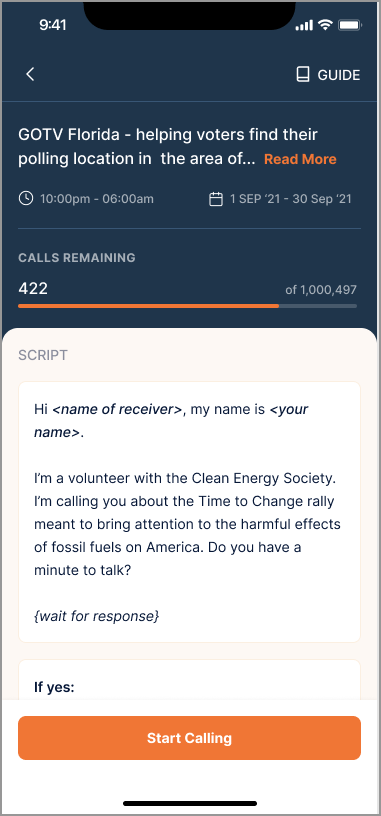
Volunteers access scripts from within the active campaign view. For branching scripts, they use the “Next” button to navigate to the appropriate script branch based on the contact’s response.
Desktop app view
Mobile app view
Recording survey responses
During surveys, volunteers choose the appropriate response based on what the contact says. If a contact prefers not to answer, volunteers can click “Skip” and the system advances to the End Call script.
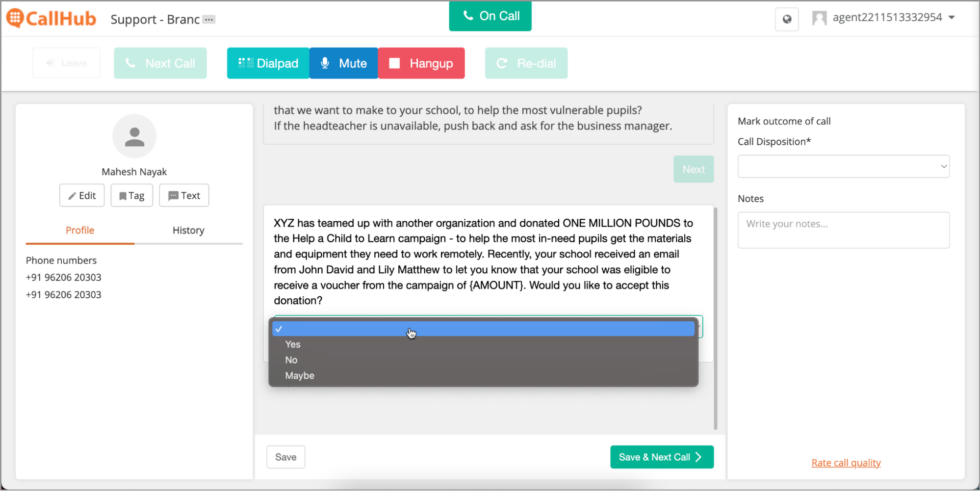
Desktop app view
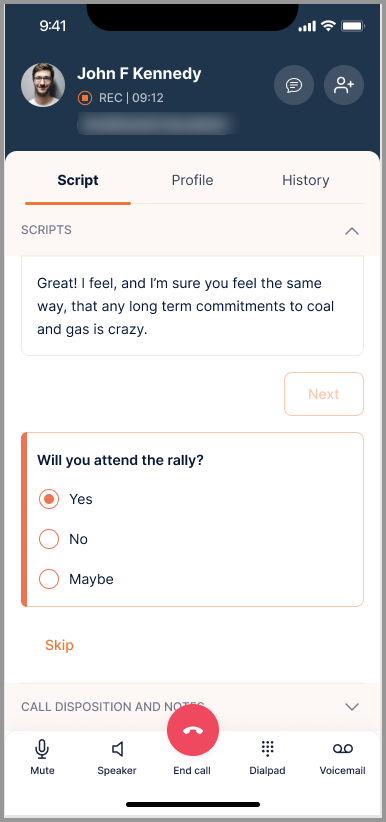
Mobile app view
Using call dispositions and notes
Volunteers record the appropriate call disposition and enter relevant notes to update the contact profile after each conversation. This is how call data compounds into campaign intelligence.
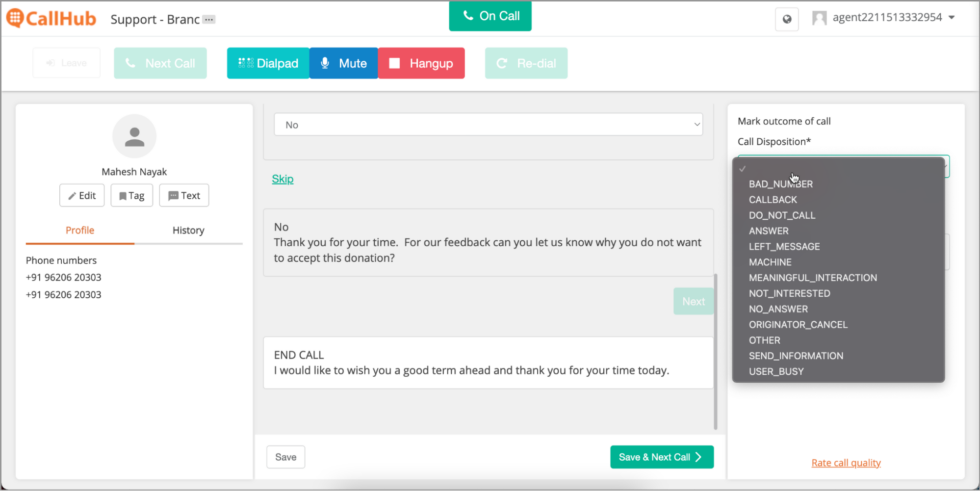
Desktop app view
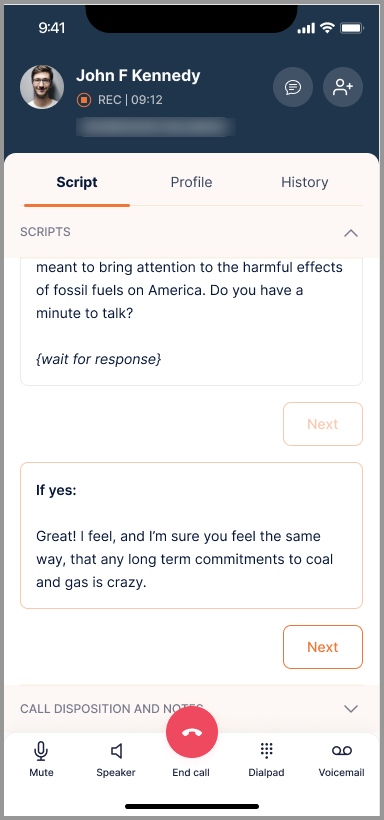
Mobile app view
Saving call details
Volunteers can select “Save” to exit the campaign or “Save and Next” to save the current call and proceed to the next one. For Auto Dialer and Predictive Dialer, the option is “Save and Leave.”
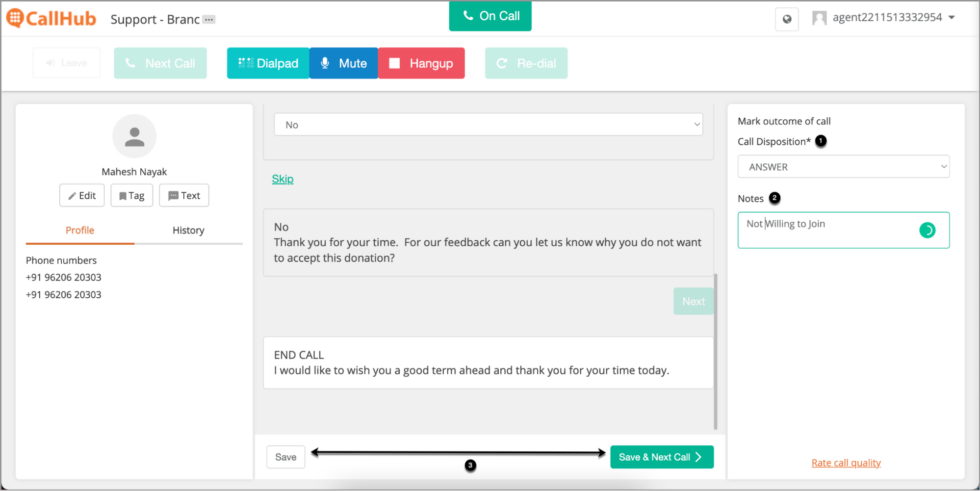
Desktop app view
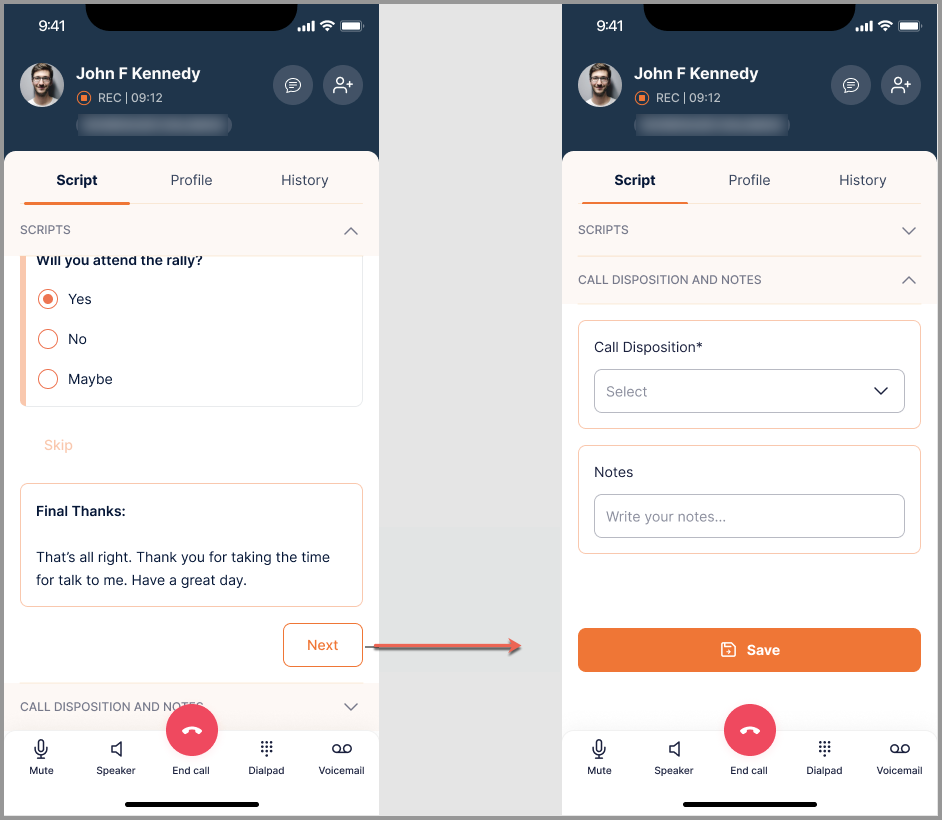
Mobile app view
Answering incoming calls
Incoming calls are marked with an “Incoming Call” label on the agent console. If a volunteer misses an incoming call, the system waits for the campaign’s designated hold time before disconnecting, then requeues the contact and dials again once an agent is available. This is displayed as an “Automated Callback.”
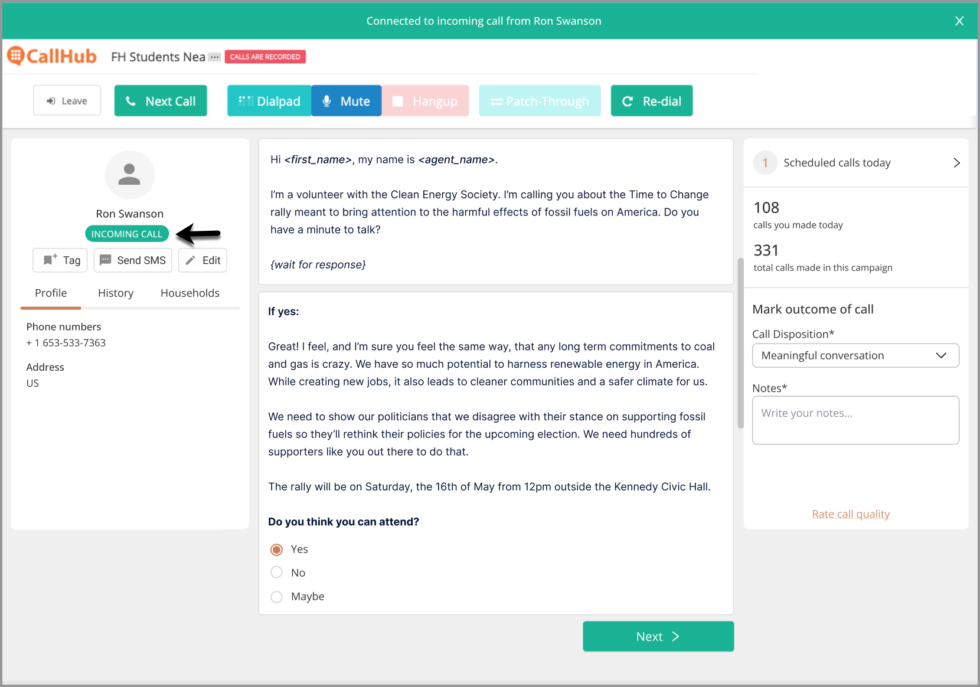
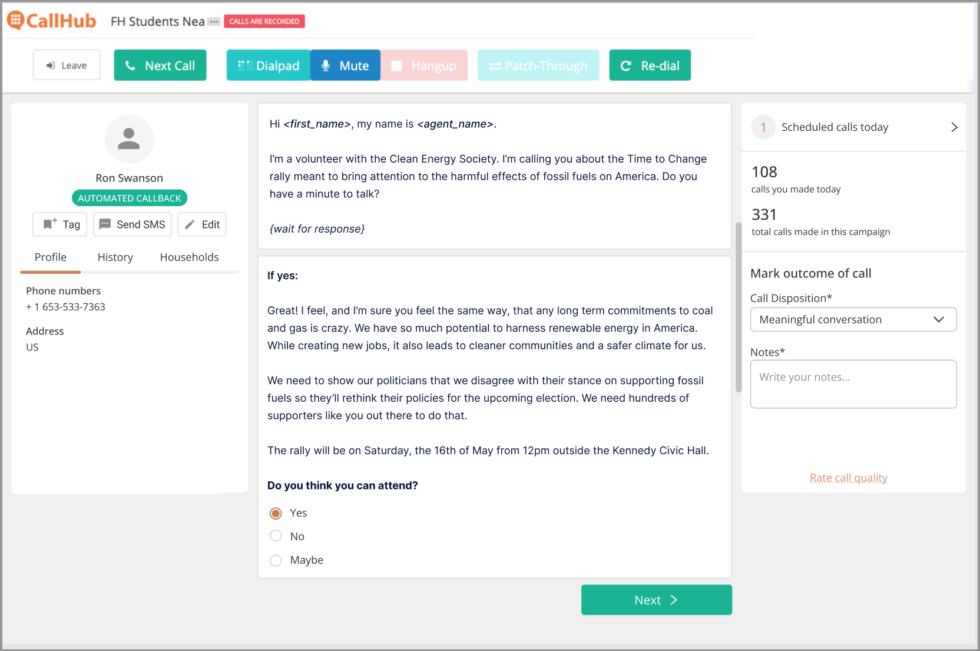
Redialing a contact
If a call is unexpectedly disconnected, volunteers can reconnect using the Re-dial button.

Scheduling a callback
When a contact requests a call at a later time, volunteers can schedule a callback by specifying date, time, and timezone. The system initiates the call automatically at the scheduled time.
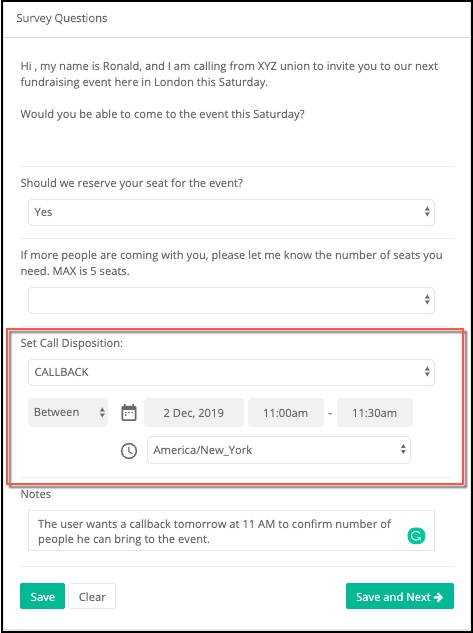
Desktop app view
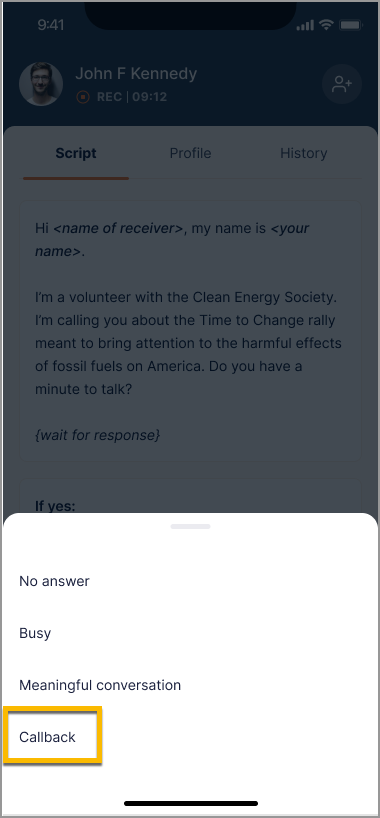
Mobile app view
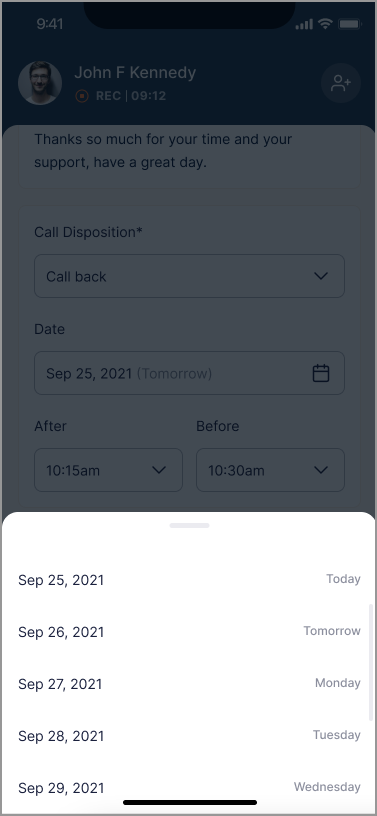
Mobile app view
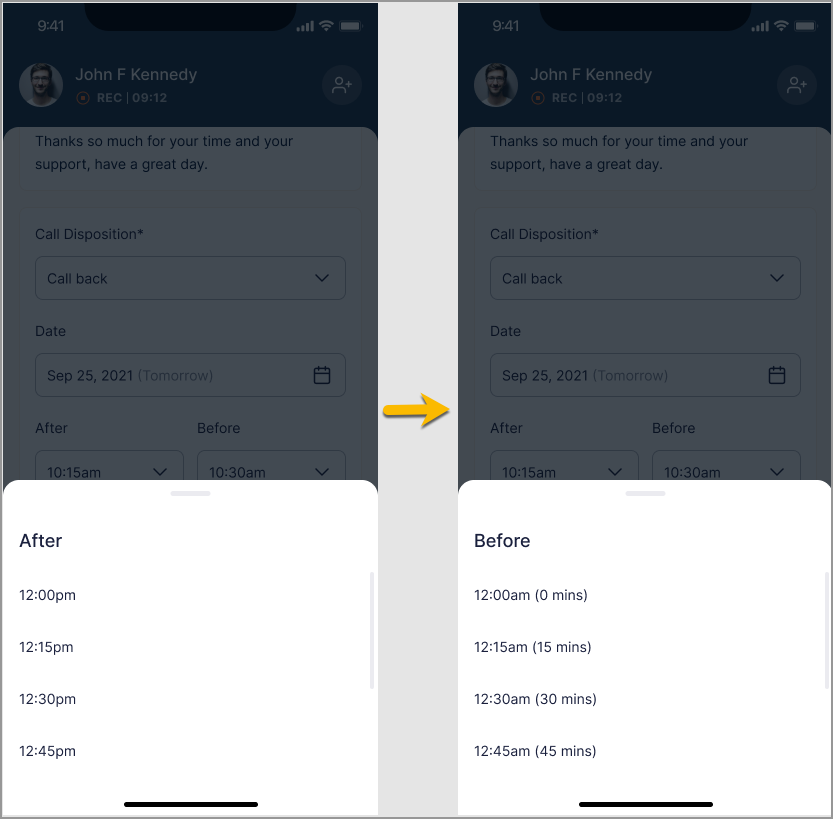
Mobile app view
Editing contact details
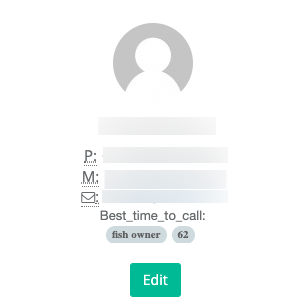
The “Edit Contact” feature allows volunteers to update contact information during a call. This feature is enabled through the campaign’s privacy settings.
Tagging contacts
In a Call Center campaign, volunteers apply tags by clicking the “+Tag” option under the contact’s name.
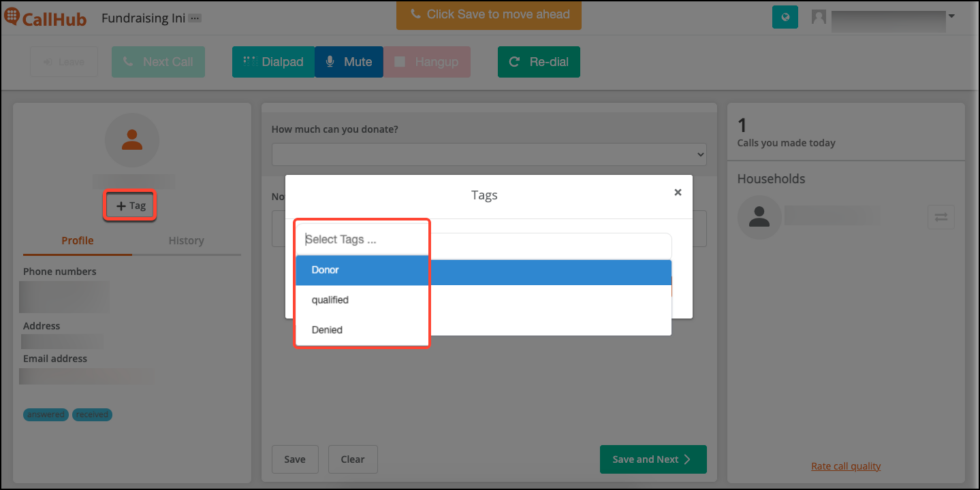
Desktop app view
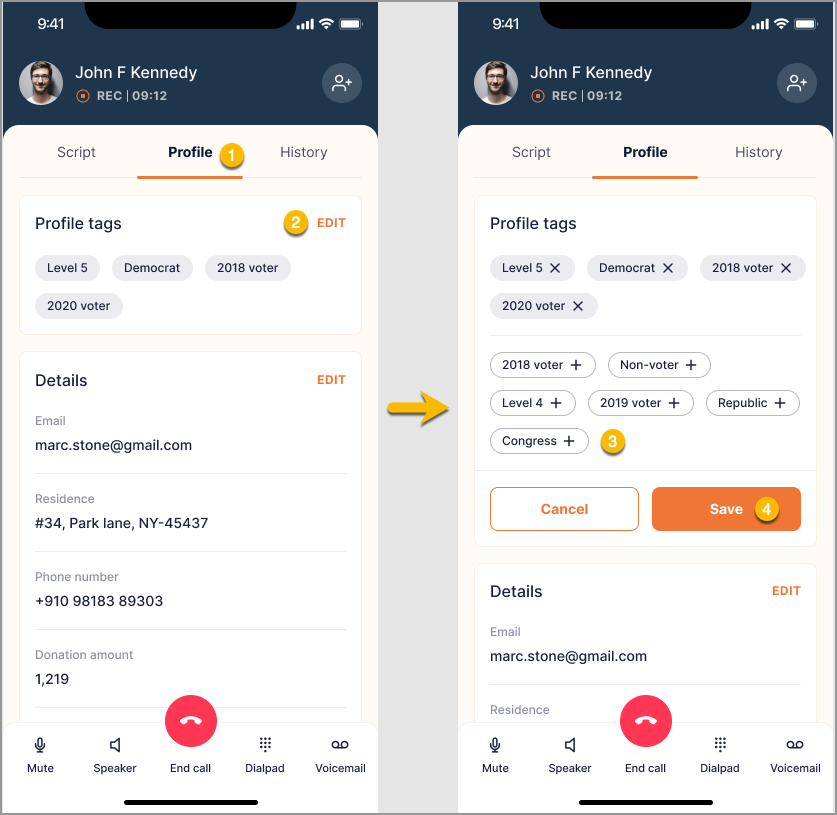
Mobile app view
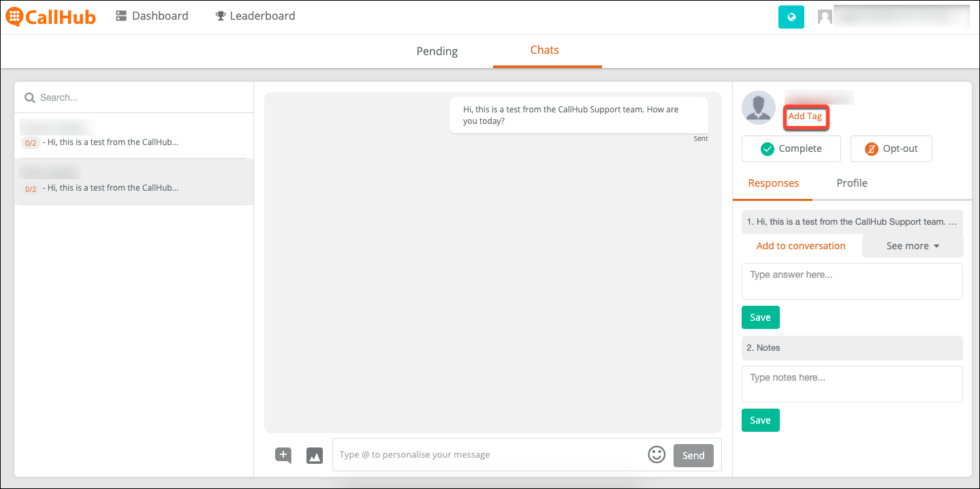
In a Peer to Peer Texting campaign, tags are added from the upper right corner.
Sending messages from a call center campaign
During an ongoing call, volunteers click the “SMS” button to send a message to the contact. They can choose from predefined templates or compose their own message, and personalize using merge tags from the “Personalize” feature.
Patching through calls
For a patch-through calling campaign, your volunteer will see the label ‘Transfers enabled’ next to the campaign name once they join the campaign.
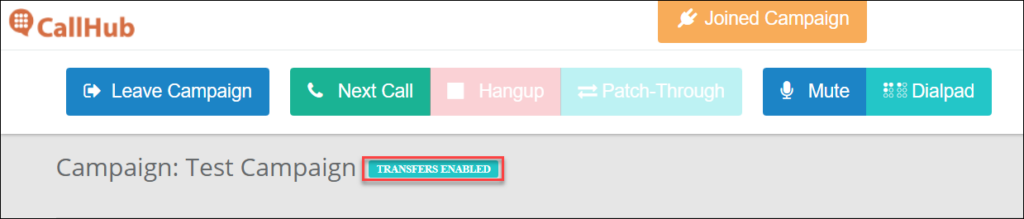
Once the volunteer has initiated calls, the patch-through option becomes available, allowing them to transfer calls.
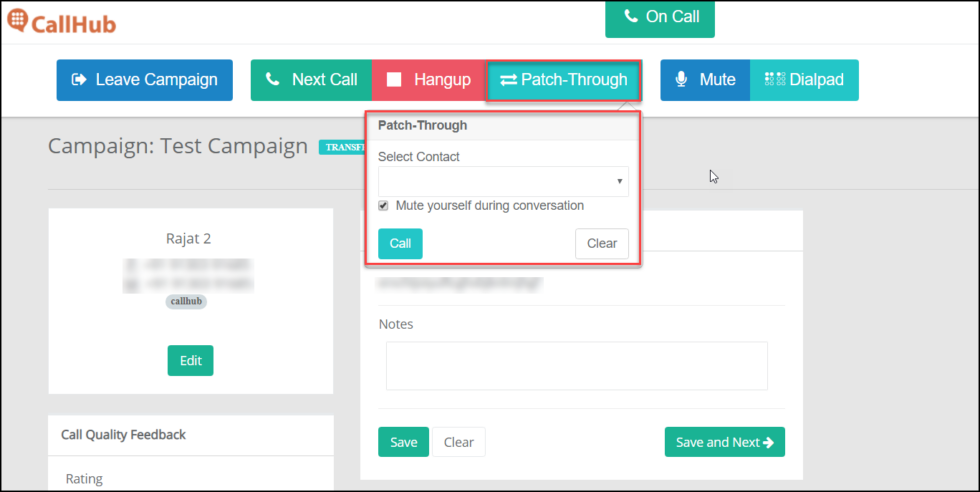
Desktop app view
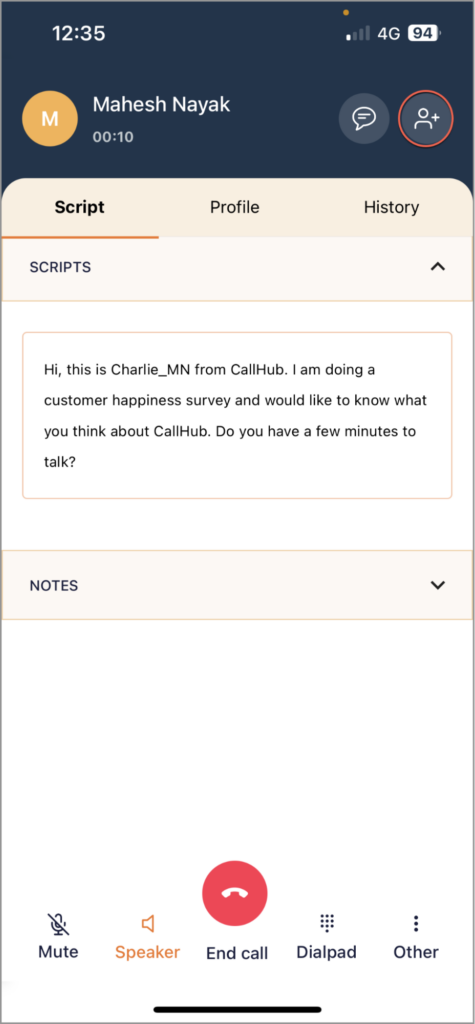
Mobile app view
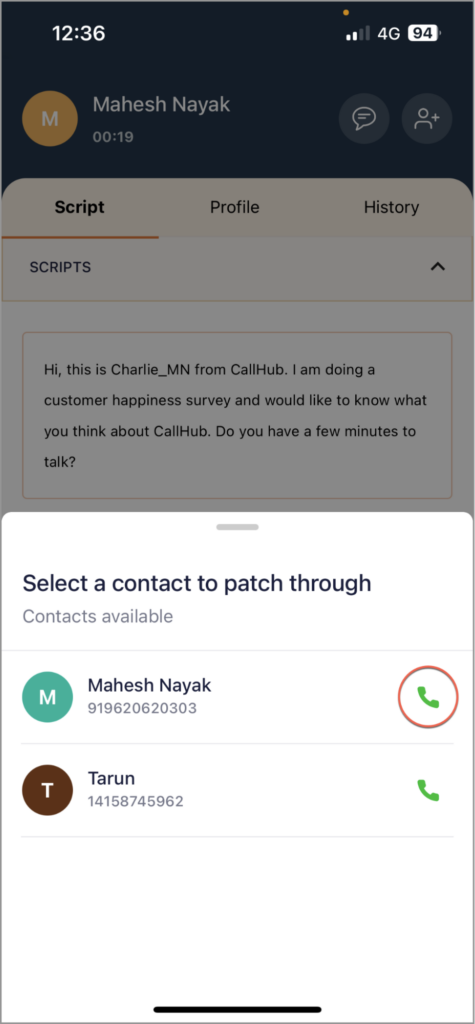
Mobile app view
Calling on a TCPA Dialer
TCPA Dialer campaigns assign two distinct roles: the Talker Agent, who engages in conversations with contacts, and the Clicker Agent, who clicks contact cards to add them to the calling queue.
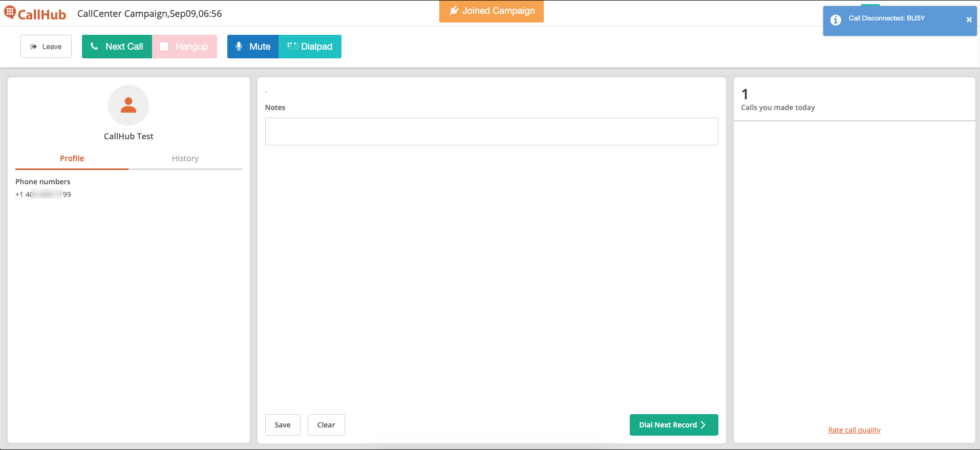
Talker Agent
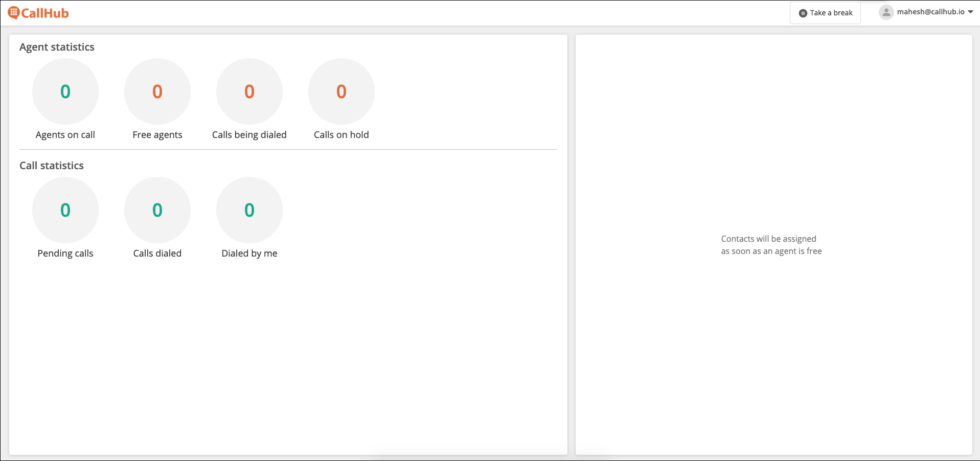
Clicker Agent
Joining a Peer to Peer Texting campaign
Volunteers log in and click “JOIN,” then select “Start Texting.” They initially receive 100 contacts under the Pending tab. Once the first message is sent to these contacts, another batch of 100 is assigned automatically.
Joining a Relational Organizing campaign
Volunteers tap the Relational Organizing campaign card in the CallHub Mobile App. The system guides them through building their network by cross-referencing their phone’s contact list with the campaign. Volunteers can then reach out via Message, Call, or Share.
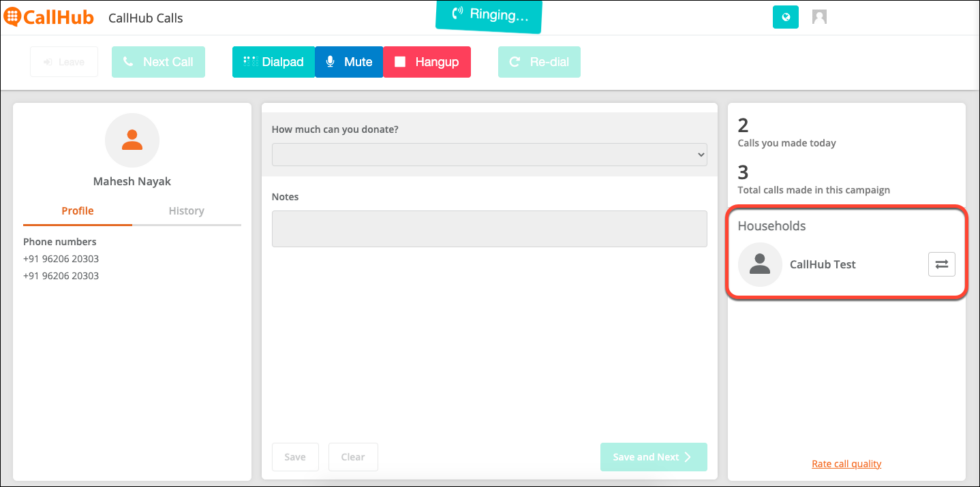
Contacting household members
When a volunteer reaches a household member during a call, CallHub lets them record survey responses, disposition details, and notes for each individual in the household.
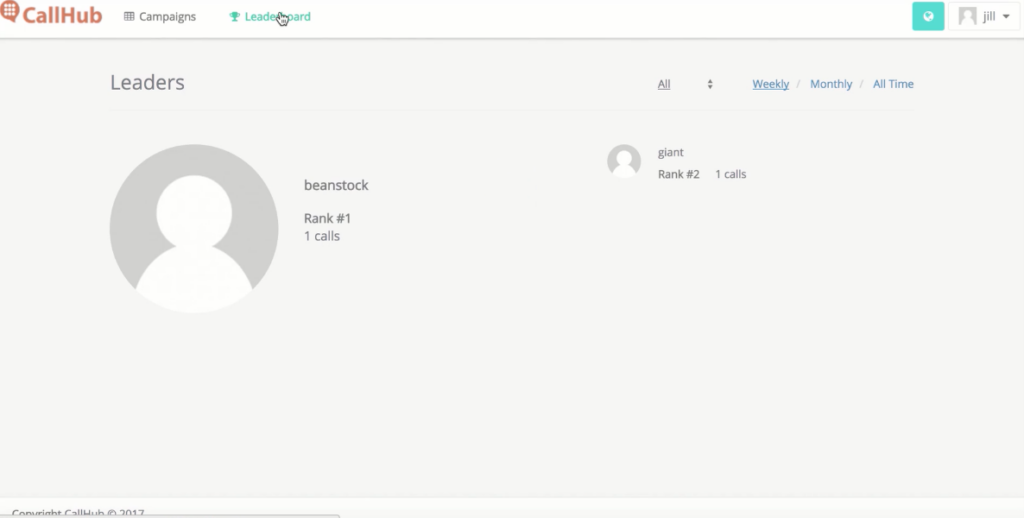
Accessing campaign leaderboards
Volunteers can view leaderboard rankings based on calls made, which adds a visible performance dimension to each shift.
Step 4: Set volunteer goals
Clear volunteer goals align individual effort with campaign objectives and give volunteers a concrete sense of what a good shift looks like.
Setting volunteer goals
- Align with campaign objectives. Every volunteer goal should connect to a larger campaign milestone — voter contacts, IDs banked, events filled.
- Be specific and measurable. Concrete targets are easier to track and more motivating than vague ones. “Make 40 calls this shift” is more useful than “try your best.”
- Consider individual skills. Hustinx (2010) found that matching volunteers to tasks that align with their abilities improves both confidence and satisfaction. Experienced phone bankers can carry higher per-shift targets than new volunteers.
- Set a timeframe. Goals without deadlines drift. Time-bound targets create productive urgency.
Examples of phone banking volunteer goals
- Make 40 voter contacts in a 3-hour shift.
- Complete 500 calls across a week-long GOTV sprint.
- Reach 80% of the assigned contact list before the campaign’s voter ID deadline.
Communicating goals during recruitment and onboarding
- Include specific goals in your recruitment materials so potential volunteers understand the commitment they are making.
- During the initial conversation or interview, explain how the volunteer’s specific role contributes to the campaign’s goals.
- Dedicate part of the orientation to goal setting — explain the significance and how individual contributions add up.
- Integrate goal-related content into the shift briefing and use regular updates to track progress and celebrate milestones.
Step 5: Manage volunteers
Monitoring volunteer progress
Consistent tracking helps you identify which volunteers need support and which are ready for more responsibility.
- Agent reporting. Use CallHub’s agent reporting tools to track calls made, contact rates, and survey completions per volunteer. These reports surface both top performers and volunteers who may need additional coaching.
- Regular check-ins. Schedule brief one-on-one or small group check-ins to discuss progress, address challenges, and provide feedback.
- Feedback loops. Create channels for volunteers to share what is and is not working. This surfaces problems early and builds investment in the program.
- Tailored training. When a gap appears in a volunteer’s performance, address it with targeted coaching rather than a generic retraining session.
- Role reassignment. Research shows that volunteers who remain committed tend to have personally meaningful motives, including skill development. If a volunteer is consistently struggling despite support, reassign them to a role that better matches their strengths.
Managing a surplus of volunteers
- Create additional shifts or roles to absorb the extra capacity.
- Implement rotation schedules so all volunteers get active time without burning out.
- Offer engagement opportunities between shifts: training, planning sessions, or recruitment activities.
Managing volunteer scarcity
- Prioritize your calling windows. When volunteer hours are limited, concentrate them on your highest-priority contact lists.
- Reach out through the seven sources listed at the top of this article, with a specific ask for the next available shift.
- Offer micro-shifts to expand who can participate given time constraints.
- Streamline your campaign setup to maximize contact output per volunteer hour.
Step 6: Appreciate volunteers
Recognizing and appreciating volunteers is fundamental to retention and morale.
The value of volunteer time
The current estimated national value of each volunteer hour is $33.49 (Independent Sector, 2025). A 3-hour phone bank shift from a single volunteer represents over $100 in contributed value to your campaign. Acknowledge that.
Showing appreciation is not just a courtesy — it is a retention strategy. Volunteers who feel genuinely seen are more likely to return, recruit others, and deepen their commitment over time.
When to appreciate volunteers
- Upon onboarding. A warm welcome at the outset sets the tone. A simple personal thank-you when someone shows up for their first shift matters.
- After significant contributions. Recognize volunteers when they hit milestones — a certain number of shifts, a high contact total, or a particularly strong GOTV week.
- Regularly and unexpectedly. Appreciation does not require a special occasion. Unexpected acknowledgment often lands harder than scheduled recognition.
How to appreciate volunteers
- Personalized thank-you notes or emails that reference what the volunteer specifically did.
- Public recognition on social media, newsletters, or campaign updates (with the volunteer’s permission).
- Volunteer awards or certificates for outstanding service.
- Small tokens of appreciation — branded merchandise, gift cards, or event access.
- Verbal acknowledgment during shift briefings and debrief conversations.
- Involvement in planning or feedback sessions, which signals that their experience and judgment are valued.
For in-depth guidance, see: Volunteer appreciation strategies.
Wrapping up
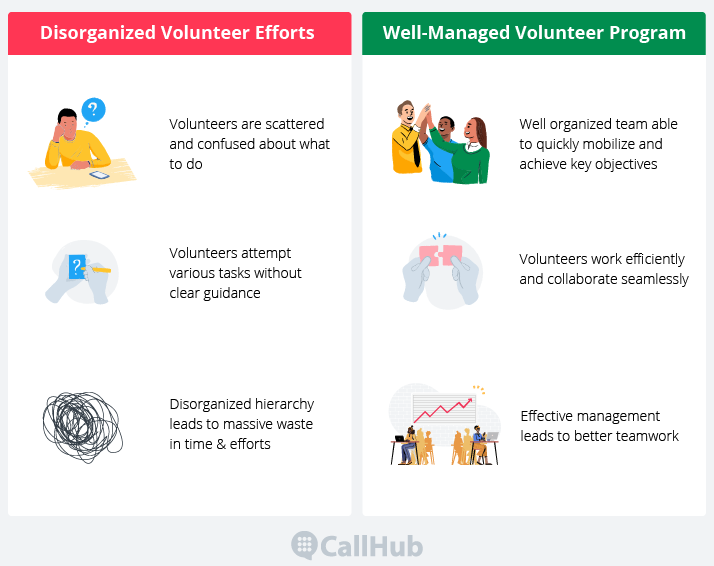
The campaigns that build strong phone banking teams do three things consistently: they ask specifically (a named shift, not vague availability), they brief honestly (contact rates are low, some voters will be rude, that is normal), and they get the re-sign-up before the first shift ends.
Everything else — sign-up forms, onboarding, CallHub training, goal-setting, appreciation — supports those three foundations. Get the recruitment and the first-shift experience right, and retention follows.
Use CallHub’s phone banking software to assign shifts, track call counts per volunteer, trigger post-shift thank-you texts automatically, and build the leaderboard visibility that keeps your best callers coming back.
Frequently asked questions
How do I get volunteers to phone bank for my campaign?
Start with your warmest audience: existing donors, event attendees, and petition signers. Ask them specifically, naming a date, time, and shift length. Use Mobilize, party organization networks, and college political groups for colder outreach. The most important thing is to ask for a specific shift, not vague availability, and to get a commitment before the conversation ends.
Where can I find political campaign volunteers for phone banking?
The most productive sources for phone banking volunteers are: your existing supporter list, party organization networks, Mobilize and VolunteerBlue, college and university political groups, relational organizing through current volunteers, social media (Facebook groups, Instagram, NextDoor), and phone banking outreach to past event attendees. General volunteer listing sites like VolunteerMatch are better suited to nonprofit and skills-based roles than political phone banking.
What do you say when recruiting phone banking volunteers?
Name a specific shift and make a specific ask: “We have a phone bank on Saturday from 10am to 1pm. Can you join us?” Provide a concrete picture of the experience — duration, method, script provided. Have ready responses for “maybe” (offer an alternative shift) and “no” (send the sign-up link for future reference). Get them to the sign-up form before the conversation ends.
How many volunteers do I need to run a phone bank?
A phone bank with 10 to 15 volunteers using a power dialer can typically make 300 to 500 voter contacts in a 3-hour shift. Smaller sessions of 3 to 5 volunteers can produce 75 to 150 contacts. The right number depends on your contact goals and the size of your list. For GOTV sprints, more volunteers across more shifts generally outperforms a single large session.
What should I tell new phone banking volunteers to expect?
Tell them: contact rates on typical lists run 10 to 20% of dials, most calls will go unanswered, a good shift is 2 to 3 hours with a target of 30 to 50 conversations, some voters will be rude and that is normal, the script is a guide not a script they must recite, and their call dispositions and notes directly shape the campaign’s targeting. Volunteers who are briefed honestly retain at far higher rates than those who encounter these realities without preparation.
Can I recruit volunteers remotely for phone banking?
Yes, and remote phone banking significantly expands your volunteer pool. Volunteers can participate from home using the CallHub desktop or mobile app with just a phone and a laptop. Posting remote-friendly shifts on Mobilize and explicitly labeling them “work from home” in your outreach typically increases sign-up rates compared to in-person-only sessions. Virtual phone banks also let you recruit from outside your immediate geography, which matters for district-specific campaign targets.
How do I keep phone banking volunteers coming back?
Get the re-sign-up before the first shift ends. Offer micro-shifts (45 to 60 minutes) for supporters who cannot commit to longer sessions. Build a ladder of engagement so experienced callers can become shift leads and then hosts. Send a thank-you text or email within 24 hours of every shift, specific to what the volunteer did. Share weekly impact numbers so volunteers can see how their hours are adding up across the team.
What is the best platform to recruit political campaign volunteers?
Mobilize is the most widely used platform for progressive campaign volunteer recruitment in the US. VolunteerBlue serves a similar function for Democratic campaigns. For Republican campaigns, party organization networks and direct outreach typically perform better than any third-party platform. CallHub’s relational organizing feature lets current volunteers recruit from their personal networks directly through the app.
How do I write a volunteer recruitment message for phone banking?
Be specific: name the date, time, and duration. Describe what the volunteer will do in one sentence. Remove friction: “script provided,” “can be done from home,” “no experience needed.” Close with a link to the sign-up form. Keep texts under 160 characters if possible. For email, use a subject line that names the specific shift date rather than a generic “volunteer with us” frame.
Read also: