


Table of Contents
The biggest challenge with a voter identification script is getting people to stay on the call long enough to answer honestly.
Ask too much, and voters hang up. Ask too little, and your campaign does not have the data it needs to decide who should get persuasion, GOTV, volunteer, or donor follow-up.
A strong voter identification script helps volunteers do three things: start the call clearly, ask the right support question, and record the answer in a way the campaign can use later.
This guide gives you ready-to-use voter identification scripts for phone banking, plus guidance on supporter scoring, call outcomes, follow-up strategy, and branching scripts.
What is a voter identification call?
A voter identification call is a campaign phone call used to find out where a voter stands.
The goal is not to persuade every voter on the first call. The goal is to sort the list so the campaign knows what to do next.
A voter ID call usually helps you identify:
- Strong supporters
- Leaning supporters
- Undecided voters
- Leaning opponents
- Strong opponents
- Potential volunteers
- Potential donors
- Yard sign hosts
- Voters who need more information
- Voters who should not be called again
This is why voter identification happens before persuasion and GOTV. You need to know who supports you before you can turn them out. You need to know who is undecided before you can persuade them.
For the full campaign setup, use this political phone banking guide. For broader script examples, use this phone banking script guide.
What should a voter ID script collect?
A voter ID script should collect enough information to guide the next campaign action, but not so much that the call feels like an interrogation.
At minimum, collect:
| Data point | Why it matters |
| Correct contact | Confirms whether the campaign reached the right person |
| Support level | Shows whether the voter supports, opposes, or is undecided |
| Top issue | Helps guide persuasion, emails, texts, and future calls |
| Volunteer interest | Identifies people who can help the campaign |
| Donation interest | Identifies warm fundraising prospects |
| Yard sign interest | Finds visible supporters in the district |
| Preferred follow-up | Shows whether text, email, or phone is best |
| Do-not-call request | Prevents unwanted future calls |
Keep the call focused. If the person is clearly undecided, do not turn the call into a fundraising ask. If they oppose you, thank them and close. If they support you, move them into the right next step.
How to use the 1-5 voter support scale
Many campaigns use a 1-5 scale to record voter support.
This scale turns a conversation into campaign data.
| Score | Meaning | What to do next |
| 1 | Strong supporter | Move to GOTV, volunteer ask, donor ask, or yard sign ask |
| 2 | Leaning supporter | Send issue follow-up, then move toward GOTV |
| 3 | Undecided | Add to persuasion universe |
| 4 | Leaning opponent | Record top concern, avoid high-frequency follow-up |
| 5 | Strong opponent | Stop persuasion unless campaign has a specific reason |
The important part is consistency. Every volunteer should understand what each number means before the shift starts.
Do not mark someone as “do not call” just because they support another candidate. Use “do not call” only when the person asks not to receive calls again or your campaign rules require suppression.
Voter identification script: example 1
Use this script when you want a detailed voter ID conversation that can identify supporters, donors, volunteers, yard sign hosts, and undecided voters.
Opening
“Hi, I’m {volunteer_name}, and I’m calling on behalf of {party_name}. Am I speaking with {contact_name}?”
If unavailable:
Mark as not home, moved, unreachable, or wrong number.
If they refuse to talk:
Mark as refused.
If it is {contact_name}, continue.
“Hi, {contact_name}. I hope you are doing well. I’ll only take a few minutes. We’re calling voters to understand where they stand before the upcoming election.”
If they agree, continue.
If they do not agree, thank them and mark the correct outcome.
Question 1: Identify the issue
“I’d like to understand the issues that are important to you. Which of these are you most concerned about?”
Options:
- [Issue 1]
- [Issue 2]
- [Issue 3]
- [Issue 4]
- Something else
Record the response.
If they choose an issue, ask a follow-up question around that issue.
“Thanks for sharing that. How concerned are you about [Issue], and what would you like to see done about it?”
Record the response.
Pro tip: Have short, approved answers ready for common concerns and policy questions. Volunteers should not guess if they do not know the answer.
Question 2: Understand past support
“In the previous {election_type}, which party or candidate did you support?”
Record the party or candidate code if your campaign uses one.
Then ask:
“The {election_type} is {no_of_days} away. Has your support changed since your last vote?”
If they support your party or candidate, continue to supporter follow-up.
If they are undecided, move them to persuasion follow-up.
If they support another party or candidate, record the correct opposition score and close politely.
Supporter follow-up
“That’s good to know, {contact_name}. We’ll need every vote to win this election. Can we count on your support for {candidate_name}?”
If yes:
Mark as strong supporter or leaning supporter based on the conversation.
Then ask one next-step question.
Donation ask:
“Would you consider donating {donation_amount} to help us reach more voters on [Issue]?”
If yes:
“Thank you, {contact_name}. I’ll send you the donation link right away. We’ll keep you updated on [Issue].”
Volunteer ask:
“Would you be interested in volunteering with the campaign?”
If yes:
“Great. What kind of activities would you be interested in?”
Options:
- Direct mail
- Email or texting
- Door-to-door canvassing
- Phone banking
- Poll watching
- Admin
- Other
Record the response.
Yard sign ask:
“Would you be interested in displaying a yard sign?”
If yes:
“Great. I’ll send you the details after this call.”
Undecided voter follow-up
If the voter is undecided:
“I understand. This is an important decision. What issue would you need more information on before deciding?”
Record the issue.
Then close with:
“Thanks for sharing that. I’ll mark this so the campaign can follow up with information on [Issue].”
Do not push too hard on this first call. The goal is to move the voter into a persuasion path.
For persuasion follow-up, use this voter persuasion call guide.
Opposed voter follow-up
If the voter supports another candidate or party:
“Thanks for letting me know. I appreciate your time.”
Record the correct support score.
If they ask not to be called again:
“Understood. I’ll mark that now.”
Then mark do not call based on your campaign’s process.
Closing
Use one of these closing lines.
Supporter:
“Thanks for your support, {contact_name}. I’ll send the follow-up information shortly.”
Undecided:
“Thanks for sharing your thoughts. We’ll send more information on [Issue].”
Opponent:
“Thanks for your time. Have a good day.”
Do-not-call request:
“Understood. I’ll mark that now. Thanks for your time.”
Voter identification script: example 2
Use this shorter script when you want a faster phone bank that identifies issue interest, support level, and follow-up needs.
Opening
“Hi, I’m {volunteer_name}, and I’m calling on behalf of {party_name}. Am I speaking with {contact_name}?”
If unavailable, mark as not home, moved, unreachable, or wrong number.
If they refuse to talk, mark as refused.
If it is {contact_name}, continue.
“Hi, {contact_name}. I’ll only take a few minutes. We’re calling voters in your area to understand what issues matter most before the upcoming election.”
Main issue question
“Which of these issues are you most concerned about?”
Options:
- [Issue 1]
- [Issue 2]
- [Issue 3]
- [Issue 4]
- Something else
Record the response.
Then ask:
“How concerned are you about [Issue], and what would you like to see done about it?”
Record the response.
Support question
“In the previous {election_type}, which party or candidate did you support?”
Record the party or candidate code.
Then ask:
“The {election_type} is {no_of_days} away. Has your support changed since your last vote?”
If they support your party or candidate:
“Thank you. Would you be open to helping the campaign by donating, volunteering, or displaying a yard sign?”
If they support another party or candidate:
“Thanks for letting me know. I’ll update our list.”
If they are undecided:
“Thanks for being open. What information would help you make a decision?”
Record the answer and move them to the nurturing or persuasion list.
Follow-up prompt
If the voter wants more information:
“I can send that by text or email. Which works better for you?”
If your software allows texting from the calling interface, send the follow-up while the voter is still engaged.
What volunteers should record:
- Support score
- Top issue
- Donation interest
- Volunteer interest
- Yard sign interest
- Wants issue information
- Prefers text
- Prefers email
- Needs follow-up
- Wrong number
- Do not call
Pro tip: Your follow-up campaigns depend on your voter ID answers. Supporters need encouragement and help to vote on Election Day. Undecided voters need persuasion before GOTV. Opponents should not keep receiving persuasion calls unless your campaign has a specific reason.
What questions should you ask in a voter ID call?
A voter ID call should ask only the questions your campaign can act on.
Use these as a starting point.
| Question | Use it when | What it tells you |
| “Can we count on your support?” | Any voter ID campaign | Support level |
| “Which issue matters most to you?” | Persuasion planning | Issue priority |
| “Have you voted in past local elections?” | Local or primary campaigns | Turnout likelihood |
| “Would you like more information?” | Undecided voter follow-up | Nurture path |
| “Would you like to volunteer?” | Supporter follow-up | Volunteer potential |
| “Would you display a yard sign?” | Supporter visibility | Public support |
| “Can we send you updates by text or email?” | Follow-up planning | Preferred channel |
| “Do you have any questions for the campaign?” | Undecided or soft supporter calls | Objections and concerns |
Do not ask all of these in one call. Pick the questions that match your campaign stage.
Early campaign calls can ask more about issue priority. Late campaign calls should focus more on support level and follow-up action.
How to build branching voter identification scripts
Branching scripts help volunteers move through a voter ID call without scrolling through long paragraphs.
A branching voter identification script starts with one main question, then changes based on the voter’s answer.
Example:
| Main question | Voter answer | Next path |
| “Can we count on your support?” | Yes | Ask volunteer, donation, yard sign, or vote plan question |
| “Can we count on your support?” | Undecided | Ask top issue and offer follow-up information |
| “Can we count on your support?” | No | Thank them and close |
| “Can we count on your support?” | Wrong number | Mark wrong number |
| “Can we count on your support?” | Do not call | Mark do not call and close |
Branching scripts are useful because they keep the conversation short and relevant.
A supporter should not hear the same script as an undecided voter. An opponent should not be pushed through a volunteer ask. A do-not-call request should immediately end the outreach path.
CallHub’s Branching Scripts feature can display the right question or answer based on the voter’s response. This helps volunteers stay on track and makes the conversation easier to manage.
How to record and use voter ID data
A voter identification call is useful only if the answer gets recorded correctly.
The call outcome decides what happens next.
| Voter ID outcome | Next campaign action |
| Strong supporter | Move to GOTV, donation, volunteer, or yard sign ask |
| Leaning supporter | Send follow-up message and move to GOTV later |
| Undecided | Add to persuasion call list |
| Leaning opponent | Record concern and reduce outreach frequency |
| Strong opponent | Stop persuasion follow-up unless needed |
| Wrong number | Clean the contact record |
| Moved or not in district | Remove or update the record |
| Refused | Do not push, follow campaign rules |
| Do not call | Suppress from future calls |
| Needs follow-up | Assign to staff, candidate, or senior volunteer |
This is where phone banking data becomes campaign strategy.
Supporters move to GOTV. Undecided voters move to persuasion. Volunteers move to shift recruitment. Donors move to fundraising. Wrong numbers get removed. Do-not-call requests get suppressed.
If your campaign syncs call outcomes with your CRM, the next team does not need to rebuild the list from scratch. CallHub integrates with campaign systems such as NGP VAN and NationBuilder, so call results can support future outreach.
How to train volunteers to use voter identification scripts
Voter ID scripts are easier than persuasion scripts, but volunteers still need training.
A 20-minute training is enough for most phone banks.
Cover:
- The goal of the call.
- The main support question.
- The 1-5 supporter scale.
- What to say if the voter is undecided.
- What to say if the voter opposes the campaign.
- How to mark wrong numbers.
- How to handle do-not-call requests.
- Where to ask for help during the shift.
Give volunteers this rule:
Do not argue. Record the answer and move to the next path.
For first-time callers, share this first-time phone banking guide before the shift.
Compliance reminders for political voter ID calls
This section is not legal advice. Confirm the rules for your campaign, jurisdiction, phone numbers, and dialing method before launch.
Political calls and texts can be affected by federal rules, state rules, caller ID requirements, opt-out handling, and technology restrictions. The FCC’s rules for political campaign calls and texts are a good starting point.
Before running a voter ID phone bank, confirm:
- Are you calling landlines, mobile numbers, or both?
- Are calls manually dialed or made with a dialer?
- Are any prerecorded messages used?
- Are volunteers calling within permitted hours?
- Does the campaign need consent for the calling method?
- Are do-not-call requests suppressed?
- Are text follow-ups compliant with campaign rules?
- Are volunteers trained to honor opt-out requests?
The script should include a clear do-not-call path.
Use this line:
“Understood. I’ll mark that now.”
Then mark the correct do-not-call outcome.
Pair this interactive script with the tool that best accommodates it
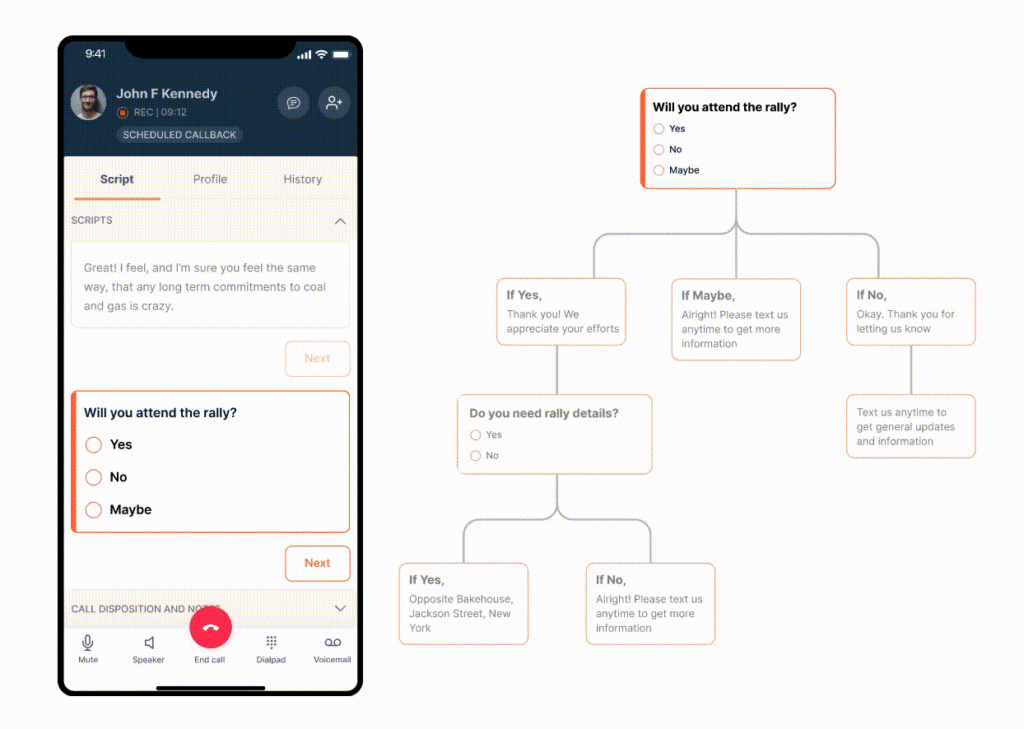
Interactive voter identification scripts work best when volunteers can see the next question based on the voter’s answer.
That is hard to manage with a static document. Volunteers end up scrolling, skipping, or guessing which section comes next.
A phone banking software can help by showing the script, survey questions, and response options during the call. With branching logic, the volunteer only sees the next relevant step.
For example:
- If the voter says yes, the script moves to a volunteer, donation, yard sign, or vote plan ask.
- If the voter says undecided, the script moves to issue questions and follow-up options.
- If the voter says no, the script moves to a polite close.
- If the voter asks not to be called, the script moves to do-not-call handling.
This directs volunteers to the right response at each step instead of asking them to scroll through a long script.
For more campaign execution help, read these phone banking tips for campaigns. For turnout follow-up after voter ID, use these GOTV script samples.
Conclusion
A voter identification script should do more than keep a volunteer talking.
It should help the campaign learn who supports you, who is undecided, who opposes you, and who needs the next step. The script should be short enough to keep people on the call and structured enough to create useful data.
Start with the right person. Ask one clear support question. Record the top issue. Use the 1-5 supporter scale consistently. Route supporters, undecided voters, opponents, and do-not-call requests into the right follow-up path.
CallHub’s phone banking software helps campaigns run voter ID calls with scripts, branching paths, survey questions, dispositions, volunteer access, and reporting in one place.
For a complete overview of how voter ID fits into a full campaign calling strategy, see the complete guide to political phone banking. For step-by-step setup guidance, read the political phone banking guide. For more script examples across all campaign call types, use the phone banking script guide.
Frequently asked questions
What is a voter identification call?
A voter identification call is a campaign phone call used to learn whether a voter supports the campaign, opposes it, or is undecided. It helps campaigns decide who should get persuasion, GOTV, volunteer, donor, or no further follow-up.
What questions do you ask in a voter ID script?
Common voter ID questions include “Can we count on your support?”, “Which issue matters most to you?”, “Would you like more information?”, and “Can we send you updates by text or email?”
What is a 1-5 supporter scale in voter ID?
A 1-5 supporter scale is a simple way to score voter support. A 1 is a strong supporter, 2 is a leaning supporter, 3 is undecided, 4 is a leaning opponent, and 5 is a strong opponent.
How long should a voter ID call be?
Most voter ID calls should be short, usually 2-4 minutes. If the voter is highly engaged, the call may go longer, but volunteers should avoid turning every voter ID call into a long persuasion conversation.
What should volunteers do if a voter is undecided?
They should ask what issue matters most, offer relevant follow-up information, and record the voter as undecided. The voter should then move into the campaign’s persuasion follow-up path.
What should volunteers do if a voter opposes the campaign?
They should thank the voter, record the correct support score, and close politely. They should not argue or keep persuading unless the campaign script gives a specific reason to continue.
Should voter ID scripts include donation or volunteer asks?
Yes, but only after the voter has shown support. Do not ask undecided voters or opponents to donate or volunteer. Supporters can be asked about volunteering, donating, displaying a yard sign, or making a vote plan.
How do you use voter ID data after the call?
Use the data to segment the next campaign action. Supporters move to GOTV or volunteer asks. Undecided voters move to persuasion. Opponents receive less outreach. Wrong numbers are cleaned. Do-not-call requests are suppressed.
What is the difference between voter ID and GOTV?
Voter ID finds out where voters stand. GOTV turns identified supporters out to vote. Voter ID usually happens earlier in the campaign. GOTV happens closer to voting deadlines.