


Table of Contents
The answer to whether does get out the vote work depends on which channel you run and what conditions you build around it. More than 100 randomized field experiments conducted since the 1990s have established a clear pattern: Canvassing lifts turnout 5–8 percentage points, phone banking lifts it 1–3, and broadcast texting produces under one point of lift.
Campaign managers allocating get-out-the-vote (GOTV) budgets need to justify channel decisions with evidence, not habit. Canvassing costs more than texting. Phone banking costs more than mailers. If you’re deploying six figures across a GOTV program, the research should drive the allocation.
This article pulls from the Analyst Institute, Yale ISPS, CIRCLE, and Mann and Haenschen’s 2024 meta-analysis to give you the data by channel, the five conditions that determine whether any GOTV effort produces results, and the documented failure modes that drain budgets without moving turnout. For the full phase-by-phase system this data feeds into, see the complete GOTV strategy guide.
Key Takeaways
More than 100 randomized field experiments conducted since the 1990s show that GOTV effectiveness varies sharply by channel and by the conditions a campaign builds around it.
Measuring GOTV effectiveness
- GOTV effectiveness is defined the same way in every study: the percentage-point difference in turnout between contacted voters and a control group that wasn’t contacted.
- Mann and Haenschen’s 2024 meta-analysis in the Stanford Social Innovation Review reviewed 100+ GOTV experiments and found that lift is real but depends heavily on context.
- High-salience elections like presidential races produce smaller percentage-point lifts because baseline turnout is already elevated, while a 2-point lift in a low-turnout school board race can represent the entire winning margin.
- Salience calibration is the first variable to control before comparing GOTV results across a midterm versus a local special election.
Turnout lift by channel
- Canvassing produces the strongest lift of any channel, 5-8 percentage points per contacted voter in Gerber and Green’s foundational Yale ISPS experiments, though Mann and Haenschen’s 2024 analysis puts average lift at about 2.5 points in high-salience elections and over 8 points in low-salience local races.
- Canvassing’s strength comes from face-to-face conversation that lets a canvasser personalize the message and build a specific voting plan with the voter, but it requires 25-50 worker-hours per additional vote produced in nonpartisan settings.
- Volunteer phone banking lifts turnout 1-3 percentage points overall, with Nickerson’s 2005 study finding 3.8-4.5 points in the experiments tested, and the spread across studies is explained almost entirely by contact quality.
- Phone banking scripts with personalization and plan-making prompts consistently outperform generic scripts, and live volunteer calls produce 1-3 points of lift versus near-zero for robocalls.
- Mass broadcast texting produces the smallest lift of any live channel at 0.5-0.9 percentage points, though its low cost-per-contact can still make it worthwhile, and peer-to-peer texting with real two-way volunteer conversations is the exception that performs better than broadcast texts.
What does “GOTV effectiveness” actually mean?
Every study measuring GOTV program performance uses the same metric: The percentage-point difference in voter turnout between people who were contacted and a control group that wasn’t.
If contacted voters turned out at 48% and the control group turned out at 42%, the program lifted turnout by 6 percentage points. Not clicks, not calls completed, not volunteer hours logged. Turnout against a control. For the full definition of that metric and how it’s benchmarked by election type, see what is voter turnout.
Mann and Haenschen’s 2024 meta-analysis, published in the Stanford Social Innovation Review, reviewed 100+ GOTV experiments and found that average lift is real but context-dependent. High-salience elections (presidential races) produce smaller percentage-point lifts because baseline turnout is already elevated. A 2-point lift in a presidential primary is not a failure. In a school board race where baseline turnout is 18%, a 2-point lift may be your entire margin.
This distinction matters for how you read any GOTV research. A study conducted in a midterm is not directly comparable to one conducted in a local special election. Salience calibration is the first variable to control before interpreting any channel data.
Turnout lift by channel: What the data shows
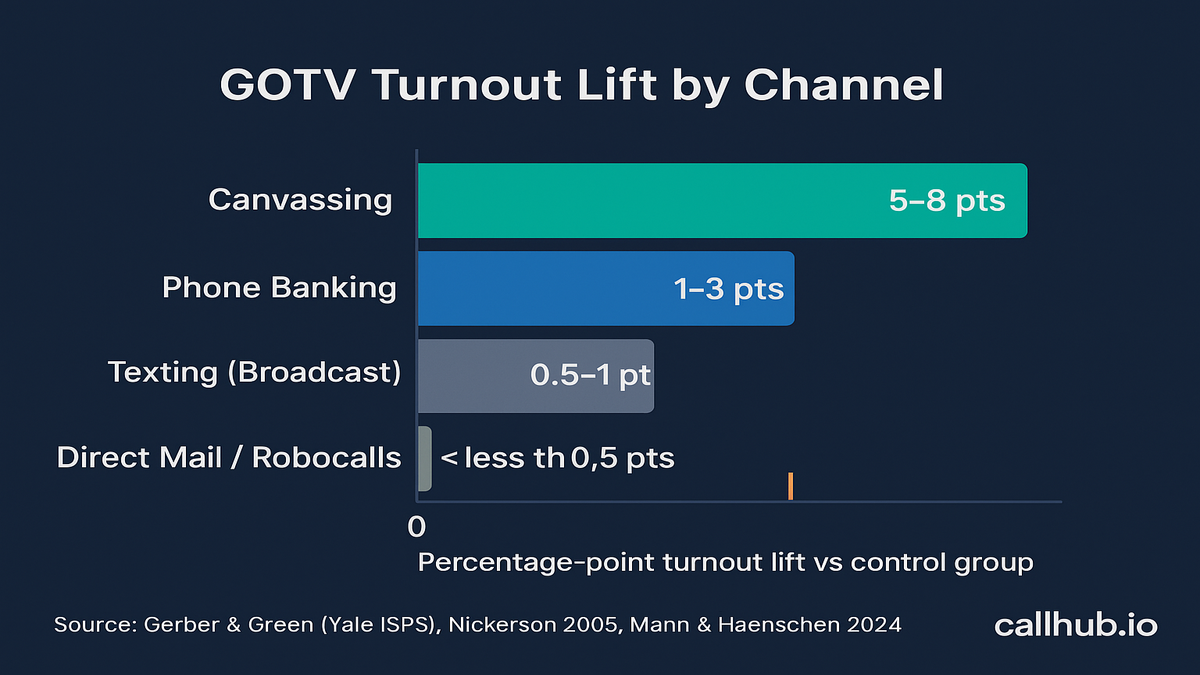
The channel hierarchy in the research is consistent across studies. Personal contact outperforms impersonal contact. Conversation outperforms broadcast. Here is what the data shows for each major GOTV channel.
Canvassing: 5–8 percentage points
Door-to-door canvassing produces the strongest measurable GOTV lift of any channel. Gerber and Green’s foundational experiments at Yale ISPS established that canvassing lifts turnout by 5–8 percentage points per contacted voter in nonpartisan contexts, a finding replicated across dozens of subsequent studies.
Mann and Haenschen’s 2024 meta-analysis refines this: In high-salience elections, average canvassing lift is approximately 2.5 percentage points. In low-salience local races, lifts are higher, sometimes exceeding 8 points. Salience calibration matters when you’re deciding where to deploy canvassing resources across a campaign cycle.
Why does canvassing produce the highest lift? The face-to-face conversation is the highest-quality contact a campaign has with a voter. A canvasser can answer questions, personalize the message in real time, and guide the voter through a specific voting plan: When they’ll vote, how they’ll get there, and what they’ll need to bring. Voter plan-making on the doorstep is one of the most consistently replicated GOTV mechanisms in the research.
The tradeoff is cost. Canvassing requires 25–50 worker-hours per additional vote produced in nonpartisan settings. For down-ballot races with tight margins and low baseline turnout, that cost is justified. For high-salience statewide races where baseline turnout is already elevated, the cost-per-additional-vote calculation shifts considerably.
For operational benchmarks alongside the research, the how effective political canvassing is breakdown covers channel data and implementation detail.
Phone banking: 1–3 percentage points
Volunteer phone banking is the highest-reach personal contact channel in GOTV. Nickerson’s 2005 study found that volunteer-led phone banking lifts turnout by 3.8–4.5 percentage points in the experiments tested, approaching canvassing lift at a fraction of the cost per contact.
The broader research range across studies is 1–3 percentage points, and that spread is almost entirely explained by contact quality. Generic scripts produce lower lift. Scripts that include plan-making prompts (“When do you plan to vote? Do you know your polling location?”) produce higher lift, consistent with canvassing findings.
The Analyst Institute’s synthesis of GOTV experiments identifies two consistent predictors of phone banking effectiveness: Personalization and plan-making. Volunteers who follow a relational script, using the voter’s name and guiding them toward a specific voting commitment, consistently outperform volunteers reading generic “your vote matters” copy.
One number holds consistently across the research: Live volunteer calls produce 1–3 percentage points of lift. Robocalls produce near-zero. That gap is not a nuance. It determines whether phone banking is worth running at all.
For the full evidence base on phone banking as a GOTV channel, the research on whether phone banking works covers the complete body of literature.
Texting: 0.5–1 percentage point (with exceptions)
Mass broadcast texting produces the smallest GOTV lift of any live channel: 0.5–0.9 percentage points in most studies. That’s small but not zero. At the cost-per-contact of broadcast texting, the return can be strong when texting is used in the right role.
The exception is peer-to-peer (P2P) texting. Two-way P2P text conversations, where a real volunteer texts individual voters and responds in real time, produce lift approaching phone banking range in some experiments. The mechanism is identical to canvassing and phone banking: Personal contact, conversational responsiveness, and plan-making.
Trusted-source framing also matters. Research shows texts from identified friends, neighbors, or community figures produce higher lift than generic campaign texts. When your GOTV texting program names the sender and localizes the message, it outperforms a broadcast blast.
The strongest evidence for texting in GOTV is as a confirmation and reminder channel, not a primary lift channel. High open rates, low friction, and easy to action make it the right tool for a voting-day reminder or a polling-location confirmation, especially as a follow-up to an initial phone contact or canvass visit.
GOTV texting works best as the second touch, not the first.
Direct mail and robocalls: Minimal lift, low cost
Direct mail produces 0–0.7 percentage points of turnout lift in the research. Robocalls produce near-zero measurable lift in most experiments, and Federal Communications Commission (FCC) restrictions on automated calls have further limited their viability as a primary GOTV channel.
The case for direct mail is cost, not lift. It’s cheaper per contact than live calling or canvassing, and it reaches voters who don’t answer phones or doors. As a supplement to higher-quality personal contact, not a replacement, mail can add volume to a multi-channel program.
Robocalls should not be a primary GOTV channel. The research doesn’t support them on lift, FCC compliance adds operational friction, and the cost-per-vote compared to live calling is poor.
What conditions make GOTV work?
The channel data above shows averages. The actual lift your program produces depends on five conditions the research consistently identifies as the difference between programs that move turnout and programs that don’t.
1. Personalization. Generic messaging underperforms personalized contact by a measurable margin across every channel studied. Personalization means using the voter’s name, referencing the specific race or issue at stake, and adapting the conversation to the voter’s history and propensity score. A script that reads identically for every voter is a script that performs below its potential.
2. Voting plan commitment. Asking voters to state when, where, and how they’ll vote (an implementation intention) is one of the most replicated mechanisms in the GOTV research. Some studies document a 9-percentage-point lift from plan-making language alone. Every script, regardless of channel, should include a plan-making prompt. If your phone banking script doesn’t ask “What time do you plan to vote?”, you’re leaving lift on the table. The GOTV text message templates guide has ready-to-use plan-making scripts for exactly this.
3. Social norms framing. “Your neighbors voted” consistently outperforms generic civic appeals. The Analyst Institute and Yale ISPS research both find that making voting feel like the local default, activating social pressure rather than just providing information, increases turnout. The message isn’t “voting is important.” It’s “people like you vote in this election.”
4. Electoral salience. GOTV lifts are three to five times larger in low-salience local races than in presidential elections. A school board race where baseline turnout is 18% has far more room for lift than a midterm senate race where it’s already 55%. Allocate your highest-effort, highest-cost channels to the races where the ceiling is highest.
5. Contact frequency. Lift increases up to five contacts per voter in the research. Beyond six contacts, returns diminish sharply and Nickerson’s work documents potential backlash from over-contact. Multi-channel programs reach voters who don’t respond to any single channel, which is why a coordinated phone, text, and mail program outperforms any single channel at the same total budget.
Common GOTV failure modes
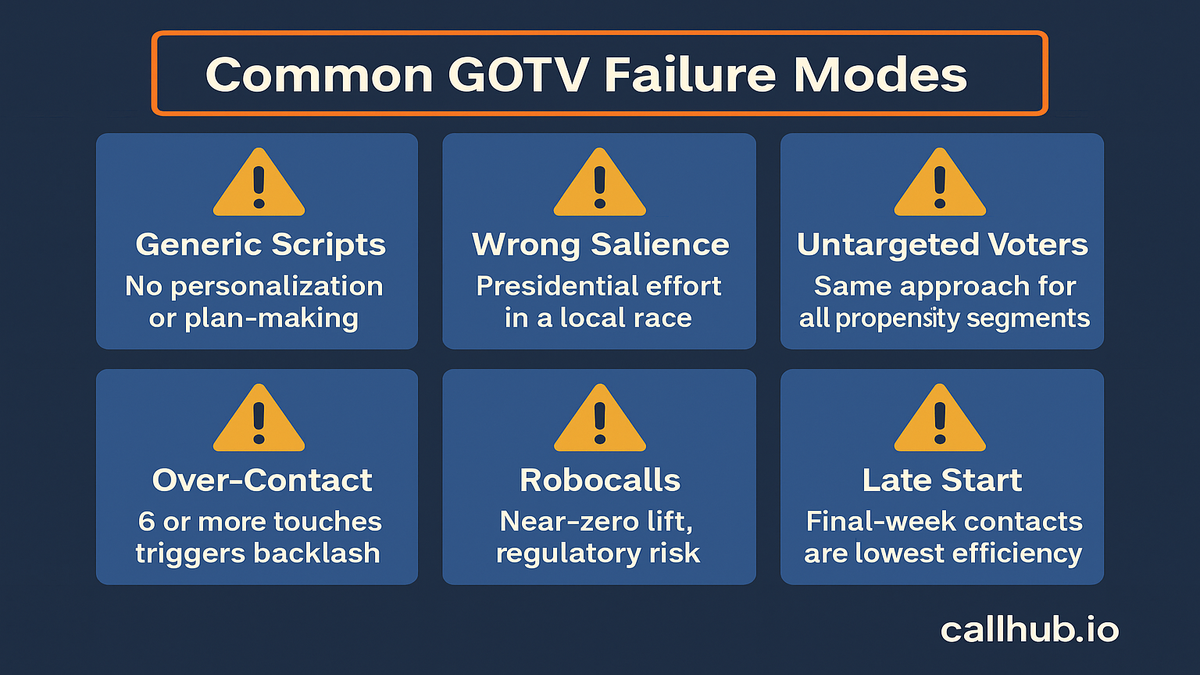
The research is equally clear on what goes wrong. These are the most consistent failure patterns across Mann and Haenschen’s meta-analysis and the Analyst Institute’s synthesis of GOTV experiments.
- Generic messaging. No personalization, no plan-making, no local relevance. Generic copy produces generic lift. Every script needs customization by race, voter propensity segment, and channel.
- Misallocated intensity. Running presidential-race GOTV intensity in a city council race, or vice versa, wastes resources. Salience calibration is a resource allocation decision, not a tactical detail to work out later.
- Undifferentiated targeting. Low-propensity voters and high-propensity voters need different approaches. Spending canvassing hours on voters who will turn out regardless of contact is a documented efficiency loss with a measurable cost in cost-per-vote.
- Over-contact. Six or more contacts per voter per channel cycle produces diminishing returns and risks backlash. Set contact frequency caps in your CRM before the program runs, not after the complaints come in.
- Robocalls as a primary channel. Near-zero lift, high cost relative to live calling, and rising FCC compliance complexity. The research doesn’t support robocalls as a primary GOTV vehicle. Use live calls.
- Late start. Voter plan-making requires runway. Last-day contacts are the lowest-efficiency contacts in every study reviewed. Start voter contact at least three to four weeks before Election Day.
How to run a research-backed GOTV program

Translating the research into an actual program means making allocation decisions before the campaign starts, not on the fly. Here is how to apply the channel data and condition findings.
1. Segment your voter file by propensity. Your GOTV budget should not be distributed equally across all voters. High-propensity voters need a reminder contact: Low effort, low cost, high efficiency. Low-propensity persuadable voters need higher-quality contact: Canvassing or live phone banking with plan-making scripts. Midrange propensity voters are the primary phone banking and texting target.
2. Lead with canvassing in high-impact, low-salience races. For city council, school board, or special election races, canvassing’s 5–8 point lift justifies the per-contact cost. In a presidential primary where baseline turnout is already elevated, canvassing resources often produce more value in persuasion, with phone banking and texting carrying GOTV load.
3. Use texting for confirmation and follow-up, not primary lift. Deploy peer-to-peer texting as the follow-up layer after phone contacts or canvass visits. Use broadcast texts for day-of polling reminders and logistics information. Don’t build your primary lift strategy around broadcast texting alone.
4. Script every channel for plan-making. When, where, and how will this voter get to the polls? Every phone banking script, every canvassing conversation guide, and every P2P text follow-up should route the voter toward a specific, committed answer to that question.
5. Activate social norms in every channel. “X% of voters in your neighborhood participated in the last election” outperforms generic civic appeals consistently across the research. Build social norms language into every phone script, canvassing guide, and mailer.
6. Set a contact cap and enforce it. Five contacts per voter per channel cycle is the research-supported ceiling. Enter this as a hard limit in your CRM before the program begins. Over-contact is one of the most consistent and avoidable failure modes in the field.
For the full operational picture on scripts, volunteer training, dialer setup, and reporting, the GOTV phone banking strategies guide covers implementation step by step. For broader voter mobilization architecture, the voter mobilization strategies guide maps out the full campaign structure and channel sequencing.
The research is clear: Run the program
Canvassing lifts turnout 5–8 points. Phone banking lifts it 1–3. Texting lifts it under one point at broadcast scale, more with peer-to-peer conversation and plan-making. Conditions matter: Personalization, plan commitment, social norms, salience matching, and contact frequency all determine whether your program hits those research averages or falls short of them.
That’s not a soft finding. It’s what more than 100 randomized experiments, replicated across three decades, consistently show.
The gap between a GOTV program that follows the evidence and one that doesn’t is real. In a close race, it can be the margin.
If you’re running phone banking and peer-to-peer texting at scale, CallHub’s phone banking software for GOTV connects your volunteer team to the voter file, enables relational scripting with plan-making prompts, and tracks contact frequency so you don’t over-contact your highest-propensity supporters. See CallHub’s GOTV platform for the full picture of how the tools work together across a program. If you’re building the full program from scratch, the proven GOTV strategies for campaigns guide is the right next read.
FAQ
Does get out the vote actually work?
Yes. More than 100 randomized field experiments across three decades confirm that personal contact reliably lifts voter turnout above control groups. The lift ranges from under one percentage point for broadcast channels to 5–8 percentage points for canvassing. The research supports GOTV as a context-dependent, channel-specific tool: Effective when deployed correctly, wasteful when it isn’t.
Which GOTV tactic produces the highest turnout lift?
Canvassing consistently produces the highest per-voter lift: 5–8 percentage points in nonpartisan contexts (Yale ISPS / Gerber and Green) and approximately 2.5 points in high-salience elections (Mann and Haenschen 2024). It’s also the most resource-intensive channel, which is why the decision to lead with canvassing should be calibrated to election salience and available budget.
What get out the vote tactics are most successful?
Ranked by per-contact turnout lift, the most successful GOTV tactics are: canvassing (5–8 percentage points, per Yale ISPS field experiments), volunteer phone banking (1–3 points, with Nickerson’s study finding 3.8–4.5 points for well-run programs), and peer-to-peer texting (approaching phone banking lift when it’s a real two-way conversation, versus 0.5–0.9 points for broadcast texting). The Analyst Institute’s synthesis of this research attributes the ranking to contact quality, not channel alone: personalized, plan-making conversations outperform generic messaging on every channel tested. The most successful program isn’t a single tactic, it’s canvassing and phone banking leading contact with your highest-priority voters, backed by texting for reminders and confirmation.
Does canvassing or phone banking work better for GOTV?
Canvassing produces higher per-contact lift (5–8 points vs. 1–3 points for phone banking). Phone banking produces higher reach at lower cost per contact. The right answer depends on your budget, race type, and voter file. In low-salience races with tight margins, canvassing’s cost is justified. In high-volume GOTV programs for competitive statewide races, phone banking is the practical scale channel.
How many times should you contact a voter during GOTV?
The research supports up to five contacts per voter per channel cycle before diminishing returns set in. Nickerson’s 2005 study documents potential backlash from six or more contacts. Set a contact frequency cap in your CRM before the program runs and enforce it across phone banking, texting, and mail programs simultaneously.
Does texting increase voter turnout?
Broadcast texting produces small but real lift: 0.5–0.9 percentage points in most studies. Peer-to-peer texting, where volunteers conduct real two-way conversations with voters, approaches phone banking lift in some experiments. The strongest evidence for texting is as a confirmation and reminder layer after higher-quality initial contact, not as a standalone GOTV channel.
Why do some GOTV programs fail?
The most documented failure modes are generic messaging with no personalization, misallocated channel intensity for the race’s salience level, over-contact beyond six touches per voter, and robocalls as a primary channel. Starting contact fewer than three weeks before Election Day also reduces lift, since voter plan-making requires time to translate into committed voting behavior.
When should GOTV efforts begin?
The research supports beginning voter contact at least three to four weeks before Election Day. Last-day contacts produce the lowest per-contact efficiency in every study reviewed. For low-salience races, a sustained multi-touch program starting four weeks out consistently outperforms a compressed final-week push. For the week-by-week schedule that operationalizes this timing, see the GOTV timeline.