
If your early voting GOTV program looks like your Election Day program with an extra week tacked on, you’re not running an early vote campaign. You’re running delayed outreach. The early vote window is a distinct campaign phase with its own universe, channel sequence, and tracking loop.
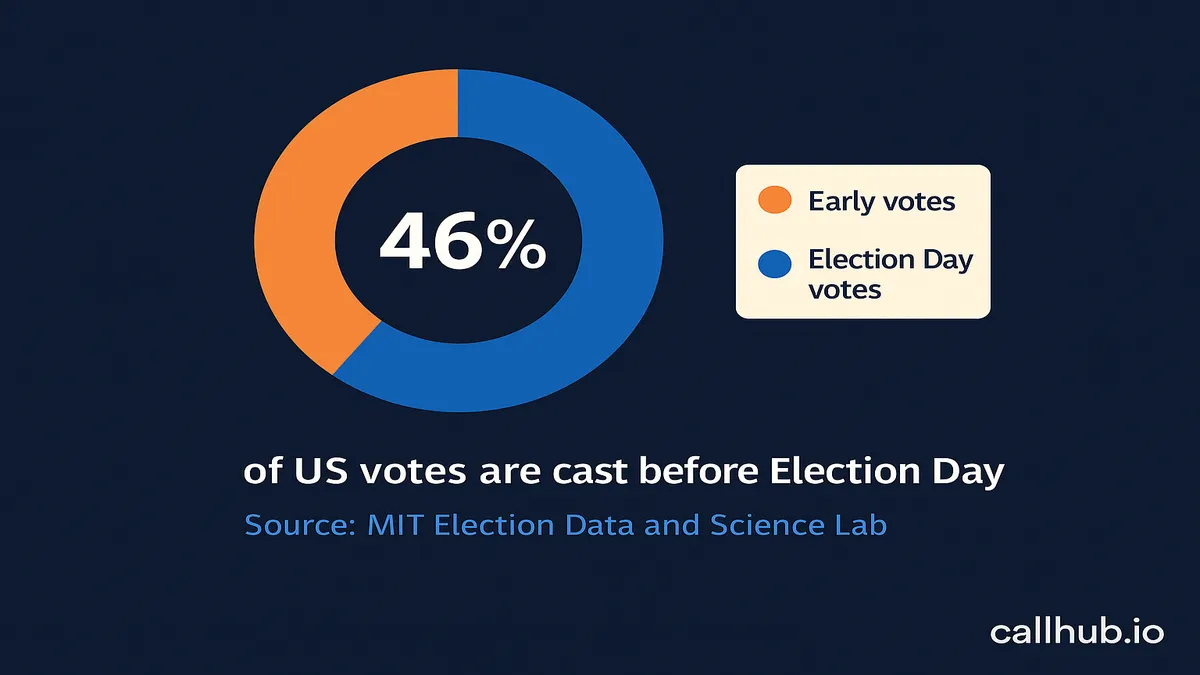
In recent election cycles, 46% of US votes were cast before Election Day, according to the MIT Election Data and Science Lab. That’s nearly half your entire target universe. Compressing that into a generic GOTV push means wasting volunteer time on contacts who already voted, missing the multi-touch sequencing advantage the window provides, and leaving daily ballot return data completely unused.
This guide covers the complete operational framework: How to build a separate early vote universe from your voter file, how to sequence channel contacts across the three phases of the early vote window, and how to use daily ballot return data to pull already-voted contacts and redirect your volunteer bandwidth where it matters. Early voting is one phase in the broader GOTV calendar — see the full GOTV framework for how it connects to voter ID, Election Day, and everything in between.
Early voting is available in 47 states and the District of Columbia, according to the National Conference of State Legislatures (NCSL). If you’re running a GOTV program in almost any state, you need a dedicated early vote strategy.
What is early voting GOTV?
Early voting Get Out the Vote (GOTV) is a targeted mobilization effort that turns out supporters during the early vote window, before Election Day. A dedicated early voting GOTV program treats the pre-Election Day period as its own campaign phase: Separate universe segmentation, channel timing, and ballot return tracking from the Election Day program.
The core difference from Election Day GOTV: Supporters who are likely early voters get contacted earlier, tracked by ballot return status, and removed from the active contact queue once their vote is confirmed. Supporters unlikely to vote early stay in the Election Day universe. The two programs run in parallel, not in sequence.
Why early voting requires its own GOTV strategy
Running early voting outreach as a longer version of your Election Day program creates four operational problems:
- The multi-touch window collapses. A campaign that starts early voter turnout contact one week before the window closes loses two to three weeks of possible touches.
- Volunteer time gets wasted. Without daily ballot return tracking, you keep calling and texting supporters who voted two weeks ago.
- The urgency arc breaks. Election Day GOTV uses deadline proximity to drive action. Early vote GOTV needs a different message arc, because the deadline is rolling, not fixed.
- Your universe stays blended. If early vote contacts stay in the same pool as Election Day contacts, you can’t calibrate contact frequency or suppression correctly.
None of these problems get solved by starting earlier. They get solved by treating early voting as a separate program entirely.
How to build your early vote universe
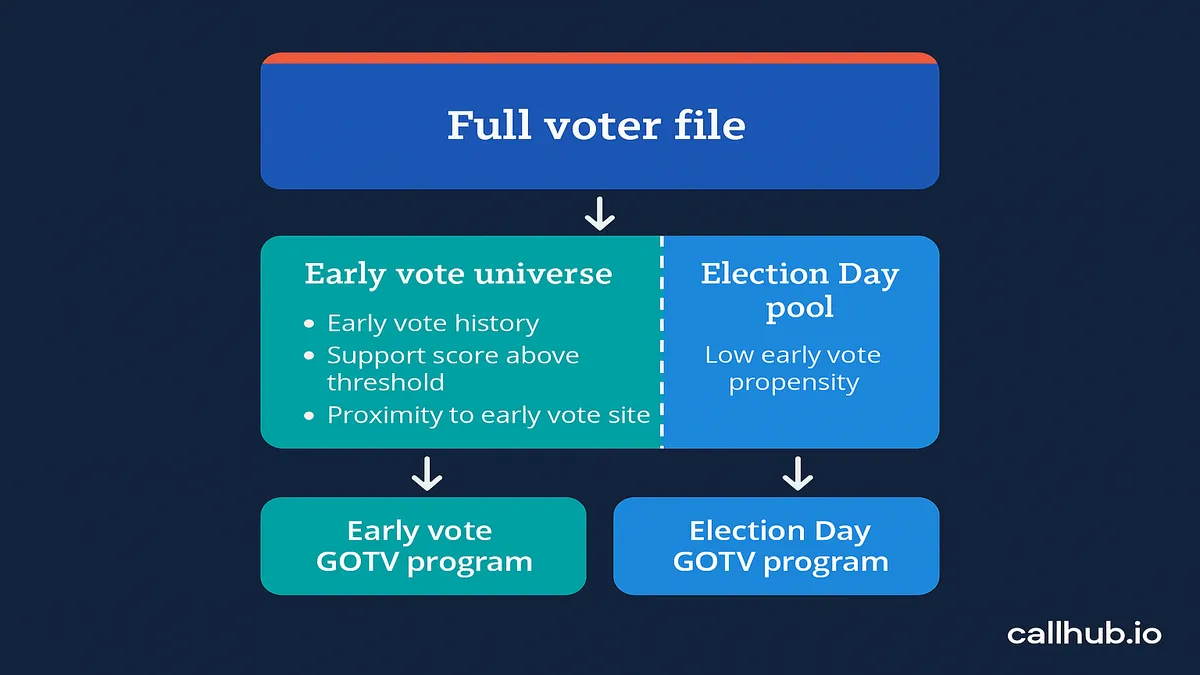
Your early vote universe is a separate segment of your overall voter contact list. You pull it from your voter file before the window opens and manage it independently through to Election Day.
The goal is to identify supporters who are both motivated by the early vote ask and likely to follow through. Your voter file is the primary input.
Voter file filters for early vote candidates
Pull early vote candidates from your supporter list using these voter file attributes:
- Early vote history: Supporters who voted early in two or more prior cycles are your highest-propensity targets. They’ve done it before, and a timely prompt will get them there again.
- Party ID and support score: Filter for confirmed supporters above your threshold. Early vote GOTV is a turnout program, not a persuasion program.
- Proximity to early vote locations: Supporters who live within a short drive of an early vote site have a lower barrier. Many voter file vendors include distance or commute-time attributes.
- Propensity score: Some campaigns score supporters by estimated likelihood to vote early based on demographic and behavioral patterns. Use this to tier your universe if available.
Sizing your universe: Who stays in the election-day pool
Not every supporter is a good early vote target. Supporters with low early vote history or low propensity scores stay in the Election Day universe. You don’t want to burn early vote contacts on supporters who are unlikely to use the window and will respond more strongly to Election Day proximity.
The right split varies by state and voter file quality. A common approach is to run early vote GOTV on the top 30 to 50% of your early vote propensity tier, while holding the rest for the Election Day program.
Channel timing across the early vote window
The single biggest operational difference between early voting GOTV and Election Day GOTV is the timing structure. Election Day GOTV has one deadline. Early voting GOTV has a rolling window that typically runs 15 to 45 days.
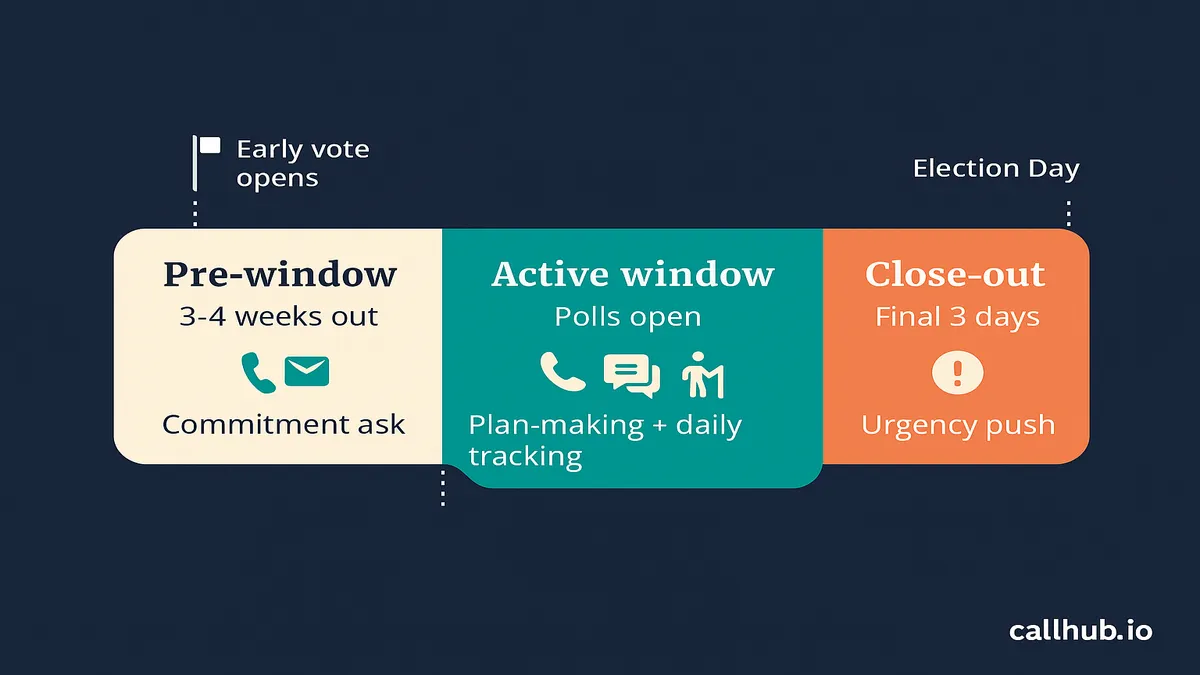
That window breaks into three phases. Each phase has a different goal, a different channel mix, and a different message.
| Phase | Timing | Goal | Primary channels |
|---|---|---|---|
| Pre-window | 3-4 weeks before early vote opens | Build awareness, lock in plans | Phone (commitment ask), email |
| Active window | When early vote opens through midpoint | Drive votes, track returns daily | Phone (plan-making), P2P texts, canvass |
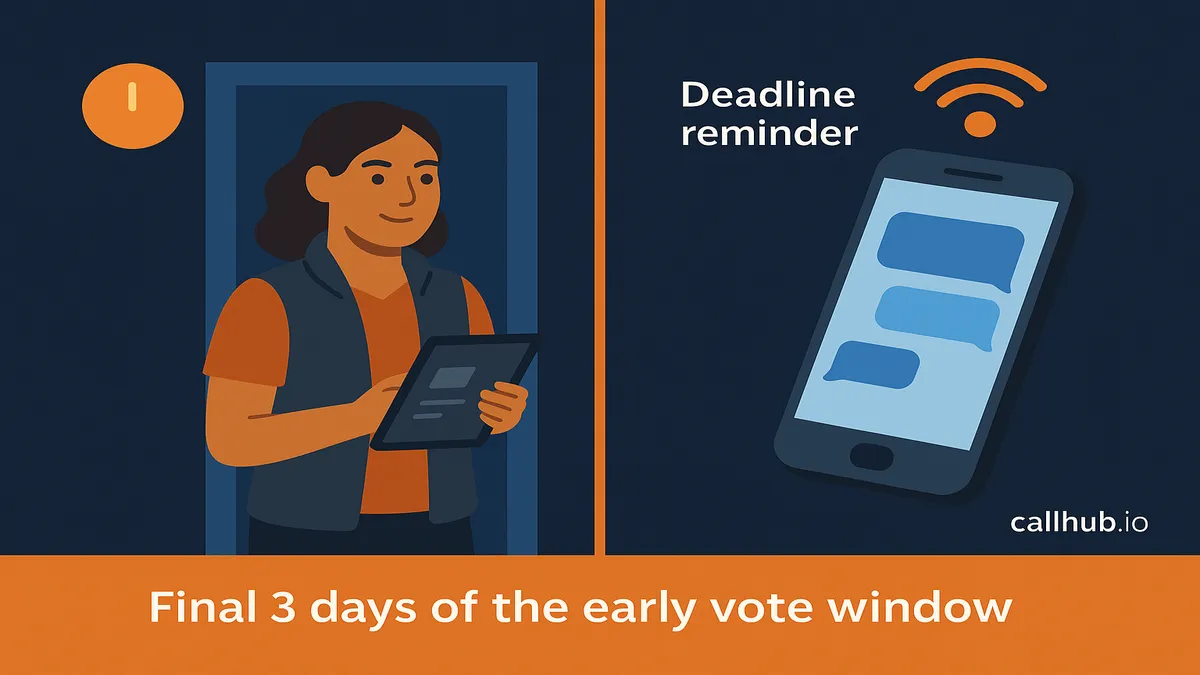
| Close-out | Final 3 days of early vote window | Urgency push for not-yet-voted contacts | Phone, broadcast text, canvass priority |
Pre-window phase (3-4 weeks out)
The pre-window phase is where most campaigns underinvest. The goal at this stage is not to turn out votes. It’s to secure commitments and set expectations so that when the window opens, your contacts are primed.
Phone calls are your primary tool here. The ask is simple: “Will you vote early this year?” and “When do you plan to go?” A specific date or location commitment from a contact increases the likelihood they’ll follow through when early voting opens.
This is also when you set up your early vote reminder sequence. Contacts who commit to voting early during the pre-window phase should receive at least one confirmation text and a reminder as the window opens.
Active window phase (when polls open)
Once early voting opens, the daily ballot return file becomes your operational dashboard. Pull it every morning, match it against your early vote universe, and suppress contacts who have already returned their ballot.
This phase is high-frequency contact for contacts who haven’t voted yet. Phone banking for plan-making works best here: “Early voting is open right now through Friday. Have you been able to get out yet?” The message is conversational, not urgent. There’s still time. Peer-to-peer texting (P2P texting) is effective for contacts who don’t pick up the phone, because the back-and-forth format lets contacts ask about locations, hours, and what identification to bring.
Close-out phase (final 3 days)
The close-out phase is where urgency kicks in. Research from the Analyst Institute shows that voter contact made one to two days before voting drives the largest single-contact turnout boost. The same principle applies to the close of the early vote window.
During the close-out phase, prioritize your highest-propensity contacts who haven’t yet voted. Canvassing becomes more cost-effective here because you’re working a smaller, more committed universe. Broadcast texts can reach your full remaining early vote list with deadline reminders in one push.
Contacts who still haven’t voted at the end of the early vote window move back into your Election Day GOTV universe, flagged as early vote contact non-converted.
The channel mix for early vote outreach
The channels that work for early voting outreach are the same ones that work for Election Day GOTV. What changes is how and when you deploy each one across the window.
Phone calls: Commitment-ask and plan-making
Phone calls are the highest-quality early vote contact method. The ask structure matters: In the pre-window and active window phases, phone calls should focus on plan-making, not generic turnout asks. “Where is your nearest early vote location?” and “What day are you planning to go?” are more effective than “Will you vote?”
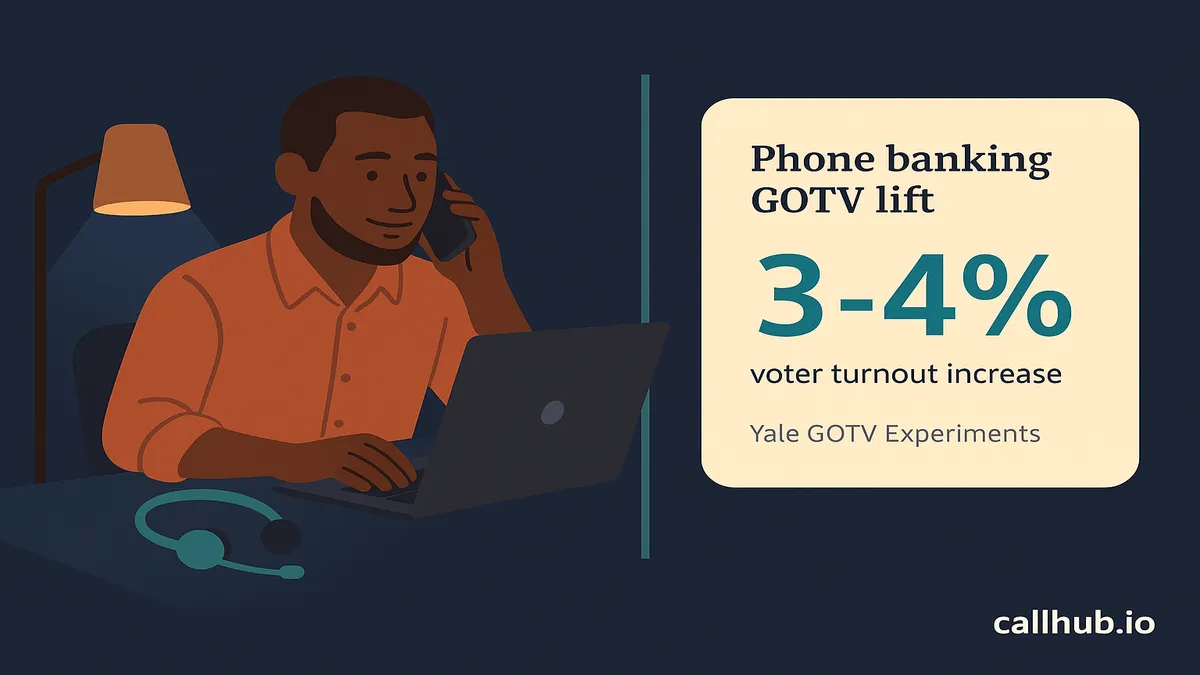
Phone banking lifts voter turnout by 3 to 4 percentage points, according to Yale GOTV experiments and the Analyst Institute. That effect holds for early vote contact, particularly when the call includes a location ask and a follow-up commitment.
During the active window, calls to not-yet-voted contacts in your early vote universe should be a daily priority. Callers should have each contact’s nearest early vote location and hours ready to share.
Text messages: Reminders and deadline urgency
Texts serve two roles in an early vote campaign: Early vote reminders during the pre-window phase and urgency messages during the close-out phase.
P2P texting works best during the active window because the conversational format lets contacts ask questions about locations, hours, and identification requirements. Broadcast text works for the close-out push, where the message is simple and time-sensitive: “Early voting closes this Friday. There’s still time.”
Text banking increases voter turnout by approximately 3 percentage points, according to Impactive research cited by NGP VAN. For early vote campaigns running both phone and text contact, these effects compound across the window.
Canvassing: High-propensity, close-deadline contacts
Face-to-face contact is the most effective single-touch GOTV method, according to the Analyst Institute. The cost makes it impractical to canvass your entire early vote universe, so target it strategically. For canvass script structure and shift planning, see the complete canvassing guide for GOTV.
Use canvassing for two situations: High-propensity contacts who haven’t responded to phone or text during the active window, and all not-yet-voted contacts during the close-out phase. A canvasser who can walk a contact directly to an early vote site has an outsized impact in the final days.
For campaigns with limited canvassing capacity, concentrate door-knocks on apartment buildings and dense precincts near early vote sites. Geographic density increases the return per volunteer hour.
How to track early ballot returns and redeploy your list
The ballot return tracking loop is what separates an early voting GOTV program from a long GOTV program. It’s also the piece most campaigns skip entirely.
Pulling the daily early vote file
Most state Secretaries of State or county election offices publish daily early vote files listing registered voters who have cast an early ballot. The file is typically available by 9 or 10 a.m. for ballots cast the previous day.
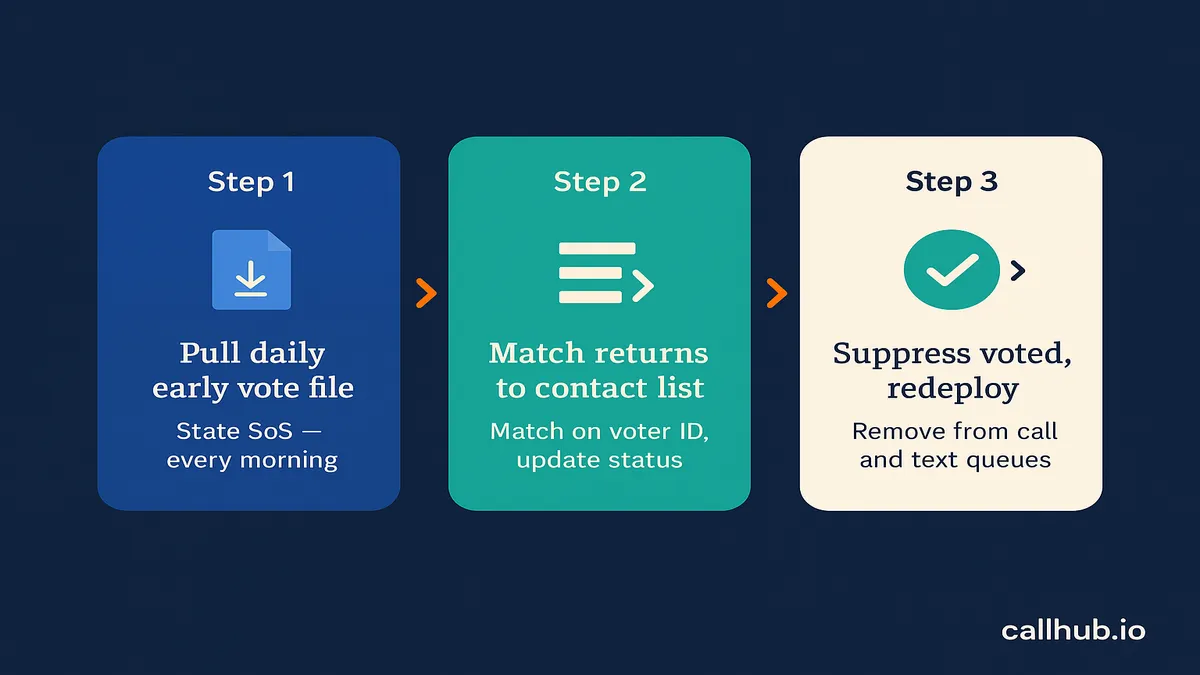
Your voter file vendor (NGP VAN, NationBuilder, Voter Activation Network) may automate this match, pulling the state file and updating voted flags in your database each morning. If not, the match process is a manual upload: Download the state file, match on voter ID, and update the early vote status field.
Syncing returns with your voter contact list
Once you’ve matched the daily early vote file against your contact list, suppress all returned voters from the active contact queue. Do not contact voters who have already cast their ballot. It’s a wasted touch, and it can frustrate a supporter who has already done their part.
The match rate won’t be perfect on day one, but it improves as the window progresses. Even an 80 to 85% match rate is enough to meaningfully reduce redundant contacts and redirect volunteer hours toward the remaining universe.
Redeploying freed bandwidth to not-yet-voted contacts
As your early vote universe shrinks each morning, the bandwidth freed by suppressing returned voters redeploys directly to the remaining not-yet-voted pool. This is the compounding advantage of a dedicated early vote program.
A campaign that starts the window with 5,000 early vote targets and pulls 1,000 returned voters after Week 1 can concentrate the same volunteer capacity on 4,000 contacts. As the close-out phase approaches, the contact intensity per remaining target increases. The early vote window doesn’t just run down the clock. It gets sharper.
For campaigns using separate tools for calling, texting, and list management, you’ll need to export the suppression list and upload it to each channel daily. For campaigns using a unified outreach platform, the redeployment is automatic.
Turn your early vote list into returned ballots with CallHub
The tracking and redeployment workflow above only works if your calling, texting, and list management tools stay in sync. When early vote returns update your voter file but your call list is a two-day-old export, your volunteers are calling people who voted yesterday.
CallHub’s voter outreach tools for political campaigns sync live with NGP VAN and NationBuilder. When a contact’s voted flag updates in your CRM, they drop out of active call and text queues automatically. No manual export. No stale lists. See how CallHub supports GOTV programs end to end, across every channel in this guide.
During the active window, use CallHub’s phone banking tools to run daily early vote calling with scripts that surface each contact’s nearest early vote location and hours inline. During the close-out phase, switch to Text Broadcasting for deadline reminders to your remaining universe at scale.
For the complete early vote toolkit across all channels, see our guide to tools to get out the vote.
Start your early vote GOTV campaign with CallHub
Read the complete guide to get out the vote tactics and strategy for the full framework this article builds on.
Frequently asked questions
How many contacts does it take to get someone to vote early?
There’s no single contact formula for early voter turnout. Most campaigns find that a commitment ask during the pre-window phase, followed by a plan-making call once early voting opens, and a reminder text in the final days produces the strongest results. Total contact volume varies by state, window length, and contact modality. The research consistently shows that contact made close to the vote date drives the largest single-contact boost.
How does early voting GOTV differ from absentee ballot chase?
Early voting GOTV focuses on in-person early vote contacts: Getting supporters to a physical early vote location during the open window. Absentee ballot chase focuses on mail ballot requests and return tracking. The daily tracking logic is similar, but the channel mix and messaging differ. For the full framework for mail ballot programs, read the absentee ballot chase guide.
When does the early vote window open in most states?
Early voting windows vary significantly by state. Most states that allow early voting open the window 10 to 30 days before Election Day. Some states open windows longer than 40 days. Check your state’s Secretary of State website for exact dates. The NCSL maintains a current list of early voting laws and window lengths by state.
Can campaigns canvass specifically for early voting?
Yes. Canvassing can be targeted to early vote contacts, particularly those living near early vote sites. The most effective approach is running walk-to-the-polls canvass shifts during the active window, targeting high-propensity contacts who haven’t voted yet. For campaigns combining door-knocking with phone banking for GOTV voter turnout, the two channels work well together on the same early vote universe.
How do campaigns handle early vote GOTV in states without early voting?
A small number of states do not offer in-person early voting. The NCSL maintains a current state-by-state list. In states without early voting, the same targeting and tracking logic applies to absentee and mail ballot programs. Read the absentee ballot chase guide for the equivalent framework. For campaigns in countries that offer early voting during snap elections, see our piece on early voting in snap elections.