



Table of Contents
You are 72 hours from polls closing, your turnout model says you are behind, and the original GOTV plan no longer fits the time left. An emergency GOTV plan helps you decide what to stop, which supporters still matter, which channels can reach them, and where extra volunteers will have an immediate effect.
This is not the moment to add more tactics. It is the moment to narrow the universe, protect high-yield work, solve voting barriers, and make decisions on a short reporting cycle. This guide gives campaign managers a triage framework, a 72-hour sequence, channel priorities, and a volunteer surge plan. Use CallHub’s complete GOTV strategy guide for the broader planning framework.
| Key principles for emergency outreach |
|---|
| Don’t panic, be creative and decisive. Use a mix of outreach tactics, tailored to the time available and the scale of the election. Prioritize methods that maximize reach and efficiency, especially when time is short. Focus on mobilizing your own supporters, rather than chasing swing voters in the last days. |
Emergency GOTV triage framework
Triage the campaign before you add capacity. A larger operation will not rescue a weak priority list. In the first hour, establish the size of the shortfall, freeze the contact universe, and decide which work will stop.
- Confirm the gap: Compare the remaining vote goal with confirmed ballots, strong commitments, and realistic turnout assumptions.
- Freeze the universe: Keep eligible supporters who have not voted. Remove confirmed voters, opt-outs, moved records, wrong numbers, and people outside the current GOTV target.
- Rank the remaining voters: Put high-support voters with unresolved barriers first, followed by supporters who need a plan or reminder.
- Calculate remaining capacity: Count usable volunteer hours, expected calls, texts, doors, and follow-up work before poll close.
- Cut low-yield work: Stop broad persuasion, low-priority turf, long creative projects, and channels that cannot deliver or return data in time.
- Set reassignment triggers: Move people and voter records when a channel misses its contact target for one reporting cycle.
Think of it this way: Every hour and every voter record must now compete for scarce campaign capacity. If a task does not produce a contact, solve a barrier, or confirm a ballot, it needs a very good reason to stay.
The 72-hour emergency GOTV plan
A last-minute GOTV plan should move from cleanup to concentrated contact, then to rapid problem-solving. Give each phase one owner and use the same voter file, disposition codes, and suppression rules across channels.
| Time remaining | Priority | Manager actions | Reporting cadence |
|---|---|---|---|
| 72–48 hours | Clean and rank | Freeze the universe, verify phone fields, split priority tiers, recruit surge volunteers, approve scripts, and test data sync | Every four hours |
| 48–24 hours | Maximize two-way contacts | Run phone and peer-to-peer text shifts, canvass dense priority turf, suppress confirmed voters, and route help requests | Every two to four hours |
| Final 24 hours | Resolve and confirm | Call unresolved supporters, send targeted reminders, dispatch assistance, abandon low-yield turf, and redeploy volunteers | Every two hours |
Campaign leadership should receive only what it needs to decide: Attempts, contacts, commitments, voting plans, confirmed ballots, open help requests, volunteer attendance, and performance by channel and priority tier.
Emergency outreach: What works best in a crunch?
With 72 hours left, use text messaging for immediate reach, phone banking for two-way scale and problem-solving, and canvassing for dense high-priority turf or supporters who need hands-on help. Budget still matters, but the harder constraint is whether a channel can complete contacts and return usable data before polls close.
But here’s a quick look at our popular ideas, and what makes them good (or bad), before we get into the details:
| Method | Strengths | Weaknesses/Limitations | Best Use Case |
|---|---|---|---|
| Door-to-Door Canvassing | Highest success rate (up to 9% increase in turnout). | Very time-intensive and requires training. | Hyper-local races. Swing voters. Targeted outreach. |
| Phone Banking | Scalable – can reach hundreds per hour. | Lower answer rates. Calls can become unfocused rambles. | Large-scale outreach. Mobilizing supporters. |
| Text Messaging | Instant delivery. High engagement (especially with younger voters). | There is a risk of channel fatigue if overused. | Reminders. Last-minute updates. Mobilizing the base |
Emergency outreach: Door-to-Door Canvassing
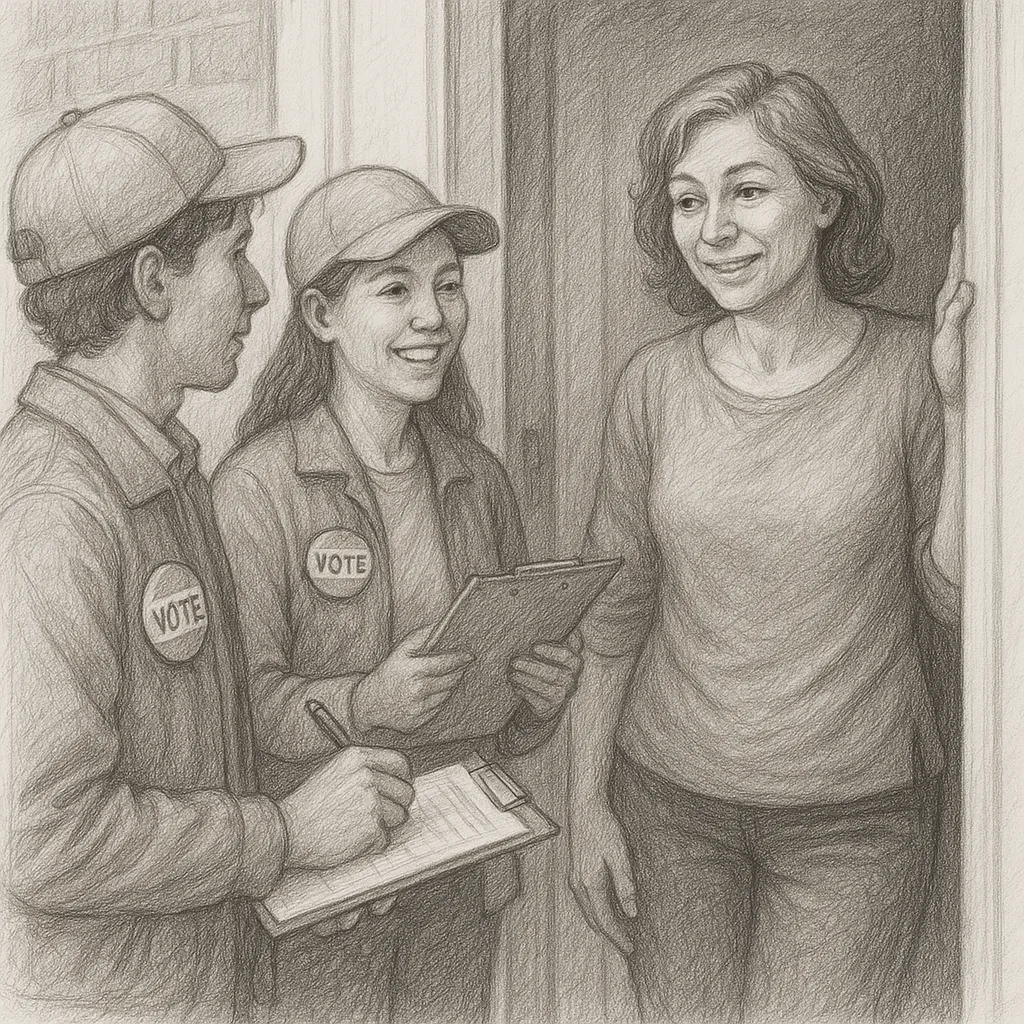
This is the most labor-intensive and expensive option. Costs such as volunteer time and travel, electronic devices and data storage, and local guides tend to pile up. However, this remains the gold standard for voter persuasion and education.
This personal interaction builds rapport and trust in ways that other methods (like phone calls or mailers) cannot match. A meta-analysis of 71 canvassing experiments in the US found, on average, door-to-door canvassing boosted votes by 2.5 percentage points, one of the most consistent effects among get-out-the-vote (GOTV) tactics.
Use emergency canvassing on dense turf containing high-priority supporters, especially voters with transportation, accessibility, polling-place, or ballot questions. Set a minimum doors-per-shift target and stop sending teams to turf that cannot justify the travel time.
Limitations: Too slow and resource-intensive for large-scale, last-minute outreach. Training is essential to avoid mixed messaging.
Read more: How Effective Is Political Canvassing? Everything To Know
Emergency outreach: Phonebanking

Phone banking is the main two-way surge channel in an emergency GOTV plan. Load high-priority supporters first, use short scripts, record a small set of disposition codes, and create callback queues for voters who request help or a later contact.
Set targets by shift: Dials, contacts, commitments, completed voting plans, callbacks, and help requests resolved. Shift leads should compare actual output with the plan and reassign volunteers when queues stall.
What do the numbers say? Volunteer phone calls have been shown to increase voter turnout by 2 – 4 percent in randomized controlled experiments. This study (page 2) found that this effect has persisted despite the increasing difficulty of having conversations via phone calls since 2016.
| CallHub phone banking will help you with that answer rate. CallHub dynamically assigns local caller IDs to your calls, and deploys a ‘Spam Label Shield‘ to avoid calls being marked as spam. This gives a significant boost to call answer rates. |
|---|
The same study confirms that those who answer your call are upto 6 percent more likely to vote, which makes phone banking a powerful tool for emergency outreach, where increasing the number of voters can often be critical.
Read More: Best Time for Phonebanking? We Studied 2 Million Calls for the Answer
In fact, for the best results, call them twice. As a 2009 study found, calling back those who have expressed a commitment to vote or requested a callback can triple the effectiveness of the phone banking campaign.
And phone banking remains strong. As recently as 2020, the progressive advocacy group People’s Action claims to have made a whopping 5 million GOTV calls.
Limitations: Training volunteers for the calls is crucial. All studies agree that paid professional calls have a very limited effect on voters. You need to have volunteers to make the calls, and they need to be well-trained to persuade voters.
Read More: The Truth About Political Phone-Banking Failures
Text Messaging
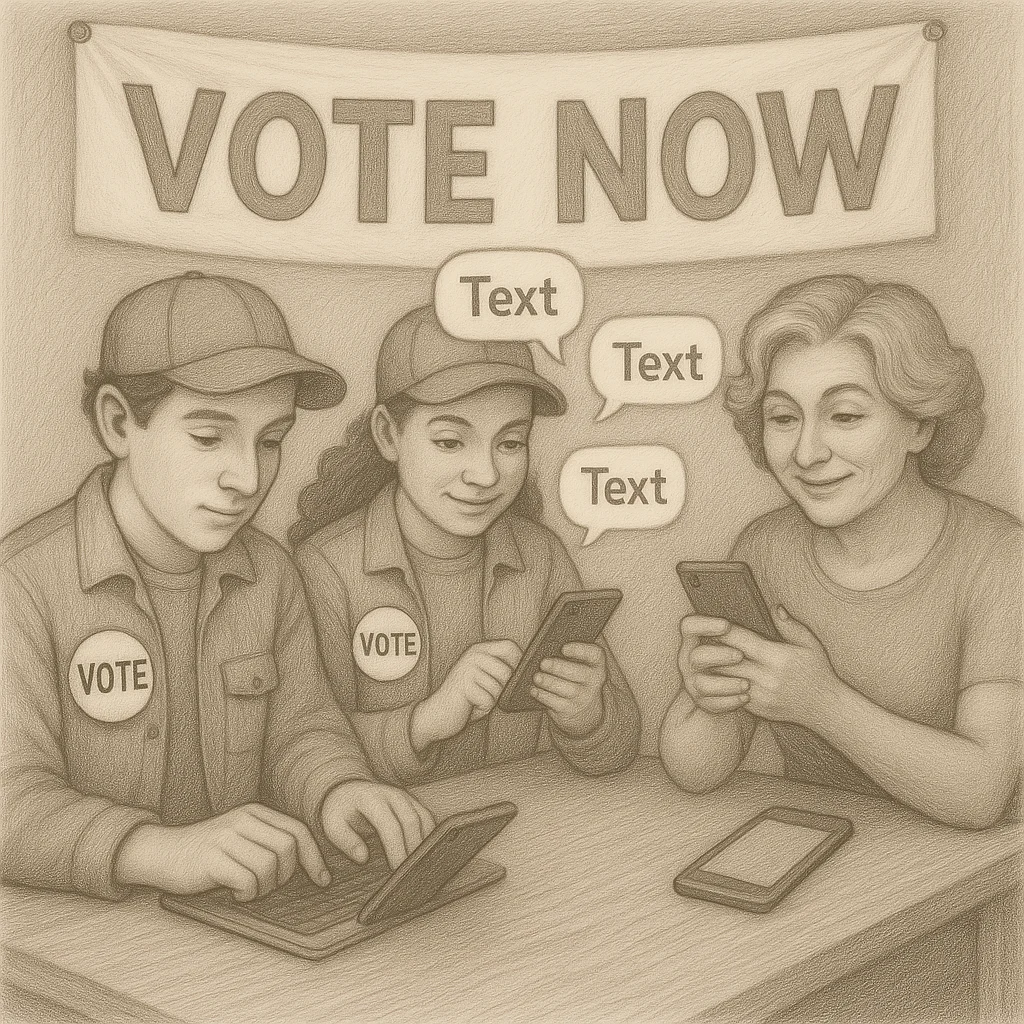
Text messaging is the fastest channel for a last-minute GOTV update. Use broadcast texts for time-sensitive information and reminders. Use peer-to-peer texting when supporters may reply with questions or barriers that need a volunteer response.
Define the escalation path before sending: Complex voting questions move to the approved help desk, urgent assistance moves to the field team, and voters who need a longer conversation move to a phone queue.
Plus, you can use MMS and RCS (GIFs, videos, images) for more engaging content, whether you want to send out reminders to voters, provide last-minute updates, or mobilize your existing supporters at the last minute.
As long as you don’t send out too many texts in a short duration and annoy recipients, use texting as a focused reminder and response channel.
| Don’t forget to make peer-to-peer (P2P) texting a part of your texting outreach. Combined with features like FastP2P and a mobile app, CallHub allows for real-time two-way conversations, enabling campaigns to answer questions, resolve issues, and mobilize volunteers instantly. |
|---|
A study by the Environmental Voter Project during the 2021 primary elections (by both parties) in Pennsylvania found that using SMS during GOTV increased turnout by one percent.
That may not sound like much. But this is the very basis of emergency outreach. Last-minute GOTV efforts are unlikely to significantly swing things in your favor. But it will swing things just enough to make close battles end in your favor.
Limitations: Texts are easy to ignore, so the ROI will be muted when compared to other methods. Crafting the perfect text message, image, audio note, or video note requires effort and expertise.
Read More: SMS vs RCS: Find the Best Fit for Your Campaign
How to call in extra GOTV volunteers
Recruit for specific shifts and roles, not for a vague emergency. People respond faster when the message states the job, start time, shift length, location or login link, and the person who will support them.
- Start with warm lists: Contact trained volunteers, reliable supporters, former staff, allied organizations, and people who completed recent actions.
- Send one clear ask: Offer two or three shift options and a low-friction signup link.
- Separate roles: Recruit phone volunteers, texters, canvassers, data support, transportation coordinators, and shift leads against known gaps.
- Use micro-training: Give volunteers a short briefing, one script, disposition definitions, escalation rules, and a quick practice round.
- Protect live support: Assign one shift lead for access issues, script questions, voter-help escalations, and quality checks.
- Plan for no-shows: Recruit a buffer and keep a standby list for remote calling or texting shifts.
Do not give a new volunteer five channels and six scripts. Give them one job they can perform correctly within 15 minutes of joining the shift. Use a short version of your established campaign volunteer training process and give every volunteer a clear escalation contact.
Strategic takeaways
While every election is unique, the above-mentioned ‘tech’ is the best (and sometimes the only) means of getting your message across. But don’t follow any tool like an automation.
Run the emergency plan as a control loop. Freeze the universe, stop broad persuasion, suppress confirmed voters, measure results every two to four hours, cut work that misses its threshold, and redeploy volunteers to the highest-yield queue.
Track attempts, contacts, commitments, voting plans, confirmed ballots, help requests, and volunteer throughput. The dashboard exists to force decisions, not to provide comfort.
- Prioritize mobilization over persuasion: In the final days, focus on getting your supporters to the polls rather than trying to sway undecided voters. Boosting turnout among your base is often more impactful than chasing swing voters.
- Mix and match tactics: Combine methods for best results, use door-to-door for key targets, phone banking and texting for mass outreach, and social media for amplification.
- Volunteer training matters: Whether on the phone or at the door, volunteers need clear scripts and training to keep conversations effective and on-message.
- Avoid over-communication: Be strategic with frequency and content. Too many messages (especially texts) can lead to a backlash.
By following these principles and adapting to the unique pressures of last-minute campaigning, campaigns can maximize their chances of success, even under tight deadlines.
Emergency GOTV checklist
- Remaining vote goal and shortfall confirmed
- Priority voter universe frozen and cleaned
- Confirmed voters, opt-outs, and invalid records suppressed
- Phone, text, and canvassing roles assigned
- 72-hour shift plan and volunteer buffer confirmed
- Scripts, dispositions, and escalation rules approved
- Data sync and reporting cadence tested
- Transportation and voter-help owners named
- Compliance guidance available to shift leads
- Channel cutoff and volunteer reassignment triggers documented
Once these controls are in place, the campaign can move quickly without turning urgency into noise. Your next job is simple: Watch the queues, solve barriers, and keep capacity on the voters who can still act.
Emergency GOTV plan FAQs
What should a campaign do first when it is behind with 72 hours left?
Confirm the actual turnout shortfall, freeze and clean the remaining supporter universe, calculate usable volunteer capacity, and stop low-yield work. Do not recruit more people until you know which voters and tasks should receive the extra capacity.
Which GOTV channel should be prioritized in the final 72 hours?
Prioritize phone banking for scalable two-way conversations, text messaging for immediate reminders and replies, and canvassing for dense high-priority turf or voters with barriers that require hands-on help. The right mix depends on contact rates, geography, and the number of trained volunteers available.
Should a campaign keep persuading undecided voters during an emergency GOTV push?
Usually, no. In the final days, an emergency GOTV plan should focus scarce capacity on identified supporters who have not yet voted. Continue persuasion only when campaign leadership has explicitly protected that work and the expected return is stronger than supporter mobilization.
How can a campaign recruit last-minute GOTV volunteers?
Start with trained volunteers, recent supporters, former staff, and allied organizations. Send a specific ask that names the role, shift time, duration, location or login link, and support contact. Give new volunteers one job and a short briefing rather than a full campaign orientation.
What should an emergency GOTV dashboard track?
Track attempts, successful contacts, commitments, completed voting plans, confirmed ballots, open help requests, volunteer attendance, and results by channel and priority tier. Review these numbers every two to four hours and redeploy volunteers when a queue misses its threshold.
For execution details, use these GOTV phone banking strategies and prepare short GOTV call and text scripts before the first surge shift.