

In October 2020, the American Postal Workers Union (APWU) started preparing for a contract that wouldn’t expire until September 20, 2021. Formal talks didn’t open until June 22, 2021, 90 days before expiration. By the time the bargaining team sat down, the union had already spent eight months getting ready.
Most locals work the other way around. The contract campaign starts when bargaining opens, and the first month goes to fixing a member list nobody trusts. By the time the campaign is ready to build pressure, the deadline is weeks away.
This contract campaign timeline counts backward from your expiration date. A contract campaign means organizing a labor union alongside collective bargaining, not a campaign staff contract or a sports league deal. Every bargaining toolkit tells you what to do. This guide tells you when, with the legal notice dates on the same calendar.
What is a contract campaign?
A contract campaign is the organizing a union runs alongside bargaining to win a stronger contract. It turns members from spectators into participants through surveys, visible actions, and escalating pressure, so the employer sees a united workforce behind every proposal.
- Bargaining: Happens at the table and has a legal start date.
- The contract campaign: Happens everywhere else and has no start date, which is exactly why it starts too late.
If you need the bargaining basics first, our guide to strategic collective bargaining covers the types, methods, and laws. This article assumes you know them and focuses on the calendar.
Why your contract campaign timeline starts 18 months out
The work that makes or breaks a contract campaign happens before anyone outside the union knows it has started. Clean data, a trained contract action team, and a tested way to reach every member all take months to build. None of them can be rushed in the final 90 days.
The APWU example shows the scale. Its 2021 cycle looked like this, according to the union’s own timeline:
- October 2020: Preparations begin
- May 23, 2021: The window to request negotiations opens, 120 days before expiration
- June 22, 2021: Formal negotiations are set to start, 90 days out
- September 7, 2021: The final two weeks of negotiations begin
- September 20, 2021: The contract expires one minute before midnight
That’s close to a year of preparation for a national union with full-time staff. A local with volunteer officers needs at least as long, which is why 18 months is the safer starting point.
The contract campaign timeline at a glance
Here’s the full contract campaign timeline on one page. Count back from your expiration date and put each milestone on a real calendar.
| Months out | What you set up | Who owns it | You’re done when |
|---|---|---|---|
| 18 | Contract and grievance review | Officers, stewards | You have a list of the top problems in the current contract |
| 18 | Member contact data cleanup | Staff, stewards | Most members have a working mobile number on file |
| 18 | Workplace map and leader list | Organizers | Every shift and worksite has a named leader |
| 18 | Employer research and budget | Officers, staff | You know the employer’s finances and your campaign budget |
| 18 | Communication channels | Communications lead | You can text and call members from one system |
| 12 | Bargaining survey | Contract action team | Most members have responded |
| 12 | Contract action team (CAT) | Organizers | Every member has a CAT contact |
| 12 | Bargaining team | Membership | The team is elected or confirmed |
| 6 | Proposals and priorities | Bargaining team | Members know the top three demands |
| 6 | Escalation plan | CAT, officers | Actions are on the calendar through expiration |
| 6 | Rapid-response test | Communications lead | You’ve measured reach by worksite and shift |
| 3 to 0 | Notices, bargaining, votes | Officers, legal | Notices are filed and votes are scheduled |
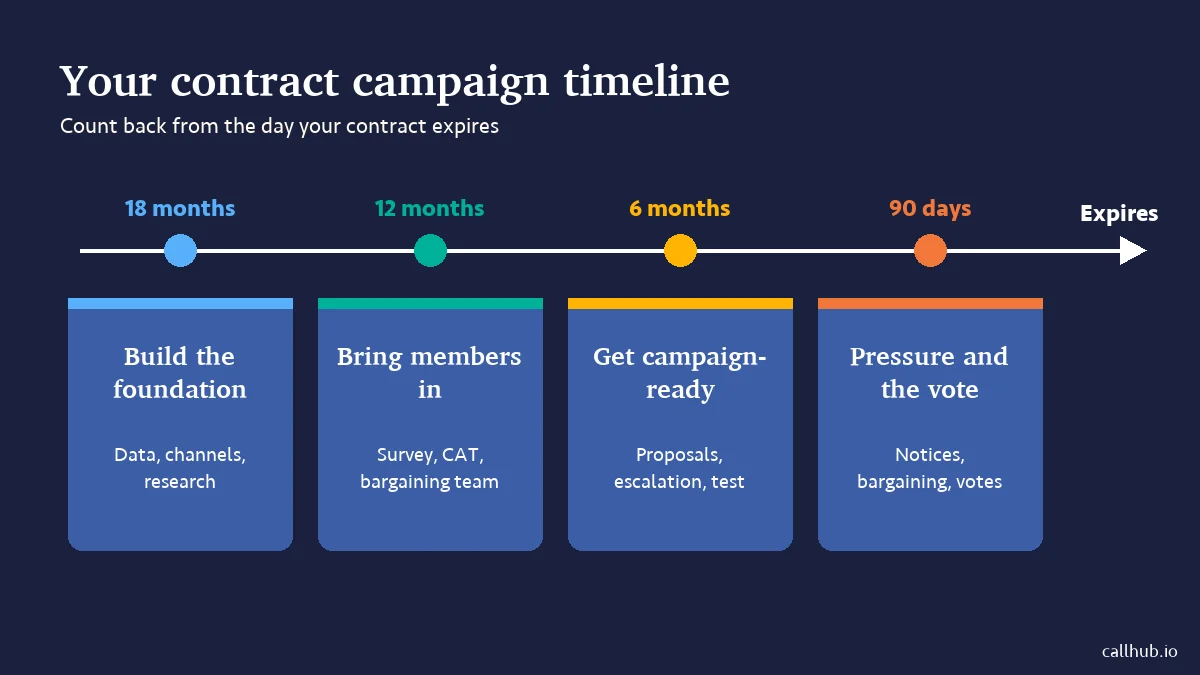
18 months out: Build the foundation
At 18 months, your job is to build what the campaign will run on. Nothing here is visible to the employer. All of it decides whether you can move members later.
Review the last contract and the grievance log
Start with what went wrong under the current contract. Grievances are the clearest evidence of where it’s failing members.
- Pull every grievance filed since the last contract and group them by article
- List the clauses that management interprets against you most often
- Note which wins from the last round never got enforced
- Ask stewards which problems members raise that never became grievances
Clean and complete your member contact data
This is the step every toolkit skips, and it’s the one that sinks campaigns in the last month. If you can’t reach a member, you can’t survey them, recruit them, or turn them out for a vote.
Audit your list for these gaps:
- Mobile numbers: Landlines and old numbers won’t work for texting
- Shift and worksite: You’ll need to target the night shift separately
- Preferred language: Members who don’t read English need materials they can use
- Steward assignment: Every member should belong to a steward’s list
- New hires: Anyone hired since the last contract is often missing

Map the workplace and identify leaders
A workplace map shows where members work, when they work, and who they listen to. That last part matters most.
The informal leader on each shift is often not a steward. Find those people now. They’ll become your contract action team in six months.
Research the employer and set a budget
You can’t build a strategy without knowing the employer’s pressure points.
- Finances: Annual reports, public budgets, or nonprofit tax filings
- Decision-makers: Who actually approves the final deal
- Pressure points: Customers, funders, regulators, or elected officials the employer answers to
- Your budget: Campaign materials, events, staff time, and a strike or hardship fund
Set up your communication channels before you need them
The worst time to choose a texting or calling tool is the week of a strike authorization vote. Pick your channels now, load your cleaned list, and run small tests while the stakes are low.
Most locals need three channels working together:
- Peer-to-peer texting for one-to-one conversations stewards can follow up on
- Calling for members who don’t reply to texts and for harder conversations
- Broadcast texts for short, time-sensitive alerts that go to everyone at once
Platforms like CallHub run peer-to-peer texting, calling, and broadcast texts from one contact list. That keeps every reply tied to the same member record. Our guide on how unions run phone banks covers the calling side in detail.
You’re on track if you know your top contract problems, most members have a working mobile number, and you’ve sent a test message to a small group.
12 months out: Bring members in
At 12 months, the campaign goes from officers to members. This is when you find out how many people you can actually reach and who’s willing to help.
Run the bargaining survey (and actually reach everyone)
The bargaining survey sets your priorities and tells you who’s engaged. A survey only half the unit answers will give you half a mandate.
- Send it by text with a short link, then follow up with non-responders by phone
- Track response rates by worksite and shift, not just overall
- Have stewards hand-deliver paper copies on shifts with low response
- Share the top results with members within a month, so they know it mattered
Recruit your contract action team
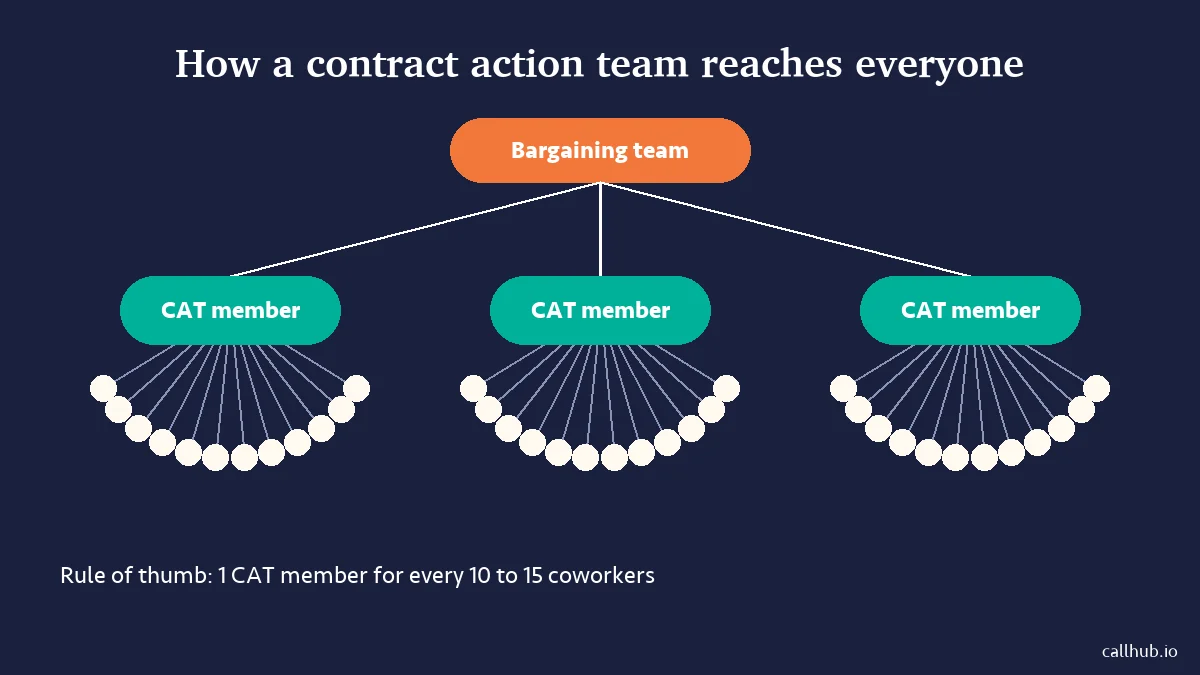
A contract action team (CAT) is a group of members who keep coworkers informed and move them to act. Labor Notes’ Winning a Strong Contract workshop pairs building a CAT with planning an escalating campaign that can build to a strike.
A common rule of thumb is one CAT member for every 10 to 15 coworkers. It’s practitioner guidance, not a study, but it keeps each list small enough to work by hand. Recruit from the informal leaders you mapped at 18 months, not only from stewards.
Elect or confirm the bargaining team
Follow your bylaws on how you choose the bargaining team. Do it early enough that the team can train together and join CAT meetings. Members trust a team they’ve seen before talks begin.
Start a regular communication rhythm
Members should hear from the union on a predictable schedule, not only when something goes wrong. Pick a cadence and hold it.
- Monthly: A short bargaining update by text, with a link to more detail
- Every two weeks: CAT check-ins with their assigned coworkers
- As needed: Broadcast alerts for meetings and actions
Track what members open and click so you know what’s working. Shannon Goecke, Communications Specialist at the National Union of Healthcare Workers (NUHW), puts it this way: “Unlike email, you can’t really track open rates and click rates on text messages. But with the URL tracker, you can. I love that function; it’s fantastic!”
For more on building that rhythm, see these union communication strategies that keep members engaged.
Line up community and political allies
Allies take time to build, and you’ll need them most when the employer pushes back.
- Other unions in your area or sector
- Community groups that rely on the services your members provide
- Elected officials with influence over a public or funded employer
You’re on track if most members have answered the survey, every member has a CAT contact, and the bargaining team is in place.
6 months out: Get campaign-ready
At six months, you stop building and start rehearsing. The goal is a campaign that can escalate on schedule without improvising.
Finalize proposals and priorities
Turn survey results into proposals the bargaining team can defend.
- Rank demands so members know the top three
- Cost out economic proposals before you table them
- Write one plain-language sentence for each priority that any member can repeat
Build your escalation plan
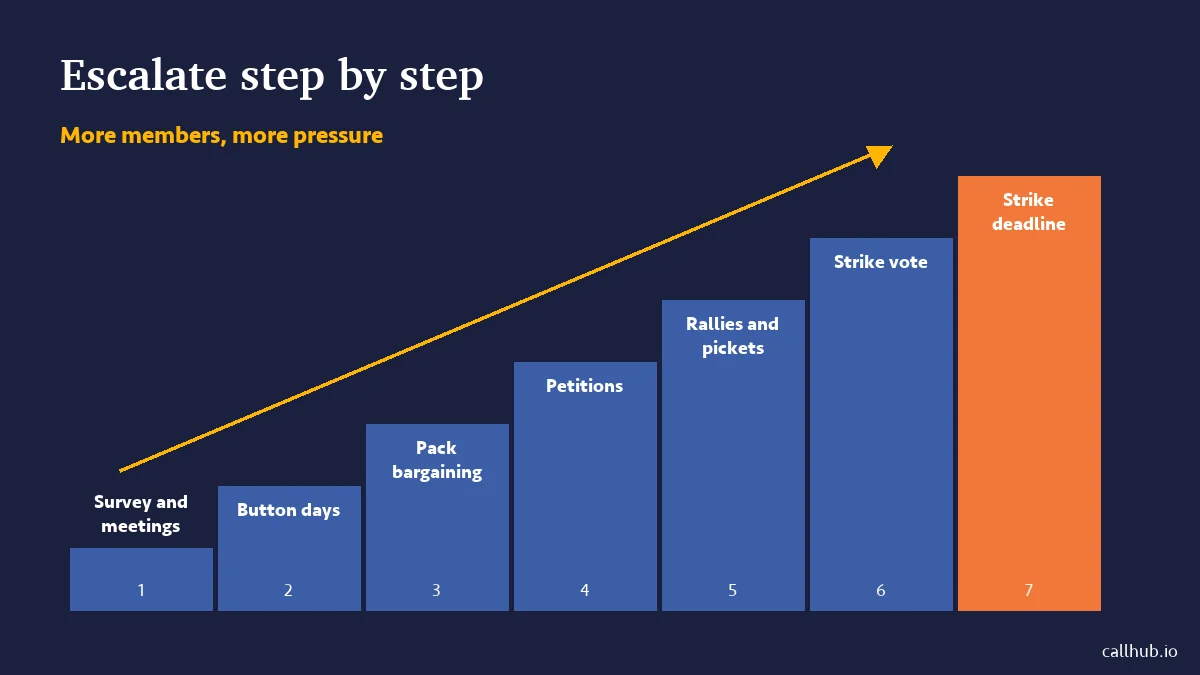
An escalation plan is a calendar of actions that build in intensity from now until the deadline. Labor Notes describes it as a ladder in Turn Up the Heat: Start with easy actions so more members join, then build toward bigger ones.
A typical ladder looks like this:
- Bargaining survey and contract meetings
- Button, sticker, or color days
- Mass attendance at bargaining sessions
- Petitions delivered to management
- Rallies and informational pickets
- Strike authorization vote
- Strike deadline
Labor Notes reports what this can do. At Camden County Library, union membership rose from 65% to 93% during its escalating campaign.
Test your rapid-response system
Before you need to reach everyone in 24 hours, find out whether you can. Run a test alert, then measure who you actually reached.
- Send a broadcast text and follow up non-responders by phone
- Break reach down by worksite, shift, and language
- Fix gaps in the list now, while there’s still time
Plan ratification and strike authorization votes now
Decide how each vote will run, where, and how you’ll turn members out. Planning now leaves time to test your turnout plan before it counts. Our member communication playbook for collective bargaining includes templates for each stage, including a ratification turnout sequence.
You’re on track if members can name the top demands, the escalation plan is on the calendar, and your test reached most of the unit.
The legal notice dates you can’t miss
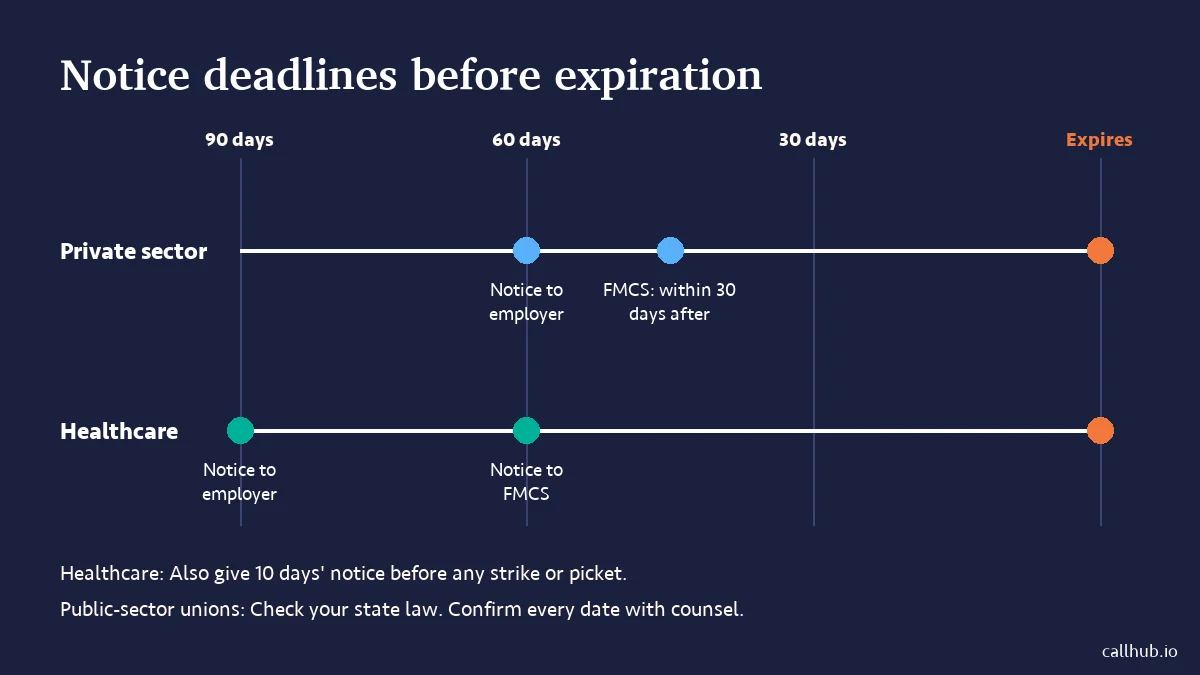
Missing a legal notice deadline can make a strike unprotected. Put these dates on the campaign calendar the day you set your expiration date.
| Notice | Who sends it | Deadline | Applies to |
|---|---|---|---|
| Notice to modify or end the contract | The party seeking change | 60 days before expiration | Private sector (National Labor Relations Act, or NLRA) |
| Notice to the Federal Mediation and Conciliation Service (FMCS) and state mediation agency | The same party | Within 30 days of the 60-day notice | Private sector (NLRA) |
| Notice to the employer | The party seeking change | 90 days before expiration | Healthcare institutions |
| Notice to FMCS | The same party | 60 days before expiration | Healthcare institutions |
| Strike or picket notice | The union | 10 days before action | Healthcare institutions |
Private sector: The 60-day and 30-day notices
Under Section 8(d) of the NLRA, the party seeking to change or end the contract must give written notice at least 60 days before it expires. That party must also notify FMCS and any state mediation agency within 30 days of that notice.
The stakes are high. If the union skips the FMCS notice, the employer can discipline or fire workers who strike, according to United Food and Commercial Workers (UFCW) guidance for locals.
Healthcare, public sector, and rail/airline exceptions
Not every union follows the 60/30-day rule.
- Healthcare: The NLRA requires 90 days’ notice to the employer and 60 days to FMCS. Section 8(g) adds a 10-day notice before any strike or picket.
- Public sector: State law governs public-sector bargaining, not the NLRA. Notice windows and bargaining start dates vary by state and by bargaining unit, so check your state statute.
- Rail and airlines: These unions fall under the Railway Labor Act, where contracts don’t expire in the same way.
This section is a planning guide, not legal advice. Confirm every date with your International’s legal department or your union’s counsel.
The final 90 days: Bargaining, escalation, and the vote
If the first 15 months went well, the last 90 days are about pressure, not setup. Your list, your CAT, and your channels should already work.
- Opening day: Pack the room or rally outside, then share the opening proposals with members the same day
- Mid-bargaining: Report back after every session and move up the escalation ladder on schedule
- Deadline week: Send daily updates, confirm every CAT contact, and get the strike authorization vote out if needed
- Tentative agreement (TA): Explain the deal clearly, then run your ratification turnout plan
You’re on track if you file notices on time, members hear from you after every session, and every vote has a turnout plan.
For the last stretch, our union strike communication guide covers what to send if talks break down.
What happens if your contract expires before you settle?
When a union contract expires before a new deal is reached, most terms don’t simply vanish. In the private sector, the employer generally can’t change wages, hours, and working conditions while bargaining continues. Members keep working under the old terms until there’s a new contract, an impasse, a strike, or a lockout.
What that means for your campaign:
- Keep members informed, because rumors spread fast after a deadline passes
- Keep escalating, since an expired contract is often when pressure matters most
- Confirm which clauses still apply with your counsel, as some may lapse at expiration
- Have your strike authorization plan ready, even if you hope not to use it
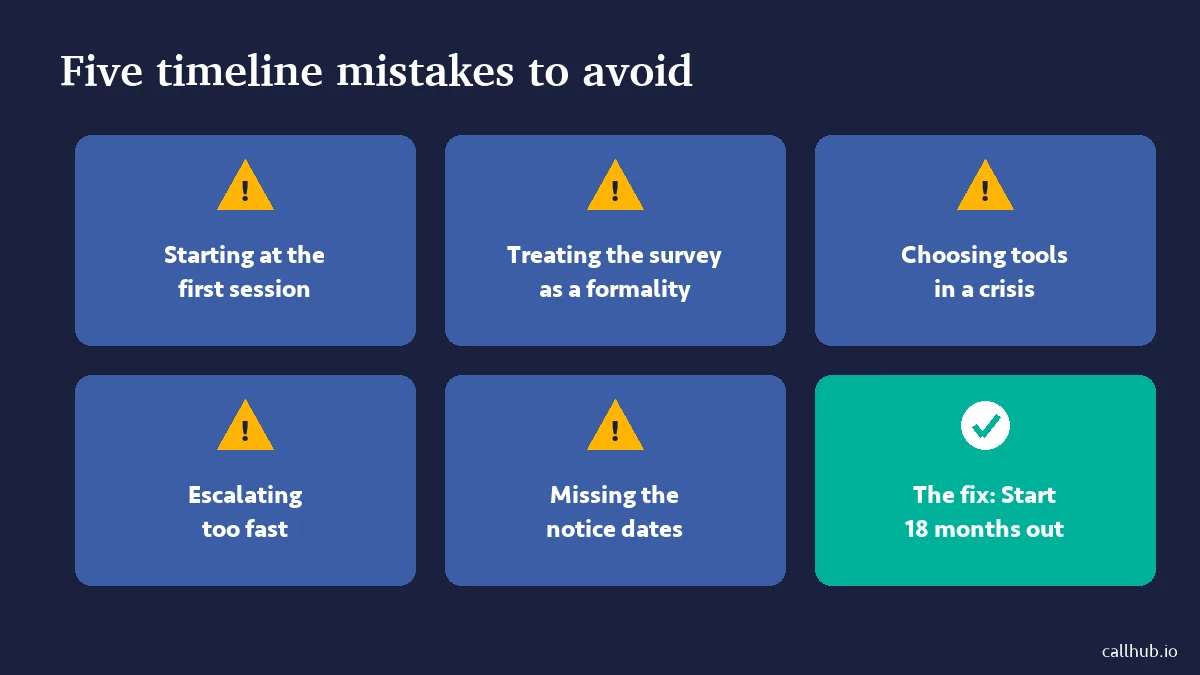
Common contract campaign timeline mistakes
- Starting at the first bargaining session. By then, there’s no time to fix the list or build a CAT.
- Treating the survey as a formality. A low response rate gives you a weak mandate and a blind spot on who’s engaged.
- Choosing tools in a crisis. Picking a texting or calling platform during deadline week means untested lists and missed members.
- Escalating too fast. Jumping to big actions before members are ready shrinks turnout and signals weakness.
- Missing the notice dates. A late FMCS notice can put a strike, and your members’ jobs, at risk.
Start your contract campaign plan today
The contract campaign starts long before bargaining opens. If you don’t build member data, CAT, and channels by six months out, you’ll spend the final 90 days building infrastructure instead of building pressure.
Count back from your expiration date today and put each milestone on the calendar.
- To turn your deadline into a phased plan, build your outreach plan with the free contract campaign planner.
- To see the channels in action, see how unions run contract campaigns on CallHub.
Frequently asked questions
What is a contract campaign?
A contract campaign is the organizing a union runs alongside collective bargaining to win a stronger contract. It uses surveys, member actions, and escalating pressure to show the employer a united workforce. Bargaining happens at the table, and the contract campaign builds the power behind it.
When should a union start a contract campaign?
Start preparing 18 months before your contract expires. That gives you time to clean member data, build a contract action team, and test your communication channels before bargaining opens. The APWU began its 2021 preparations about 11 months before expiration.
What is a contract action team?
A contract action team (CAT) is a group of members who keep coworkers informed during bargaining and move them to act. A common rule of thumb is one CAT member for every 10 to 15 coworkers. To keep that network engaged over the long run, see how to keep labor union members engaged.
How long do union contract negotiations take?
Union contract negotiations vary widely by unit size, sector, and how far apart the parties are. Formal talks often open 60 to 90 days before expiration, but preparation should start a year or more earlier. Some negotiations continue well past the expiration date.
What happens when a union contract expires?
In the private sector, the employer generally must maintain existing wages and working conditions while bargaining continues. Members keep working under the old terms until a new deal, an impasse, a strike, or a lockout. Check with your union’s counsel on which specific clauses continue.
What is a 60-day notice in collective bargaining?
Under Section 8(d) of the NLRA, the party that wants to change or end a private-sector contract must give at least 60 days’ written notice before it expires. It must also notify FMCS within 30 days of that notice. Healthcare institutions have longer notice periods.
Do public-sector unions follow the same timeline?
Not for legal notices. State law governs public-sector bargaining, so notice dates differ by state. The planning timeline still applies, since clean data, a CAT, and tested channels take just as long to build. Our guide to strategic collective bargaining covers the laws that shape bargaining.