

Text messaging for unions usually lands on a local union’s agenda the same way. Someone at an executive board meeting says, “We need a texting platform,” and the vendor demos start piling up.
Pause before the demos. Your local’s parent union, your International (like SEIU, UFCW, or the Steelworkers), may already give you access to a texting tool. Usually there’s a small usage fee. Occasionally it’s free. So the honest first answer is that you may not need to buy texting at all
This guide helps you decide. It compares your four realistic options on cost and control, then shows what’s worth paying for if texting is already covered.
Do you need to buy text messaging for your union?
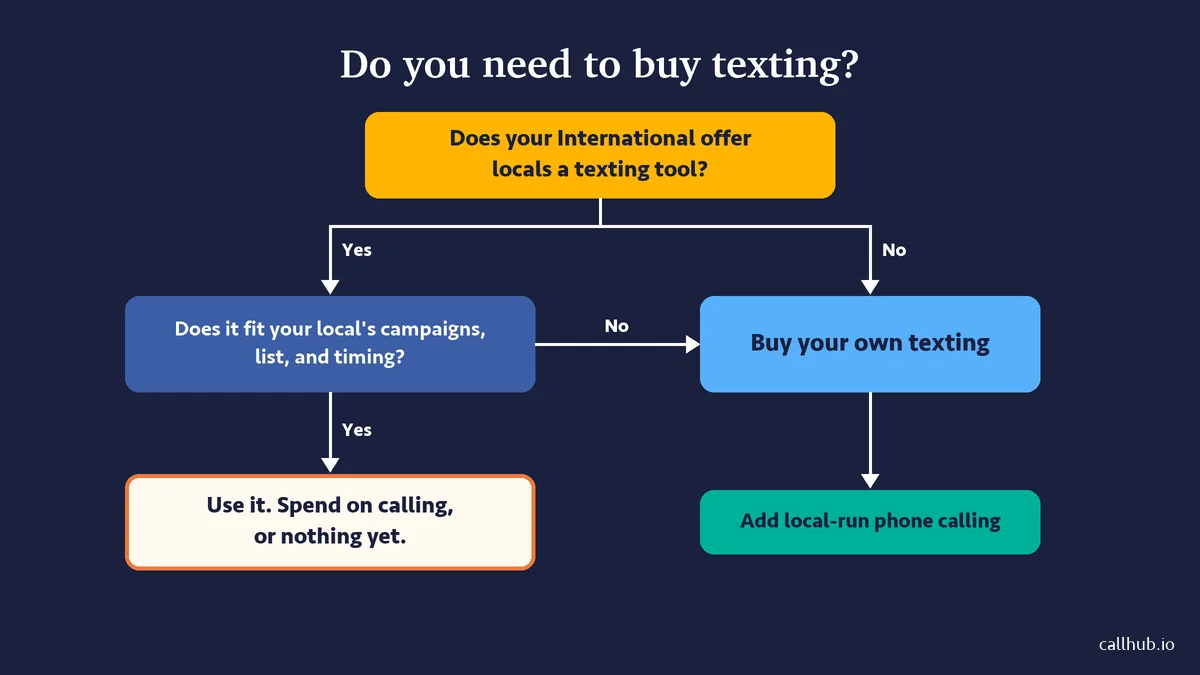
Probably not, if your International already offers your local a texting tool and your campaigns match its priorities. Text messaging for unions means texting members, either as one-to-one conversations (peer-to-peer, or P2P) or one message to everyone at once (broadcast). Buy your own when you need local-only campaigns, control of your member list, or speed.
You probably don’t need to buy texting if
- Your International offers locals a texting tool and will set you up on it
- Most of what you text is elections or national campaigns the International already runs
- You send a few messages a month, and the usage fee is small
- Nobody at the local has time to run a texting program right now
You probably do need your own texting if
- You’re running a fight the International isn’t, like a contract campaign
- Your member list lives in your own database, and you want replies to come back to it
- You need to text today, for a strike update or schedule change, without waiting on anyone
- You want texts and phone calls to the same members to run as one campaign
How do unions send mass communications to members, then? With a mix. Broadcast texts carry alerts, peer-to-peer texts carry conversations, and phone calls carry the asks that need a human voice. Texting is one piece of the wider set of union communication strategies that keep members engaged.
Your options for union texting and calling, compared
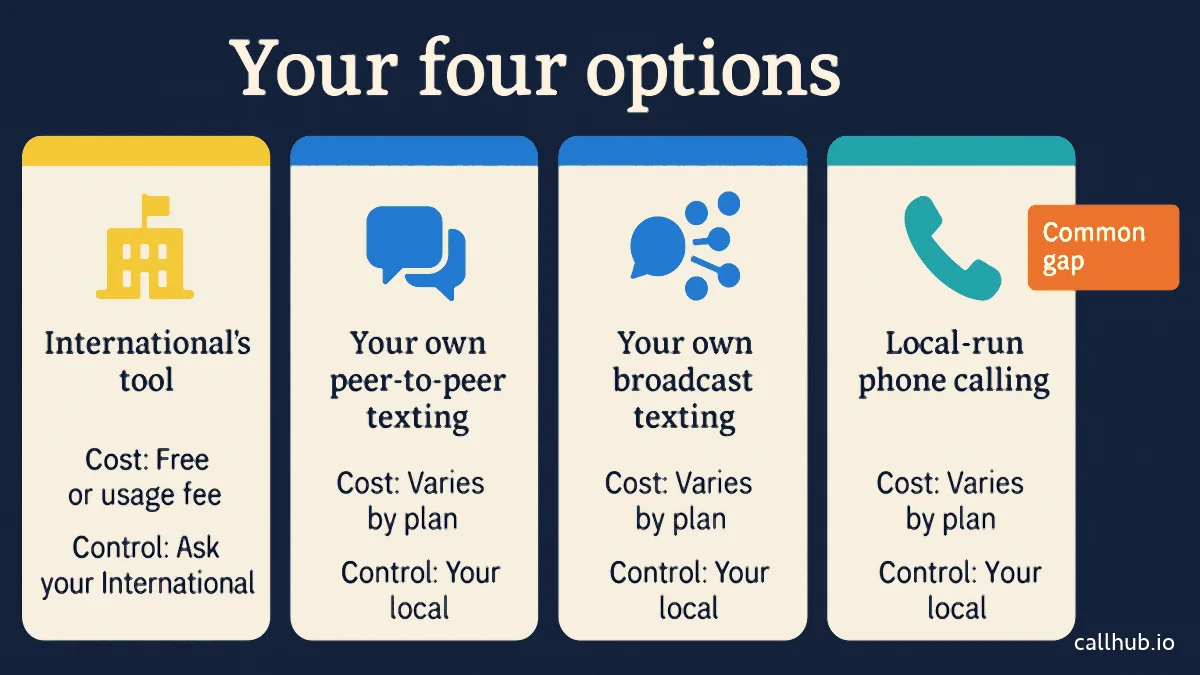
Most locals have four realistic choices. They differ less in features than in the two things a local cares about most: cost and control.
| Option | What it is | Typical cost | Who controls the list and replies | Local-only campaigns? | Setup | Best union uses |
|---|---|---|---|---|---|---|
| 1. Your International’s texting tool | A tool the International sets up for affiliates. | Often a usage fee, occasionally free. Ask your International. | Varies. United Steelworkers (USW) says the account and data belong to the International, while American Federation of State, County and Municipal Employees (AFSCME) and Communications Workers of America (CWA) locals run their own Action Network accounts. | Usually, with setup steps and limits. Ask which. | Ask whose brand and phone numbers your texts go out under | Elections and national campaigns the International runs |
| 2. Your own peer-to-peer texting | Staff and volunteers send each text by hand and reply one-to-one | Per-message or per-credit pricing, plus numbers and 10-digit long code (10DLC) fees. Varies by plan. | Your local | Yes | Your local registers its own 10DLC brand and campaign | Contract campaigns, strike prep, steward recruitment |
| 3. Your own broadcast texting | One message goes to your whole opted-in list at once | Per-message pricing, plus numbers and registration fees. Varies by plan. | Your local | Yes | 10DLC registration plus documented opt-in consent | Meeting reminders, schedule changes, urgent alerts |
| 4. Phone calling run by the local | Staff and volunteers call members from a phone banking platform | Per-minute or per-credit pricing. Varies by plan. | Your local | Yes | Phone numbers and caller ID | Contract votes, strike authorization turnout, member surveys |
Read it row by row. If row 1 answers “free” and “yes” in every column your local cares about, stop there. If it doesn’t, in our conversations with locals, the gap usually sits in rows 2 and 4. That means a texting tool your local controls and a way to call your own members.
One option that covers both rows in one place is CallHub, with peer-to-peer texting software and phone banking running on the same member list.
What your International’s texting does and does not cover
Many Internationals give locals access to texting. What they provide usually centers on the International’s priorities, such as elections and national campaigns. That’s not a flaw. It’s what those tools are for.
Public information about these tools is patchy, and some of it is years old.
Free is the exception. Most documented examples charge a usage fee or say charges will apply later.
Questions to ask your International before you buy anything
One email to your International’s digital team can save you a purchase. Ask these in writing.
- Is texting free for our local, or is there a usage fee? Who pays carrier fees?
- Do we need to sign an agreement or get approval before we text, and does each message need sign-off?
- Who owns our list, our data, and the replies?
- Can we use the tool for local-only campaigns, such as a contract fight or dues drive?
- Whose brand and phone numbers do our texts go out under?
- What limits apply, such as account or keyword limits or monthly minimums?
- Does the tool connect to our own member or dues database?
- Do you provide phone calling too, and can we use it outside elections?
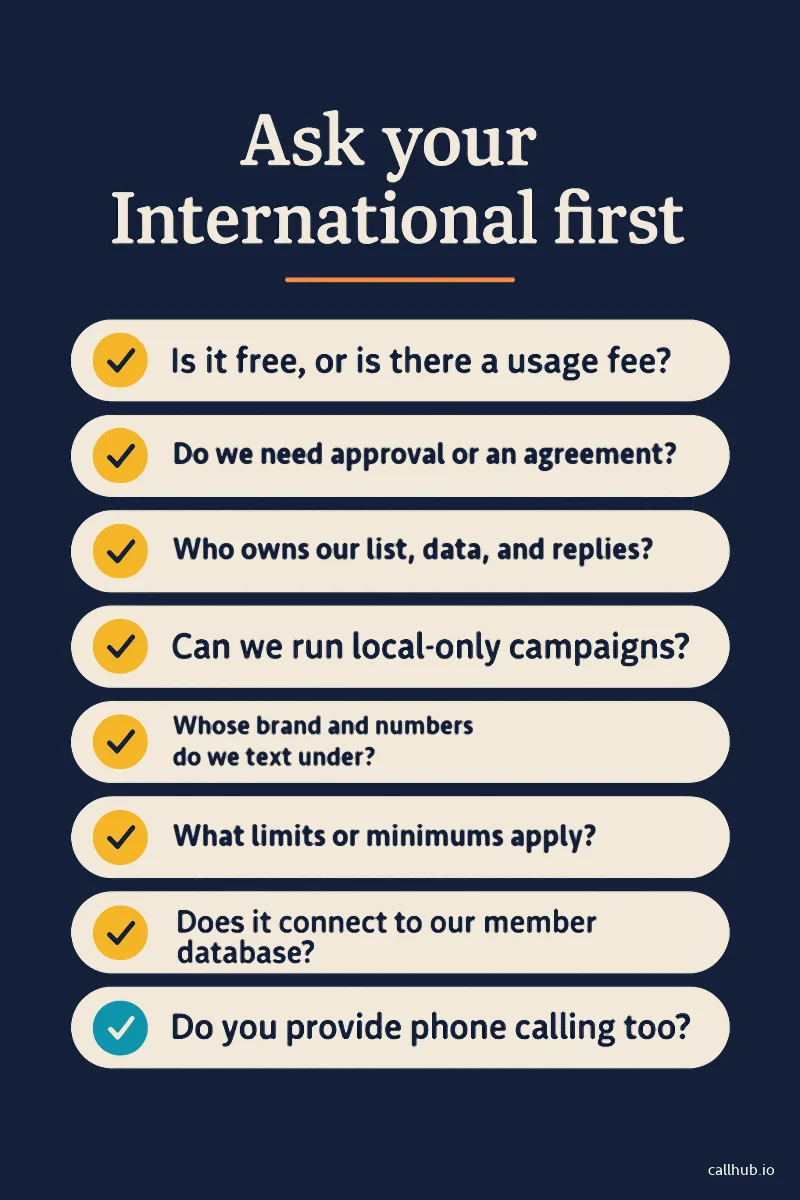
If the answers come back affordable, fast, flexible, and yours, you probably don’t need to buy texting. If not, the answers show you exactly where the gaps are.
When a local genuinely needs its own texting
A local needs its own texting when its fight, its data, or its timing doesn’t match the International’s. That’s a practical call, not a political one.
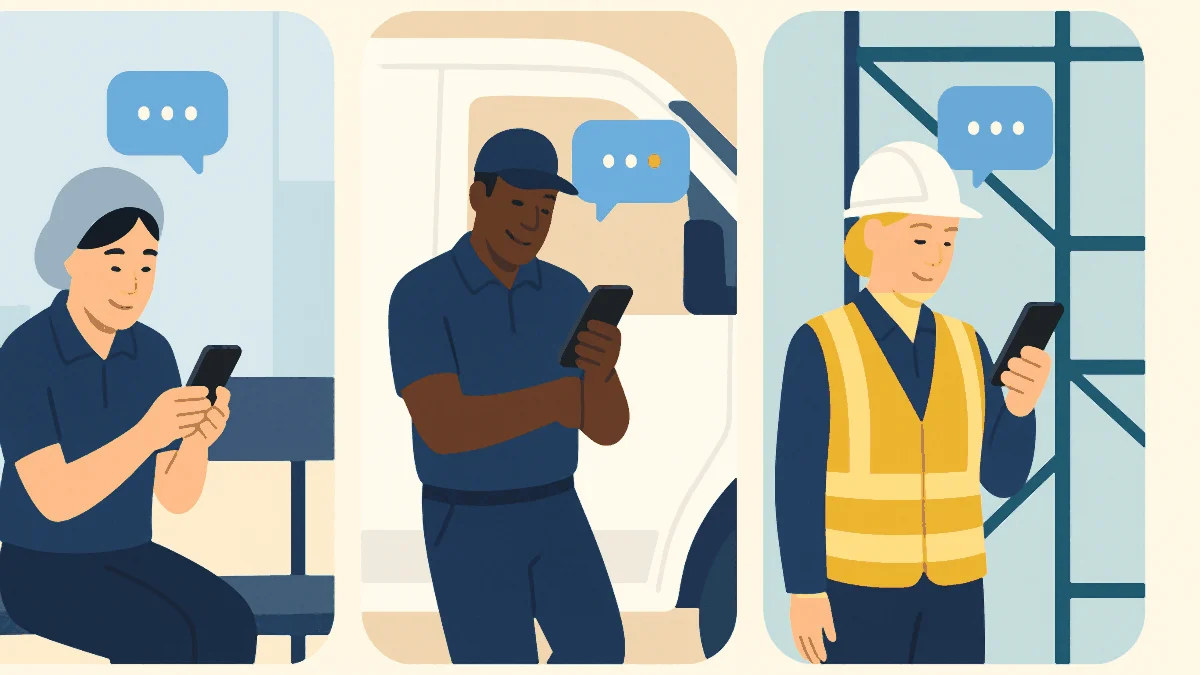
It matters more for some memberships than others. Shift workers, drivers, and members on job sites rarely check union email. For members who work with their hands, a text is often the only message they’ll see that day.
Local-only fights the International isn’t running
These campaigns tend to stay local.
- Contract campaigns and bargaining updates
- Grievance follow-ups and worksite issues
- Steward recruitment
- Dues, membership cards, and new-hire outreach
- Local officer elections and membership meetings
Here’s what that looks like as member texts.
| Use | Example text |
|---|---|
| Contract campaign | “Hi Maria, it’s Dave from your local. Bargaining resumes Thursday. Can you wear red to work that day? Reply YES and I’ll save you a shirt.” |
| Steward recruitment | “Hi James, coworkers on second shift named you as someone people trust. Open to a 10-minute call about becoming a steward?” |
| Membership card | “Hi Ana, it’s Priya from your local. We don’t have your membership card yet. Can I send you the 2-minute online form?” |
Every example asks for a reply. That’s what peer-to-peer texting does well. For a sense of scale, read how PCS used P2P texts to reach 100,000 petition signatures (PCS is the Public and Commercial Services Union, a UK civil service union).
Your members live in your own database
Many locals keep their real member list in their own membership or dues system. That list has the shop, the shift, the steward, and the number someone updated last week.
Some Internationals host that list instead, like USW, whose locals manage member information on Steelweb, the International’s database. USW’s Protext terms say the account and all data belong to the International and “must be relinquished upon request.” If your list lives with the local and the International’s tool doesn’t connect to it (ask), every campaign starts with an export and ends with replies copied back by hand. Once you’re texting every few weeks, that manual loop becomes the real cost.
You need to move today, not after approval
Some messages can’t wait. A walkout starts at 6 a.m., a shift schedule changes overnight, or a safety issue comes up on site.
Ask what sign-off your International requires. Access often requires an agreement first. Per-message approval is rarer in public sources.
- UFCW’s 2019 guidance said no International blast texts go out “without prior consent from the President’s Office.”
- USW’s International can remove content it believes breaks its rules, “in its sole discretion.”
If sign-off takes “a few days,” that’s fine for a rally invite. It isn’t fine for a strike update.
What is worth buying if your International already gives you texting
In our conversations with locals, the gap usually isn’t texting. It’s phone calls the local runs itself, to its own members, for its own campaigns. If your International’s texting covers what you need, put your budget there.
Phone calling for union members
A text gets read. A conversation gets a commitment. Contract votes, strike authorization turnout, and member surveys move faster when a coworker actually talks to the member.
Calling has its own problem. 80% of Americans say they don’t generally answer cellphone calls from unknown numbers, according to the Pew Research Center (2020). That’s why three things matter before you call.
- A heads-up text before the call
- A recognizable caller ID
- Good timing
Check what you already have here too. Ask whether you can use it for member calling outside elections, like contract campaigns, dues conversations, and surveys.
If you can’t, that’s the gap worth filling.
- Plan it with this guide on how to run union phone banking for member outreach.
- See how unions use calling to mobilize members.
- Compare tools, starting with CallHub’s phone banking software for union member calls.
- Already on Action Network, like many AFL-CIO, CWA, and AFSCME affiliates? You can connect your Action Network account to CallHub for both calling and texting. This guide to phone banking with Action Network explains how.
Running calls and texts in one member campaign
Calls and texts work best in sequence, on one list.
- Text first. Tell members what’s coming and invite a reply.
- Call the members who didn’t reply, starting with the shops that matter most.
- Text a follow-up with the details, like the vote time or a link.
- Update your member list with every reply and call outcome.
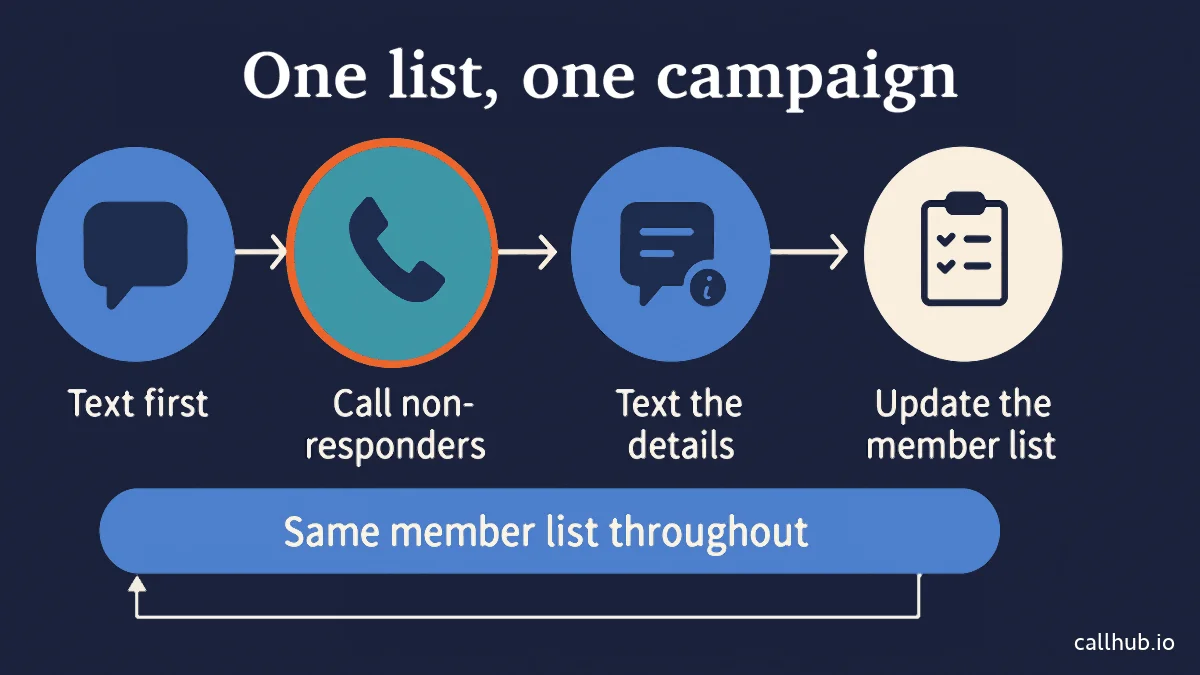
If you’re comparing multi-channel texting platforms for unions, this is the test. Can one tool run all four steps on one member list, with no exports in between?
Tracking matters here too. “Unlike email, you can’t really track open rates and click rates on text messages. But with the URL tracker, you can. I love that function; it’s fantastic!” says Shannon Goecke, Communications Specialist at the National Union of Healthcare Workers (NUHW), a CallHub customer.
Read Also: “CallHub Reduced Our Text Costs by 55%!” NUHW’s Texting Journey with CallHub
When the honest answer is “nothing yet”
Sometimes the right purchase is no purchase. If your International’s tool covers your texting, your campaigns are mostly national, and nobody has time to run calls, wait.
Spend the time getting member phone numbers current and consent records in order. Both make any tool you buy later work better.
What text messaging for unions costs
What you pay depends first on whether you text through your International or on your own. Here’s what’s publicly documented for International-provided texting.
- Action Network mobile messaging is an add-on to an email plan. AFSCME’s 2022 page lists $10 per 1,000 messages a month ($50 minimum) plus telecom fees on the Movement plan, or $20 per 1,000 ($100 minimum) on the Network plan.
- CWA locals pay “a nominal fee based on usage.”
- USW’s Protext was free only “during the beta testing phase.” Its 2024 agreement says “monthly charges will apply” after that.
- SEIU, UFCW, and AFT don’t publish what locals pay, so ask who pays.
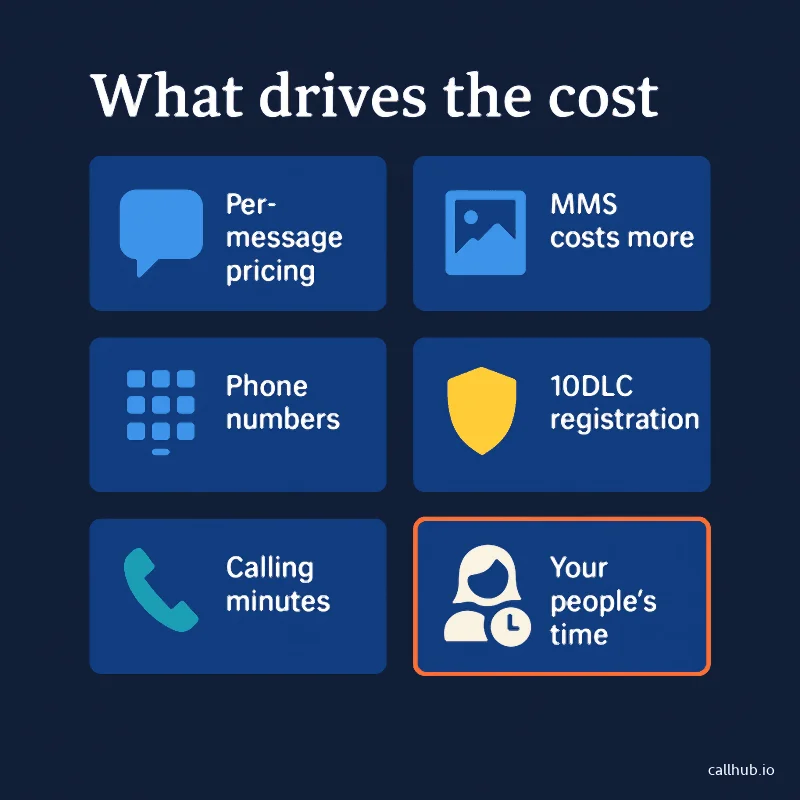
If you’re buying SMS (Short Message Service) software for labor unions yourself, compare these cost drivers across any platform.
- Per-message or per-credit pricing. Longer texts can count as more than one message.
- MMS (Multimedia Messaging Service). Picture texts cost more than plain SMS.
- Phone numbers. Most platforms charge monthly per number.
- 10DLC registration. Brand and campaign registration carries fees.
- Calling minutes. Calls are usually priced per minute or per credit.
- Your people’s time. The cheapest tool your stewards won’t use costs the most.
For current rates, see CallHub pricing. Prices change, so check any vendor’s live pricing page rather than a number in a blog post.
Peer-to-peer texting vs broadcast texting for unions, in plain terms
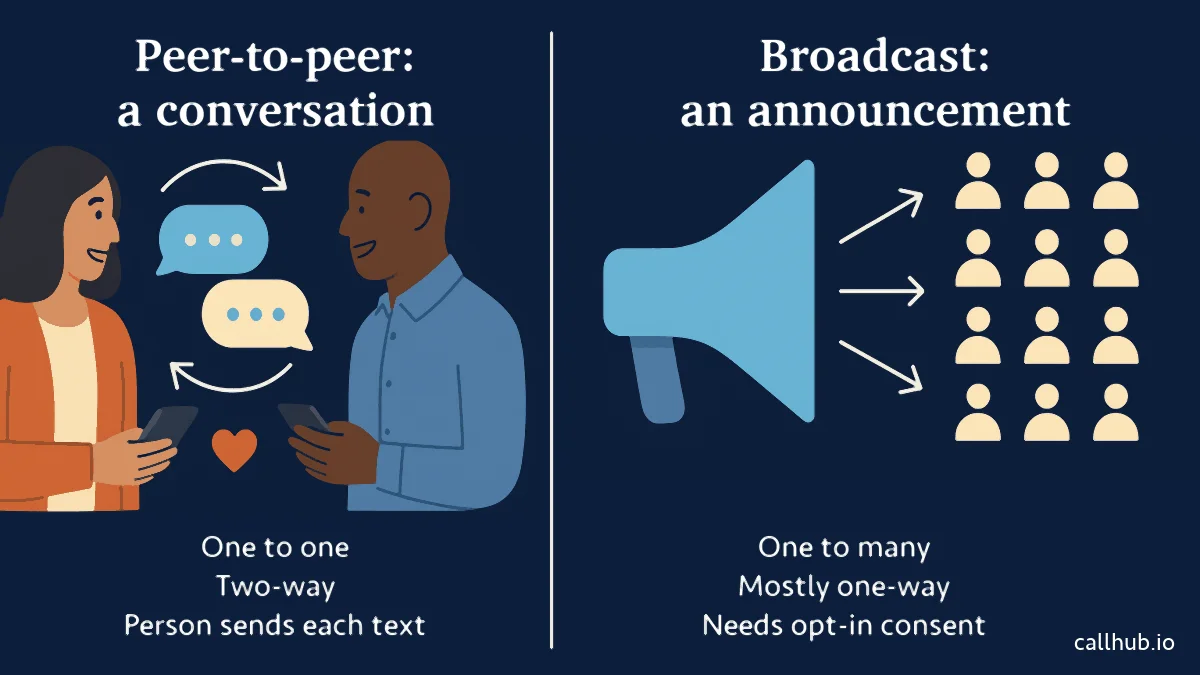
Peer-to-peer texting is a conversation. Broadcast texting is an announcement. Both have a place in union mass texting, and most locals use both.
| Peer-to-peer texting | Broadcast texting | |
|---|---|---|
| Who sends it | A person sends each text, often from a script | One send reaches the whole list |
| Number type | Local 10DLC numbers | 10DLC, toll-free, or short code |
| Two-way? | Yes. A real person answers replies. | Mostly one-way, with keywords like STOP |
| Consent and legal bar | Lower bar under the Telephone Consumer Protection Act (TCPA). Carrier rules and opt-outs still apply. | Needs documented prior consent |
| Best union uses | Contract campaigns, steward recruitment, check-ins | Reminders, schedule changes, urgent alerts |
The legal difference comes from a June 2020 Federal Communications Commission (FCC) ruling. A platform that needs a person to actively send each text isn’t an autodialer under the TCPA, as Wiley Law’s summary explains. That lowers the bar for unions using peer-to-peer texting. It isn’t a free pass.
For the longer version, read what peer-to-peer texting is and how it works, or see the peer-to-peer texting software page.
Compliance basics before your local sends a single text
These apply whether you text through your International or your own platform. This isn’t legal advice, so check specifics with your union’s counsel.
- Keep consent records. Note when and how each member gave you their number. Automated broadcast texts need prior consent.
- Honor opt-outs right away. A STOP reply must end all texts to that member.
- Register for 10DLC if you text from 10-digit numbers. US carriers filter or block unregistered texts. See the 10DLC compliance guide for texting programs.
- Say who you are. Name your local in the first text.
- Text at reasonable hours. A common rule of thumb is 8 a.m. to 9 p.m. in the member’s time zone, and some states are stricter.
- Know the cost of mistakes. UFCW’s 2019 guidance warns TCPA violations can cost $500 per text, per person. The FCC’s guide to unwanted calls and texts covers the rules.
Start with what your International gives you, then fill the gap
Check what your International already gives you before you buy any texting tool. Send the eight questions, read the answers, and look at the options table again.
In our conversations with locals, the gap usually isn’t texting. It’s local-run phone calls to members, plus the freedom to run your own campaigns on your own list. Sometimes the gap is nothing at all, and that’s a fine answer too.
- When you’re ready to fill it, see CallHub’s phone banking software for union member calls.
- If your International’s tool doesn’t fit your local’s fights, look at peer-to-peer texting for locals that need their own.
Frequently asked questions
Can a union text members without consent?
Not for automated broadcast texts, which need prior consent. Peer-to-peer texts, where a person sends each message, face a lower legal bar after the FCC’s 2020 ruling, but carrier rules and opt-outs still apply. This isn’t legal advice.
Is Action Network texting free for union locals?
It depends on your International. AFL-CIO material says Action Network is free with AFL-CIO support, but its mobile messaging is a paid add-on starting at $10 per 1,000 messages. CWA locals pay “a nominal fee based on usage,” so ask what your local pays.
Do union locals need 10DLC registration?
Yes, if your local texts from 10-digit numbers on its own platform, since carriers filter unregistered texts. Texting through your International’s tool may use other number types, such as the toll-free numbers or short codes Action Network uses. Ask whose brand and numbers your texts go out under. The 10DLC compliance guide for texting programs covers the process.
Can our local use the International’s texting for a local-only campaign?
Usually yes, but with setup steps and limits that depend on your International. CWA locals run their own Action Network accounts, while USW gives each local one editor account and one keyword per unit after training and a signed agreement. Ask which steps and limits apply before you build a contract fight or dues drive around it.
What software is best for unions that need to coordinate calls and texts to members?
Look for one platform that runs peer-to-peer texts, broadcast texts, and phone calls on the same member list, with replies and call outcomes in one place. For a fuller comparison, see this guide to choosing labor union software for calls and texts.
Is peer-to-peer texting better than a text blast for union members?
For anything that needs a reply, yes. Peer-to-peer texting lets a real person answer members’ questions during a contract campaign or steward drive. A text blast is better for one-way alerts, like a meeting reminder, sent to members who opted in.