


Union households delivered 21% of votes in Michigan, 18% in Pennsylvania, and 13% in Wisconsin in the 2020 election, according to AFSCME’s post-election analysis. Those margins didn’t come from national campaigns. They came from locals that built member contact programs and ran them consistently through election day. Your union GOTV program starts with the same asset: A membership list that no campaign can buy.
A union get-out-the-vote (GOTV) program is different from a campaign phone bank in one important way: Your member list is a built asset. Members have an existing relationship with the union, legal standing under FEC (Federal Election Commission) restricted class rules, and a documented track record of responding to member-to-member outreach. That’s an electoral advantage no outside campaign can replicate.
This guide covers how to build and run a union GOTV program compliant with FEC guidance and the Telephone Consumer Protection Act (TCPA): How to source your member voter list, how to staff and run your phone and text programs, how to write a compliant script, and how to measure turnout lift after it’s over.
Why union member contact outperforms every other GOTV channel
The data on phone banking for GOTV is clear: Each conversation with a prospective voter increases their likelihood of turning out by 3.8 to 4.5 percentage points, according to research compiled by the Analyst Institute and the Institution for Social and Policy Studies at Yale. That’s the baseline for any GOTV calling program, and it’s the benchmark the complete guide to phone banking for GOTV is built around.
For union programs, the lift is likely higher for one reason: Trust. A member receiving a call from another member of the same local isn’t receiving an anonymous campaign contact. They’re talking to a peer within an organization they belong to, on a question their union has a direct stake in.
The structural comparison matters too. Union members already reported lower non-participation rates in 2024: 7.9% of members didn’t vote compared to 12.2% of non-union workers, per Harvard Law School’s Center for Labor and a Just Economy. A union GOTV program targets the remaining gap, with callers who are already invested in the outcome.
UNITE HERE ran 10 million phone calls and knocked 3 million doors in the 2020 election cycle. Most unions don’t have that infrastructure. But the model is replicable at the local level: A clean member list, a trained caller pool, and a compliant script.
The legal framework for union GOTV programs
Two regulatory frameworks govern union GOTV: FEC rules on what treasury funds can support, and TCPA rules on how you can contact people by phone and text. Get both right before you start calling.
What the restricted class means for union GOTV
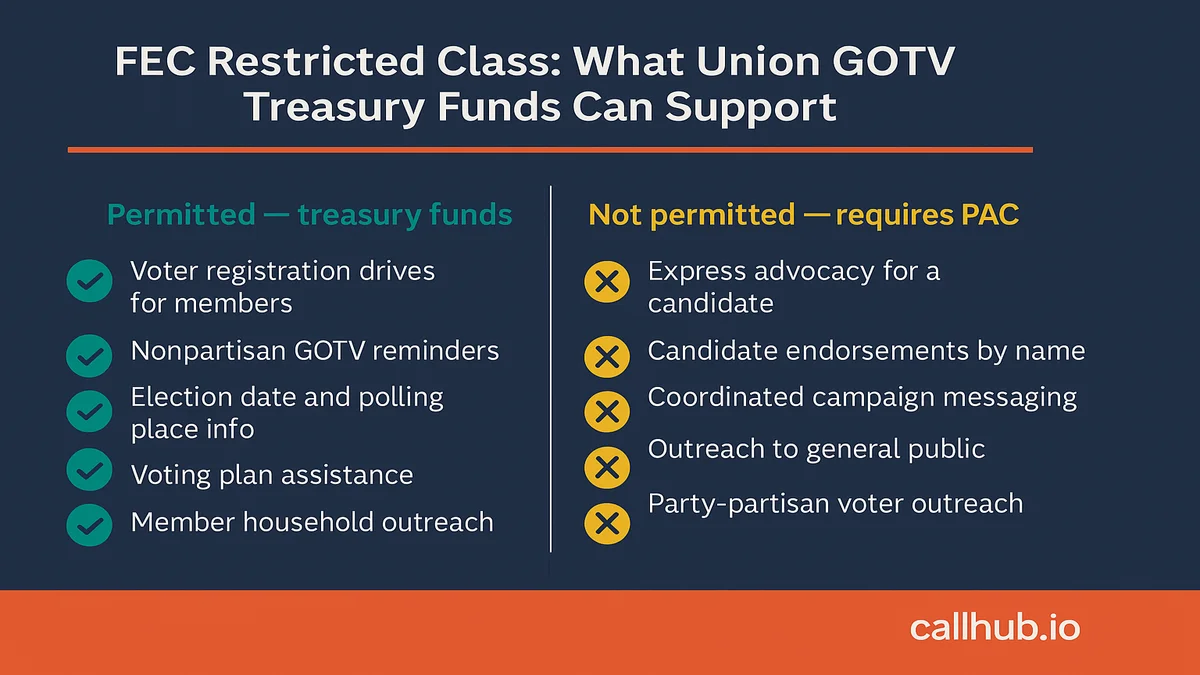
Under FEC guidance, a union may use treasury funds to conduct voter registration and GOTV drives aimed at its restricted class: Members, executive and administrative personnel, and their families. A GOTV drive aimed at the restricted class is not a contribution or expenditure if the drive is nonpartisan and includes no express advocacy for or against any candidate.
This means your union can pay for calling software, volunteer staff time, and voter contact lists covering your members and their households using treasury funds, as long as you’re driving nonpartisan participation, not telling members who to vote for.
Political Action Committee (PAC) funds are required only when you move beyond the restricted class or engage in express advocacy. Know your scope before the program launches.
Nonpartisan GOTV vs express advocacy
The FEC line between compliant GOTV and prohibited express advocacy is whether the contact tells the recipient how to vote. FEC guidance on conducting voter registration and GOTV drives draws the distinction clearly.
Compliant treasury-funded GOTV contact:
- Confirms the member is registered to vote
- Reminds them of the election date and polling location
- Helps them make a voting plan (where, when, how to get there)
- Asks if they need transportation or information
Not compliant for treasury-funded outreach:
- Endorsing a specific candidate or party by name
- Asking members to vote for or against a ballot measure
- Using language coordinated with a candidate’s campaign
Run every script draft through your labor counsel before it goes live.
TCPA considerations for union calling and texting
TCPA rules apply to automated calls and texts to mobile phones. For union GOTV programs, member contact under an existing membership relationship has stronger legal standing than contacting the general public. Your member database is your consent record.
For household extension, the standing is narrower. Apply the same caution you would for any non-member contact: Peer-to-peer texting, where a volunteer sends each message individually, creates significantly less TCPA exposure than automated broadcast texts sent without confirmed opt-in. When you have any doubt on a TCPA question, consult legal counsel familiar with labor organization compliance before the program goes live.
Building your union member voter list
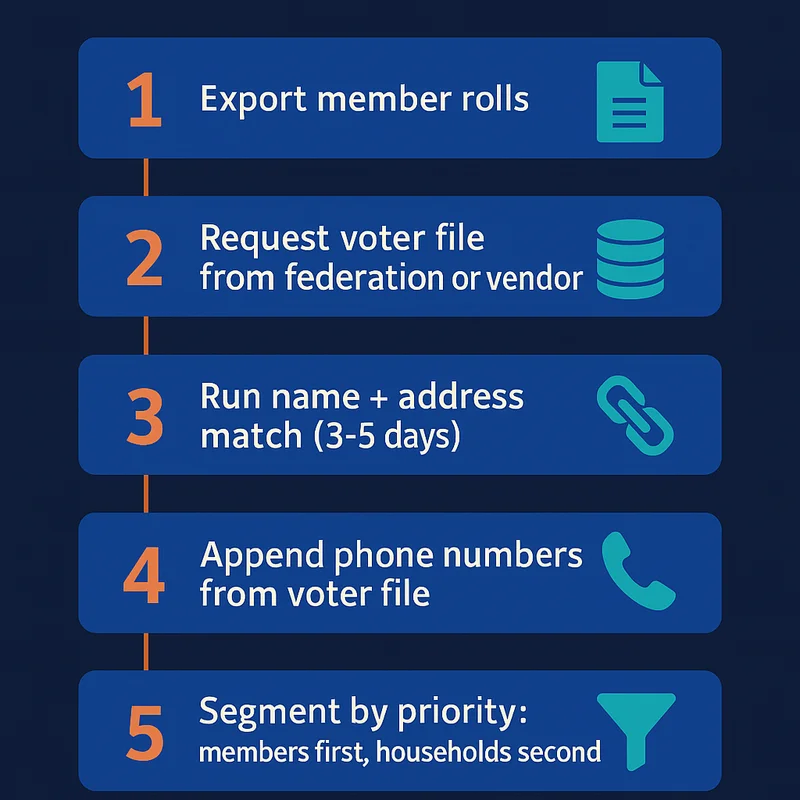
Your member rolls are the foundation of your GOTV list. But a member roll and a voter contact list aren’t the same thing: Names and mailing addresses don’t give you phone numbers, voter registration status, or election history. Matching your member rolls to the voter file fills those gaps.
Matching your member rolls to the voter file
The voter file is the state’s official list of registered voters, including name, address, date of birth, and in most states, voting history. Matching your member rolls to the voter file gives you two things: Confirmation that your members are registered, and phone numbers sourced from voter file vendors.
Most unions working on electoral programs access the voter file through a state party committee, through a vendor like NGP VAN, or through a state labor federation with an existing data agreement. If your union is affiliated with a national or regional federation, ask the political department whether a member list match service is available before sourcing data independently.
The match process typically takes three to five business days. Plan to run it at least 30 days before election day so you have time to run a registration cleanup program before the deadline, if your state allows late registration.
Extending the list: household members under the restricted class
FEC rules allow union treasury-funded GOTV to reach the families of members, not just members themselves. Household extension, where the voter file match includes registered voters living at a member’s address, can meaningfully increase your total list size.
Handle household data carefully. Not every member’s family will have the same relationship with the union. Outreach should reflect that: Identify the call as coming from the union, and make the same nonpartisan voting plan ask that applies to the full program.
Running a union phone bank for member mobilization
A union phone bank for GOTV runs the same basic workflow as any calling program: Callers log in, receive contacts from a queue, follow a script, and record outcomes. What makes it effective is how you staff it and coordinate shifts. IATSE’s local union phone and text banking program is a practical reference for how a craft union runs member-to-member contact at scale.
Member-to-member vs volunteer caller pools
Member-to-member calling, where a union member from the same local or same trade calls a fellow member, produces higher contact and conversation rates than using outside volunteers. The caller ID recognition alone improves answer rates when members recognize the name or local number.
The trade-off is recruitment. Member callers require a targeted ask through your local’s communication channels: Steward networks, existing labor union member engagement programs, and direct outreach to active members. Give your member callers a defined shift length, a clear goal (conversations per shift), and a reason to feel accountable to the outcome.
Volunteer caller pools from allied organizations fill gaps when member capacity runs short. Keep them on lower-priority list segments so member callers stay focused on the highest-priority contacts.
Coordinating remote and in-person calling shifts
Remote calling has become the default for most union phone banks because it expands your geographic reach to members who can’t physically get to a union hall. What you need to make it work:
- A calling platform that assigns contacts automatically and logs outcomes to a shared database, so supervisors can monitor contact rate in real time
- A short training session built for GOTV callers, 15 to 20 minutes, before the first shift, covering the script, the platform, and how to handle questions you can’t answer
- Defined shift windows with a clear start and end time, so callers aren’t self-scheduling into conflict with peak contact hours
- A live channel for callers to escalate questions during a shift without stopping to call a supervisor
Your union communication strategies for ongoing member outreach apply directly here: The channels you already use to reach members are the same ones you use to recruit callers.
For in-person phone banks at union halls, coordination is simpler. But the same platform requirements apply: Every call logged digitally, every outcome recorded, real-time visibility for supervisors.
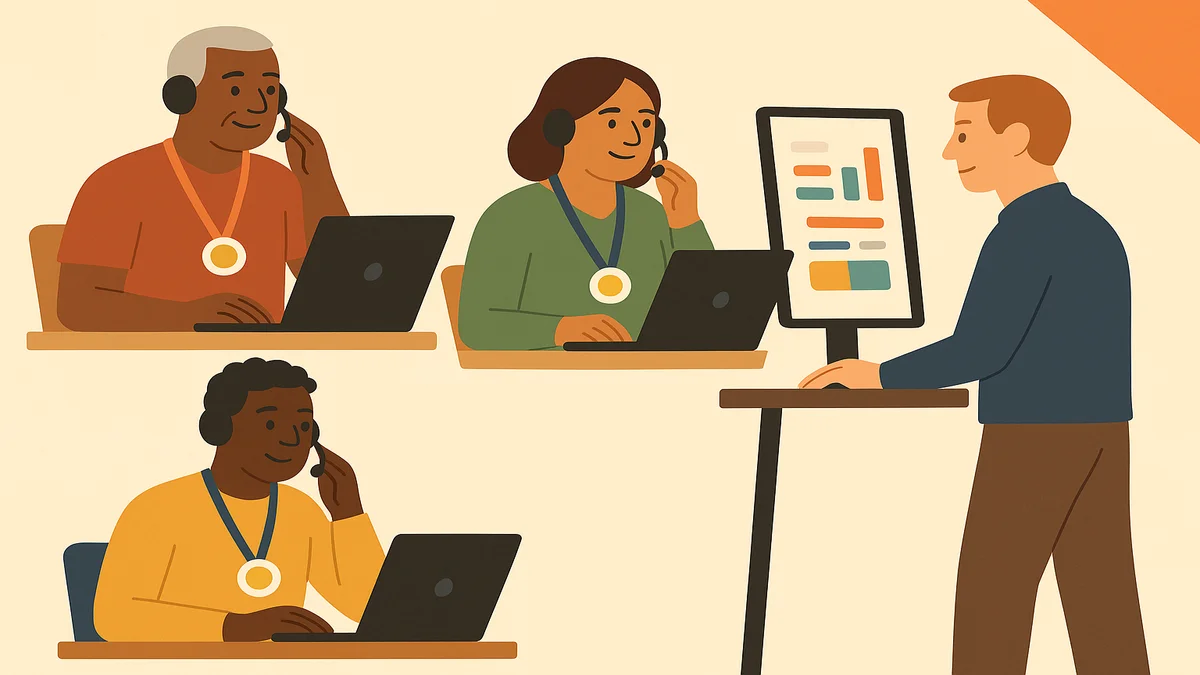
CallHub’s union calling and texting platform includes auto-assignment of contacts, real-time supervisor dashboards, and branching scripts so callers can navigate member responses without improvising answers to compliance-sensitive questions.
Text messaging your members for election day outreach
Text banking runs on a different timeline than phone banking. Text is most effective in the final 72 hours before election day, when a voting plan confirmation message lands better than a live call. In the week before, text is effective for event reminders (early vote locations, union-organized transportation) and low-barrier asks (confirm your polling place address).
Peer-to-peer texting vs broadcast SMS for union GOTV
| Format | How it works | Best for |
|---|---|---|
| Peer-to-peer texting (P2P) | A volunteer sends each message individually through a web platform, with real-time response handling | Two-way conversations, member-specific outreach, higher TCPA safety on household lists |
| Broadcast SMS | Messages sent automatically to a full list at once | Time-sensitive reminders to opted-in member lists, high volume in short windows |
For member lists with confirmed opt-ins, broadcast SMS works for election day reminders. For household extension lists where consent is less explicit, peer-to-peer texting is the safer format.
“CallHub peer-to-peer texting shined brightest when sharing information with voters,” says Shannon Goecke, Communications Specialist at the National Union of Healthcare Workers (NUHW). “Take event invites; no one wants to get a phone call from some volunteer saying hey, the candidate’s going to be in your town next week.”
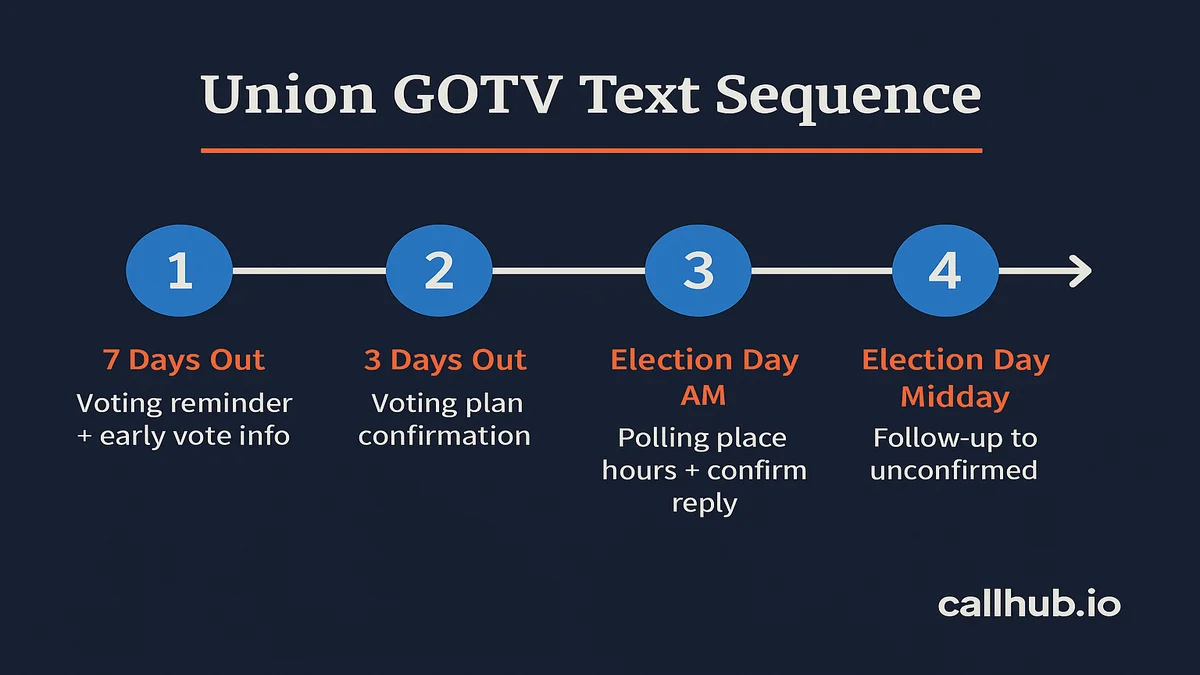
For ready-to-use scripts at each stage, see GOTV text message templates. The full text sequence for the GOTV window:
- Seven days out: Voting reminder and early vote information
- Three days out: Voting plan confirmation (“Are you voting on Tuesday?”)
- Election day morning: Polling place hours reminder with a reply-to-confirm ask
- Election day midday: Follow-up to contacts who haven’t confirmed they voted
Writing a compliant union GOTV script
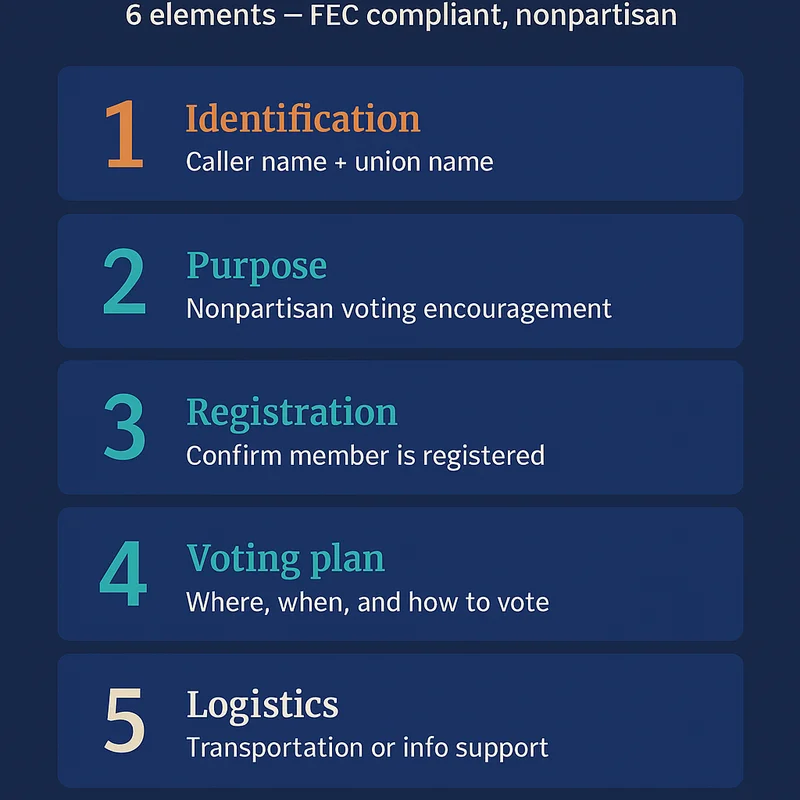
A compliant union GOTV script does four things: Identifies the caller and their union, establishes the nonpartisan purpose of the call, makes a specific ask around voting plan, and closes with an action the member can take immediately.
What a compliant script includes:
- Identification: “Hi, I’m [name], calling on behalf of [union name].”
- Purpose: “We’re calling to make sure all our members have a plan to vote in the upcoming election.”
- Registration check: “Are you registered to vote at your current address?”
- Voting plan: “Do you know where your polling place is? Are you planning to vote early or on election day?”
- Logistics offer: “Can we help with anything that might make it easier to get there?”
- Close: “Thanks, and remember polls are open [hours] at [location]. Is there anything else you need?”
What a compliant script must not include:
- Any reference to a specific candidate or party
- Any characterization of candidates or ballot measures
- Any union position on how members should vote
- Any language coordinated with a candidate’s campaign
Run every script draft through your labor counsel before it goes live. A one-hour legal review is far cheaper than a FEC enforcement inquiry.
Measuring your union GOTV program
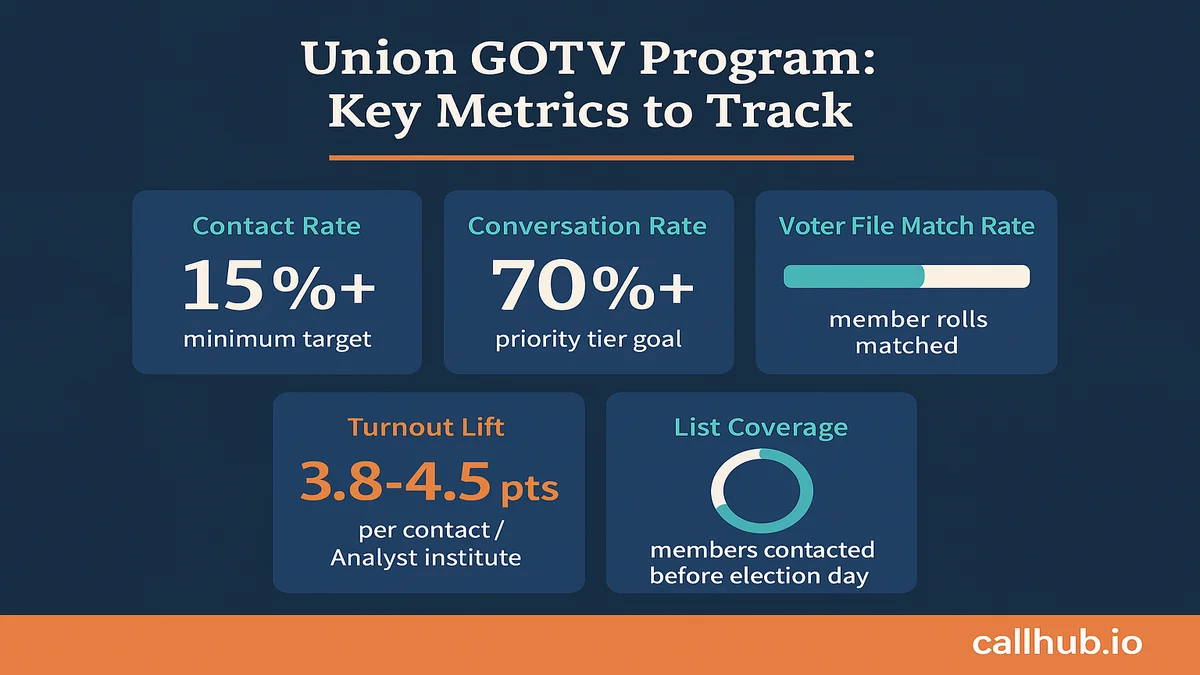
A union GOTV program that doesn’t measure outcomes can’t improve. Track these five metrics across every program:
| Metric | What it measures | How to track |
|---|---|---|
| Contact rate | Percentage of calls that reached a live member | Platform call logs |
| Conversation rate | Percentage of contacts who completed the voting plan ask | Dispositions in calling platform |
| Voter file match rate | Percentage of members found in the voter file | Data vendor report |
| Turnout lift | Difference in turnout between contacted and uncontacted members | Post-election voter file pull |
| List coverage | Percentage of total member list contacted before election day | Cumulative contact count vs. list size |
Turnout lift is the most valuable measure but requires a post-election voter file pull, which most states make available within 30 to 60 days of the election. Match your contacted member list against the post-election file to see who voted. The difference between contacted and uncontacted members is your program’s estimated impact — see post-GOTV analysis for the full measurement process.
Track contact rate and conversation rate in real time during the program so you can adjust. If contact rate drops below 15%, your list may need phone number refreshes or call window adjustments. If conversation rate is low despite successful contacts, your script may need revision.
Getting every union member to the polls, and knowing it worked
Union GOTV is most effective when it’s systematic: A clean member list matched to the voter file, callers who are members themselves, a nonpartisan script that stays inside the FEC’s restricted class rules, and metrics that prove turnout lift after the election.
The infrastructure that makes it work is the same infrastructure unions already use for calling for unions: A calling platform with contact queues, branching scripts, and outcome logging. What changes is the ask and the legal framework around it.
If your union is building this program for the first time, start with your member list and your calling platform. The voter mobilization layer runs on top of what you’re already doing for member engagement. For the full phase-by-phase system this program fits into, see the complete GOTV strategy guide, and explore how CallHub supports GOTV programs end to end, from list building to election-day reporting.
Build your union GOTV program with CallHub’s union calling and texting platform
Frequently asked questions
Can a union use treasury funds for a GOTV program?
Yes, with conditions. The FEC allows unions to use general treasury funds for nonpartisan GOTV drives aimed at the restricted class: Members, their families, and administrative and executive personnel. The drive must not include express advocacy for or against any candidate. If the program extends beyond the restricted class or includes express advocacy, PAC funds are required.
Who counts as the restricted class for union GOTV?
The restricted class includes current union members, their families (spouses and dependents), and union executive and administrative staff. Members of the general public, non-union workers, and retirees not affiliated with the union fall outside the restricted class for treasury-funded GOTV purposes. If your union has a complex membership structure, confirm the scope with your labor counsel before the program launches.
Does TCPA apply to union member phone calls?
TCPA rules apply to automated calls and texts to mobile phones. Union member contact under an existing membership relationship generally has stronger legal standing than cold outreach, but this doesn’t create a blanket TCPA exemption. If your program uses automated dialing or bulk texting, consult legal counsel on consent requirements before launching. Peer-to-peer texting, where a volunteer sends each message individually, carries significantly less TCPA exposure.
What is the difference between union GOTV and express advocacy?
Union GOTV is nonpartisan: It encourages members to register, make a voting plan, and turn out. Express advocacy explicitly supports or opposes a specific candidate or ballot measure. Treasury funds can support union GOTV; express advocacy requires PAC funds. The test is whether the communication is designed to help members vote, or to tell them how to vote.
How do unions measure voter turnout from a GOTV program?
After the election, obtain a post-election voter file pull from your data vendor or state party committee. Match the file against your list of contacted members to see who voted. Compare that to the uncontacted portion of your member list. The difference is your estimated turnout lift. Most states make post-election files available within 30 to 60 days of the election.
Can a union text members to get out the vote?
Yes. Peer-to-peer texting to union members falls within the restricted class for treasury-funded programs, provided the messages are nonpartisan. Broadcast automated texts require confirmed opt-in consent to meet TCPA standards. P2P texting, where a volunteer manually sends each message and can respond to replies, is the most defensible format for lists where explicit opt-in consent isn’t documented.
How many calls does a union GOTV program need to make to affect turnout?
Research from the Analyst Institute and the Institution for Social and Policy Studies at Yale puts individual phone contact’s turnout effect at 3.8 to 4.5 percentage points per person reached in a live conversation. To move turnout across a member list of 5,000, you need completed conversations, not just calls made. Aim for a 70% or higher conversation rate on your priority tier before election day.