

Short code texting uses 5-6 digit numbers to send high-volume, authorized SMS/MMS marketing and alerts, offering better deliverability and speed than regular phone numbers. Often called “short numbers” or “short codes”, they are ideal for campaigns, two-factor authentication, and reaching large audiences.
Since US carriers retired shared short codes in 2021, every short code in the US now belongs to a single organization. This guide covers what short code texting costs, how it compares with 10-digit long code (10DLC) and toll-free numbers, and how to get a short code of your own.
Key Takeaways
Short code texting uses carrier-vetted 5 or 6 digit numbers, now each dedicated to a single organization, to send high-volume SMS/MMS marketing, alerts, and two-factor authentication messages.
What a short code is
- A short code sends around 100 texts per second, well ahead of typical 10DLC throughput, making it suited for large lists and text-to-join keywords.
- Random short codes are assigned by the provider and lease for $500 a month, a popular choice for nonprofits and political campaigns reaching large audiences affordably.
- Vanity short codes are custom-chosen to spell a word, such as Obama’s 62262 or the Red Cross’s 90999 for Haiti donations, and lease for $1,000 a month.
- US carriers retired shared short codes on June 1, 2021, so every short code now belongs to a single organization rather than being split among multiple senders.
Cost and timeline
- Budgeting requires three separate costs: the Registry lease, provider setup fees, and per-message fees, with the lease non-refundable and due in full upfront.
- Carrier provisioning takes about two to four weeks after leasing a code, and longer if carriers request changes, so senders should time the lease to their launch date.
Choosing a number type
- Short codes fit speed-at-scale sending and memorable keyword campaigns.
- 10DLC fits one-to-one and peer-to-peer conversations, with throughput depending on the registered brand’s Trust Score and use case.
- Toll-free numbers fit mid-volume alerts and support messaging.
Why short codes help
- Short codes are easier for audiences to remember than standard 10-digit numbers, simplifying opt-in for campaigns.
- Dedicated and vanity short codes boost brand recall, helping messages stand out in a recipient’s inbox.
- Carriers vet every short code program before approval, which the article notes makes messages from a short code more trustworthy to recipients than those from an unregistered 10-digit number.
Compliance requirements
- Senders must get express consent before the first text, honor STOP and HELP requests, keep sends between 8 a.m. and 9 p.m. in the recipient’s time zone, and stay within carrier-approved use cases, since violations can get a code suspended.
Key takeaways
- A short code is a 5 or 6 digit number built for high-volume texting. It sends around 100 texts per second, well ahead of what most 10DLC setups allow, and it is the best fit for large lists and text-to-join keywords.
- Every US short code is now dedicated to one organization. Carriers retired shared short codes on June 1, 2021, so any guide that mentions a cheap shared code is outdated.
- Budget for three costs, not one. The Registry lease is $500 a month for a random code or $1,000 a month for a vanity code. On top of that come provider setup and per-message fees. The lease is non-refundable and due in full up front.
- Plan for weeks, not days. Carrier provisioning takes about two to four weeks after you lease, and it can take longer if carriers request changes. Time your lease to your launch date.
- Pick the number type that matches how you text. Choose a short code for speed at scale and memorable keywords. Choose 10DLC for one-to-one and peer-to-peer conversations. Choose toll-free for mid-volume alerts and support.
- Compliance protects your code. Get express consent before the first text, honor STOP and HELP, keep sends within 8 a.m. to 9 p.m. in the recipient’s time zone, and stay within the use cases carriers approved. Break the rules, and your code can be suspended.
Table of Contents
- What is shortcode texting?
- Types of short codes
- How does a shortcode texting help?
- Cost of a shortcode texting campaign
- Short codes vs 10DLC vs toll-free numbers
- How to use shortcode texting
- How keywords, opt-ins, and opt-outs work on a short code
- Shortcode texting compliance
- Who uses shortcode texting?
- SMS code list
- How to get shortcodes for text messaging
- SMS short code service – CallHub
- FAQs for shortcode texting
What is shortcode texting?
A shortcode is a shortened phone number that you can use to send and receive text messages.
How short are they?
Most common texting shortcodes are about 5 or 6 digits long.
Major wireless carriers like Verizon, AT&T, and T-Mobile developed them as an alternative to 10-digit phone numbers.
Chances are, you have received a text message from a short code.
Here’s a prominent example of shortcode texting in the political space.
Then-candidate Barack Obama used a short code to alert supporters of his choice of running mate in 2008.
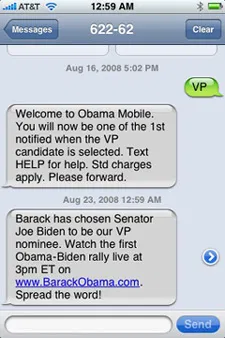
Notably, Obama’s short code 62262 spelled “Obama” when entered on a telephone dial pad.
Custom shortcodes like these are called vanity short codes.
Every US short code today is dedicated to a single organization; you choose between a random and a vanity code, covered next. (Shared short codes, where many senders used one number, were retired by US carriers in 2021.)
Types of short codes
Random Shortcode:
A random shortcode is a 5- or 6-digit number assigned to you at random by the provider when you apply for a shortcode. You don’t get to choose the digits instead; you’re given whatever is available. These are more affordable than vanity shortcodes, making them a popular choice for nonprofits and political SMS campaigns that want to reach large audiences without high costs. It’s like being assigned a random phone number rather than picking a custom one.
For example, a nonprofit running disaster-relief updates can use a random short code to send timely alerts to thousands of people without paying for a vanity number. Random short codes lease for $500 a month from the Short Code Registry.
Vanity Shortcode:
A vanity shortcode is a custom, memorable number that you specifically choose—often because it spells out a word or is easy to remember, like 62262 (“Obama”) or 90999 (used by the Red Cross for “HAITI” donations). This is similar to picking a personalized license plate for your car.
For example (hypothetical), a food bank could choose 36637, which spells “FOODS” on a keypad, so supporters remember where to text during a holiday food drive. Vanity short codes, which the Registry calls Select codes, lease for $1,000 a month.
How does a shortcode texting help?
They are easy to remember
If you are running an SMS opt-in campaign to gather new subscribers, you want your number to be easy for your audience to recall.
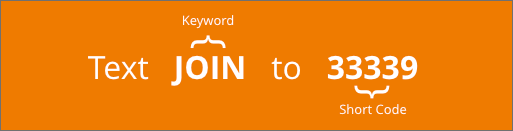
Using a 5-digit (or 6-digit) text number instead of a standard 10-digit one makes it easier for your contacts to remember.
That means your supporters don’t have to worry about memorizing a long, complicated number to opt-in to your text messages.
They offer brand recall
Another advantage of shortcodes, especially dedicated ones that are unique to you (take the example of Obama above), is that they make your texts stand out.
If your audience knows and trusts your brand, they are less likely to miss your text messages in their inbox.
They are professional
Business texting from a 10-digit long code now requires 10DLC brand and campaign registration. Short codes go further: Carriers vet every short code program before it can send a single message.
Renting a new short code requires an approval process and an opt-in from the audience you are contacting. That makes receiving a message from a short code more trustworthy for the receiver.
Speedier message delivery
A short code lets you send around 100 SMS per second, and you can provision higher throughput. 10DLC throughput depends on your registered brand’s Trust Score and use case, according to Twilio’s 10DLC throughput guide. T-Mobile also caps daily volume per Employer Identification Number (EIN), so large sends queue up.
Cost of a shortcode texting campaign
A dedicated short code costs $500 a month for a random number or $1,000 a month for a vanity number you choose. That’s the lease from the Short Code Registry, and it’s only one of three costs you’ll pay.
| Cost | What it covers | How it’s billed |
|---|---|---|
| Registry lease | The right to use the number | $500 a month (random) or $1,000 a month (vanity), leased for 3, 6, or 12 months and paid in full before activation |
| Provider setup | Carrier vetting, provisioning, and connecting the code to your texting platform | Set by your texting provider |
| Messages | Every SMS or MMS you send and receive | Per message segment |
Think of it this way: The lease buys you the number, but setup and message volume decide what a campaign actually costs.
Before you pay, keep three things in mind:
- Registry fees are non-refundable. Settle on random or vanity first.
- The lease starts when you pay. Carrier provisioning still takes weeks, so time the lease to your launch.
- The $25-a-month shared short code is gone. Older guides still mention it, but US carriers retired shared short codes in 2021.
On CallHub, texting on the pay-as-you-go Essential plan costs $0.20 per SMS segment, with lower custom rates on the Scale plan. Short code setup is quoted on request, and the same code powers text-to-join campaigns for list building. See CallHub pricing for current rates.
Short codes vs 10DLC vs toll-free numbers
Short codes are the fastest way to text a large list and the slowest number to set up. 10DLC and toll-free numbers get you texting with less setup, but with lower throughput and tighter volume limits.
| Short code | 10DLC (local long code) | Toll-free number | |
|---|---|---|---|
| Format | 5 or 6 digits | 10-digit local number | 10-digit number with a toll-free prefix |
| Throughput | Up to 100 texts per second on CallHub | Set by your brand’s Trust Score and use case | Lower than a short code, varies by provider |
| Registration | Program brief vetted by every carrier | Brand and campaign registration | Toll-free verification |
| Time to launch | 2 to 4 weeks of provisioning after the lease | After brand and campaign approval | After toll-free verification |
| Keyword exclusivity | Yes | No | No |
| Best for | Large lists, text-to-join keywords, and high-volume broadcasts | Conversational and peer-to-peer texting | Mid-volume alerts and support |
Pick a short code when speed at scale or a memorable number matters. If most of your texting is one-to-one conversation, a 10DLC number fits better, and CallHub’s mass texting supports 10DLC numbers too.
What happened to shared short codes?
Shared short codes let many organizations send from one number, each with its own keywords. They were cheap and quick to launch, which also made them a favorite of spammers. When one sender on a shared code misbehaved, carriers couldn’t easily tell which one.
US carriers phased shared short codes out, and the ban took full effect on June 1, 2021, according to Digital Commerce 360. Your options today are a dedicated short code, a 10DLC number, or a toll-free number. Our guide to the shared shortcode phase-out covers each option.
How to use shortcode texting
Since mobile short codes are designed to let you send a high volume of text messages at a time, that opens up plenty of possibilities for your texting campaigns.
You can use short codes texting to:
- Send quick updates to a large contact base
- Update subscribers about a time-limited sale
- Disaster response and recovery
- Get more people to subscribe to your texts with SMS opt-in process.
- Text-based voting
- Text to donate campaigns
- SMS surveys
How keywords, opt-ins, and opt-outs work on a short code
A keyword is the word people text to your short code to join a list. “Text JOIN to 33339” is a keyword campaign: JOIN is the keyword, and 33339 is the short code.
Here’s what happens after someone texts in:
- They get a confirmation text. It names your program and says how many messages to expect. It also notes that message and data rates may apply and explains how to get help or stop.
- They join your list. From here, you can send broadcasts or ask follow-up questions to collect details like a name or zip code.
- They can leave anytime. Texting STOP unsubscribes them immediately, and texting HELP returns your support contact.
With a dedicated short code, every keyword belongs to you, and you can run as many as you need. On CallHub, SMS opt-in campaigns send confirmations, ask follow-up questions, and automatically sync new contacts to your CRM.
Shortcode texting compliance
Short code texting answers to two rulebooks: Federal law and the carriers. The Telephone Consumer Protection Act (TCPA) sets the legal rules for consent. The wireless industry group CTIA publishes the Messaging Principles and Best Practices that carriers use to vet your program. Break either one and your short code can be suspended.
In practice, that comes down to six habits:
- Get express consent before the first text. Someone texting your keyword counts. A purchased list doesn’t.
- Say what people signed up for. Your sign-up materials and confirmation message should name the program and say how often you’ll text.
- Honor STOP and HELP. STOP must unsubscribe the contact immediately. HELP must return your organization’s name and a support contact.
- Respect quiet hours. Keep sends inside the TCPA’s 8 a.m. to 9 p.m. window in the recipient’s time zone.
- Stay within your approved use case. Carriers vet the program brief you submit, so sending fundraising asks from a code approved for event alerts violates the program.
- Keep proof of consent. Log when and how each contact opted in, in case a complaint or audit comes up.
If you’re getting a short code through CallHub, we handle carrier approval. You’ll provide your expected message frequency per contact, a support phone number, and a support email address, which carriers use for HELP responses.
This isn’t legal advice. Check your program with legal counsel before launch.
Who uses shortcode texting?
Organizations use short codes regardless of industry.
That includes:
- Charitable organizations
- Businesses
- Schools
- Religious organizations
- Advocacy groups
How 350.org used shortcode texting to engage supporters
Climate advocacy group 350.org used a shared short code for their SMS opt-in, mass texting, and peer-to-peer texting campaigns.
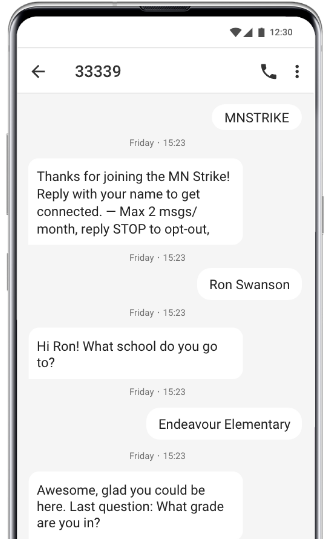
By asking people to opt in during a protest, they got almost half of their event attendees to text into their short code, allowing them to have follow-up conversations and bring them back to future events.
Read 350.org’s complete story.
SMS code list
If you are considering renting a dedicated short code, you may want to check whether the number you want is available.
The easiest way to do that is to look to online resources, such as the Short Code Registry’s directory.
The Short Code Registry, along with CTIA’s rules, looks over the operation of common short code functions. They maintain a database of available, reserved, and registered text message short codes.
The directory allows you to check the availability of any short code number in the United States.
If the number you want is taken, the directory tells you who is currently renting the short code.
Two of the best-known short codes come from past campaigns:
| Short code | What it spells | Used by |
|---|---|---|
| 62262 | OBAMA | Barack Obama’s 2008 campaign, to announce his running mate |
| 90999 | Not a word | The American Red Cross, for “HAITI” text donations |
To look up any short code:
- Go to the Short Code Registry.
- Search for the five- or six-digit number.
- Check whether it’s available or leased, and who holds the lease if it’s taken.
How to get shortcodes for text messaging
Getting a dedicated short code takes several weeks from lease to first text. Here are the five steps:
- Choose random or vanity. A random code costs $500 a month, and a vanity code you pick costs $1,000 a month.
- Check availability. Search the Short Code Registry to see whether the vanity number you want is free.
- Lease the code. Pay the Registry for a 3, 6, or 12-month term. You pay the full amount up front.
- Submit your program brief for carrier vetting. Your texting provider sends carriers a description of your campaign, sample messages, and your opt-in flow. The Registry says provisioning can take two to four weeks, and guides from TextUs and Bloomreach put carrier approval at six to eight weeks.
- Launch with keywords. Once carriers approve the code, set up your keywords and opt-in messages and start texting.
Getting a dedicated short code with CallHub
On CallHub, you start by creating an account and submitting a short code request. We handle the carrier approval process with you. Once your code is live, you can use it for text broadcasts, text-to-join keywords, and opt-in campaigns from the same account, at up to 100 texts per second.
Moving an existing short code
Migrating your US short code between two different providers takes 8-12 weeks.
But if your current provider uses the same carrier connection as the texting service you’re migrating to, such as CallHub, you can get started in a day.
SMS short code service – CallHub
A short code earns its cost when you text large lists or collect opt-ins on signs, at events, and in ads, where a memorable number matters. Plan for several weeks of setup, and budget for the lease, the provider setup, and your per-message rate.
On CallHub, one account covers the whole short code workflow:
- Short code broadcasts and keywords at up to 100 texts per second
- Text-to-join to grow your list from signs, events, and ads
- Mass texting and peer-to-peer texting to follow up with the supporters who join
Request a dedicated short code when you create your account, and test your campaigns first with the $6 in free credits every new account gets. If you used a shared short code in the past, our guide to the shared shortcode phase-out covers the switch.
FAQs for shortcode texting
1. What is a shortcode?
A short code is a 5- or 6-digit number you can use for mass texting campaigns.
2. What other countries does CallHub offer short codes to?
CallHub offers short codes in the United States. Short codes for sms messages are available for rent in most major countries, including the USA, Canada, and the UK. For a full list, refer to this Wikipedia page.
3. How long does it take to rent one?
Leasing from the Short Code Registry is immediate, but carrier provisioning takes about two to four weeks (and often longer if carriers ask for changes). Shared short codes, which used to launch in days, are no longer available in the US.
4. How to get an SMS short code?
In the US, you can rent a short code directly from the US Short Code Registry. Then activate it through a messaging provider such as CallHub, which submits your program for carrier approval.
5. Can people send texts to short codes?
Yes, people can reply to your short code texts. They cannot however make a call to a short code.
6. What carrier rules apply to short code texting?
Carriers follow CTIA’s messaging rules. You need express consent before texting, a clear disclosure of message frequency, working HELP and STOP responses, and a program that matches the use case carriers approved. You can check the full list of short code regulations from the CTIA website.
7. How can I look up a short code in the US?
You can look up a short code using official industry resources such as the US Short Code Registry, which maintains records of leased short codes.
8. Are shared short codes still available?
No. US carriers stopped supporting shared short codes, and the ban took full effect on June 1, 2021. Use a dedicated short code, a 10DLC number, or a toll-free number instead.
Featured Image Credit: No Revisions