






Table of Contents
Donor data is the information you collect about who gives, how they give, and why – and using it well can increase revenue, retention, and major gifts for your nonprofit. When you turn the data into clear actions, you stop guessing and start running predictable, scalable fundraising campaigns and improving overall fundraising efforts and long-term fundraising strategy.
Key takeaways
- Donor data includes demographics, giving history, wealth indicators, engagement, and interests, all of which help you segment and prioritize supporters into meaningful donor segments.
- Clear and centralized data in a donor database or CRM is essential before you apply analytics, AI, or advanced segmentation and begin analyzing data effectively.
- Simple workflow like a lapsed-donor winback series or a major donor discovery process – can be built from reports you already have and can strengthen donor relationships over time.
- Ethical, compliant data practices (consent, privacy, regional rules) protect trust while still giving you the insight you need.
- Tools like CallHub help you collect, sync, and act on donor data across calling, texting, and digital campaigns so you can operationalize your strategy and scale your fundraising efforts.
What is donor data?
Donor data is the structured record of a person’s relationship with your organization and other causes, including their contact details, demographics, giving history, interests, and engagement. It lives in your donor database for nonprofits (or CRM) and can come from online donation forms, events, website analytics, donor lookup tools, and integrated fundraising software.
Common donor data fields include:
- Contact details (name, email, phone, address)
- Demographics (age, gender, location, education, employment data)
- Giving history (amounts, frequency, recency, campaigns) and donation history or tracker fields
- Engagement (events attended, calls, texts, emails, volunteer activities including volunteer grants)
- Affinities (causes supported, issues, programs, hobbies)
- Wealth and capacity indicators (real estate, business ties, major gifts, and publicly available wealth data)
When this information is organized in a fundraising database and surfaced through clear donor reports, it becomes much easier to act on and maintain accurate donor records.
Read Also: How to Manage Your Donor Data for Meaningful Donor Relationships.
Why is donor data important?
Donor data gives you evidence-based answers to key fundraising questions: who to ask, for how much, through which channel, and when. Instead of treating donors as a generic list, you can use donor analytics and donor search to build donor segments, personalize messages, and focus staff time on the highest-potential relationships.
With strong donor data and disciplined donor data management you can:
- Plan better events and appeals based on donor interests and behavior.
- Increase retention by sending relevant, timely communication that strengthens donor engagement.
- Grow average gift size through informed ask amounts and major gift targeting.
- Improve campaign ROI by doubling down on channels and segments that perform and refining your fundraising strategy.
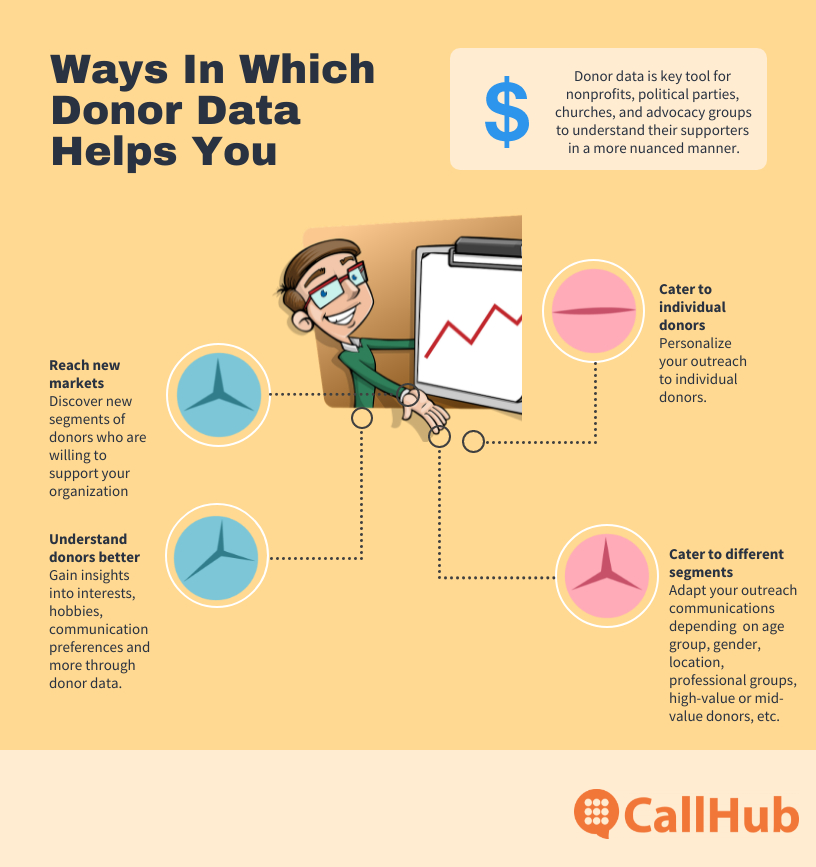
Here’s how donor data helps you:
The five core types of donor data to track
Most nonprofits should track five core types of donor data: who donors are, what they can give, how they’ve given, what they support, and what they care about.
| Donor data type | What it tells you |
| Demographics | Who the donor is and how to contact them |
| Wealth indicators | Their likely capacity for larger gifts |
| Nonprofit involvement | How engaged and loyal they already are |
| Political giving | Causes they support and giving likelihood |
| Hobbies and interest | What stories, events, and campaigns will resonate |
1. Demographic and contact details
Demographic details help you identify who your donors are and how to reach them efficiently, examples include;
- Name, email, phone, mailing address.
- Age range, location, household data where appropriate.
- Preferred language and communication channel, helping teams stay connected and ensure donors are reading email and other communications at the right time.
2. Wealth and capacity indicators
Their likely capacity for larger gifts and overall fundraising potential, often identified through wealth screening and prospect research.
- Real estate holding or business affiliations.
- Past large gifts to your or similar organization.
- Publicly available philanthropy or securities data and other form of wealth data.
3. Nonprofit involvement and engagement
Engagement data shows who is most invested and likely to keep supporting you. Useful metrics include:
- Giving history: recency, frequency, amount (RFM) and overall donation history.
- Event attendance, volunteering, peer-to-peer participation, and tracking of volunteer grants.
- Email opens/clicks, SMS replies, call outcomes, social interactions – all useful indicators of donor engagement.
4. Political giving data
Political giving data can reveal issue affinity and capacity, but it is heavily regulated and must be used carefully. In compliance context, it can show:
- Which causes, parties, or candidates a donor backs.
- How frequently they give in an election cycle.
- Whether they have a history of high-value contributions.
Always confirm local laws and platform rules before incorporating political data into targeting or target outreach, and ensure data is used responsibly to maintain trust and support meaningful relationships.
Read Also: The 8 Most Important Political Calls Rules to Follow
5.Hobbies and interest
Hobbies and interest data tell you why people give and how they prefer to interact. You can gather:
- Program preferences (e.g., education vs. healthcare).
- Story or content topics that trigger engagement.
- Channel and timing preferences (SMS vs, email, weekday vs, weekend).
understanding these factors helps nonprofits craft tailored messaging, strengthen meaningful relationships, and design campaigns that make supporters feel valued and motivated to raise money for causes they care about, it also helps teams identify opportunities such as matching gifts that donors may be eligible for but unaware of.
Read Also: Donor Cultivation: 3 Tips to Build Lasting Relationships
Keep your your donor data clean, secure, and compliant
Strong fundraising analytics require clean, well-governed data. Before you scale campaigns, put simple data hygiene and compliance practices in place to ensure accurate donor records, generate actionable insights, and use reporting tools effectively.
Data hygiene and maintenance essentials
- Standardize fields and entry rules so each record looks the same.
- Deduplicate records regularly to avoid duplicates and split histories.
- Audit your database at least yearly to fix missing or outdated data.
- Document who owns which fields and who can edit them.
These practices help ensure real time data updates remain accurate and allow teams to gain insight quickly when reviewing performance.
Privacy, consent, and regional rules
Donor trust depends on using data ethically and in line with regulations.
- Get explicit consent for email and SMS, and log it in your CRM.
- Publish a clear privacy policy outlining what your collect and why.
- Offer easy opt-out options and honor them across all systems.
- Understand local rules (GDPR, CCPA, election law, telemarketing rules) before using wealth or political data.
Maintaining transparency helps nonprofits build meaningful relationships and ensure donors feel respected and confident in how their data is used.
Read Also: The Ultimate TCPA Compliance Checklist to Avoid Massive Fines
How to collect donor data: practical sources and methods
To collect donor data, you don’t need to start from scratch; much of the donor data you need already exists across your tools. Here is a table summarizes the most practical sources and what each one gives you. collecting data from a wide array of sources allows organizations to gain insight and deliver more effective targeted outreach.
These sources strengthens your data collection practices and help maintain complete donor records.
| Sources | Key data you collect |
| Donor management software / CRM | Profiles, giving history, engagement, preferences. |
| Past donor records and exports | Retention, upgrades, lapses, LYBUNT(Last Year But Unfortunately Not This Year) /SYBUNT ( Some Year But Unfortunately Not This Year) lists. |
| Donation and event forms | Demographics, gift intent, program preferences. |
| Website analytics | Traffic sources, content interests, conversion paths. |
| Social media & ads | Topic interests, lookalike audiences, engagement data. |
| SMS opt-in and texting | Mobile numbers, opt-in consent, survey responses, and quick feedback. |
| Calling campaigns | Qualitative motivations, objections, anecdotes, and pledge commitments. |
Using CallHub to collect richer data:
- Run Text-to-Join campaigns so supporters can opt in with a keyword; sync new contacts and tags directly to your CRM., enabling real time data updates.
- Use surveys in SMS and calling campaigns to capture interests and preferred communication channels and support tailored messaging.
- Run outbound calling campaigns in CallHub and log standardized call outcomes (e.g., “interested in monthly giving”, “prefers email”, “do not call”) that provide actionable insights and strengthen future fundraising strategy decisions.
Donor data workflows you can implement this quarter
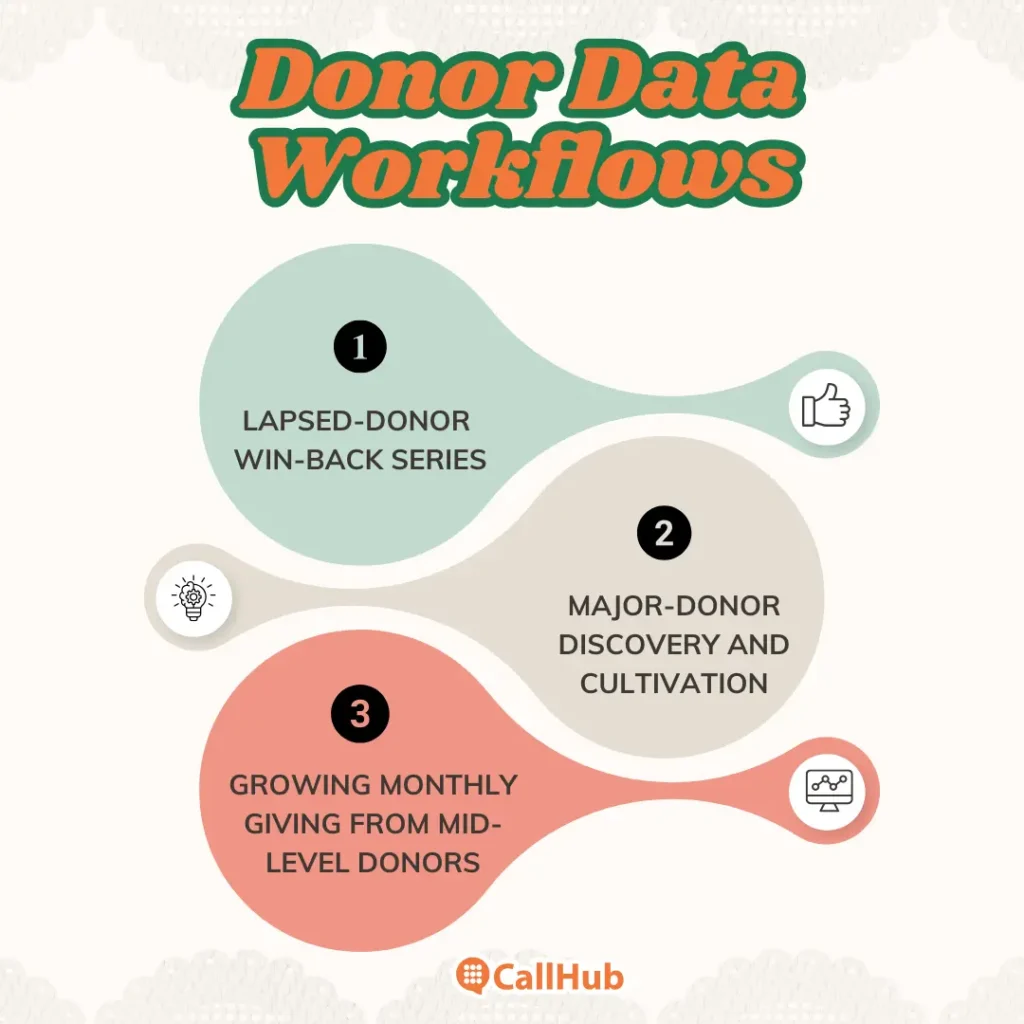
Once your data is centralized and reasonably clean, focus on a few high-yield workflows instead of trying to use everything at once.
Workflow 1: Lapsed-donor win-back series
- Build a “12–24 months since last gift” list in your CRM.
- Segment by past giving level (small, mid, major) and channel preference.
- Send a short, personalized email or SMS reminding them of their last impact.
- Use CallHub to run a calling campaign to high-value lapsed donors and have fundraisers ask directly if they’d consider renewing.
- Track responses and update their status (reactivated, unreachable, not interested).
Workflow 2: Major-donor discovery and cultivation
- Use wealth and giving data to identify donors with high capacity and prior generosity.
- Layer in engagement data (event attendance, volunteerism, call history) to find warm prospects.
- Assign each prospect to a staff member with a simple contact plan (call → meeting → proposal).
- Log every touchpoint; adjust ask amounts based on response and updated data.
Read Also: Nonprofit Event Registration 101: Everything You Should Know
Workflow 3: Growing monthly giving from mid-level donors
- Identify donors who give multiple times per year but are not yet recurring.
- Craft a tailored campaign explaining the benefits and impact of monthly support.
- Use CallHub’s SMS and phone calls to invite them into a specific monthly level based on past giving.
- Tag new recurring donors and monitor retention, upgrade opportunities, and churn warnings.
Read Also: Donor Recognition: Best Practices to Nurture Donor Relationship
Turning donor data into strategy: analytics and reporting
Analytics is how you translate data into decisions and board-ready stories. You don’t need a data science team – start with a handful of recurring reports and reliable reporting tools that help teams gain insight and make informed decisions faster.
Core reports to build
- Retention and churn: how many donors renew each year and who is at risk.
- LYBUNT/SYBUNT lists: donors who gave last year or some year but not this year.
- Major-donor pipeline: prospects by stage, capacity, and next action.
- Campaign performance: response rate, average gift, and ROI by channel.
Use these reports to answer three questions every quarter:
- Where are we losing donors?
- Which segments are growing?
- Which campaigns are most efficient?
Read Also: Major Gift Fundraising: The 9 Essential Steps To Guide You
Key metrics to watch
High-performing organizations pay attention to trends, not just totals.
These metrics provide actionable insights into campaign performance and overall fundraising potential.
- Donor retention rate and first-year retention.
- Average gift and lifetime value by segment.
- Response rate by channel and campaign type.
- Percentage of revenue from monthly and major donors.
Donor database buyer guide: choosing the right system
Your donor database is where all your donor data lives, so the right choice directly affects your ability to report, personalize, and scale outreach across multiple channels, ensuring consistent communication and stronger meaningful relationships with supporters.
Must-have features
- Unified profiles: all gifts, interactions, notes, and preferences in one place.
- Segmentation and reporting: flexible filters, saved reports, dashboards.
- Integrations: native or API connections to tools like CallHub, email platforms, and online forms.
- Data hygiene tools: deduplication, validation, standardization.
- User permissions and audit trails for data security.
Selection checklist
- Evaluate your current pain points (e.g., limited reporting, manual imports).
- List must-have vs. nice-to-have features based on your strategy.
- Shortlist 3–5 vendors, ask for demos, and test with real data.
- Check pricing, support, implementation help, and integration options.
- Plan a phased rollout with training and clear data-entry standards
When your CRM or donor database integrates smoothly with CallHub, every call outcome and SMS reply automatically enriches the donor records you reply on for reporting and planning.
Case example: using donor data to save a slipping campaign
Imagine your mid-year appeal is underperforming after two weeks.
- Your CRM shows response rates are strong among donors who attended a recent event but weak among everyone else.
- CallHub call notes reveal that many non-responders haven’t heard from you since last year and feel disconnected.
- Website analytics show that a story about one specific program is driving most donations.
With that data, you:
- Pull a segment of event attendees and send them an SMS reminder with a direct link to give.
- Launch a short CallHub calling campaign for long-lapsed donors focusing on that high-performing story and asking for specific gifts.
- Update next year’s plan to include a pre-appeal engagement touch for low-engagement donors.
This kind of quick pivot is only possible when your donor data is centralized, clean, and actively used to gain and maintain deeper relationships with donors.
Read Also: Hybrid Events: 3 Strategies for Using Virtual in Live Events
Simple donor data workflow to follow
Use this four-step loop to structure your ongoing donor data strategy:
- Act and iterate: Run targeted campaigns through tools like CallHub, measure performance, and feed those results back into your next round of analysis.
- Collect: Capture data from forms, events, SMS, calls, and social campaigns.
- Centralize and clean: Sync everything into your donor database or CRM, deduplicate, and standardize.
- Analyze and segment:Build core reports and segments for lapsed donors, major prospects, monthly candidates, and key interests.
What’s next?
If you’re just getting started, pick one workflow – like lapsed-donor winback or major-donor discovery – and build the reports and segments you need for that single use case. As you see results, add more segments, refine your data hygiene practices, and deepen your analytics.
When you’re ready to turn donor data into consistent, multichannel outreach, connect your CRM to CallHub so every phone call and text message strengthens your database instead of sitting in a silo. Book a quick demo with CallHub today to see how data‑driven calling and texting can boost your fundraising results.
Frequently asked questions on donor data
What is donor data, and why is it so important for nonprofits?
Donor data is the information you collect about supporters – such as contact details, demographics, giving history, and engagement—that describes who they are, how they interact with you, and how they give. It is important because it lets nonprofits segment donors, personalize communication, measure results, and make better fundraising decisions that increase revenue and retention.
What donor data should my nonprofit collect, and what can we safely ignore?
Most nonprofits should prioritize collecting core fields like contact information, basic demographics, giving history (amount, frequency, recency), communication preferences, and key engagement activities (events, volunteering, responses). You can often skip or delay collecting highly sensitive, rarely used, or intrusive details that do not clearly support your fundraising or stewardship goals, keeping forms lean and donor-friendly.
How should we manage and store donor data (what is donor data management, and do we need a donor database/CRM)?
Donor data management is the process of storing, organizing, updating, securing, and using donor information so it stays accurate and useful over time. Most nonprofits benefit from a dedicated donor database or CRM because it centralizes records, supports segmentation and reporting, and integrates with fundraising tools like email, calling, and texting platforms.
How can we use donor data and donor analytics to improve fundraising results and donor retention?
Donor analytics uses your donor data to uncover patterns, such as which segments respond best to certain channels, messages, or ask amounts. Nonprofits can then tailor appeals, identify major or recurring gift prospects, optimize campaigns, and build targeted stewardship plans that lead to higher revenue and stronger donor retention.
What laws and best practices do we need to follow to keep donor data secure and compliant (GDPR, CCPA, etc.)?
Nonprofits should understand and follow applicable privacy and data protection rules such as GDPR (for EU residents), CCPA/CPRA (for California residents), and other state-level regulations, especially around consent, data access, and deletion rights. Best practices include collecting only necessary data, getting clear consent for communications, securing systems with access controls and encryption, training staff, and maintaining written policies for data retention and breach response.