
The nonprofit organizations with the deepest community trust, food banks that know which families struggled last winter, health clinics where staff know patients by name, housing nonprofits that helped community members navigate the eviction moratorium, are among the least likely to run a nonprofit GOTV program.
Not because they oppose civic engagement. Most 501(c)(3) leaders believe that get-out-the-vote (GOTV) activity is legally off-limits for tax-exempt organizations. That belief is common. It’s also wrong.
Nonpartisan voter mobilization is explicitly permitted for 501(c)(3)s. The legal boundary is straightforward: No candidates, no parties, no partisan coordination. Nonpartisan voter mobilization means encouraging all eligible voters to participate regardless of who they vote for. Partisan campaign activity means directing outreach to benefit a specific candidate or party. Your organization can do the first. It cannot do the second.
This guide covers the legal framework, the list-building approach, and the outreach program execution so your organization can turn its existing community relationships into voter contacts when it matters most. If your organization is a 501(c)(4) or runs both issue advocacy and voter mobilization, CallHub’s guide to advocacy GOTV covers the additional legal lane and messaging considerations that apply.
Key Takeaways
Trusted community nonprofits (food banks, clinics, housing groups) rarely run GOTV programs because leaders mistakenly believe nonpartisan voter mobilization is legally off-limits for 501(c)(3)s, when it is explicitly permitted.
Legal boundaries for 501(c)(3) voter mobilization
- 501(c)(3) organizations can run voter registration drives, nonpartisan phone and text banking, Election Day reminders, and candidate forums open to all candidates.
- The Internal Revenue Code (26 U.S.C. § 501(c)(3)) absolutely prohibits participating in or intervening in political campaigns on behalf of or against any candidate, covering endorsements, partisan social media posts, campaign volunteer coordination, and donation bundling.
- The Johnson Amendment, added to Section 501(c)(3) in 1954, has drawn this line for over 70 years: issue advocacy is permitted, candidate advocacy is not.
- The practical test is whether outreach encourages all eligible voters to participate regardless of who they vote for, versus filtering contacts by likely candidate preference or coordinating timing with a campaign.
- The National Council of Nonprofits offers guidance on structuring voter engagement programs within these legal boundaries.
Phone and text banking compliance
- The Telephone Consumer Protection Act (TCPA) adds a compliance layer for calls and texts, though exposure is generally low when contacting an existing supporter base that has provided phone numbers and has an ongoing relationship with the organization.
- Contacts reached outside the existing list, such as through a matched voter file, require legal counsel consultation on state-specific consent requirements.
- Every compliant call must identify the calling organization, frame the outreach as nonpartisan and unaffiliated with any candidate or party, encourage voting without directing candidate preference, and avoid evaluating any candidate by name.
- Peer-to-peer texting, where a volunteer sends messages to individual contacts one at a time, carries a cleaner TCPA posture than bulk automated texts.
Building a voter mobilization list
- Nonprofits should start with their existing contact database of donors, volunteers, program participants, and newsletter subscribers rather than the voter file, since the established trust relationship makes outreach more likely to be received and acted on.
- The list-building sequence involves pulling the current contact database, cleaning duplicates and flagging missing address data, conducting a voter file match against the publicly available state or county voter registration file, and segmenting supporters by registration status.
- Organizations like Nonprofit VOTE provide free toolkits and state-by-state guidance for nonprofits running their first voter file match.
What your 501c3 can and cannot do for voter mobilization
A 501(c)(3) organization can run voter registration drives, make nonpartisan phone and text banking calls, send Election Day reminders, and host candidate forums open to all candidates. What it cannot do is endorse, oppose, or coordinate with any candidate or political party in any way.
The authority for this comes from the Internal Revenue Code (26 U.S.C. § 501(c)(3)), which prohibits 501(c)(3) organizations from participating in or intervening in political campaigns on behalf of, or in opposition to, any candidate for public office. This is an absolute prohibition. It covers formal endorsements, social media posts that express candidate support or opposition, volunteer coordination with campaigns, and donation bundling.
The Johnson Amendment, the 1954 addition to Section 501(c)(3) of the tax code, is the legal shorthand most people reference. It has been in effect for over 70 years. The line it draws is clear: Issue advocacy is permitted; candidate advocacy is not.
| Permitted activity | Prohibited activity |
|---|---|
| Nonpartisan voter registration drives | Endorsing or opposing any candidate |
| GOTV phone banking and text banking | Coordinating outreach with a political campaign |
| Election Day reminders to all eligible voters | Donating to a candidate or political action committee |
| Candidate forums open to all candidates equally | Distributing candidate-specific materials |
| Issue-focused voter education materials | Targeting outreach to benefit a specific candidate’s voters |
| Turnout calls and texts from your supporter base | Making partisan statements through organizational accounts |
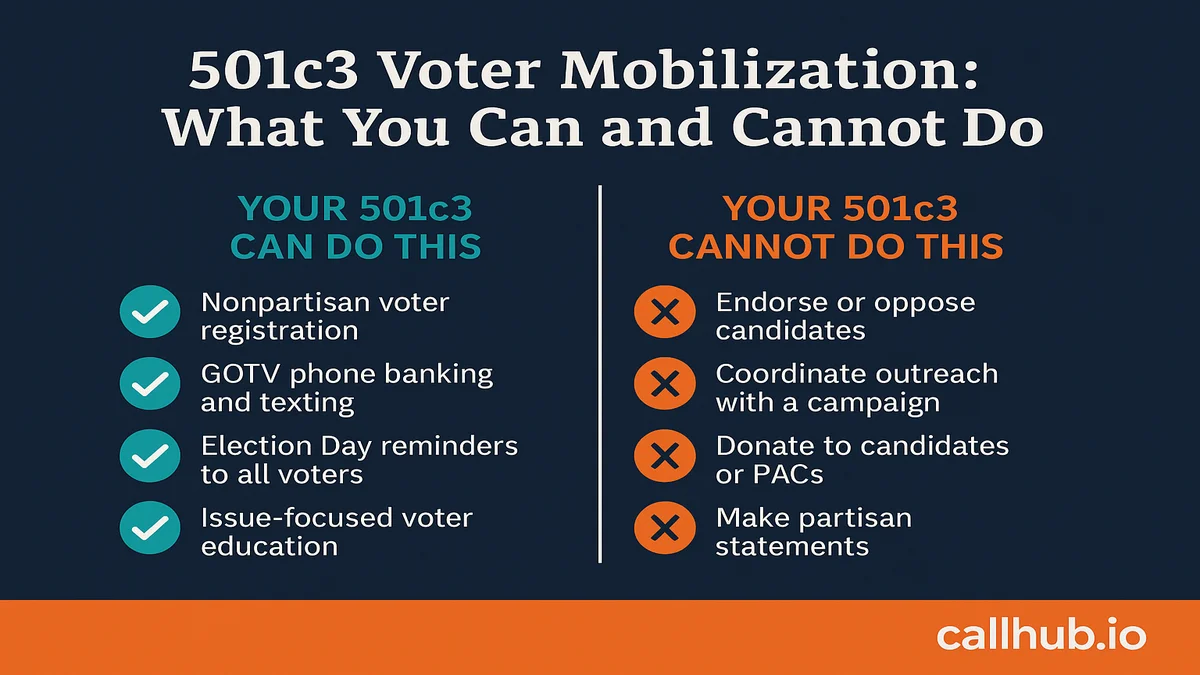
The practical test is this: Does your outreach encourage all eligible voters to participate, regardless of who they vote for? If yes, it’s nonpartisan. If your outreach filters contacts by their likely candidate preference, or coordinates timing with a campaign, it crosses the line.
The National Council of Nonprofits provides guidance on how 501(c)(3)s can structure voter engagement programs within these legal boundaries.
Phone banking and text banking under 501c3 rules
Both phone banking and text banking are permitted for 501(c)(3) GOTV programs, with one additional compliance layer: The Telephone Consumer Protection Act (TCPA).
For calls and texts to your existing supporter base, TCPA exposure is generally low. Supporters who have provided their phone number and have an ongoing relationship with your organization typically fall within prior express consent requirements. When you reach contacts outside your existing list, such as from a matched voter file, consult legal counsel before proceeding on what consent requirements apply in your state.
Script compliance for calls is straightforward. Every call must:
- Identify the calling organization by name
- Frame the outreach as nonpartisan and not affiliated with any candidate or party
- Encourage voting without directing candidate preference
- Avoid evaluating any candidate by name
For text banking, peer-to-peer texting, where a volunteer sends messages to individual contacts one at a time rather than through an automated broadcast, carries a cleaner TCPA posture than bulk automated texts. Your existing phone banking for nonprofits guide covers the channel setup for both calling and texting programs.
How to build your nonprofit voter mobilization list
Your nonprofit already has the most valuable asset in voter mobilization: A community of supporters who trust your organization. Start with your existing contact database, not the voter file.
The voter file, the database of registered voters maintained by state and county election authorities, is where most GOTV programs begin. For nonprofits, that’s the wrong starting point. Your donors, volunteers, program participants, and newsletter subscribers are a community you’ve already earned. The relationship means your outreach is more likely to be received, responded to, and acted on.
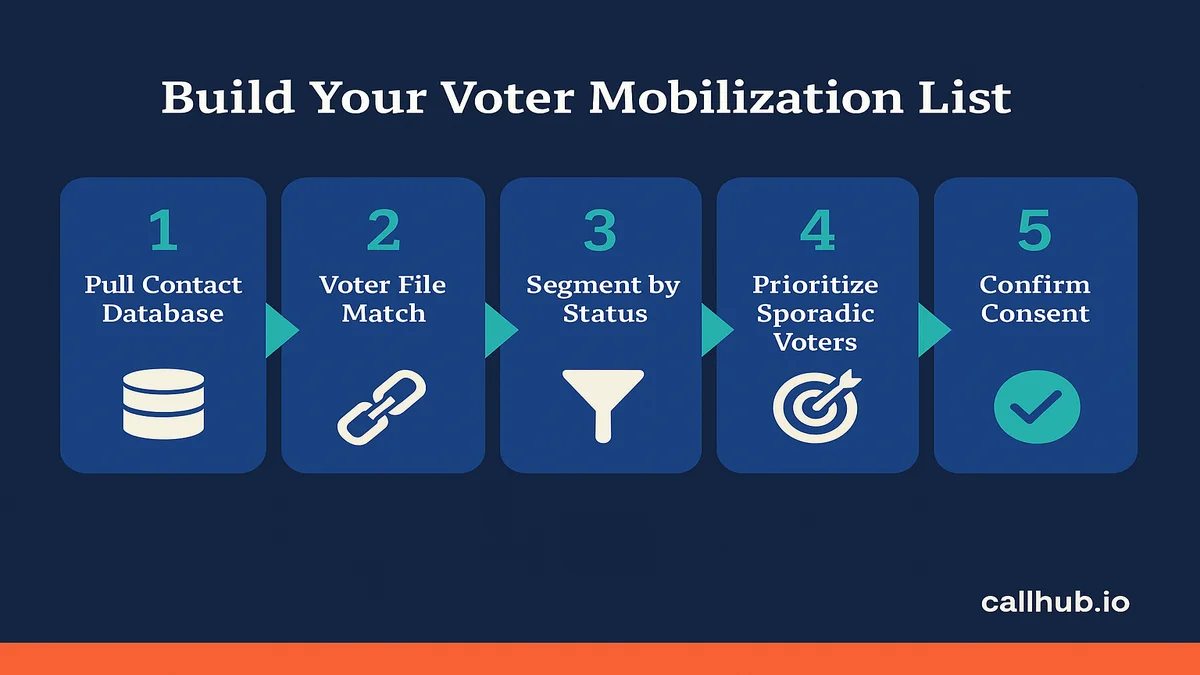
The sequence to build your mobilizable contact list:
- Pull your current contact database. Export name, address, and phone number for all active supporters. Clean duplicates and flag records with missing address data before moving forward.
- Conduct a voter file match. Cross-reference your supporter list against the publicly available voter registration file for your geography. Organizations like Nonprofit VOTE provide free toolkits and state-by-state guidance for nonprofits running their first voter file match.
- Segment by registration status. Supporters who are not yet registered become targets for your voter registration program. Those already registered go into your GOTV outreach queue.
- Prioritize by voting history. If you have access to propensity scores through a voter data partner, prioritize sporadic voters. The marginal impact of GOTV outreach is highest for contacts with an inconsistent voting history.
- Confirm contact consent. Before calling or texting, confirm you have the appropriate consent for each channel. Peer-to-peer texting to your existing opt-in list is generally the cleanest starting point.
Matching your existing supporters to the voter file
A voter file match cross-references your supporter database against registered voter records using name, address, and date of birth. Match rates depend heavily on the quality of your contact data. A clean, current list with complete address fields achieves significantly higher match rates than one with missing or inconsistent records.
If your supporter data is incomplete, your match rate will be low, and your outreach list will be thin. Invest in data hygiene before running the match: Standardize address formats, merge duplicates, and flag records missing phone numbers.
Some states allow 501(c)(3)s to access voter files directly for nonpartisan civic engagement purposes. Others restrict access to political committees. Check your state’s voter file access policy through your secretary of state office before requesting a file, and review the 501c3 political activity rules that apply to your organization before entering into any data sharing arrangement.
Running your GOTV outreach program
A nonprofit GOTV program running phone banking and text banking in parallel comes down to three things: Contact prioritization, script compliance, and volunteer management.
Phone banking produces measurable turnout lift. Research consistently shows that volunteer-led GOTV calls produce meaningful gains among contacted voters. The Analyst Institute’s meta-analysis of GOTV field experiments found that volunteer-conducted calls are approximately 2.1% more effective at turning out voters than calls made by paid or hired callers. The relationship your volunteers have to your community translates directly into outcomes.
What does that mean for your program? Prioritize volunteer outreach over hired callers wherever possible. Your volunteers represent the organization’s community ties. That’s what makes a GOTV call from your housing nonprofit different from a call from an unknown number. See CallHub’s guide to training GOTV volunteers for how to prepare them for these conversations.
When to use each channel:
- Phone banking: High-priority contacts, sporadic voters, community members with specific turnout barriers (transportation, polling place changes, ID requirements), and anyone who needs a real conversation
- Peer-to-peer texting (P2P texting): Broader list coverage, Election Day reminders, follow-ups after initial phone contact, and contacts who are more likely to respond to text than a call
Running both channels in parallel is standard for well-resourced nonprofit GOTV programs. The channels complement each other: Phone reaches depth, text reaches breadth.

“Predictive Dialing means that our callers are utilized at optimum capacity but not overwhelmed. Its ability to adjust in real time based on answer rate helps us provide a consistent experience as we reach thousands of contacts at scale,” says L, Operations Manager at a nonprofit that has mobilized over one million voters.
For organizations coordinating volunteers across both channels, CallHub for political and civic organizations handles contact deduplication, real-time data sync, and channel coordination so volunteers don’t reach the same contact twice through different channels.
What a compliant nonpartisan GOTV script looks like
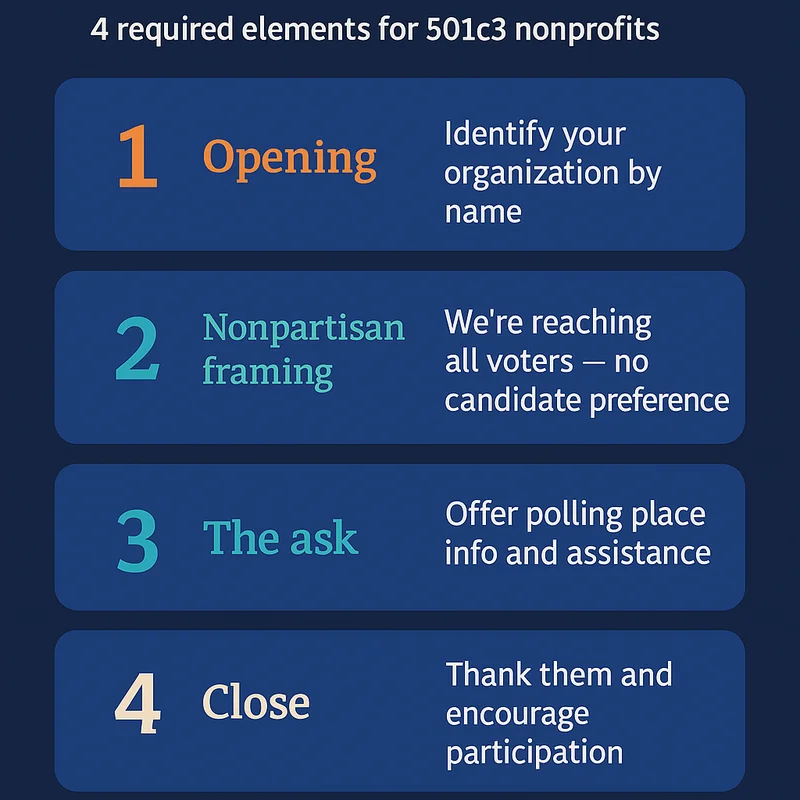
A compliant 501(c)(3) GOTV script has three required elements: Organization identification, nonpartisan framing, and a specific ask.
A sample framework for phone banking:
Opening: “Hi, I’m [volunteer name] calling on behalf of [Organization Name]. We’re reaching out to community members to make sure everyone has the information they need to vote on [Election Day date].”
The ask: “We want to make sure you know when the polls are open and where your polling place is. Can I share that with you?”
Offer of assistance: “If you have any questions about how to get there, what ID to bring, or what to expect at the polls, we can help with that.”
Close: “Thanks for your time. We hope to see you at the polls.”
What the script does not include: Candidate names, party names, any framing that implies who to vote for, and any statement like “vote for the side that supports [issue]” that signals partisan preference.
For text banking scripts, the same principles apply. The message identifies the organization, offers information or assistance, and encourages participation without directing preference. Keep texts to two to three sentences with a clear offer to help. See CallHub’s GOTV text message templates for ready-to-adapt nonpartisan scripts.
Measuring your nonprofit GOTV program
Nonprofits often underinvest in GOTV measurement because the results feel intangible. They’re not. Your program produces concrete data you can report to funders, use to refine your next cycle, and use to identify which contacts responded to outreach.
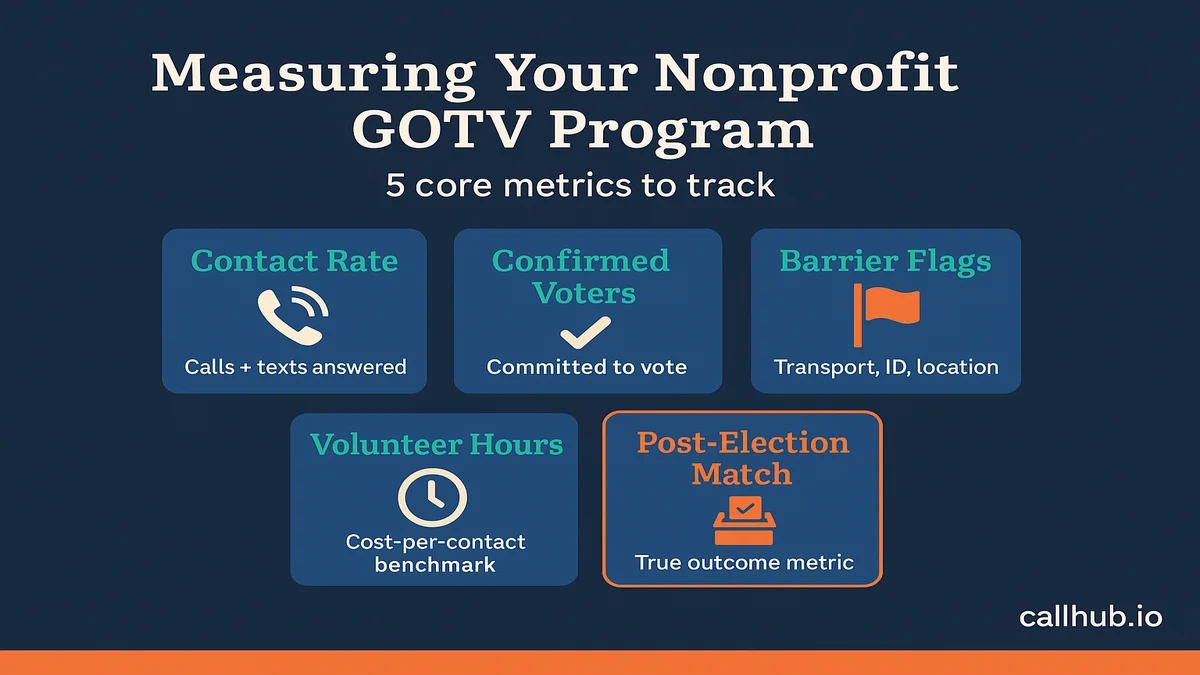
Core metrics to track across your program:
- Contact rate: What percentage of outreach attempts reached a live person or received a text response?
- Confirmed voters: How many contacts confirmed they planned to vote or had already voted?
- Barrier flags: How many contacts raised a specific turnout barrier, such as transportation, polling place location, or ID requirements?
- Volunteer hours: Total hours spent on GOTV outreach divided by contacts reached gives you your cost-per-contact benchmark, which funders often ask for.
- Post-election voter file match: After Election Day, match your outreach list back against the updated public voter file to see what percentage of your contacts actually voted.
The post-election voter file match is your true outcome metric. It’s the most credible evidence of program impact for board members and funders. Plan your data retention before you start: You’ll need your contact list from outreach paired with your post-election outcomes file to run the match.
For more depth on measurement frameworks across a multi-channel program, the complete guide to get out the vote campaigns covers program-level planning from list building through post-election evaluation. For a deeper post-election framework, reconciling contact records, calculating conversion rates, and running the debrief, see CallHub’s post-GOTV analysis guide.
Make every community relationship count on Election Day
Your organization has already done the hardest part of voter mobilization. You’ve built trust with community members that political campaigns spend millions trying to replicate in the weeks before an election.
A compliant nonprofit GOTV program doesn’t require abandoning your mission or your nonpartisan identity. It requires applying the same organizing skills you already have, community outreach, volunteer coordination, and follow-through on barriers, to a specific window when your contacts can exercise the most direct influence over the policies that affect their lives.
Start with your existing supporters. Build the legal framework into your script from the first call. Keep the program nonpartisan at every step. Use the voter mobilization tools for your GOTV program that let your volunteers work at scale without burning out.
When your organization is ready to run phone banking and text banking at scale, see how CallHub powers nonprofit voter outreach and start with the phone banking guide for nonprofits to get your first program off the ground. For the complete phase-by-phase GOTV framework this program fits into, see CallHub’s complete GOTV guide, or explore CallHub’s GOTV platform built for turnout programs like yours.
Frequently asked questions
Can a 501(c)(3) do voter registration?
Yes. Nonpartisan voter registration drives are among the most clearly permitted activities for 501(c)(3) organizations. The requirement is that registration efforts must be nonpartisan: They encourage all eligible voters to register regardless of party, and do not target registration at voters based on their likely candidate preference.
Can nonprofits endorse political candidates?
No. The prohibition on candidate endorsements is absolute for 501(c)(3) organizations. It covers formal endorsements, social media posts that express support or opposition, and any organizational communication that recommends a specific candidate. Violating this rule risks the loss of your tax-exempt status. For more detail on the full range of 501c3 political activity rules, consult legal counsel before launching any new program.
Can a 501(c)(3) send texts reminding people to vote?
Yes, with two conditions. First, the message must be nonpartisan: It encourages participation without directing candidate preference. Second, texts must comply with the Telephone Consumer Protection Act (TCPA), which means your organization needs a clear consent basis for texting each contact. Supporters who have opted in to communications from your organization are generally within your consent basis for GOTV outreach.
What is the Johnson Amendment?
The Johnson Amendment is the 1954 addition to Internal Revenue Code Section 501(c)(3) that prohibits tax-exempt nonprofit organizations from intervening in political campaigns on behalf of, or in opposition to, any candidate for public office. It is the primary legal constraint on 501(c)(3) political activity and has been continuously in effect for over 70 years.
Can a nonprofit do phone banking for GOTV?
Yes. Nonpartisan GOTV phone banking is permitted for 501(c)(3) organizations. Volunteers can call registered voters, provide polling place information, identify transportation barriers, and encourage turnout without directing candidate preference. Every call must clearly identify the nonprofit making the call and must not evaluate any candidate by name.
Can nonprofits work with political campaigns on voter outreach?
No. Coordinating outreach with a political campaign crosses from nonpartisan voter mobilization into prohibited partisan campaign activity. Your GOTV program must be operationally independent from any campaign’s voter outreach efforts. Sharing data, volunteer schedules, or outreach lists with a campaign is not permitted for 501(c)(3)s.
How do nonprofits track voter turnout after GOTV outreach?
After Election Day, you can match your GOTV contact list against the updated public voter file for your state or county. Post-election voter files include a turnout record for each registered voter. Matching your outreach list against this file shows what percentage of your contacted supporters actually voted, giving you the most credible impact metric available for funder reporting and program evaluation.