
Organizing for Change had something most electoral campaigns spend months trying to build: A community that already cared. The environmental coalition and 24 partner groups had supporters connected by shared policy concerns. When a provincial election arrived, those groups pooled their resources and called members to help them vote.
That shift from issue action to electoral action is the hard part of advocacy GOTV. A petition signer is not automatically a voter. A rally attendee is not automatically ready for a turnout message. Your advantage is the relationship, but you still need a compliant system that turns concern into a voting plan.
This guide shows you how to build that system without abandoning the issue that brought supporters to you.
What is advocacy GOTV?
Advocacy GOTV is a voter mobilization program that connects an organization’s issue supporters with an election, helps eligible supporters make a voting plan, and follows up until they vote. It uses existing relationships and engagement history to make turnout outreach more relevant than a generic election reminder.
The definition matters because advocacy organizations start from a different place. Candidate campaigns usually build voter universes around candidate support and voting propensity. Advocacy organizations often begin with petition signatures, event attendance, volunteer work, donations, or responses to a policy campaign.
Your issue data tells you why someone cares. Your voter data tells you what turnout support they may need. Neither signal is enough on its own.
How advocacy GOTV differs from a candidate campaign
| Decision | Advocacy GOTV | Candidate campaign GOTV |
|---|---|---|
| Starting relationship | Shared issue or community interest | Candidate or party support |
| Core message | Connect the issue to electoral power | Reinforce candidate support and voting logistics |
| Primary data | Advocacy actions, consent, and engagement history | Voter file, support score, and turnout history |
| Long-term goal | Bring voters back into year-round advocacy | Win the current election |
| Main risk | Breaking trust by making an abrupt partisan ask | Wasting turnout contacts on undecided voters |
The Organizing for Change case study shows this distinction in practice. The coalition did not treat members as anonymous voter-file records. It mobilized people through organizations they already knew.
Start with the legal lane your organization occupies
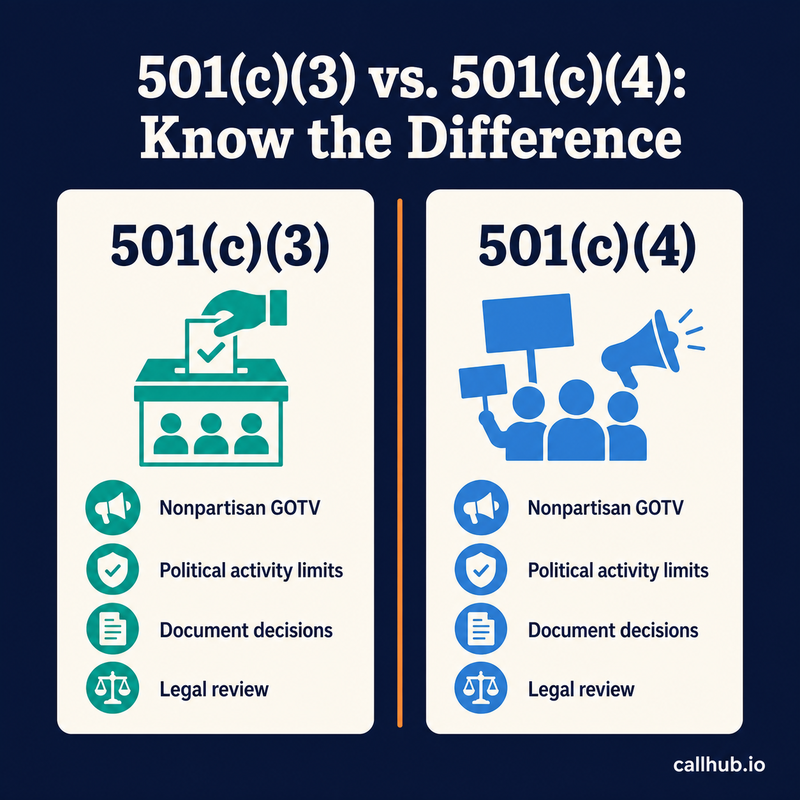
Your tax status shapes the program before your first script is written. It does not answer every legal question, but it determines which election activities need immediate scrutiny.
| Question | 501(c)(3) public charity | 501(c)(4) social welfare organization |
|---|---|---|
| Can it run voter registration and GOTV? | Yes, when conducted in a neutral, nonpartisan manner | Yes, subject to tax, election, and state-law limits |
| Can it support or oppose candidates? | No | Political campaign activity may be permitted, but cannot become the organization’s primary activity |
| Can it advocate on ballot measures? | Generally treated as lobbying, subject to applicable limits | Generally permitted within applicable rules |
| What should the team document? | Neutral criteria, scripts, targeting, training, and execution | Activity purpose, spending, targeting, coordination, disclaimers, and allocation |
This is operational guidance, not legal advice. Have qualified counsel review your structure, targeting, scripts, disclaimers, data use, and state-specific obligations.
Nonpartisan GOTV for 501(c)(3) organizations
The Internal Revenue Service says a 501(c)(3) organization may conduct voter registration and GOTV drives when they are neutral and nonpartisan. For the full nonpartisan compliance playbook, see CallHub’s guide to GOTV for nonprofits.
Neutrality needs to show up across the entire program:
- Use nonpartisan messages that do not favor or oppose a candidate or party.
- Choose audiences through mission-related, neutral criteria rather than expected candidate preference.
- Give accurate voting information without selective presentation.
- Train staff and volunteers to avoid off-script endorsements.
- Apply the same rules to events, guides, reminders, and assistance.
A neutral script cannot rescue a partisan targeting method. Review the audience selection and the words supporters will receive.
Election activity for 501(c)(4) organizations
A 501(c)(4) has more room for political campaign activity, but that room is not unlimited. IRS Publication 4221-NC states that political campaign activity cannot constitute the organization’s primary activity.
Do not turn that standard into a casual percentage shortcut. The right operational response is to classify activities, track spending and staff time, maintain organizational purpose, and seek advice for the actual program.
Your review should cover:
- Whether the message includes express advocacy.
- Whether a communication triggers federal or state reporting.
- Whether coordination rules apply.
- Which entity paid for staff, data, technology, or creative work.
- Which disclaimer must appear on each communication.
Add the state, campaign-finance, and telecom checks
Tax status is only the first layer. The Alliance for Justice voter-assistance resources emphasize that state rules can change which activities are practical or legally safe.
Before launch, verify:
- Voter-registration requirements in every state where your team operates.
- Campaign-finance registration, reporting, disclaimer, and coordination rules.
- Ballot-measure rules when the issue appears directly on the ballot.
- Calling and texting consent, identification, quiet-hour, and opt-out requirements.
- Data-sharing agreements between affiliated entities and coalition partners.
Build this review into campaign setup. A compliance check performed after messages are scheduled is just damage control.
Map the journey from issue supporter to voter
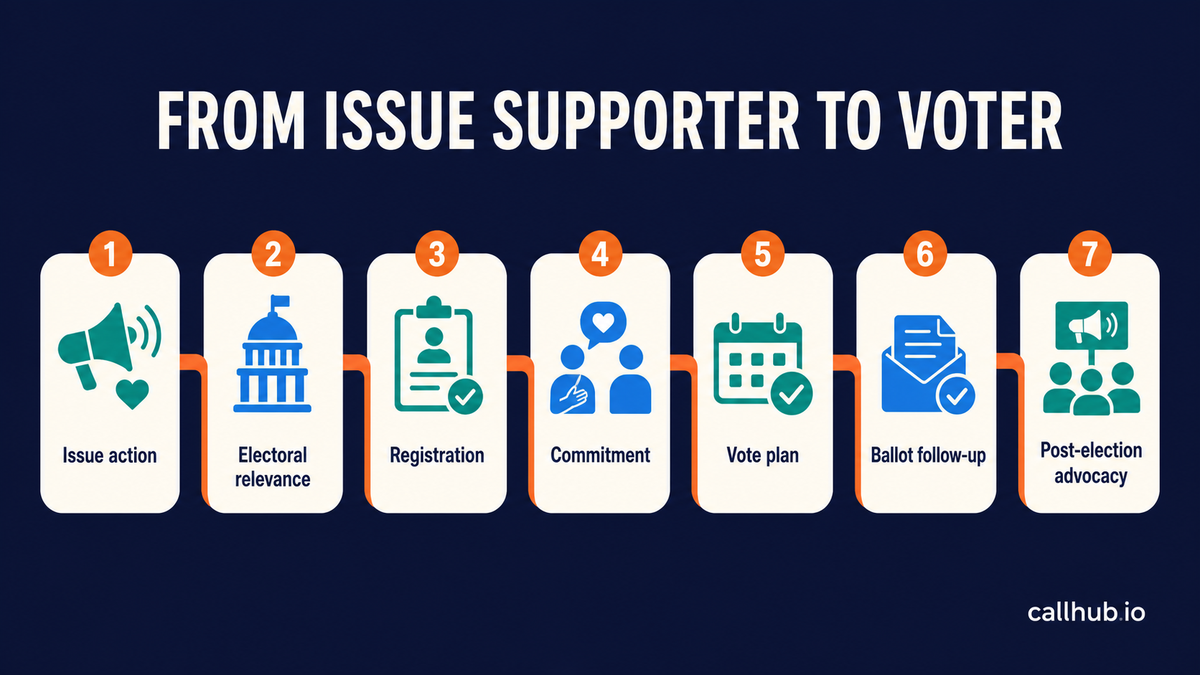
The cleanest advocacy voter mobilization plan follows the supporter journey instead of jumping straight to reminders.
- Issue action: The person signs, calls, attends, donates, or volunteers.
- Electoral relevance: Your organization explains which elected office or ballot decision affects the issue.
- Eligibility and registration: The supporter checks registration and receives official resources.
- Turnout commitment: The supporter says whether they intend to vote.
- Vote plan: The supporter chooses when, where, and how to vote.
- Ballot follow-up: Your team resolves barriers and suppresses people who have already voted when reliable data permits.
- Post-election advocacy: The voter receives results, next steps, and a path back into the issue campaign.
The election is one moment in the relationship, not the end of it. That principle changes both your message and your measurement.
Define the electoral connection without abandoning the issue
Supporters need a credible bridge between the issue and the election. Start with the decision-making power attached to the office or ballot question. Then explain why participation matters without pretending one vote will settle a complex campaign.
Weak transition:
You signed our housing petition. Remember to vote.
Stronger transition:
You asked the city to protect affordable housing. Council members elected this November will vote on the next housing plan. Check your registration today, then choose how you will vote.
The stronger version respects the original action. It names the decision-maker, connects the election to the issue, and gives the supporter one next step.
Preserve consent, source, and engagement history
Do not flatten every supporter into one GOTV list. Keep the context that made the relationship possible:
- Original acquisition source.
- Issue or campaign joined.
- Communication consent by channel.
- Location and relevant district.
- Actions completed.
- Volunteer or donor history.
- Language preference.
- Prior responses and opt-outs.
- Voter-file match status, where lawful and appropriate.
At a 350.org rally attended by 6,000 people, 2,919 people joined the message list through a short message service (SMS) keyword opt-in, according to a mobile advocacy case study. That source and consent history should remain attached to later outreach.
Segment supporters before you ask them to vote
Prioritize people using two separate signals: Advocacy engagement and turnout need.
| Advocacy engagement | Turnout propensity | Recommended treatment |
|---|---|---|
| High | Low or inconsistent | High-priority personal calls, barrier resolution, and repeated vote-plan follow-up |
| High | High | Early commitment ask, volunteer recruitment, and lighter reminders |
| Low | Low or unknown | Issue-to-election education before a turnout ask |
| Low | High | Concise voting information and a re-engagement opportunity |
This matrix protects your highest-value conversations. A frequent voter who already volunteers does not need the same sequence as a first-time petition signer with no consistent voting history.
Separate advocacy engagement from voter propensity
Advocacy engagement includes signals such as repeat actions, event attendance, donations, volunteer shifts, and replies. Voter propensity comes from lawful voter-file data, self-reported behavior, or prior turnout history.
Do not use issue passion as a substitute for turnout evidence. Highly engaged supporters may still face registration, transportation, language, work-schedule, identification, or confidence barriers.
Build suppression and escalation rules
Write these rules before outreach begins:
- Suppress channel opt-outs immediately.
- Stop turnout reminders when reliable data confirms a ballot was cast.
- Escalate complex voting questions to trained staff or official election resources.
- Route undecided voters away from a logistics-only GOTV script.
- Limit total contact frequency across coalition partners.
- Flag threats, misinformation, or voter-access incidents for the designated response team.
One shared contact policy prevents five coalition partners from texting the same person on the same evening.
Time GOTV alongside the issue campaign cycle
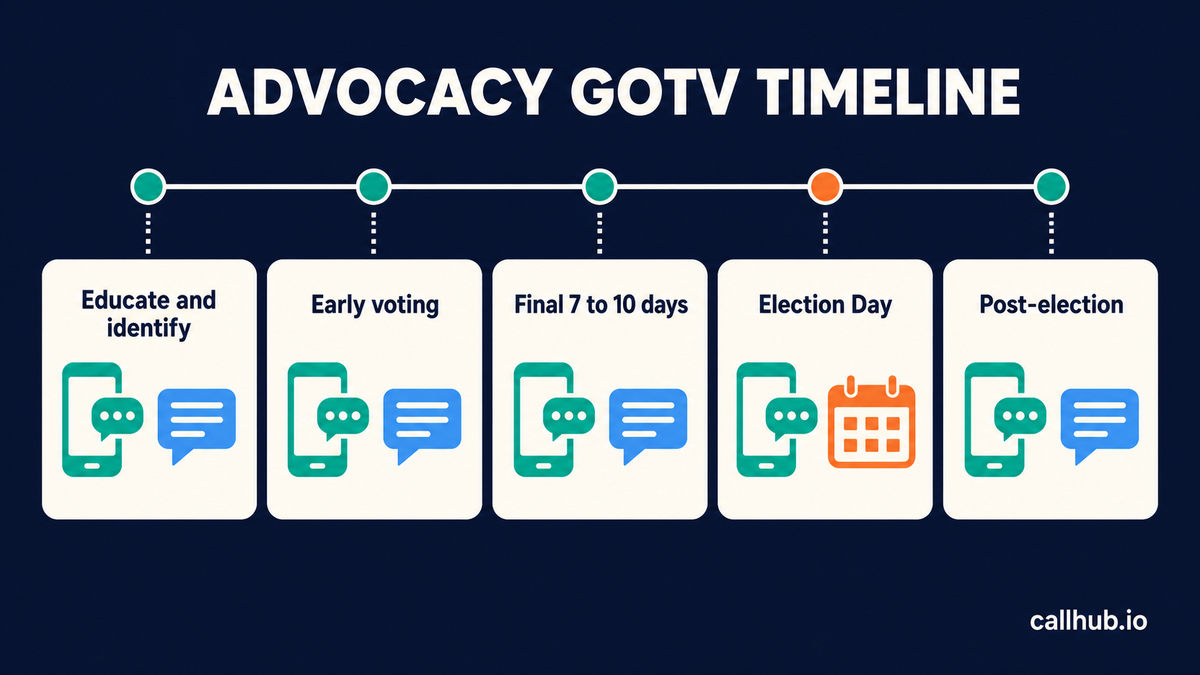
Advocacy GOTV should build gradually, then narrow toward turnout as voting begins. For the general election-cycle schedule this timeline adapts, see CallHub’s GOTV timeline guide.
| Campaign window | Primary goal | Best ask |
|---|---|---|
| Before ballots are available | Explain electoral relevance and identify supporters | Check registration, pledge to vote, or volunteer |
| Early voting and mail voting | Move supporters from intent to action | Choose a voting method and date |
| Final 7 to 10 days | Turn out confirmed supporters | Confirm the vote plan and solve barriers |
| Election Day | Reach remaining supporters | Vote now, find official information, or report a problem |
| After Election Day | Retain civic energy | Thank supporters and return them to the issue campaign |
Before ballots are available: Educate, identify, and recruit
Use the issue campaign to establish why the election matters. Collect commitments, confirm consent, recruit volunteers, and clean data before the high-volume period.
This is also the time to train people on the distinction between persuasion and turnout. Volunteers should know when to discuss the issue, when to ask for a commitment, and when to focus only on voting logistics.
Early voting and vote-by-mail: Move logistics forward
A single national start date rarely works. Build state-specific calendars around registration deadlines, ballot mailing, early voting, absentee requests, cure processes, and Election Day.
As soon as voting begins, ask supporters to choose a method and date. Follow up based on that choice. Someone waiting for a mail ballot needs a different message from someone planning to vote after work.
Final 7 to 10 days: Switch from persuasion to turnout
CallHub’s GOTV phone banking guide separates persuasion from intensive turnout work. Persuasion often happens 30 to 60 days before Election Day, while GOTV focuses on confirmed supporters in the final 7 to 10 days.
That shift should be visible in your scripts:
- Stop reopening broad issue debates with confirmed supporters.
- Confirm when, where, and how they will vote.
- Ask what could prevent the plan.
- Provide official resources for unresolved questions.
- Record the next action before ending the contact.
Election Day and post-election: Close the loop
Election Day outreach should be short, accurate, and responsive. Use live results to prioritize people who still need contact, where such data is reliable and lawful.
After polls close, thank supporters without making the relationship conditional on the result. Explain what happens next on the issue and invite one appropriate action. This is how voter participation becomes lasting advocacy power.
Build a multichannel advocacy voter mobilization plan
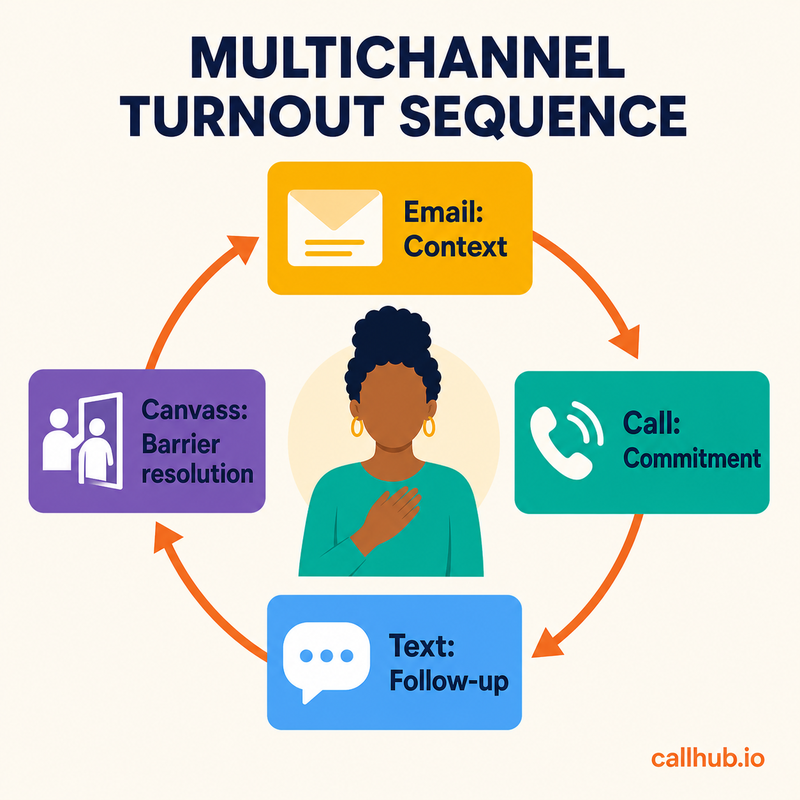
Each channel should do a different job. Repeating the same reminder everywhere creates fatigue without resolving barriers.
| Channel | Best role | Useful outcome |
|---|---|---|
| Phone banking | Commitment, conversation, and barrier resolution | Vote plan, volunteer sign-up, or escalation |
| Peer-to-peer texting | Fast personal follow-up and troubleshooting | Reply, resource delivery, or plan confirmation |
| Broadcast text | Time-sensitive reminders for consented lists | Deadline awareness or urgent action |
| Detailed context and resource collections | Education and reference | |
| Canvassing | High-trust conversation and local assistance | Commitment and problem solving |
Use calls for commitment and barrier resolution
Calls work when the supporter needs a conversation. Keep the script focused:
- Reconnect through the issue.
- Explain the electoral connection.
- Ask whether the supporter plans to vote.
- Help them name a method and time.
- Ask what could get in the way.
- Record the outcome and next step.
A phone banking platform can show volunteers the right script and capture structured outcomes. That matters more than raw dialing speed when conversations need careful routing.
Use texts for consented reminders and rapid follow-up
Texts work well for specific next steps, official links, and quick replies. A volunteer can follow a call with the polling-place resource the supporter requested or confirm the time they chose.
Use peer-to-peer texting when people may answer with questions. Use broadcasts only for messages that genuinely fit one-way delivery. Keep consent, identification, and opt-out handling central to both.
Use email and canvassing to reinforce, not duplicate
Email gives supporters room for detail. Canvassing creates the highest-context conversation. Neither should repeat the phone script word for word.
Your channel sequence might use email for the issue explanation, a call for the commitment, a text for the requested link, and a doorstep conversation for a supporter who still faces a barrier.
When several channels and partners are involved, CallHub’s advocacy outreach platform can keep calls, texts, scripts, and outcomes connected. The operational value is coordination, not another stream of identical messages.
Run the campaign as a measurable turnout operation
Contact volume tells you how busy the team was. Movement through the supporter-to-voter journey tells you whether the program worked. For a full framework on turning this data into next-cycle decisions, see CallHub’s post-GOTV analysis guide.
Track:
- Supporters matched or prepared for voter outreach.
- Registration checks completed.
- Turnout commitments received.
- Vote plans created.
- Barriers identified and resolved.
- Supporters reached by each channel.
- Contacts suppressed after voting or opting out.
- Volunteers recruited from high-propensity supporters.
- Post-election advocacy actions completed.
The useful unit is a supporter moving to the next stage, not a message leaving the platform.
Review results by segment, channel, script, day, and organizer. If calls produce commitments but texts produce plan confirmations, protect that sequence. If one coalition partner generates opt-outs, stop and inspect its targeting and message.
Common advocacy GOTV mistakes to avoid
Most failures come from treating the election as a separate campaign.
- Making the electoral connection too late: Supporters need time to understand why the office or measure affects the issue.
- Treating every supporter as equally ready: Engagement and turnout propensity are separate.
- Using a persuasion script during GOTV: Confirmed supporters need logistics and barrier resolution.
- Ignoring coalition frequency: Shared audiences can receive duplicate contacts from multiple partners.
- Assuming tax status settles compliance: State, election, telecom, and data rules still apply.
- Measuring sends instead of movement: Activity counts hide stalled supporters.
- Ending the relationship after Election Day: Voters should return to the year-round advocacy program.
Fix these choices in the campaign design. Volunteer enthusiasm cannot compensate for a broken sequence.
Turn Election Day participation into lasting advocacy power
Advocacy organizations do not need to build electoral power from zero. They need to translate existing issue commitment into a compliant voting plan, then carry those voters back into year-round advocacy.
For coordinated calls and texts, explore multichannel outreach for advocacy organizations. For the organizing foundation behind the program, use this complete guide to grassroots advocacy strategy. For the phase-by-phase GOTV framework this program plugs into, see CallHub’s complete GOTV guide, and explore CallHub’s GOTV platform to see how calling and texting come together for turnout specifically.
External sources and further reading
- IRS guidance on nonpartisan 501(c)(3) GOTV activity
- IRS Publication 4221-NC for tax-exempt organizations
- Alliance for Justice guidance on nonprofit voter assistance
- National Council of Nonprofits nonpartisan voter engagement guide
- Nonprofit VOTE voter engagement guide
Frequently asked questions
Can a 501(c)(3) organization conduct a GOTV drive?
Yes. A 501(c)(3) organization may conduct voter registration and GOTV drives when they are neutral and nonpartisan, according to the IRS. Review targeting, scripts, training, and execution because neutrality applies to the complete program.
Can a 501(c)(4) endorse candidates?
A 501(c)(4) may have more scope for political campaign activity than a 501(c)(3), but political activity cannot become its primary activity. Election, state, reporting, coordination, and disclaimer rules may also apply, so obtain organization-specific legal advice.
Is advocacy GOTV the same as voter persuasion?
No. Persuasion tries to change a person’s position, while GOTV helps an identified supporter follow through on voting. The GOTV phone banking strategy guide explains how the audiences, scripts, and timing differ.
When should an advocacy organization start GOTV outreach?
Start education, identification, registration support, and volunteer recruitment well before ballots are available. Shift confirmed supporters into logistics-focused GOTV as early or mail voting begins, then intensify follow-up during the final 7 to 10 days.
Can an advocacy organization text its supporter list about voting?
It may be able to text supporters when the message, consent, identification, opt-out process, timing, and targeting comply with applicable rules. Do not assume that an email signup or petition signature creates permission for every texting use.
What should advocacy organizations do with GOTV supporters after the election?
Thank them, report what happened, and reconnect the result to the issue campaign. Invite one relevant next action so the voter remains part of the organization’s advocacy community.