


Table of Contents
 It’s election time (or soon to be election time) almost everywhere. One of the questions we frequently get at New/Mode is, “how do I mobilize my members/supporters to get more involved in elections?”.
NGO’s, unions, advocacy organizations and progressive candidates have at least four great engagement opportunities during an election:
It’s election time (or soon to be election time) almost everywhere. One of the questions we frequently get at New/Mode is, “how do I mobilize my members/supporters to get more involved in elections?”.
NGO’s, unions, advocacy organizations and progressive candidates have at least four great engagement opportunities during an election:
-
- Acquire new contacts/supporters. There’s a good chance other people care about the issue you care about too. Empowering them to get involved, and giving them the platform to easily take action, is a great way to bring new supporters into your ecosystem.
- Convert your passive contacts into more engaged supporters. They’ve opted in to your newsletter or they’ve signed a petition. Now invite them to take the next step and lead them all the way to the ballot box.
- Shape the narrative in the media and on social media. Your supporter base can be mobilized to support a powerful progressive story both online and in traditional media.
- Build a community to move the dial on your issue. Recent studies show that decision makers take note, and are influenced, when constituents speak up through multiple channels over time. This is especially true leading up to and during elections. Progressive candidates can do this as well – ask your supporters to call out your opponent’s regressive policy positions.
Key Takeaways
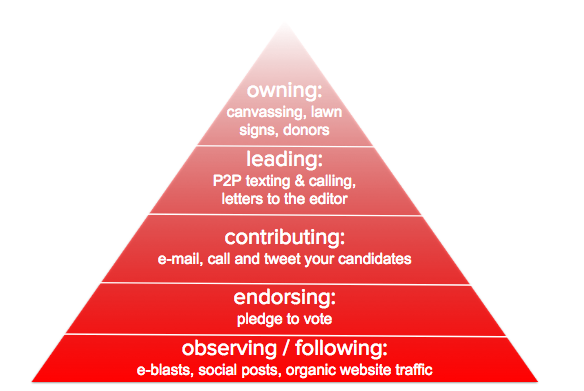
The engagement pyramid, an escalating series of asks from easy to high-commitment actions, combines digital and field tactics to help campaigners mobilize supporters during elections.
Engagement Pyramid Basics
- A digital engagement pyramid maps a user journey from following on social media to making a pledge, emailing a representative, then becoming a monthly donor.
- A field pyramid converts event RSVPs into canvassing teams.
- The strongest engagement plans mix digital and field activities chosen for the specific audience and the campaign’s theory of change.
Four Election Engagement Opportunities
- Organizations can acquire new contacts by giving people who share their concerns an easy platform to take action.
- Passive contacts who already signed a petition or newsletter can be converted into more engaged supporters by inviting them to take the next step toward voting.
- Supporter bases can be mobilized to shape narratives in traditional and social media around a progressive story.
- Communities can be built to move the dial on an issue, since decision makers respond when constituents speak up through multiple channels over time, especially around elections.
Case Example: Mental Health Campaign
- Over 3,000 people signed a declaration for increased mental health and addictions support ahead of an election.
- An escalating series of asks led to 2,000 people contacting candidates, 380 signing up to volunteer, and 44 candidates pledging support.
- Mental health and addictions became a platform issue, and the newly formed government announced a dedicated Ministry as a result.
Building an Election Toolkit Under Spending Limits
- Election landing pages built with tools like ActionNetwork can explain an issue and its importance to visitors.
- Pledge and petition tools, such as those from New/Mode and ActionNetwork, drive signups since studies show pledge signers are more likely to vote.
- Supporters can be turned into advocates through social media tools, letters to local papers, or click-to-call tools for local radio, and asked to contact candidates about their positions using one-click email and calling tools.
- Action takers can become organizers and be reminded to vote through phone banking (via tools like CallHub) or peer-to-peer texting, a method previously used by Bernie Sanders and Hillary Clinton.
Mobilizing members and supporters, when election spending is out
In many districts, election spending limits make it difficult for third-party organizations to spend big bucks to support candidates or parties. So how do you build community, show power and influence decisions without ads or campaigns in the public domain? Many organizations, especially unions, are turning to members – and empowering them – to put their votes where your collective values are.Your election toolkit should include:
- An election landing page that explains the issue(s) and why it’s important to get involved. ActionNetwork and other cause-based CMS’s make this easy.
- Ask visitors to pledge their vote. New/Mode and ActionNetwork have petition tools that work great for signups and pledges. Studies show voters who sign a pledge are more likely vote. New/Mode’s tool is optimized for social media virality to help you grow your supporter base through pledge forms.
- Turn supporters into advocates through social media tools, letters submitted to local papers or using a click-to-call tool to phone into local radio shows.
- If you’re not a candidate yourself, ask pledged supporters to contact candidates to find out where they stand on the issues you care about. New/Mode’s One-click email and calling tools embed directly into your existing website. OntarioVoters.ca is an example of a voter engagement campaign using tools to contact candidates.
- Turn action takers into organizers. You could reach them by email or increasingly popular peer-to-peer texting services like CallHub.
- Remind people to vote. By this point, your supporters have taken one or more actions and they’re armed with the information they need to vote. Phone banking campaigns, using tools like CallHub, are a great way to reinforce that personal relationship and inspire action. Peer-to-peer texting, famously used by Bernie Sanders and Hillary Clinton, can also successfully drive your supporters to polling stations.
Author: Natasha Wilsion
 With experience in both digital marketing and community organizing, Natasha develops strategies and campaigns – using the latest tech and data – to tackle timely social, political and environmental issues.
Prior to joining New/Mode, Natasha was the Digital Director at cStreet Campaigns where she helped labour, NGO and political clients build progressive movements across Canada, the US and Australia. Her free time is spent volunteering, petting dogs, and tweeting pictures of cars in bike lanes.
With experience in both digital marketing and community organizing, Natasha develops strategies and campaigns – using the latest tech and data – to tackle timely social, political and environmental issues.
Prior to joining New/Mode, Natasha was the Digital Director at cStreet Campaigns where she helped labour, NGO and political clients build progressive movements across Canada, the US and Australia. Her free time is spent volunteering, petting dogs, and tweeting pictures of cars in bike lanes. 
Tony Joy


Tony works on stories at CallHub, where the customer is the protagonist, and the setting changes across politics, advocacy, and business. He shapes and builds the story arc to help them mobilize supporters, assess voter sentiment, or get citizens out to vote.