

Most campaigns treat election day GOTV (Get Out the Vote) as the 72-hour push with a harder deadline. Same list. Same shift structure. Same channel mix. Just a faster clock.
The problem with that framing is operational. Your election day universe should be 40–60% of your GOTV list, filtered for anyone who has already voted, unresponsive to any prior contact, or outside precincts where polls are open. The channel sequence needs to compress from four days into 13 hours. And the real-time feedback loop that barely matters in a multi-day push becomes your primary redeployment tool by noon.
This playbook covers what happens from polls-open to polls-close: The election day universe build, the morning text blast, three phone bank shifts, hourly precinct tracking, mid-day redeployment, and the poll closing reminder. For the full GOTV framework before election day, start with the complete GOTV strategy guide.
What is election day GOTV?
Election day GOTV is the final mobilization push: All outreach targeted at confirmed supporters who have not yet voted, executed from polls-open to polls-close on election day itself.
It is not the 72-hour push extended. The 72-hour push builds voting intent. It moves identified supporters from “planning to vote” to “committed to voting today.” Election day GOTV converts that intent into a confirmed ballot. The job is different, so the operation has to be too.
Three things change on election day:
- The list shrinks. Anyone who has already voted (early, absentee, or same-day) exits the active queue. You’re working a tighter subset of your GOTV universe.
- The channel sequence compresses. You’re not running a four-day outreach arc. You’re sequencing a morning text blast, three phone bank shifts, and a poll close reminder inside a single calendar day.
- Feedback becomes real-time. In a multi-day push, you optimize overnight. On election day, you’re adjusting your list and redeploying volunteers every hour.
This playbook assumes the earlier phases, voter ID, the 72-hour push, early vote tracking, are already built. For that full sequence, see the phase-by-phase GOTV guide.
Building your election day universe
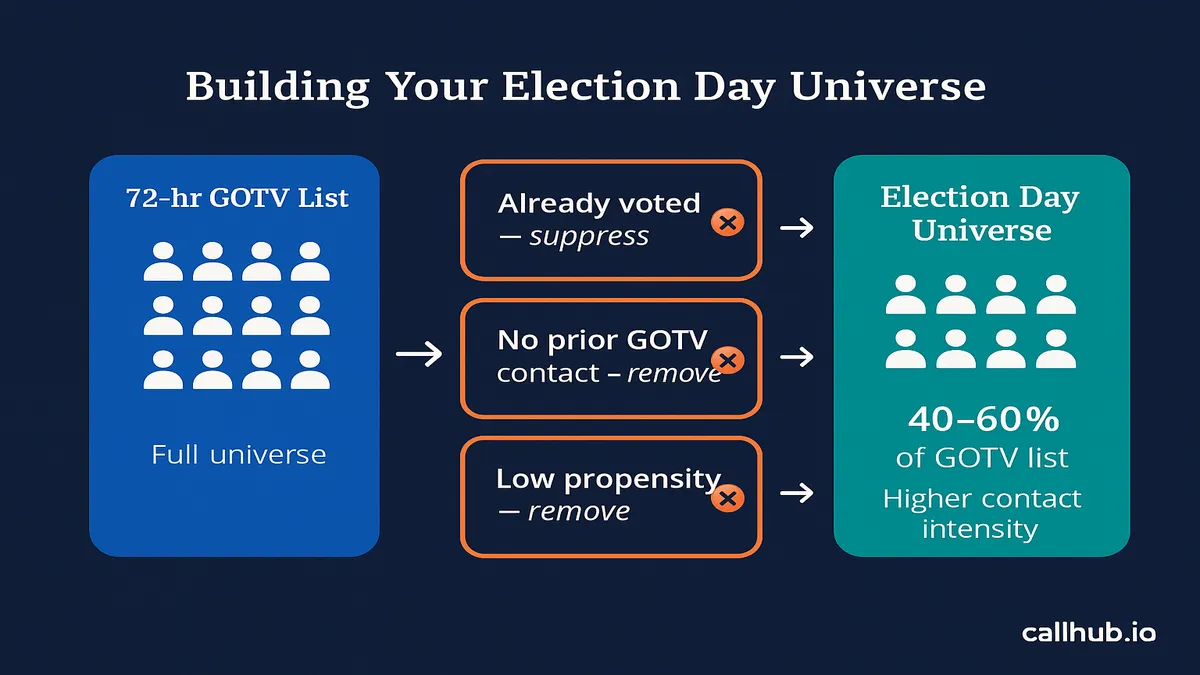
Your election day universe is a filtered subset of your GOTV list, not a copy of it. The goal is concentration: A smaller list you can contact at high intensity, not a large list you can barely reach.
Who makes the cut
The election day list should include confirmed supporters who:
- Have not yet voted (no early vote confirmation, no absentee ballot return)
- Live in precincts where polls are currently open
- Had at least one GOTV contact during the prior 72 hours
Remove anyone who confirmed they voted during the 72-hour push. Remove contacts on the absentee ballot chase list who returned a ballot before election day. Remove low-propensity contacts who did not respond to any prior outreach. They are unlikely to respond now and will pull your contact rate down.
Sizing expectations
Most campaigns find their election day universe is 40–60% of the 72-hour GOTV list. If your list is still close to full GOTV size by election day morning, it usually means the suppression logic has not run, not that your program is performing well.
The Analyst Institute research on GOTV contact timing shows that the final one to two days of contact represent the largest single-contact turnout boost in any GOTV program. Concentration matters. A tight list with high contact rates outperforms a large list with scattered reach. For more on the full-cycle approach to increasing voter turnout, that guide covers the strategy from voter ID through election day.
Syncing with ballot return data
In states that publish same-day ballot return data (uncommon, but available in some jurisdictions), run a final suppression pass before polls open. Pull the latest file, match it against your election day list, and remove confirmed voters. This takes 20 minutes and can clear hundreds of contacts from the active queue before shift 1 starts.
If your state does not publish intraday data, you will rely on phone bank contact confirmations and poll watcher data throughout the day. That is the standard path and it works, but it requires the hourly refresh process described below.
The morning text blast
The morning text blast is the first touchpoint of the day. It goes to the full election day universe before phone banking begins and serves a specific function: It primes contacts before a call arrives.
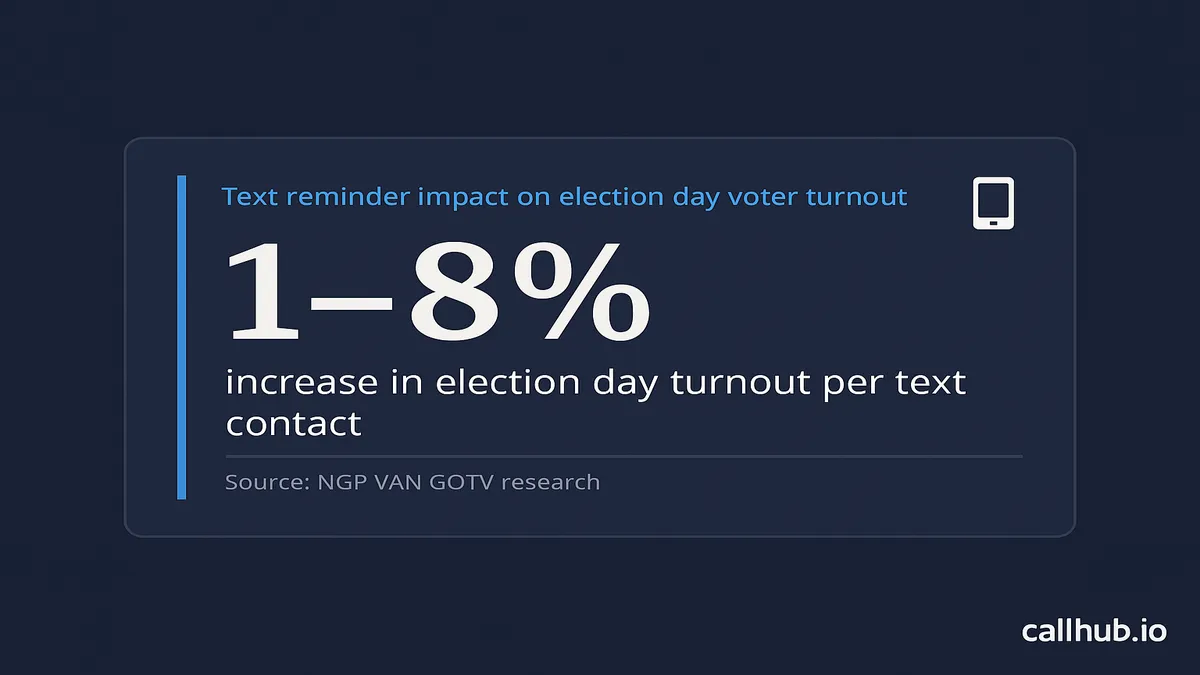
Text reminders increase election day turnout by 1–8% according to research cited by NGP VAN. The lift varies by list quality and contact history, but the morning blast is one of the highest-return moves of the day given its low cost and the speed at which it reaches the full universe.
Timing
Send between 7 and 9 a.m. in each contact’s local time zone. This window opens after polls are confirmed open and reaches contacts before the morning phone bank shift gets underway. A text that arrives at 7:30 a.m. sets up the phone call that arrives at 9.
What it says
Keep the election day text blast short and direct. The message should include:
- The voter’s polling location (if available in your voter file)
- Polling hours
- One clear action: Vote today
No link is required. A message the reader can read and act on in 10 seconds outperforms a multi-paragraph text. If your platform supports dynamic field insertion, pull in the polling location from the voter file automatically. It meaningfully increases response rates versus a generic broadcast.
Who sends it
Use Text Broadcasting for the morning blast. It reaches the full election day universe in a single push without volunteers. Reserve peer-to-peer texting (P2P texting) for contacts who reply to the broadcast or request additional information: Polling location directions, voting ID requirements, and ride-to-polls options. P2P texting is the right tool for two-way conversations, not mass morning outreach.
Phone bank shift timing and structure
Election day phone banking runs in waves tied to when contacts are reachable and when your list changes. One long shift from 8 a.m. to 8 p.m. burns volunteer energy on contacts who have already voted and misses the cadence that makes each hour count.
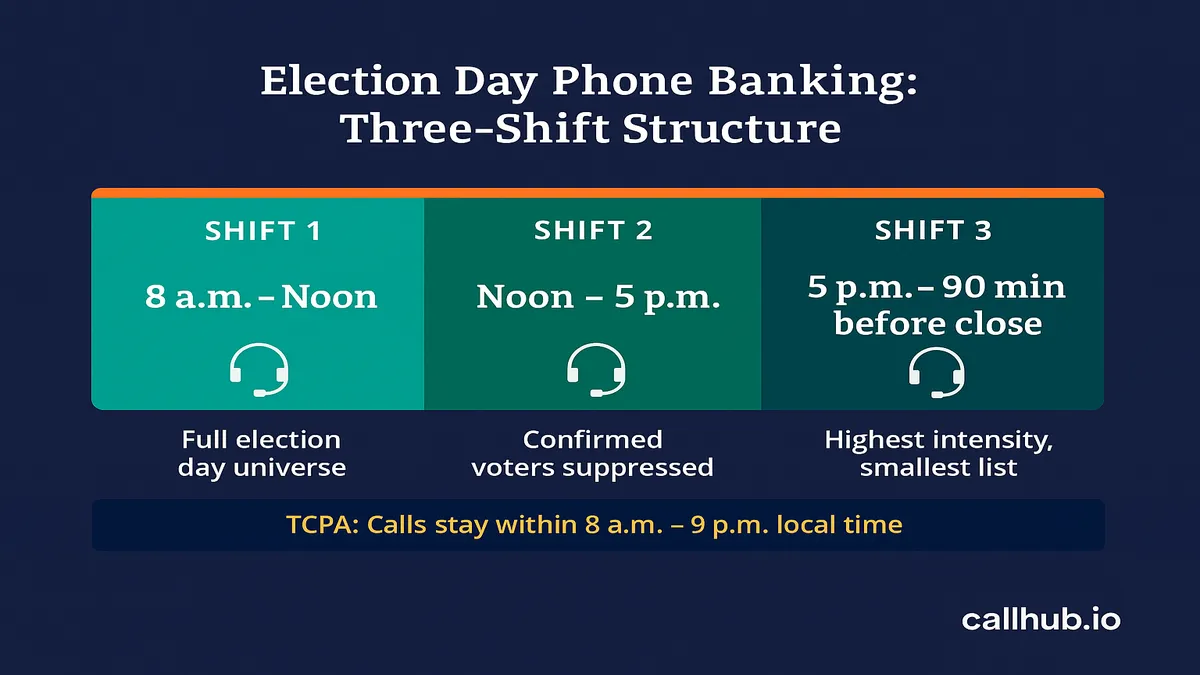
Shift 1: Morning (8 a.m. to noon)
Shift 1 starts when polls open. Answer rates are highest in the morning. Many contacts are at home before work, already planning their route to the polls. Your list at this stage is the full election day universe.
The goal for morning callers: Confirm voting plans, share polling location and hours, and flag contacts who say they’ve already voted for same-day suppression. Every confirmed voter in shift 1 is a contact removed from the shift 2 list.
Callers need an election-day-specific script, shorter and more action-specific than the 72-hour GOTV version. Fewer questions, a direct voting plan ask, and a quick transition to “Is there anything preventing you from getting to the polls today?” The GOTV script samples guide covers both the 72-hour version and the election day variant. For how to get volunteers ready to run that script in the few minutes you have before shift 1, see the GOTV volunteer training guide.
Shift 2: Afternoon (noon to 5 p.m.)
The afternoon list is the morning list minus confirmed voters. Suppress everyone shift 1 callers flagged as voted, plus any ballot return confirmations that came in since morning. Run the suppression pass before shift 2 starts.
The tone shifts to urgency. Contacts who did not answer in the morning are still reachable now. Shift 2 callers surface transportation barriers and offer ride-to-polls options where available. Contacts who don’t answer by 3 p.m. become canvass-escalation candidates.
Phone banking for GOTV lifts election day turnout by 3–4 percentage points according to Yale ISPS GOTV experiments. That lift comes primarily from completed contacts, which is why shift 2 works the same unreached contacts from the morning, not new reach. For a deeper look at the full phone banking for GOTV voter turnout strategy, that guide covers the broader approach.
Shift 3: Evening (5 p.m. to 90 minutes before polls close)
Shift 3 works the smallest, highest-intensity list: Contacts in open precincts who have not yet confirmed as voted. Scripts shift to deadline urgency. Callers are not building rapport. They are delivering a final reminder that polls are closing.
End shift 3 at least 90 minutes before your local poll close time. In most states, this means ending well before the compliance window closes.
TCPA compliance note: Federal Telephone Consumer Protection Act (TCPA) regulations require calls to stay within the 8 a.m. to 9 p.m. window in the contact’s local time zone. Plan shift 3’s end time around your state’s poll close time, not around 9 p.m. If your polls close at 7 p.m., shift 3 should end by 5:30 p.m., not run until the TCPA cutoff.
Real-time turnout tracking by precinct
The ballot return file does not update during in-person voting in most states. You will not receive an automatic confirmation when a supporter walks into a polling location. You will hear it from your callers and your poll watchers, and you need to act on it within the hour.
Two data streams
Election day turnout tracking runs through two parallel channels:
- Contact confirmations from phone banking and texting. When a volunteer notes “says they voted” or a texter receives a “I already voted” reply, update the flag immediately. That contact exits the active call and text queues on the next refresh.
- Poll watcher sheets. Precinct-level foot traffic returned from field every one to two hours. Poll watchers at multiple locations give you an early signal on which precincts are pacing behind, before your contact confirmation data catches up.
Neither stream is complete on its own. Contact confirmations undercount actual turnout because not every voter picks up the phone. Poll watcher counts lag by up to two hours. Used together, they give you enough signal to make redeployment decisions.
The hourly refresh
Refresh your contact lists at minimum every hour. Every confirmed voter exits the active call and text queues. Leaving confirmed voters in the queue means callers burn contact attempts on supporters who voted 90 minutes ago, and your contact rate statistics become meaningless.
Campaigns that update lists less frequently than hourly find significant portions of their afternoon contact attempts going to supporters who already voted in the morning. Per NationBuilder’s election day operational guidance, the hourly refresh is the operational floor for a program that wants its tracking data to be actionable.
Four metrics to watch in real time
| Metric | What it tells you |
|---|---|
| Precinct completion rate | Calls or doors completed vs. targets in each precinct |
| Confirmed votes vs. target per precinct | Whether you’re pacing toward your win number |
| Shift fill rate by precinct | Whether you have enough volunteers where you need them |
| Phone contact rate by precinct | If it drops, escalate to canvass or switch channel |
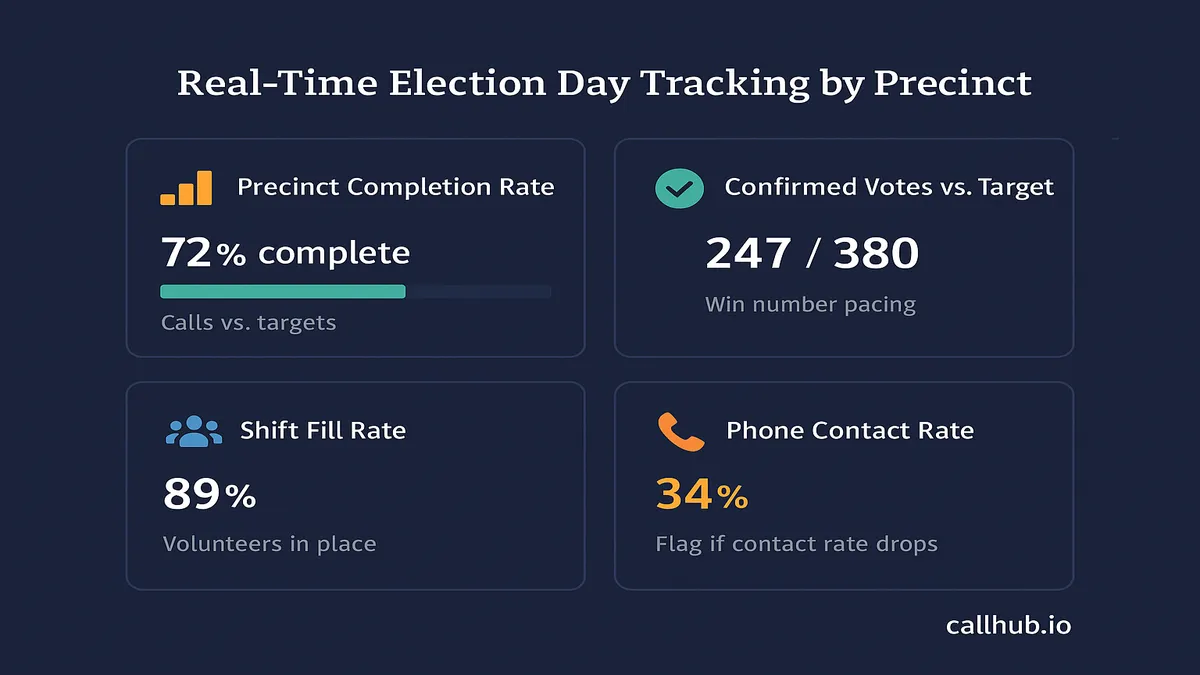
Track these at the precinct level, not just campaign-wide. A campaign-wide 75% completion rate can hide one precinct at 40% and another at 100%. The precinct at 40% is where your afternoon resources should go.
Decision threshold
If a high-priority precinct is more than 20% behind pace by 2 p.m., it triggers redeployment. Adjust this threshold based on your volunteer capacity and the precinct’s weight toward your win number, but 20% at 2 p.m. is a reliable default. Waiting until 4 p.m. to redeploy leaves you with two hours of runway. Acting at 2 p.m. leaves you with four.
Adjusting priorities mid-day
Real-time tracking is only useful if it triggers decisions. The most common failure in election day operations is not bad data. It is data that no one acted on until late afternoon.
When to redeploy
If a precinct’s completion rate is behind pace and its phone contact rate is low, move phone bank slots from a strong precinct to the lagging one. A volunteer calling into a precinct already at 90% completion is not the best use of their shift. A volunteer calling into a precinct at 55% is.
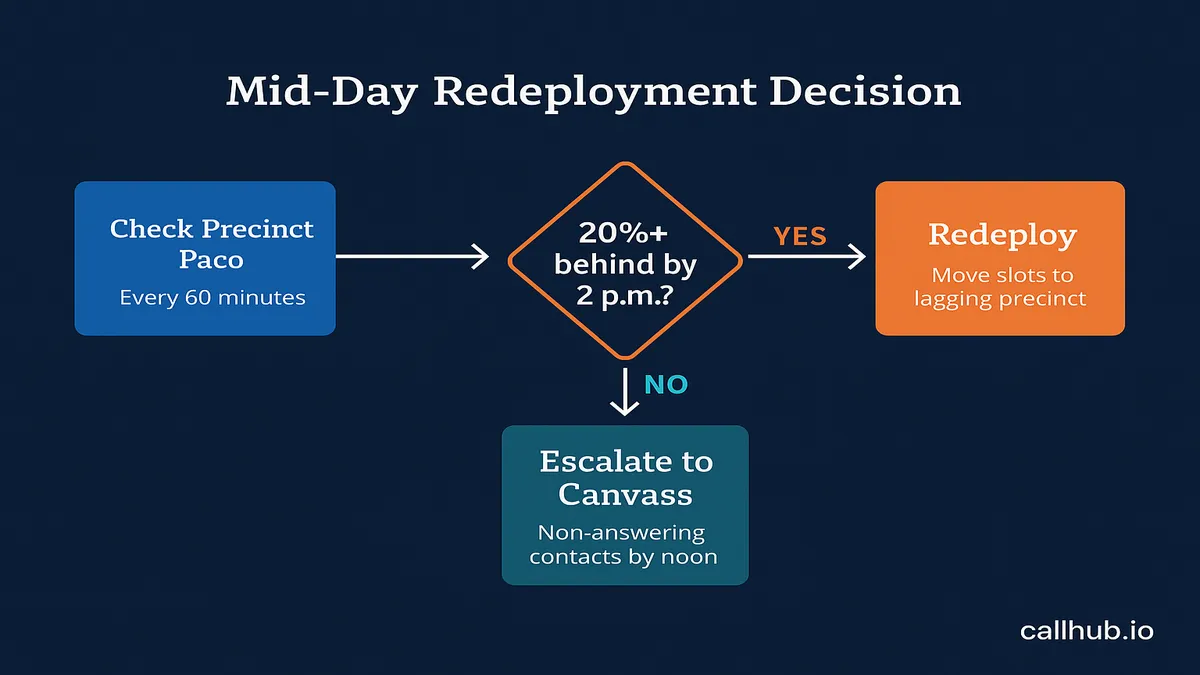
This requires someone watching the dashboard every 60 minutes and empowered to reassign. It does not happen automatically. Appoint a dedicated data monitor for election day: Someone whose only job is to read the tracking metrics and flag when a precinct needs attention.
Escalation from phone to door
Contacts who have not answered any calls and have not confirmed a voting plan by noon are canvass-escalation candidates. A door knock is more resource-intensive than a phone call, but it is also harder to ignore. In precincts near polling locations, canvassers can walk a contact to the polls directly rather than waiting for a callback. See the complete canvassing guide for GOTV for how to structure that door-to-door escalation.
Flag these contacts explicitly in your voter file so canvassers are not duplicating phone bank work. The goal is a coordinated escalation, not two channels hitting the same person in the same hour.
Volunteer absorption
When a precinct reaches its target completion rate before the shift ends, release those volunteers immediately. Pool them into the afternoon reserve for lagging precincts. Volunteers who finish their assigned territory and sit idle for 90 minutes are wasted capacity on a day when capacity is the constraint.
Build the redeployment pool into your shift structure in advance: A set of unassigned volunteers held back specifically for late-day coverage. When a precinct finishes early, the pool absorbs those volunteers without a logistics scramble.
Poll closing reminders
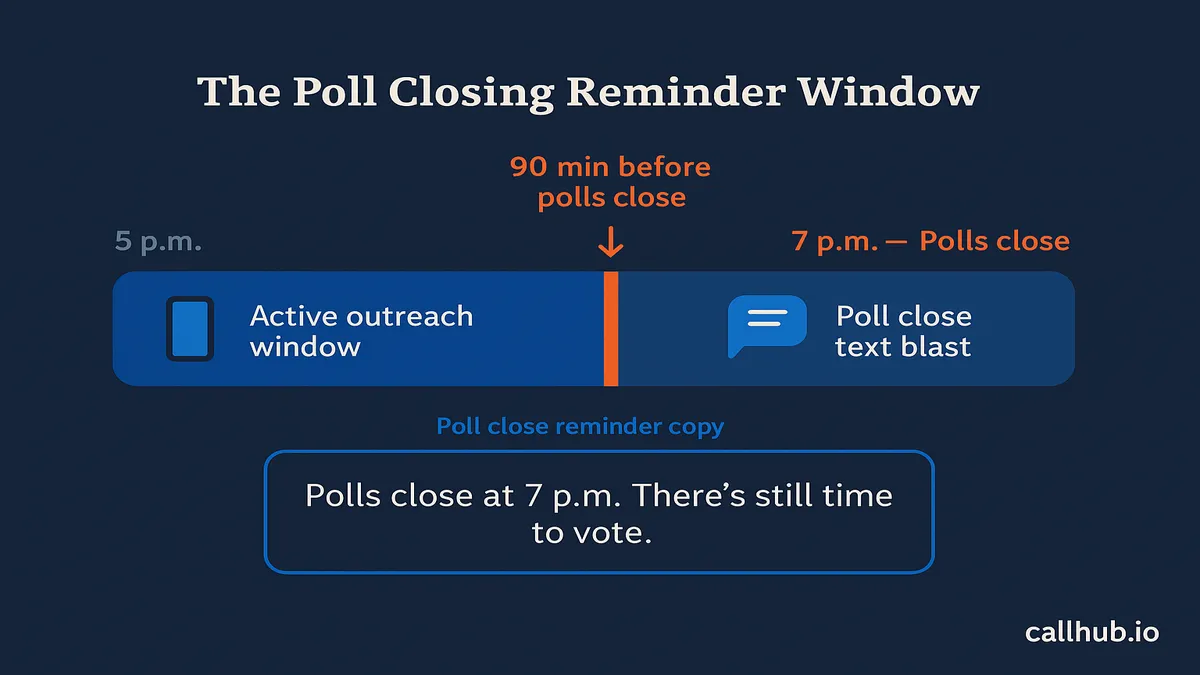
The final 90 minutes before polls close is the highest-conversion window of the day. A supporter who planned to vote but got distracted needs one reminder. This is it.
Timing
Send the broadcast text 90 minutes before polls close in your district. The message copy shifts from “don’t forget to vote today” to something more concrete: “Polls close at 7 p.m. There’s still time to vote.” That specificity matters. “Don’t forget” is a nudge. A concrete close time is urgency with a deadline.
Use your actual local poll close time in the message. If your polls close at 8 p.m., the message says so, not a generic “soon” or “tonight.” Contacts need to know exactly how much time they have.
Who receives it
The closing reminder goes to any contact in your election day universe not yet flagged as voted. Before sending, cross-reference with the current call list: If a caller reached someone in the last 30 minutes, suppress them from the text blast to avoid a double-touch. Refresh your list immediately before the send.
A GOTV text reminder with deadline framing performs differently from a standard GOTV reminder. The article on that page covers the mechanics of the close-time variant specifically.
Time zone caution
If your district or state spans time zones, use each contact’s local poll close time, not a single broadcast time. A message that tells a voter polls close in 90 minutes when they actually closed 20 minutes ago does active harm. It confuses the voter and damages trust in future outreach.
Use per-contact local time in your broadcast logic wherever your texting platform supports it. For states with a single time zone, this is not an issue. For multi-zone districts, it is not optional.
Run your election day program with CallHub
Election day GOTV is not the 72-hour push with a tighter deadline. It is a distinct execution phase: A tighter universe, a compressed channel sequence, and a real-time decision loop that requires hourly action. The campaigns that win close races on election day treat it as its own operation, not as the final day of something already underway.
The tools that make this manageable:
- Live CRM sync with NGP VAN and NationBuilder. Confirmed votes suppress from call and text queues in real time, without a manual export. Every contact who tells a volunteer “I voted” is out of the queue before the next refresh.
- Phone banking tools for shift management. Polling location and hours surface inline for callers, so every volunteer has the information they need without switching screens. Use the Predictive Dialer for high-volume morning and afternoon shifts.
- Text Broadcasting for the morning blast and poll close reminder. Reach the full election day universe in a single push, with per-contact time zone support for multi-zone districts.
- Peer-to-peer texting for reply handling. Ride-to-polls requests, polling location questions, and contacts who respond to the broadcast. P2P texting handles the two-way volume your shift 1 callers can’t.
Start with the complete GOTV guide for the full framework from voter ID through election day. For election day operations specifically, explore voter outreach tools for political campaigns. See how CallHub supports GOTV programs end to end, from voter ID through the closing bell.
Frequently asked questions
What is the difference between 72-hour GOTV and election day GOTV?
The 72-hour GOTV push builds voting intent across the final days before the election. It moves supporters from “planning to vote” to “committed to voting.” Election day GOTV converts that intent into a confirmed ballot on election day itself. The list is smaller, the channel sequence compresses into a single day, and the feedback loop runs hourly rather than overnight.
What time should campaigns send the election day morning text blast?
Send the morning text blast between 7 and 9 a.m. in each contact’s local time zone. This window opens after polls are confirmed open and reaches contacts before the morning phone bank shift starts. A text arriving at 7:30 a.m. primes the contact to answer the 9 a.m. call.
How often should election day contact lists be refreshed?
Refresh your contact lists at minimum every hour. Each refresh removes supporters who have confirmed they voted, preventing callers and texters from contacting people who are already done. Campaigns that update lists less frequently than hourly find a significant share of afternoon contact attempts going to supporters who voted hours earlier.
What should an election day phone banking script focus on?
Election day scripts should be shorter than 72-hour GOTV scripts and action-specific: Confirm the voting plan, share polling location and hours, and ask directly if anything is preventing the contact from getting to the polls today. Skip persuasion language. The contact is an identified supporter. The goal is a confirmed voting plan and a cleared transportation barrier, not a persuasion conversation.
When should poll closing reminder texts go out?
Send the poll closing reminder 90 minutes before polls close in your district. The message should use a concrete close time, not a generic reminder. “Polls close at 7 p.m., there’s still time” outperforms “Don’t forget to vote today.” Always cross-reference with the current call list before sending to suppress contacts a caller just reached.