

Your campaign has committed supporters and a voter file full of people who need a reminder, but those two assets often operate in separate systems. A relational organizing GOTV program connects them by giving supporters responsibility for turning out people they already know.
The trusted relationship creates an opening that a call from a stranger may not. It does not guarantee a vote. You still need to choose the right captains, assign manageable contacts, track commitments, and supervise follow-up through Election Day. This guide shows you how to build that operating model alongside your phone bank.
What is relational organizing for GOTV?
Relational organizing for GOTV is a voter-mobilization method in which volunteers contact friends, family members, coworkers, and neighbors to help them make and complete a voting plan. The campaign supplies the goal, guardrails, tools, and supervision. The volunteer supplies the relationship and personal context.
| List-based outreach | Relational outreach |
|---|---|
| The campaign assigns voters from a central list | Volunteers identify people in their personal networks |
| A caller may have no prior relationship with the voter | The organizer already knows the voter |
| Standard scripts support consistency at scale | Message guidance leaves room for personal context |
| Staff manage contact rates and list coverage | Staff manage captain activity, commitments, and follow-up |
For broader context beyond election turnout, use this complete guide to relational organizing.
Relational GOTV versus peer-to-peer texting
Relational GOTV describes who contacts whom and why. Peer-to-peer texting describes a communication channel and sending workflow.
A volunteer texting a close friend from a personal network is relational outreach. A campaign volunteer texting assigned voters who do not know them is peer-to-peer outreach, but it is not relational. Campaigns can combine the two, provided the system preserves the relationship, records the outcome, and gives staff a way to supervise follow-up.
What the campaign owns and what the volunteer owns
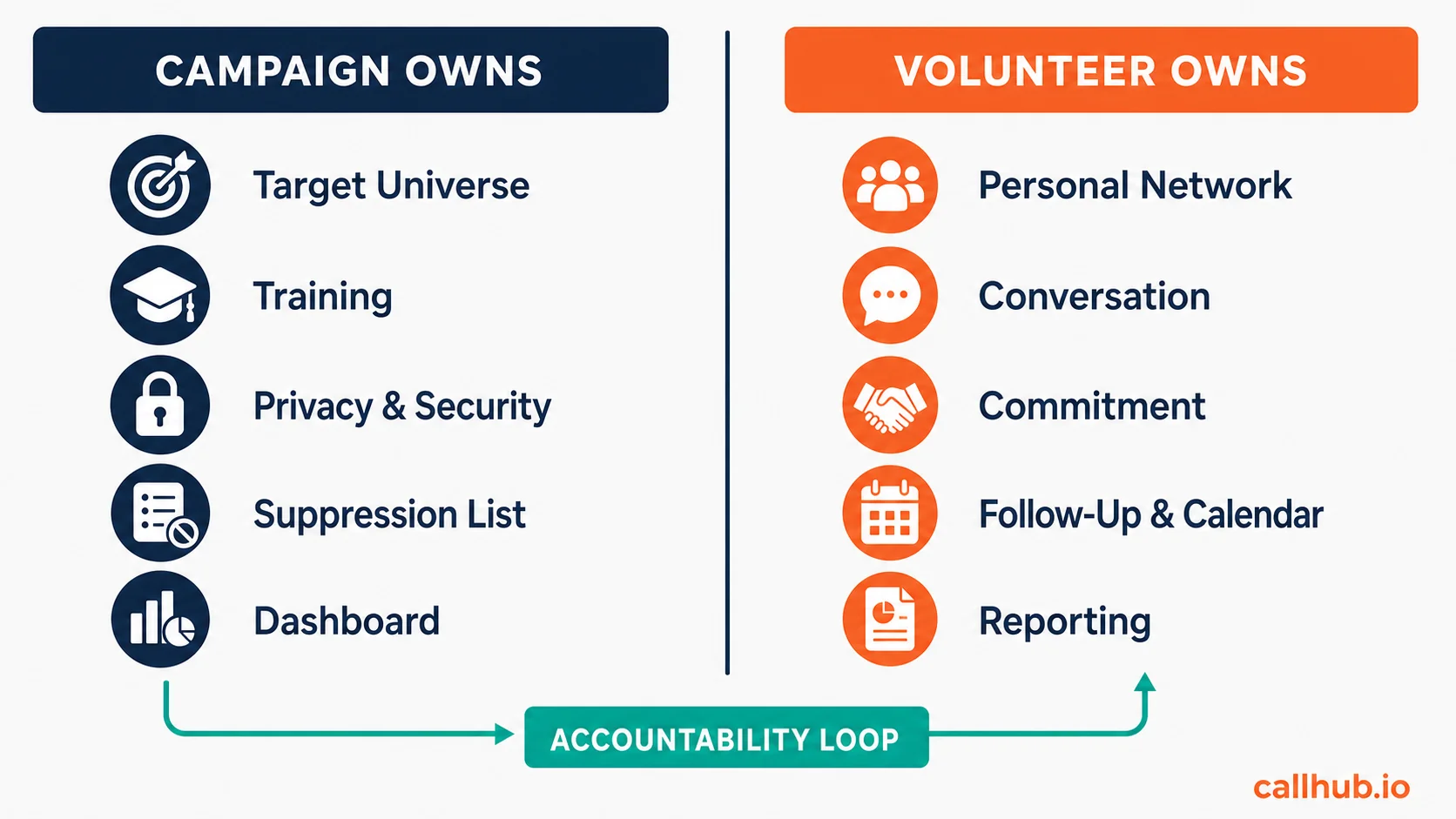
Trust belongs to the volunteer. Program accountability belongs to the campaign.
| The campaign owns | The volunteer captain owns |
|---|---|
| Turnout goal and target universe | Honest identification of people they know |
| Captain selection and training | Personal outreach using approved guardrails |
| Data access, consent, and privacy rules | Accurate updates on conversations and commitments |
| Contact suppression and channel coordination | Follow-up with assigned contacts |
| Progress review and escalation | Promptly flagging help requests or problems |
This division prevents two common errors: Over-scripting volunteers until they sound like strangers, and leaving them without enough structure to complete the work.
Why peer contact can outperform stranger contact
Peer contact can create more attention and accountability because the voter recognizes the messenger. Research suggests that advantage can be meaningful, but the outcome depends on program design, compliance, target selection, and follow-through.
| Study | Reported result | What campaign managers should conclude |
|---|---|---|
| 2018 OutVote field experiment | Estimated intent-to-treat effect of 2.09 percentage points; estimated effect of 8.3 percentage points among message recipients who complied with assignment | Reaching the intended voter matters, and the larger estimate is not a universal effect |
| 2019 Turnout Nation pilot | Turnout was 13.2 percentage points higher in the assigned treatment group | A supervised captain model deserves further testing, but the pilot was small and low-salience |
| 2020 youth captain experiment | No turnout increase; control turnout was 85%, one-third of subjects were lost to attrition, and captains lacked close oversight | Trust alone cannot overcome ceiling effects, attrition, or weak supervision |
What the 2018 OutVote experiment actually found
The 2018 experiment reported two different estimates. The 2.09-point intent-to-treat estimate covers people assigned to the program, whether or not they ultimately received the intended message. The 8.3-point complier estimate applies to message recipients who complied with the assignment.
Think of it this way: The second number describes the effect among a narrower group that the program successfully reached. It should not be advertised as the expected lift for every relational campaign. The operational lesson is more useful than the headline number. Captains need to contact the right people, and campaign staff need visibility into whether that contact happened.
Why the Turnout Nation captain model mattered
The Turnout Nation pilot treated volunteers as captains with assigned responsibilities rather than as occasional message senders. Its reported result was encouraging, but the design points to the conditions that make a captain model credible:
- Give each captain named contacts they genuinely know.
- Make ownership clear enough that nobody assumes someone else will follow up.
- Review progress before Election Day, not after it.
- Help captains answer voting questions or route them to campaign staff.
- Keep the final contact list small enough for repeated, personal follow-up.
The study authors called for more testing. Campaigns should use the model as a disciplined program design, not as proof of a guaranteed effect.
The null result campaigns should not ignore
The 2020 youth captain experiment found no turnout increase. The control group already voted at an 85% rate, one-third of subjects were lost to attrition, and captains did not receive close oversight.
Those limitations explain why relational outreach should not begin and end with recruiting enthusiastic supporters. If you target people who were already almost certain to vote, lose track of assigned contacts, or fail to supervise captains, the relationship advantage has little room to produce measurable movement.
Choose supporters who can become relational captains
The best relational captains are not necessarily your loudest supporters or your most prolific social media followers. Choose people who combine trust, relevant reach, and reliable follow-through.
| Selection factor | Strong signal | Warning sign |
|---|---|---|
| Trust | People seek their advice or respond to them | They know many people only superficially |
| Relevant reach | Their network includes voters in your turnout universe | Most contacts fall outside the district or target group |
| Follow-through | They complete prior volunteer tasks on time | They need repeated reminders for simple commitments |
| Communication | They listen, personalize, and report accurately | They argue, pressure, or improvise factual claims |
| Data discipline | They accept privacy and reporting rules | They want to export or keep contact data unnecessarily |
Recruit for trust, reach, and follow-through
Use a short screening conversation before assigning captain status:
- Ask which communities and relationships the supporter can genuinely reach.
- Ask them to describe a time they followed up on a volunteer commitment.
- Confirm that they are comfortable logging outcomes, not just sending messages.
- Explain that a captain helps voters solve practical barriers without pressuring them.
- Set expectations for training, check-ins, privacy, and Election Day availability.
Supporters who are not ready to become captains can still join a conventional phone bank. The goal is to match responsibility to readiness, not to exclude willing volunteers.
Give each captain a manageable voter universe
There is no universal number of contacts that fits every campaign. Set the list according to the depth of the relationships, the length of the GOTV window, and the follow-up each voter may need.
- Start with people the captain can identify by name and relationship.
- Prioritize low- or mid-propensity supporters who have room to move.
- Remove contacts who are already assigned to another relational captain.
- Ask the captain to commit only to a list they can contact more than once.
- Expand the list after the first review only when follow-through is strong.
Build the relational organizing GOTV program step by step
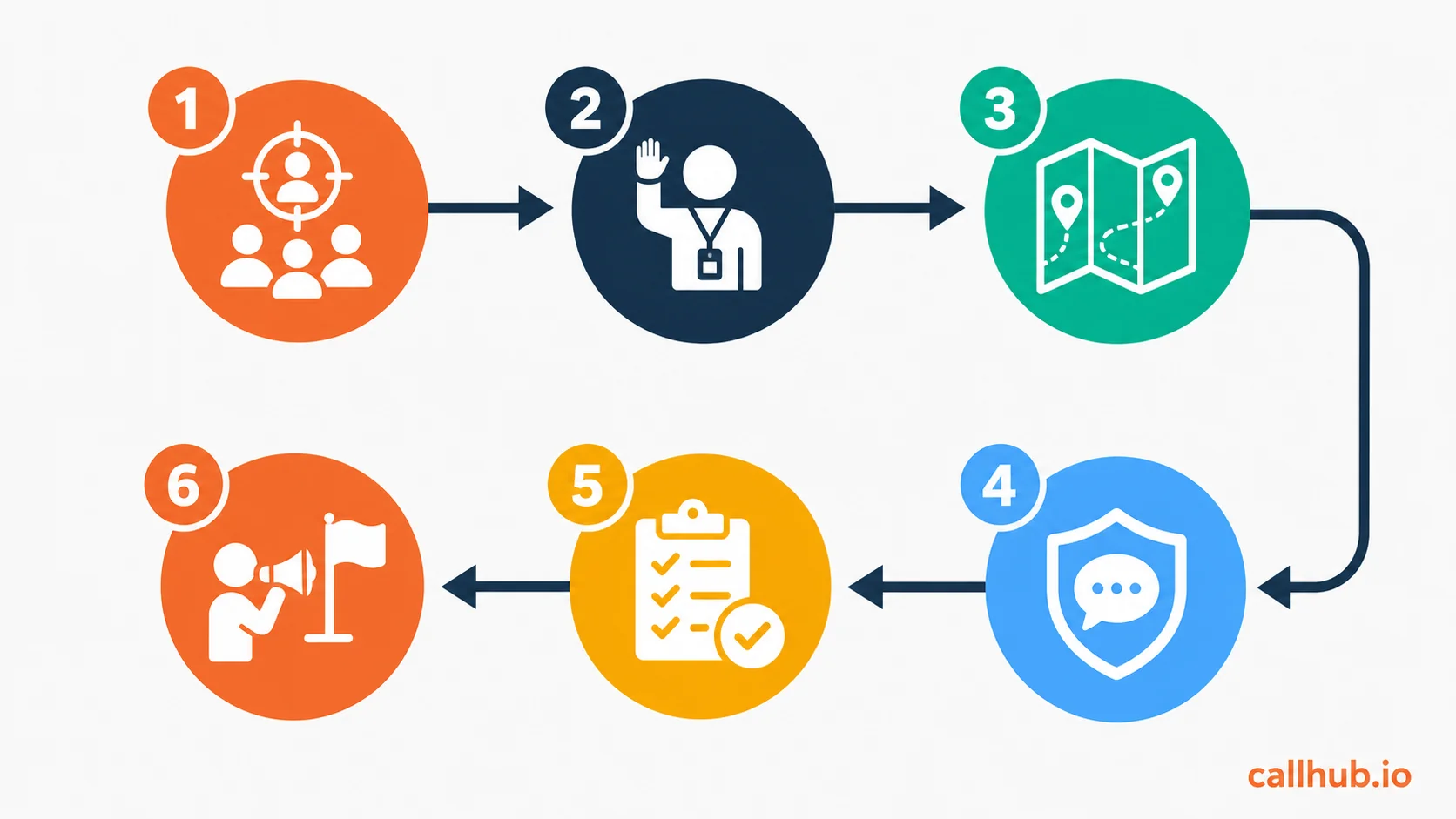
A workable program moves through six stages: Define the universe, recruit captains, map contacts, set message guardrails, track commitments, and supervise the final push.
Step 1: Define the turnout universe and goal
Start with the voters whose participation matters and who are plausible relational targets. A campaign may prioritize identified supporters with inconsistent voting histories, new registrants, or people facing a known participation barrier.
Do not ask captains to browse the entire voter file. Give them a clear purpose and matching criteria. Your goal should describe a completed voter action, such as returning a ballot or making an Election Day plan, rather than the number of messages sent.
Step 2: Recruit and onboard captains
Your onboarding should prepare supporters to organize, not just teach them where to click.
- Explain the turnout goal and the people the program is designed to reach.
- Show captains how to identify genuine personal relationships.
- Practice a conversation that begins with listening.
- Teach the approved process for answering or escalating voting questions.
- Demonstrate how to record contact, commitment, barrier, and next action.
- Schedule the first progress review before the captain leaves training.
These principles for recruiting and developing phone banking volunteers can also help you build a dependable captain pipeline. GOTV volunteers also need training that goes beyond a standard phone-bank onboarding — see how to train volunteers specifically for GOTV before the first shift.
Step 3: Map personal contacts safely
Contact mapping should reveal useful matches without turning a volunteer’s address book into an unrestricted campaign asset.
A relational organizing app may match a volunteer’s contacts against campaign data, or a small program may use a controlled spreadsheet. In either case, collect only the data required for the outreach, restrict access by role, state how the data will be used, and define when it will be removed.
Volunteers should review possible matches and confirm the relationship themselves. Software can suggest a match. It cannot decide whether the relationship is strong enough for a personal political conversation.
Step 4: Set message guardrails without scripting away trust
Give captains a conversation framework instead of a rigid script:
- Personal opening: Refer to the real relationship and ask whether now is a good time.
- Reason for reaching out: Explain why the election or issue matters personally.
- Open question: Ask whether the voter plans to participate and listen for barriers.
- Specific support: Help with a voting plan or route factual questions to approved resources.
- Commitment and follow-up: Agree on the next action and when the captain will check back.
The campaign should provide accurate election information and prohibited-message guidance. The captain should choose words that sound natural within the relationship.
Step 5: Track commitments, vote plans, and follow-up
Your reporting system needs to show movement, not just activity.
| Record | Why it matters |
|---|---|
| Contact attempted and channel | Prevents repetitive or conflicting outreach |
| Conversation completed | Separates real contact from sent messages |
| Voting intention or commitment | Shows who needs another conversation |
| Voting method and planned date | Turns support into a specific plan |
| Barrier or question | Lets staff provide accurate help |
| Next follow-up date and owner | Makes accountability visible |
| Reported completion | Supports suppression and final targeting |
Keep free-text notes limited. Captains should not store sensitive personal details that the turnout program does not need.
Step 6: Supervise the final GOTV push
Supervision becomes more frequent as voting deadlines approach.
- Before voting begins: Train captains, confirm matches, and test reporting.
- During early voting: Review conversations, resolve barriers, and follow up on incomplete plans.
- Before the final weekend: Reassign unreachable contacts only when another genuine relationship exists.
- On Election Day: Focus captains on unresolved commitments and suppress confirmed voters from further outreach where data permits, coordinated with the rest of your election day GOTV operations.
- After polls close: Close access, retain only required records, and document lessons for the next cycle.
Compare relational organizing tools without confusing the category
Choose tools based on how well they preserve relationships, protect contact data, and connect captain activity to the wider campaign. A messaging product alone does not create a relational organizing program.
| Tool type | Useful for | Limitation to plan around |
|---|---|---|
| Relational organizing platform or app | Contact matching, captain assignments, outcome tracking | Still requires training, supervision, and sound universe design |
| Peer-to-peer texting platform | Staff-guided one-to-one text conversations at scale | Assigned recipients may not know the sender |
| Controlled spreadsheet | Small pilot with simple assignments | Manual matching, access control, suppression, and reporting become difficult at scale |
| Phone banking platform | Broad list coverage, scripts, calling, and outcome reporting | Stranger contact does not provide the same relational context |
Hustle and peer-to-peer texting
Hustle fits the wider workflow as a peer-to-peer texting tool. It can support one-to-one campaign conversations, but the method becomes relational only when the sender has a real relationship with the recipient.
Use a texting tool for scale and structured replies. Use relational organizing tools when you also need personal-network mapping, captain ownership, and relationship-aware follow-up. Do not treat the product category as a substitute for the program design.
OutVote is now Impactive
OutVote is not a separate current tool. The company rebranded OutVote as Impactive in 2021 while retaining relational-organizing functionality.
When comparing older research or tool lists, map references to OutVote to the current Impactive product. That keeps procurement research accurate and prevents your team from evaluating the same platform twice.
What to evaluate in any relational GOTV tool
Ask vendors or internal teams to demonstrate:
- How volunteers confirm personal relationships and resolve uncertain matches.
- Which contact data enters the system and who can access it.
- How staff assign captains, review progress, and reassign work.
- How the tool records commitments, barriers, and follow-up dates.
- Whether confirmed contacts can be suppressed across calling and texting programs.
- How campaign staff export results without exporting unnecessary personal data.
- What happens to volunteer contact data after the program ends.
Run relational GOTV alongside phone banking
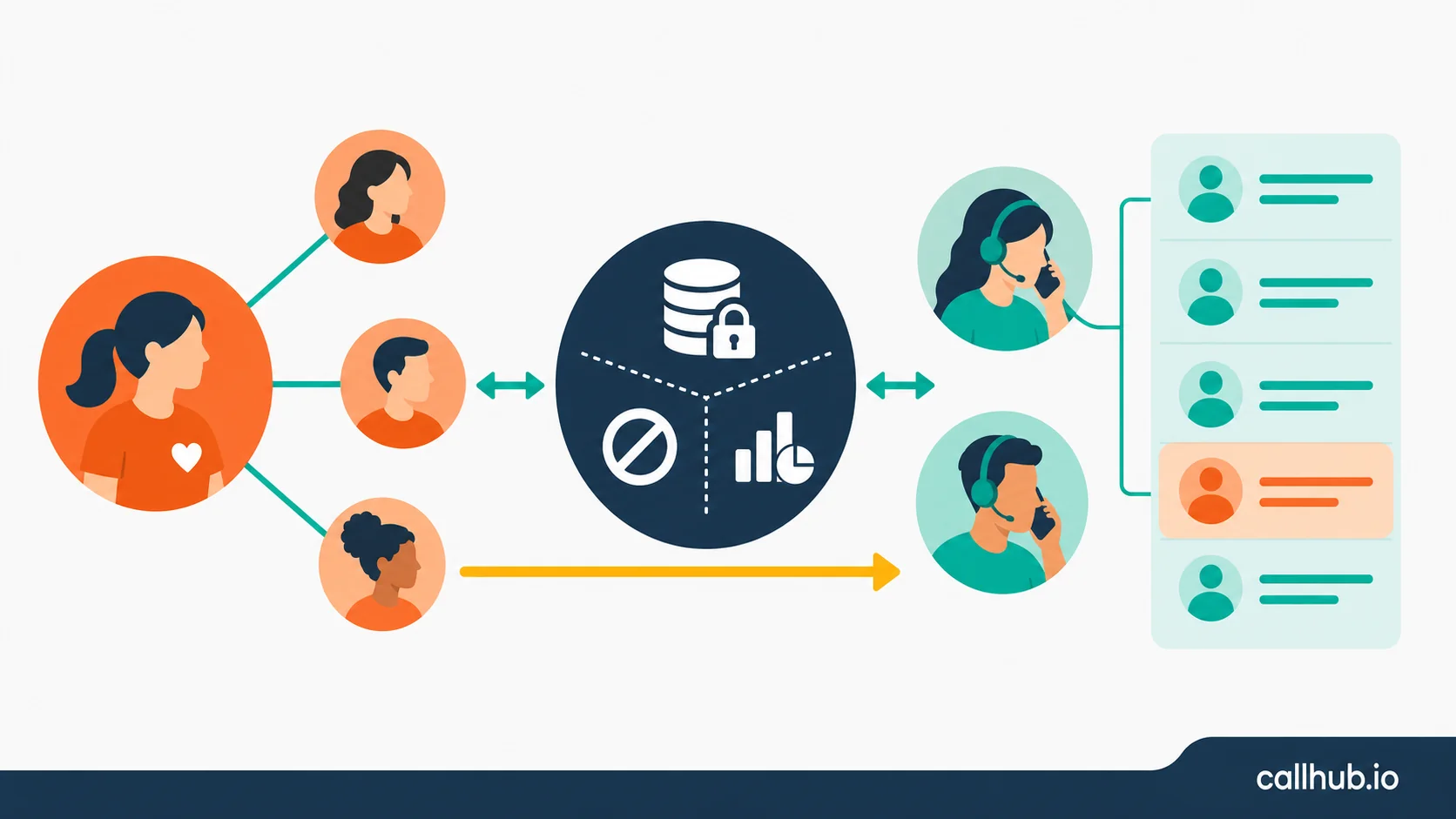
Phone banking provides list-based scale. Relational outreach provides trust and context. The strongest operating model assigns each channel a clear job and shares enough data to prevent duplication.
| Voter situation | Primary channel | Reason |
|---|---|---|
| A captain has a genuine relationship with a target voter | Relational outreach | Personal context can support a candid conversation and repeated follow-up |
| No known relationship exists | Phone banking | A central list gives the campaign systematic coverage |
| A voter has a complex question or unresolved barrier | Staff or trained phone team | The campaign can provide accurate information and escalation |
| A captain has not acted by the review deadline | Phone banking, unless another trusted contact exists | The voter should not disappear from the turnout universe |
Use phone banking for scale and relational outreach for trust
Do not force every voter into the relational program. Reserve it for confirmed relationships where the volunteer can make a credible personal ask.
The phone bank covers the remaining universe, handles reassigned contacts, and gives staff a structured route for follow-up. These phone banking tactics that improve contact rates can help the list-based side of the program without changing the captain model.
Create handoffs instead of duplicate contacts
Use one ownership field for every voter in the shared turnout universe:
- Mark voters assigned to a relational captain.
- Suppress them from routine phone-bank lists during the captain’s active window.
- Set a review deadline for the captain’s first attempt and completed conversation.
- Return unworked contacts to the phone bank when the deadline passes.
- Route questions and barriers to a staff queue without removing captain ownership.
- Suppress reported completed voters from further GOTV contact when reliable data permits.
The handoff rule matters more than the number of channels. Every voter should have one current owner and one visible next action.
Coordinate scripts, suppression, and reporting
Shared infrastructure makes the two programs easier to manage. CallHub reports that its relational organizing platform for campaigns works in the same platform as call center, peer-to-peer texting, mass texting, and voice broadcasting workflows.
Whatever platform you use, keep these elements aligned:
- Approved election facts and escalation instructions.
- Voter ownership and suppression status.
- Contact outcomes and voting-plan fields.
- Captain and phone-bank performance views.
- Role-based access and retention rules.
The relationship should shape the conversation. Shared campaign data should shape who contacts the voter next.
Measure organizer activity and voter movement
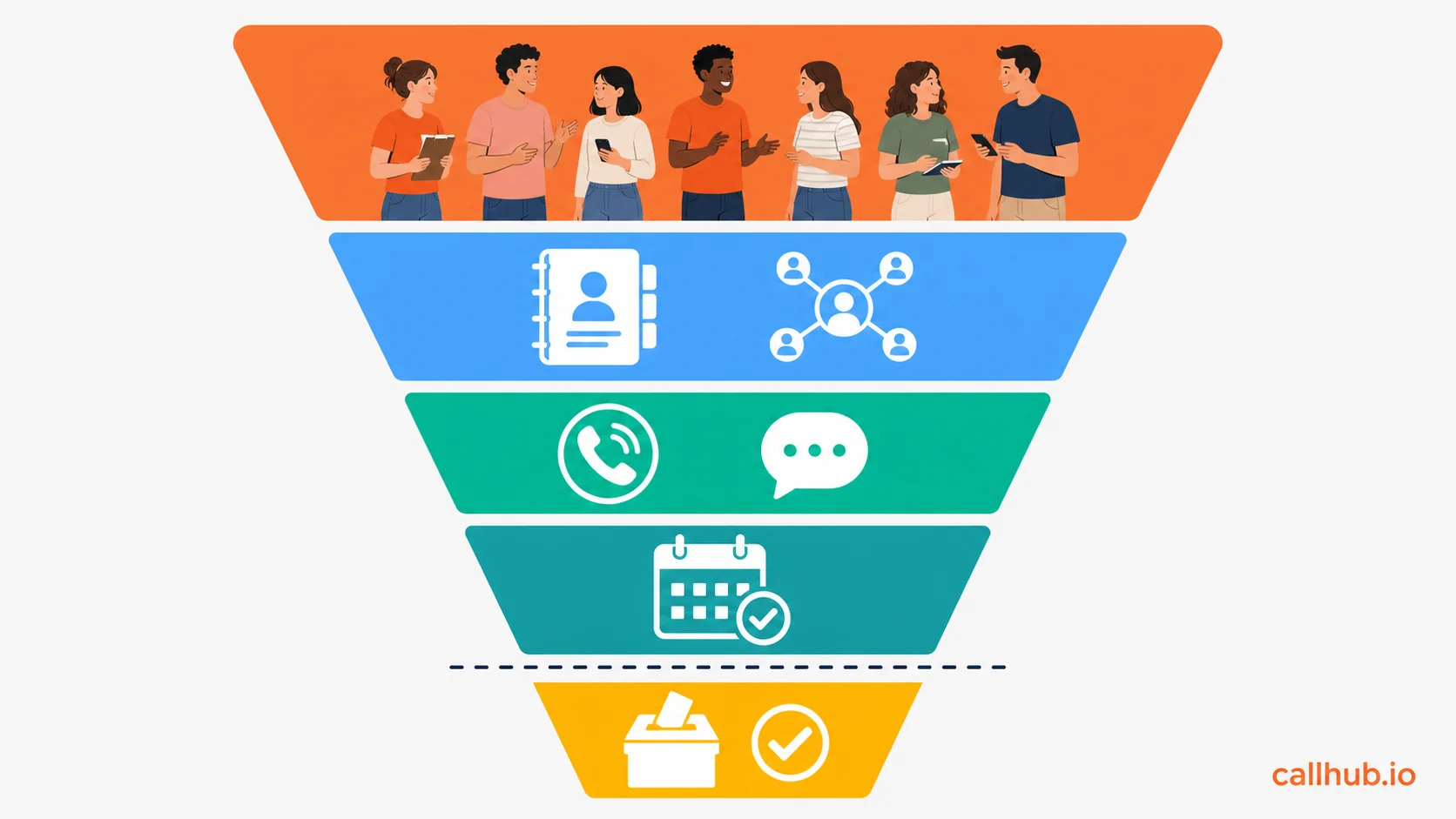
A useful dashboard separates what captains did from what voters did. Activity shows whether the program ran as designed. Outcomes show whether the target group moved.
| Funnel stage | Example metrics |
|---|---|
| Captain recruitment | Supporters invited, trained, activated, and retained |
| Contact mapping | Relationships submitted, confirmed matches, eligible assigned voters |
| Outreach activity | Attempts, conversations, follow-ups due, overdue assignments |
| Voter movement | Commitments, completed vote plans, barriers resolved, reported votes |
| Program outcome | Validated turnout by treatment or assignment group, where evaluation design permits |
Separate activity metrics from turnout outcomes
A high message count does not prove turnout impact. It may show that volunteers were active, but it says nothing about whether the right voters received meaningful contact.
Review captain coverage and overdue follow-ups during the program. Evaluate turnout after the election using validated data where available. Keep reported votes in their own field so staff do not mistake a volunteer update for official turnout confirmation. For the full post-election measurement process, see post-GOTV analysis.
Test incremental impact without overstating causality
Campaigns that want to estimate incremental impact need a comparison design planned before outreach begins.
- Randomize assignment when program constraints and ethics permit.
- Define the treatment group, control group, and primary outcome in advance.
- Track whether assigned voters actually received contact.
- Report attrition and baseline voting propensity.
- Distinguish assignment effects from effects among people actually reached.
- Treat one election’s estimate as evidence for learning, not a universal promise.
The mixed research record is useful. It directs attention to the variables a campaign can manage: Targeting, captain supervision, contact completion, and measurement discipline.
Avoid the failure modes that erase relational advantage
Relational GOTV fails when campaigns assume trust can compensate for weak execution.
| Failure mode | Practical fix |
|---|---|
| Recruiting enthusiastic but unreliable captains | Screen for prior follow-through and set an early review |
| Targeting people already certain to vote | Prioritize supporters with meaningful room to move |
| Assigning long, shallow contact lists | Require genuine relationships and manageable ownership |
| Sending rigid scripts | Use factual guardrails and a flexible conversation framework |
| Measuring sent messages only | Track conversations, commitments, barriers, and follow-up |
| Running relational and phone programs separately | Share ownership, suppression, and escalation data |
| Neglecting captain supervision | Schedule reviews before deadlines and reassign stalled work |
| Collecting unnecessary personal data | Minimize fields, restrict access, and close retention after the program |
Turn trusted supporters into an accountable turnout network
Relational organizing works when trust is paired with ownership, supervision, and shared campaign data. Treat captains as volunteer organizers with defined voters and follow-up responsibility, then use phone banking to cover the people outside those relationships.
Relational organizing is one channel inside a larger turnout system — see the complete guide to GOTV for how it fits alongside phone banking, texting, and canvassing across the full campaign calendar.
Explore relational organizing tools connected to your GOTV campaign to manage captain-led outreach in the wider campaign workflow.
See how CallHub supports coordinated GOTV calls, texts, and relational outreach across your turnout program.
Frequently asked questions
What is relational organizing?
Relational organizing mobilizes people through existing personal relationships. For GOTV, volunteers contact friends, relatives, coworkers, or neighbors to help them make and complete a voting plan. This guide explains how relational organizing campaigns work beyond the turnout phase.
Is relational organizing effective?
Relational organizing can improve turnout when campaigns reach the intended voters and supervise follow-up, but results are conditional. Studies have reported positive estimates as well as a null result, so campaigns should evaluate target propensity, compliance, attrition, and captain oversight.
How should I structure a relational organizing conversation?
Start from the real relationship, explain your personal reason for reaching out, ask about the person’s voting plan, listen for barriers, and agree on a follow-up. Give volunteers factual guardrails without forcing every conversation into identical language.
What outreach methods can relational organizers use?
Relational organizers can call, text, speak in person, or use a relational organizing app. The method is relational because of the preexisting connection between organizer and voter, not because of the channel.
How can I start relational organizing?
Define a target universe, recruit reliable captains, match their genuine contacts, train them, and track commitments through Election Day. Connect the program to your coordinated GOTV campaign tools so phone and relational teams share ownership and suppression data.
How much does relational organizing cost?
Cost depends on program size, staff time, training, data work, and whether you use a spreadsheet or dedicated relational organizing app. Compare tools by total operating needs, including supervision, contact matching, privacy controls, reporting, and integration with your other outreach channels.