


Table of Contents
First time phone banking and nervous about your first shift? You’re not alone.
Most volunteers feel a mix of curiosity and nerves before their first call. Maybe you’re wondering what you’ll say, whether it’ll be awkward, or if people will even pick up.
The short answer? You’ll be fine.
This guide will walk you through what happens before, during, and after a first phone banking shift. You’ll learn how to log in, follow the script, handle common caller situations, record call results, and get through the first few minutes without freezing.
If you’re using CallHub, you’ll also see the script, contact details, and call outcomes in one place, so you don’t have to figure everything out while someone is already on the line.
If you’ve raised your hand to help, thank you. This guide is here to make your first shift feel less mysterious and more manageable.
Key Takeaways
This guide walks first-time phone banking volunteers through logging in, following a script, handling calls, and recording outcomes, using CallHub as the example platform.
How CallHub simplifies a first shift
- CallHub connects volunteers directly to voters and supporters and handles the calling setup so volunteers can focus on the conversation.
- An auto dialer removes manual dialing by connecting the volunteer directly to answered calls.
- A beep signals when someone has picked up, eliminating awkward waiting.
- The campaign script and contact information appear automatically, so volunteers don’t have to guess what to say.
- Volunteers can log the call result right after the conversation instead of relying on paper notes.
The six-step shift workflow
- The campaign adds the volunteer as a phone banking agent and provides a login link.
- Volunteers log in through the CallHub web browser version or the CallHub mobile app, available on Android and iOS.
- Volunteers are assigned a campaign along with talking points before going live.
- Once live, a beep indicates a picked-up call, after which the volunteer follows the script, marks the response, and moves to the next call.
- The CallHub mobile app lets volunteers make calls using their phone’s network if their internet connection becomes unstable.
Logging call outcomes
- Common dispositions include supporter, undecided, opposed, no answer, voicemail left, wrong number, needs follow-up, and do not call.
- Volunteers should ask the campaign lead which option to choose if they are unsure rather than guessing.
- Accurate call logging helps the campaign avoid duplicate calls, follow up with the right people, and improve future shifts.
Tips for first-time volunteers
- Memorizing a short, friendly opening line prevents freezing and keeps the tone clear and human rather than polished.
- Jumping into the greeting right after the beep keeps the conversation natural.
- The script serves as a foundation that can be slightly adapted but should stay close to the campaign’s main message.
- Listening with empathy and politely recording the outcome matters more than winning every conversation.
- A headset, hydration, and short resets after an awkward or rude call help volunteers maintain focus through the shift.
Handling no-answer calls
- No-answer calls are normal and several may occur in a row during a shift.
- When a campaign allows voicemail, volunteers should leave only the approved, short voicemail message without adding personal details.
How does CallHub make first-time phone banking easy?
CallHub is the behind-the-scenes helper that makes phone banking easier for volunteers and organizers. It connects you directly to voters and supporters, takes care of the calling setup, and helps you stay focused on what matters: having a real conversation.
For your first shift, you may use an auto dialer. That means:
- No manual dialing. The system connects you to answered calls.
- No awkward waiting. You’ll hear a beep when someone picks up.
- No guessing what to say. Your campaign script and contact information appear automatically.
- No paper notes. You can log the call result right after the conversation.
Since CallHub is designed with first-time phone banking volunteers in mind, you don’t need to stress if you’ve never made a campaign call before. Show up, take a breath, and start with the opening line.
For a broader explanation of the tactic itself, read what is phone banking. If you are helping manage the campaign, not just volunteering for a shift, see CallHub’s phone banking software.
How your first time phone banking shift works
Your first phone banking experience will usually follow a straightforward process. Here’s what to expect:
- Step 1: Your campaign adds you as a phone banking agent and gives you a login link.
- Step 2: You log in via the CallHub web (on your browser) or the CallHub mobile app (available for both android and iOS).
- Step 3: You’re assigned a campaign, complete with talking points.
- Step 4: You go live. Beep means someone has picked up.
- Step 5: You follow the script, mark the response, and move to the next call.
- Step 6: Download the CallHub mobile app and join your campaign on the go. (Andriod and iOS)
Tip: If you’re ever without a stable internet connection, the CallHub mobile app lets you make calls using your phone’s network, so you can keep calling from a reliable setup.
For campaign managers planning the full operation, use this political phone banking guide.
How to log call results after each conversation
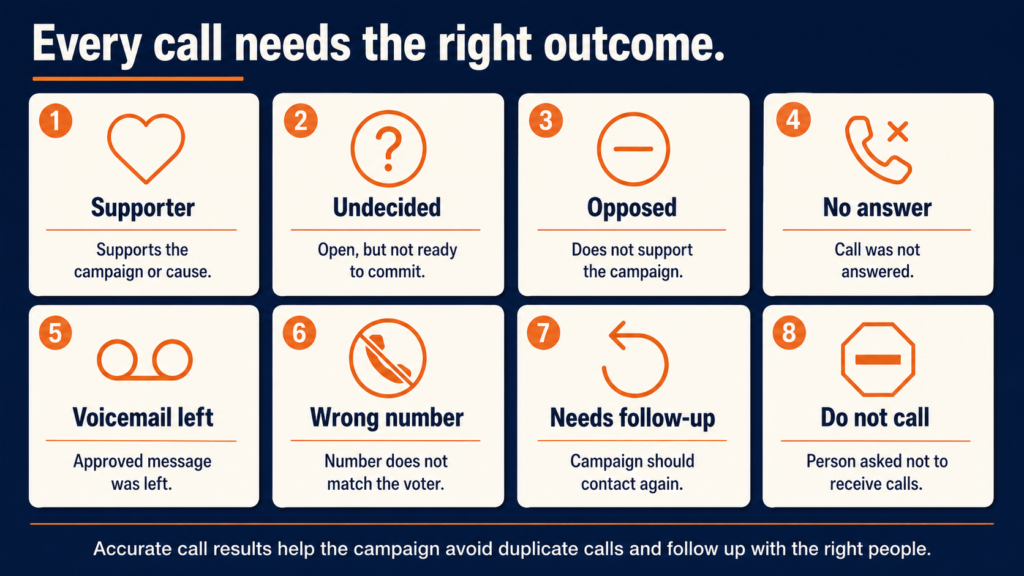
Logging the call result matters as much as making the call.
After each conversation, your campaign may ask you to select a disposition or answer survey questions. These are simple labels that tell the campaign what happened.
Common call outcomes include:
| Call outcome | What it means |
| Supporter | The person supports the campaign or cause |
| Undecided | They are open but not ready to commit |
| Opposed | They do not support the campaign or cause |
| No answer | The call was not answered |
| Voicemail left | You left a campaign-approved voicemail |
| Wrong number | The number does not belong to the intended person |
| Needs follow-up | Someone from the campaign should contact them again |
| Do not call | The person asked not to receive more calls |
If you are unsure which option to choose, ask the campaign lead before guessing. Accurate call results help the campaign avoid duplicate calls, follow up with the right people, and improve the next phone banking shift.
Building your success: phone banking tips for first-time volunteers
Everyone gets a little anxious before their first campaign call. The key is to focus on being present, not perfect.
Here are beginner-friendly phone banking tips to help you feel ready.
Start with a consistent opening line
Memorize a short, friendly intro so you don’t freeze. You don’t need to sound polished. You need to sound clear and human.
Example:
“Hi, is this Jordan? My name is Maya, and I’m a volunteer with the Rivera campaign. We’re calling voters in your area today about the upcoming election.”
Don’t wait too long after the beep
The system lets you know when a person is on the line. Jump right in with your greeting. A quick start keeps the conversation natural.
Use the script as your foundation
The script is there to guide you. You can adapt it slightly so it sounds like you, but stay close to the main message and questions your campaign gave you.
You’re not expected to improvise the whole call.
Listen with empathy
Some people will want to talk. Others may say, “Not interested.” That’s okay.
Your job is to listen, respond politely, and record the outcome. You don’t need to win every conversation.
Use a headset and stay hydrated
A quiet space, headphones, and water nearby can make a big difference. Calling takes more focus than people expect, especially during your first shift.
Take short resets when you need them
If a call feels awkward or someone is rude, pause for a moment before the next one. Take a breath, sip water, and come back to the script.
One bad call does not define the shift.
For more advanced advice, read these phone banking tips for campaigns.
What to do when no one answers
No-answer calls are normal. You may have several in a row.
What you do next depends on the campaign’s instructions.
If the campaign allows voicemail, leave only the approved voicemail message. Keep it short and avoid adding your own details.
Example:
“Hi, this is Maya calling with the Rivera campaign. We’re reaching out with a quick reminder about the upcoming election. You can learn more at [campaign website]. Thanks.”
If the campaign does not want voicemail, simply mark the call as “No answer” and move on.
If the system gives you a voicemail drop option, use the approved message. Do not record a new message unless the campaign lead tells you to.
The important part is to log the outcome correctly. A no-answer contact may get a follow-up text, email, or another call later.
What to say when phone banking: sample script lines
You don’t need to create your own phone banking script. Your campaign should provide one.
Still, it helps to see what common lines sound like before your first shift.
Opening line for voter ID calls
“Hi, is this Jordan? My name is Maya, and I’m a volunteer with the Rivera campaign. We’re calling voters in your area to ask what issues matter most to them this election. Do you have a minute?”
Opening line for GOTV calls
“Hi, is this Jordan? My name is Maya, and I’m a volunteer with the Rivera campaign. I’m calling with a quick reminder that Election Day is Tuesday. Do you already have a plan for when you’ll vote?”
Opening line for volunteer recruitment
“Hi, is this Jordan? My name is Maya, and I’m calling with the Rivera campaign. You recently said you supported the campaign, and we’re looking for volunteers for a short phone banking shift this week. Would you be open to helping for two hours?”
If someone says they are busy
“No problem. Is there a better time for someone from the campaign to follow up?”
If someone says they are not interested
“Thanks for letting me know. I’ll update our list. Have a good day.”
If someone asks a question you cannot answer
“That’s a good question, and I don’t want to guess. I’ll mark this for follow-up so someone from the campaign can get you the right answer.”
If someone asks not to be called again
“Understood. I’ll mark that now. Thanks for your time.”
Then select the correct do-not-call or opt-out option in the system, based on the campaign’s instructions.
If you need a full script framework, use these phone banking scripts.
Why your calls count: the impact of phone banking
It’s easy to focus on how many calls you made or whether you followed the script exactly. But the true impact goes beyond call volume.
When you phone bank, you become a bridge between a campaign and the people it serves. Every conversation can help someone understand an issue, make a plan, ask for help, or feel connected to the cause.
Phone banking also has research behind it. The StatesWin and Sister District Phonebanking Research summary notes that Nickerson’s nonpartisan GOTV phone studies found a 3.8% turnout boost from phone calls across eight studies. The same summary says unhurried, personal calls that allow real dialogue can produce a 3-5% turnout boost, while rushed volume-focused calls perform much worse.
That is why your tone matters. A calm, respectful call can do more than a rushed call that only tries to hit a number.
Let’s look at a real example

A real-life example of phone banking impact comes from the New York Cares “Mission Vet Check” campaign.
New York Cares used CallHub to call military veterans across New York state, check in on their well-being, and connect them with needed resources. Volunteers asked whether veterans had access to food, housing, healthcare, financial support, and mental health resources. When veterans needed help, volunteers shared resources or connected them to the right support path.
Some highlights from the campaign:
- New York Cares had a contact list of 15,000-16,000 veterans.
- Volunteers called about 800 contacts in 90 minutes during weekly phone banks.
- Branching scripts helped volunteers follow the right question path without getting lost.
- Voicemail drops helped the team leave approved messages when people did not answer.
- Patch-through calling helped volunteers connect veterans to crisis managers when a conversation required specialized help.
That is the point of a good phone bank. It is not just about making calls. It is about reaching people who may need information, reassurance, or a next step.
Your quick-start checklist for campaign calling
Before you log in and start your first shift, use this checklist.
| Before your shift | Why it matters |
| Test your login link | You don’t want to solve login issues after the shift starts |
| Skim the script | You’ll feel calmer when the first call connects |
| Check your internet or phone signal | Clear audio makes the call easier for both sides |
| Use headphones or a headset | It helps you focus and keeps your hands free |
| Keep water nearby | Calling for a full shift takes energy |
| Find a quiet spot | Background noise makes you harder to hear |
| Review common outcomes | You’ll know how to mark each call |
| Know who to ask for help | Every volunteer needs a support path |
You don’t need to have every answer. Bring your voice, your attention, and your willingness to help.
Take the first step. You’re ready
The technology handles the complicated parts. The script guides the conversation. Your job is to show up, listen, and record what happened.
You’re prepared, supported, and ready to make your first call.
Log into your CallHub agent dashboard and begin your first shift when your campaign lead tells you to start.
If you want to understand the bigger picture of how campaigns use phone banking, the complete guide to political phone banking is a good next read.
If you are not just volunteering but helping run the campaign, use the political phone banking guide to plan lists, scripts, volunteers, and results tracking. You can also explore CallHub’s phone banking software to see how campaigns manage call lists, scripts, survey responses, and reporting.
First-time phone banking FAQs: honest answers
Feeling uncertain is natural when you’re just getting started. Many first-time volunteers have the same questions.
What if someone hangs up on me?
That’s part of the process. It happens to everyone. Don’t take it personally. Mark the call outcome if the system asks you to, then move on to the next call.
Every call is a fresh start.
What if I mess up the line or forget what to say?
No big deal. If you stumble, say, “Sorry, let me start over,” or “What I meant to say was…”
People usually appreciate a real person more than a perfect robotic delivery.
What if I get a tricky question I can’t answer?
Say:
“That’s a good question, and I want to make sure you get accurate information. I’ll have someone from the campaign follow up with you.”
Then make a note in the system. You’re not expected to be a policy expert. You’re there to connect, listen, and record the right next step.
What if someone gets angry or confrontational?
Stay calm and polite. You can say:
“Thanks for your time. I’ll let you go.”
Then end the call respectfully and mark the correct outcome. No campaign expects you to stay in an abusive conversation.
Can I phone bank from home?
Yes. Many campaigns run virtual phone banks where volunteers call from home. You usually need a laptop, tablet, or phone, a login link, a quiet space, and a stable internet connection or phone signal.
Your campaign lead should tell you whether to use a browser, the CallHub mobile app, or another setup.
How long is a typical phone banking shift?
Most volunteer phone banking shifts last 2-3 hours. Some campaigns run shorter shifts for first-time volunteers.
If you are nervous, start with one shift. You can always sign up for another once you know what it feels like.
What happens if no one answers?
You mark the call as “No answer” or follow the campaign’s voicemail instructions. Some campaigns want volunteers to leave a short approved voicemail. Others prefer no voicemail.
Follow the campaign’s instructions and log the outcome correctly.
Do I need special equipment for phone banking?
Usually, no. A laptop or phone, headphones, and a stable internet connection are enough for most virtual phone banking shifts.
A headset helps because it keeps your hands free and improves audio quality, but you do not need a professional call center setup.
Is phone banking effective?
Yes, when calls are personal and targeted. StatesWin’s 2022 phone banking research summary cites Nickerson’s finding that nonpartisan GOTV calls boosted turnout by 3.8% across eight studies. The same summary says call quality matters, with more personal calls performing better than rushed volume-focused calls.
For a deeper evidence breakdown, read is political phone banking effective.
What should I do after my first shift?
Take a minute to note what felt easy, what felt hard, and what questions came up. If the campaign asks for feedback, share it.
Then sign up for the next shift if you can. Your second shift will feel much easier than your first.