
A new volunteer sits down at your call station on election day. They’ve been through your September onboarding. They’ve made persuasion calls. They know the basics of phone banking. Now they’re back, expecting something similar.
You have 10 minutes before the shift starts.
That’s the GOTV situation. Get-out-the-vote (GOTV) calling is not persuasion calling with a tighter deadline. It’s a categorically different operation: You’re calling confirmed supporters, not undecided voters. Your goal is to move them to the polls, not to change their minds. Your window is measured in hours, not weeks. GOTV volunteer training needs to match that reality, not import the same 60-to-90-minute onboarding model from September.
This guide covers five structural differences between GOTV training and regular phone bank onboarding, and then gives you a field-ready framework for the 10 minutes you actually have.
Key Takeaways
GOTV calling targets confirmed supporters in the final hours before polls close and demands a distinct training model rather than a shortened version of standard persuasion onboarding.
Why GOTV Training Needs a Different Model
- Yale ISPS research finds personal phone contact is the most effective voter mobilization tactic, but only when the call feels relevant and credible.
- The Analyst Institute finds well-executed GOTV phone banking lifts turnout by 3.8 to 4.5 percentage points, a range that assumes volunteers understand the specific task they’re performing.
- Applying the standard persuasion-calling framework to GOTV shifts is the most common training mistake campaign teams make.
Five Structural Differences from Regular Phone Banking
- The training window shrinks from 60 to 90 minutes before a persuasion shift to just 10 minutes before a GOTV shift.
- The call universe changes from a mix of supporters and persuadables to supporters only, meaning people who have already confirmed they’ll vote for the candidate.
- The script goal shifts from persuading and identifying voters to confirming a voting plan and removing logistical barriers.
- Data entry changes from candidate support IDs and issue codes to voted confirmation and reason-for-not-voting codes.
The Over-Training Problem
- 60% of first-time phone banking volunteers never return after a poorly structured shift, according to CallHub’s guide on training phone banking volunteers.
- A poorly structured GOTV shift is often an over-trained one, where volunteers arrive with a persuasion framework and no sense of how election-day calling differs.
The 10-Minute Pre-Shift Framework
- The GOTV window covers the final 72 to 96 hours before polls close, so training must fit inside shift time rather than pull volunteers away from calling.
- Minutes 1 to 2 orient volunteers to the call universe, clarifying they are confirming a voting plan rather than changing anyone’s mind.
- Minutes 3 to 5 walk volunteers through the GOTV script structure, explicitly naming why it is shorter than the September script because the job is narrow.
GOTV training is not a shorter version of regular phone bank onboarding
Every guide on volunteer phone bank training covers the same territory: how to introduce yourself, how to handle objections, how to pitch the candidate, and how to mark a disposition. That framework works for persuasion calling. It does not work for GOTV, and applying it without adjustment is the most common training mistake campaign teams make.
Yale ISPS research confirms that personal phone contact is the most effective voter mobilization tactic available. But the effect only holds when the contact feels relevant and credible. A volunteer who sounds uncertain, over-trained on a persuasion frame, or unclear about why they’re calling confirmed supporters will not close the turnout gap.
According to the Analyst Institute, GOTV phone banking increases voter turnout by 3.8 to 4.5 percentage points when executed well. That range assumes volunteers understand the task they’re performing. When they don’t, the impact erodes quickly. For the full research picture across channels, see does GOTV work.
The five dimensions where GOTV training diverges
The differences between GOTV and regular phone bank training are structural. Updating your script alone is not enough.
| Dimension | Regular phone bank | GOTV phone bank |
|---|---|---|
| Training window | 60–90 minutes before first shift | 10 minutes before first shift |
| Call universe | Mixed: Supporters, soft-supporters, persuadables | Supporters only: People who have confirmed they’ll vote |
| Script goal | Persuade, identify, update | Confirm plan to vote, remove logistical barriers |
| Emotional register | Informative, persuasive | Urgent, warm, peer-to-peer |
| Data entry | Candidate support ID, issue codes | Voted confirmation, reason for not voting (RFN) |
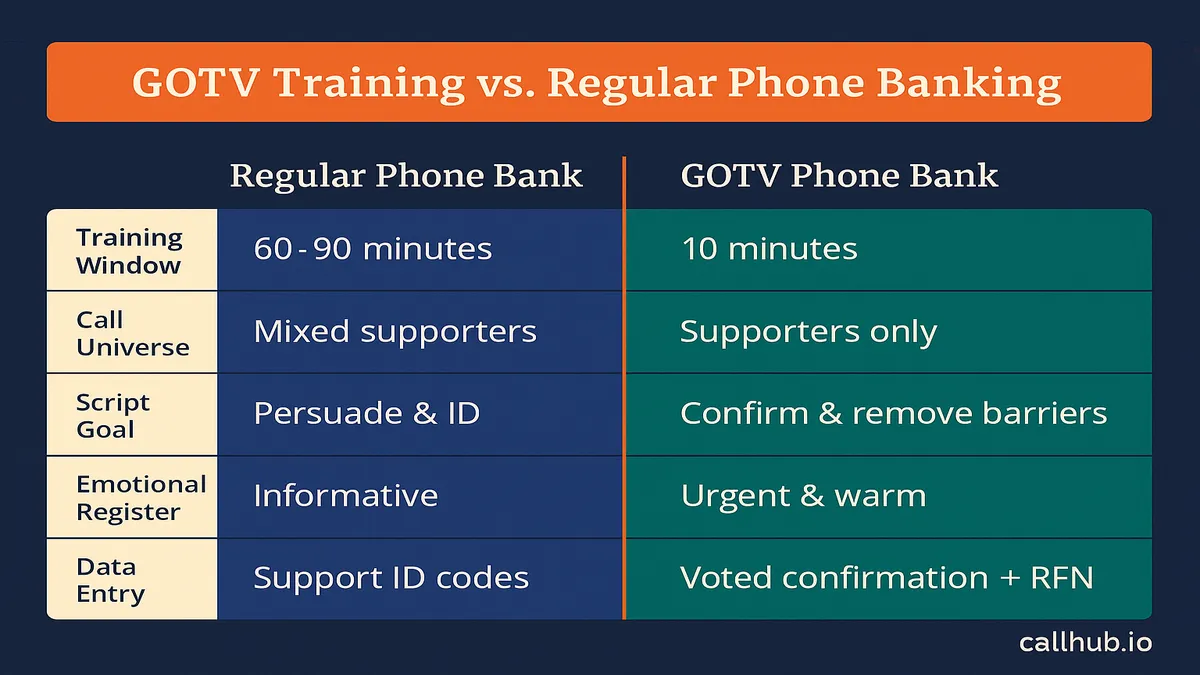
These five differences require a completely different training structure. Volunteers who receive the same onboarding they got for persuasion calling will try to persuade supporters who already support your candidate. They’ll over-explain when they should be brief. They’ll wait for objections that won’t come.
The most common mistake: Applying the same training model
The 90-minute onboarding exists for good reason. Persuasion calling is cognitively demanding: volunteers navigate objections, qualify candidates, and update the voter file with nuanced results. The training load matches the task.
GOTV calling is not cognitively demanding in the same way. The task is narrow: confirm a voting plan and remove barriers. 60% of first-time phone banking volunteers never return after a poorly structured shift, according to CallHub’s guide on training phone banking volunteers. A poorly structured GOTV shift is not always an under-trained one. It is often an over-trained one, where volunteers arrived loaded with a persuasion framework and no clear sense of how election day calling is different.
When a volunteer who trained for persuasion gets on a GOTV call, they do what they practiced: they build rapport slowly, they introduce the candidate’s platform, they wait for a chance to handle an objection. That approach burns call time, confuses the contact, and leaves the volunteer feeling like the shift didn’t fit what they prepared for. The result is drop-off and low return rates.
Keep the 90-minute framework for September. Replace it with a focused 10-minute pre-shift structure for GOTV.
The 10-minute pre-shift walkthrough
The GOTV window is the final 72 to 96 hours before polls close. Your training needs to fit inside the shift structure, not pull volunteers away from calling time.
Ten minutes is not a constraint. It’s a design specification. Here is how to fill it.
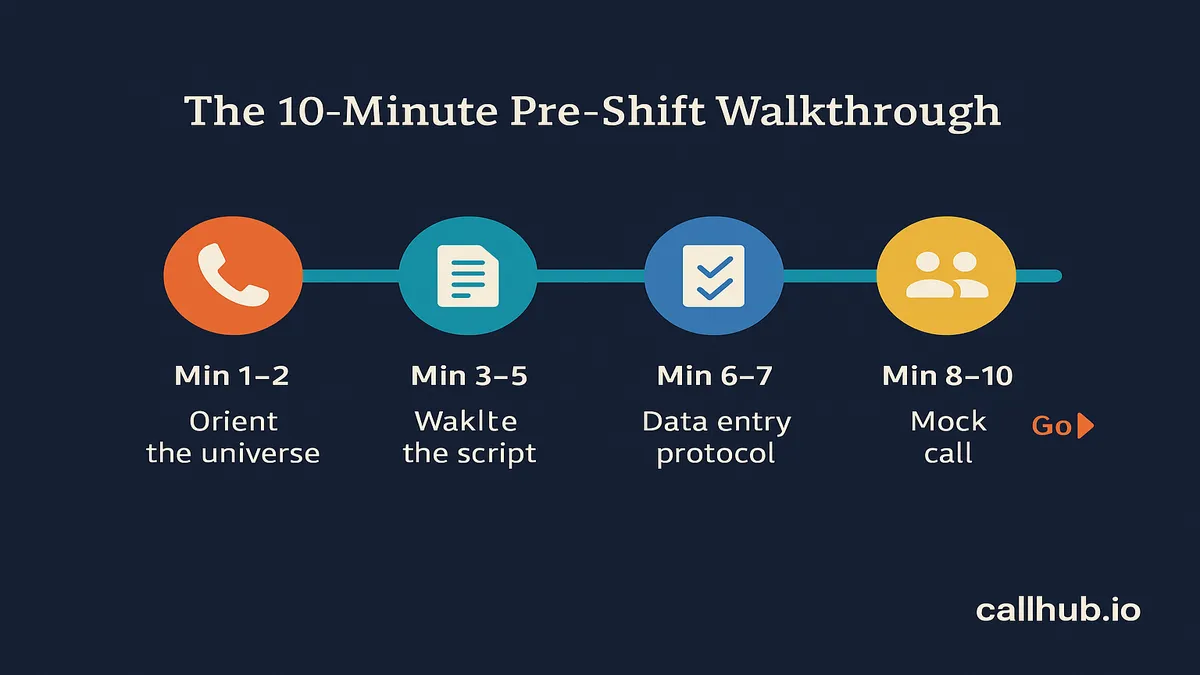
Minute 1–2: Orient volunteers to the universe
Tell volunteers exactly who they’re calling and why that matters.
“Everyone in your contact queue has already told us they support the candidate. We’re calling to make sure they vote today. You are not trying to change anyone’s mind. Your job is to confirm that they have a plan to vote and to remove anything in the way.”
This briefing eliminates the most common confusion GOTV volunteers experience: they don’t understand why the calls feel different from September. Once they understand the universe, everything else follows logically.
Post this briefing on a printed card at each call station. Volunteers will re-read it between calls when they lose their footing on a difficult contact.
Minute 3–5: Walk through the GOTV script
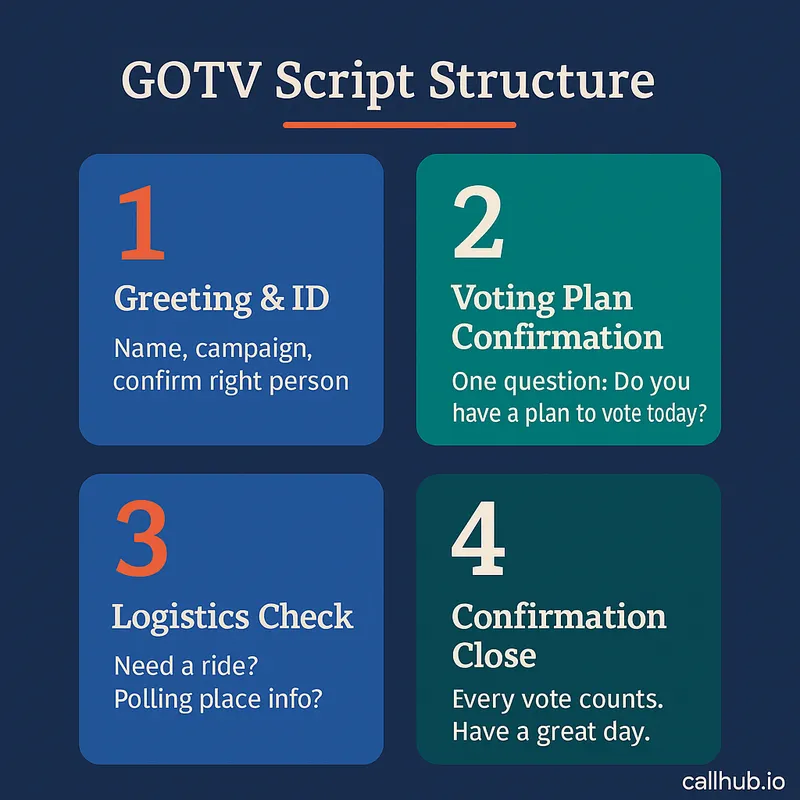
Do not read the script to volunteers. Walk through its structure: greeting, confirmation question, logistics check, confirmation close.
Show them one complete call from start to finish. Point out explicitly where the script is shorter than what they used in September. Name that difference.
“You’ll notice we’re not asking about issues. You’re not pitching. The contact already supports us. The script is short because the job is narrow.”
Narrow is not simpler in the casual sense. Narrow means staying in lane. Volunteers who understand why the script is structured the way it is will execute it more cleanly than volunteers who received the script without context.
Minute 6–7: Cover the data entry protocol
GOTV data entry has two dispositions that don’t exist in regular phone banking: voted confirmation and reason for not voting (RFN).
Explain each one in one sentence. Then show where to enter them in the dialer.
“If someone says they’ve already voted, mark ‘Already Voted’ and move on. If they say they can’t vote today, mark the reason from the dropdown. Do not spend time on it.”
John Chrastka, Founder and Executive Director of EveryLibrary, America’s Library PAC, describes what makes the difference: “We’ve really found that CallHub has that capability that lets our campaigns integrate the data side and to bring it the easy-to-use, intuitive-to-manage technologies to these volunteers with a small amount of training.” That small amount of training only works when it is specific and clear, not comprehensive.
Minute 8–10: One live mock call before going live
Put the script in front of two volunteers. Run one mock call before the shift starts.
This is not about catching mistakes. It’s about breaking the seal. Volunteers who have made one call before the shift, even a simulated one, make their first real call with significantly less hesitation.
The 10-minute window feels tight, but the mock call pays for itself in the first hour of the shift. Keep the debrief to one sentence: “Any questions about that? Okay, let’s dial.”
Building the GOTV calling script for your volunteers
The gotv volunteer script training your team receives depends on how clearly you explain why the script looks the way it does, not just what it says. Training election day volunteers on a script they don’t understand produces worse results than a shorter script with clear rationale.
The script structure drives call pace, and call pace determines how many contacts your volunteers reach in a finite shift. A confused volunteer slows down every call. A volunteer who understands the structure runs clean calls even when contacts push back.
The four-part GOTV script structure
Every effective GOTV script follows the same four-part structure:
- Greeting and identification. State your name, the campaign, and confirm you have the right person. Two sentences maximum.
- Voting plan confirmation. Ask one question: “Do you have a plan to vote today?” Not “Are you voting?” Not “Do you plan to vote?” One specific question, answered yes or no.
- Logistics check. If they say yes, ask one follow-up: “Do you need a ride or any information about your polling place?” Most will say no. Some will say yes. That’s where the call earns its place.
- Confirmation close. “Thanks so much. Every vote counts today. Have a great day.” No pitch. No closing argument.
Kayla Lawrence-White of New York Cares explains the value of structured scripts for volunteer execution: “Branching scripts help deter the volunteers from being confused. It leaves no room for them to decide the information.” For GOTV calls, that clarity is not optional. Every second of uncertainty on a GOTV call is a second that could have been a contact.
This structure runs in 45 to 90 seconds per contact. That’s the target.
Emotional tone vs. persuasion tone
The difference in tone is harder to train than the difference in structure. Persuasion calling is informative. GOTV calling is emotional.
Your volunteers are not delivering an argument. They’re functioning as a social signal: someone from the campaign called, which means today matters. The contact is more likely to vote because the call happened than because of anything specific said during it.
Here is what that difference looks like in practice:
| Context | Persuasion line | GOTV line |
|---|---|---|
| Opening | “Hi, I’m calling on behalf of [Candidate]. I wanted to share some information about [Candidate’s] position on [Issue].” | “Hi, I’m [Name] calling for [Campaign]. We’re reaching out to everyone who said they’d vote today to make sure you have everything you need.” |
| Close | “We’re counting on your support on election day. Can we count on your vote?” | “Thanks so much. Every vote matters today. Have a great day.” |
Spend two minutes of your pre-shift walkthrough on this distinction. Volunteers who understand why the tone is different will execute it naturally. Volunteers who don’t will revert to what they practiced in September.
For full script structures with examples for both linear and branching formats, see GOTV script samples for every campaign type.
Handling election day anxiety in your volunteer team
Election day phone bank training carries a different emotional weight than September calling. Volunteers can feel the stakes. The race is close. The shift matters. The urgency is real. That urgency is an asset when it’s calibrated and a problem when it isn’t.
Where anxiety comes from
Most election day volunteer anxiety traces to three sources:
- Uncertainty about the outcome. Volunteers know the day is high-stakes but can’t see how the campaign is performing against the universe.
- Pressure to make calls quickly. When coordinators push volume without explaining why, volunteers feel like they’re failing when they’re not.
- Unclear expectations. When volunteers don’t know whether to handle objections themselves or pass them to staff, every uncertain contact creates stress.
Your training should address all three before the shift starts, not after volunteers start expressing doubt on the floor.
Reframing urgency without creating panic
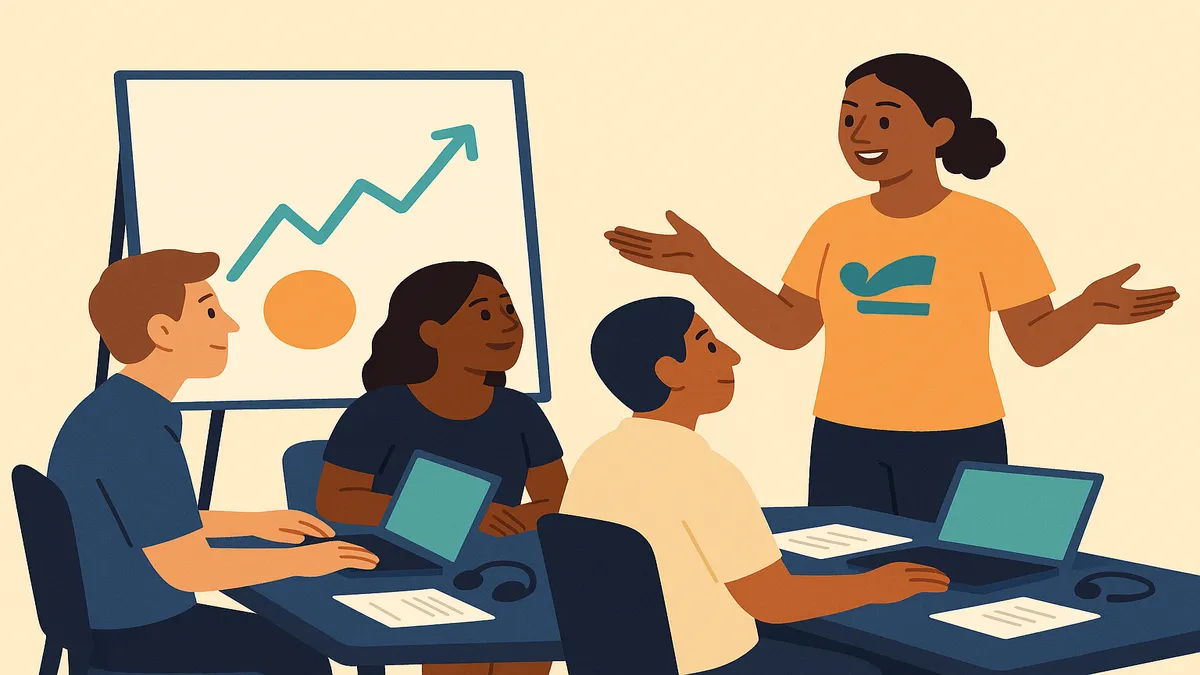
The goal is to channel the urgency of election day without converting it into anxiety.
Brief your volunteers in terms of what they control, not what they don’t. “We’re going to reach every contact in the queue before the polls close” is more useful than “This is the most important day of the campaign.” Both are true. One gives volunteers a task. The other gives them a weight.
Set a shift target at the start. Put it somewhere visible: “We want to reach 300 contacts by 3 PM.” Track it and report it at mid-shift. Volunteers who can see progress manage their own energy. Volunteers who can’t see progress tend to estimate low and feel behind even when they’re on pace.
The other lever is specificity around expectations. Tell volunteers before the shift exactly what to do when a contact says they can’t vote, when a contact gets angry, and when they’re unsure of an answer. Three scenarios, three pre-decided responses. That level of specificity removes the biggest source of per-call anxiety for volunteers who haven’t run a GOTV shift before.
Keeping volunteers motivated across a full election day
Election day shifts run long. Volunteers who are energized at 9 AM often look different by 2 PM. Managing motivation across a full shift is as much a coordinator responsibility as running the script training at the start. For the full day-of operation your trained volunteers plug into, including shift timing and precinct-level redeployment, see the election day GOTV playbook.
Setting a visible progress target
Set a shift goal in contacts, not calls. Contacts means live answers. Calls includes no-answers, voicemails, and disconnects. If your goal is in total calls, volunteers will make 200 calls, reach 40 contacts, and feel like they’ve underperformed.
Set the goal in contacts and frame it as the metric that matters. Write it on a whiteboard or post it digitally if you’re running a virtual shift. Update it every 30 minutes.
Mid-shift check-ins and caller rotation
A mid-shift check-in takes three minutes and resets volunteer energy more effectively than any motivational speech.
At the midpoint of each shift:
- Read out the contact total so far
- Name one or two specific contacts that mattered (a volunteer reported a needs-a-ride contact, someone confirmed a household of four)
- Remind volunteers of the shift-end target
- Rotate callers to break the monotony of the same position
The specific contacts piece matters more than it seems. Volunteers who hear that someone else’s call produced a real outcome feel less like they’re doing mechanical data entry and more like they’re participating in something with a visible result.
Using live call data to sustain energy
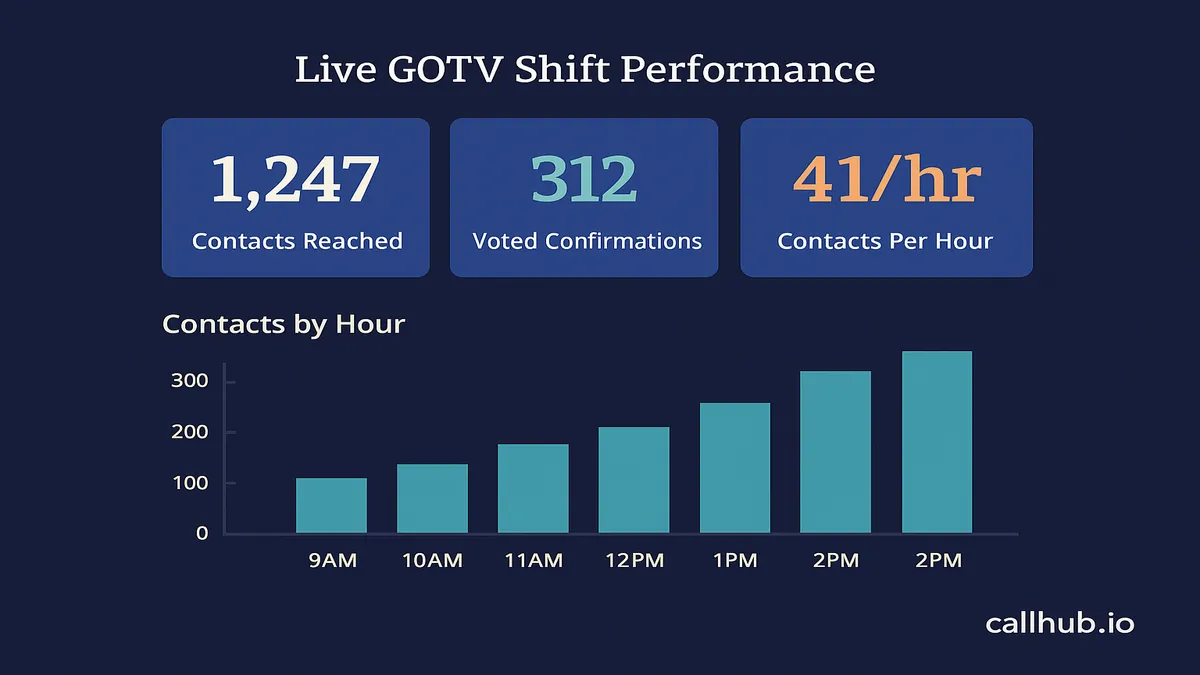
Real-time data changes the experience of a long shift. When volunteers can see that the team has reached 1,200 contacts in the last three hours, the work feels different than when they can only see the individual call they’re currently on.
Share aggregate data at check-ins: total contacts, contacts per hour, voted confirmations logged. The phone banking strategies for GOTV that consistently produce the highest contact rates treat real-time data as a team resource, not just a management reporting function.
For a complete breakdown of GOTV phone banking strategy, including how to structure your calling universe and manage shift throughput, see the complete guide to GOTV strategy.
Your GOTV training is the last preparation your callers get, so make it count
GOTV training is not a repeat of September. The universe is different, the script is different, the emotional stakes are different, and the data entry protocol is different. Volunteers who understand why their job has changed will execute the shift more effectively than volunteers who received the same training briefing twice.
The 10-minute pre-shift walkthrough works because it matches the reality of election day: you don’t have 90 minutes, your volunteers don’t need 90 minutes, and the most effective preparation is focused and fast.
Start with who they’re calling. Walk through the script. Cover the two data entry dispositions. Run one mock call. Then dial.
Training is one piece of the broader operation. See the complete GOTV strategy hub for the full system this fits into, from voter ID through election day.
To run your GOTV phone bank on CallHub, visit CallHub for political campaigns, or see how CallHub supports GOTV volunteer programs specifically. And before training day, review GOTV script samples for every campaign type for linear and branching formats with full examples.
Frequently asked questions
How is GOTV volunteer training different from regular phone bank training?
GOTV volunteer training differs from regular phone bank training across five structural dimensions: training window (10 minutes, not 90), call universe (supporters only, not persuadables), script goal (turnout confirmation, not persuasion), emotional register (urgent and warm, not informative), and data entry protocol (voted confirmation and reason for not voting, not support ID codes). These differences require a different training structure, not just a shorter version of the same onboarding.
How long should GOTV training take?
Ten minutes per shift. The GOTV window is the final 72 to 96 hours before polls close, and your training needs to fit inside the shift structure, not pull time away from calling. A well-structured 10-minute pre-shift walkthrough covering the universe, the script, data entry dispositions, and one mock call is sufficient for a prepared volunteer.
What should training election day volunteers cover?
Training election day volunteers should cover four things: Who they’re calling (supporters only, not persuadables), the GOTV script structure (greeting, voting plan confirmation, logistics check, confirmation close), the two data entry dispositions (voted confirmation and reason for not voting), and one live mock call before the shift starts. Keep each element to two or three minutes maximum.
How do you handle volunteers who have only done persuasion calling?
Name the difference explicitly at the start of training. Tell them: “Today is different from September in these specific ways.” Then walk through the five dimensions in the comparison table. Volunteers who understand why the task has changed adapt much faster than volunteers who receive a shorter script without context. The most important shift to establish is that they’re not trying to change anyone’s mind: Every contact in the queue is already on your side.
When should GOTV phone banking start?
Most campaigns begin GOTV calling in the final 72 to 96 hours before election day, with the highest-intensity calling on election day itself. Standard organizing research, including guidance from NGP VAN, places the optimal GOTV phone bank window within that 72-to-96-hour range. Starting earlier risks contacting supporters before they’ve locked in their voting plan. Starting later than the morning of election day leaves your shifts understaffed for the most critical hours. For how that window fits into the full campaign schedule, see the GOTV timeline guide.