
Voters on your list receive campaign mailers they toss, robocalls they screen, and emails they delete. Text messages cut through all of that. Research consistently shows SMS open rates far above every other outreach channel, and multiple academic GOTV studies including Yale ISPS research show that a well-sequenced program increases voter turnout by roughly 1% per contact. Issue-specific messages lift that probability by up to 8%, according to EZTexting’s GOTV SMS research guide.
The problem is that most campaigns improvise their gotv text templates on the fly, which means they miss the compounding effect of a sequenced program where each touchpoint builds on the last. This article gives you 25+ copy-paste-ready scripts organized by campaign stage, from voter identification three to four weeks out through the final poll-closing push. These scripts are one channel within a larger system — see the complete GOTV playbook for how texting fits alongside phone banking and canvassing.
Every template includes a broadcast version, a peer-to-peer variant, or both. Customize the merge fields and schedule. That’s it.
Key Takeaways
Text messaging outperforms mailers, robocalls, and email for get-out-the-vote outreach because it reaches voters in the same personal inbox they use with family and friends, and a staged multi-week sequence beats a single election-eve reminder.
Why texting drives turnout
- SMS open rates run far above every other GOTV outreach channel according to the research cited.
- Yale ISPS research on well-sequenced GOTV programs shows turnout increases by roughly 1% per contact.
- Issue-specific messages that name a voter’s top policy concern lift turnout probability by up to 8%, per EZTexting’s GOTV SMS research guide.
- Campaigns that improvise texts on the fly miss the compounding effect that comes from a sequenced program where each touchpoint builds on the last.
Broadcast vs. peer-to-peer texting
- Broadcast texts go out at scale through a text broadcasting tool and work best for large-list reminders and deadlines with a one-directional, scheduled tone.
- Peer-to-peer texting has a volunteer send messages individually from their own device and respond personally to each reply, making it suited for voter ID and voting-plan conversations.
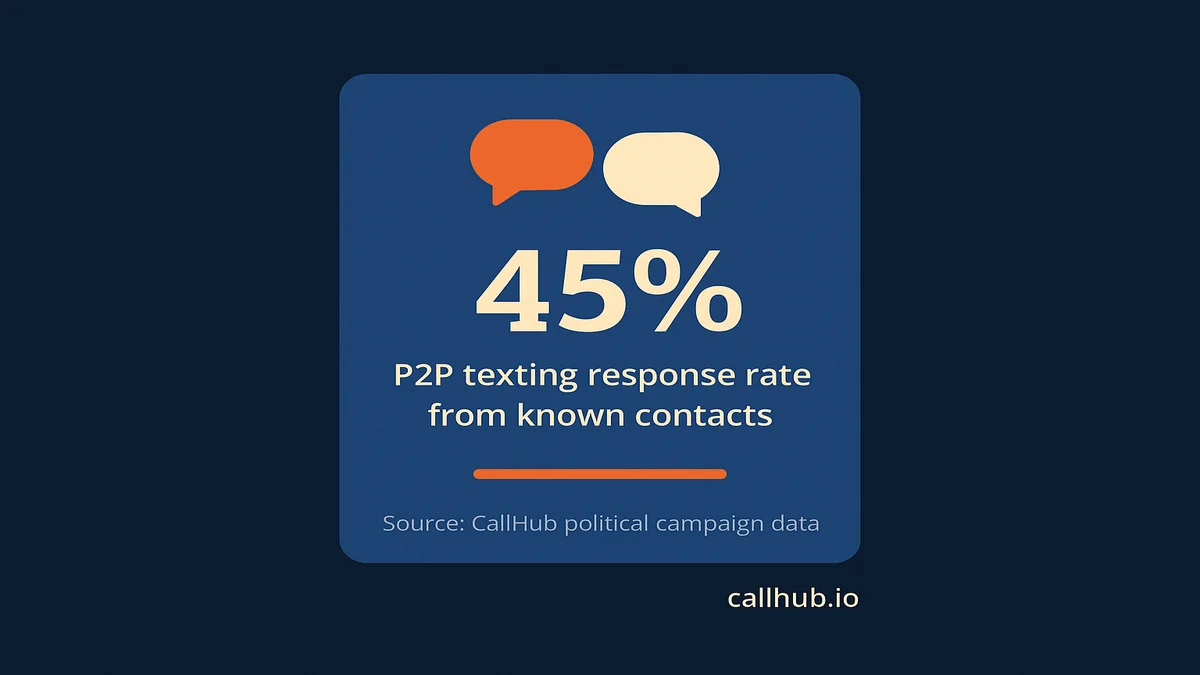
- P2P texting from a known contact drives response rates up to 45%, according to CallHub political campaign data.
- Personalizing with a first_name merge field and naming the specific issue a voter cares about outperforms a generic reminder, and Communications Strategist Eli Zbar notes voters tune out event-invite calls and the mass emails they already receive daily.
Templates by campaign stage
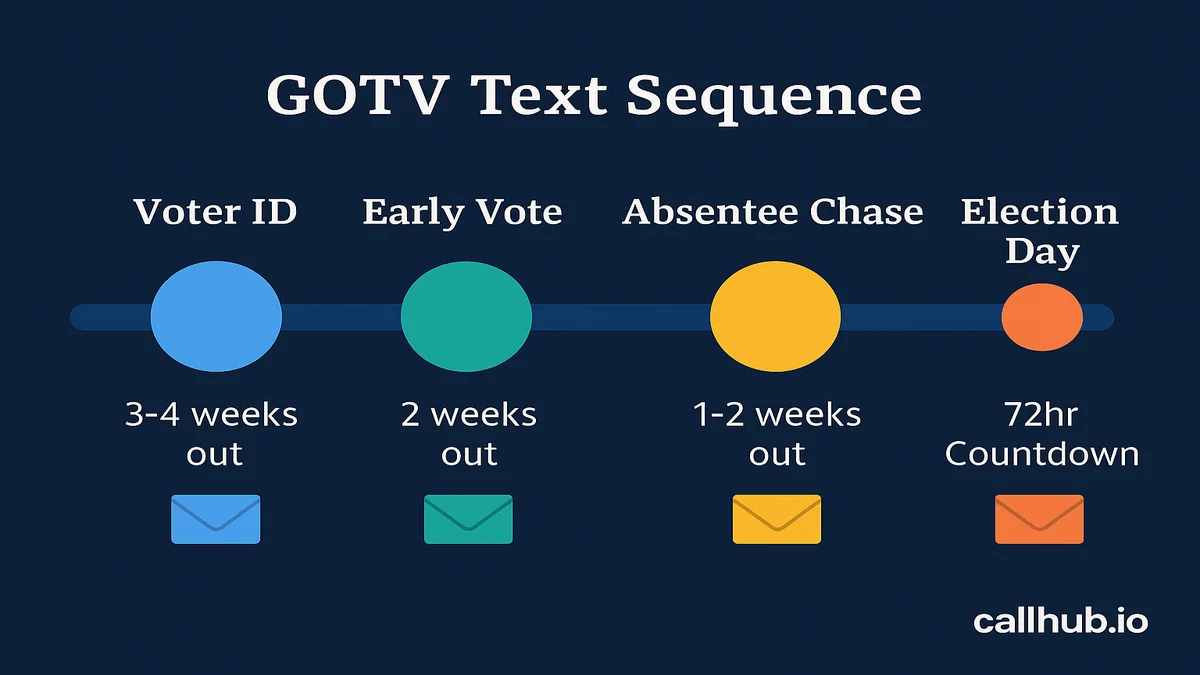
- The guide provides 25+ copy-paste-ready scripts organized by stage, spanning voter identification three to four weeks out through the final poll-closing push.
- Pre-election voter ID templates, used three to four weeks out, aim at identification rather than mobilization and close with a short binary or simple reply prompt (YES, NO, MAYBE).
- Early voting and mail-in ballot templates, deployed about two weeks out, push committed supporters to vote early in order to reduce Election Day workload and should always include the jurisdiction’s actual dates and drop box locations.
Why text messaging works for GOTV
Text messages reach voters where other channels don’t: In the same inbox where they talk to family and friends. That personal context makes even a scheduled broadcast feel more direct than a mailer or a robocall.
The practical result is that a staged texting sequence, one that moves voters from awareness to commitment to action over several weeks, consistently outperforms a single election-eve reminder. The templates below are designed around that sequence logic. Each stage has a specific goal, a specific message format, and a specific call to action.
For the full strategic framework behind the sequence, see the GOTV strategy guide. That staging follows the same phases mapped out in the GOTV timeline guide.
How to use these templates
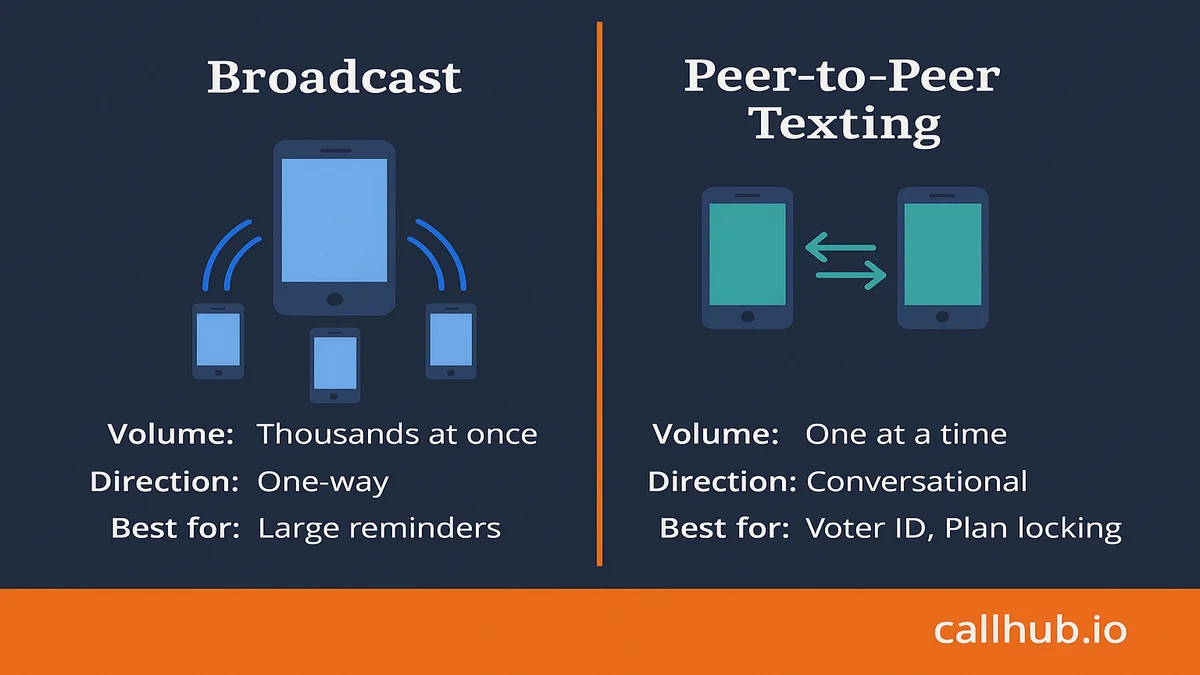
Two message types appear throughout this guide:
| Type | Best for | Volume | Tone |
|---|---|---|---|
| Broadcast | Large-list reminders and deadlines | Thousands at once | One-directional, scheduled |
| Peer-to-peer texting | Conversations, ID, voting plan locking | One volunteer per batch | Personal, response-expected |
Broadcast messages go out at scale through a text broadcasting tool. Peer-to-peer texting (P2P texting after this) means a volunteer sends messages individually from their own device and responds to each reply. P2P texting from a known contact drives response rates up to 45%, according to CallHub political campaign data. For campaigns without a large volunteer bench, the GOTV for small campaigns guide shows how to prioritize between the two.
Personalization lifts both. Add `{first_name}` where indicated. For issue-based templates, name the specific policy your voter list cares about most: A message with an issue reference outperforms a generic reminder.
“Take event invites; no one wants to get a phone call from some volunteer saying hey, the candidate’s going to be in your town next week. And people don’t check their emails because people get a million emails a day,” says Eli Zbar, Communications Strategist at the Dianne Watts BC Liberal Party Leadership Campaign.
For a deeper look at how P2P works and when to use it, read the guide on how peer-to-peer texting works.
Pre-election voter identification templates (3-4 weeks out)
The goal at this stage is identification, not mobilization. You want to know who is with you, who is persuadable, and who needs a voting plan conversation. Keep messages short and end with a binary or simple response prompt.
Template 1: Broadcast, voter ID
Hi {first_name}, I’m {volunteer_name} with {campaign_name}. On [DATE], will you be voting for {candidate_name}? Reply YES, NO, or MAYBE. Thanks.
~130 characters. Run this against your full supporter list before committing resources to any segment.
Template 2: Broadcast, issue-based activation
{first_name}, {candidate_name} is fighting to protect {issue}. Are you with us on Election Day? Reply YES to confirm your support.
~130 characters. Replace {issue} with the policy your voter list cares about most. Issue-specific messages lift turnout probability by up to 8%.
Template 3: Broadcast, general supporter activation
Hi {first_name}, it’s {campaign_name}. Election Day is [DATE]. Can we count on your vote? Reply YES to confirm or HELP to find out how to get involved.
~150 characters.
Template 4: P2P, personal outreach
Hey {first_name}, this is {volunteer_name} volunteering for {campaign_name}. Do you have a plan to vote on [DATE]? Happy to answer any questions.
~145 characters. P2P: Send from volunteer’s device and respond to replies personally.
Template 5: P2P, follow-up for no response
Hey {first_name}, following up from {campaign_name}. Wanted to check if you’re planning to vote for {candidate_name}. Any questions I can help with?
~148 characters. Send three to five days after Template 4 if no response.
Early voting and mail-in ballot reminder templates (2 weeks out)
The goal at this stage is moving committed supporters to vote early, which reduces election-day workload significantly. Early vote periods vary by state: Always use the actual dates and drop box locations for your jurisdiction.
Template 6: Broadcast, early voting opens
{first_name}, early voting is now open in [COUNTY]. Vote early at [LOCATION] through [DATE]. Hours: [HOURS]. No lines, no waiting. Reply HELP for your polling place.
~163 characters. Update with real early voting location and hours.
Template 7: Broadcast, mail-in ballot deadline reminder
{first_name}, your mail-in ballot must be returned by [DATE]. Drop it at [LOCATION] or mail by [EARLY DATE] to avoid postal delays. Need help? Reply BALLOT.
~155 characters. Always include a physical drop box option for supporters who requested a ballot late.
Template 8: Broadcast, early vote deadline approaching
{first_name}, only [X] days left to vote early. Skip the Election Day rush and vote this week. Find your location: [LINK]. Questions? Reply here.
~143 characters.
Template 9: P2P, personal early vote nudge
Hey {first_name}, it’s {volunteer_name} from {campaign_name}. Early voting is open now. Any chance you could get out this week? Happy to help you find your polling place.
~168 characters. P2P: Adjust length if your tool has a 160-character limit per message.
Template 10: P2P, mail-in ballot request reminder
Hi {first_name}, this is {volunteer_name} checking in for {campaign_name}. Have you sent in your mail ballot yet? Deadline is [DATE]. Let me know if you need any info.
~165 characters.
For detail on how to pace absentee outreach alongside early-vote messaging, see the guide on how to time your GOTV text reminders.
Absentee ballot chase templates (1-2 weeks out)
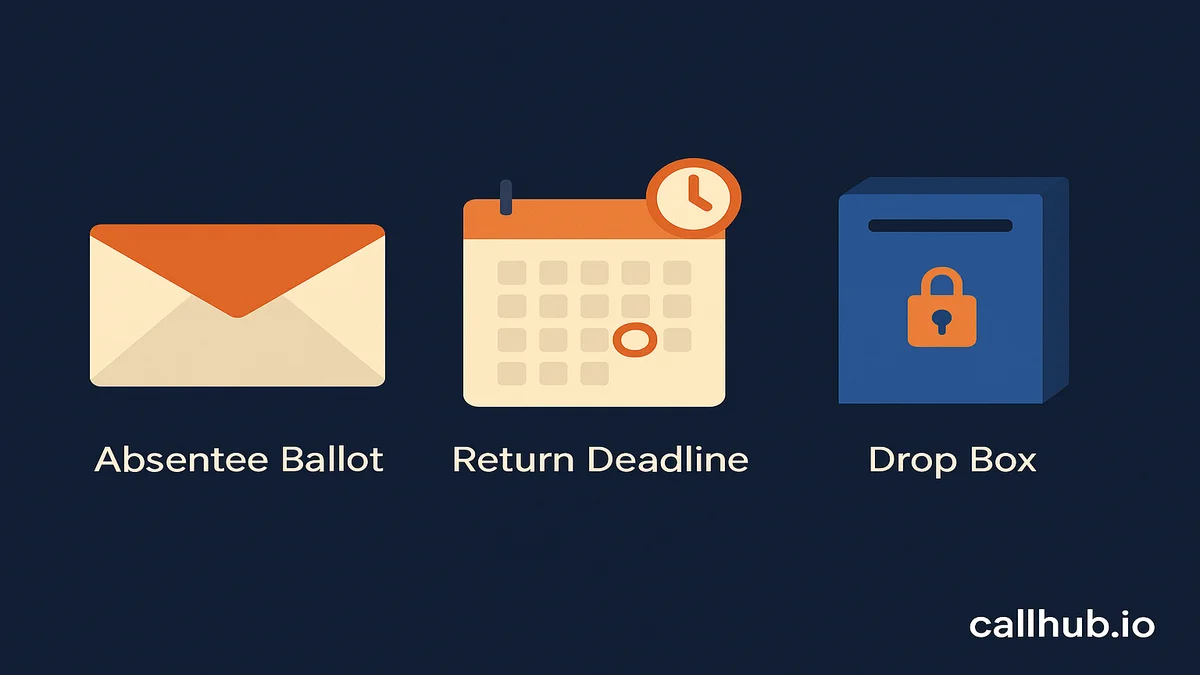
Absentee ballot chase is time-critical. You have a list of voters who requested a mail ballot but have not returned it. Every day without a return is a vote that might not count.
Before running these templates: Always verify your state’s ballot receipt and postmark deadlines. Rules vary significantly, and an incorrect deadline in a message can cost you votes.
Template 11: Broadcast, ballot return chase
{first_name}, our records show you requested an absentee ballot. Have you sent it back? Deadline is [DATE]. Drop it at [LOCATION] to be safe. Reply YES if it’s already in.
~170 characters.
Template 12: Broadcast, drop box push
{first_name}, if you haven’t mailed your absentee ballot yet, drop it off instead. Nearest drop box: [LOCATION]. Open until [DATE/TIME]. Avoids any mail delays.
~160 characters. Drop box framing reduces late-return risk caused by postal delays.
Template 13: P2P, personal ballot chase
Hey {first_name}, this is {volunteer_name} with {campaign_name}. Did you return your absentee ballot? Deadline is [DATE]. Happy to help you find the nearest drop box.
~164 characters. Target: Supporters who requested a ballot with no return confirmation on file.
For a full absentee chase cadence with script sequencing, see the absentee ballot chase tactics guide.
Commitment and voting plan confirmation templates (3-5 days out)
Three to five days before election day, the goal shifts from identification to commitment locking. Asking a voter when they plan to vote, not whether they plan to vote, assumes intent and generates a specific commitment that translates to higher turnout follow-through.
The vote-tripling approach (asking who the three people are that a voter will remind to cast their ballot) shows consistent lift in P2P conversations when a volunteer follows up on the named contacts. For the full relational organizing framework behind this tactic, see relational organizing for GOTV.
Template 14: P2P, voting plan conversation
Hey {first_name}, it’s {volunteer_name} for {campaign_name}. Election Day is [DATE]. When are you planning to vote: morning, afternoon, or after work?
~150 characters. Asking “when” instead of “if” books a specific plan.
Template 15: P2P, vote tripling ask
{first_name}, great that you’re voting! Who are three friends or family who might also vote for {candidate_name}? We can send them a reminder if you want.
~153 characters. Follow this with a response handler for contacts who share names.
Template 16: P2P, commitment confirmation after plan conversation
{first_name}, got it! You’re voting [MORNING/AFTERNOON/EVENING] on [DATE] at [POLLING PLACE]. We’ll send you a reminder the night before. Thanks for your support.
~162 characters. Send immediately after a voting plan conversation to lock in the commitment.
Template 17: Broadcast, five-day general reminder
{first_name}, Election Day is [DATE], just [X] days away. Your polling place: [LINK]. Hours: [HOURS]. Reply PLAN if you want a reminder the morning of.
~150 characters.
72-hour countdown templates
The final 72 hours is where a sequenced program pays off. Voters who received the earlier stage messages are already primed. Each message in this window should reinforce the commitment and remove logistical friction: ID requirements, polling hours, and the “stay in line” instruction.
| Day | Send window | Goal |
|---|---|---|
| D-3 | 6:00-8:00 PM | Prompt voting plan if not already locked |
| D-2 | 12:00-2:00 PM | Logistics: ID requirements, polling hours |
| D-1 | 6:00-8:00 PM | Final reminder with polling place link |
| D-1 evening | 8:00-9:00 PM | Last check-in for unconfirmed supporters |
Template 18: Broadcast, D-3
{first_name}, [X] days until Election Day. Make your voting plan now: [LINK] to find your polling place and hours. Two minutes is all it takes. See you at the polls.
~163 characters.
Template 19: Broadcast, D-2
{first_name}, don’t forget: you need [ID TYPE] to vote in [STATE]. Polls open at [TIME]. Your polling place: [LINK]. Questions? Reply here.
~137 characters. ID requirements vary by state. Verify before sending.
Template 20: Broadcast, D-1
{first_name}, Election Day is tomorrow! Polls: [HOURS]. Your location: [LINK]. If you’re in line when polls close, STAY. Your vote still counts. See you there.
~159 characters.
Template 21: P2P, D-1 evening final check-in
Hey {first_name}, it’s {volunteer_name}. Big day tomorrow. Are you all set? Polls are [HOURS], your place is [POLLING LOCATION]. Let me know if anything comes up tonight.
~168 characters.
Election day morning and midday templates
Election day texts follow a two-window pattern: Morning urgency while polls first open, and a midday push for supporters who haven’t gone yet. Keep morning messages brief and action-forward.
All election day broadcast messages must go out between 8:00 AM and 9:00 PM in the recipient’s local time zone per the Telephone Consumer Protection Act (TCPA). Do not send before 8:00 AM.
Template 22: Broadcast, election day morning
{first_name}, TODAY is Election Day! Polls open until [TIME]. Your polling place: [LINK]. Every vote matters. Go vote!
~116 characters. Send between 8:00-9:00 AM.
Template 23: Broadcast, midday push
{first_name}, have you voted yet? Polls close at [TIME] tonight. Still time: [LINK] for your polling place. Takes about [X] minutes. Go now!
~139 characters. Send between 11:00 AM and 1:00 PM.
Template 24: P2P, morning volunteer check-in
Morning {first_name}! It’s {volunteer_name} from {campaign_name}. Happy Election Day! Did you get a chance to vote this morning? Polls are open until [TIME].
~156 characters. P2P volunteers work a list of supporters flagged as “voting plan confirmed.”
Template 25: P2P, midday follow-up for unconfirmed voters
Hey {first_name}, this is {volunteer_name}. Just checking in. Polls are open until [TIME]. Need a ride or anything? Happy to help. This one really matters.
~154 characters. Target: Supporters who have not confirmed a vote yet by midday.
Poll closing reminder templates
The final two hours are the highest-urgency window. Voters who intended to vote but got sidetracked need a strong, direct push. Keep messages short. Include the exact closing time, the “stay in line” instruction, and a polling place link.
Template 26: Broadcast, two hours before polls close
{first_name}, polls close in 2 hours at [TIME]. Have you voted? Your polling place: [LINK]. If you’re in line at [TIME], stay. You can still vote.
~145 characters. “Stay in line” is legally accurate in most states. Verify for your jurisdiction.
Template 27: Broadcast, 30 to 60 minutes before closing
{first_name}, last chance! Polls close at [TIME]. GO NOW if you haven’t voted. [LINK] for your location. Every vote counts tonight.
~131 characters. High urgency. No pleasantries. Short.
Template 28: P2P, final two-hour push
Hey {first_name}, it’s {volunteer_name}. Polls close at [TIME], less than 2 hours left. Please go vote if you haven’t. Your polling place is [LOCATION]. We need you.
~163 characters.
GOTV texting compliance: What every campaign must know
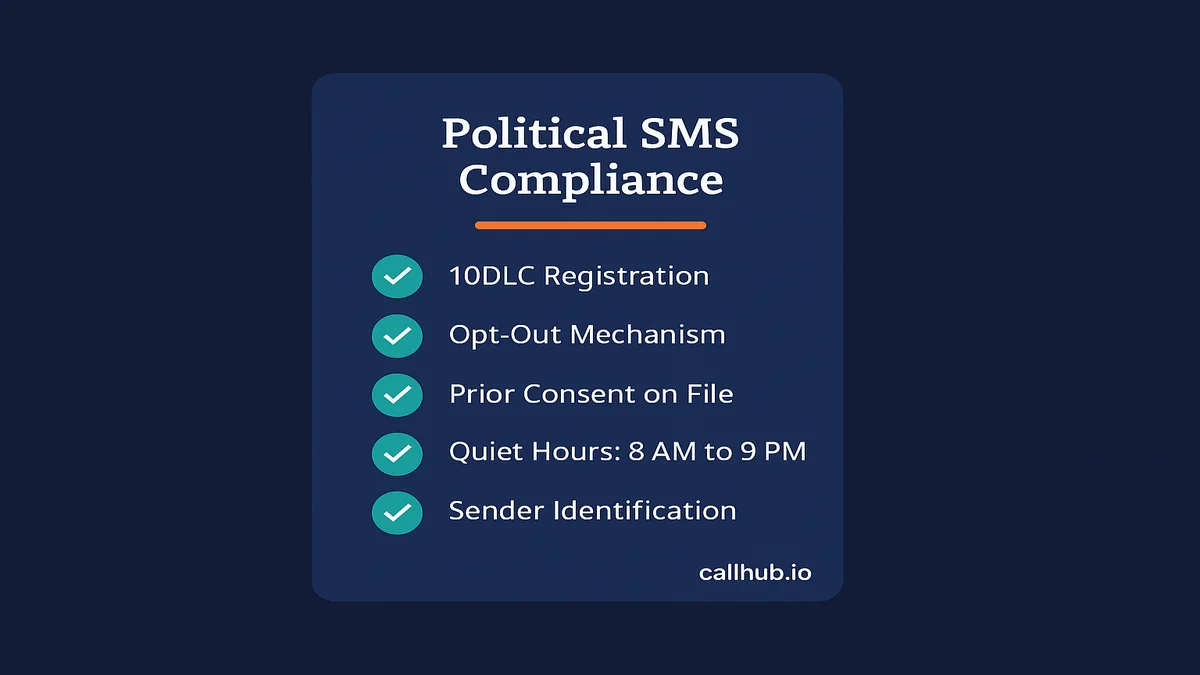
Political SMS campaigns require registration under the 10-digit long code (10DLC) framework, which took effect in 2024. Carriers actively filter unregistered political messages. All 28 templates above should run through a registered 10DLC campaign to avoid delivery failures.
Five compliance requirements every GOTV campaign must meet before sending:
- 10DLC registration: Register your brand and campaign with the Campaign Registry before your first send. Unregistered political messages are subject to carrier filtering across all major US networks.
- Opt-out mechanism: Every broadcast message must include an opt-out instruction (“Reply STOP to unsubscribe”). P2P messages are generally exempt from this requirement, but including it is best practice.
- Prior consent: Voter registration data does not equal consent to text. You need documented opt-in consent from each contact before running broadcast SMS campaigns.
- Quiet hours: Send between 8:00 AM and 9:00 PM in the recipient’s local time zone. The Telephone Consumer Protection Act (TCPA) prohibits contact outside these hours.
- Sender identification: Include the campaign name or candidate name in every broadcast message. Anonymous political texts are non-compliant.
For the full political texting legal framework, see the political text messaging guide. For FCC guidance on texting rules, see the FCC resource on stopping unwanted calls and texts.
Run your GOTV texts from one place without the tab-switching
Managing broadcast and P2P texts across separate tools is where GOTV programs lose hours and data. Volunteer confirmations don’t make it back to your voter file. Broadcast lists get out of sync with your P2P contact records. The morning push goes out late because someone had to manually approve it at 7:00 AM.
Run your GOTV texts from CallHub to keep broadcast scheduling, P2P volunteer texting, and contact list management in one place. Voter contacts update automatically as responses come in, and your field team has live visibility into who has confirmed, who is unreachable, and who needs a final push before polls close. Visit CallHub’s GOTV platform to see how texting connects with phone banking and canvassing data in one program.
To see how the P2P side works in more detail, read how peer-to-peer texting works.
Frequently asked questions
What should a GOTV text message include?
A GOTV text should include the voter’s first name, a clear action prompt, the election date or relevant deadline, and a way to respond or get help. For broadcast messages, add sender identification and an opt-out instruction. For P2P messages, the volunteer’s name makes the message feel personal and increases the response rate significantly.
When should you send GOTV text messages?
Start three to four weeks before election day with voter ID messages and follow the staged schedule in this guide. For time-of-day, send between 10:00 AM and 8:00 PM to stay within TCPA quiet hours and reach voters when they’re likely to respond. Avoid early Monday mornings and late Sunday evenings for best engagement on non-election-day sends.
How many GOTV texts should I send before election day?
A six-to-eight message sequence across four stages is the standard approach: Voter ID (two to three messages), early vote or absentee reminders (two messages), 72-hour countdown (two to three messages), and election day (one to two messages). Sending more than 10 messages to the same voter without any response risks opt-outs and hurts deliverability for your entire campaign.
What is the difference between P2P and broadcast texting for GOTV?
Broadcast texting sends a single message to thousands of voters at once through a text broadcasting tool. Peer-to-peer texting means volunteers send messages individually from their own devices and respond to each reply personally. Broadcast works for high-volume reminders and deadline alerts. P2P works for voter ID conversations, voting plan confirmations, and any stage where back-and-forth matters. Both types are in this guide; which you prioritize depends on your list size and volunteer capacity.
Do I need voter consent to send GOTV text messages?
Yes. Voter registration data does not equal consent to text. You need documented opt-in consent for broadcast SMS campaigns before sending. Peer-to-peer texting operates under different rules, but best practice is to use contacts who have previously engaged with your campaign. Review the political text messaging guide and consult your legal counsel before your first send.
What are 10DLC requirements for political texting?
10DLC registration requires campaigns to register their brand and message campaign with the Campaign Registry before sending automated SMS at scale. Registration includes a campaign description, message samples, and sender information. The major carriers began filtering unregistered political messages in 2024. Register at least two to three weeks before your first scheduled send to avoid delays.
What is a good response rate for GOTV texts?
Response rates vary by message type and list quality. P2P texts from a known contact consistently outperform broadcast reminders because they feel personal. Voter ID messages (Templates 1 to 5) see higher response rates than election-day pushes because they arrive earlier and ask a clear binary question. Track your response rate per stage rather than benchmarking against a single number, and adjust your sequencing based on what your list actually responds to.