
Most campaigns choose get out the vote software the wrong way. They ask what tools comparable campaigns are using, and they buy what they hear most often. The problem is that the right platform for a coordinated state campaign with 300 volunteers is not the right platform for a local race with five staff members and a surge of election-day volunteers.
Get out the vote (GOTV) software is any platform used to coordinate voter outreach in the 72-to-96-hour window before Election Day. That includes calling, texting, email, and combinations of all three. According to the Analyst Institute, a single phone contact increases turnout by 3.8 to 4.5 percentage points (see the does GOTV work research breakdown for the full channel-by-channel picture). That lift disappears when the platform can’t scale, can’t sync with your voter file in real time, or routes calls to voters who already confirmed they voted that morning.
This guide gives you a six-criteria framework to evaluate any GOTV platform before your team is on the clock. By the end, you’ll know what to look for, what to walk away from, and which questions to ask vendors before you sign.
What is GOTV software? (And what it isn’t)
GOTV software is the outreach engine. It sequences contacts across channels, tracks voter status in real time, syncs dispositions back to your voter file, and gives coordinators visibility into who has been reached and who still needs a contact.
It is not a voter file. Platforms like NGP VAN (also called VoteBuilder) and TargetSmart are the data layer. They store voter records and contact history. GOTV software uses that file to work the list.
It is also not a general campaign CRM. Tools that manage donor relationships, volunteer schedules, and year-round communications serve a different function. They are built for relationship management over months, not for running 1,000 contacts per hour over 48 hours.
The clearest way to understand the category: A voter file is your list. A campaign CRM is your relationship database. Get out the vote software is how you work both on Election Day.
The best platforms bring all channels under one roof with shared contact records. A voter reached by text on Sunday evening should not receive a duplicate call Monday morning. Without shared records, channels create conflicting dispositions and wasted volunteer hours. For a full breakdown of what tools exist in each channel, see the full list of GOTV tools by channel.
Why the wrong platform stalls your final push
The window for GOTV outreach is fixed and unforgiving. Once the polls close, the window closes. A platform limitation discovered two days before Election Day is not a vendor problem you can escalate. It is a real-time operational crisis.
The most common failure points are predictable. The platform can’t handle 50 simultaneous callers without dropping connections. The VAN integration turns out to be one-directional, meaning dispositions entered by volunteers don’t write back to the file. Compliance settings aren’t configured for the state’s autodialer rules, so call flagging spikes mid-shift.
Each of these has the same outcome: Volunteer hours wasted on calls that shouldn’t be made, to voters who have already been reached, with data that won’t survive the shift. The six criteria below tell you how to identify these problems before you commit.
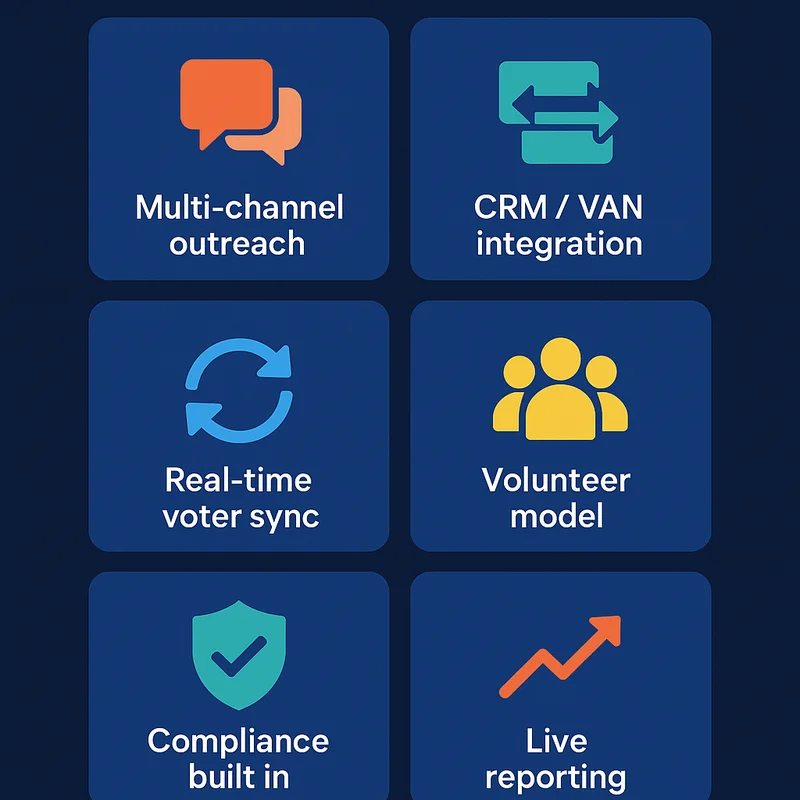
Six criteria for evaluating any GOTV software platform
| Criterion | What to look for | Red flag |
|---|---|---|
| Multi-channel outreach | Calls, texts, email from one platform | Tool covers only one channel |
| CRM/VAN integration | Named 2-way real-time sync | One-way export only |
| Real-time voter sync | Auto-removal from queue on status update | Manual list updates between shifts |
| Volunteer model | Unlimited seats, mobile-accessible | Per-seat pricing |
| Compliance | STIR/SHAKEN, DNC, time-zone enforcement built in | Compliance listed but not technically enforced |
| Live reporting | Real-time contacted/remaining/voted by hour | Reporting runs as a daily summary |
Multi-channel outreach from one platform
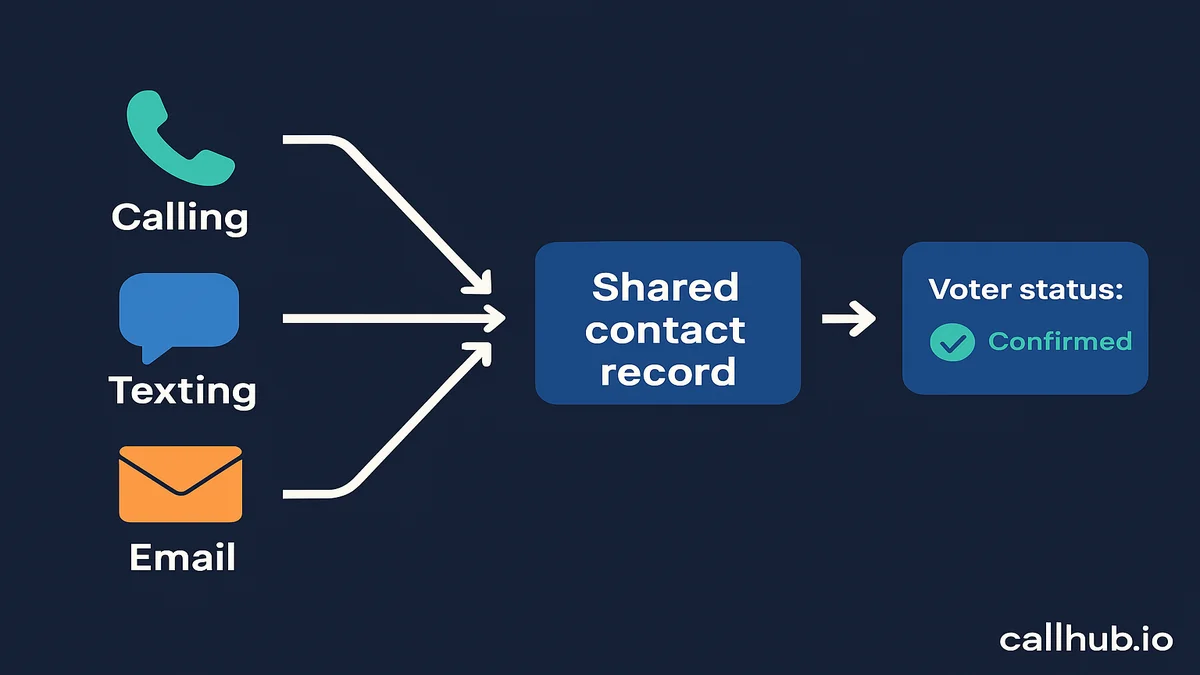
GOTV contact sequences layer channels. A voter receives a text reminder on Saturday. A call on Sunday asks if they have a plan to vote. A final text on Monday morning confirms polling hours. If these three touches run on separate platforms, contact history is siloed. Your caller has no way to know the voter already confirmed on Sunday.
Look for a single login that covers calling campaigns, peer-to-peer texting, broadcast texts, and email. The shared contact record, which shows every touchpoint in one place, is the differentiating feature. Without it, multi-channel becomes multi-problem.
For GOTV specifically, how GOTV phone banking increases turnout and GOTV texting strategies are distinct disciplines. Running them from the same platform with shared data is what turns them into a coordinated program.
CRM and voter file integration
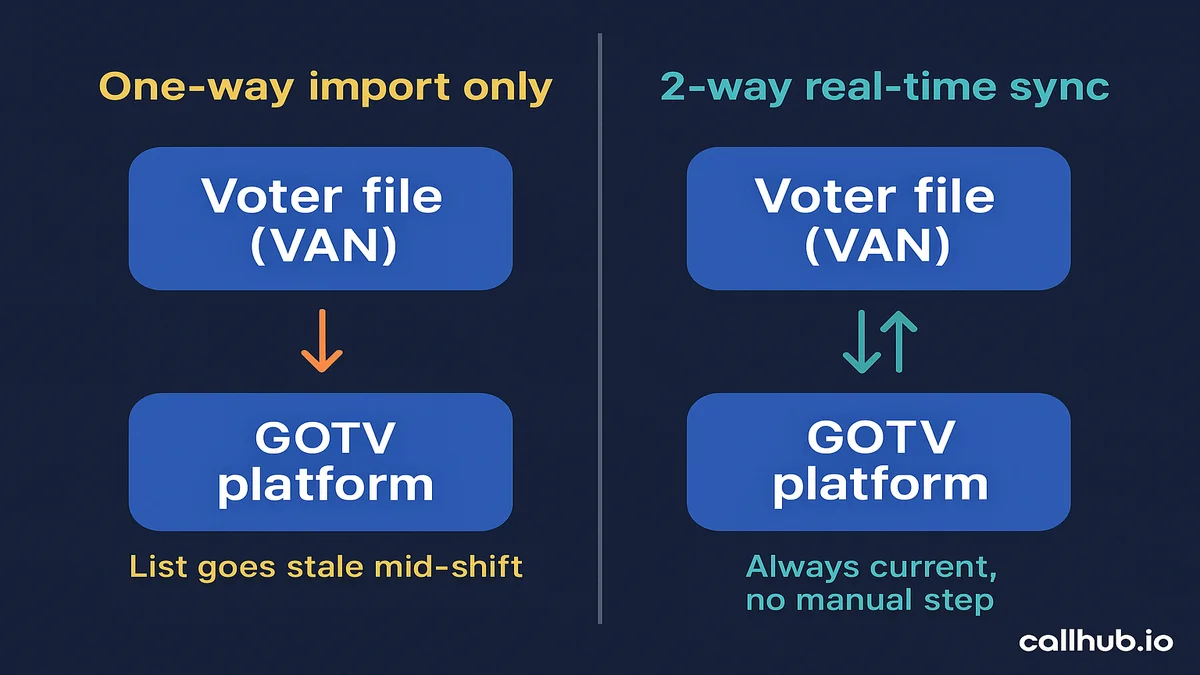
Your voter file is the source of truth. Any GOTV platform that treats it as a one-time import is a platform that will give you stale data by hour two of your first shift.
Look for named integrations, specifically with NGP VAN (VoteBuilder), NationBuilder, and Action Network. More importantly, ask whether the sync is bidirectional. When a volunteer marks a voter as “voted,” does that disposition write back to VAN automatically, or does someone on staff have to export a CSV at the end of the shift and manually upload it?
“Being able to have that integration with data talking both ways is super helpful. It cuts down manual data hygiene and management time because it automatically pushes data both ways.” — Lanae, Founder and Principal, L. Norwood and Associates
The alternative is well-documented. One campaign’s experience before adopting live sync: “The data collected by the volunteers had to be manually entered into their database. This data entry job meant that any insights learned by the volunteers was not available to the party immediately.” That lag, measured in hours during a 72-hour GOTV window, is the difference between a clean list and a list that wastes a third of your volunteer capacity on already-contacted voters.
Real-time data sync across channels
Real-time sync means something specific: When a voter’s status changes in one channel, every other channel updates immediately. A voter who confirmed early voting by text on Saturday afternoon should be removed from the calling queue by Saturday afternoon, not by Sunday morning after the overnight data reconciliation.
Ask vendors two questions. First, how often does the contact queue update when a voter’s status changes? Second, is cross-channel deduplication automatic, or does it require a manual sync trigger?
Without automatic deduplication, a volunteer running calls simultaneously with a peer-to-peer texting team will reach voters who have already been contacted and have no record of it. In a high-volume GOTV operation, that represents a significant portion of shift hours.
Volunteer capacity and pricing model
GOTV operations scale unpredictably. You might have eight volunteers on Monday and 200 on Election Day morning. Per-seat platforms build that unpredictability into your budget risk.
Look for unlimited volunteer access with no per-caller fees. Volunteers should be able to join from a mobile browser without installing anything. You should be able to add new callers mid-shift without a provisioning process that takes 20 minutes.
The red flag is any contract that requires you to estimate volunteer count 30 days in advance. GOTV volunteer surge is a feature of a healthy campaign, not a billing event.
Also check: Can volunteers access the platform from their own devices? A mobile-accessible calling interface means you can add 50 volunteers from a parking lot on Election Day morning without sending them to a dedicated call center.
Compliance built into the platform
The Telephone Consumer Protection Act (TCPA), state-level autodialer regulations, and Do Not Call (DNC) list requirements all apply to political calling and texting. Non-compliance creates legal exposure and, more immediately, call flagging that tanks your answer rates mid-shift.
Look for STIR/SHAKEN certification (the FCC’s call authentication standard, which prevents calls from being labeled as spam by carriers), built-in DNC scrubbing, and time-zone-aware scheduling that enforces legal calling windows automatically. These should be enforced at the platform level, not managed manually by your team.
Ask vendors specifically: How is STIR/SHAKEN handled technically? Is DNC scrubbing run against the list before each campaign, or only at upload? Can you set calling hours per state, or only per campaign?
Compliance listed in a feature sheet is not the same as compliance built into the workflow. The distinction matters when your team is running at volume.
Live reporting and dashboards
A GOTV coordinator’s job is to redirect resources in real time. If the evening calling shift is 40% complete by 7 PM, do you scale up, or is the pace on track? If contacted totals are lagging in one geographic area, can you pull volunteers from another? For how that redeployment plays out hour by hour, see the election day GOTV playbook.
None of those decisions are possible if the dashboard updates every four hours or requires a database query to run.
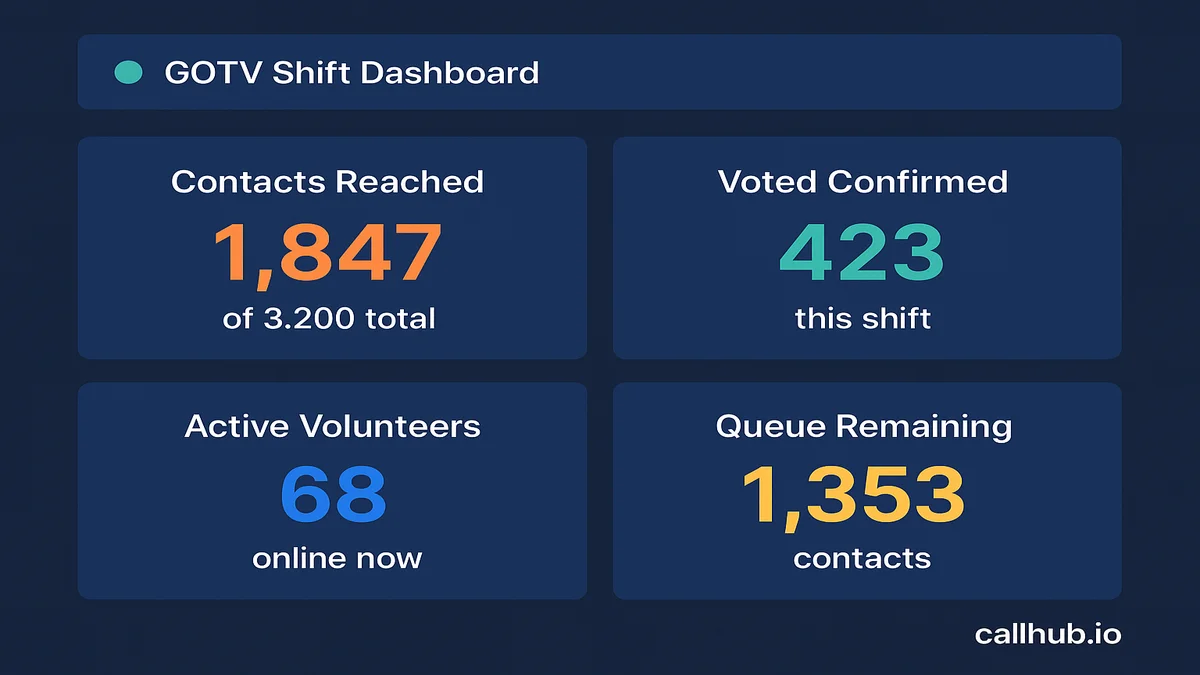
Look for a live supervisor dashboard that shows contacted totals, remaining queue, voted confirmations, and volunteer performance by hour. The key word is “live.” Not “updated daily.” Not “available in the morning report.”
“We compared information from every month and every week and every day to see if we are improving or if we did better the previous week. So it was quite interesting to see the graphs and see if our strategy was working.” — Anthony Samama, Nicolas Sarkozy campaign
That level of feedback loop should apply by the hour during GOTV, not by the week.
How to match GOTV software to your campaign size
Not every campaign needs the full enterprise stack. And not every grassroots campaign can make a simple dialer work for a 200-volunteer Election Day operation. Match the platform to the actual scale of your operation.
| Campaign type | What matters most | What you can skip |
|---|---|---|
| Grassroots / small local | Simple volunteer onboarding, low entry cost, CSV import is acceptable | Enterprise SLA, dedicated account management |
| Mid-size (state / federal primary) | 2-way VAN sync, multi-channel, compliance built in | Canvassing module (use a separate tool) |
| Large (general election / coordinated) | Real-time deduplication, unlimited volunteers, live dashboards, enterprise support | Nothing. All six criteria apply. |
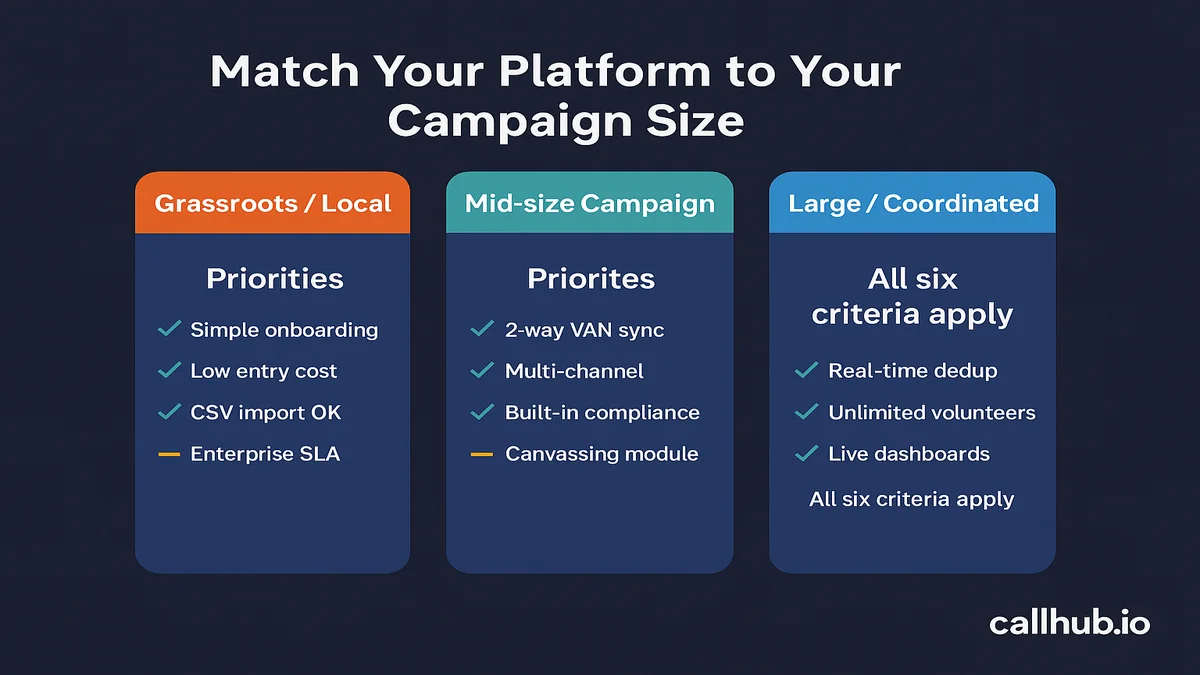
For grassroots campaigns: Simplicity of onboarding matters more than integration depth. If you have a clean CSV from VAN and 10 volunteers, you don’t need bidirectional sync. You need a platform that gets your volunteers making calls in under 10 minutes.
For mid-size campaigns: The 2-way VAN sync is where the gap between platforms becomes operationally significant. When you’re running multiple shifts with different volunteer pools, the cost of manual data entry compounds every shift. Get the integration right before Election Day.
For large coordinated campaigns: Every criterion in the table above applies. The platforms that fail large operations fail at one of two points: They can’t scale volunteer capacity fast enough when surge happens, or their live reporting can’t handle the volume of real-time updates from hundreds of simultaneous callers.
How CallHub fits your GOTV operation
CallHub’s political platform covers all six criteria. Here is how each maps to what you just read.
Multi-channel: Calling, peer-to-peer texting (P2P texting), Text Broadcasting, and email run from a single login with a shared contact record. Calling modes include the Predictive Dialer, Power Dialer, and Preview Dialer, selected by contact rate target and campaign size.
CRM integration: 2-way real-time sync with NGP VAN (VoteBuilder), NationBuilder, Action Network, and other major political CRMs. Volunteer dispositions and activist codes write back to VAN without a CSV export step.
Real-time sync: Contact queues update automatically when voter status changes. Cross-channel deduplication prevents a voter contacted by text from entering the calling queue.
Volunteer model: Unlimited volunteers with no per-seat fee. Browser-based and mobile-accessible. New volunteers can join an active campaign mid-shift without a provisioning step.
Compliance: STIR/SHAKEN certified. Built-in DNC scrubbing. Time-zone-aware scheduling enforces legal calling windows by state automatically.
Reporting: Live supervisor dashboard showing contacted totals, volunteer performance, and voted confirmations by hour. No CSV export required for real-time visibility.
“Switching to CallHub was a game changer. Features like easy-to-share metrics were extremely satisfying. But what was critical for me was the dynamic script and the ability for volunteers to select ‘yes’ or ‘no’ and move to the next section.” — Clement Pairot, Political Organizer, Victoires Populaires / Nouveau Front Populaire
Campaigns including the Bernie Sanders 2020 organization and Georgia Democrats have run GOTV operations on CallHub’s political outreach platform. For the full scope of what the platform covers across the election cycle, including voter ID, persuasion, and GOTV, that page is the right starting point.
Frequently asked questions
What is the difference between GOTV software and a voter file?
A voter file (such as NGP VAN or TargetSmart) is the data layer. It stores voter records and contact history. GOTV software is the outreach engine that uses that file to coordinate calling, texting, and email. They work together: The voter file is your list, and the GOTV platform is how you work it during the final 72-to-96-hour window.
Can GOTV software handle multi-channel outreach from one login?
Some platforms can. Most cannot. Look for a platform where a call, a text, and an email to the same voter all share one contact record. Without shared records, channels produce duplicate contacts and conflicting dispositions. Ask vendors specifically whether the contact history across channels is unified or stored separately by channel.
How does GOTV software integrate with NGP VAN?
Strong integrations are bidirectional: Voter dispositions and activist codes entered during outreach write back to VAN automatically, without a CSV export step. One-way integrations (import from VAN only) mean your VAN file is stale within hours of your first shift. Before committing to a platform, ask whether sync is bidirectional and how frequently it runs.
What is real-time voter sync and why does it matter?
Real-time sync removes a voter from your contact queue the moment they confirm they have voted or have been reached. Without it, callers spend time on already-confirmed voters during the most time-sensitive window of your campaign. When you are running parallel phone and text outreach, automatic deduplication across channels is what prevents one team from contacting voters the other team already closed.
Can small campaigns use GOTV software affordably?
Yes, but check the pricing model. Per-seat platforms become expensive as your volunteer count grows unpredictably in the final days before Election Day. Look for platforms with unlimited volunteer access or per-campaign pricing that does not penalize you for a strong volunteer turnout. For grassroots campaigns, prioritize ease of onboarding and low cost of entry over enterprise integration depth.
Your GOTV window is fixed. Your platform choice should not be
The 72-to-96-hour GOTV window does not expand to accommodate a platform that can’t handle the volume, can’t sync with your voter file, or can’t give a coordinator real-time visibility into what the shift is producing. Those limitations become real the moment the operation starts, not when you discover them in a product review. For the full week-by-week schedule leading into that window, see the GOTV timeline guide.
Use the six criteria above to evaluate any platform before you commit: Multi-channel capability, bidirectional CRM integration, real-time sync, unlimited volunteer capacity, built-in compliance, and live dashboards. Score every vendor against the same framework. The platform that clears all six criteria for your campaign size is the right one.
To see how CallHub scores against each criterion and what the political campaign platform covers end to end, visit CallHub’s GOTV outreach platform. For the full strategic context behind effective GOTV programs, the complete guide to get out the vote strategy covers what happens before the platform even matters.
For the full phase-by-phase system this software runs, voter universe, every channel, election day, and post-election metrics, see the full GOTV strategy playbook. And for CallHub’s dedicated GOTV product page, see CallHub’s GOTV platform.