

The offices closest to voters often attract the fewest voters. Low voter turnout in local elections is not simply a sign that people do not care. Off-cycle dates, limited information, weak competition, unequal mobilization, and practical voting barriers all narrow the electorate.
A local campaign cannot change every structural condition while an election is underway. It can make the race visible, connect the office to a concrete local stake, identify supporters with room to move, and follow through until each supporter has a workable voting plan.
How low is voter turnout in local elections?
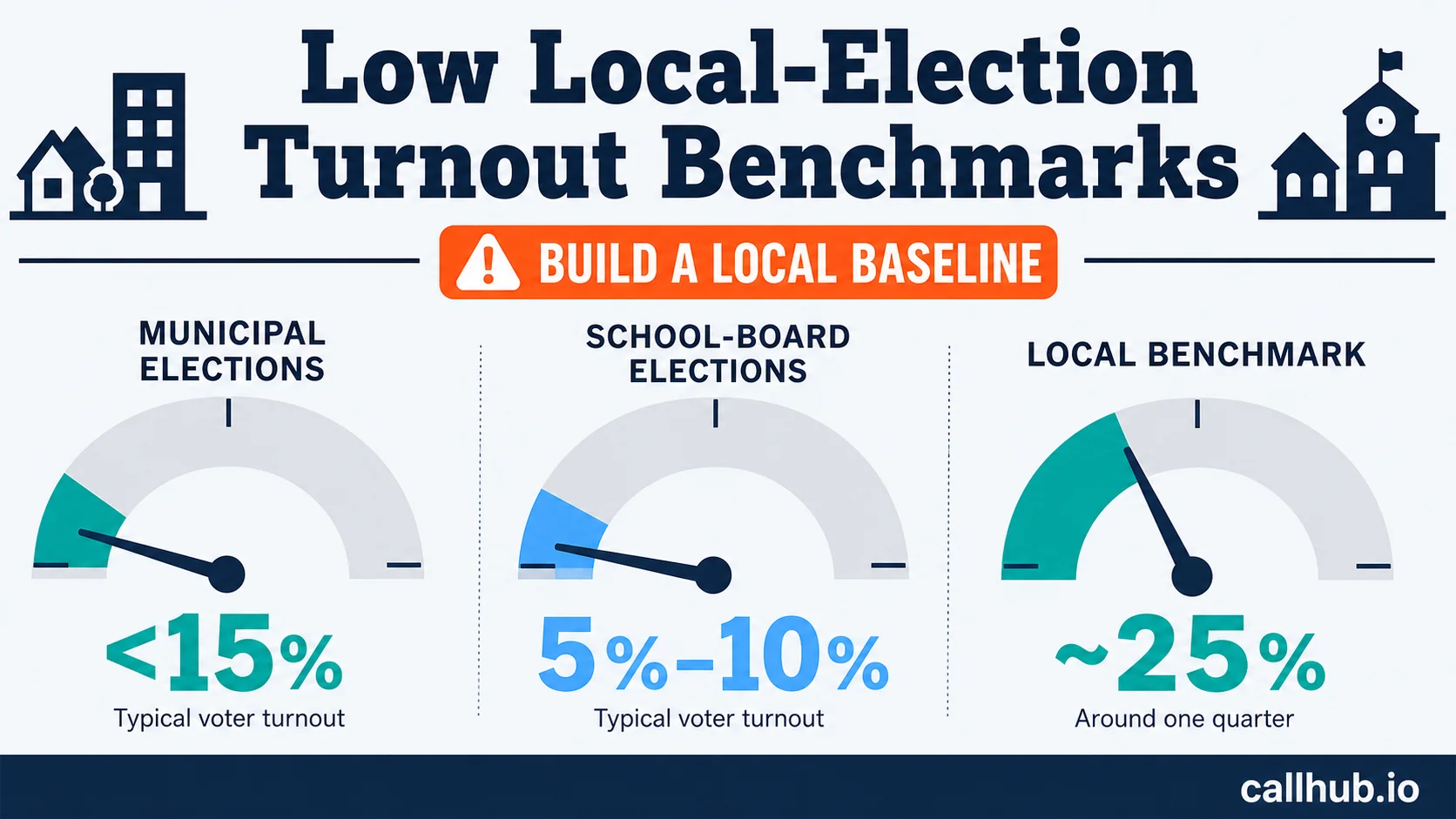
Local turnout is often substantially lower than turnout in presidential or other high-salience elections, but there is no single average that applies to every jurisdiction. The useful benchmark is turnout in comparable elections with the same office, calendar, electorate, and voting rules.
| Benchmark | What the research reports | How to use it |
|---|---|---|
| Municipal elections | Turnout is often below 15% | Treat this as a scale indicator, not a forecast |
| School-board elections | Turnout often falls between 5% and 10% | Expect a small electorate, then confirm it locally |
| Large-city contests | Turnout for mayor and city council was below 15% in 20 of 30 large cities studied | Compare your city with its own prior contests |
| Local elections overall | A recent summary places average turnout around one-quarter of registered voters | Check the denominator and election timing before comparing |
These figures come from the Carnegie Corporation’s analysis of municipal and school-board elections and a National Conference of State Legislatures research summary. Both reinforce the same point: Local turnout is low and uneven, but the headline percentage alone does not tell a campaign how many people will vote.
Use the right denominator and comparison election
Turnout can mean ballots cast divided by registered voters, eligible voters, voting-age residents, or active registered voters. Those denominators produce different percentages.
Before adopting any turnout estimate, confirm:
- Denominator: Which population does the published percentage use?
- Office: Is the comparison for the same office or a similar local office?
- Calendar: Was the prior race on-cycle, off-cycle, or a special election?
- Rules: Were vote-by-mail, early voting, registration, or identification rules comparable?
- Competition: Was the race contested and visible?
- Geography: Did district or precinct boundaries change?
Build a comparable-election baseline
Use two or three recent elections that most closely resemble the current race. Do not default to the most recent presidential election because its turnout environment is fundamentally different.
Suppose a city has 40,000 active registered voters. Comparable local elections produced 7,200, 7,800, and 8,100 ballots. A reasonable planning range is 7,500 to 8,200 ballots, adjusted for competition, calendar changes, registration growth, and current voting rules.
The formula is:
Expected turnout = Comparable local turnout × justified adjustment
Document every adjustment. “The race feels energetic” is not an adjustment. A newly competitive contest, a concurrent statewide election, or a major change in voting access may be.
Why is local election voter turnout so low?
Local turnout stays low because several barriers reinforce one another. Timing reduces attention, limited coverage leaves voters unsure what is at stake, and thin mobilization means fewer people receive a direct prompt to act.
| Cause | What it does to turnout | Campaign implication |
|---|---|---|
| Off-cycle timing | Separates the race from the high-attention election calendar | Repeat the date and voting options early |
| Low information | Leaves voters unfamiliar with offices, candidates, and consequences | Explain the office through one concrete local decision |
| Weak competition | Reduces urgency and media coverage | Give supporters a specific reason their participation matters |
| Election frequency | Creates fatigue and confusion across repeated contests | Use a simple deadline sequence |
| Unequal mobilization | Concentrates outreach among habitual voters | Prioritize supporters who are less consistent voters |
| Voting friction | Turns intention into missed deadlines or incomplete plans | Ask about method, timing, location, and help needed |
For a broader view, see the factors that affect voter turnout.
Off-cycle timing and election frequency
Election timing is a structural driver, not a messaging problem. Research published in the American Political Science Review found that moving local elections to on-cycle November dates generally doubles turnout and produces a more representative electorate. Read the study on election timing and voter composition.
A campaign cannot reschedule an election. It can treat awareness as an early field objective instead of waiting until the final weekend to announce the date.
Low information and perceived stakes
Voters may know that local government affects daily life without knowing which office controls a specific decision. Make the connection explicit:
- Name the office and the decision it influences.
- Explain the consequence in local, concrete terms.
- State the election date and available voting methods.
- Give the voter one next action.
“Local elections matter” is too broad. “The next council will decide the transit route serving this neighborhood” gives the voter a reason to pay attention.
Competition, mobilization, and voting friction
The same voter can face multiple barriers. A low-information voter may also have an uncertain polling location and no reminder from a trusted organization.
| Barrier | Signal | Response |
|---|---|---|
| Awareness | Voter does not know the date or office | Inform before persuading |
| Relevance | Voter sees no personal stake | Connect the office to one local outcome |
| Confidence | Voter lacks reliable election information | Route them to an official source |
| Logistics | Voter has no method, time, or location plan | Complete a voting plan |
| Follow-through | Voter supports the candidate but has not acted | Schedule a specific reminder |
Who votes when local turnout is low?
Low-turnout electorates are usually narrower than the communities they represent. Habitual voters, older residents, homeowners, and people with more political information can become overrepresented when participation falls.
| Broader community | Typical low-turnout electorate |
|---|---|
| Includes frequent and infrequent voters | Skews toward habitual voters |
| Includes newer and less-connected residents | Rewards people familiar with local institutions |
| Reflects a wider range of schedules and barriers | Underrepresents people facing greater voting friction |
| Contains varied levels of political information | Skews toward highly informed voters |
The exact composition varies by jurisdiction. Use the voter file and comparable returns to understand your electorate instead of treating demographic tendencies as fixed rules.
Why turnout composition matters to campaign strategy
Uneven turnout changes both representation and campaign incentives. When campaigns repeatedly contact only habitual voters, they can reinforce the same narrow electorate.
The practical response is not to ignore reliable voters. It is to identify supporters among mid- and lower-propensity groups, understand their barriers, and give them enough information and follow-up to participate.
Separate structural causes from campaign levers
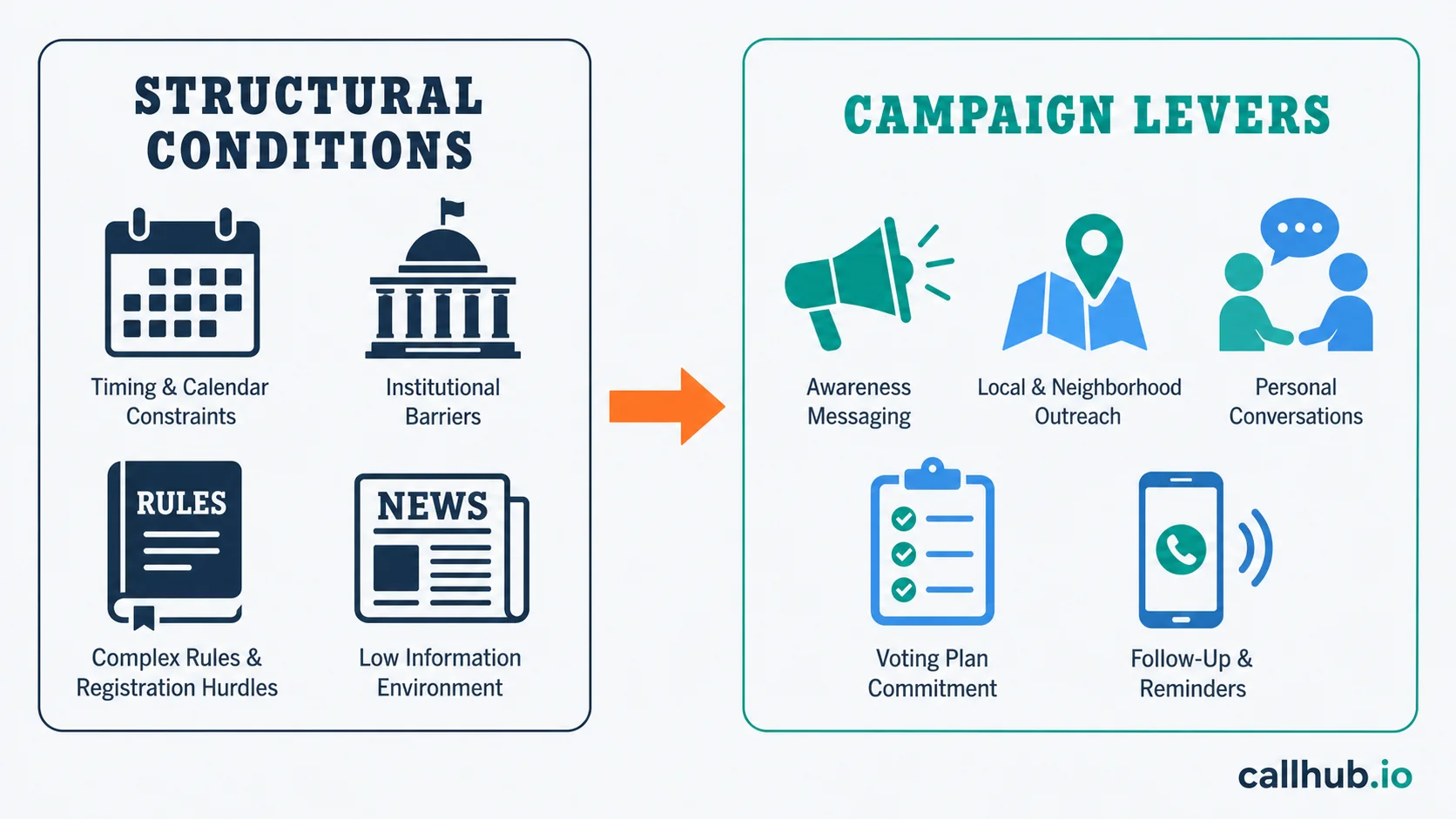
A strong local plan distinguishes conditions the campaign must accept from behaviors it can change now.
| Structural condition | Campaign lever |
|---|---|
| Off-cycle election date | Election awareness and repeated deadline communication |
| Number and frequency of contests | Simple, consistent voter education |
| Registration and voting rules | Accurate guidance and referral to official sources |
| Media coverage | Direct voter contact and community messengers |
| Baseline political interest | Local relevance and personal stakes |
| Size of the electorate | Targeting, coverage, and follow-up discipline |
Structural reform still matters. On-cycle elections can increase participation. During an active race, however, campaign managers need an operating plan for the election that exists.
Calculate the turnout universe and vote goal
Your field plan should begin with a defensible turnout range and win number, then work backward to the supporters and contacts required.
- Collect comparable returns: Use the same office and similar election timing where possible.
- Estimate a turnout range: Adjust only for documented changes in competition, rules, registration, or concurrent contests.
- Set the win number: Divide the expected ballots by two, then add one for a two-candidate race.
- Add a planning margin: Account for uncertainty, undecided voters, and imperfect supporter identification.
- Build the supporter universe: Include identified supporters and persuadable voters who can realistically move into the turnout pool.
- Translate the goal into contacts: Use observed contact and commitment rates, not optimistic assumptions.
For targeting inputs, review how campaigns use voter data to build target universes.
Start with comparable election returns
Prefer elections that match on office, district boundaries, timing, and voting method. Record the reason each election belongs in the comparison set.
Exclude or down-weight a comparison if:
- A presidential or statewide contest transformed attention.
- The race was uncontested.
- District boundaries changed materially.
- Voting rules changed.
- A special circumstance made the election unusually visible.
Segment high-, mid-, and low-propensity supporters
Propensity should guide the type and intensity of contact, not decide whether a person deserves outreach.
| Segment | Primary objective | Contact approach |
|---|---|---|
| High-propensity supporter | Confirm method and timing | Light-touch reminder and completion check |
| Mid-propensity supporter | Resolve uncertainty and build a plan | Personal call or canvass, then reminder |
| Low-propensity supporter | Establish relevance and remove barriers | Earlier conversation, clear local stake, repeated follow-up |
| Unknown support | Identify support before GOTV | Persuasion or identification program |
Convert the win number into daily contact goals
Suppose the campaign needs 4,101 votes and has identified 4,800 supporters. If 3,200 have complete voting plans, the immediate gap is 1,600 supporters without verified plans.
If six contact days remain, divide the unresolved universe by the number of days and available shifts. That creates a daily coverage requirement. Recalculate it each night using actual conversations, completed plans, unreachable voters, and reported votes. For more on running an effective program with a small team and a short timeline, see GOTV for small campaigns.
Build a local-election GOTV strategy that addresses the real barriers
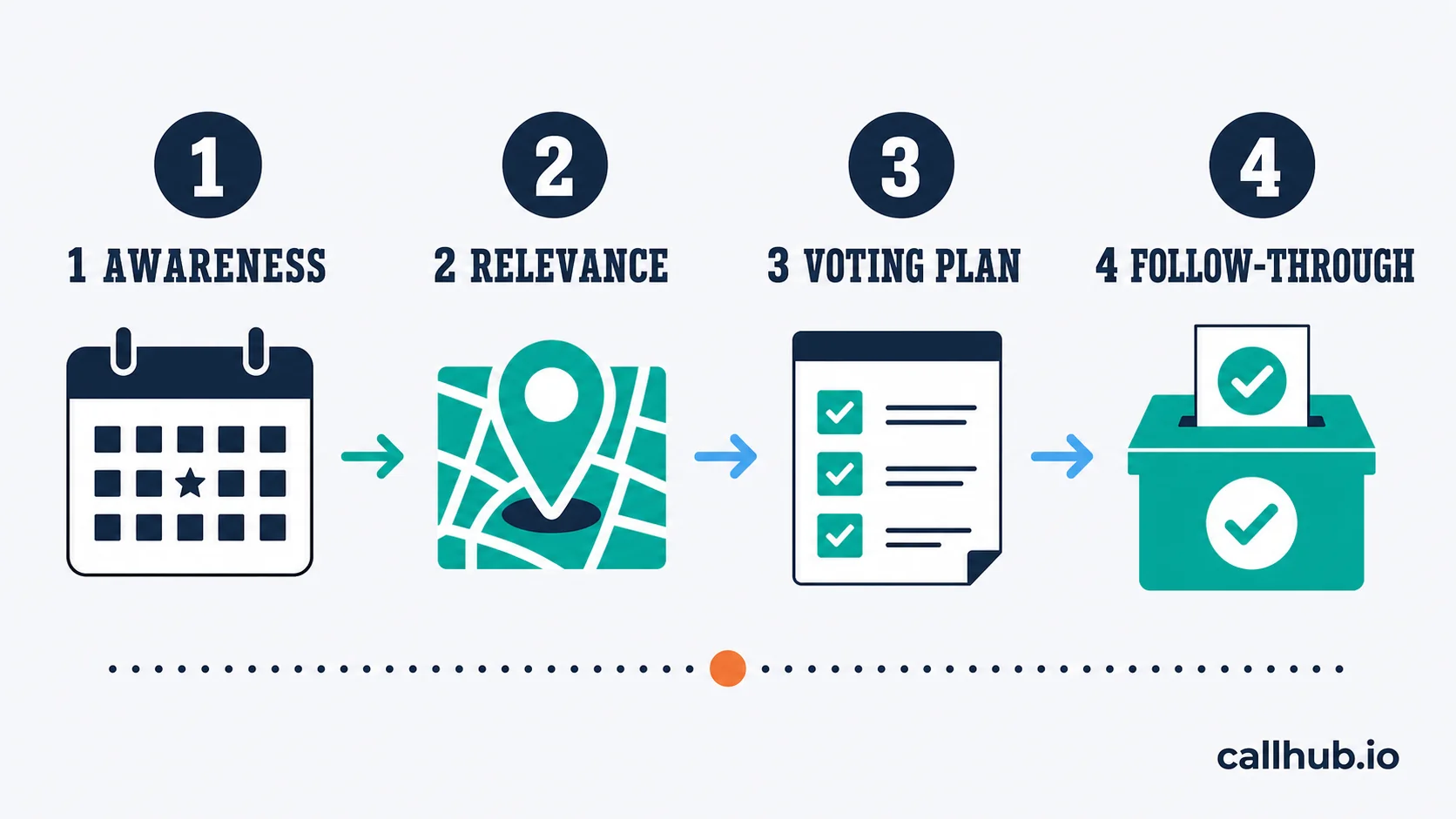
The most effective local strategy moves voters through four stages: Awareness, relevance, planning, and follow-through.
| Stage | Voter question | Campaign action |
|---|---|---|
| Awareness | What election is happening and when? | Repeat the office, date, and voting options |
| Relevance | Why should I care about this office? | Tie it to a specific local decision |
| Planning | How and when will I vote? | Confirm method, date, time, and location |
| Follow-through | What could stop me? | Resolve barriers and schedule the next contact |
Make the election visible before making the ask
Begin awareness work four to six weeks before voting ends. Use consistent language across canvassing, calls, texts, email, and community events so voters repeatedly see the same office, date, and next action.
Do not make every early contact sound like an Election Day alarm. Early messages should orient the voter. Later messages should become more specific and action-focused.
Connect the office to a specific local stake
Build messages with four parts:
- Office: Name the position being elected.
- Decision: Identify one responsibility of that office.
- Local consequence: Explain how the decision affects the voter’s community.
- Action: Ask the voter to choose a voting method or date.
Keep factual claims within the campaign’s approved guidance. Refer procedural questions to the official election authority.
Turn support into a concrete voting plan
A support ID is not a completed plan. End a productive GOTV conversation by confirming:
- Voting method.
- Planned day and approximate time.
- Voting location or ballot-return method.
- Transportation, accessibility, identification, or schedule barriers.
- Next follow-up date and responsible volunteer.
For the research behind why this single question moves turnout, see the science behind voting plans.
Use personal contact first, then add scalable reminders
Personal conversations do the best work when a voter has questions or barriers. Scalable channels help campaigns cover deadlines and follow up, but they should reinforce rather than replace real contact.
| Channel | Best use | Limitation |
|---|---|---|
| Canvassing | Personal conversation and neighborhood visibility | Contact rates and volunteer capacity vary |
| Volunteer phone banking | Broad coverage, live problem solving, outcome tracking | Unknown calls may go unanswered |
| Peer-to-peer texting | One-to-one reminders and quick replies | Requires disciplined assignment and suppression |
| Voice broadcast | Urgent factual reminders at scale | Limited depth for complex barriers |
Canvassing for high-value personal contact
In six US local-election experiments involving 18,933 voters, door-to-door canvassing increased turnout by 2.1 percentage points across the assigned group and 7.1 points among people reached. Contact rates ranged from 14% to 45%, and the Raleigh site showed no significant effect, according to the J-PAL summary of local GOTV field experiments.
Those results do not guarantee a lift. They show why campaigns must measure both assignment and successful contact, then adapt to local execution.
Volunteer phone banking for coverage and problem solving
Volunteer calls can cover voters a canvass team cannot reach and give people space to ask questions. Research summarized in CallHub’s guide to GOTV tools and tactics reports a 3.8-point turnout increase from volunteer-led phone banks, compared with less than one point from commercial phone banks.
Use a conversational script, record outcomes immediately, and route unresolved questions to trained staff.
Text and voice reminders for deadlines and logistics
After a conversation, use reminders to reinforce the plan:
- Send the agreed reminder close to the voter’s planned action.
- Include one deadline or logistical detail per message.
- Provide a route for questions.
- Stop routine reminders when reliable data shows completion.
Coordinate handoffs and suppress completed voters
CallHub can support calls, peer-to-peer texts, mass texts, and voice broadcasts in one unified outreach platform for political campaigns. Whatever system you use, every voter needs one current owner and one next action.
Suppress completed voters where reliable data permits. Return unworked contacts to a shared queue after a defined deadline. Preserve conversation outcomes so the next volunteer does not ask the voter to repeat information.
Run the final local GOTV calendar
A local campaign should start before the final weekend. Each phase narrows the universe and makes the next action more concrete, mirroring the same week-by-week structure covered in GOTV timeline: what to do and when.
Four to six weeks out: Identify and inform
- Confirm the turnout range and win number.
- Clean and segment the voter universe.
- Begin support identification.
- Make the office, stakes, election date, and voting methods visible.
- Recruit and train volunteers.
Early voting: Build and verify vote plans
- Ask supporters how and when they plan to vote.
- Resolve location, ballot, accessibility, and scheduling questions.
- Record commitments and next actions.
- Reassign unworked contacts.
- Begin suppressing reliably completed voters.
Final weekend: Resolve barriers and reassign contacts
- Prioritize supporters without complete plans.
- Escalate unresolved factual or logistical questions.
- Move stale assignments back into active queues.
- Use reminders to reinforce completed conversations.
- Review progress at the end of every shift.
Election Day: Focus on unresolved supporters
- Start with supporters whose plans are incomplete or unverified.
- Update the queue as completion data arrives.
- Match urgent barriers with trained staff.
- Keep scripts short and specific.
- Stop contacting voters once reliable completion is recorded.
The broader complete get-out-the-vote process can help teams connect this calendar to their full campaign plan.
Measure coverage, movement, and turnout
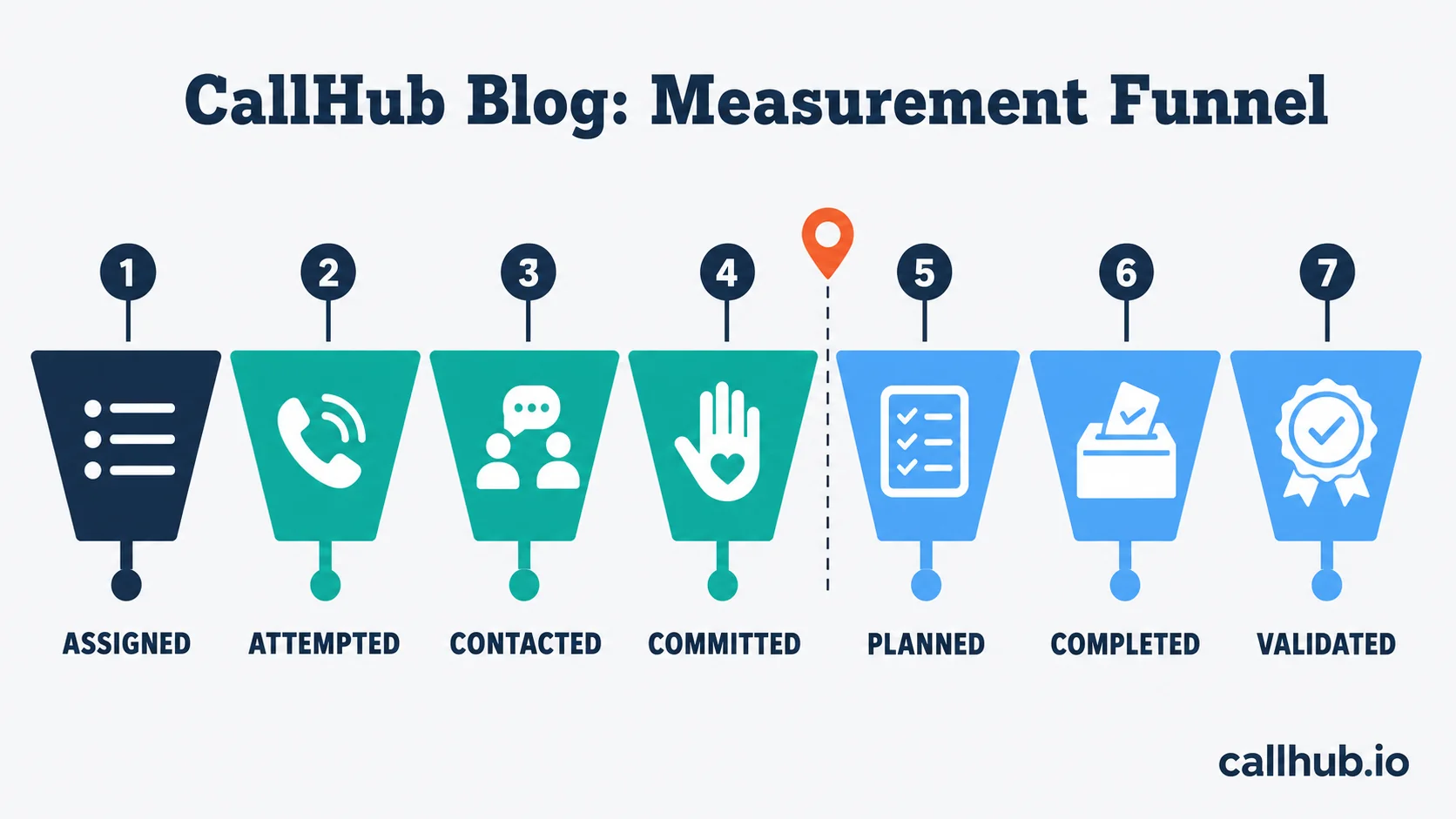
A useful dashboard separates activity from voter movement. Attempts show effort. Conversations, plans, resolved barriers, and turnout show progress.
| Funnel stage | Metric | What it proves |
|---|---|---|
| Assigned | Voters allocated to a channel or volunteer | Planned coverage |
| Attempted | Calls, doors, or messages attempted | Activity |
| Contacted | Two-way conversations completed | Actual reach |
| Committed | Supporters who intend to vote | Stated intention |
| Planned | Supporters with method, timing, and logistics | Readiness |
| Completed | Supporters reliably reported as voted | Action |
| Validated | Turnout confirmed after the election | Outcome |
Separate activity metrics from voter outcomes
Do not report attempts as contacts. The J-PAL experiments found contact rates from 14% to 45%, which explains why assigned-group effects differ from effects among reached voters.
Track contact rate by channel, shift, volunteer, precinct, and segment. A high attempt count with a low conversation rate calls for a different intervention than a high conversation rate with few completed plans.
Compare results with the right baseline
After the election:
- Compare turnout with the range built from comparable local contests.
- Compare precincts or segments only when their starting conditions are reasonably similar.
- Separate observed turnout from self-reported completion.
- Record contact, plan, and completion rates by channel.
- Preserve lessons about timing, scripts, barriers, and volunteer performance.
Turn a small electorate into a manageable field plan
Low local turnout is shaped by structural conditions, but it is not beyond a campaign’s influence. Make the election visible, connect it to local stakes, target supporters with room to move, and use personal follow-up to complete voting plans.
Local races follow the same core GOTV logic as any other race, just compressed into a smaller electorate — see the complete guide to GOTV for the full phase-by-phase system this plan is built on.
For coordinated execution, explore coordinated outreach tools for local political campaigns.
For the full workflow, see how to plan and run a focused local-election GOTV campaign.
Frequently asked questions
What is the average voter turnout in local elections?
There is no universal average that fits every local race. Municipal turnout is often below 15%, school-board turnout often falls between 5% and 10%, and one recent summary places average US local turnout around one-quarter of registered voters. Use comparable local returns with the same denominator and timing to forecast your race.
Why is voter turnout so low in local elections?
Local turnout is low because off-cycle timing, limited information, weak competition, election frequency, unequal mobilization, and voting friction reinforce one another. A campaign should separate structural causes from the barriers it can address through awareness, relevance, personal contact, and vote planning.
How can voter turnout in local elections be increased?
Campaigns can increase participation by publicizing the election early, connecting the office to a concrete local consequence, prioritizing supporters with room to move, and completing personal voting plans. Use research-backed GOTV tools and tactics to coordinate the channels.
Does election timing affect local voter turnout?
Yes. Research indicates that on-cycle November local elections generally produce substantially higher and more representative turnout than stand-alone contests. Campaigns cannot change the date mid-race, so they must compensate with earlier awareness and repeated deadline communication.
How can a school-board campaign improve turnout?
A school-board campaign should explain which decisions the board controls, use comparable school-board returns to set its vote goal, and contact identified supporters early enough to resolve practical barriers. A small electorate makes assignment, follow-up, and accurate completion tracking especially important.
What can a campaign do if it starts GOTV late?
Narrow the universe to identified supporters without verified voting plans. Prioritize live conversations, resolve urgent barriers, assign one owner per voter, and use reminders only after a plan exists. Do not spend the final hours repeatedly contacting voters who have already completed voting.