


Ever encountered one of those situations where your agents can’t find their way around a script and leave the conversation hanging?
Well, I don’t blame them. Working as an agent and having conversations with strangers can be intimidating. They have a lot of information to deliver and scrolling through long scripts doesn’t make the job any easier.
Conversations aren’t always linear, your scripts shouldn’t be either. Not all your contacts have the same opinion about an issue, or not everyone is a supporter of your campaign.
Making your scripts simpler so they can get through the conversation easily will help.
Showing them what to say at each step of the conversation not only solves the challenges of an agent but is beneficial to your campaigns too.
The solution: Branching Scripts
‘Branching Scripts’ was the most requested feature on CallHub due to the ability to solve multiple challenges posed by linear scripts.
Let’s see what they are and how Branching Scripts solve them.
Key Takeaways
Branching scripts let agents navigate calls dynamically by following a conversation’s actual twists rather than reading down a fixed, linear script.
Challenges with linear scripts
- Linear scripts reduce engagement because agents must scroll to find answers while the contact is left waiting on the line.
- Linear scripts make navigation difficult since there is no defined way to branch a conversation to match each contact’s specific query.
- Linear scripts raise the risk of miscommunication when agents lack immediate access to the right answer, which can damage brand reputation.
Benefits of branching scripts
- Branching scripts populate the screen with questions and answers based on a contact’s response, and CallHub lets agents preview the script before getting on calls.
- Branching scripts let agents sound natural and engage contacts by covering the full flow of a conversation across multiple branches instead of forcing a rigid, fixed path.
- Branching scripts show agents only the questions relevant to a given contact’s stated concerns, helping them complete more surveys in less time and gather more data.
- Branching scripts boost agent productivity by eliminating the need to scroll through long scripts, keeping agents’ full focus on the call.
- Branching scripts cut training time because the script itself guides agents through conversations, and they enable faster resolution by preparing agents to address every possible scenario.
CallHub’s branching script features
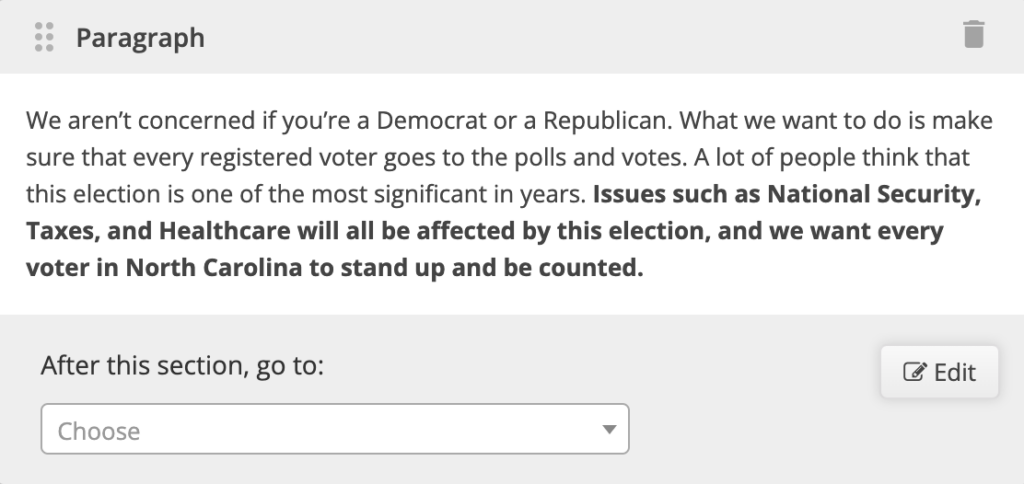
- CallHub lets campaign managers bold key information agents must convey and use italics to add instructions within the script.
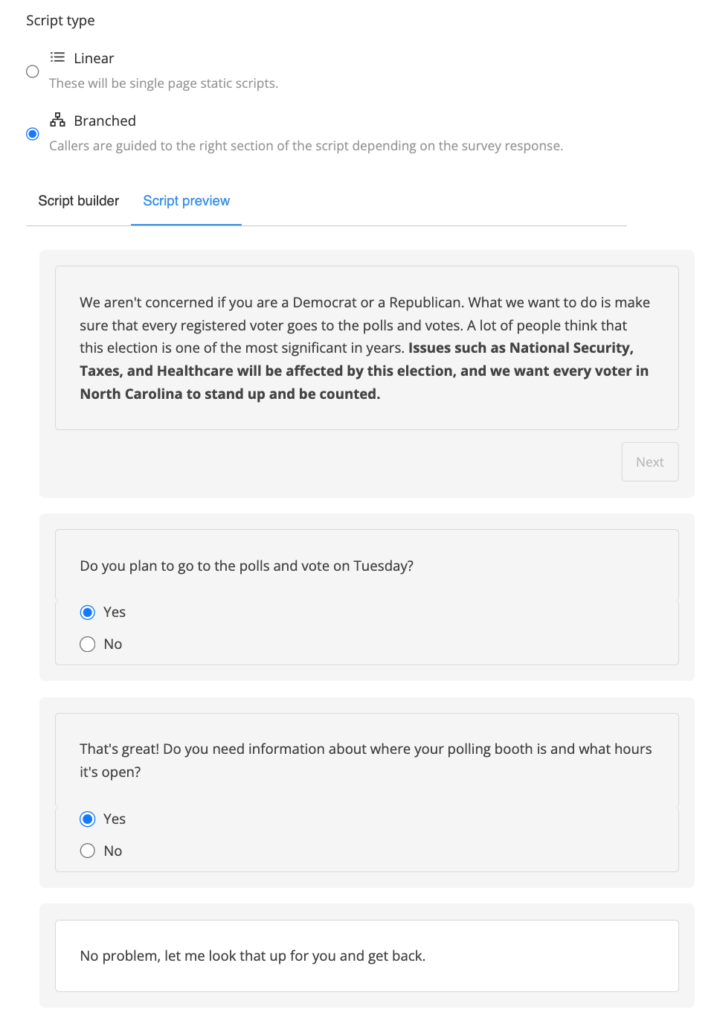
- CallHub allows managers to preview the script while building it, reducing the risk of errors in complex branching conversations.
Challenges with linear scripts
Engaging conversations.
Relevant data collection.
Automating the repetitive tasks for agents.
These are all the expectations of every calling campaign. While linear scripts help you meet these expectations for simple conversations, they fall behind in doing so for complex ones.
- Less engagement: When your agents scroll through the scripts to find the answer to one question, your contact is kept waiting.
- Difficult navigation: Your script may be customized to solve each of your contacts’ queries, but with no right way to define the branches a conversation can take, navigating through a complex script is challenging.
- Higher chances of miscommunication: When your agents don’t have immediate access to the answer to a question, there are chances that they’ll give incorrect answers, leading to a poor brand reputation.
Now let’s see how ‘Branching Scripts’ solves these issues.
What are branching scripts and why are they important?
Your scripts need to keep evolving alongside the conversation.
A branching script helps agents say exactly what they need to at every step of the conversation. It acts as a real-time guide to your agents throughout each call.
It populates the screen with specific questions and answers, based on your contacts’ responses.
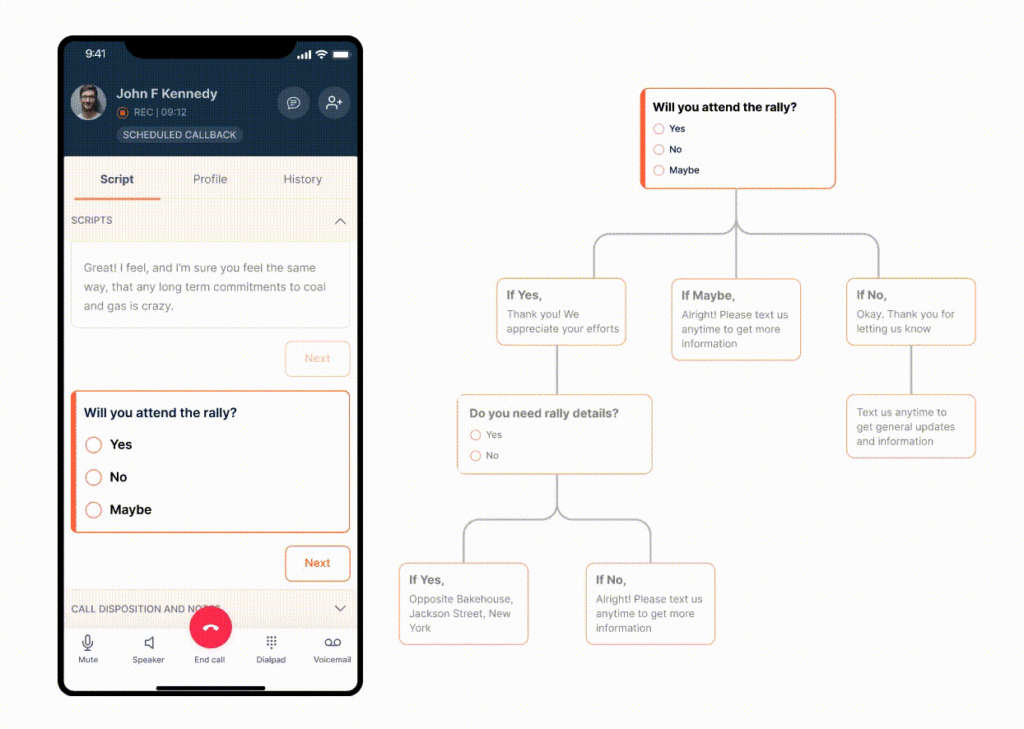
Branching Scripts comes with multiple benefits on both campaign managers’ and agents’ sides.
1. Give the right answers
Not all your agents have years of experience, and even if they do, sometimes complex conversations can still be intimidating. A branching script ensures they don’t face such a situation.
Your campaigns, most importantly, must give your audience the answers they need, so they consider your ask. For that, your script cannot be static and should evolve with your audience’s questions.
Branching Scripts allows you to define questions and responses depending on your contact’s reply. These branches guide your agents through even the most complex conversations.
CallHub’s Branching Scripts feature also lets agents preview the script before they get on calls. With visibility into the flow of the calls, your agents will be prepared for a predetermined outcome.
2. Engage with your audience
Once your contacts answer your calls and hear a live agent on the other end, the least they expect is to have a natural conversation. Rigid, fixed scripts with little to no room for flexibility don’t help.
A branched script lets you address the complete flow of the conversation with multiple branches, helping your agents sound natural, and thus engage with your audience.
3. Complete more surveys
When you have long scripts for conducting surveys that have questions one below the other, it’s difficult for your agents to keep track. They will either lose interest and stop the survey midway or end up making a mistake.
More importantly, say, you have a set of issues your audience cares about. If contact A cares about issue 1, your agents need only the part of a script that talks about facts, events, and asks around issue 1. Similarly, when contact B cares about issue 2, it’s a whole different scenario.
Branching scripts help your agents see only the relevant questions at every stage through an easily navigable script. This helps them complete more surveys in less time and therefore gather more data for your future campaigns.
4. Improve agent productivity
Your agents will know exactly what to say at each step of the conversation. This avoids the mishandling of conversations and keeps them going smoothly. This real-time guidance through the scripts helps your agents efficiently handle calls and prevents them from going off-track.
Since they don’t have to spend time scrolling through scripts, their complete focus stays on calls, making them more productive.
5. Reduced training efforts
Campaigns have an ongoing need for training agents. Branching Scripts offers organizations a means to guide agents through the conversations without even being there.
Since your script acts as a guide, they won’t have to spend much time in training.
6. Faster resolution
With the ability to address every possible scenario, agents will be able to answer your contacts’ queries quickly. This results in a better experience for your audience, getting them interested in your campaign.
Branching Scripts features
CallHub’s Branching Scripts feature, in addition to offering the benefits mentioned above, provides the following features.
1. Highlight important information within a script
Let your agents know the most important information to deliver in a conversation. Bold the parts which are important to convey and use Italics to add instructions for your agents.
2. Preview the script while building it
You may think that with having complex conversation comes the risk of making errors.
You’re right, but not with CallHub.
You will be able to preview the script while you’re building it, helping you to fix any missed branches and points right away.
3. Import events and surveys
With integrations to CRMs such as NationBuilder, NGP VAN, Salesforce, and more, you will be able to import events and surveys and share data bidirectionally.
Note: The linear and branching scripts report on call center survey data the same way, so regardless of the type of script you use, reporting will not be affected.
Key steps to developing a branched script
- Map out the primary elements of the interaction depending on the type of your campaign. For instance, for a fundraising campaign, this will involve addressing the following stages:
- Greeting and introducing yourself
- Explaining the problem and the cause
- Solutions to the problem
- How your campaign implements those solutions
- Making the ask
- Objection handling
- Setting up a follow-up as applicable
- Thanking the contact
- Draw out the decision points and the branches the conversation can take at each of those decision points.
- Keep reviewing your script while building it to make sure your logic is sound.
- Save time by duplicating a campaign to reuse the script in other campaigns.
Using a branched script on CallHub
Here’s a complete tutorial on using Branching Scripts on CallHub. The video takes you through every possible scenario your scripts may have and how to best use Branching Scripts so your conversations go smoothly.
If you need more help understanding Branching Scripts, book a call with our experts.
FAQs: Branching scripts
1. What is an example of a branching strategy?
A branching strategy is a planned approach where each possible response leads to a different path or outcome. For example, in a customer service call, if a customer says they are unhappy with a product, the script branches to troubleshooting steps. If the customer is satisfied, the script moves to a closing statement or a new offer.
2. What are branching scenarios?
Branching scenarios are interactive situations used in training or scripts where each choice or response leads to a different outcome. They simulate real-life decision-making by presenting users with options, and each option takes the conversation or lesson in a new direction, helping users practice handling various situations.
3. Can branching scripts reduce agent training time?
Yes. Real-time guidance means new agents learn faster, reducing onboarding and training time.
4. How do I start using branching scripts on CallHub?
Map your campaign’s key points, build branches in CallHub’s script builder, preview, and test. For help, watch the tutorial or contact CallHub.