


Table of Contents
In 2008, Obama debuted the campaign slogan “Yes We Can” to great effect. From the adoring crowds chanting it at rallies, it was clear that among the best election campaign messages from that election cycle.
Why was it so effective?
The slogan appealed to personal responsibility. It asked supporters to stop waiting for change to happen and instead be proponents of it. It served as inspiration for people to get involved in the campaign and make a difference. And it was uniquely suited to his base. So political marketing at its finest.
That’s not to say that a similar campaign message wouldn’t work for you. But finding the best election campaign messages involves getting the measure of your audience and finding what would work for them.
So, what are political campaign messages?
The decision-making process of a voter is tied to their perception and desires. It is often not a logical path of judgment about who is the right person but rather guided by their impression of a candidate. Naturally, your campaign has to use that to create a candidate profile that appeals to voters.
This is done through the use of voter communication material like speeches, literature, mail and texts addressed to the voter. All these election campaign communication methods have to stick to a single message. Keeping every one of those channels anchored to that single idea is what political messaging, as a discipline, really amounts to. It’s the message which contains your candidate’s ideas and is to be shared with your voters.
Key Takeaways
Political campaign messages are the core statement of a candidate’s ideas, built to appeal to voters’ perceptions and values rather than win them over through objective candidate comparisons.
Why Messages Work
- Obama’s 2008 “Yes We Can” slogan succeeded because it appealed to personal responsibility, inspired supporters to drive change themselves, and matched the specific concerns of his base.
- Effective messages tie policy issues to core human values and needs: security from crime, terrorism and environmental threats, living standards and healthcare, financial safety like job security and retirement, morality and leadership integrity, and prospects for the next generation.
- Voters do not objectively compare candidates on merit, so campaigns must show shared values, relevant issue focus, and qualifying experience or ideology instead.
- Incumbents running for re-election need to shift messaging toward highlighting prior-term progress and the case for sustaining that momentum.
Developing the Message
- Campaigns should mine census data, past voter records, and prior candidates’ voter lists to map demographic makeup such as age, gender, occupation, race, home-ownership, party registration and voting history, then build an ideal-voter persona from it.
- Identifying target voters’ issues and interests requires direct conversations at meetings or benchmark polling, then cross-referencing those results with demographic data to find aligned interests.
- Messaging must tell voters what the candidate will do for them rather than just inform them, since persuading voters matters more than educating them when it comes to grabbing attention.
- Campaigns need to draw contrasts with opponents by weighing virtues and flaws like experience, integrity, compassion and stability, ideology and political alignment, and positioning on change versus status quo.
Testing the Message
- Campaigns should test their messaging early using both qualitative and quantitative methods, including opinion polls that provide hard numbers on how the messaging is performing.
What makes a good political campaign message?

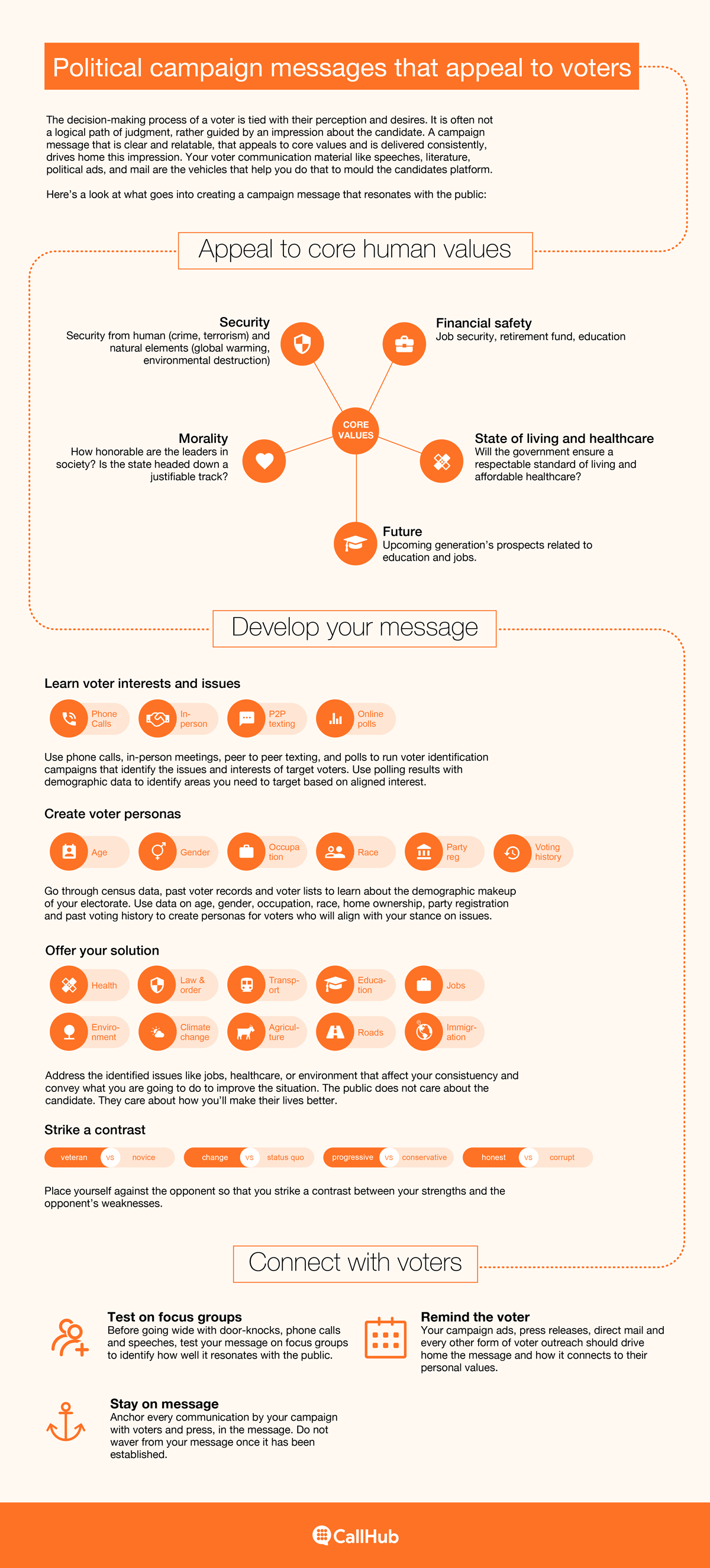
Political campaign messages have always reflected the times. The way to create a political campaign message that plays into the voter’s perceptions and helps them choose your candidate is to make it relevant and appealing to their core human values and needs. Those values and needs are:
- Security from human (crime, terrorism) and natural elements (global warming, environmental destruction)
- State of living and healthcare
- Financial safety – Job security, retirement fund, and education costs
- Morality – How honorable are the leaders in society? Is the state headed down a justifiable track?
- Upcoming generation’s prospects related to education and jobs
Sure, you want to discuss a specific policy change or an issue affecting the community. However, you have to tie the issue to the human values it triggers.
This way, you draw the voter’s attention by showing that you care about the same things that they do.
The campaign message is not just about stating why the candidate is better than the opponent. The voter does not objectively compare candidates to choose whom to vote for. Instead, you have to show that you share their values, want to address issues that affect them, and are qualified to do so through experience and ideology. It is worth separating the messages political candidates send directly to voters – a text, a doorstep pitch, a line in a stump speech – from the party or committee messaging running alongside them: the candidate-level message has to make a personal case for one named individual, while the party-level message only has to carry a platform.
If running for re-election, you will need to shift your messaging to highlight the progress made in the previous term and the need to sustain that momentum.

Read Next: Our Complete A-Z Guide To Boost Your Electioneering Efforts
How do you develop a political campaign message?
Now that you understand what a political campaign message should incorporate, you are ready to develop the best election campaign messages for your next campaign.
Let’s go through the initial steps to figuring out the messaging suitable for the supporters you aim to draw in:
Learn the demographic majority
Go through census data, past voter records, and voter lists of previous candidates.
From the compiled data, you have to learn what you can about the demographic makeup of your electorate, including age, gender, occupation, race, home-ownership, party registration, and past voting history.
Based on this, create a persona of the ideal voter who aligns with your stance on the issues.
Learn their issues and interests
You have to figure out the issues and interests of the average target voter. If you don’t already have an idea of what issues matter to your voters, this could take a while.
Place yourself among the voters in meetings and talk with them directly. Alternatively, you could conduct a benchmark poll to discover what these voters care about. The poll results and the demographic data together would show you the areas you need to target based on aligned interest.
Tell them what you would do

The messaging should address what you are going to do to bring about positive change as it relates to voters.
It has to persuade the voter, not just educate them with new information. The voter cares less about you than what you are going to do for them. If the message does not tell them that, it will fail to grab their attention.
Draw contrasts with the opponent

Finally, remember that the race is against your opponent, who would be pushing their own message at the same voter. So you need to place yourself against the opponent in such a way that makes you the obvious choice.
The campaign message has to position your strengths against the opponent’s weaknesses.
Take these points into account when doing so:
- The candidate’s virtues and flaws, including experience, integrity, compassion, and stability
- Ideology and political alignment
- The current condition and philosophy, like change vs status quo, reform vs old principles, etc.
Through all of this, you can decide on a campaign message that is perfect to address your ideal voter.
Having the best election campaign messages might not assure you a win. But political campaign messages are what you offer the voter to position your candidacy. It is the reason that you present to choose you over the opponent. Consult with the right people and choose a message that makes the decision-making process easier for the voter. That way, you can win over more supporters and be on your way to a win.
Test your messaging
It’s a good idea to make sure your messaging works in the early stages of your campaign.
You can do that through qualitative and quantitative testing.
You can conduct quantitative tests through opinion polls to find the hard numbers on how your messaging is doing. One great way to do that among your supporters is through political phone surveys, to understand supporter behavior around specific issues.
Another way to do it is by sending out peer-to-peer text messages with quick polls to supporters.
| “What did you think of the Senator’s performance at last night’s debate? Respond with Yay or Nay to let us know.“ |
By recording these responses on your CRM software, you can get a quantitative view of the effectiveness of your messaging.
Try out text messages for polling today with CallHub.
Qualitative testing is as simple as judging the reaction of a crowd at a rally when you debut a message, or asking them questions after a town hall.
It involves taking a step further in finding out what drives supporters towards a message and asking them more specific questions.
Stay on the message
The best election campaign messages ensure voters have a clear idea of the core message of the campaign. Your campaign communication strategy is all about steering important discussions toward the message. Every communication your campaign has with a voter has to anchor in the message.
The way to get voters to instantly recognize your message and associate it with your candidate is by constantly reminding them what it is.
Voters will forget what a candidate says in a speech. They will not recall specific policies or the candidate’s background and the way they all tie together. They will, however, remember how you made them feel.
Read Next: 11 Top Features of a Political Texting Tool (+ Election Campaign SMS Message Templates)
Stay on your voters’ minds
Your campaign ads, press releases, mail, and text messages that you send directly to the voters should remind them of the campaign message and how it connects to their personal values.
Over time, they would build an instinctive connection with the candidate because they share similar beliefs. That way, the voters would accept the candidate as the right person to tackle their problems.
One way of doing it is to have a catchy slogan to sum it up. Slogans are short and stick in the mind. It is also vital that the slogan you go with clearly implies the core message of the campaign. An average voter should understand what the message is about at a glance.
Just as important as the message itself is the way you deliver it.
Get your message out
It’s safe to say that even excellent campaign messaging that resonates with people won’t help you if you can’t deliver it to them.
- Older voters respond to more traditional campaign messaging, like TV and radio ads or posters and billboards.
- For minority demographics, reaching them through their religious communities or unions is a good option.
- Younger voters tend to notice communications via channels like text messaging and social media.
In 2012, one of the most impressive aspects of Obama’s re-election campaign was the way his team managed to vary and deliver his political campaign slogans across various channels.
His campaign’s use of social media and text messaging connected with voters, old and young, and got them to the polls.
Here are some ways your campaign can use text messages to communicate with supporters. You can also have a look at some sample political canvassing scripts.
Political campaign text message samples
The greatest advantages of political text messages are that they are immediate, personalized, unintrusive, and flexible. Let’s see some of the most common political message examples:
Fundraising text messages
Reach out to your supporters, or the right person, in your time of need with fundraising text messages. Below is the campaign message example:
| Mark, for a grassroots campaign like mine, every dollar donated goes a long way. If you like my ideas and policies, please consider donating at: bit.ly/f34g76 |
You May Also Like: A Quick Guide On How To Raise Money For A Campaign
Campaign announcement text messages
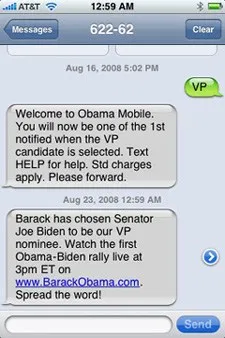
Famously used by Obama to announce his VP pick in 2008, you can send out important campaign news to supporters who opt-in to your text messages.
| Congressman Saunders will be on BNN tonight at 9 PM to talk about his new bill. Catch him live! |
GOTV Text messages
A text message can be a great way to remind supporters to show up at the polls.
| Hi Adam. Polling closes in an hour at 94 Brindley Road, Northville, FR. Click the link to catch a ride there. bit.ly/65h68j |
Political polling messages
Get quick reactions from supporters after a live broadcast through text messaging.
| Senator Johnson demonstrated the need for strong health care reform on tonight’s debate. Text YES if you agree and NO if you disagree. |
Thank you text messages
Your job doesn’t end with political campaign slogans. Send supporters a quick thank you after a donation or after voting ends.
| Dear Joe, your generous donation takes us a significant step towards achieving our goals. Thank you. |
So, there you have it- some common sample political campaign text messages.
Positive messaging: why an encouraging voting message outperforms attack framing
Drawing contrasts with an opponent is one register, but it is not the only one available to you. A positive voting message asks people to act out of belief rather than fear: it tells them their vote counts, that the people around them are turning out, and that showing up is simply the normal thing to do. Contrast messaging is built to change a voter’s mind about someone else; a positive voting message is built to change what that voter actually does on election day.
The two do different jobs, so pick your framing based on the action you need from the voter:
- Contrast or negative framing works best with people who already intend to vote, where your only task is to make the choice between two names obvious.
- Positive framing works best when the ask is turnout itself – registering, requesting a mail ballot, finding a polling place, or getting out the door on the day.
- Encouragement beats urgency everywhere except the closing hours. Deadline pressure is a finishing tool; used too early, it reads as nagging to exactly the low-propensity voters you most need to reach.
Here are two positive voting messages of the kind supporters actually receive:
| Hi Dana, neighbours across Northville are heading to the polls today, and your vote is part of that. Your polling place at 94 Brindley Road is open until 8 PM – we would love to see you there. Need a ride? bit.ly/65h68j |
| Thanks for voting early, Sam. You just made it easier for the people around you to do the same – pass this on to one friend who has not voted yet: bit.ly/65h68j |
Set those against the urgency-led GOTV reminder further up this page, the one that leads with polls closing in an hour. Both are legitimate, but they belong at different moments: encouragement carries the long stretch of the campaign and the early-vote window, while urgency is held back for the final hours when the deadline is the only remaining argument.
A quick test before you send: if the message would still make sense to someone who already supports your candidate and simply has not voted yet, it is doing positive work. If it only lands with someone who dislikes your opponent, it is contrast work – useful, but it will not raise turnout on its own.
Sending political campaign messages with texts on CallHub
Now that you have understood how to craft the best election campaign messages, you can move on sending them out to people. Sending out political campaign texts to your supporters is simple. The first thing you need to do is getting supporters to subscribe to your SMS system through an opt-in keyword:
1. Set up a Keyword and Shortcode
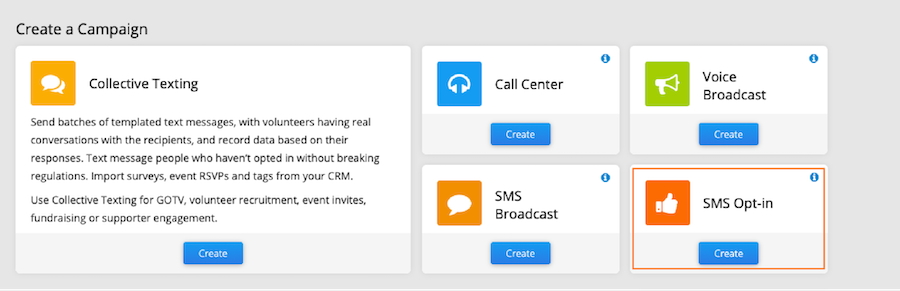
Choose the SMS Opt-in campaign on the CallHub dashboard.
To set a text alert system for your campaign, you need to have just two elements:
- A keyword
- A shortcode or long code (to act as Caller Id)

For example, ‘Text “VP” to 33339 for election updates and reminders.’
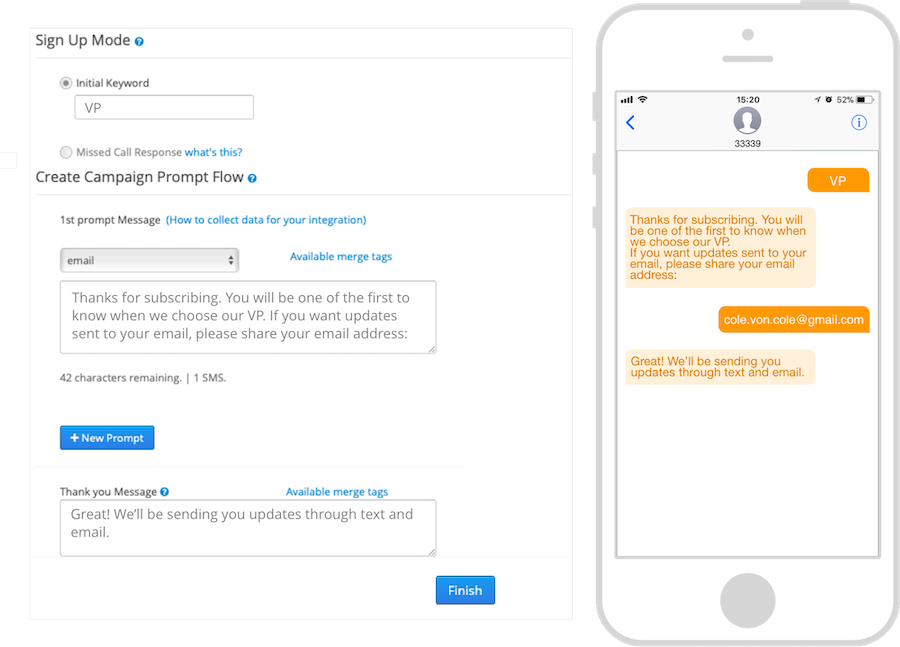
Here, the keyword is “VP,” and the number is “33339”.
You can set a keyword of your choice while setting up your campaign’s SMS system and rent a shortcode or long code from your text messaging service. If not, you can use a cell phone number as the caller ID.
Once you finish setting it up, go ahead and promote your keyword and shortcode. When people text in your keyword to the number, they will automatically be added to your database.
2. Let supporters know about your keyword and shortcode
Let supporters know about the SMS system, advertising it wherever you can:
- Ask your candidate to promote it during a rally or a debate.
- Promote your shortcode and keyword on social media and through ads.
- Send it out in your email communications with supporters.
Now you’re all set to start sending updates straight to supporter’s mobile phones
3. Send your first message
You can send messages through the SMS broadcast campaign on the dashboard.
Type out the message you want to send, for example, asking supporters to donate:
| “Mark, for a grassroots campaign like mine, every dollar donated goes a long way. If you like my ideas and policies, please consider donating at: bit.ly/f34g76.” |
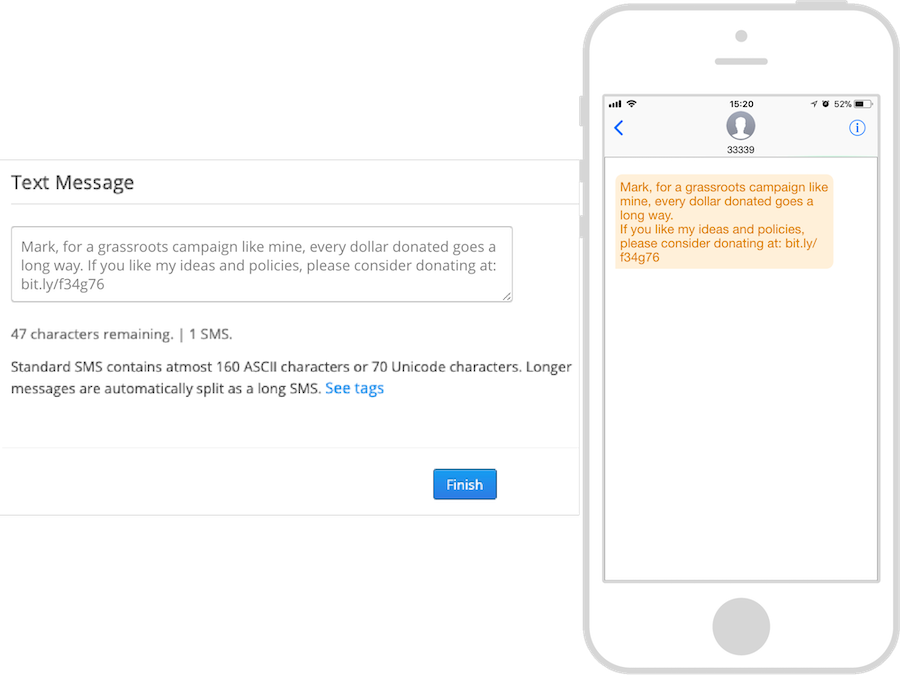
Choose the list with the numbers of the supporters to whom you want to send the message.
Now schedule a time you want the message to go out and hit DONE.
Sending out a group text to your supporters is as simple as that.
Political campaign texting is a powerful way to distribute your political campaign message. Know how you can scale them up with the right use cases. 8 Ways To Use Texts And Calls In Your Next Election Campaign.