


Table of Contents
You’ve built your list, hired your field team, and locked in your message. Now comes the part that decides whether any of that work pays off: Get out the vote. Most campaigns and causes are not lost because the other side out-argued them. They are lost because too many supporters who already agreed never made it to the polls.
This guide is the operating manual for that final, decisive stretch. It walks through every phase of a GOTV program: Building your voter universe, running each contact channel, training volunteers, managing election day, and measuring what worked once the votes are counted. Each section links to a deeper, practitioner-level guide on that specific piece, so you can go as deep as you need without losing the full picture.
Whether you’re running a statewide campaign, a union mobilization drive, or a first-time nonprofit voter program, the phases below are the same. Only the scale changes.
Key Takeaways
This guide lays out the full operating sequence for get-out-the-vote work, from building a target universe through measuring turnout lift after the election.
What GOTV Is and Why It Matters
- GOTV covers building a target list and then calling, texting, and knocking on doors in the final weeks before an election to turn supporters who already agree into people who actually vote.
- Persuasion work tries to change a mind, while GOTV tries to move someone from intends to vote to voted.
- The Analyst Institute and Yale’s Institution for Social and Policy Studies have run two decades of randomized field experiments showing that direct personal contact, not mailers, is what moves already-leaning supporters into actually voting.
- A typical GOTV program builds and segments a voter universe, runs phone, text, canvassing, email, and event outreach in sequence, trains volunteers for the shorter high-pressure GOTV conversation, tracks contact status in real time, and measures turnout lift by channel once votes are counted.
- GOTV is a narrower, time-boxed push in the days and weeks before an election, distinct from the broader ongoing category of voter mobilization.
Understanding and Targeting Turnout
- Turnout is measured differently by jurisdiction, against either registered voters or the voting-eligible population, so campaigns need to confirm which denominator their target race uses before setting a goal.
- GOTV universes split into four categories: strong supporters who need only a reminder and a plan, soft supporters where GOTV work earns the most votes per hour, persuadable voters who are only worth a GOTV push after they lean your way, and opposition supporters who should never be contacted for GOTV.
- Pew Research Center post-election analyses show persistent turnout gaps by age and by first-time versus repeat voter status that do not close on their own between cycles.
- A universe built only from past voter file history will under-target the demographic groups that turn out least reliably, even though those are the groups a well-timed GOTV push moves the most.
- Voter apathy is the one turnout factor fully in a campaign’s control, since apathetic voters usually have an opinion but lack a reason to believe their vote in that specific race matters, which is the gap GOTV closes.
Building the Plan
- A GOTV program rests on five moving parts: the plan itself, the voter universe, the timeline, the channel mix, and the team running it, and getting the first three wrong undermines every channel used afterward.
- Before picking any contact channel, campaigns need to decide who they are targeting, what specific action they want from that person, and how they will know the effort worked.
What is GOTV, and why does it decide elections?
Get out the vote (GOTV) is the set of tactics campaigns, nonprofits, unions, and advocacy groups use to turn supporters who already agree with them into people who actually cast a ballot. It covers everything from building a target list to calling, texting, and knocking on doors in the final weeks before an election.
For what GOTV means in full, including how it differs from persuasion work, see our dedicated explainer. The short version: Persuasion tries to change a mind. GOTV tries to move someone from “intends to vote” to “voted.”
Turnout work is not optional polish on top of a campaign plan. The Analyst Institute and Yale’s Institution for Social and Policy Studies (ISPS) have spent two decades running randomized field experiments on which contact methods actually increase turnout. Their consistent finding: Direct, personal contact (a real conversation, not a mailer) moves people who already lean toward voting into actually voting.
The practical implication matters more than the research itself. A campaign that spends its final six weeks trying to flip undecided voters is fighting the wrong battle. Most of the movable universe in that window isn’t undecided at all. It’s supporters who already agree but won’t vote without a specific nudge: A call, a text, a knock, a plan.
A GOTV program typically includes:
- Building and segmenting a voter universe from your existing supporter list
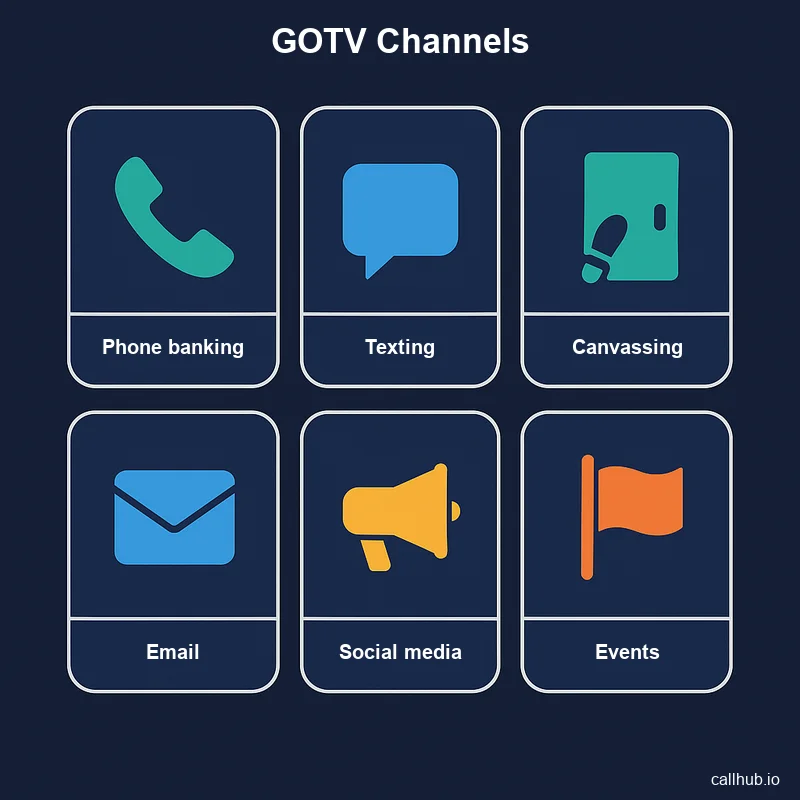
- Running phone, text, canvassing, email, and event outreach in a coordinated sequence
- Training volunteers specifically for the shorter, higher-pressure GOTV conversation
- Tracking who has been reached and who still needs contact, in real time
- Measuring turnout lift by channel once the election is over
If you want the research on whether GOTV works laid out study by study, we break down that research in detail.
GOTV is often used as a synonym for voter mobilization, though the two are not identical. What voter mobilization means is the broader category: Any effort to get supporters civically active. GOTV is the specific, time-boxed push in the days and weeks before an election.
Understanding voter turnout
Before you build a GOTV plan, you need a shared definition of the thing you’re trying to move.
How voter turnout is defined and measured varies by jurisdiction. Some report it against registered voters, others against the voting-eligible population. Know which denominator your target race uses before you set a goal.
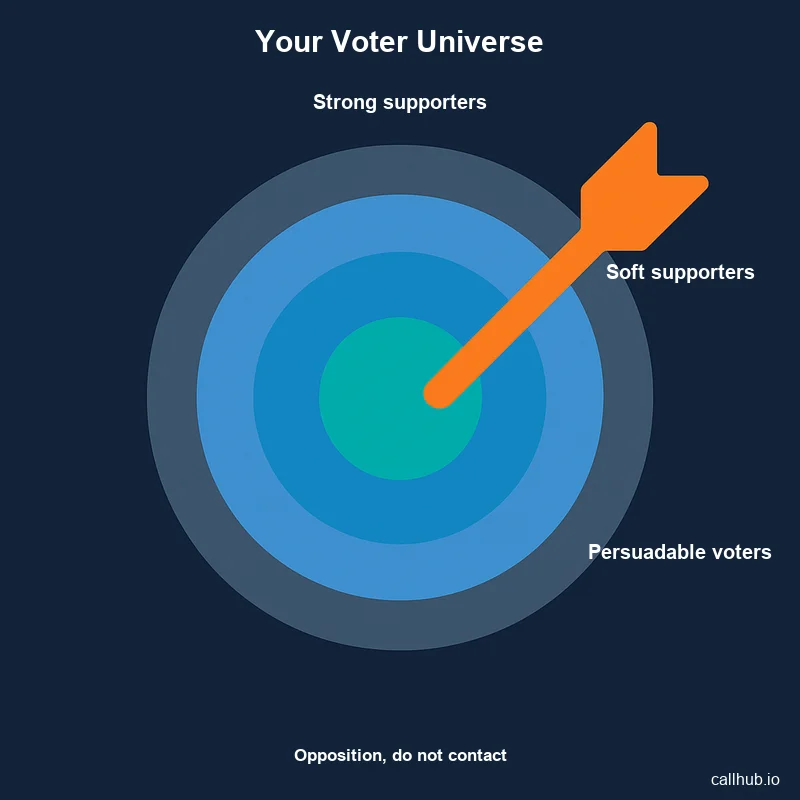
Every GOTV universe breaks down into four rough categories, and knowing which one you’re targeting changes both your message and your channel choice:
- Strong supporters: Already committed, high likelihood to vote without help. Lowest priority for persuasion, highest priority for a reminder and a plan.
- Soft supporters: Supportive but uncertain to turn out. This is where GOTV work earns the most votes per hour spent.
- Persuadable voters: Not yet committed. Worth a GOTV push only after they’ve moved toward your side, not before.
- Opposition supporters: Do not contact for GOTV. Turning out people who oppose you is the fastest way to lose ground you already had.
Turnout also varies sharply by demographic group, and that variation should shape where you spend limited GOTV hours. Pew Research Center post-election turnout analyses consistently show large, persistent gaps by age and by first-time versus repeat voter status, gaps that don’t close on their own between cycles. A universe built only from past voter file history will systematically under-target the groups that turn out least reliably, which is exactly the group a well-timed GOTV push moves the most.
Turnout does not move on its own from there. The factors that affect voter turnout range from weather and election-day access to how many contacts a voter received, and from whom. Some of these you can influence. Others you can only plan around.
One factor is squarely in your control: Apathy. Voter apathy and how GOTV overcomes it comes down to a simple mechanism. Apathetic voters rarely lack an opinion. They lack a reason to believe their vote in this specific race matters enough to act on.
That is exactly the gap GOTV closes. Strategies to increase voter turnout walks through the tactics that close it fastest, from voting plans to social pressure messaging.
Building your GOTV plan and timeline
A GOTV program has five moving parts: The plan itself, the voter universe, the timeline, the channel mix, and the team running it. Get the first three wrong and the channels below won’t save you.
Build your GOTV plan first
Before you pick a single channel, decide three things: Who you’re targeting, what specific action you want from them, and how you’ll know it worked. Skip any of the three and you’ll end up running tactics that feel productive without actually moving turnout. How to build a GOTV plan walks a campaign manager through that sequence, tool by tool.
Build your voter universe
Your universe is the list of people worth contacting, not everyone in your district, just the supporters and persuadable voters whose turnout actually changes the outcome. It comes from your voter file or CRM, filtered and segmented long before your first GOTV call goes out. Building your GOTV voter universe shows how to size and segment that list before you spend a single volunteer hour on it.
Work the GOTV timeline
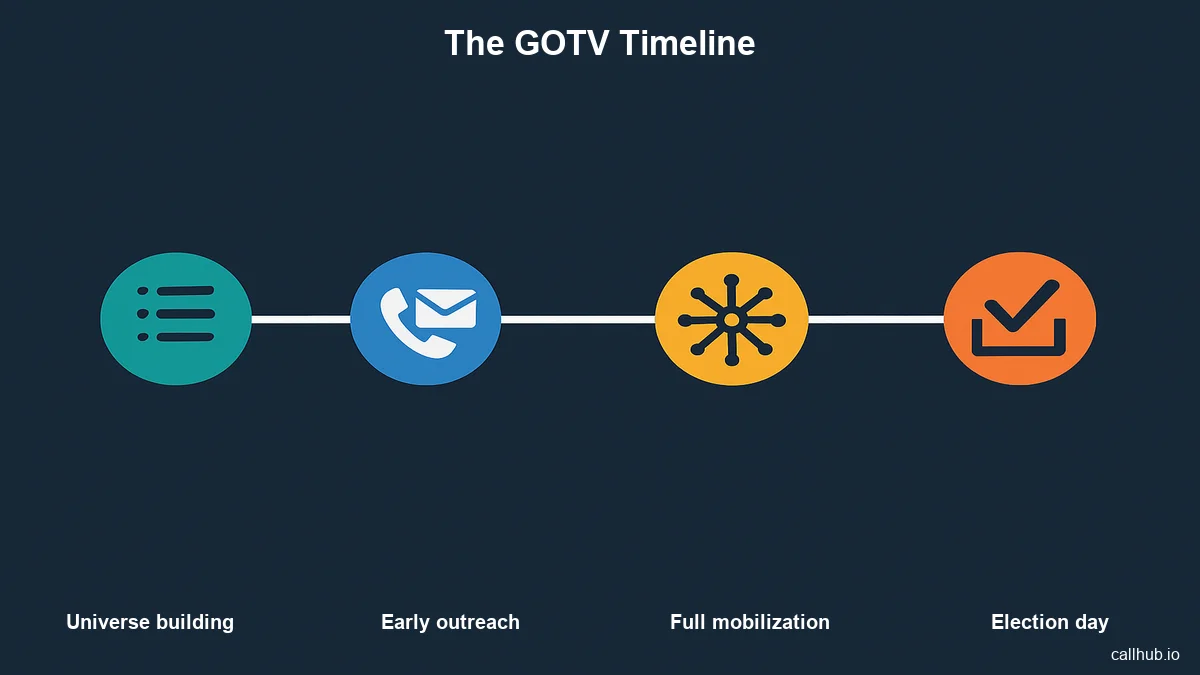
GOTV is not a single push in the final 72 hours. It’s a sequence that starts weeks earlier: Universe building first, then early outreach, then full-volume mobilization, then the final 72-hour close. Skipping ahead to the high-volume phase without doing the earlier work means your volunteers spend the critical final days reaching people who were never going to vote for you in the first place. A complete GOTV timeline maps what to do at each stage, from early voter ID through election night.
Running GOTV with a small team or budget
Most GOTV advice assumes a paid field team and a six-figure budget. Most programs have neither. The instinct is to run every channel at reduced volume, which spreads a small team too thin to do any one thing well. GOTV for small campaigns and limited budgets covers what to cut and what to protect when resources are tight, usually canvassing first and phone or text last, since those two channels cost the least per voter reached.
What to do if you’re starting late
If you’re reading this two weeks out with no plan in place, you still have options, just fewer of them. The highest-yield move at that point is almost always phone and text to your existing supporter list, since both can be stood up in days, not weeks. An emergency GOTV plan prioritizes the highest-yield tactics when time is the scarce resource.
The GOTV channels: Reaching every voter
Once your plan, universe, and timeline are set, the work becomes channel execution. Here’s how each one fits into a coordinated program.
Phone banking
Phone banking remains the highest-volume way to have an actual conversation with a voter in a short window. GOTV phone banking covers call timing, script structure, and how to keep volunteers making calls instead of looking up numbers.
A Predictive Dialer or Power Dialer removes that lookup time entirely by connecting volunteers only to answered calls, which matters most in the final week when every volunteer hour on the phone counts. Scripts matter more in the final stretch than at any other point in a campaign, because volunteers are often newer and the message needs to be tight. GOTV phone banking scripts gives you templates for the closing push specifically, not general persuasion scripts repurposed for turnout.
Branching scripts, ones that adapt based on how a voter responds, cut down on volunteer confusion during high-pressure GOTV shifts. As Kayla Lawrence-White, Community Relations and Program Design Office at New York Cares, puts it: “Branching scripts help deter the volunteers from being confused. It leaves no room for them to decide the information.”
Texting
Text messaging works differently from a call. Voters read it on their own time, and it supports two-way troubleshooting that a phone bank can’t easily replicate at scale. GOTV text messaging strategy covers cadence, message length, and when texting outperforms a call.
Most programs run two kinds of texting during GOTV: A one-way Text Broadcasting send for reminders and logistics, and peer-to-peer texting for anything that needs a real answer. That includes questions like where a voter’s polling place is or whether they can still register. Peer-to-peer texting, where a real volunteer sends and answers each message rather than a script broadcasting to thousands at once, is what makes that two-way troubleshooting possible.
Eli Zbar, Communications Strategist on the Dianne Watts BC Liberal Party Leadership Campaign, describes exactly this use case: “It was really effective during voting, when we were able to do voter registration and troubleshooting via text messaging. I could have 50 people who all had issues, and individually troubleshoot them one at a time. You can’t do that on the phone.”
Once you’re ready to write the messages themselves, GOTV text message templates gives you a starting script for every stage of the program, from early reminders to election-day nudges.
Canvassing and door-knocking
Door-knocking produces the strongest turnout lift of any single tactic in the research literature, and it’s also the most labor-intensive. It works best as the anchor tactic in a universe with high supporter density, where a volunteer can cover a full turf in a single shift. Door-knocking for GOTV covers turf-cutting, volunteer safety, and how to log doors in real time instead of on paper.
Pair every canvass shift with a phone or text follow-up for the doors nobody answered. A missed door isn’t a dead end, it’s just a contact that needs a second channel.
Email is not the highest-response channel for GOTV, but it’s the cheapest, and it works well for supporters who’ve already opted in and expect updates from you. Use it for logistics your other channels don’t have room for: Polling place details, sample ballots, and volunteer sign-up links. GOTV email strategy covers what to send and on what cadence so it supports your other channels instead of competing with them for attention.
Social media
Social platforms are best used to reinforce a voting plan your other channels already started, not to introduce someone to your program for the first time. Organic posts rarely reach anyone outside your existing followers in the final week, so treat social as a supporting channel, not your primary GOTV push. Using social media for GOTV covers which platforms and formats actually move turnout, versus which just generate impressions.
Relational organizing
The single most persuasive GOTV contact often doesn’t come from a volunteer at all. It comes from a friend or family member. A supporter asking three friends if they’ve voted yet will usually get a more honest answer, and a stronger commitment, than a stranger asking the same question. Relational organizing for GOTV shows how to turn your existing supporters into that kind of organizer, at scale.
Events and rallies
A well-timed rally or canvass kickoff does two jobs at once: It energizes the volunteers you already have, and it gives supporters a visible reason to bring a friend. Time these events for the two to three weeks before election day, early enough to convert energy into a voting plan, late enough that it doesn’t fade before people actually vote. GOTV events and voter rallies covers how to time these so they build momentum into election day instead of peaking too early.
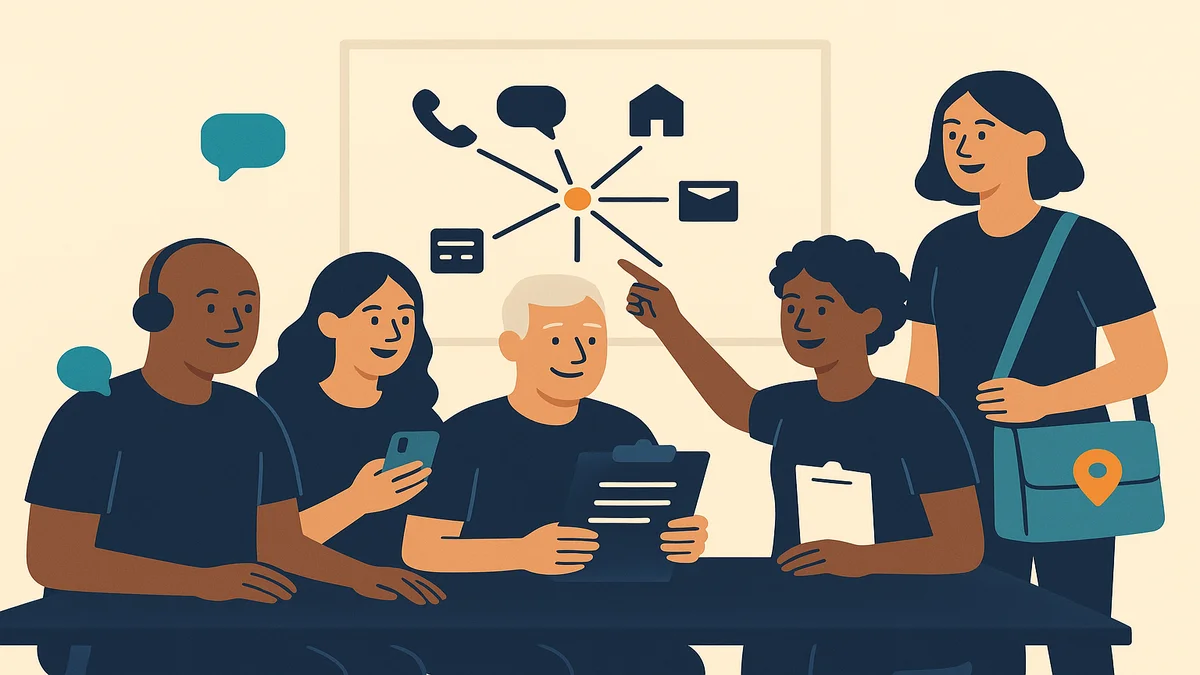
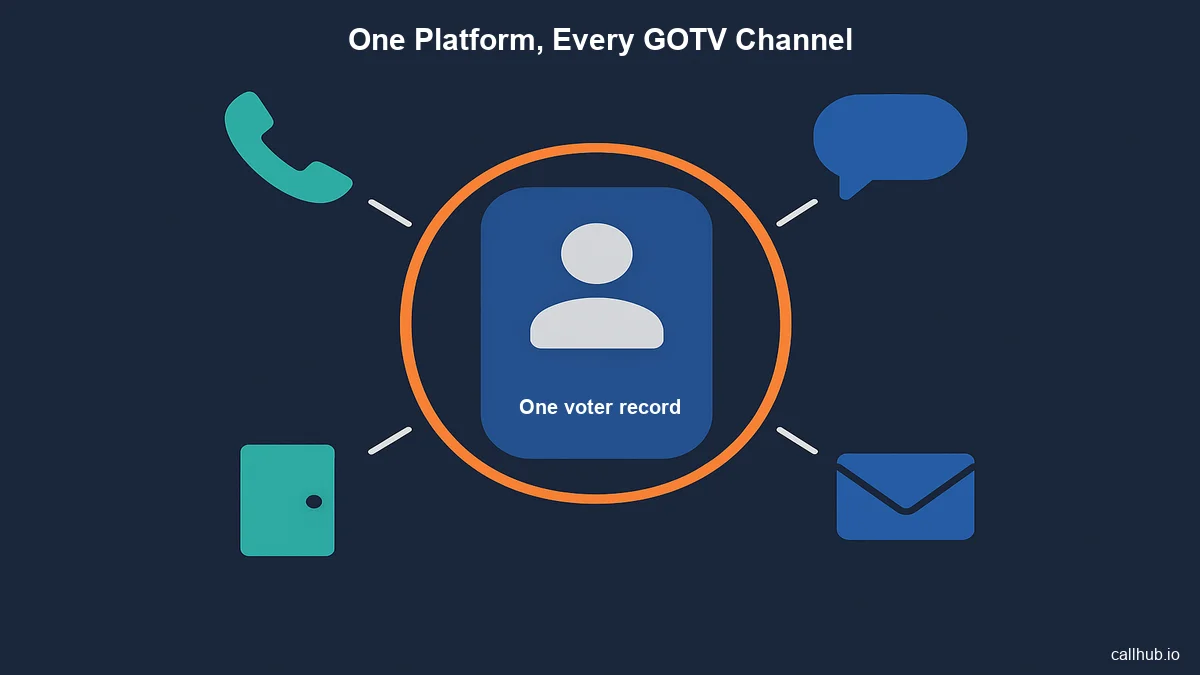
Running phone, text, canvassing, email, and events as five disconnected efforts is how programs lose track of who’s already been reached, and burn volunteer hours re-contacting people who already committed. The programs that turn out the most voters run every channel from one coordinated system. CallHub’s GOTV platform is built around exactly that problem: One contact record across calls, texts, canvassing, and email, so your field team always knows who still needs a nudge.
Choosing your GOTV tools and software
Most programs start with separate tools for each channel and end up with a fragmented contact history right when a single view matters most. A volunteer who doesn’t know a voter was already texted twice will call them a third time, which costs you goodwill you can’t get back this close to an election. The best GOTV tools and software compares dialers, texting platforms, and unified suites side by side.
If you’re still narrowing the decision, how to choose GOTV software walks through the criteria that matter most for a GOTV program specifically: Contact sync across channels, compliance features built in, and volunteer capacity that can scale fast. All three matter more here than in a general-purpose tool.
Before signing a contract, run every option against the same short list:
- Does it share one contact record across channels? If a call, a text, and a canvass entry live in three separate tools, no volunteer can see the full contact history for a voter before reaching out again.
- Can volunteer capacity scale in days, not weeks? GOTV volume spikes hard in the final two weeks. A tool that requires a lengthy onboarding process for new volunteers will cost you exactly when speed matters most.
- Does it handle compliance natively? Look for built-in consent tracking, opt-out handling, and calling-hour restrictions rather than relying on volunteers to remember the rules mid-shift.
- How does it price at GOTV volume? Per-contact or per-seat pricing can look identical at low volume and diverge sharply once you scale to a final-week push, so model your actual peak volume before comparing quotes.
- Can a non-technical volunteer lead run it without IT support? The person managing shifts on election day is rarely the same person who set up the software. It needs to be usable under pressure by whoever is on shift.
Early vote and absentee ballot outreach
In most states, a meaningful share of your electorate votes before election day. Ignoring that shifts your entire timeline.
Early voting
Early vote GOTV strategy covers how to identify likely early voters and move your contact schedule up to reach them before, not after, they’ve already decided when to vote. In states with a long early voting window, this can mean starting your highest-volume push weeks before what used to be considered the final stretch.
Vote-by-mail and absentee ballots
Mail ballots introduce a multi-step process your program needs to track: Request, receipt, and return. Losing track of any one step means chasing a voter who already voted, or worse, missing one who still needs a nudge. Mail-in ballot GOTV strategy covers the full sequence.
For voters who haven’t requested a ballot yet, absentee ballot request scripts gives you the exact ask to use by phone or text.
For voters who requested a ballot but haven’t returned it, chasing absentee ballots covers how to follow up without sounding like a robocall.
A fourth step belongs in this sequence even though it’s easy to overlook: Curing. Many states reject mail ballots over a small, fixable problem, a missing signature or one that doesn’t match the file on record, and give the voter a short window to correct it. A voter who submitted a ballot believes their job is done. Unless your program specifically tracks rejection notices and reaches out fast, a cured ballot problem quietly becomes a lost vote that never shows up as a contact failure on your end.
Reminder cadence
Timing matters as much as message content. Send reminders too early and voters forget them. Send them too late and there’s no time left to act. GOTV text reminders covers what to send and when, from the first early-vote window through election day itself.
Voting plans: The science of asking when someone will vote
One of the best-documented findings in GOTV research is also one of the simplest to apply. Asking a voter to state their specific plan (what time, what location, how they’ll get there) makes them measurably more likely to follow through. The mechanism is straightforward: A voter who has mentally rehearsed the act of voting has already cleared the small logistical objections that otherwise cause someone to skip it. The science of voting plans covers how to build that question into every script, text, and door-knock conversation you run.
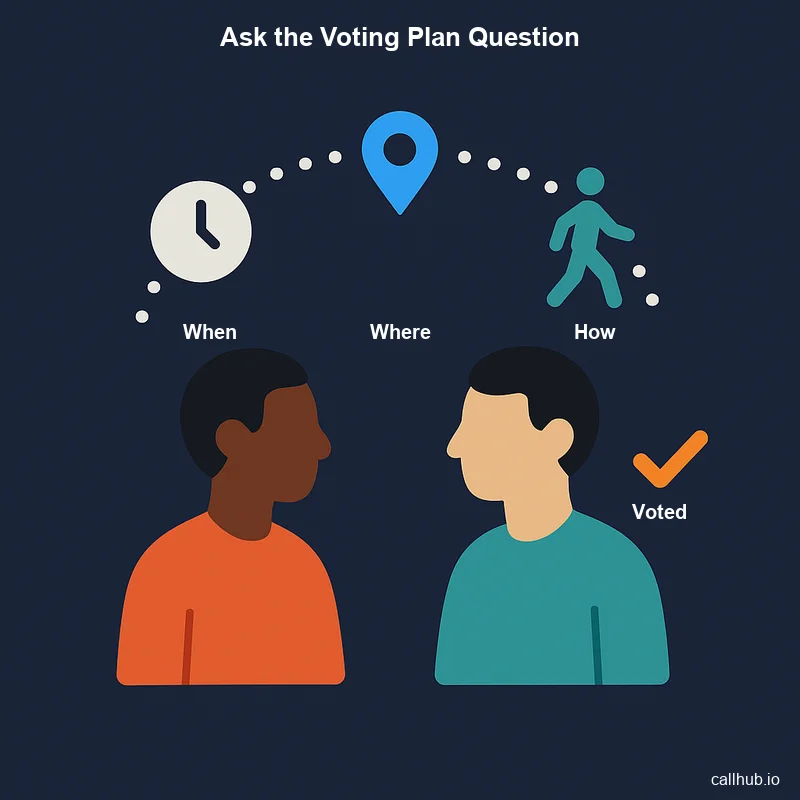
The question itself doesn’t need to be elaborate. A caller who asks “Do you have a plan for when you’re voting?” and then follows with “What time works, morning or after work?” has already done the work. The specificity is what matters, not the wording. A voter who answers “sometime Tuesday” hasn’t really made a plan yet. One who answers “Tuesday morning before my shift starts at nine” has, and that’s the answer a script should be built to draw out rather than accept the vaguer version at face value.
Recruiting and training your GOTV volunteers
None of the channels above run themselves. Volunteers do.
Recruiting volunteers
Recruiting GOTV volunteers covers where to find them and, just as important, how to ask in a way that gets a yes instead of a maybe. GOTV recruitment has a shorter runway than general volunteer recruitment, so the ask needs to be specific: A shift, a date, and a clear task, not an open-ended invitation to help out sometime.
Existing supporters, people who already donated, signed a petition, or attended an event, convert to volunteers at a far higher rate than a cold recruitment post ever will, since they’ve already shown they care about the outcome. Ask that list first, before spending time or budget on broader outreach.
Training volunteers
GOTV shifts differ from a standard phone bank: Volunteers face more rejection, more rushed conversations, and higher stakes in a shorter window. New volunteers who’ve only trained on persuasion scripts often struggle when a voter says they’ve already voted or already decided not to. Training GOTV volunteers covers what to change in your onboarding for the final push specifically.
The fastest way to get a new volunteer shift-ready is a short role-play before their first live contact, not a slide deck. Have them practice the two moments that trip up almost everyone new: A voter who’s already voted, and a voter who says they’re not going to. Both need a graceful, quick exit line so the volunteer moves on to the next contact instead of losing minutes on a conversation that was never going to change anything.
Election day operations
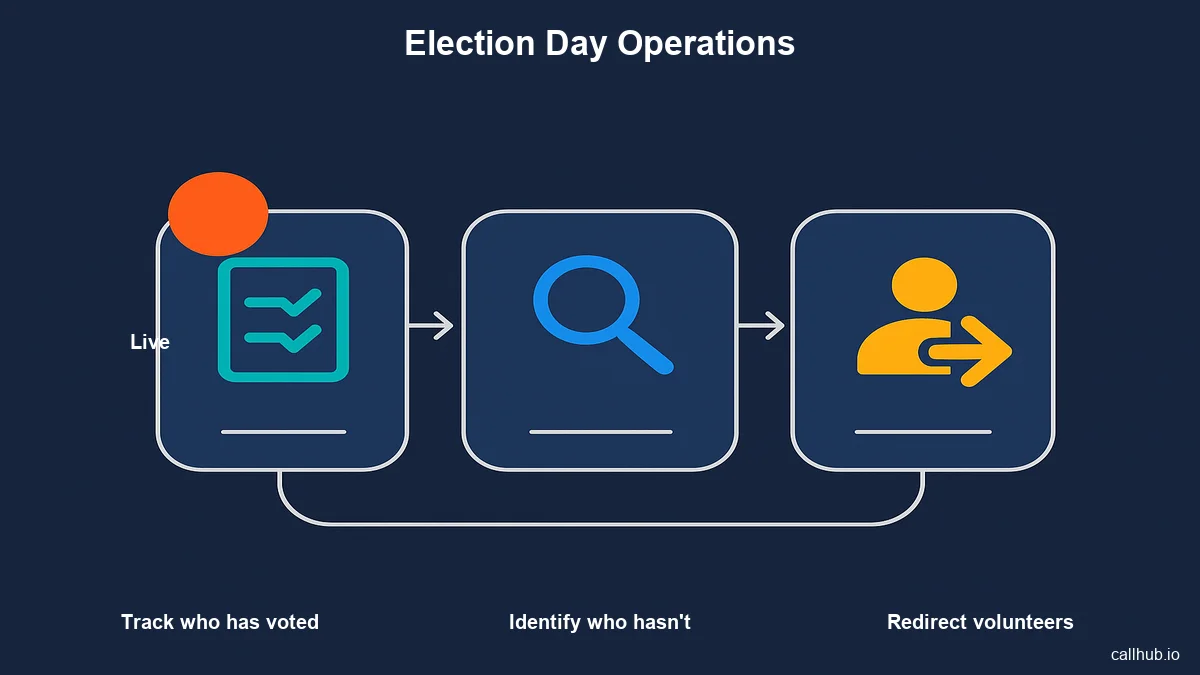
Election day is where every earlier decision either pays off or shows its gaps. Your job on that single day is to know, in real time, who has already voted and redirect volunteer effort away from them and toward everyone else. Election day GOTV operations covers staffing your final shift, real-time turnout tracking, and how to redirect volunteers toward the precincts that need them most as results come in.
Running that single day well takes a small set of clearly assigned roles, not just a room full of volunteers:
- Shift lead: Owns the schedule, covers gaps when a volunteer doesn’t show, and is the one person everyone else can ask when something goes wrong.
- Phone or text captain: Monitors contact volume against the target list in real time and reassigns volunteers toward the precincts still lagging.
- Ride and logistics coordinator: Handles voters who need a ride to their polling place, a role that only matters on this one day but matters a great deal to the voters who need it.
- Data and tracking lead: Keeps the voted list current as results come in from poll observers or check-in data, so nobody wastes a contact on someone who already voted.
Smaller programs often combine two or three of these into one person. What matters is that each function has a named owner before the day starts, not that four different people fill four different chairs.
After the election: Measuring what worked
Once the votes are counted, the work isn’t over. It’s the only chance you’ll get to know which tactics earned their cost before the next cycle. Pull your numbers while the program is still fresh in everyone’s memory, not months later when nobody remembers which script was running in which week. Post-GOTV analysis covers which metrics to pull, from contact rate to turnout lift by channel, and how to turn them into next cycle’s plan.
At minimum, pull these numbers by channel before you move on to the next cycle’s planning:
- Contact rate: How many attempted contacts actually reached a live voter, not just a dial or a send.
- Conversation rate: Of those reached, how many had an actual back-and-forth rather than a hang-up or an ignored text.
- Voting plan completion: How many contacted voters gave a specific plan versus a vague “yes, I’ll vote.”
- Turnout lift: Compare contacted voters against a similar but uncontacted group to see whether the channel actually moved anyone, rather than just assuming it did because volume was high.
- Cost per contact and per vote: Even a rough figure here tells you which channel to fund first next cycle.
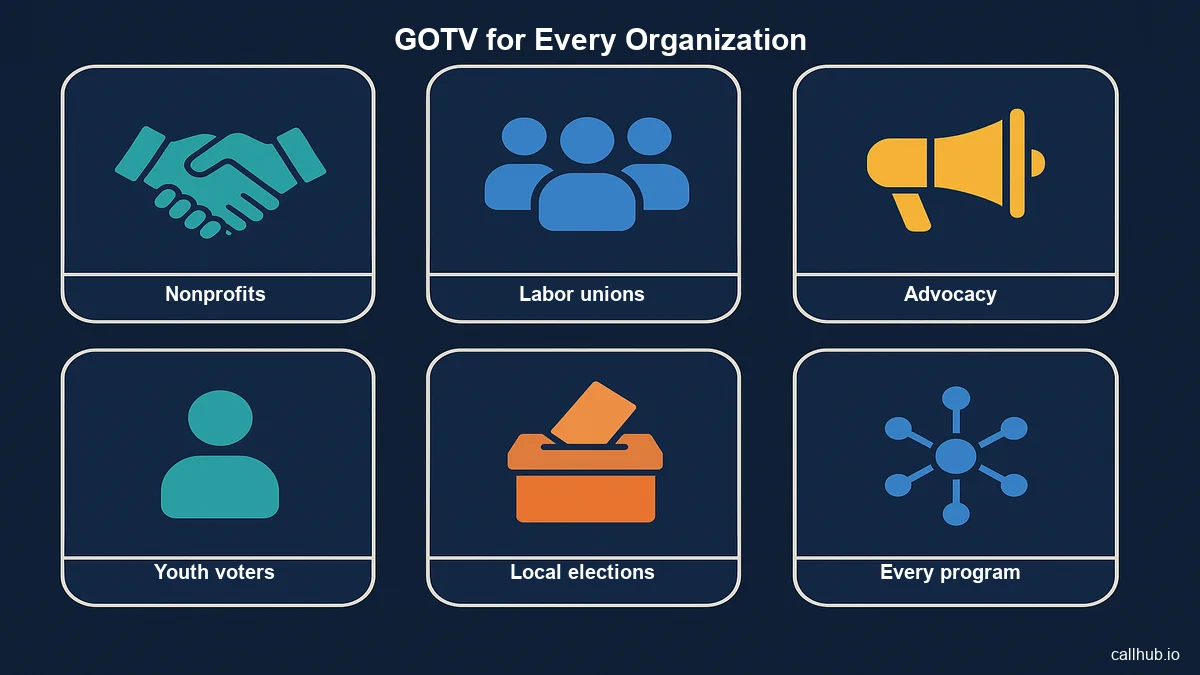
GOTV for your organization type
The five phases above hold regardless of who’s running the program. The specifics shift by organization.
Nonprofits
Nonprofit GOTV work has to stay strictly nonpartisan to protect 501(c)(3) status, which means every message has to be about voting itself, never about a candidate or party. GOTV for nonprofits covers how to run a full turnout program inside that constraint.
Labor unions
Union GOTV programs run through an existing structure: Stewards, worksite networks, and a membership list that already trusts the messenger. That trust is the advantage most outside campaigns don’t have, and it’s worth building the program around rather than replacing with a generic volunteer phone bank. Union GOTV programs covers how to activate that network instead of building a separate one from scratch.
Advocacy organizations
Advocacy groups often have supporters who are passionate about an issue but have never been asked to vote on it specifically. The gap is rarely enthusiasm, it’s translation: Connecting the issue someone cares about to the specific act of voting for or against it. GOTV for advocacy organizations covers how to convert issue energy into an actual turnout program.
Youth voters
Why youth voter turnout is low comes down to a few specific, addressable barriers: Registration friction, unfamiliarity with the voting process, and rarely being asked directly. None of these are attitude problems, which means they respond well to direct outreach rather than persuasion messaging. How to get young people to vote covers the tactics that address each barrier instead of treating youth turnout as a single problem.
Local elections
Local races routinely see far lower turnout than the top of the ticket, which means a well-run GOTV program has an outsized effect on the outcome. A few hundred contacted voters can decide a city council or school board race in a way they never could a statewide one. Voter turnout in local elections covers why turnout drops so sharply down-ballot and what a local campaign can do about it.
GOTV compliance, briefly
Every channel above operates inside real legal constraints, and getting them wrong carries real liability, both financial and reputational, right when you need every volunteer hour focused on turnout instead of a legal problem. Calling and texting voters is governed in part by the Telephone Consumer Protection Act (TCPA), which the FCC enforces and which restricts autodialed or prerecorded calls and texts to certain numbers without prior consent. Text campaigns increasingly need 10-digit long code (10DLC) registration as well, to avoid carrier filtering that can silently block your messages from ever reaching a voter.
Three practical rules cover most of what a volunteer-run program needs to get right day to day:
- Keep a documented consent record for every number you’re calling or texting.
- Honor an opt-out immediately and permanently, not just for that shift.
- Restrict calling and texting to the hours your state or the TCPA allows, whichever is more restrictive.
None of these require legal expertise to follow. They require the program to build them into the tool and the script rather than trusting a volunteer to remember them under pressure.
These rules shift by state and by channel, and they change often enough that a general guide can’t substitute for legal advice specific to your program. CallHub’s phone banking compliance guide covers the baseline rules for calling and texting at scale. Always confirm your specific plan with legal counsel before your program goes live.
Common GOTV mistakes that quietly cost turnout
Most GOTV programs don’t fail because of one dramatic error. They lose votes a few at a time, in ways that never show up as a contact failure. Watch for these specifically:
- Treating the final 72 hours as the whole program. By the time the final push starts, your universe should already be built and segmented. Programs that skip straight to high-volume calling without that groundwork spend their scarcest hours reaching people who were never going to vote for them.
- Re-contacting voters who already voted. Without a shared contact record across channels, a voter gets called, texted, and knocked on by three different volunteers who each think they’re the first. That burns goodwill and volunteer hours you can’t recover this close to an election.
- Skipping the voting plan question. A reminder that an election exists is weaker than a question that gets a voter to state exactly when and how they’ll vote. Scripts that skip straight to “please vote” leave real turnout lift on the table.
- Losing track of mail ballots after they’re requested. A requested ballot is not a cast ballot. Programs that stop tracking after the request step miss both the voters who never received one and the ones whose ballot got rejected and never cured.
- Running every channel at reduced volume instead of picking a few and running them well. A small team spread across five channels at partial effort usually turns out fewer voters than the same team running two channels at full capacity.
Your GOTV program, one coordinated system
Every phase covered above (plan, universe, timeline, channels, volunteers, election day, and the analysis after) works best when it runs through one system instead of five disconnected ones. Programs that run each channel from a separate tool spend real volunteer hours re-contacting people who were already reached, hours that matter most in exactly the week they can least afford to lose them. That’s the coordination problem CallHub’s multi-channel GOTV outreach platform is built to solve: Calls, texts, canvassing, and email, all against the same contact record, so nothing falls through the cracks in the stretch that matters most.
Explore CallHub’s GOTV platform to see how campaigns, unions, and nonprofits run every channel above from one place.
Read the complete GOTV timeline to build out your own schedule from today’s date to election day.
Frequently asked questions
What does GOTV stand for?
GOTV stands for get out the vote. It refers to the organized effort campaigns, nonprofits, unions, and advocacy groups run to turn supporters who already back a candidate or cause into people who actually cast a ballot. Unlike persuasion work, it assumes the supporter has already decided and focuses entirely on removing the friction between that decision and an actual vote.
What is the difference between GOTV and voter mobilization?
Voter mobilization is the broader category: Any effort to get supporters civically engaged and active. GOTV is the specific, time-boxed push that happens in the days and weeks immediately before an election, focused narrowly on turning out a ballot. The two often run side by side earlier in a campaign, but GOTV becomes the exclusive focus once persuasion season ends.
When should a campaign start its GOTV program?
Most GOTV timelines start six to eight weeks before election day with voter universe building and early-vote targeting, then intensify in the final two weeks. Campaigns starting later than that should prioritize the highest-yield tactics first rather than trying to run the full program in a compressed window. Starting late doesn’t mean skipping the work, it means compressing it and cutting the most labor-intensive tactics first.
What GOTV tactics have the strongest research backing?
Direct, personal contact (in-person canvassing first, followed by phone calls) consistently shows the strongest turnout lift in randomized field experiments from groups like the Analyst Institute and Yale’s ISPS. Voting plan questions, asking a supporter exactly when and how they’ll vote, add a measurable lift on top of any contact method. No single tactic replaces the others entirely, which is why most well-run programs combine several channels rather than betting everything on one.
How much does an effective GOTV program cost to run?
Cost depends almost entirely on channel mix and volunteer capacity, not on any fixed program price. Door-knocking is the most expensive tactic per contact because it’s labor-intensive, while texting and calling cost far less per voter reached, which is why most programs blend all three rather than relying on one. Programs with a fixed budget generally get more total turnout by blending channels than by maxing out spend on any single one.
What is the difference between GOTV and voter persuasion?
Persuasion tries to change how someone plans to vote. GOTV assumes the supporter already agrees and focuses entirely on getting them to actually cast that ballot. The two require different messages: Persuasion argues a case, GOTV removes friction and adds a concrete plan.
How do I know if my GOTV program is working?
Track contact rate, voting plan completion, and turnout lift by channel throughout the program, not just after election day. Comparing turnout among contacted versus uncontacted but otherwise similar voters is the clearest signal of whether your specific tactics moved anyone. If you can’t run that comparison directly, even a simple before-and-after look at contact rate and self-reported voting intent tells you more than assuming the program worked because it felt busy.
What is a voting plan, and why does asking about it increase turnout?
A voting plan is a voter’s specific answer to when, where, and how they’ll vote. Asking someone to state that plan out loud, rather than just reminding them an election is happening, makes them measurably more likely to follow through, because they’ve already mentally rehearsed the act of voting.
Do I need special software to run a GOTV program?
You don’t need it to run a small program manually, but it becomes hard to avoid once volume grows past what a spreadsheet and a shared inbox can track. The specific need is a shared contact record across whichever channels you’re running, so no volunteer re-contacts someone who already responded on a different channel. Below a certain scale, a well-organized spreadsheet and a clear division of labor can substitute for dedicated software.
What is the single highest-priority GOTV tactic for a program with limited time?
Direct personal contact, in whichever form your team can execute fastest and cleanest, almost always beats a broader but shallower effort. For most volunteer-run programs starting late, that means phone and text to an existing supporter list, since both can be stood up quickly, rather than canvassing or events, which take longer to organize well.