

Table of Contents
By the time you reach political phone banking on the checklist of things that your political campaign needs to do, you’re probably already stretched thin. So, let’s make this quick and easy. If you need answers to:
“Where do I get a list of people to call?”
“How do I recruit volunteers?”
“What should my phonebanking script look like?”
“How do I make calls, and what dialer should I use?” or
“How do I measure the results of a phone banking campaign?”
This will be your guide.
This article shows you how to phone bank for a campaign without turning the process into a mess of spreadsheets, missed follow-ups, and confused volunteers.
Key Takeaways
Political phone banking is a campaign outreach method where volunteers call potential voters to identify supporters, raise funds, drive event attendance, and persuade people to vote.
Core Components and Types
- A phone banking operation requires recruiting and training volunteers, building targeted call lists, preparing scripts, selecting a calling tool, and tracking activity.
- Traditional phonebanking has volunteers manually calling voters from offices or home, offering a slower but more personal touch.
- Automated outreach uses robocalls, voice broadcasts, and voicemail drops to reach thousands of people quickly at the cost of personalization.
- Text-based communication through peer-to-peer texting and SMS broadcasts works well for reaching younger, mobile-first audiences.
- Interactive and hybrid models pair automation tools like IVR or predictive dialers with live volunteer follow-up to balance efficiency and human conversation.
Evidence That It Works
- French party Les Républicains made over 900,000 calls and recruited 800 volunteers in four months using phone banking integrated with their NationBuilder CRM.
- Jagmeet Singh used GOTV phone banking to identify supporters during his NDP leadership run, reaching 70% turnout among targeted supporter segments and becoming the party’s youngest leader.
- Australia’s Greens MP Jamie Parker combined door-to-door canvassing with follow-up phone calls in a hyperlocal campaign strategy.
- Organizing for Change used phone banking to raise voter turnout by 7% in a British Columbia provincial election.
- StatesWin’s 2022 Phonebanking Research found that quality calls from trained callers can lift turnout by 3-5%, while high-volume calling from poorly trained callers has a much weaker effect.
Setting Up a Virtual Phone Bank
- Campaigns can obtain call lists from three sources: local election offices for basic voter files, political parties for enhanced data like past support and donor tags, or vendors such as L2 or Aristotle for the most comprehensive but costly lists.
- NationBuilder offers free voter files similar to those available from local election offices.
- Candidates can also buy or rent voter lists from others who previously ran campaigns in the same area.
- After building a list, campaigns must choose how volunteers will make calls, with virtual phone banking software like CallHub supporting this step.
What is political phone banking?
Political phone banking is a form of campaign outreach where volunteers make direct phone calls to potential voters to identify supporters, raise funds, get people to attend events, and persuade them to vote for a candidate or a cause.
Phone banking involves everything like:
- Recruiting and training volunteers
- Creating targeted lists of people to be called
- Preparing call scripts
- Deciding on a calling tool
- Tracking all calling activities
This ensures that outreach efforts contribute to the ultimate goal of getting every supporter to vote.
Types of political phone banking
There’s more than one way to run a successful political phone banking campaign. Here are the key types to know:
Traditional phonebanking: This involves volunteers manually calling voters, either from campaign offices or from home. It’s slower but offers a personal touch.
Automated outreach: Robocalls, voice broadcasts, and voicemail drops help you reach thousands quickly. It’s perfect for scale, though less personal.
Text-based communication: Peer-to-peer texting and SMS broadcasts are ideal for reaching younger, mobile-first audiences. It’s fast, flexible, and still feels direct.
Interactive tools and hybrid models: Combining automation with live volunteer follow-up, this approach uses tools like IVR or predictive dialers to boost efficiency while keeping conversations human.
Political phone banking isn’t one-size-fits-all. The best method depends on your campaign goals, whether it’s voter ID, GOTV, or volunteer recruitment.
Does phone banking work?
It’s no coincidence that political campaigns all over the world use phonebanking as a way to reach out to constituents. It works.
Take a look at Les Républicains, one of the two major political parties in France.
Using political phone banking for volunteer recruitment, they managed to make over 900,000 calls and recruit 800 volunteers in four months.
Integrations made sure that data from their phonebanking campaigns in CallHub flowed into their CRM, NationBuilder, so new information that was collected through phone banks immediately reflected in their database.
Jagmeet Singh, who ran for the leadership of the NDP in Canada, used phonebanking extensively for GOTV efforts targeted at identifying supporters and party members.
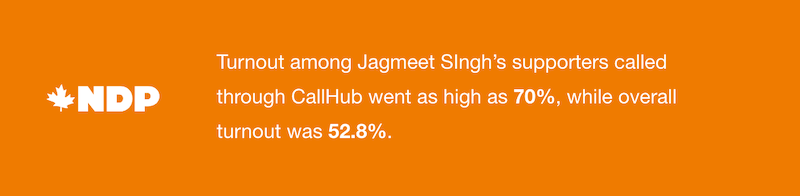
With an impressive turnout of 70% among segments of Jagmeet’s supporters, he went on to win the election, becoming the youngest leader in the party’s history.
Australia’s Greens Party MP Jamie Parker decided to run a hyperlocal campaign combining door-to-door canvassing and political phone banking.
They followed up each face-to-face interaction with a phone call and then continued calling voters throughout the campaign.
In Canada, Organizing for Change, an environmental coalition group used phone banking to drive calls to British Columbia voters to get them out to vote in their recent provincial elections, increasing voter turnout by 7%.
LGBT advocacy group, NEAT, uses phone calls to connect voters to their elected officials.
Quality matters here. StatesWin’s 2022 Phonebanking Research reports that quality calls from trained callers can produce a 3–5% turnout boost, while volume-focused calling from poorly trained callers produces a much smaller effect. So phone banking works best when the campaign gives volunteers a strong list, a clear script, and enough training to have real conversations.
How to organize a virtual phonebanking campaign
So what makes a political phone banking campaign successful? This virtual phone banking guide lays out a step-by-step process you can follow:
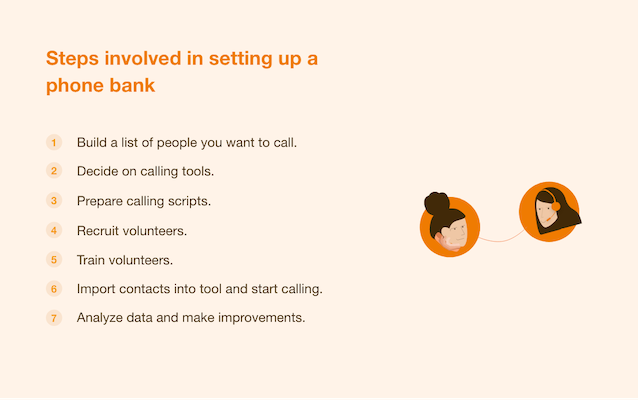
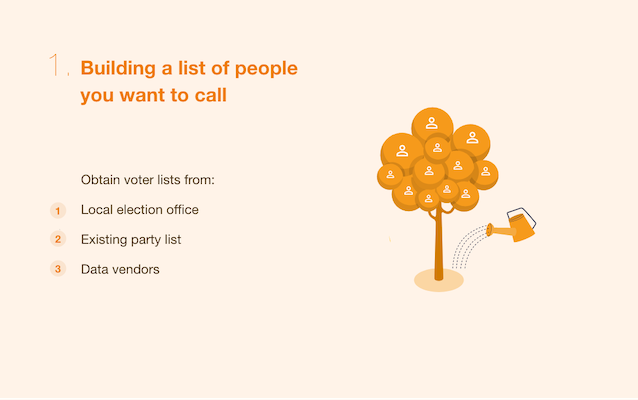
1. Building a list of people you want to call
A step-by-step guide to setting up a phone bank, recruiting volunteers, loading lists, running the session, and tracking results.
It all starts with the list of contacts you need to call. Depending on where you are from and the data you require, there are three ways to get lists:
Local election office
Your state or county election official can provide the latest list available from the state. Contact your Secretary of State’s office or the local election bureau for the voter file. This will likely be a very basic list. NationBuilder provides similar voter files as a free resource on their website.
Your political party
The major political parties maintain their own voter data on top of the public lists. So, if you are contesting as a party candidate, you can use the party voter file. These files would contain additional information on potential voters, such as past candidates supported and donor tags.
Data vendors
Some voter data vendors like L2 or Aristotle provide lists they have built or collected from past campaigns. The information in those lists is more comprehensive than a state-provided list. It also comes at a higher cost so it might not be viable for small campaigns.
If you just have a basic voter list, these services can also append missing data, helping with list cleaning.
Note: Another option is to buy or rent lists from other candidates who previously ran in the same area.
Further Reading: Building your voter contact list
2. Deciding how you want to make calls
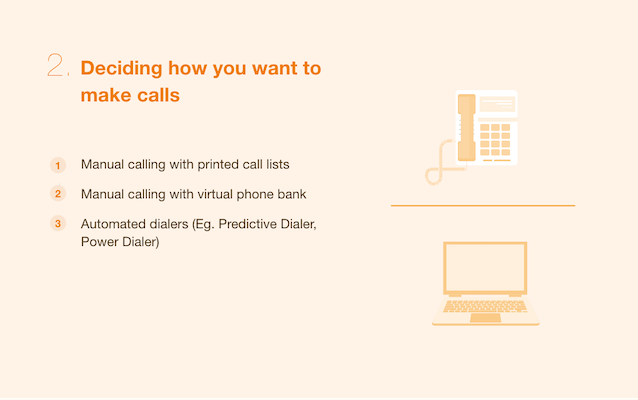
Once you have your list, you need to determine how you want your volunteers to make calls. That’s where virtual phone banking software like CallHub can help.
However, even after choosing a software, you can select how you want the calling campaigns to be set up. Typically, your software will give you the following options.
Let’s see the differences between the types of dialing:
| Feature | Manual calling | Automated dialers | Patch-through calling |
| Definition | Volunteers manually dial contacts, either from printed lists or from a virtual phone bank interface | Software dials through a contact list and connects answered calls to live volunteers | Volunteers coach supporters on a conversation, then connect them directly to officials |
| Pros | Can call cell phones, familiar for older volunteers, virtual option syncs data with CRM | High call volume, no manual data entry, easier volunteer onboarding | Educates supporters on issues, connects voters to elected officials, builds political pressure |
| Cons | Very slow, printed lists require manual data entry, splitting contacts is cumbersome | Cannot call cell phones without the right consent, higher software costs | More complex scripts and training, fewer calls per hour than automated dialers |
| Costs | About $0.02–$0.05 per call, mainly for call minutes | About $0.05–$0.15 per call, depending on volume and provider | About $0.20–$0.40 per call, due to dual-leg calling |
| Ideal use cases | Small or local campaigns with limited budgets, campaigns where calling cell phones is critical | Large-scale campaigns needing speed and efficiency, GOTV drives | Advocacy campaigns that connect constituents to lawmakers |
Read Also: Manual Dialer: Here is What the New Laws Say
What is virtual phone banking?
Virtual phone banking is a remote calling setup where volunteers call from home or from distributed locations using a campaign phone banking tool. Volunteers log in, see the script, call assigned contacts, record outcomes, and stay connected with the campaign team through a shared communication channel.
For campaigns with volunteers spread across districts, this is now the default setup. It removes the need for every volunteer to come to the campaign office while still keeping the list, script, and reporting centralized.
For distributed teams, add one extra layer of planning: test the tool before the shift starts. Make sure every volunteer can log in, hear audio clearly, find the script, and record dispositions before they call real voters.
3. Preparing a phonebanking script
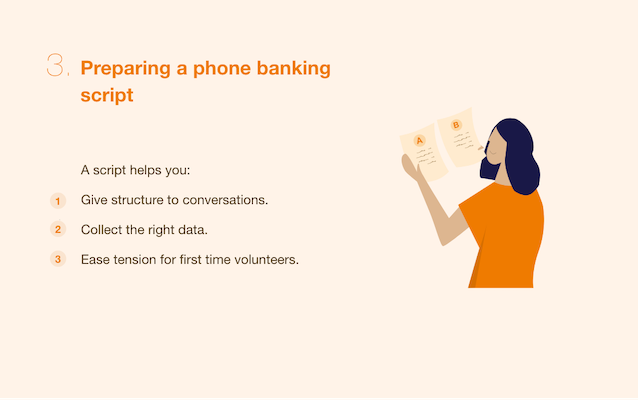
A political phone banking script lets volunteers structure the conversation around the right talking points without deviating into long-winded debates, and for nervous, first-time phone banking volunteers who don’t have experience cold calling strangers, a script is a godsend.
Volunteers should be able to use the phone banking script to collect the right data points while coming across as polite and helpful.
For example, the goal of a Voter ID script is to identify the level of support for your candidate, issues the voter cares about, and potential volunteers or yard sign hosts.
You can do that by posing potential voters direct questions that will reveal their voting preferences.
The questions on a voter ID script should look something like this:
- Can we count on your support?
- What issue matters most to you this election?
- Would you like to receive campaign updates?
- Would you be interested in volunteering?
- Do you need help finding your polling place?
A persuasion script is for recontacting undecided voters who have already been ID’d.
These scripts are usually longer, with the volunteers engaging the voter in a conversation on the issues they identify with.
A GOTV script is aimed at getting the supporters you’ve identified out to vote.
During the initial stage of GOTV, it is crucial for the script to engage the voters in creating a plan for how and when they vote. Right before the election, your scripts should be tailored toward getting out the vote.
Take a look at our article on writing a strong phone banking script.
Your script is essential in making sure all your volunteers are on the same page when it comes to talking to potential voters or volunteers.
4. Recruiting volunteers for political phone banking
How do you get people to donate their time?
Volunteers are likely to step forward if they feel that the work they do is going to make a difference or if they are deeply aligned with your campaign’s agenda.
Talk about how political phone banking impacts your campaign efforts and how it can be the difference between winning and losing your election.
Recruiting volunteers is all about having a compelling objective and story for your campaign.
Another option is looking within your organization. Assuming you are not taking their time away from more crucial tasks, asking in-house for volunteers can bypass the need to promote your phonebanking event.
If you’re considering distributed phone banking with phone banks, a phone banking software like CallHub can make it easy for you to add volunteers to your campaign through a sign-up form.
Here are some ways your campaign can start recruiting volunteers for your campaign:
- Put your phone banking dates on the website and let people sign up to phone bank right from there.
- Make the ask to people who are identified as supporters during the voter ID stage.
- Put the call out on social media.
- Assign volunteers responsibility of local recruiting efforts. They’ll be able to connect better with peers in the area.
5. Training volunteers and encouraging collaboration
There’s no getting around the fact that most of your phonebanking volunteers are going to be inexperienced. This is why easing the learning curve and making your volunteers comfortable is an important part of setting up a phone banking campaign.
Some steps you can take for a more efficient phone bank are:
Getting volunteers used to the interface
If you’re using a phone banking software to run your campaign, take some time initially to make sure your volunteers can comfortably navigate the interface.
Make it a collaborative process
If your volunteer has a question or a suggestion that they think will improve your political phone banking efforts, set aside the time to hear them out.
Providing distractions every now and then
There’s no doubt that making calls for hours on end can get dull. Re-energize your volunteers with the occasional distraction. Don’t forget to keep your stores of snacks, water, and coffee stocked throughout the day.
Use a centralized communication tool
Using Slack or WhatsApp to centralize your communication has two clear advantages:
- It makes it a lot easier to coordinate phonebanking efforts and share important updates.
- It gives volunteers the space to interact with each other and form a sense of community and shared purpose.
Start every shift with a short briefing
Before volunteers start calling, run a 20–30 minute briefing. Cover the campaign update, the calling goal for the shift, the script, the tool, and the most common voter responses you expect.
RepresentUs recommends a structured phone bank lead process that includes training, script review, and live support for volunteers. You can use their How to Lead a Phonebank resource as a useful reference.
For new volunteers, add a short role-play. Pair them up and have them practice one easy call and one difficult call before they call real voters.
Keep shifts short enough to protect call quality
Most campaigns should keep phone banking shifts to two or three hours. GetThru’s phone banking guide recommends three-hour shifts as a workable structure for most volunteers.
If you run longer shifts, build in a 15-minute break at the midpoint. Use that break to answer questions, share what volunteers are hearing, and update the group on progress.
Avoid four-hour calling blocks unless you have very experienced volunteers. After a certain point, call quality drops.
Prepare volunteers for difficult calls
Volunteers need to know what to do when a voter is angry, hostile, or not interested.
Give them a simple exit line:
“Thanks for your time. I’ll let you go.”
Then ask them to mark the disposition correctly and move on. They should not argue, debate, or try to win the voter back in that moment.
This is important for volunteer retention. First-time volunteers get less anxious when they know they are allowed to end a bad call politely.
Reduce first-call anxiety
Most new volunteers are nervous before the first call. Say that out loud in the briefing.
Pair new volunteers with experienced ones for the first 30 minutes. Let them listen to one or two calls if your setup allows it. Then have them make their first call while someone is nearby to help.
The first call is usually the hardest. Once volunteers get past it, the shift becomes much easier.
6. Importing lists and assigning contacts to volunteers
You can connect your CRM or database directly to the phone banking tool and import contact lists. If you don’t use a CRM and simply have your lists as spreadsheets, you can import them as well.
You can then select the group of volunteers for your campaign and your software will automatically split up the list and assign it to them. You can even let new volunteers join the campaign while a phone bank is going on and a tool like CallHub will start assigning them contacts too.
Some of the most popular integrations available for phone banking tools like CallHub are NGP VAN, Action Network, or NationBuilder.
See the full list of integrations with CallHub.
7. Running the live phone bank session
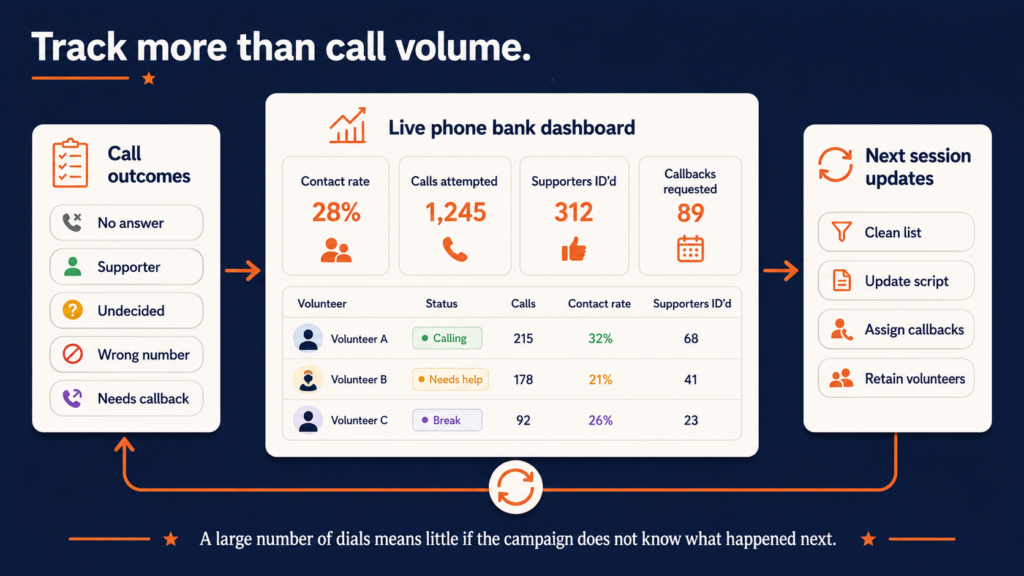
A phone bank does not run itself once volunteers start calling. The campaign manager or phone bank lead needs to watch the session in real time, coach volunteers, and protect data quality.
Start with the briefing from the previous section, then move volunteers into calling quickly. The longer the pre-call talk goes, the more nervous first-time volunteers get.
During the session, the phone bank lead should:
- Watch the volunteer dashboard.
- Look for volunteers with very short or very long average call times.
- Check whether volunteers are logging dispositions correctly.
- Answer questions in Slack, WhatsApp, or Zoom chat.
- Pair struggling volunteers with experienced callers.
- Note common voter objections that may require a script update.
Short calls can signal that the opener is not working. Very long calls can mean volunteers are getting pulled into debates or not finding the right next step. Both are coaching signals.
If the shift is three hours or longer, take a short midpoint break. Use it to share one or two wins, answer questions, and update volunteers on what the group is hearing from voters.
The most important live-session habit is disposition discipline. Every call should end with the right outcome logged: no answer, supporter, undecided, wrong number, needs callback, do not call, or another campaign-specific tag.
Missed dispositions create bad data for the next session.
For deeper session tactics, use this guide on tips to win at phone banking.
8. Analyzing data and making improvements
After running a successful political phone banking campaign, it’s finally time to measure your results.
Analyze your conversions at the end of your campaign. Did you reach out to the people you wanted to? Did they turn up to vote?
There are some key metrics you can measure that are specific to phonebanking campaigns:
- Agent occupancy rates: Percentage of time volunteers spend on calls against idle time.
- Call drop rates: Calls that got disconnected before they were connected to a volunteer divided by total number of calls dialed.
- Reach rates: Percentage of calls that were picked up.
- Number of call attempts: Per agent and total.
What is a good contact rate for phone banking?
A normal phone banking contact rate often falls in the 10–20% range, according to StatesWin and Sister District’s 2022 phone banking research.
If your contact rate is consistently below 10%, look for three problems:
- Are you calling at the wrong time of day?
- Is your list stale?
- Are your numbers being flagged as spam?
GetThru recommends calling between 5 p.m. and 9 p.m. local time, when people are more likely to answer. Use that as a starting point, then track your own campaign’s answer rates by region, list, and shift.
How to use call data to improve the next session
Data is useful only if it changes what you do next.
If most calls end in under 60 seconds, your opener may not be working. Review the first line of the script, the caller ID, and the first question. If many voters ask the same question, add that answer into the script before the next shift.
After every session, track:
- Contacts reached
- Survey responses collected
- Support levels logged
- Callbacks requested
- Wrong numbers found
- Volunteers retained for the next shift
- Notes that should change the script
This data should sync back to the campaign CRM before the next session. A phone bank that does not update the voter record is running blind.
9. Post-session debrief and follow-up
The phone bank is not done when volunteers stop calling.
Before volunteers leave, pull a quick summary: total contacts reached, top dispositions, callbacks requested, and any script issues that came up. Keep the debrief to 10 minutes so volunteers do not dread it.
Use three questions:
- What went well?
- What confused voters?
- What should change before the next shift?
Then handle the follow-up immediately. Contacts who asked for a callback should be assigned to the right campaign staff or volunteer. Supporters who want to volunteer should receive the next action. Wrong numbers should be removed or corrected.
Volunteer retention matters here. Ask every volunteer to sign up for the next shift before they log off. Getting a second shift from someone who already called is easier than recruiting a brand-new volunteer.
Thank people specifically. “You helped us identify 47 supporters tonight” is stronger than “Thanks for helping.”
Use cases of political phone banking
Previously explored briefly, the main use cases of phone banking for political campaigns are:
Identifying voters and cleaning lists
Categorizing supporters in order to target them for different calling campaigns. Filling in crucial data that can help you identify your supporters.
GOTV or Get out the vote
Mobilizing supporters to vote at the end stages of your political campaign.
There are other ways to identify voters and GOTV, like social media and going door to door, but political phone banking edges them out, simply because social media isn’t as personal, and door-to-door canvassing isn’t as scalable.
Cleaning lists and identifying voters
In the early stages of your campaign, you need to be aware of who still lives in the area you are campaigning in and how likely they are to support you. Depending on where and how you are getting your contact lists, you may be missing crucial information, such as party affiliation, email address, history of voting, or voter stance on specific issues.
Cleaning your lists by filling these knowledge gaps is a significant step in the campaign process. This lets you identify voters based on who you want to target for future efforts. With every phone call, volunteers fill these gaps in the database to make sure future campaign outreach efforts can be tailored to individual voter preferences.
For example, you can call people to determine which voters will probably vote for your campaign and separate them from those who need to be persuaded to vote for you, letting you target the former category with a GOTV campaign.
Another way to ID voters is to rate them on a scale, e.g. 1–5, where 1 is highly likely to vote and 5 is highly unlikely.
The main goal of a voter identification campaign is to create a target universe of supporters who’ll form the crux of your campaign messaging across the persuasion and Get Out The Vote stage.
Get out the vote
GOTV or Get Out The Vote efforts are the vital last stage of your campaign, aimed towards mobilizing your entire GOTV universe, people that you already know are supporting your campaign, and getting them out to vote.
GOTV campaigns are most effective right before voting begins. The message should be simple and to the point, conveying the urgency of voting and getting your candidate the win.
Irrespective of how many volunteers you have, it can be very daunting to reach every supporter on your GOTV list by manually dialing their numbers. While a single volunteer hand dialing contacts from a physical list may talk to about 10–15 people in the span of an hour, an automated dialer can bring that number up to 45–50 conversations in the span of an hour, and is commonly used at this stage for its capacity to handle higher volumes.
The above are just a few ways political phone calls can help your campaigns.
Also read: Phone Calls for GOTV: 8 Solid Strategies for your Campaign
A final rundown: what you need to phone bank during elections
There are a few more questions you need to ask yourself before getting started with a political phone banking campaign.
What is the scale and budget of your political phone banking?
Before you start planning your overall political banking campaign, you need to be aware of how many people you want to reach and your budget estimate for making calls.
Some key figures you need to determine are:
Your win number
The number of votes you need in order to get your candidate elected. This will give you the number of people you need to contact for your phone banking.
Read Also: How to determine your win number and create a perfect voter outreach plan.
Voter contact estimate
This is the estimated cost of contacting all the voters you are planning to reach during your political phone banking campaign.
Vote deficit
This is the number of extra votes you need in order to win an election.
How many volunteers?
Make sure you plan for enough volunteers to comfortably reach your calling goal.
Assuming you have these numbers at hand:
- Total contacts on your contact list
- Number of days you plan to run the campaign
- No. of hours per day
- No. of calls a single volunteer can make per hour, which varies depending on your dialer and how much time volunteers spend on each call
You can calculate your total volunteers with this formula:
Total Volunteers = Total Contacts / ((Days x Hours) x Calls Per Volunteer)
For example, with 10,000 contacts, 14 days, and 2 hours per day to spend on phonebanking, with your volunteers making 15 calls an hour, you would need approximately 24 volunteers to comfortably call everyone in your contact list.
What are the laws?
Different countries have different regulations when it comes to political phone calls. For example, in the US, you cannot make calls to cellphones using an automated dialer without the right consent. Make sure your campaign is operating within compliance.
In the US, the Telephone Consumer Protection Act (TCPA) restricts the use of autodialers and prerecorded voice messages to mobile phones without prior express consent. The FCC’s TCPA guidance is the best starting point for federal rules.
For campaign planning, use these basic guardrails:
- Automated dialers are generally safer for landlines than cell phones.
- Manual dialing is commonly used when campaigns need to call mobile numbers.
- Political calls are generally exempt from the federal Do Not Call list, but state rules may vary.
- Federal rules restrict calls before 8 a.m. or after 9 p.m. local time.
- Some states have stricter rules than federal law.
- Always honor internal do-not-call requests from voters.
If your campaign is unsure whether it can use an automated dialer, prerecorded message, or specific calling list, check with counsel before launch. For more detail, see CallHub’s guide to calling compliance.
What type of dialer should you use?
If you are using a phone banking software, the dialer you choose can have a considerable impact on your campaign.
CallHub lets you choose between four dialers for your campaigns:
Power dialer
A power dialer is an outbound calling tool that automates the dialing process, automatically dialing the next number on a list when a representative is ready for a call, and connecting them with a live person.
What power dialer can do:
- Lets volunteers focus on the call while the system handles dialing.
- Gives time to fill in surveys or notes before moving to the next call.
- Typically makes 50–70 calls per hour, depending on call length.
Use cases:
- Small to medium-scale fundraising campaigns.
- Donor engagement or follow-up calls.
- Membership or subscription renewal outreach.
Predictive dialer
A predictive dialer is a calling tool that automatically dials multiple numbers simultaneously and connects only answered calls to available volunteers.
What predictive dialer can do:
- Maximizes volunteer talk time by screening unanswered calls.
- Adjusts dialing rate dynamically based on call patterns.
- Enables volunteers to make calls in large volumes efficiently.
Use cases:
- GOTV campaigns to mobilize voters quickly.
- Large-scale volunteer recruitment calls.
- Any campaign requiring high call volume in a short time.
Preview dialer
A preview dialer is an outbound calling tool that enables volunteers to review contact information before making a call, giving them more control over the outreach process.
What can this dialer do:
- Allows volunteers to prepare personalized messages based on contact info.
- Volunteers choose whether and when to call a contact.
- Helps improve call quality and personalization.
Use cases:
- Donor stewardship or high-value fundraising campaigns.
- Volunteer engagement campaigns requiring detailed messaging.
- Surveys or feedback collection where personalization improves response.
Auto dialer
An auto dialer is an outbound calling tool that automatically dials numbers from a contact list and connects calls to available volunteers without manual intervention.
What it can do:
- Eliminates manual dialing completely.
- Connects contacts to volunteers automatically.
- Handles high-volume calling efficiently.
Use cases:
- Appointment reminders or notifications.
- Large-scale awareness campaigns.
- Event invitations or RSVP follow-ups.
FAQs on political phonebanking
1. Where to find political phone banking jobs?
Political phone banking jobs can be found through a variety of channels, including:
- Local political party offices
- Campaign websites
- Nonprofit organizations
- Online job boards, like the CallHub community page, where volunteers and campaigns connect
2. Example of a political phone banking script?
Introduction:
“Hi, my name is [Volunteer Name], and I’m calling on behalf of [Candidate/Party Name]. How are you today?”
Purpose:
“Pleasure speaking to you. We’re reaching out to supporters in your area to share information about [Candidate/Issue] and to encourage voter participation in the upcoming election.”
Key questions:
“Are you familiar with [Candidate/Party Name]?”
“Do you plan to vote in the upcoming election?”
“Would you like to receive updates or volunteer for our campaign?”
Optional persuasion, if voter is undecided:
“[Candidate] is focusing on [Key Issue/Policy], which affects our community by [Brief Explanation]. Does this align with your priorities?”
Closing:
“Thank you so much for your time. If you’d like to get more involved or have any questions, you can visit [Website/Contact Info]. Have a great day.”
3. How do you phone bank for a candidate?
Get trained, use a voter list, follow the script, record responses in the campaign system, and follow up with supporters as needed.
4. How do you run a phone bank?
To run a phone bank, build your call list, choose a dialer, prepare a script, recruit and train volunteers, import the list, run the live calling session, and review the results after the shift. The live session needs a phone bank lead who can monitor progress, coach volunteers, and make sure call outcomes are logged correctly.
5. What do phone bankers do during calls?
Phone bankers follow a script, speak with voters, answer basic campaign questions, record support levels, and log outcomes after each call. Depending on the campaign, they may also ask voters to donate, volunteer, attend an event, or make a plan to vote.
6. What is a good contact rate for phone banking?
A normal phone banking contact rate is often 10–20%, based on StatesWin and Sister District’s 2022 phone banking research. If your contact rate is lower than 10%, review your list quality, calling time, caller ID, and script opener.
7. How long should phone banking shifts be?
Most campaigns should plan two to three hour shifts. Longer shifts can work for experienced volunteers, but campaigns should include breaks so call quality does not drop.
8. What is virtual phone banking?
Virtual phone banking is a remote setup where volunteers call voters from home using online phone banking software. The campaign still controls the list, script, volunteer assignments, and reporting in one place.
9. What should I do if a voter gets angry or hostile?
Volunteers should not argue with hostile voters. Use a simple exit line like, “Thanks for your time. I’ll let you go,” mark the correct disposition, and move on.
10. How do I measure phone banking success?
Track contact rate, supporters identified, vote plans made, callbacks requested, volunteers retained, and conversions tied to your campaign goal. Do not stop at call volume. A large number of dials means little if the campaign does not know who was reached and what happened next.
Wrapping up your political phone banking campaign
You’re equipped with almost everything you need to get started with your political phone banking campaign. However, the question that remains is which software or platform to use.
CallHub makes this easier with predictive, power, preview, and auto dialers, CRM integrations, scripts, volunteer management, and live reporting, so your campaign can focus on connecting with supporters.
Explore CallHub’s phone banking software to see how campaigns set up voter lists, scripts, dialers, volunteer access, and reporting in one place.
More resources for political phone banking
You might still have some questions. We’re happy to answer them, so just schedule a call with us here. Or take a look at some more posts from our blog that might help you:
- Complete guide to political phone banking
- What is phone banking
- 10 tips to win at political phone banking
- Distributed campaigning with phone banks
- Best phone scripts for political GOTV campaigns
- Get out the vote tools and tactics
- Calling compliance for outreach campaigns
If you want to try out CallHub for phone banking, take a test run by signing up.